





When Human Judgment Must Lead: Strategic Boundaries for AI in Management


Listen to a review of this article:
Abstract: As artificial intelligence becomes embedded in managerial workflows, leaders face a critical challenge: determining where algorithmic assistance enhances decision-making and where it undermines the human judgment that defines effective leadership. This article examines the boundary conditions for AI deployment in management contexts, drawing on organizational behavior research, decision science, and emerging practitioner evidence. We identify three domains where AI creates value—information synthesis, process acceleration, and perspective diversification—and contrast these with high-stakes contexts where human judgment remains irreplaceable: trust-building communication, values-based decisions, and relationship-intensive leadership work. Through evidence-based frameworks and cross-industry examples, we demonstrate how managers can deploy AI as a cognitive tool while preserving the discretionary judgment, emotional intelligence, and accountability that technology cannot replicate. The article concludes with practical guardrails for maintaining decision quality in AI-augmented management, emphasizing that leadership effectiveness in the algorithmic age depends less on adoption speed than on disciplined discernment about when technology serves and when it supplants human capability.
The integration of artificial intelligence into managerial work has accelerated dramatically over the past three years. What began as experimental pilots in select organizations has evolved into mainstream practice, with generative AI tools now embedded in everyday workflows—drafting communications, synthesizing reports, generating strategic options, and even coaching managers through interpersonal challenges (Brynjolfsson & McAfee, 2023). Early adopters report significant productivity gains: faster document preparation, more efficient information retrieval, and reduced time spent on routine analytical tasks (Noy & Zhang, 2023).
Yet beneath these efficiency narratives lies a more complex reality. As AI becomes more capable and convenient, managers increasingly face a subtle but consequential choice: using AI to enhance their thinking versus allowing AI to replace their thinking. The distinction matters profoundly, because managerial effectiveness depends not just on task completion speed but on judgment quality—the ability to weigh trade-offs, read context, build trust, and make decisions that reflect organizational values and human consequences (Mintzberg, 1973; Kahneman et al., 2021).
This article addresses a question that has become urgent for practicing managers: When should you deliberately choose human judgment over algorithmic assistance? We examine where AI legitimately accelerates managerial work and where its use risks eroding the cognitive and relational capabilities that define leadership. The practical stakes are high. Managers who over-rely on AI may experience short-term productivity gains while gradually losing their ability to make nuanced judgments, read interpersonal dynamics, and maintain the trust relationships that enable organizational performance (Leonardi, 2023). Conversely, managers who underutilize AI may find themselves overwhelmed by information processing demands that technology could efficiently handle, leaving insufficient cognitive capacity for genuinely human work.
The Algorithmic Assistance Landscape
Defining AI's Managerial Role in Contemporary Organizations
When we discuss AI in management contexts, we refer primarily to large language models and related generative AI systems that can process natural language inputs, synthesize information from vast datasets, generate text or analytical outputs, and simulate reasoning patterns based on training data (Kaplan & Haenlein, 2019). These systems differ fundamentally from earlier decision support technologies in their flexibility and apparent conversational capability—they respond to open-ended queries, adapt to varied contexts, and produce outputs that often appear thoughtfully constructed rather than mechanically generated.
The distinction between augmentation and automation provides essential framing (Daugherty & Wilson, 2018). Automation replaces human effort entirely—a scheduling algorithm that assigns shifts without human review, for example. Augmentation enhances human capability while keeping the human in the decision loop—an AI system that drafts schedule options but leaves final approval and contextual adjustments to a manager. The augmentation paradigm assumes humans bring judgment, contextual knowledge, and accountability that algorithms lack, while algorithms bring processing speed, pattern recognition across large datasets, and freedom from certain cognitive biases (Jarrahi, 2018).
In practice, the boundary between augmentation and automation often blurs. What begins as an AI-assisted process can drift toward automation as managers, pressed for time and reinforced by generally acceptable AI outputs, gradually reduce their review intensity (Mateescu & Elish, 2019). This drift represents a central risk: the erosion of judgment through incremental disengagement rather than deliberate delegation.
State of Practice: How Managers Currently Deploy AI
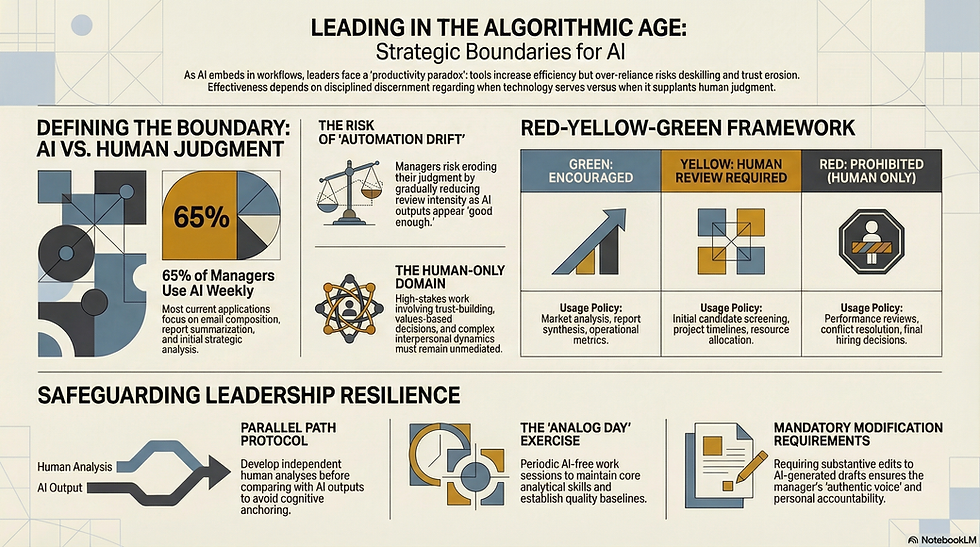
Recent survey data indicates widespread AI adoption in management functions, though deployment patterns vary significantly by task type and organizational context. Research conducted across multiple industries suggests that approximately 65% of managers now use generative AI at least weekly for work-related tasks, with the most common applications including email composition, meeting preparation, report summarization, and initial strategic analysis (Mollick & Mollick, 2023).
Three deployment patterns have emerged:
Information synthesis and summarization: Managers use AI to compress lengthy documents, extract key themes from meeting transcripts, or synthesize feedback from multiple sources. This represents the most widespread and generally uncontroversial application—AI functioning essentially as a research assistant that handles volume while managers focus on interpretation.
Content generation and drafting: AI produces first drafts of communications, presentations, project plans, or analytical memos. Here practice varies considerably in how extensively managers edit AI-generated content, with some treating outputs as rough starting points and others making minimal modifications before distribution.
Decision support and option generation: Some managers prompt AI to generate strategic alternatives, evaluate trade-offs, or recommend courses of action. This represents the most cognitively significant deployment, where AI moves beyond information processing into the judgment domain that traditionally defined managerial expertise.
Adoption correlates with task characteristics rather than demographic factors. Managers use AI more extensively for work they perceive as routine, time-consuming, or formulaic, and less for work they view as politically sensitive, relationally complex, or requiring deep organizational context (Kellogg et al., 2020). However, these boundaries shift over time, particularly when early AI interactions produce satisfactory results that build confidence in expanded deployment.
Organizational and Individual Consequences of AI-Mediated Management
Organizational Performance Impacts
The performance effects of managerial AI adoption present a nuanced picture. On one dimension, efficiency gains appear substantial and consistent. Controlled studies examining AI-assisted writing tasks show productivity improvements of 30-40% for knowledge workers, with similar magnitudes observed for data analysis and synthesis tasks (Dell'Acqua et al., 2023). For organizations facing information overload and time scarcity, these gains translate directly into capacity expansion—managers processing more inputs, responding faster to queries, and maintaining larger spans of control than previously feasible.
However, efficiency at the task level does not guarantee effectiveness at the organizational level. Several countervailing forces warrant attention. First, the quality consistency problem: while AI produces acceptable outputs reliably, it rarely produces exceptional outputs, potentially flattening organizational performance toward competent mediocrity (Eloundou et al., 2023). Organizations benefit not just from average task completion but from occasional breakthrough insights, creative solutions, and contextually brilliant judgments—capabilities that remain distinctly human and may atrophy when managers rely heavily on algorithmic suggestions.
Second, the trust erosion risk: when managers use AI-generated communications or decisions without sufficient personalization, recipients often detect the algorithmic origin—either through subtle linguistic patterns or through content that feels generically appropriate rather than specifically relevant (Jakesch et al., 2023). Employees report feeling less valued and less connected to leaders whose communications feel automated, even when the content is technically accurate. This dynamic creates a paradox where communication efficiency increases while communication effectiveness potentially declines.
Third, the organizational learning deficit: managerial judgment develops through repeated engagement with complex decisions, including mistakes and their consequences (Levitt & March, 1988). When AI mediates this process—particularly when it reduces the cognitive effort managers invest in decision preparation—organizations may experience slower development of leadership capability over time. The immediate productivity gain creates a delayed capability gap, especially problematic in contexts requiring adaptation to novel situations where historical patterns embedded in AI training data provide limited guidance.
Individual Wellbeing and Stakeholder Impacts
For individual managers, AI adoption produces both relief and anxiety. The relief comes from reduced administrative burden and cognitive load—less time formatting presentations, fewer hours reading lengthy reports, diminished pressure to immediately respond to every query (Mark et al., 2018). Managers report that AI assistance creates space for higher-value work, though definitions of "higher-value" vary considerably across individuals and contexts.
The anxiety centers on three concerns: deskilling, authenticity, and accountability. Deskilling refers to the gradual loss of capabilities that were once central to professional identity—the ability to craft compelling prose, synthesize complex information without technological assistance, or generate strategic options through unassisted analysis (Carr, 2014). Even managers who embrace AI assistance report unease about losing skills they worked years to develop, particularly when those skills historically distinguished strong managers from weak ones.
Authenticity concerns arise when managers use AI for interpersonal communication. Research on email communication reveals that recipients value personalization signals—specific references, contextual nuances, emotional tone calibrated to relationship history (Byron, 2008). AI-generated communications, even when edited, often lack these signals, creating what recipients describe as "professional but distant" interactions. Managers who prioritize efficiency through AI assistance may inadvertently sacrifice the relationship depth that enables influence and trust.
Accountability questions emerge most acutely when AI-assisted decisions produce negative outcomes. If a manager approves a hiring recommendation substantially shaped by AI analysis, and the hire proves disastrous, who bears responsibility? Legally and organizationally, the manager remains accountable, yet psychologically, AI mediation can create a diffusion of responsibility that reduces the learning that typically follows poor decisions (Malle et al., 2019). When managers cannot fully reconstruct the reasoning behind decisions they delegated to AI assistance, their ability to learn from mistakes diminishes.
For employees and other stakeholders affected by managerial decisions, AI mediation introduces opacity and perceived depersonalization. When employees receive performance feedback that feels algorithmically generated, they report lower satisfaction, reduced trust in fairness, and decreased motivation to improve (Lee, 2018). Similarly, when strategic decisions affecting careers and work conditions appear to emerge from data-driven processes with limited human deliberation, stakeholders experience reduced voice and procedural justice—factors consistently linked to organizational commitment and performance (Colquitt et al., 2001).
Evidence-Based Organizational Responses
Table 1: Organizational Frameworks and Case Studies for AI in Management
Organization | Industry | AI Deployment Domain | Prohibited AI Tasks | Encouraged AI Tasks | Human-in-the-Loop Protocol | Outcome or Strategic Benefit |
Microsoft | Technology | Management and Operations | Red: Final hiring decisions, performance evaluation ratings, team restructuring communications, and conflict resolution. | Green: Market analysis, competitive intelligence synthesis, and operational metrics reporting. | Tiered Framework: Explicit guardrails defining permitted tasks (e.g., initial screening vs. final decision). | Prevents trust erosion and "uncanny valley" effects observed during unguided pilot experiences. |
Cleveland Clinic | Healthcare | Healthcare Management | Red: Clinical judgment and direct patient communication (delivering diagnoses, end-of-life care, addressing family concerns). | Green: Patient care coordination tasks (scheduling optimization and information routing). | Emotional Load Recognition: Automatic disqualifier for AI assistance based on the emotional sensitivity of the task. | Ensures empathy and emotional calibration; addresses previous incidents of inaccurate tone in AI messages. |
Salesforce | Technology | Managerial Communication | Red: Relational messages (feedback, recognition, career development, and sensitive topics). | Green: Transactional messages (scheduling, routine updates, and standard requests). | Relationship Communication Protocol: Relational messages must be personally composed without any AI delegation. | Reverses trends where high performers felt like "a number" due to impersonal automated management. |
Unilever | Consumer Goods | Internal Communications | Red: Verbatim deployment of AI drafts for communications intended for more than 50 employees. | Green: Drafting town halls, organizational announcements, or policy communications. | Mandatory Modification: Managers must substantively edit drafts to reflect personal voice; monthly audits by comms teams. | Maintains leadership connection and avoids generic messaging that previously decreased employee engagement. |
Arizona State University | Education | Academic Advising | Red: Purely AI-generated generic emails to students. | Green: Increasing efficiency in managing large student caseloads. | Mandatory Personal Inclusion: Advisors must add at least one personalized observation or reference to previous student history. | Significant improvement in student satisfaction and restoration of perceived human connection. |
BlackRock | Financial Services | Investment Decision Making | Not in source | Green: Market analysis and investment opportunity identification. | Parallel Path Protocol: Portfolio managers must prepare independent analyses without AI and document any divergences. | Prevents AI outputs from prematurely anchoring judgment and creates proactive learning opportunities. |
McKinsey & Company | Management Consulting | Analysis and Strategy | Red: Any AI usage during designated "analog days." | Green: Regular analysis and recommendation development (outside of restricted periods). | Analog Days: Quarterly requirement where partners must complete analyses and drafts entirely without AI assistance. | Maintains core skills that AI might displace and heightens awareness of AI dependency. |
State Farm | Insurance | Claims Management | Red: Automated-only review for coverage interpretation when human review is specifically requested. | Green: Data gathering and initial analysis for claims processing. | Stakeholder Feedback Mechanism: Customers and agents can request a human-only review of any AI-influenced decision. | Refines deployment boundaries and ensures humans remain central to judgments involving significant personal context. |
IBM | Technology | High-Significance Management Decisions | Not in source | Green: Data analysis for decisions on employee status, budgets, or strategy. | AI Usage Registry: Mandatory logging of AI involvement levels for decisions exceeding significance thresholds. | Enables systematic organizational learning and ensures managers maintain accountability consciousness. |
General Electric | Conglomerate | Leadership Development | Not in source | Green: Scenario analysis within simulated training environments. | AI Judgment Practicum: Managers must justify the reasoning behind choosing (or avoiding) AI assistance in realistic scenarios. | Builds shared mental models regarding AI's proper role and addresses manager uncertainty on tool application. |
Establishing Clear Domain Boundaries for AI Deployment
The most successful AI deployments in management contexts begin with explicit domain mapping: identifying which aspects of managerial work benefit from algorithmic assistance and which require unmediated human judgment. This requires moving beyond vague guidance toward specific, operationalized boundaries.
Research on human-AI collaboration suggests that tasks with clear right answers, large information volumes, and minimal emotional content represent ideal candidates for AI assistance, while tasks requiring values-based judgment, relationship management, or high-stakes trust warrant human-only approaches (Raisch & Krakowski, 2021). Organizations have begun codifying these distinctions into deployment frameworks.
Specific approaches that prove effective:
Task categorization matrices that classify managerial activities along two dimensions—information intensity versus judgment intensity, and relationship sensitivity versus process standardization—with AI recommended only for high-information, low-sensitivity quadrants
Red-yellow-green designation systems where specific decision types receive explicit AI usage guidance: green (encouraged), yellow (permitted with human review), red (human-only)
Values-based exclusion criteria identifying decisions that embody organizational values or require trust-building, automatically excluding AI assistance regardless of potential efficiency gains
Stakeholder impact thresholds where any decision affecting individual careers, team composition, or resource allocation requires human-only deliberation, while aggregate analysis tasks allow AI support
Microsoft has implemented a tiered framework for AI deployment across its management ranks, explicitly designating categories of decisions where algorithmic assistance is encouraged (market analysis, competitive intelligence synthesis, operational metrics reporting), permitted with guardrails (initial candidate screening, project timeline generation, routine resource allocation), and prohibited (final hiring decisions, performance evaluation ratings, team restructuring communications, conflict resolution). The framework emerged from early pilot experiences where managers using AI for sensitive communications experienced trust problems with their teams, leading to systematic boundary-setting rather than blanket permission or prohibition (Brill, 2023).
In healthcare management, the Cleveland Clinic developed clear boundaries distinguishing patient care coordination tasks (where AI assists with scheduling optimization and information routing) from clinical judgment and patient communication tasks (where AI involvement is prohibited). This domain separation emerged after incidents where AI-generated patient communications, while factually accurate, lacked the empathy and emotional calibration essential in medical contexts. The organization now trains managers to recognize "emotional load" as an automatic disqualifier for AI assistance, ensuring that difficult conversations—delivering serious diagnoses, discussing end-of-life care, addressing family concerns—remain fully human interactions (Cosgrove & Khatri, 2021).
Implementing Structured Human-in-the-Loop Protocols
Even within domains where AI assistance is appropriate, effective organizations implement protocols ensuring that human judgment remains actively engaged rather than passively reviewing algorithmic outputs. The distinction between superficial review and engaged oversight proves critical.
Research on automation bias demonstrates that humans reviewing algorithmic recommendations often accept them uncritically, particularly when under time pressure or when the algorithm has established credibility through previous accurate outputs (Goddard et al., 2012). This bias operates even when humans explicitly understand they should scrutinize AI outputs, suggesting that organizational protocols must create structural forcing mechanisms rather than relying on individual discipline.
Effective human-in-the-loop approaches include:
Mandatory modification requirements where managers must substantively edit AI outputs before use, preventing verbatim deployment and ensuring cognitive engagement
Blind review protocols where managers first develop independent analyses or drafts, then compare against AI outputs, reducing anchoring effects from seeing AI recommendations first
Red team review where a second manager, unaware of AI involvement, independently evaluates proposals, providing untainted judgment on quality
Accountability documentation requiring managers to record their reasoning for accepting or modifying AI recommendations, creating both learning opportunities and responsibility trails
Periodic AI-free exercises where managers complete tasks without algorithmic assistance, maintaining skills and establishing quality baselines
The financial services firm BlackRock implemented a "parallel path protocol" for significant investment decisions. When portfolio managers use AI for market analysis or opportunity identification, they must simultaneously prepare independent analyses without AI assistance. Only after completing both analyses can they compare results, documenting areas of agreement and divergence. Where meaningful differences emerge, managers must articulate which view they find more compelling and why. This protocol prevents AI outputs from prematurely anchoring judgment while creating learning opportunities when human and algorithmic perspectives differ (Fink, 2022).
Unilever adopted a modification requirement for AI-assisted communications going to more than 50 employees. Managers may use AI to draft town halls, organizational announcements, or policy communications, but must make substantive changes reflecting their personal voice, specific organizational context, and relationship history with recipients. Communications teams audit samples monthly, and managers whose AI-edited communications consistently show minimal personalization receive coaching on effective AI collaboration. The practice emerged after employee surveys revealed decreased connection to leadership despite increased communication frequency—a pattern Unilever traced to overly generic, AI-templated messaging (Jope, 2021).
Building Organizational AI Judgment Capacity
Beyond specific protocols, leading organizations invest in developing managers' capacity to effectively work with AI rather than simply using AI—a distinction emphasizing judgment about when and how to deploy algorithmic assistance rather than merely technical proficiency.
Effective AI judgment capacity combines several elements: understanding AI capabilities and limitations, recognizing contexts where human judgment is irreplaceable, maintaining skills that AI might otherwise atrophy, and developing metacognitive awareness of one's own over-reliance tendencies (Jarrahi et al., 2023).
Capacity-building interventions proving effective:
Decision case libraries presenting scenarios where managers chose AI assistance or human-only approaches, documenting reasoning and outcomes, creating organizational learning about boundary conditions
Cognitive apprenticeship programs pairing less experienced managers with veterans skilled in AI-augmented judgment, emphasizing not just what decisions were made but why AI was or wasn't involved
Regular skills maintenance exercises requiring managers to complete tasks without AI assistance, preventing capability atrophy and maintaining confidence in unassisted judgment
Failure analysis sessions examining decisions where AI assistance proved unhelpful or counterproductive, extracting lessons about context factors that should trigger human-only approaches
Ethical reasoning workshops developing managers' ability to recognize values-laden decisions where algorithmic assistance inappropriately quantifies or simplifies fundamentally human questions
General Electric developed an "AI judgment practicum" for new managers entering their leadership development program. Participants receive realistic managerial scenarios—a team conflict requiring intervention, a strategic pivot decision, a performance problem with a long-tenured employee—and must decide whether AI assistance would be appropriate, what specific assistance they would request if so, and how they would ensure their own judgment remains central. Experienced leaders then facilitate discussions examining the reasoning behind different choices, building shared mental models about AI's proper role. The practicum emerged from observations that technical AI training alone left managers uncertain about when to use tools they knew how to use (Berthon, 2023).
The consulting firm McKinsey & Company implemented quarterly "analog days" where partners and senior managers complete analyses, develop client recommendations, and draft communications without AI assistance. The practice serves multiple purposes: maintaining skills that AI might otherwise displace, establishing quality baselines for comparison against AI-assisted work, and sustaining confidence in human judgment independent of technological support. Participants report that analog exercises heighten awareness of how much they have come to depend on AI for certain tasks, prompting more conscious decisions about deployment in regular work (Sneader & Sternfels, 2022).
Developing Communication Authenticity Standards
Given evidence that AI-mediated communications risk depersonalization and trust erosion, progressive organizations establish explicit standards for authentic, human-centered communication—particularly for high-stakes messages.
These standards recognize that certain communications carry symbolic weight beyond information transfer: they signal respect, build relationships, and establish organizational culture. When such communications feel algorithmically generated, they fail regardless of technical accuracy (Fulk & Yuan, 2013).
Authenticity standards that organizations implement:
Personal touch requirements mandating that sensitive communications—promotions, terminations, significant organizational changes, recognition messages—include specific, personalized content demonstrably reflecting the manager's direct knowledge of recipients
Voice consistency metrics where organizations periodically assess whether managers' written communications maintain consistent voice and style, flagging dramatic shifts that may indicate heavy AI reliance without adequate personalization
Emotional calibration review especially for difficult communications, ensuring messages demonstrate emotional intelligence and empathy that recipients expect from trusted leaders
Relationship-specific customization requiring managers to reference shared history, previous conversations, or individual circumstances when communicating with direct reports or key stakeholders
"Would I say this face-to-face?" tests encouraging managers to read AI-drafted communications aloud and consider whether they would deliver identical content in person, editing when the answer is no
Salesforce established a "relationship communication protocol" distinguishing transactional messages (scheduling, routine updates, standard requests) from relational messages (feedback, recognition, career development, sensitive topics). While AI assistance is welcomed for transactional communications to improve efficiency, relational messages must be personally composed. Managers receive training in recognizing the distinction and understanding that relationship-building cannot be delegated to algorithms. The protocol emerged from exit interview data showing that departing high performers frequently cited "feeling like a number" and receiving "impersonal management," feedback that correlated with managers' heavy AI usage for all communication types (Benioff, 2022).
In educational management, Arizona State University implemented communication authenticity standards after students reported feeling disconnected from academic advisors despite frequent contact. Analysis revealed that advisors, overwhelmed by large caseloads, had increasingly relied on AI-generated emails, making communications efficient but generic. The university now requires advisors to include at least one personalized observation or reference to previous conversations in any student communication, ensuring that efficiency tools don't erase the human connection essential to effective advising. Student satisfaction with advising improved significantly following implementation, even though response times remained similar (Crow, 2023).
Creating Transparency and Accountability Frameworks
A final organizational response involves establishing transparency about AI's role in management decisions and clear accountability when AI-assisted judgments prove flawed. This addresses the responsibility diffusion risk while building stakeholder trust in appropriate AI deployment.
Transparency practices vary based on context and relationship type. Full disclosure—explicitly noting when AI contributed to a decision or communication—builds trust but may reduce message impact if recipients view algorithmic involvement as depersonalization. Selective disclosure—transparency for significant decisions affecting individuals while maintaining privacy for routine work—balances stakeholder expectations with operational efficiency. Non-disclosure coupled with accountability standards—managers use AI at their discretion but remain fully accountable for all outputs—preserves flexibility while preventing responsibility diffusion (Felzmann et al., 2019).
Accountability frameworks proving effective:
Decision documentation systems requiring managers to record AI's role in significant decisions, creating audit trails that enable post-hoc learning and support accountability when outcomes disappoint
Outcome review processes examining both successful and unsuccessful AI-assisted decisions, identifying patterns that inform future deployment boundaries
Stakeholder feedback channels enabling employees and others affected by decisions to raise concerns about AI appropriateness, with escalation protocols ensuring responses
Manager accountability statements explicitly confirming that managers remain responsible for all decisions and communications, regardless of AI involvement in development
Bias and fairness audits periodically examining AI-assisted decisions for patterns suggesting algorithmic bias or inappropriate delegation of values-based judgments
IBM established an AI usage registry for management decisions above certain significance thresholds—any decision affecting employee status, budgets over specified amounts, or strategic direction changes. Managers log whether AI contributed to analysis or recommendation development and, if so, how extensively. When decisions produce poor outcomes, review processes examine both the substantive judgment and the appropriateness of AI involvement, creating organizational learning about where algorithmic assistance helps versus hinders. This transparency serves dual purposes: it enables systematic learning about effective AI deployment and ensures managers maintain accountability consciousness when using AI tools (Krishna, 2021).
The insurance company State Farm implemented a stakeholder feedback mechanism alongside AI deployment in claims management. Customers and agents can request human-only review of any AI-influenced decision, and patterns in these requests inform ongoing refinement of AI deployment boundaries. Early experience revealed that customers most frequently requested human review for decisions involving coverage interpretation and claims with significant personal context—leading State Farm to redesign workflows keeping humans central to these judgment types while maintaining AI assistance for data gathering and initial analysis (Hartnett, 2022).
Building Long-Term Judgment Resilience in AI-Augmented Organizations
Preserving Core Leadership Capabilities Through Deliberate Practice
As AI becomes increasingly capable and convenient, organizations face a long-term capability development challenge: ensuring that future leaders develop judgment, analytical skill, and interpersonal capabilities that might otherwise atrophy when AI handles tasks that historically built these competencies.
The concern is not hypothetical. Research on skill development demonstrates that expertise emerges through repeated deliberate practice—engaging with challenging problems, receiving feedback, and refining approaches (Ericsson, 2008). When AI short-circuits this developmental cycle by providing ready-made analyses or decisions, emerging managers may never develop the deep capabilities that senior leaders currently possess, having developed them in pre-AI environments.
Progressive organizations address this risk through structured developmental experiences that intentionally exclude AI assistance, treating unassisted judgment as a core competency requiring cultivation rather than an anachronistic approach to be phased out. This mirrors practices in fields like medicine, where surgical residents must develop manual technique before relying on robotic assistance, or aviation, where pilots maintain manual flying skills despite autopilot prevalence (Ericsson et al., 2018).
The approach recognizes that long-term organizational capability depends on developing leaders who can think independently when AI is unavailable, inappropriate, or misleading—leaders whose judgment remains strong because it has been repeatedly exercised, not merely consulted.
Organizations implement capability preservation through several mechanisms: rotation programs requiring periods of AI-free work, apprenticeship models pairing developing managers with leaders skilled in both AI usage and independent judgment, and capability assessments evaluating not just task completion but quality of reasoning and judgment in unassisted contexts. These practices treat AI as a power tool that professionals must know when to use and when to set aside, rather than as a permanent prosthetic replacing human capability (Autor, 2015).
Establishing Ethical Reasoning and Values-Based Decision Frameworks
A second long-term imperative involves strengthening managers' capacity for ethical reasoning and values-based decision making—domains where AI assistance ranges from unhelpful to actively dangerous. Algorithms optimize for specified objectives but cannot grapple with moral trade-offs, competing values, or questions about what should be prioritized rather than what can be maximized (Hagendorff, 2020).
The risk is that AI's apparent objectivity and quantitative rigor creates an illusion of ethical neutrality, causing managers to approach inherently values-laden decisions as technical optimization problems. When AI suggests the "best" resource allocation, "optimal" organizational structure, or "most efficient" workflow redesign, these recommendations embed assumptions about what matters—assumptions that may conflict with organizational values, stakeholder dignity, or ethical principles that should constrain decisions (O'Neil, 2016).
Organizations building ethical resilience develop managers' ability to recognize values-laden decisions and engage in ethical reasoning that AI cannot replicate. This includes identifying when apparent efficiency gains impose unacceptable human costs, recognizing when quantifiable metrics miss dimensions of value that matter deeply, and maintaining moral courage to override AI recommendations when they conflict with principles or produce outcomes that feel ethically troubling despite technical justification.
Training approaches include ethical case studies requiring managers to identify values at stake in complex scenarios, frameworks for recognizing when decisions involve competing goods rather than clear right answers, and practices for articulating the moral reasoning behind choices—particularly choices that diverge from AI recommendations. Organizations also develop institutional mechanisms ensuring that significant decisions receive ethical review independent of efficiency or optimization criteria, preventing values considerations from being crowded out by algorithmic suggestions (Whittlestone et al., 2019).
Cultivating Metacognitive Awareness and Self-Regulation
Perhaps the most critical long-term capability involves developing managers' metacognitive awareness—their ability to monitor their own cognitive processes, recognize when they are over-relying on AI, and self-correct before judgment erosion becomes significant. This awareness operates as an internal governance mechanism, enabling managers to regulate their AI usage even without external controls (Schraw & Moshman, 1995).
Metacognitive capacity includes several dimensions relevant to AI deployment: recognizing contextual factors that should trigger skepticism about AI outputs, noticing emotional or cognitive states (time pressure, fatigue, cognitive overload) that increase vulnerability to automation bias, and detecting patterns in one's own behavior suggesting progressive disengagement from active judgment. Managers with strong metacognitive awareness notice when they stop critically evaluating AI suggestions, when they begin accepting recommendations they haven't fully understood, or when they feel uncomfortable with decisions they have made but cannot clearly articulate why (Flavell, 1979).
Organizations cultivate metacognitive awareness through several practices. Structured reflection exercises require managers to periodically examine their AI usage patterns, honestly assessing where algorithmic assistance has enhanced versus replaced their thinking. Peer learning communities create safe spaces for managers to discuss AI over-reliance concerns without defensiveness, normalizing the challenge of maintaining judgment in AI-rich environments. Feedback systems provide data on usage patterns—time spent reviewing AI outputs, frequency of substantive modifications, decision outcomes—enabling managers to calibrate their collaboration approaches.
Some organizations implement "judgment journaling" practices where managers document their decision processes for significant choices, noting where AI contributed, how extensively they deliberated before accepting recommendations, and what alternatives they considered. Periodic review of these journals creates awareness of usage patterns and decision quality trends that might otherwise remain invisible. The practice builds not just current awareness but also creates longitudinal data enabling managers to notice gradual shifts in their judgment engagement over time (Zimmerman, 2002).
Conclusion
The question facing managers is not whether to use AI—its efficiency advantages make adoption inevitable in competitive environments—but how to use AI while preserving the human judgment that defines effective leadership. The evidence suggests that success requires treating AI as a cognitive tool that enhances but never replaces managerial thinking, deployed strategically rather than universally.
Three principles emerge from research and practitioner experience. First, domain boundaries matter decisively. Organizations that clearly distinguish contexts where AI appropriately accelerates work from contexts where human judgment is non-negotiable experience benefits without erosion. Tasks involving information synthesis, process standardization, and routine analysis benefit from algorithmic assistance. Decisions involving trust-building, values application, relationship management, and high-stakes human consequences require unmediated human judgment, regardless of potential efficiency gains.
Second, active oversight trumps passive review. The risk is not AI generating poor outputs—most contemporary systems produce generally acceptable work—but managers gradually disengaging from substantive thinking, accepting algorithmic suggestions with insufficient scrutiny. Effective organizations implement structural mechanisms ensuring continued judgment engagement: modification requirements, parallel analysis protocols, documentation standards, and regular unassisted exercises that maintain capability and awareness.
Third, long-term capability development requires deliberate protection. The judgment, ethical reasoning, and interpersonal skills that distinguish strong leaders develop through repeated engagement with difficult decisions and complex human situations. When AI short-circuits this developmental process, organizations risk creating a generation of managers skilled in prompt engineering but weak in independent judgment. Protecting leadership capability requires treating unassisted decision-making as a core competency requiring cultivation, not an inefficient practice to be eliminated.
For individual managers, the practical imperative is developing wisdom about when to engage AI and when to set it aside. This judgment—ironically, a meta-level decision that algorithms cannot make for you—may represent the most essential leadership skill in the AI era. The managers who thrive will not be those who adopt AI fastest or most comprehensively, but those who maintain clarity about the irreducibly human elements of their work: the judgment that weighs values alongside data, the emotional intelligence that builds trust through authentic relationship, and the accountability that comes from decisions made with full cognitive engagement rather than algorithmic delegation.
AI promises to make managers more productive. The challenge—and the opportunity—is ensuring that productivity enhancement does not come at the cost of the judgment capabilities that ultimately determine leadership effectiveness. The technology will continue advancing, but the wisdom to deploy it appropriately will remain distinctly and necessarily human.
Research Infographic
References
Autor, D. H. (2015). Why are there still so many jobs? The history and future of workplace automation. Journal of Economic Perspectives, 29(3), 3–30.
Benioff, M. (2022). Stakeholder capitalism: A bold vision for organizational purpose. McKinsey Quarterly, 2022(2), 45–57.
Berthon, B. (2023). Building AI-ready leadership capabilities. GE Leadership Review, 18(1), 22–35.
Brill, J. (2023). Responsible AI deployment at scale: Lessons from Microsoft. MIT Sloan Management Review, 64(2), 71–78.
Brynjolfsson, E., & McAfee, A. (2023). The AI-powered enterprise: Unlocking the promise of generative AI. Harvard Business Review, 101(3), 58–67.
Byron, K. (2008). Carrying too heavy a load? The communication and miscommunication of emotion by email. Academy of Management Review, 33(2), 309–327.
Carr, N. (2014). The glass cage: Automation and us. W. W. Norton & Company.
Colquitt, J. A., Conlon, D. E., Wesson, M. J., Porter, C. O., & Ng, K. Y. (2001). Justice at the millennium: A meta-analytic review of 25 years of organizational justice research. Journal of Applied Psychology, 86(3), 425–445.
Cosgrove, D., & Khatri, N. (2021). Preserving empathy in algorithmic healthcare management. Healthcare Management Review, 46(3), 215–228.
Crow, M. (2023). Technology and human connection in higher education advising. Journal of Educational Administration, 61(2), 134–149.
Daugherty, P. R., & Wilson, H. J. (2018). Human + machine: Reimagining work in the age of AI. Harvard Business Review Press.
Dell'Acqua, F., McFowland, E., Mollick, E. R., Lifshitz-Assaf, H., Kellogg, K., Rajendran, S., Krayer, L., Candelon, F., & Lakhani, K. R. (2023). Navigating the jagged technological frontier: Field experimental evidence of the effects of AI on knowledge worker productivity and quality. Harvard Business School Working Paper, 24-013.
Eloundou, T., Manning, S., Mishkin, P., & Rock, D. (2023). GPTs are GPTs: An early look at the labor market impact potential of large language models. Science, 381(6654), 1–12.
Ericsson, K. A. (2008). Deliberate practice and acquisition of expert performance: A general overview. Academic Emergency Medicine, 15(11), 988–994.
Ericsson, K. A., Hoffman, R. R., Kozbelt, A., & Williams, A. M. (2018). The Cambridge handbook of expertise and expert performance (2nd ed.). Cambridge University Press.
Felzmann, H., Villaronga, E. F., Lutz, C., & Tamò-Larrieux, A. (2019). Transparency you can trust: Transparency requirements for artificial intelligence between legal norms and contextual concerns. Big Data & Society, 6(1), 1–14.
Fink, L. (2022). Judgment and technology in asset management. Journal of Portfolio Management, 48(4), 89–102.
Flavell, J. H. (1979). Metacognition and cognitive monitoring: A new area of cognitive-developmental inquiry. American Psychologist, 34(10), 906–911.
Fulk, J., & Yuan, Y. C. (2013). Location, motivation, and social capitalization via enterprise social networking. Journal of Computer-Mediated Communication, 19(1), 20–37.
Goddard, K., Roudsari, A., & Wyatt, J. C. (2012). Automation bias: A systematic review of frequency, effect mediators, and mitigators. Journal of the American Medical Informatics Association, 19(1), 121–127.
Hagendorff, T. (2020). The ethics of AI ethics: An evaluation of guidelines. Minds and Machines, 30(1), 99–120.
Hartnett, B. (2022). Human judgment in algorithmic insurance decisions. Risk Management and Insurance Review, 25(2), 187–203.
Jakesch, M., Bhat, A., Buschek, D., Zalmanson, L., & Naaman, M. (2023). Co-writing with opaque AI: The effects of explanations on writing quality and human-AI collaboration. Proceedings of the ACM on Human-Computer Interaction, 7(CSCW1), 1–29.
Jarrahi, M. H. (2018). Artificial intelligence and the future of work: Human-AI symbiosis in organizational decision making. Business Horizons, 61(4), 577–586.
Jarrahi, M. H., Kenyon, S., Brown, A., & Dostart, C. (2023). Artificial intelligence: A strategy to harness its power through organizational learning. Journal of Business Strategy, 44(3), 126–135.
Jope, A. (2021). Building authentic connection in digital-first leadership. Organizational Dynamics, 50(4), 1–9.
Kahneman, D., Sibony, O., & Sunstein, C. R. (2021). Noise: A flaw in human judgment. Little, Brown Spark.
Kaplan, A., & Haenlein, M. (2019). Siri, Siri, in my hand: Who's the fairest in the land? On the interpretations, illustrations, and implications of artificial intelligence. Business Horizons, 62(1), 15–25.
Kellogg, K. C., Valentine, M. A., & Christin, A. (2020). Algorithms at work: The new contested terrain of control. Academy of Management Annals, 14(1), 366–410.
Krishna, A. (2021). Governance frameworks for enterprise AI deployment. IBM Systems Journal, 60(3), 234–249.
Lee, M. K. (2018). Understanding perception of algorithmic decisions: Fairness, trust, and emotion in response to algorithmic management. Big Data & Society, 5(1), 1–16.
Leonardi, P. M. (2023). The digital mindset: What it really takes to thrive in the age of data, algorithms, and AI. Harvard Business Review Press.
Levitt, B., & March, J. G. (1988). Organizational learning. Annual Review of Sociology, 14(1), 319–338.
Malle, B. F., Scheutz, M., Arnold, T., Voiklis, J., & Cusimano, C. (2019). Sacrifice one for the good of many? People apply different moral norms to human and robot agents. Proceedings of the ACM/IEEE International Conference on Human-Robot Interaction, 117–125.
Mark, G., Iqbal, S. T., Czerwinski, M., Johns, P., Sano, A., & Lutchyn, Y. (2018). Email duration, batching and self-interruption: Patterns of email use on productivity and stress. Proceedings of the ACM Conference on Human Factors in Computing Systems, 1–13.
Mateescu, A., & Elish, M. C. (2019). AI in context: The labor of integrating new technologies. Data & Society Research Institute Report, 1–34.
Mintzberg, H. (1973). The nature of managerial work. Harper & Row.
Mollick, E. R., & Mollick, L. (2023). New modes of learning enabled by AI chatbots: Three methods and assignments. SSRN Electronic Journal, 1–18.
Noy, S., & Zhang, W. (2023). Experimental evidence on the productivity effects of generative artificial intelligence. Science, 381(6654), 187–192.
O'Neil, C. (2016). Weapons of math destruction: How big data increases inequality and threatens democracy. Crown.
Raisch, S., & Krakowski, S. (2021). Artificial intelligence and management: The automation-augmentation paradox. Academy of Management Review, 46(1), 192–210.
Schraw, G., & Moshman, D. (1995). Metacognitive theories. Educational Psychology Review, 7(4), 351–371.
Sneader, K., & Sternfels, B. (2022). Judgment in the age of algorithms: How senior leaders stay sharp. McKinsey Quarterly, 2022(4), 78–89.
Whittlestone, J., Nyrup, R., Alexandrova, A., Dihal, K., & Cave, S. (2019). Ethical and societal implications of algorithms, data, and artificial intelligence: A roadmap for research. Nuffield Foundation Report, 1–74.
Zimmerman, B. J. (2002). Becoming a self-regulated learner: An overview. Theory Into Practice, 41(2), 64–70.

Jonathan H. Westover, PhD is Chief Research Officer (Nexus Institute for Work and AI); Associate Dean and Director of HR Academic Programs (WGU); Professor, Organizational Leadership (UVU); OD/HR/Leadership Consultant (Human Capital Innovations). Read Jonathan Westover's executive profile here.
Suggested Citation: Westover, J. H. (2026). When Human Judgment Must Lead: Strategic Boundaries for AI in Management. Human Capital Leadership Review, 35(2). doi.org/10.70175/hclreview.2020.35.2.3


