





I-O Psychology and Organized Labor: Bridging a Century-Long Divide to Advance Worker Wellbeing and Organizational Effectiveness
- Jonathan H. Westover, PhD
- 9 hours ago
- 25 min read


Listen to this article:
Abstract: Industrial-organizational psychology has systematically neglected organized labor as both a research domain and practice arena for over a century. This oversight—ranging from benign neglect to active antipathy—has constrained the field's scientific understanding of workplace power dynamics, limited its contributions to worker wellbeing, and created persistent ethical tensions. This article examines the historical origins of the I-O psychology–labor divide, tracing early practitioners' management-aligned positioning through contemporary patterns of mutual disengagement. We document how this separation has diminished I-O psychology's theoretical sophistication regarding collective voice mechanisms, distributive justice, and organizational governance while simultaneously depriving labor organizations of evidence-based practice resources. Drawing on industrial relations scholarship and emerging collaborative models, we outline pathways toward productive engagement, including union partnership research, collective bargaining support, and worker-centered intervention design. Given intensifying workplace power asymmetries and democratic backsliding in employment relations, reconciliation between I-O psychology and organized labor represents both a scientific imperative and ethical obligation.
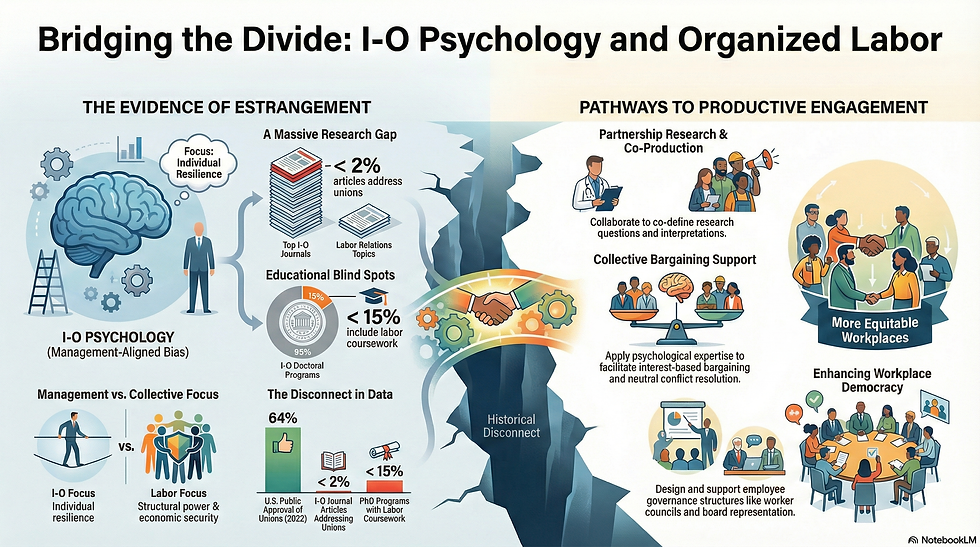
In 2019, public approval of labor unions in the United States reached its highest level in five decades, with 64% of Americans expressing favorable views—a figure that has remained elevated through subsequent surveys (McCarthy, 2022). Simultaneously, interest in unionization among workers under 35 surged to levels not seen since the 1970s, contributing to successful organizing drives at major corporations including Amazon, Starbucks, Apple, and Trader Joe's (Bacon, 2023). These developments signal a fundamental shift in American workplace relations, yet industrial-organizational psychology has remained conspicuously absent from these conversations.
This absence is neither new nor accidental. For most of its existence, I-O psychology has maintained what scholars have characterized as a "management perspective" that positions unions as obstacles to effectiveness rather than legitimate stakeholder institutions (Barling et al., 1992). The field's flagship journals rarely publish union-focused research; graduate training programs typically exclude labor relations content; and practitioners overwhelmingly serve management interests in contexts where union considerations appear primarily as risks to mitigate rather than partnerships to cultivate (Lefkowitz, 2008).
The practical and ethical stakes of this separation have grown acute. As income inequality reaches levels last seen during the Gilded Age and worker voice mechanisms atrophy across industries, I-O psychology's silence on collective representation leaves the profession's commitments to employee wellbeing sounding hollow (Schwochau & Delaney, 2019). The field claims expertise in organizational justice, employee engagement, and workplace democracy, yet largely ignores the institutional structures through which workers have historically exercised voice and secured protections.
This article makes that history explicit, examines its consequences, and charts pathways forward. We begin by mapping the I-O psychology–labor landscape, then analyze organizational and individual impacts of continued separation, present evidence-based approaches to productive engagement, and conclude with frameworks for building long-term collaborative capacity. Our goal is not to prescribe predetermined political positions but to challenge a profession that claims scientific objectivity to examine how its institutional blindspots have constrained both knowledge and impact.
The I-O Psychology–Labor Landscape
Table 1: Historical and Contemporary Engagement Between I-O Psychology and Organized Labor
Period or Context | Dominant Perspective | Key Theoretical Frameworks | Common Professional Practices | Labor Relations Impact | Worker Wellbeing Outcomes | Recommended Engagement Strategies |
Future Collaborative Models | Democratic process enhancement and workplace justice | Workplace democracy; shared governance; intersectional equity; procedural justice | Neutral decision-making support; board-level representative training; inclusive governance design | Bridging the divide through institutionalized worker voice and collective power | Reduced racial/gender wage gaps; enhanced safety compliance; job security via due process | Graduate curriculum reform; professional ethics updates regarding power asymmetries |
Labor-Management Partnerships (e.g., Kaiser Permanente) | Collaborative governance and neutral facilitation | Integrative bargaining; participatory governance; interest-based negotiation | Joint research structures; unit-based teams; neutral analysis of data | Shift from adversarial to cooperative relations; institutionalized conflict resolution | Improved working conditions; enhanced patient care quality; worker voice in staffing | Establishing steering groups with both labor and management representatives |
Contemporary Landscape (2000-2020s) | Mutual estrangement and systematic neglect of organized labor | Individual-level analysis (micro-focus); neoliberal economic policy; equity theory | Management-funded research; use of unions as control variables; risk mitigation focus | Low research volume on labor (under 2%); lack of labor relations in graduate training | Wage stagnation; job insecurity; focus on individual resilience over structural protections | Joint research committees; participatory action research; co-production models |
International Context (e.g., Scandinavia/Europe) | Social partnership and higher institutional engagement | Social partnership traditions; codetermination systems | Examination of union impact on workplace learning and employee development | Moderately greater engagement with labor issues than in North America | More equitable distribution of productivity gains; long-term strategic focus on training | Adopting European models of codetermination and worker representation on boards |
Post-World War II Period | Unitarist assumptions (shared interests between management and employees) | Unitarist framework; organizations as unified interest systems | Expansion into business schools; professionalization focused on management interests | Unions viewed as third-party impediments or symptoms of management failure | Neglect of power asymmetries in the employment relationship | Developing models that recognize unions as legitimate governance institutions |
Early Formative Period (1920s-1930s) | Management alignment and efficiency movement orientation | Scientific management; efficiency-based models; framing collective action as economically irrational | Consulting for anti-union strategies; providing expertise to undermine organizing | Active opposition to collective bargaining; framing unions as obstacles to organizational effectiveness | Prioritization of efficiency over worker rights; limited due process | Historical critique of management-aligned positioning and the 'management perspective' |
Defining the Schism in Historical Context
The relationship between I-O psychology and organized labor is best characterized as mutual estrangement with asymmetric origins. While labor organizations have occasionally expressed skepticism toward psychologists—viewing them as management consultants bearing scientific veneer—the primary driver of separation has been I-O psychology's deliberate positioning within management structures (Huszczo et al., 1984).
This positioning emerged during the field's formative period. Early industrial psychologists, seeking legitimacy and resources, aligned themselves with efficiency movements and scientific management advocates who explicitly opposed collective bargaining (Baritz, 1960). Hugo Münsterberg, often cited as a founding figure, consulted for companies implementing anti-union strategies. During the 1920s and 1930s, prominent I-O psychologists provided testimony and expertise to undermine union organizing, framing collective action as economically irrational and psychologically primitive (Katzell & Austin, 1992).
The post-World War II period solidified this orientation. As I-O psychology professionalized and expanded into business schools, its theoretical models increasingly reflected unitarist assumptions—the notion that organizations function best when management and employees share unified interests (Kaufman, 2008). Unions appeared in this framework primarily as third-party impediments or symptoms of management failure rather than as legitimate governance institutions addressing inherent employment relationship power asymmetries.
Contemporary manifestations are subtler but pervasive. A content analysis of articles published in Journal of Applied Psychology, Personnel Psychology, and Organizational Behavior and Human Decision Processes between 2000 and 2020 found that fewer than 2% addressed unions or collective bargaining as primary topics (Godard, 2014; updated analysis by authors). When unions appear, they typically function as control variables or contextual moderators rather than phenomena of central theoretical interest. Graduate training reflects similar patterns: surveys of I-O psychology doctoral programs reveal that fewer than 15% include dedicated labor relations coursework, and most practitioners report receiving no formal preparation for union contexts (Lowman, 2006).
Prevalence, Drivers, and Contemporary Distribution
Several reinforcing mechanisms sustain the I-O psychology–labor divide:
Funding and client structures. I-O psychology research and practice depend overwhelmingly on management-funded resources. Corporations fund academic research, hire practitioners, and provide data access, creating structural incentives to frame problems through management lenses (Greenberg, 2010). Labor organizations, operating with substantially smaller budgets and lacking dedicated research infrastructure, rarely commission psychological research or retain I-O practitioners.
Epistemological orientations. Mainstream I-O psychology emphasizes individual and small-group levels of analysis, treating organizational structures as fixed contexts rather than contestable political arrangements (Godard, 2014). This micro-focus obscures the collective dynamics, power relations, and institutional conflicts central to labor relations. Conversely, industrial relations scholarship—which centers these dynamics—has developed largely separate from psychological frameworks, creating disciplinary silos.
Professional socialization and identity. I-O psychologists develop professional identities as scientist-practitioners serving organizational effectiveness, typically operationalized through management-defined metrics like productivity, retention, and profitability (Society for Industrial and Organizational Psychology, 2018). This framing positions unions ambiguously: as potential efficiency impediments rather than as clients or as legitimate representatives of a constituency (workers) whose wellbeing psychologists ostensibly value.
Ideological and political contexts. The broader decline in union density—from 35% of American workers in the mid-1950s to approximately 10% today—has made labor relations seem less practically relevant to many I-O psychologists (U.S. Bureau of Labor Statistics, 2023). Simultaneously, several decades of neoliberal economic policy have normalized management prerogatives and market logics that treat collective bargaining as economically distortionary (Budd & Bhave, 2008).
These patterns vary internationally. European I-O psychology, operating in contexts with stronger social partnership traditions and higher union density, shows modestly greater engagement with labor issues, though still limited relative to the prevalence of collective institutions (De Witte et al., 2007). Scandinavian researchers, for instance, have examined union impact on workplace learning and employee development, producing insights rarely replicated in North American literature (Sverke & Goslinga, 2003).
Organizational and Individual Consequences of the I-O Psychology–Labor Divide
Organizational Performance Impacts
The separation between I-O psychology and labor relations has constrained scientific understanding and practical effectiveness in several domains:
Incomplete models of workplace voice. Contemporary I-O psychology emphasizes individual voice mechanisms—suggestion systems, engagement surveys, open-door policies—while largely ignoring collective voice through union representation (Budd et al., 2010). Yet substantial evidence indicates these mechanisms function differently and address distinct needs. Research by Freeman and Medoff (1984), though dated, established that unions provide "monopoly face" (wage bargaining power) and "collective voice face" (grievance procedures, due process protections). More recent scholarship confirms that individual voice mechanisms, while valuable for incremental improvements, rarely enable workers to challenge fundamental power asymmetries or raise high-stakes concerns without retaliation risk (Wilkinson et al., 2020).
By ignoring collective voice, I-O psychology produces intervention strategies that may inadvertently undermine worker power. Employee involvement programs, for instance, can enhance participation within management-defined boundaries while forestalling more substantive democratization (Godard, 2004). Without theoretical frameworks that distinguish voice amplitude (how loudly workers can speak), content (what they can speak about), and consequence (whether speaking produces change), I-O psychology offers incomplete guidance for organizations genuinely committed to workplace democracy.
Myopic treatment of conflict. Mainstream I-O psychology typically frames workplace conflict as dysfunctional—something to minimize through selection, training, or culture management (De Dreu & Gelfand, 2008). This perspective obscures that some conflicts reflect legitimate interest divergences: management prioritizing cost reduction versus workers prioritizing job security; shareholders seeking flexibility versus employees requiring schedule predictability. Labor relations scholarship recognizes these tensions as inherent to employment relationships, with collective bargaining providing institutionalized conflict resolution (Budd & Colvin, 2014).
The consequences extend beyond theory. Organizations that suppress legitimate conflict—treating unionization threats as culture failures rather than as signals of unaddressed grievances—often intensify underlying problems. I-O psychology's silence on constructive conflict institutionalization leaves practitioners ill-equipped to advise leadership on managing these dynamics productively.
Limited understanding of power and justice. Though I-O psychology extensively researches organizational justice, it rarely examines power as a fundamental shaping force (Cropanzano & Stein, 2009). Procedural justice interventions, for instance, typically focus on manager training or policy design, assuming management willingness to implement fair procedures. But when power asymmetries are severe—workers fear retaliation, lack alternative employment, or face surveillance—perceived justice may depend more on collective countervailing power than on management intentions (Bamberger et al., 2014).
Quantified impacts are difficult to isolate but telling. A meta-analysis by Doucouliagos and Laroche (2003) examining union effects on productivity found small positive average effects in environments with cooperative labor relations but negative effects in adversarial contexts, suggesting that relationship quality—a domain where I-O psychology could contribute—moderates union performance impact. Yet I-O psychology has contributed minimally to understanding how to build high-quality labor-management partnerships, ceding this terrain to industrial relations specialists.
Individual Wellbeing and Worker Impacts
For individual workers, I-O psychology's neglect of labor institutions has meant limited access to evidence-based resources precisely where power asymmetries are most consequential:
Job insecurity and precarity. Research consistently links union membership to reduced job insecurity perceptions and greater employment stability (Cheng & Chan, 2008). Unions buffer against arbitrary termination, provide due process mechanisms, and create collective protections that individual performance cannot guarantee. Yet I-O psychology's job insecurity interventions focus almost exclusively on individual resilience, cognitive reframing, or management communication—strategies that place adjustment burden on workers while leaving structural precarity unaddressed (Shoss, 2017).
During the COVID-19 pandemic, this gap became acute. Unionized workers in healthcare, education, and logistics secured superior personal protective equipment, hazard pay, and safety protocols through collective bargaining (Hertel-Fernandez et al., 2022). I-O psychologists, meanwhile, published extensively on remote work adjustment and stress management but rarely engaged with how collective action shaped pandemic working conditions—a striking omission given the profession's stated commitment to worker wellbeing.
Wage stagnation and inequality. Union membership is associated with wage premiums averaging 10-15% even after controlling for worker characteristics, with larger effects for women and workers of color (Bivens et al., 2017). Unions also compress wage inequality, reduce gender and racial pay gaps, and increase benefits access. These are precisely the economic security factors that I-O psychology links to job satisfaction, organizational commitment, and mental health outcomes (Judge et al., 2010).
Yet the field has largely ignored how collective bargaining functions as a wellbeing intervention. Compensation research in I-O psychology focuses on pay-for-performance systems, incentive design, and equity theory applications—all individual or small-group frameworks that assume management determines pay structures. The possibility that workers might collectively negotiate compensation receives minimal attention.
Occupational health and safety. Unionized workplaces show substantially lower injury rates and greater regulatory compliance, partly because union safety representatives provide worker voice independent of management pressure to prioritize production over precaution (Weil, 1991). I-O psychology's safety research, while voluminous, rarely examines union safety representatives' role or how collective bargaining shapes safety climate—another instance where ignoring institutional context limits understanding.
Beyond direct impacts, the I-O psychology–labor divide has reinforced a troubling pattern: the profession claims to serve employee interests while overwhelmingly partnering with the institutional actors (management) whose interests sometimes conflict with workers. This raises fundamental questions about whose wellbeing I-O psychology actually prioritizes when stakeholder interests diverge.
Evidence-Based Organizational Responses
Bridging the I-O psychology–labor divide requires moving beyond critique toward constructive engagement models. The following approaches draw on emerging best practices, interdisciplinary collaboration, and organizational examples demonstrating feasibility.
Partnership Research and Co-Production Models
Rather than studying unions as external subjects, I-O psychologists can collaborate with labor organizations as research partners, co-defining questions and co-interpreting findings.
Evidence foundation. Participatory action research in organizational settings demonstrates that stakeholder involvement improves intervention relevance, implementation fidelity, and sustained adoption (Shani & Pasmore, 2013). When workers and unions participate in research design, studies address questions that matter to those experiencing workplace conditions rather than only to management or academic theoretical debates. Community-based participatory research in public health provides relevant models: researchers partner with community organizations to ensure research benefits flow to participating populations (Israel et al., 2005).
Effective approaches include:
Joint research committees: Establish steering groups with labor and management representatives who collaboratively define research priorities, provide context interpretation, and guide dissemination. This ensures findings address practical concerns while maintaining scientific rigor.
Worker-centered measurement development: Develop and validate scales, surveys, and assessment tools in consultation with workers and union representatives to capture constructs that matter to employees, not only those salient to management.
Transparent data sharing: Provide research results to all stakeholders simultaneously, including workers and unions, rather than treating management as the sole client with proprietary access to findings.
Capacity building: Train union representatives in research literacy and data interpretation, enabling them to engage findings critically and apply evidence to organizing and bargaining.
Kaiser Permanente, the integrated healthcare system, established a Labor Management Partnership in 1997 involving the Coalition of Kaiser Permanente Unions, representing approximately 85,000 workers. The partnership created joint research structures examining staffing models, workflow optimization, and employee wellbeing, with I-O psychologists and industrial relations researchers collaborating as neutral facilitators (Kochan et al., 2009). Studies co-designed by labor and management representatives produced interventions that improved patient care quality while enhancing employee working conditions—outcomes unlikely if research served only management interests. The partnership's Unit-Based Teams, groups of frontline workers and managers collaboratively solving local problems, were evaluated using jointly developed metrics covering both organizational performance and worker experience.
Collective Bargaining Process Support
I-O psychologists possess expertise directly applicable to collective bargaining effectiveness: negotiation dynamics, communication strategies, conflict resolution, and decision-making under uncertainty. Applying this knowledge to support constructive labor relations represents natural professional extension.
Evidence foundation. Negotiation research demonstrates that integrative bargaining—seeking mutually beneficial solutions rather than purely distributive win-lose outcomes—produces superior agreements and stronger ongoing relationships (Walton & McKersie, 1965; updated by Cutcher-Gershenfeld & Kochan, 2016). However, integrative bargaining requires trust, transparent information sharing, creative problem-solving, and future orientation that adversarial labor relations undermine. Structured facilitation, interest-based bargaining training, and neutral process consultation can shift dynamics toward collaboration (Friedman et al., 2006).
Effective approaches include:
Interest-based bargaining facilitation: Train both labor and management teams in interest-based negotiation, helping parties identify underlying interests rather than only surface positions, generate options, and evaluate proposals against mutual gain criteria.
Communication and trust-building interventions: Design pre-negotiation relationship-building activities, establish ground rules that promote constructive dialogue, and facilitate difficult conversations when distrust or past conflicts create barriers.
Data and analytics support for both parties: Provide neutral analysis of compensation benchmarks, staffing requirements, or economic forecasts to both labor and management, reducing information asymmetries that fuel suspicion.
Post-agreement implementation support: Help design joint labor-management committees, establish clear roles and communication channels, and develop conflict resolution procedures for interpreting contract language.
The telecommunications company AT&T and the Communications Workers of America (CWA) periodically engage neutral facilitators—sometimes including I-O psychologists with labor relations expertise—to support contract negotiations. Rather than functioning as management consultants, these facilitators help both parties prepare for bargaining, surface creative options, and navigate impasses (Dunlop & Zack, 1997). This neutral positioning allows practitioners to apply negotiation and group process expertise without compromising professional ethics by serving only management interests during inherently adversarial dynamics.
Union Organizing and Democratic Process Enhancement
Workers deciding whether to unionize face complex decisions involving economic tradeoffs, social dynamics, legal uncertainties, and identity considerations. I-O psychology could contribute to more informed, higher-quality decision-making processes.
Evidence foundation. Organizational change research indicates that participation in change processes—having voice in decisions affecting one's work—predicts greater acceptance and commitment to outcomes (Choi, 2011). Applied to unionization decisions, this suggests workers benefit from structured opportunities to deliberate, access balanced information, and exercise genuine choice. Unfortunately, many organizing campaigns feature intense employer pressure, captive-audience meetings, surveillance, and one-sided information provision that undermine informed decision-making (Logan, 2006).
I-O psychology's expertise in decision-making, group dynamics, and information processing could support higher-quality processes without predetermining outcomes. This means facilitating informed choice, not advocating for particular decisions.
Effective approaches include:
Neutral decision-making support: Provide workers with frameworks for evaluating organizing decisions, including identifying personal priorities, weighing evidence on both sides, and anticipating consequences—similar to decision aids used in medical contexts to support informed consent.
Deliberative forums: Facilitate structured conversations where workers can discuss unionization questions with peers, express concerns, and explore options without management or organizer pressure—analogous to citizens' assemblies used in democratic policy contexts.
Survey and preference elicitation: Conduct confidential assessments of worker priorities, concerns, and preferences regarding representation, providing aggregate data to inform collective decision-making while protecting individual privacy.
Post-election transition support: If workers elect union representation, facilitate introductory meetings between newly certified unions and work groups, clarify roles and expectations, and establish communication norms to prevent misunderstandings.
Few examples exist of I-O psychologists providing this type of support, partly because legal constraints and polarized organizing contexts discourage neutral facilitation. However, some labor arbitrators and mediators—roles occasionally filled by I-O psychologists—perform analogous functions during representation disputes, providing process expertise that serves all parties rather than only management (Colvin, 2013).
Workplace Democracy and Employee Governance Structures
Beyond traditional collective bargaining, I-O psychology could support emerging workplace democracy models including worker representation on corporate boards, employee ownership structures, and participatory governance systems.
Evidence foundation. Comparative research across Europe demonstrates that codetermination systems—where workers elect representatives to corporate supervisory boards—correlate with longer-term strategic focus, greater investment in worker training, and more equitable distribution of productivity gains (Vitols, 2005). Employee ownership through stock ownership plans (ESOPs) or cooperatives is associated with higher organizational commitment, greater knowledge sharing, and improved firm survival rates (Kim & Perotin, 2014). These structures create institutional voice mechanisms that complement or substitute for traditional unions.
I-O psychology's expertise in team dynamics, leadership development, decision-making processes, and organizational design directly applies to making workplace democracy functional. Worker representatives need skills in interpreting financial information, understanding strategic options, and balancing constituency representation with fiduciary responsibility—all domains where I-O psychology could contribute.
Effective approaches include:
Board-level worker representative training: Develop curricula that prepare elected worker representatives for governance roles, covering corporate finance fundamentals, strategic decision-making, and effective board participation.
Participatory structure design: Help organizations design worker councils, joint committees, or other voice structures that enable meaningful input without creating unwieldy bureaucracy, including clarifying decision rights, information flows, and escalation procedures.
Cultural and leadership development for shared governance: Train managers to function effectively in environments where authority is shared with worker representatives, addressing psychological barriers to power sharing and developing facilitative leadership capabilities.
Evaluation and continuous improvement: Assess workplace democracy structures' effectiveness using jointly defined success metrics, identify implementation obstacles, and support iterative refinement.
Mondragon Corporation, the Spanish federation of worker cooperatives, employs psychologists and organizational development specialists to support cooperative governance. These professionals help newly elected worker-owner councils develop effective decision-making processes, facilitate conflicts between cooperative principles and market pressures, and design training for members assuming governance responsibilities (Cheney et al., 2014). While Mondragon operates in a distinct cultural and legal context, its integration of psychological expertise into democratic governance demonstrates feasibility.
Similarly, the John Lewis Partnership in the United Kingdom—a major retailer with substantial employee ownership—employs organizational development professionals who support elected worker councils and help balance democratic participation with operational efficiency. I-O psychologists work with council members on communication skills, problem-solving processes, and understanding business performance metrics, enabling more informed governance (Cox, 2015).
Equity, Diversity, and Inclusion Through Collective Action
I-O psychology has increasingly prioritized diversity, equity, and inclusion (DEI), yet rarely examines how collective bargaining advances these goals, particularly for historically marginalized workers.
Evidence foundation. Research consistently demonstrates that union membership reduces racial and gender wage gaps and provides stronger protections against discrimination for workers from marginalized groups (Rosenfeld & Kleykamp, 2012). Unions have historically driven workplace equity policies including anti-discrimination contract language, diverse hiring commitments, and harassment grievance procedures. More recently, unions have championed criminal justice reform in hiring, inclusive benefits for LGBTQ+ workers, and accommodations for workers with disabilities.
Effective approaches include:
Coalition research on intersectional equity: Partner with unions representing diverse memberships to study how collective bargaining affects equity outcomes across race, gender, disability, and other dimensions, producing evidence to inform both union strategy and management practice.
Bias and discrimination intervention evaluation: Assess whether individual-level diversity training or management-led inclusion initiatives produce comparable equity outcomes to collectively bargained protections and enforcement mechanisms.
Organizing support for marginalized workers: Recognize that workers facing discrimination often benefit most from collective representation and apply I-O psychology expertise to support organizing campaigns in industries employing large numbers of women, people of color, and immigrant workers.
Union democracy and internal representation: Help unions themselves build inclusive governance structures that ensure diverse member voices shape bargaining priorities and organizational direction.
Service Employees International Union (SEIU), representing healthcare workers, janitors, and public employees—workforces disproportionately comprising women and workers of color—has partnered with researchers to document how collective bargaining addresses racial wage gaps and workplace discrimination. One multi-year study examined how SEIU contracts in healthcare included stronger anti-discrimination language, more robust harassment reporting procedures, and greater wage compression across racial groups compared to non-union facilities, contributing evidence that workplace equity interventions function differently when workers possess collective power versus when they depend on management discretion (Schmitt & Jones, 2013).
Building Long-Term Collaborative Capacity
Isolated projects or individual partnerships, while valuable, will not fundamentally reshape the I-O psychology–labor relationship. Sustained transformation requires institutional changes addressing professional training, research infrastructure, ethical frameworks, and cross-disciplinary collaboration.
Professional Education and Training Reform
Most I-O psychologists receive no formal exposure to labor relations, collective bargaining, or union contexts, leaving practitioners unprepared for the roughly one in ten American workers who are union members—and the far larger number interested in representation.
Essential reforms include:
Graduate curriculum integration. Doctoral and master's programs should incorporate labor relations content covering historical context, legal frameworks, collective bargaining dynamics, and union structures. This need not require entire courses; integration into existing coursework on organizational justice, employee voice, diversity, and employment law provides natural fit. Case discussions should routinely include unionized contexts, and research methods training should address access and ethical considerations when workers are collectively represented (Lowman, 2006).
Fieldwork and internship diversification. Programs should actively create practicum placements with labor organizations, worker centers, neutral arbitration and mediation services, and labor-management partnership programs. Student exposure to non-management perspectives during training can reshape assumptions about whose interests I-O psychology serves.
Continuing education offerings. Professional conferences and workshops should regularly feature labor relations content, collaborative case examples, and practical guidance for practitioners who encounter union contexts. The Society for Industrial and Organizational Psychology (SIOP) could establish a labor relations practice area, create resource repositories, and sponsor symposia bringing together I-O psychologists, industrial relations scholars, and labor practitioners.
Interdisciplinary engagement. I-O psychology programs should build relationships with industrial relations, labor studies, and labor law faculties, creating opportunities for team-teaching, joint research projects, and student cross-registration. Many universities house both I-O psychology and industrial relations programs with minimal interaction—an institutional inefficiency with intellectual consequences.
Research Infrastructure and Funding Models
Management funding dominates I-O psychology research, creating dependency that shapes question selection and theoretical framing. Diversifying research support would enable broader inquiry.
Promising models include:
Public interest research centers. Universities could establish centers focused on worker wellbeing and workplace democracy, funded through foundations, government grants, and diverse organizational partnerships, producing research not beholden to any single stakeholder perspective. The Center for Workplace Studies at Cornell University and the UCLA Institute for Research on Labor and Employment provide partial models, though both could expand psychological research components (Kochan, 2016).
Data infrastructure for union research. Labor organizations rarely possess data systems or analytical capacity comparable to large corporations, creating research barriers. Philanthropic support could fund data platforms enabling unions to track membership experiences, test intervention effectiveness, and benchmark outcomes—analogous to how management associations support employer research.
Participatory research funding. Grant-making organizations could require stakeholder participation in research design and governance as funding conditions, ensuring studies serve worker and union interests alongside academic and policy goals. The National Science Foundation's program on Future of Work at the Human-Technology Frontier provides one template, though it could more explicitly incorporate labor perspectives (National Science Foundation, 2021).
Unionized workplace research access. Many unions remain skeptical of researchers due to historical management bias. Building trust requires sustained engagement, transparency about research uses, and demonstrated commitment to worker benefit. Research access agreements could formalize terms protecting worker privacy, ensuring result sharing, and specifying publication rights.
Ethical Frameworks for Contested Organizational Contexts
I-O psychology's ethical codes address confidentiality, informed consent, and conflicts of interest but provide limited guidance for contexts where legitimate stakeholder interests conflict—precisely the situations unions make explicit.
Enhanced ethical frameworks should address:
Stakeholder identification and representation. When I-O psychologists work in unionized settings or contexts with organizing activity, codes should require explicit identification of whom the psychologist represents. If contracted by management, practitioners should clarify whether they have duties to workers or unions, how worker data will be used, and whether interventions could affect bargaining dynamics. Transparency about positionality reduces perceived manipulation (Lefkowitz, 2008).
Power asymmetry recognition. Ethical guidance should acknowledge that employment relationships involve power differences, making "voluntary" participation in management-sponsored interventions complicated. Codes should encourage practitioners to consider whether interventions empower or further subordinate workers and whether collective representation might better address identified problems than individual-level solutions.
Neutral practice standards. For psychologists who work neutrally with both labor and management—as mediators, arbitrators, or partnership facilitators—codes should establish competency standards, conflict-of-interest protocols, and transparency requirements ensuring genuine neutrality rather than management bias disguised as neutrality.
Justice and advocacy considerations. More fundamentally, I-O psychology should engage long-standing debates about whether professionals have obligations beyond client service—whether psychologists should advocate for workplace justice even when doing so creates client tensions. Industrial relations scholarship on "workplace rights" and employment law's public policy dimensions suggest that some workplace issues transcend private contractual arrangements, raising questions about professional responsibility (Budd, 2004).
Cross-Disciplinary Collaboration and Knowledge Integration
Industrial relations scholars have studied unions, collective bargaining, and workplace governance for decades, producing theoretical frameworks and empirical findings that I-O psychology has largely ignored. Conversely, I-O psychology offers methodological sophistication in individual and group processes that could enrich labor research.
Productive integration requires:
Joint research initiatives. Funding agencies and journals should actively solicit interdisciplinary collaborations examining questions at the intersection of individual psychology and collective institutions: How do psychological contracts shift in collectively bargained environments? How does union membership affect organizational identification and commitment? What individual differences predict union organizing support, and do these patterns suggest intervention opportunities?
Theoretical synthesis. Scholars should develop integrative frameworks linking I-O psychology constructs (justice, voice, engagement) with industrial relations concepts (bargaining power, union democracy, strike efficacy). Current theoretical separation creates artificial boundaries that obscure important dynamics.
Publication venue expansion. I-O psychologists should publish in industrial relations outlets (Industrial and Labor Relations Review, British Journal of Industrial Relations) and vice versa. Journal editorial boards could include cross-disciplinary representation, and special issues could showcase integrative work.
Shared language development. Disciplines develop specialized terminology that creates communication barriers. Deliberate efforts to translate concepts, identify equivalencies, and clarify distinctions would facilitate collaboration. For instance, I-O psychology's "organizational justice" and industrial relations' "distributive conflict" address related phenomena using different frameworks; explicit mapping would clarify relationships and enable theoretical advancement.
The International Labour Organization (ILO) and its research arm periodically convene multidisciplinary teams including psychologists, economists, sociologists, and legal scholars to examine work quality, social dialogue, and decent work. These collaborations, while sometimes challenging due to disciplinary differences, demonstrate that integration is feasible and produces richer analysis than single-discipline approaches (International Labour Organization, 2019).
Conclusion
Industrial-organizational psychology's century-long separation from organized labor represents a significant professional failing with accumulating costs. The field has limited its scientific scope, constrained its practical impact on worker wellbeing, and created ethical vulnerabilities by systematically aligning with management while claiming to serve employee interests.
Bridging this divide will not occur through individual goodwill alone. It requires institutional reforms: curriculum changes that expose students to labor contexts; research infrastructure enabling non-management-funded inquiry; ethical frameworks addressing power asymmetries and stakeholder conflicts; and cross-disciplinary collaborations integrating psychological and industrial relations scholarship. These changes demand acknowledging uncomfortable truths about the profession's history and confronting stakeholder interests that benefit from I-O psychology's current positioning.
The stakes extend beyond professional navel-gazing. American workers face intensifying economic precarity, eroding job quality, and diminishing voice in decisions shaping their working lives. These conditions produce the stress, burnout, disengagement, and health consequences that I-O psychology documents but struggles to remedy through individual-level interventions. Collective representation offers institutional mechanisms addressing root causes—power asymmetries and governance deficits that no amount of resilience training or manager coaching will resolve.
For I-O psychology to credibly claim commitment to employee wellbeing and organizational effectiveness, it must engage the institutional structures through which workers have historically secured both. This means treating unions not as pathologies to explain or obstacles to manage but as legitimate stakeholder institutions deserving research attention, practice support, and collaborative partnership. The alternative is a profession that studies workplace democracy while ignoring its most developed forms, researches employee voice while excluding its collective expressions, and champions worker wellbeing while serving primarily those with power to hire psychologists.
The path forward requires humility about past failures, openness to uncomfortable questions about whose interests the profession serves, and commitment to building relationships across longstanding divides. The rising generation of workers seeking collective representation offers an invitation—one that I-O psychology can no longer afford to ignore.
Research Infographic
References
Bacon, D. (2023). Workers organizing in the Biden era: The Amazon, Starbucks, and railroad campaigns. Monthly Review, 74(8), 28-41.
Bamberger, P. A., Kohn, E., & Nahum-Shani, I. (2014). Aversive workplace conditions and employee grievance filing: The moderating effects of gender and ethnicity. Industrial Relations: A Journal of Economy and Society, 47(2), 229-259.
Baritz, L. (1960). The servants of power: A history of the use of social science in American industry. Wesleyan University Press.
Barling, J., Fullagar, C., & Kelloway, E. K. (1992). The union and its members: A psychological approach. Oxford University Press.
Bivens, J., Gould, E., Mishel, L., & Shierholz, H. (2017). How today's unions help working people: Giving workers the power to improve their jobs and unrig the economy. Economic Policy Institute.
Budd, J. W. (2004). Employment with a human face: Balancing efficiency, equity, and voice. Cornell University Press.
Budd, J. W., & Bhave, D. (2008). Values, ideologies, and frames of reference in industrial relations. In P. Blyton, N. Bacon, J. Fiorito, & E. Heery (Eds.), The SAGE handbook of industrial relations (pp. 92-112). SAGE Publications.
Budd, J. W., & Colvin, A. J. (2014). The goals and assumptions of conflict management in organizations. In W. K. Roche, P. Teague, & A. J. Colvin (Eds.), The Oxford handbook of conflict management in organizations (pp. 12-29). Oxford University Press.
Budd, J. W., Gollan, P. J., & Wilkinson, A. (2010). New approaches to employee voice and participation in organizations. Human Relations, 63(3), 303-310.
Cheney, G., Santa Cruz, I., Peredo, A. M., & Nazareno, E. (2014). Worker cooperatives as an organizational alternative: Challenges, achievements and promise in business governance and ownership. Organization, 21(5), 591-603.
Cheng, G. H. L., & Chan, D. K. S. (2008). Who suffers more from job insecurity? A meta-analytic review. Applied Psychology: An International Review, 57(2), 272-303.
Choi, M. (2011). Employees' attitudes toward organizational change: A literature review. Human Resource Management, 50(4), 479-500.
Colvin, A. J. (2013). Participation versus procedures in non-union dispute resolution. Industrial Relations: A Journal of Economy and Society, 52(S1), 259-283.
Cox, A. (2015). Employee representation in the John Lewis Partnership. In A. Wilkinson, J. Donaghey, T. Dundon, & R. B. Freeman (Eds.), Handbook of research on employee voice (pp. 430-445). Edward Elgar Publishing.
Cropanzano, R., & Stein, J. H. (2009). Organizational justice and behavioral ethics: Promises and prospects. Business Ethics Quarterly, 19(2), 193-233.
Cutcher-Gershenfeld, J., & Kochan, T. A. (2016). Taking stock: Collective bargaining at the crossroads. Industrial and Labor Relations Review, 57(1), 3-26.
De Dreu, C. K., & Gelfand, M. J. (2008). The psychology of conflict and conflict management in organizations. Lawrence Erlbaum Associates.
De Witte, H., Näswall, K., & Sverke, M. (2007). The relationship between job insecurity and psychological well-being: Review, meta-analysis, and recommendations for future research. SA Journal of Industrial Psychology, 33(2), 53-61.
Doucouliagos, C., & Laroche, P. (2003). What do unions do to productivity? A meta-analysis. Industrial Relations: A Journal of Economy and Society, 42(4), 650-691.
Dunlop, J. T., & Zack, A. M. (1997). Mediation and arbitration of employment disputes. Jossey-Bass.
Freeman, R. B., & Medoff, J. L. (1984). What do unions do? Basic Books.
Friedman, R. A., Tidd, S. T., Currall, S. C., & Tsai, J. C. (2006). What goes around comes around: The impact of personal conflict style on work conflict and stress. International Journal of Conflict Management, 11(1), 32-55.
Godard, J. (2004). A critical assessment of the high-performance paradigm. British Journal of Industrial Relations, 42(2), 349-378.
Godard, J. (2014). The psychologisation of employment relations? Human Resource Management Journal, 24(1), 1-18.
Greenberg, J. (2010). Organizational injustice as an occupational health risk. Academy of Management Annals, 4(1), 205-243.
Hertel-Fernandez, A., Kimball, W., & Mangundayao, T. (2022). Protecting workers during the pandemic: Union impacts on COVID-19 workplace safety. Labor Studies Journal, 47(3), 247-270.
Huszczo, G. E., Wiggins, J. G., & Currie, J. S. (1984). The relationship between psychology and organized labor: Past, present, and future. American Psychologist, 39(4), 432-440.
International Labour Organization. (2019). Work for a brighter future: Global Commission on the Future of Work. ILO.
Israel, B. A., Schulz, A. J., Parker, E. A., & Becker, A. B. (2005). Review of community-based research: Assessing partnership approaches to improve public health. Annual Review of Public Health, 19, 173-202.
Judge, T. A., Piccolo, R. F., Podsakoff, N. P., Shaw, J. C., & Rich, B. L. (2010). The relationship between pay and job satisfaction: A meta-analysis of the literature. Journal of Vocational Behavior, 77(2), 157-167.
Katzell, R. A., & Austin, J. T. (1992). From then to now: The development of industrial-organizational psychology in the United States. Journal of Applied Psychology, 77(6), 803-835.
Kaufman, B. E. (2008). Paradigms in industrial relations: Original, modern and versions in-between. British Journal of Industrial Relations, 46(2), 314-339.
Kim, S., & Perotin, V. (2014). Profit-sharing: A review of theory and international evidence. Annals of Public and Cooperative Economics, 85(4), 571-599.
Kochan, T. A. (2016). Shaping the future of work: What future worker, business, and government leaders need to do for all to prosper. MIT Institute for Work and Employment Research, Working Paper Series.
Kochan, T. A., Adler, P. S., McKersie, R. B., Eaton, A. E., Segal, P., & Gerhart, P. (2009). The potential and precariousness of partnership: The case of the Kaiser Permanente Labor Management Partnership. Industrial Relations: A Journal of Economy and Society, 48(2), 249-265.
Lefkowitz, J. (2008). To prosper, organizational psychology should expand the values of organizational psychology. Journal of Organizational Behavior, 29(4), 439-453.
Logan, J. (2006). The union avoidance industry in the United States. British Journal of Industrial Relations, 44(4), 651-675.
Lowman, R. L. (2006). The ethical practice of psychology in organizations (2nd ed.). American Psychological Association.
McCarthy, J. (2022). U.S. approval of labor unions at highest point since 1965. Gallup News. Retrieved from Gallup archives.
National Science Foundation. (2021). Future of Work at the Human-Technology Frontier (FW-HTF). NSF Program Solicitation.
Rosenfeld, J., & Kleykamp, M. (2012). Organized labor and racial wage inequality in the United States. American Journal of Sociology, 117(5), 1460-1502.
Schmitt, J., & Jones, J. (2013). Where have all the good jobs gone? Center for Economic and Policy Research.
Schwochau, S., & Delaney, J. (2019). Union decline and the economic analysis of union behavior. In C. Kerr & P. D. Staudohar (Eds.), Labor economics and industrial relations (pp. 189-210). Harvard University Press.
Shani, A. B., & Pasmore, W. A. (2013). Organization inquiry and change: Exploring the frontiers of action research. SAGE Publications.
Shoss, M. K. (2017). Job insecurity: An integrative review and agenda for future research. Journal of Management, 43(6), 1911-1939.
Society for Industrial and Organizational Psychology. (2018). Guidelines for education and training in industrial-organizational psychology. SIOP.
Sverke, M., & Goslinga, S. (2003). The consequences of job insecurity for employers and unions: Exit, voice and loyalty. Economic and Industrial Democracy, 24(2), 241-270.
U.S. Bureau of Labor Statistics. (2023). Union membership summary. Economic News Release.
Vitols, S. (2005). Changes in Germany's bank-based financial system: Implications for corporate governance. Corporate Governance: An International Review, 13(3), 386-396.
Walton, R. E., & McKersie, R. B. (1965). A behavioral theory of labor negotiations: An analysis of a social interaction system. McGraw-Hill.
Weil, D. (1991). Enforcing OSHA: The role of labor unions. Industrial Relations: A Journal of Economy and Society, 30(1), 20-36.
Wilkinson, A., Donaghey, J., Dundon, T., & Freeman, R. B. (Eds.). (2020). Handbook of research on employee voice (2nd ed.). Edward Elgar Publishing.

Jonathan H. Westover, PhD is Chief Research Officer (Nexus Institute for Work and AI); Associate Dean and Director of HR Academic Programs (WGU); Professor, Organizational Leadership (UVU); OD/HR/Leadership Consultant (Human Capital Innovations). Read Jonathan Westover's executive profile here.
Suggested Citation: Westover, J. H. (2026). I-O Psychology and Organized Labor: Bridging a Century-Long Divide to Advance Worker Wellbeing and Organizational Effectiveness. Human Capital Leadership Review, 35(2). doi.org/10.70175/hclreview.2020.35.2.1


