According to the World Bank , more than 4 billion people, over 50 per cent of the global population, live in cities today , with that number expected to grow as urban populations expand further. Cities are responsible for a large share of economic output and face rising pressure to improve infrastructure, mobility and sustainability in ways that work for residents and businesses alike. According to a recent market analysis , the global smart cities market was valued at USD 87
Organizational consensus, while appearing productive, often masks critical decision-making vulnerabilities. This article examines the phenomenon of false consensus in organizational settings, exploring how apparent agreement can signal groupthink, power asymmetries, or psychological safety deficits rather than genuine alignment.
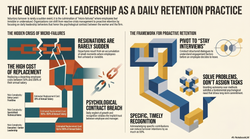
Real retention stories start in small, human moments that compound over years. It is when someone feels respected on their first day, supported through a family crisis, and trusted with more responsibility long before they get a new title. At our company, those moments have stretched across generations. Many of our people have stayed 40 years or more. Their kids now work in the business. That kind of tenure does not come from trendy engagement programs. It comes from how peop
Super Bowls are rarely decided by talent alone. They’re decided in moments of chaos, when a season — or a legacy — teeters on a single drive. Think of Super Bowl LI, when Tom Brady and the Patriots stared down a 28–3 deficit. Or Super Bowl XLIX, when Russell Wilson had seconds to process a defense, a clock, and the weight of expectation at the goal line. Or Super Bowl LVII, when Patrick Mahomes, visibly injured, engineered a second-half comeback on one leg. These are not j
As winter sets in and temperatures drop across the UK, many office workers are finding themselves reaching for extra layers, hot drinks and desk heaters just to stay comfortable at work. While it might be tempting to blame the cold on rising energy costs or cautious heating use, interior experts say the real problem often lies elsewhere. According to Hannah Prescott, Interior Designer at Diamond Interiors, office design plays a far bigger role in how warm a workplace feels
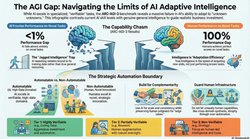
Artificial intelligence adoption consistently underdelivers on organizational expectations, with failure rates approaching 95% in some estimates. This article examines why AI investments fail when leaders treat implementation as purely a technical exercise rather than a behavioral change challenge.
Tech and media roles top the list as automated screening leaves qualified candidates in limbo Key Findings: Job market experts reveal which industries and roles face the highest risk of candidate ghosting in 2026, with technology and media positions topping the list The hospitality, retail, technology, and media sectors show the weakest applicant response rates, with index scores ranging from 28 to 44 Yassin Aberra warns that weak digital presence and poor keyword alignment a
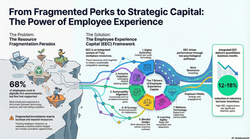
Organizations invest heavily in digital tools, sustainability initiatives, and wellness programs, yet struggle to translate these investments into sustained performance gains. This fragmentation reflects a deeper challenge: modern workplace resources are often managed as isolated interventions rather than integrated systems that shape holistic employee experience.
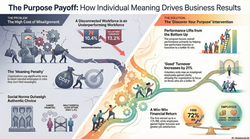
The personal meaning penalty describes the psychological and performance costs incurred when employees' work misaligns with their core values, sense of purpose, or desired impact. Unlike traditional engagement metrics, this penalty persists even when individuals perform competently and achieve external success.
Organizations face mounting pressure to develop digital fluency across their entire workforce, not merely within technical departments. Research indicates companies with advanced digital and AI capabilities outperform competitors by two to six times in total shareholder returns, yet only 28 percent plan significant upskilling investments despite 80 percent acknowledging it as the most effective gap-closing strategy.
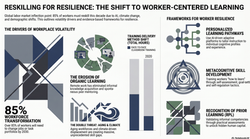
Organizations face unprecedented environmental turbulence requiring continuous adaptation to survive and thrive. This article examines the interconnected relationship between organizational learning capacity, employee wellbeing, and shared purpose as critical determinants of adaptive capability.
This paper presents Clio (Claude insights and observations), a privacy-preserving platform that uses AI assistants to analyze and surface aggregated usage patterns across millions of conversations without requiring human reviewers to read raw user data.
62% of employees say misconduct is more likely overlooked when top performers or leaders are involved. TalentLMS , a leading employee training platform , today released a new survey revealing deep gaps between how protected employees feel and how organizations actually respond to misconduct, highlighting widespread fear, silence, and unequal accountability in today's workplaces. Based on a survey of 1,000 U.S. employees, 71% say they feel protected at work. However, their e
Financial stress is far more common in today’s workforce than many organizations realize, and its effects do not stay confined to employees’ personal lives. When people are worried about money, that stress often manifests at work in subtle yet costly ways. The anxiety influences focus, engagement and overall performance. Over time, these pressures can downgrade productivity and increase turnover rates, even in well-managed organizations. Understanding how financial strain a
This article examines the organizational implications of behavioral homogeneity in large language models (LLMs), a phenomenon we term the "Artificial Hivemind." Drawing on a comprehensive analysis of 26,000 real-world user queries and 70+ language models, we reveal that contemporary AI systems exhibit pronounced intra-model repetition and inter-model convergence, generating strikingly similar outputs despite variations in architecture, training, and scale.
Despite increased awareness of neurodiversity in contemporary workplaces, organizational responses remain fragmented, compliance-driven, and disconnected from neurodivergent lived experiences. This article examines how human resource management can catalyze systemic transformation toward neuroinclusion through co-design approaches grounded in critical pragmatism and sociotechnical systems theory.
In 2025, European startups are securing unprecedented investment and global attention. According to recent data, European tech companies attracted approximately €72 billion in venture capital and completed over 3,740 funding deals in the calendar year, reflecting robust ecosystem activity and investor confidence heading into 2026. At the same time, Europe’s innovation landscape shows both depth and momentum: venture investment across the continent is projected to reach arou