top of page
Human Capital Leadership Review


6 hours ago5 min read

2 days ago4 min read


3 days ago4 min read


4 days ago6 min read

06:04


06:46

45:30

26:57

07:36

26:35

01:01:18
Blog: HCI Blog
Search


The Evolution of AI as Workplace Partner: From Chatbot Novelty to Strategic Collaborator
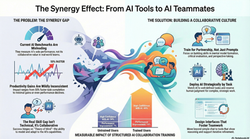
Three years after ChatGPT's launch, artificial intelligence has evolved from generating coherent text to functioning as a collaborative workplace partner capable of autonomous planning, coding, research, and analysis. This article examines the transformation of AI capabilities through the lens of Google's Gemini 3 and similar agentic systems, analyzing their implications for organizational work design, human-AI collaboration models, and knowledge work transformation.
8 hours ago18 min read


The Myth of the Workless Future: Why AI Will Reshape—Not Replace—Human Labor
Predictions of a fully automated, workless society within two decades have captured public imagination and policy attention. This article examines the empirical evidence and theoretical frameworks surrounding large-scale technological displacement, arguing that rather than eliminating work entirely, AI and automation are more likely to hollow out middle-skill occupations while preserving demand for high-touch human services and augmented knowledge work.
1 day ago32 min read


The Case for a Chief Innovation and Transformation Officer in the Age of AI
Artificial intelligence is reshaping how organizations operate, yet many enterprises approach AI adoption primarily as a technical implementation challenge. This narrow focus overlooks the profound cultural, structural, and human capital transformations that determine whether AI investments deliver value or create organizational dysfunction.
2 days ago21 min read


Mastering the AI Capability Gap: Why Domain Experts Must Lead AI Integration Before the Window Closes
Artificial intelligence presents organizations with an unprecedented paradox: the engineers building AI systems possess limited insight into optimal applications within specific professional domains, while domain experts often lack the technical fluency to unlock AI's potential in their fields. This capability gap creates a strategic window for practitioners who bridge both worlds—combining deep domain knowledge with AI literacy—to establish competitive advantages before comm
3 days ago16 min read


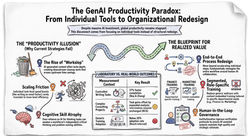
The GenAI Divide: Why 95% of Enterprise AI Investments Fail—and How the 5% Succeed
Despite $30–40 billion in enterprise GenAI investment, 95% of organizations achieve zero measurable return, trapped on the wrong side of what we term the "GenAI Divide." This review synthesizes findings from MIT's Project NANDA research examining 300+ AI implementations and interviews with 52 organizations to identify why pilots stall and how exceptional performers succeed.
4 days ago34 min read


When the Going Gets Tough: Identifying and Overcoming Burnout as a Sign it May be Time for a New Job Opportunity
Burnout is a significant issue facing professionals in a wide range of industries, yet it often goes unnoticed until the negative impacts emerge. This article explores the key dimensions of burnout as distinguished from temporary job stress, including emotional exhaustion, cynicism, and reduced professional efficacy. A review of common signs and objective assessment strategies helps practitioners recognize when stress has crossed over into burnout.
5 days ago7 min read


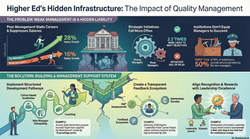
From Silence to Stewardship: Business Faculty Responses to Administrative Incompetence
U.S. higher education faces mounting existential pressures—enrollment declines, cost escalation, political skepticism, and administrative managerialism that prioritizes short-term institutional survival over long-term scholarly mission. Despite widespread critique, business management faculty have largely failed to mount effective resistance to managerialist interventions, even as these practices erode academic autonomy and institutional purpose.
6 days ago24 min read


The AI Skills Paradox: Why Meta-Competencies Trump Technical Know-How in the Age of Intelligent Automation
As artificial intelligence reshapes labor markets globally, organizational leaders face a fundamental strategic question: which capabilities truly predict performance in AI-augmented work environments? While public discourse fixates on job displacement projections—the World Economic Forum estimates 92 million job losses against 170 million new roles by 2030—emerging research reveals a critical distinction between superficial AI adoption and transformative capability developme
Dec 620 min read
bottom of page