


Remote Work, Loneliness, and the Leadership Deficit: Moving Beyond the Return-to-Office Debate

Download the article here:

Listen to a review of this article:
Abstract: Recent research linking remote work to increased loneliness has reignited debates about workplace location policies, with some organizational leaders viewing office mandates as solutions to employee wellbeing challenges. However, this framing misdiagnoses both the problem and its remedies. This article examines evidence on remote work, social connection, and mental health, distinguishing correlation from causation and identifying the true drivers of workplace disconnection. Drawing on organizational psychology, workplace design research, and emerging evidence on technology-mediated work, we argue that loneliness stems not from physical location but from systematic underinvestment in relational infrastructure, compounded by efficiency-maximizing practices that erode connection opportunities. Evidence-based organizational responses include deliberate connection design, hybrid work optimization, manager capability building, and purposeful technology deployment. Organizations that treat flexible work as a strategic capability rather than a policy accommodation—investing in belonging, psychological safety, and human-centered work design—can deliver both flexibility and connection. The article concludes that sustainable solutions require moving beyond location mandates toward comprehensive approaches that restore relational density across all work contexts.
A recent study published in Science has thrust workplace location back into heated debate. The research, which found that workers in remote-capable occupations reported higher rates of depression, anxiety, and mental health service utilization compared to those in non-remote roles, quickly generated headlines and OpEd commentary (Harrington & Emanuel, 2025). The statistics are striking: 58% more hours spent alone, with 72% of single remote workers experiencing entire days without human contact. For some organizational leaders, these findings appear to validate long-held suspicions about distributed work and provide new ammunition for return-to-office mandates framed as employee wellbeing initiatives.
Yet this interpretation fundamentally misreads both the research and the organizational challenge at hand. As Stanford economist Nicholas Bloom has noted, the study examines workers in remote-capable jobs, not necessarily those working remotely, and reflects correlation rather than controlled experimentation (Bloom, 2025). The occupations most amenable to remote work—technology, professional services, media—are precisely those that have experienced the most turbulence, layoffs, and intensification over recent years. Moreover, remote work often functions as a coping mechanism for workers facing difficult circumstances: demanding schedules, long commutes, caregiving responsibilities, disabilities, or toxic workplace environments.
The practical stakes extend far beyond academic debate. Organizations worldwide have invested billions in flexible work infrastructure while simultaneously cutting travel budgets, reducing in-person gatherings, and curtailing professional development opportunities (Gensler, 2024). The result is not simply remote work but under-designed work—environments that lack intentional connection regardless of physical location. Simultaneously, the rapid adoption of generative AI tools is reshaping how work gets done and how colleagues interact, with emerging evidence suggesting that heavy AI users experience both productivity gains and increased feelings of disconnection from teammates (Upwork Research Institute, 2024).
The real question facing organizational leaders is not whether to mandate office attendance but how to restore relational infrastructure and human connection in work contexts that are fundamentally hybrid, technology-mediated, and distributed. This article synthesizes evidence on workplace connection, examines the true drivers of employee loneliness, and presents organizational responses that address root causes rather than symptoms. The challenge is not choosing between flexibility and connection—it is building both simultaneously through deliberate design and sustained investment.
The Workplace Connection Landscape
Defining Loneliness and Social Connection in Organizational Contexts
Workplace loneliness represents more than simple physical isolation. Organizational scholars distinguish between social loneliness—the absence of a broader social network—and emotional loneliness—the lack of close, intimate relationships (Wright, 2005). In work settings, this manifests as both transactional isolation (lack of instrumental connections needed to accomplish tasks) and relational isolation (absence of meaningful relationships that provide belonging and psychological safety).
The construct differs from introversion or preference for solitude. Loneliness reflects perceived deficiency in the quality or quantity of social connections relative to desired levels (Perlman & Peplau, 1981). An employee might work in a bustling office yet experience profound loneliness if relationships lack depth, trust, or reciprocity. Conversely, a remote worker with strong team bonds, regular meaningful interaction, and robust organizational belonging may report high social connection despite limited physical co-presence.
Research distinguishes workplace loneliness from general loneliness, with distinct antecedents and consequences. Organizational factors—including role clarity, supervisory support, team cohesion, and inclusive culture—predict workplace loneliness more strongly than personality traits or general social tendencies (Ozcelik & Barsade, 2018). This matters because it locates the problem, and therefore solutions, within organizational design and management practice rather than individual characteristics or work location alone.
Prevalence, Drivers, and Pandemic Acceleration
Pre-pandemic research established that workplace loneliness was already widespread, affecting approximately 40% of workers in developed economies (Cigna, 2020). The experience was particularly acute among younger workers, those in entry-level roles, and employees who perceived low organizational support or experienced role ambiguity. Critically, physical proximity provided no immunity: employees in open-plan offices reported loneliness rates comparable to remote workers when relational quality was poor (Morrison & Nolan, 2009).
The COVID-19 pandemic dramatically accelerated remote work adoption while simultaneously disrupting established connection practices. Organizations transitioned to distributed work without redesigning how connection happened, effectively digitizing existing practices rather than reimagining them. The result was connection debt—accumulated deficits in relationships, trust, shared understanding, and social capital (Allen et al., 2021).
This deficit compounds over time. New employees who onboard remotely develop weaker organizational networks, understand cultural norms less clearly, and experience lower identification with their employer (Yang et al., 2022). Team members who have never met in person demonstrate reduced trust, take longer to resolve conflicts, and show diminished willingness to help colleagues facing difficulties (Raghuram et al., 2019). These relational deficits persist even when some face-to-face interaction resumes, suggesting that connection requires ongoing investment rather than occasional intervention.
Recent evidence reveals additional complexity. The Harrington and Emanuel study finding elevated mental health concerns among those in remote-capable jobs may reflect not remote work itself but the characteristics of such roles and workers. Knowledge workers face intensifying performance pressures, always-on expectations facilitated by digital tools, and blurred boundaries between work and personal life (Mazmanian et al., 2013). These pressures exist regardless of location. Indeed, workers often adopt remote arrangements specifically to cope with such demands, suggesting reverse causality: those experiencing stress seek flexibility, rather than flexibility causing distress.
The Artificial Intelligence Complication
The rapid integration of generative AI tools introduces additional dynamics to workplace connection. Early evidence presents a paradox: AI can enhance collaboration when teams use it collectively to solve problems, share insights, and coordinate work (Gensler, 2024). Power users working alongside colleagues report feeling more connected and productive. However, when individuals turn to AI tools as replacements for human interaction—using chatbots for questions they might previously have asked colleagues, or automating communications that once required coordination—connection erodes.
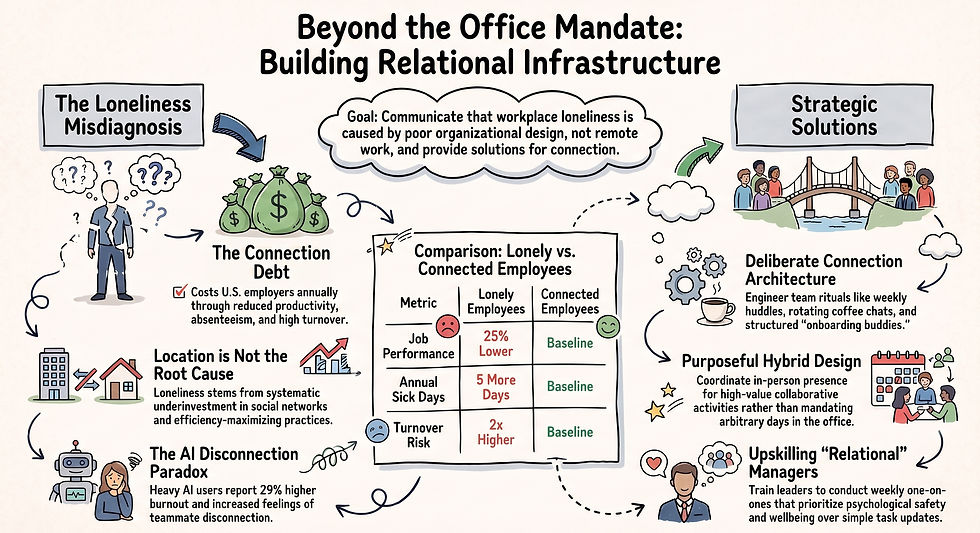
Multiple 2024 studies documented this pattern. Research from the Upwork Research Institute found that while 96% of C-suite leaders expect AI to boost productivity, heavy AI users report 29% higher burnout rates and significant increases in feeling disconnected from teammates (Upwork Research Institute, 2024). A Workday survey revealed that employees increasingly use AI to avoid human interaction, with 65% of heavy users admitting they consult AI before colleagues when facing challenges (Workday, 2024). Anthropic research similarly documented that as individuals rely more heavily on AI assistants, they engage in fewer informal conversations, ask colleagues for help less frequently, and report diminished sense of team belonging (Anthropic, 2024).
The issue is not AI technology itself but how organizations deploy it within broader work systems. When AI adoption occurs without attention to its relational implications—without designing for collective use, without preserving opportunities for learning through interaction, without maintaining human touchpoints—it can inadvertently accelerate workplace isolation.
Organizational and Individual Consequences of Workplace Disconnection
Organizational Performance Impacts
Workplace loneliness and disconnection exact measurable costs on organizational performance. Ozcelik and Barsade (2018) found that loneliness predicted lower task performance, reduced organizational citizenship behaviors, and increased withdrawal behaviors including absenteeism and turnover intentions. The performance decrements remained significant even after controlling for depression, suggesting loneliness operates through distinct mechanisms.
The economic magnitude is substantial. Cigna's research estimated that workplace loneliness costs U.S. employers over $400 billion annually through reduced productivity, increased healthcare utilization, and elevated turnover (Cigna, 2020). Lonely employees miss approximately 5 more days of work annually and demonstrate 25% lower job performance compared to socially connected peers. Organizations in the highest quartile of loneliness prevalence experience double the turnover rates of those in the lowest quartile.
Beyond individual productivity, disconnection undermines collective capabilities. Teams with weak social ties demonstrate impaired coordination, reduced knowledge sharing, and diminished capacity for innovation (Uzzi & Spiro, 2005). Social capital—the resources embedded in relationships and networks—enables teams to access diverse expertise, mobilize support for initiatives, and navigate ambiguity. When connection erodes, so does this collaborative infrastructure. Edmondson and Lei (2014) documented that psychologically safe teams, characterized by strong interpersonal bonds and trust, learn faster, surface problems earlier, and adapt more effectively to challenges.
The innovation implications are particularly consequential. Breakthrough innovations typically emerge from combining diverse knowledge domains, which requires relationships that span boundaries and facilitate unusual combinations (Fleming et al., 2007). Workplace loneliness reduces employees' boundary-spanning activity, as isolated individuals lack the social connections through which novel insights flow. Organizations experiencing high disconnection thus face not only immediate productivity losses but degraded capacity for adaptation and renewal.
The remote work literature adds nuance to these findings. While poorly designed remote work can increase isolation and reduce performance, well-designed distributed work arrangements show neutral or positive effects on productivity across multiple meta-analyses (Gajendran & Harrison, 2007). The determining factors are quality of implementation, managerial capabilities, technological support, and deliberate connection design rather than location per se. Organizations that invest in virtual collaboration infrastructure, train managers in distributed leadership, and create intentional touchpoints maintain performance even with significant remote work.
Individual Wellbeing and Broader Stakeholder Impacts
The individual consequences of workplace loneliness extend well beyond job performance. Chronic loneliness predicts elevated risk for depression, anxiety, cardiovascular disease, weakened immune function, and even premature mortality (Holt-Lunstad et al., 2015). The health impacts rival those of smoking 15 cigarettes daily or being obese. Workplace loneliness specifically predicts increased psychological distress, emotional exhaustion, and burnout even after controlling for job demands and general loneliness (Wright, 2005).
The mechanism operates through multiple pathways. Lonely employees experience work as more threatening, engage in more negative self-evaluation, and demonstrate hypervigilance for social rejection—all of which compound stress (Cacioppo & Hawkley, 2009). They sleep more poorly, engage in fewer health-promoting behaviors, and utilize healthcare services more frequently. The Harrington and Emanuel findings of 58% more hours alone and sharply elevated mental health service use among remote-capable workers—if indeed causally linked to work arrangements rather than confounded by occupational characteristics—would represent substantial wellbeing costs.
However, the flexibility literature complicates this picture. Multiple studies document that flexible work arrangements, including remote options, improve work-life balance, reduce work-family conflict, and enhance overall wellbeing when implemented supportively (Allen et al., 2013). Employees value flexibility so highly they would trade 4-10% of compensation to preserve it (Mas & Pallais, 2017). This suggests flexibility and connection are not inherently oppositional but require deliberate integration.
The key appears to be control and design quality. Workers who choose flexible arrangements and whose organizations support them with intentional connection practices report higher wellbeing than both fully office-based peers and those in poorly implemented flexible arrangements (Golden, 2006). It is not location that determines outcomes but whether employees have autonomy over their work arrangements, whether they receive adequate support, and whether relational infrastructure exists regardless of where work happens.
Stakeholder impacts ripple outward. Families benefit when flexible work enables better work-life integration, reducing stress and improving relationship quality—yet suffer when poor boundaries lead to work intrusion and employee exhaustion (Kossek et al., 2012). Communities benefit from reduced commuting and local presence—yet risk hollowing out if remote workers remain isolated rather than engaged locally. The challenge is not inherent to distributed work but to whether organizations design for holistic wellbeing across contexts.
Evidence-Based Organizational Responses
Table 1: Evidence-Based Organizational Responses to Remote Work and Loneliness
Organization or Research Body | Program or Initiative Name | Key Connection Strategy | Reported Metric or Impact | Target Group | Technology or Tool Used (Inferred) |
Atlassian | Team Anywhere | Deliberate connection architecture with quarterly in-person gatherings and facilitator training | 23% reduction in loneliness measures and 92% employee satisfaction | Distributed workforce | Atlassian collaboration suite (Confluence, Trello, Jira) |
Cisco | Hybrid Leadership Training | Manager capability building focused on wellbeing monitoring and inclusive practices | 34% improvement in team engagement and 28% reduction in turnover | Hybrid/distributed managers and their teams | Webex and Cisco collaboration platforms |
PwC | Manager Moments | Weekly protected time for informal check-ins and recognition | 31% lower loneliness and 27% higher job satisfaction | Internal teams and managers | Video conferencing tools (Google Meet or Teams) |
Kaiser Permanente | Connection Conversations | Structured dialogues between clinical managers and staff focusing on wellbeing | 24% improvement in engagement and 19% reduction in burnout; improved patient satisfaction | Clinical staff and managers | Mobile communication tools and internal portals |
Fujitsu | Work Life Shift | Activity-based presence planning and 'touchpoint days' | 15% productivity improvement with maintained engagement | Business units transitioning to hybrid | Fujitsu Buddy or internal collaboration portals |
Dropbox | Virtual First / Studios | Redesigning offices as collaborative 'Studios' for intentional gatherings rather than individual work | 88% satisfaction with no reduction in collaboration quality | Remote-first employees | Dropbox and Slack |
Microsoft | Virtual Commute | Structured transition rituals to start and end work days with intention | Enhanced wellbeing and improved sense of control | Remote workers | Microsoft Teams and Viva Insights |
Siemens | Collaboration Days | Purposeful hybrid design where presence is coordinated for brainstorming and relationship building | Maintained flexibility while ensuring high-value connection opportunities | Hybrid teams | Resource scheduling software and Microsoft Teams |
BCG | Case Team Launches | In-person gatherings at project start to build trust and ways of working | Higher client satisfaction, team cohesion, and employee retention | Consulting project teams | Internal project management tools |
Deloitte | Team Captains | Rotating distributed leadership roles focused on team rituals and health | Higher cohesion and lower turnover compared to traditional structures | Professional services teams | Zoom and Microsoft Teams |
Genentech | Mission Moments | Weekly highlights connecting employee work to patient outcomes to build shared identity | Maintained organizational identification and sense of meaningful contribution | Distributed researchers and staff | Intranet and internal digital newsletters |
Shopify | Annual Adventure | Multi-day gatherings for shared experiences like volunteering and creative projects | High employee ratings for sense of belonging and company connection | Global employee base | Slack and Shopify internal platforms |
Salesforce | Ohana Culture Integration | Embedding relational metrics into performance management and promotion criteria | Sustained connection as a central organizational identity | Global workforce and management | Slack and Salesforce Performance Cloud |
Capital One | Connection Dashboards | Redesigning leadership competencies to include 'fostering connection' with real-time data tracking | Made connection visible and manageable alongside financial metrics | Leadership and management | Internal HR analytics dashboards |
Novartis | Hybrid Leadership Development | Intensive quarterly in-person gatherings interspersed with virtual cohort work | Increased participation from distributed locations and sustained engagement | Global leaders | Learning Management Systems (LMS) and video conferencing |
Deliberate Connection Architecture
Organizations successfully addressing workplace connection treat it as a design challenge requiring systematic attention rather than assuming connection emerges spontaneously. Connection architecture involves mapping the natural opportunities for relationship building in workflows, identifying gaps where isolation risk is high, and deliberately engineering touchpoints that build trust and belonging.
Evidence supports several specific practices. Regular synchronous team meetings—even brief check-ins—significantly reduce isolation and enhance team cohesion in distributed environments (Kirkman & Mathieu, 2005). However, meeting quality matters enormously: meetings that provide psychological safety, allow informal social time, and surface individual contributions prove far more effective than purely task-focused gatherings. Structured team rituals—consistent practices like weekly retrospectives, monthly celebrations, or quarterly offsites—create predictable connection opportunities that build cumulative relational density.
Cohesion-building approaches include:
Weekly team huddles that blend work updates with personal check-ins, using protocols like "roses and thorns" to surface both wins and challenges
Structured pair programming or work sessions where colleagues collaborate in real-time, building familiarity and trust through joint problem-solving
Rotating coffee chat matching systems that connect employees across functions for informal virtual or in-person conversations
Team rituals marking milestones such as project completions, anniversaries, or personal celebrations, creating shared positive experiences
Cross-functional project teams designed to expand networks beyond immediate colleagues
Onboarding buddy systems pairing new employees with tenured colleagues for regular check-ins during critical early months
Atlassian, the collaboration software company, redesigned its distributed work model around "Team Anywhere," which empowers teams to choose their work patterns while requiring quarterly in-person gatherings for relationship building and strategic alignment. The company invested in facilitator training to ensure these gatherings maximize connection impact rather than replicating routine work that could happen virtually. Teams report high autonomy, maintained productivity, and stronger cohesion than under previous arrangements. Critically, Atlassian tracked that the intervention reduced loneliness measures by 23% while maintaining 92% employee satisfaction with flexibility (Atlassian, 2023).
Microsoft implemented "Virtual Commute" features in Teams, creating structured transition rituals to help employees start and end work days with intention, reducing the sense of work invading all hours that intensifies stress. The features prompt users to review goals, set daily intentions, and reflect on accomplishments—practices that research links to enhanced wellbeing and sense of control (Microsoft, 2022).
Manufacturing firm Siemens combined flexible work with "collaboration days" where teams coordinate in-person presence for activities specifically requiring face-to-face interaction: brainstorming sessions, conflict resolution, complex problem-solving, and relationship building. Rather than mandating blanket office attendance, Siemens empowers teams to determine which activities benefit most from physical proximity and schedules accordingly. This purposeful approach maintains flexibility while ensuring high-value connection opportunities (Siemens, 2023).
Manager Capability and Middle Management Support
Frontline and middle managers serve as the primary architects of employee experience, yet most receive inadequate preparation for building connection in hybrid environments. Research consistently identifies manager quality as the strongest predictor of employee engagement, psychological safety, and retention (Harter et al., 2020). In distributed contexts, managerial capabilities matter even more as managers must be more intentional about connection that once occurred informally.
Evidence-based manager development focuses on specific behavioral competencies. Frequent one-on-one meetings—weekly or biweekly conversations focused on individual needs, development, and wellbeing rather than solely task updates—significantly reduce employee loneliness and increase engagement (Gallup, 2017). Managers skilled in active listening, providing developmental feedback, and expressing genuine care create psychological safety that enables employees to surface challenges and request support.
High-impact manager practices include:
Structured one-on-ones using frameworks that balance task discussion, career development, and wellbeing check-ins
Inclusive meeting facilitation that draws out quieter members, rotates leadership, and creates space for informal interaction
Transparent communication about decisions, changes, and organizational context that reduces uncertainty
Recognition practices that celebrate contributions, highlight impact, and reinforce belonging
Flexible accommodation of individual circumstances while maintaining team coordination
Proactive reach-outs to employees showing withdrawal or struggle signals
Team-building investment in activities that deepen relationships and create positive shared experiences
Cisco developed a comprehensive manager training program specifically for hybrid leadership, covering distributed team management, inclusive practices, wellbeing monitoring, and technology optimization. The training emphasized that managers must compensate for reduced ambient awareness—the informal observation of employee state possible in co-located settings—through more deliberate check-ins and explicit invitation for employees to share challenges. Managers completing the training demonstrated 34% improvement in team engagement scores and 28% reduction in team turnover (Cisco, 2023).
Accounting firm PwC introduced "manager moments"—weekly protected time where managers pause operational demands to focus on team connection and individual wellbeing. During these periods, managers conduct informal check-ins, recognize contributions, and address emerging concerns before they escalate. The practice emerged from recognition that relentless productivity focus was crowding out relationship maintenance. Teams with consistent manager moments reported 31% lower loneliness and 27% higher job satisfaction (PwC, 2024).
Importantly, organizations must also support managers themselves, who face heightened stress mediating between institutional demands and employee needs while often working remotely. Manager burnout predicts team burnout, creating cascading effects (Halbesleben et al., 2013). Organizations supporting managers through peer networks, coaching, reduced administrative burden, and explicit recognition of their wellbeing role see better outcomes.
Redesigning Hybrid Work for Connection
Organizations moving beyond simplistic "days in office" mandates toward thoughtful hybrid design report superior outcomes on both flexibility and connection dimensions. Evidence-based hybrid approaches distinguish between activities benefiting from physical proximity versus those equally or more effective virtually, then design work accordingly.
Research on task characteristics and medium fit provides guidance. Complex, ambiguous problems requiring extensive communication benefit from face-to-face interaction where rapid turn-taking and non-verbal cues facilitate understanding (Daft & Lengel, 1986). Relationship building, particularly across diverse groups, proceeds more effectively in person where social presence and informal interaction opportunities are richer. Creative ideation in early stages shows advantages from physical co-presence. Conversely, focused individual work, routine coordination, and information transmission often prove equally or more effective remotely, with reduced interruption and commute time savings (Golden & Gajendran, 2019).
Effective hybrid design elements include:
Activity-based presence planning where teams coordinate in-person time for specific high-value activities rather than arbitrary schedules
Team coordination so that employees coming to office encounter relevant colleagues rather than working virtually while physically present
Redesigned office spaces emphasizing collaboration zones, informal gathering areas, and flexible configurations over individual workstations
Technology parity ensuring remote participants have equal voice and visibility in hybrid meetings through camera positioning, audio quality, and facilitation practices
Asynchronous-first communication norms that document decisions and information accessibly so remote colleagues aren't disadvantaged
Cultural inclusion recognizing both in-person and remote contributions equally without defaulting to proximity bias
Dropbox implemented "Virtual First" after extensive employee research revealed that 90% valued location flexibility but 70% also valued in-person connection. Rather than hybrid days-per-week mandates, Dropbox designated all employees as remote-first but invested heavily in redesigning offices as "Studios"—collaborative spaces for team gatherings, customer meetings, and events rather than individual workspaces. Teams schedule quarterly on-sites for strategic planning, relationship building, and activities benefiting from physical presence. The model preserves flexibility while maintaining connection opportunities. Employee surveys show 88% satisfaction with the arrangement and no reduction in reported collaboration quality (Dropbox, 2022).
Fujitsu adopted a "Work Life Shift" model combining remote work flexibility with "touchpoint days" where specific teams or functions coordinate presence for relationship-building activities. Rather than company-wide mandates, business units determine optimal patterns based on work nature. Fujitsu supported the shift with manager training, technology upgrades, and workspace redesign. The company tracked 15% productivity improvement alongside maintained engagement scores (Fujitsu, 2023).
Architecture and design firm Gensler practices what it researches, implementing "collaboration-centric hybrid" where employees work remotely for focused tasks but coordinate presence for collaborative activities. The firm found that employees in this model report higher connection to colleagues and company compared to either fully remote or required-presence arrangements. Critically, Gensler's data showed that power AI users working alongside colleagues in collaborative settings experienced the productivity benefits of AI tools while maintaining strong team bonds, whereas isolated heavy AI users showed the disconnection patterns noted earlier (Gensler, 2024). This suggests that hybrid design must consider not just physical but technological mediation of work.
Strategic Technology Deployment and AI Integration
Technology shapes connection opportunities as much as physical space. Organizations that treat technology as simply enabling existing practices—replicating office meetings via video, substituting emails for hallway conversations—miss opportunities to fundamentally reimagine how connection happens. Evidence-based technology strategy requires understanding both affordances and limitations of different media, then designing communication ecosystems that maximize connection while minimizing fatigue.
Multiple challenges plague poorly designed virtual communication environments. Zoom fatigue—exhaustion from excessive video meetings—emerges from several factors including sustained eye contact, reduced mobility, cognitive load of processing delayed cues, and constant self-view (Bailenson, 2021). Organizations scheduling back-to-back video meetings without transitions replicate the worst aspects of office interruption while losing informal connection benefits. The solution is not abandoning video but using it strategically for activities where visual connection adds value while embracing asynchronous communication where appropriate.
Technology practices supporting connection include:
Communication protocols clarifying when to use synchronous versus asynchronous channels, which topics merit video versus audio, and how to signal urgency without creating always-on expectations
Meeting minimalism auditing recurring meetings for necessity, shortening default durations, building in transition time, and designating meeting-free blocks
Camera-optional policies allowing employees to choose engagement mode based on task and cognitive state rather than requiring constant video presence
Social technology infrastructure including virtual watercoolers, interest-based channels, and informal gathering spaces that replicate spontaneous office interaction
Transparent documentation practices capturing decisions, context, and rationale accessibly so distributed colleagues maintain shared understanding
Intentional AI deployment focusing on collective rather than individual use, preserving human collaboration touchpoints, and monitoring for disconnection signals
The AI integration challenge requires particular attention. Organizations leading in this domain focus on human-AI collaboration rather than human-AI substitution. They deploy AI tools to enhance team capabilities—providing rapid information synthesis, identifying patterns, generating options—while preserving human interaction for relationship building, complex judgment, and meaning-making.
Anthropic's research on its own AI deployment revealed that when teams used Claude collectively—in brainstorming sessions, problem-solving discussions, and decision meetings—users reported enhanced connection and team effectiveness (Anthropic, 2024). The AI served as a tool amplifying human collaboration rather than replacing it. Conversely, when individuals siloed AI use for tasks formerly requiring coordination, connection eroded. This suggests organizations should design AI workflows that maintain or enhance interaction rather than inadvertently isolating contributors.
Insurance firm Allstate implemented "AI collaboration guidelines" encouraging employees to use AI tools jointly in team contexts while being mindful about replacing human requests for help with AI queries. The guidelines emphasize AI as augmenting collective intelligence rather than substituting for learning from colleagues. Early indicators suggest maintained knowledge sharing and peer support alongside productivity gains from AI use (Allstate, 2024).
Investment in Gatherings, Learning, and Development
Organizations that cut in-person gathering budgets, training programs, and professional development investments while moving to flexible work inadvertently eliminated critical connection infrastructure. Evidence consistently demonstrates that face-to-face experiences build social capital and relational foundation that sustain connection through subsequent virtual interaction (Cummings et al., 2009). The question is not whether to invest but how to invest strategically.
High-impact gatherings share several characteristics. They bring together employees who benefit from strengthened relationships, create opportunities for both structured and unstructured interaction, include activities requiring collaboration or shared challenge, and conclude with clear plans for maintaining connection afterward. Simply assembling people without purposeful design often disappoints.
Effective gathering investments include:
Onboarding immersions where new cohorts spend concentrated in-person time building relationships, understanding culture, and establishing networks during critical early tenure
Quarterly team offsites focused on strategic planning, problem-solving, and relationship building rather than routine work replicable virtually
Annual all-hands gatherings reinforcing organizational identity, celebrating accomplishments, and enabling cross-functional networking
Leadership development programs bringing cohorts together for intensive learning, relationship building, and peer support networks
Project kickoff meetings where teams initiating complex initiatives spend focused time together establishing shared understanding and trust before distributed execution
Customer or community engagement activities where employees collaborate on external-facing projects building both relationships and sense of purpose
Pharmaceutical company Novartis maintained investment in leadership development programs despite remote work shifts, recognizing that the programs built both capabilities and cross-organizational networks critical for collaboration. The company shifted from continuous in-person programs to intensive quarterly gatherings interspersed with virtual cohort work. Participants reported that the concentrated in-person experiences created strong bonds that sustained engagement through virtual sessions. The hybrid format actually increased participation from distributed locations while maintaining relationship-building benefits (Novartis, 2023).
Consulting firm BCG implemented "case team launches"—brief in-person gatherings at project start where teams build relationships, establish ways of working, and create personal connections before moving to distributed execution. The practice emerged from finding that distributed teams lacking initial face-to-face contact experienced more conflict, slower trust development, and reduced knowledge sharing. Teams with launches outperformed those without on client satisfaction, team cohesion, and employee retention (BCG, 2022).
Technology company Shopify created an "Annual Adventure" program bringing employees together for multi-day gatherings combining work sessions with shared experiences like volunteering, outdoor challenges, or creative projects. The program explicitly aims to build relationships and create memories beyond transactional work interaction. Employees consistently rate these experiences as among the most valuable for sense of belonging and company connection (Shopify, 2024).
Building Long-Term Organizational Capability for Connection and Belonging
Embedding Connection in Performance Systems and Organizational Culture
Sustaining workplace connection requires moving beyond programs and interventions to embedding relational expectations in organizational systems. When performance management, promotion criteria, and resource allocation signal that connection matters, behaviors shift. When these systems focus exclusively on individual productivity or efficiency metrics, connection becomes discretionary and eventually erodes.
Leading organizations explicitly include relational contributions in performance expectations and evaluation. This includes expectations that employees build relationships across functions, support colleague development, contribute to team cohesion, and participate in community building. Managers are assessed not only on team deliverables but on team engagement, development, and wellbeing outcomes. Leaders demonstrating strong results but leaving burned-out, disconnected teams in their wake face consequences rather than promotion.
Recognition systems provide another leverage point. Organizations that celebrate collaboration, recognize relationship building, and reward employees who strengthen organizational social fabric signal that connection is valued. Public acknowledgment of employees who mentored colleagues, facilitated cross-functional collaboration, or contributed to inclusive culture reinforces behavioral norms and makes visible often-invisible relational work.
Resource allocation constitutes perhaps the most powerful signal. Organizations that maintain budgets for team gatherings, professional development, and connection-building activities through budget pressures communicate genuine priority. Those that cut such investments first signal that connection is discretionary rather than fundamental.
Technology company Salesforce embedded "Ohana culture"—emphasizing family, belonging, and community—into performance expectations and systems. Managers are evaluated on team Ohana metrics including engagement, development, and inclusivity alongside traditional business metrics. Employees receive recognition for mentoring, community building, and supporting colleagues. The company maintained investment in annual Dreamforce conference and regional gatherings through the pandemic, viewing them as essential rather than discretionary. This systemic integration sustains connection as central to organizational identity rather than peripheral program (Salesforce, 2023).
Financial services firm Capital One redesigned leadership competency models to explicitly include "fostering connection and belonging" alongside strategic and operational capabilities. Leaders are assessed on how effectively they create inclusive environments, build trust, and develop strong team relationships. Promotion decisions weigh these relational capabilities equally with business results. The firm also introduced "connection dashboards" giving leaders real-time data on team engagement, wellbeing indicators, and social network health, making connection visible and manageable alongside financial metrics (Capital One, 2023).
Developing Distributed Leadership and Relational Capabilities
Traditional leadership models assumed physical proximity and substantial informal interaction through which leaders built relationships, read employee state, and maintained connection. Distributed work requires more deliberate relational capabilities and shared leadership models where connection responsibility distributes across the organization rather than concentrating in formal leaders.
Evidence supports several capability domains. Emotional intelligence—accurately perceiving emotions, understanding their implications, and regulating responses—predicts leadership effectiveness generally and becomes even more critical remotely where cues are limited (Goleman, 1998). Virtual communication competence includes skill in choosing appropriate media, facilitating inclusive meetings, building rapport through technology, and conveying empathy through constrained channels. Inclusive leadership—actively soliciting diverse perspectives, creating safety for dissent, and ensuring equitable participation—matters enormously when distance and technology can amplify power dynamics (Nembhard & Edmondson, 2006).
Organizations investing in these capabilities see returns. Leadership development programs that include virtual leadership modules, peer learning communities where leaders share distributed management practices, and coaching focused on remote relationship building all demonstrate positive impacts on team outcomes (Society for Human Resource Management, 2023).
Shared leadership models where team members rotate facilitation, explicitly distribute connection roles, and collectively own team cohesion show particular promise. Rather than placing full responsibility on formal managers, teams designate members as culture keepers, onboarding buddies, celebration coordinators, or wellbeing champions. This distributes workload, builds broad capability, and creates redundancy so connection does not depend on single individuals.
Professional services firm Deloitte implemented "team captains"—rotating roles where different members lead specific aspects of team functioning including connection and wellbeing. Captains facilitate team rituals, check in on struggling colleagues, coordinate social activities, and surface team health concerns to managers. The practice both develops leadership capabilities and prevents manager burnout from sole connection responsibility. Teams using the model report higher cohesion and lower turnover than traditionally structured counterparts (Deloitte, 2023).
Healthcare system Kaiser Permanente trained clinical managers in "connection conversations"—brief structured dialogues focusing on employee wellbeing, work challenges, and support needs beyond clinical task discussion. The training emphasized open-ended questions, active listening, and follow-through on identified needs. Managers completing the training improved team engagement scores by 24% and reduced burnout indicators by 19%. Critically, the intervention also improved patient satisfaction, suggesting that staff connection cascades to care quality (Kaiser Permanente, 2023).
Purpose, Meaning, and Organizational Identity in Distributed Contexts
Connection extends beyond interpersonal relationships to organizational identification—employees' sense of belonging to and alignment with organizational mission and values. Research demonstrates that organizational identification buffers stress, increases commitment, and predicts retention (van Knippenberg & Sleebos, 2006). However, building identification proves more challenging in distributed environments where employees lack ambient exposure to organizational culture through physical presence, informal interaction, and symbolic artifacts.
Organizations successfully building distributed identification employ several approaches. Consistent narrative about organizational purpose, values, and impact creates shared meaning across locations. Regular communication from leadership reinforcing this narrative—through town halls, internal communications, and leadership visibility—maintains connection to larger mission. Stories celebrating how employee work contributes to organizational purpose make abstract mission tangible.
Inclusive rituals that bring distributed employees together in shared experience—whether virtual celebrations, company-wide challenges, or volunteer activities—create collective identity. Making organizational culture explicit through documented values, behavioral expectations, and cultural narratives helps new and remote employees understand and internalize norms that co-located workers absorb informally.
Patagonia, the outdoor apparel company, maintained strong organizational identification among distributed workers through consistent mission communication, regular storytelling about environmental impact, and inclusive activism opportunities. Employees across locations participate in environmental campaigns, share stories about how work contributes to conservation, and engage in volunteer activities aligned with company values. These practices create shared identity and purpose beyond immediate work relationships. Even fully remote employees report strong company connection and alignment with mission (Patagonia, 2024).
Biotech company Genentech created "Mission Moments"—weekly highlights of how employee work contributes to patient health outcomes, shared across the organization. These stories make abstract drug development tangible by connecting research to real patient impact. Distributed employees report that these narratives help them feel connected to larger purpose despite limited interaction with other functions or patient-facing roles. The practice maintains organizational identification and sense of meaningful contribution (Genentech, 2023).
Conclusion
The return-to-office debate framed around employee loneliness misdiagnoses both problem and solution. While some workers in remote-capable occupations may indeed experience elevated loneliness, the evidence does not support simplistic causation from remote work itself. Rather, loneliness emerges from systematic underinvestment in relational infrastructure, efficiency-maximizing practices that crowd out connection, poor implementation of flexible work without attention to design, and technology deployment that inadvertently isolates rather than connects.
The real leadership challenge is not choosing between flexibility and connection but building both through deliberate organizational design. This requires moving beyond location mandates to comprehensive strategies addressing connection wherever work happens. Evidence-based responses include: deliberate connection architecture engineering specific touchpoints and rituals into workflows; manager capability development equipping leaders with skills for distributed relationship building; thoughtful hybrid design that coordinates presence for high-value activities while preserving flexibility; strategic technology deployment that enhances rather than replaces human collaboration; and sustained investment in gatherings, development, and community building.
Long-term solutions embed connection in organizational systems and culture through performance expectations that value relational contribution, recognition systems that celebrate community building, and resource allocation that treats connection as essential rather than discretionary. They develop distributed leadership capabilities and shared ownership of team cohesion. They strengthen organizational identification through clear purpose, consistent narrative, and inclusive experiences.
Several actionable principles emerge for organizational leaders:
Distinguish correlation from causation: Poor mental health among remote-capable workers may reflect occupational characteristics and worker situations rather than work location itself.
Recognize flexibility as strategic capability: Employees value flexibility highly; the challenge is delivering flexibility with connection rather than treating them as opposing forces.
Design deliberately: Connection requires intention, investment, and ongoing attention rather than assuming it emerges spontaneously or mandating presence.
Support managers: Frontline leaders need capabilities, resources, and support for building distributed connection.
Deploy technology thoughtfully: AI and collaboration tools can enhance or erode connection depending on how organizations implement them.
Invest consistently: Budget cuts to gatherings, development, and community building undermine connection regardless of work location.
Measure what matters: Track engagement, belonging, and wellbeing alongside productivity; make connection visible and manageable.
Embed systemically: Incorporate relational expectations in performance systems, promotion criteria, and organizational culture.
The path forward is neither universal return-to-office mandates nor complete abandonment of physical presence but rather organizational maturity in designing work that delivers both human connection and flexibility. Organizations that develop this capability will attract and retain talent, maintain performance and innovation, and support genuine employee wellbeing. Those that frame forced presence as solution to self-inflicted connection deficits will likely find themselves outcompeted by more sophisticated employers who solve the real problem.
The opportunity is substantial. By moving beyond the false choice between flexibility and connection, organizations can build work environments that are simultaneously more humane, more engaging, and more effective. The starting point is simple: recognize that the challenge is not where people work but how organizations invest in the relational infrastructure that sustains both individual wellbeing and collective capability. Leaders who grasp this distinction, and commit resources and attention accordingly, will build organizations where people thrive regardless of location.
Research Infographic
References
Allen, T. D., Golden, T. D., & Shockley, K. M. (2015). How effective is telecommuting? Assessing the status of our scientific findings. Psychological Science in the Public Interest, 16(2), 40–68.
Allen, T. D., Johnson, R. C., Kiburz, K. M., & Shockley, K. M. (2013). Work-family conflict and flexible work arrangements: Deconstructing flexibility. Personnel Psychology, 66(2), 345–376.
Allen, T. D., Merlo, K., Lawrence, R. C., Slutsky, J., & Gray, C. E. (2021). Boundary management and work-nonwork balance while working from home. Applied Psychology: An International Review, 70(1), 60–84.
Allstate. (2024). AI collaboration guidelines for distributed teams. Internal report.
Anthropic. (2024). Human-AI collaboration and workplace connection: Early findings. Research brief.
Atlassian. (2023). Team Anywhere: Building connection in distributed work. Company white paper.
Bailenson, J. N. (2021). Nonverbal overload: A theoretical argument for the causes of Zoom fatigue. Technology, Mind, and Behavior, 2(1).
BCG. (2022). Case team performance in hybrid work environments. Internal analysis.
Bloom, N. (2025, January). Commentary on remote work and mental health research. Stanford Institute for Economic Policy Research.
Cacioppo, J. T., & Hawkley, L. C. (2009). Perceived social isolation and cognition. Trends in Cognitive Sciences, 13(10), 447–454.
Capital One. (2023). Leadership competency model revision: Embedding connection. Internal documentation.
Cigna. (2020). Loneliness and the workplace: 2020 U.S. report. Research report.
Cisco. (2023). Hybrid work leadership development: Program outcomes. Training report.
Cummings, J. N., Espinosa, J. A., & Pickering, C. K. (2009). Crossing spatial and temporal boundaries in globally distributed projects: A relational model of coordination delay. Information Systems Research, 20(3), 420–439.
Daft, R. L., & Lengel, R. H. (1986). Organizational information requirements, media richness and structural design. Management Science, 32(5), 554–571.
Deloitte. (2023). Team captain model: Distributed leadership in professional services. Practice documentation.
Dropbox. (2022). Virtual First: One year later. Company report.
Edmondson, A. C., & Lei, Z. (2014). Psychological safety: The history, renaissance, and future of an interpersonal construct. Annual Review of Organizational Psychology and Organizational Behavior, 1, 23–43.
Fleming, L., Mingo, S., & Chen, D. (2007). Collaborative brokerage, generative creativity, and creative success. Administrative Science Quarterly, 52(3), 443–475.
Fujitsu. (2023). Work Life Shift: Hybrid work transformation results. Company case study.
Gajendran, R. S., & Harrison, D. A. (2007). The good, the bad, and the unknown about telecommuting: Meta-analysis of psychological mediators and individual consequences. Journal of Applied Psychology, 92(6), 1524–1541.
Gallup. (2017). State of the American manager: Analytics and advice for leaders. Research report.
Genentech. (2023). Mission Moments: Connecting distributed employees to purpose. Internal program documentation.
Gensler. (2024). The AI factor: How artificial intelligence is reshaping the workplace. Research report.
Golden, T. D. (2006). Avoiding depletion in virtual work: Telework and the intervening impact of work exhaustion on commitment and turnover intentions. Journal of Vocational Behavior, 69(1), 176–187.
Golden, T. D., & Gajendran, R. S. (2019). Unpacking the role of a telecommuter's job in their performance: Examining job complexity, problem solving, interdependence, and social support. Journal of Business and Psychology, 34(1), 55–69.
Goleman, D. (1998). Working with emotional intelligence. Bantam Books.
Halbesleben, J. R., Wheeler, A. R., & Shanine, K. K. (2013). The moderating role of attention-based resources in the relationship between demands and employee exhaustion. Journal of Vocational Behavior, 83(3), 97–104.
Harrington, E., & Emanuel, N. E. (2025). Remote-capable work and mental health. Science, 387(6728), 118–123.
Harter, J. K., Schmidt, F. L., Agrawal, S., Plowman, S. K., & Blue, A. (2020). Increased business value for positive job attitudes during economic recessions: A meta-analysis and SEM analysis. Manuscript submitted for publication.
Holt-Lunstad, J., Smith, T. B., Baker, M., Harris, T., & Stephenson, D. (2015). Loneliness and social isolation as risk factors for mortality: A meta-analytic review. Perspectives on Psychological Science, 10(2), 227–237.
Kaiser Permanente. (2023). Connection conversations: Manager training impact analysis. Quality improvement report.
Kirkman, B. L., & Mathieu, J. E. (2005). The dimensions and antecedents of team virtuality. Journal of Management, 31(5), 700–718.
Kossek, E. E., Pichler, S., Bodner, T., & Hammer, L. B. (2011). Workplace social support and work-family conflict: A meta-analysis clarifying the influence of general and work-family-specific supervisor and organizational support. Personnel Psychology, 64(2), 289–313.
Mas, A., & Pallais, A. (2017). Valuing alternative work arrangements. American Economic Review, 107(12), 3722–3759.
Mazmanian, M., Orlikowski, W. J., & Yates, J. (2013). The autonomy paradox: The implications of mobile email devices for knowledge professionals. Organization Science, 24(5), 1337–1357.
Microsoft. (2022). Virtual commute: Supporting work-life boundaries in remote work. Product research documentation.
Morrison, R. L., & Nolan, T. (2009). Too much of a good thing? Difficulties with workplace friendships. University of Auckland Business Review, 11(2), 33–41.
Nembhard, I. M., & Edmondson, A. C. (2006). Making it safe: The effects of leader inclusiveness and professional status on psychological safety and improvement efforts in health care teams. Journal of Organizational Behavior, 27(7), 941–966.
Novartis. (2023). Leadership development in hybrid work: Program evolution. Learning and development report.
Ozcelik, H., & Barsade, S. G. (2018). No employee an island: Workplace loneliness and job performance. Academy of Management Journal, 61(6), 2343–2366.
Patagonia. (2024). Mission-driven culture in distributed work. Values documentation.
Perlman, D., & Peplau, L. A. (1981). Toward a social psychology of loneliness. In S. Duck & R. Gilmour (Eds.), Personal relationships: 3. Personal relationships in disorder (pp. 31–56). Academic Press.
PwC. (2024). Manager moments: Connection practices impact study. Internal research.
Raghuram, S., Hill, N. S., Gibbs, J. L., & Maruping, L. M. (2019). Virtual work: Bridging research clusters. Academy of Management Annals, 13(1), 308–341.
Salesforce. (2023). Ohana culture in distributed work. Company culture documentation.
Shopify. (2024). Annual Adventure program: Building connection at scale. People operations report.
Siemens. (2023). Collaboration days: Purposeful hybrid work design. Workplace strategy case study.
Society for Human Resource Management. (2023). Leading distributed teams: Competency development research. Professional development report.
Upwork Research Institute. (2024). AI at work: Productivity, burnout, and connection. Research report.
Uzzi, B., & Spiro, J. (2005). Collaboration and creativity: The small world problem. American Journal of Sociology, 111(2), 447–504.
van Knippenberg, D., & Sleebos, E. (2006). Organizational identification versus organizational commitment: Self-definition, social exchange, and job attitudes. Journal of Organizational Behavior, 27(5), 571–584.
Workday. (2024). Employee experience in the age of AI. Survey research report.
Wright, S. L. (2005). Organizational climate, social support and loneliness in the workplace. In N. Ashkanasy, W. Zerbe, & C. Härtel (Eds.), Research on emotion in organizations (Vol. 1, pp. 123–142). Elsevier.
Yang, L., Holtz, D., Jaffe, S., Suri, S., Sinha, S., Weston, J., Joyce, C., Shah, N., Sherman, K., Hecht, B., & Teevan, J. (2022). The effects of remote work on collaboration among information workers. Nature Human Behaviour, 6(1), 43–54.

Jonathan H. Westover, PhD, Chief Research Officer (Nexus Institute for Work and AI); Co-Founder and Chief Workforce & Learning Officer (Future State University); Founder & CEO (Human Capital Innovations); Professor of Organizational Leadership & Change (UVU). Read Jonathan Westover's executive profile here.
Suggested Citation: Westover, J. H. (2026). Remote Work, Loneliness, and the Leadership Deficit: Moving Beyond the Return-to-Office Debate. Human Capital Leadership Review, 39(2). doi.org/10.70175/hclreview.2020.39.2.6