top of page
Home
Bio
Pricing
Merch
Podcast Network
Advertise with Us
Be Our Guest
Academy
Learning Catalog
Learners at a Glance
The ROI of Certification
Corporate L&D Solutions
Research
Research Initiatives
Nexus Institute
Catalyst Center
Adadptive Organization Lab
Future of Work Collective
Renaissance Project
Collaboration Form
Research Models and Tools
Research One Sheets
Research Snapshots
Research Videos
Research Briefs
Research Articles
Free Educational Resources
HCL Review
Contribute to the HCL Review
HCL Review Archive
HCL Review Slide Decks and Infographics
HCL Review Process
HCL Review Reach and Impact
HCI Press
From HCI Academic Press
From HCI Popular Press
Publish with HCI Press
Free OER Texts
Our Impact
Invest with HCI
Industry Recognition
Philanthropic Impact
Kiva Lending Impact
More
Use tab to navigate through the menu items.
Navigating the Jagged Technological Frontier: Organizational Strategies for AI Integration in Knowledge Work
NEXUS INSTITUTE FOR WORK AND AI
3 hours ago
24 min read
Unlocking Organizational Ambidexterity: How Strategic HR Practices Fuel Employee Creativity in Healthcare
CATALYST CENTER FOR WORK INNOVATION
1 day ago
21 min read
When the Loop Becomes the System: Rethinking Human Control in High-Velocity AI Environments
NEXUS INSTITUTE FOR WORK AND AI
2 days ago
21 min read
When the Cliff Becomes the Ground: Strategic Portfolio Transformation in U.S. Higher Education
CATALYST CENTER FOR WORK INNOVATION
3 days ago
20 min read
When AI Meets Command-and-Control: Why Traditional Hierarchies Are Failing the Intelligence Revolution
NEXUS INSTITUTE FOR WORK AND AI
4 days ago
24 min read
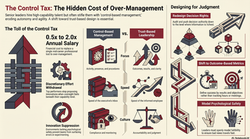
The Control Tax: How Managing by Oversight Costs Senior Leaders Their Strongest Talent
CATALYST CENTER FOR WORK INNOVATION
5 days ago
17 min read
Leading Through Uncertainty: How CEOs Navigate the Dual Challenge of AI Transformation and Stakeholder Trust
NEXUS INSTITUTE FOR WORK AND AI
6 days ago
26 min read
The Evolution of Artificial Intelligence: From Large Language Models to Superintelligence and the Transformation of Work
NEXUS INSTITUTE FOR WORK AND AI
May 16
22 min read
Algorithmic Anxiety in the Modern Workplace: Understanding and Addressing the Human Cost of AI Integration
NEXUS INSTITUTE FOR WORK AND AI
May 15
28 min read
When Being Yourself Works—And When It Doesn't: How Culture Shapes Authentic Leadership
CATALYST CENTER FOR WORK INNOVATION
May 14
18 min read
Human Capital Leadership Review
Zen Zone Days: Protecting Focus in a Noisy Workplace
2 hours ago
7 min read
Navigating the Jagged Technological Frontier: Organizational Strategies for AI Integration in Knowledge Work
NEXUS INSTITUTE FOR WORK AND AI
3 hours ago
24 min read
Why Mid-Level Management Training Must Evolve in 2026
1 day ago
4 min read
Unlocking Organizational Ambidexterity: How Strategic HR Practices Fuel Employee Creativity in Healthcare
CATALYST CENTER FOR WORK INNOVATION
1 day ago
21 min read
Gen Z Workers Most Worried about AI Job Disruption, New Survey Reveals
2 days ago
4 min read
When the Loop Becomes the System: Rethinking Human Control in High-Velocity AI Environments
NEXUS INSTITUTE FOR WORK AND AI
2 days ago
21 min read
How to Save Time and Boost Efficiency with Smart Business Apps
3 days ago
4 min read
AI Can Make Images in Seconds, but Artist Doddz Says It Still Cannot Replace Emotion
3 days ago
5 min read
The AI Readiness Problem Isn't Talent Scarcity — It's Organizational Design
3 days ago
5 min read
1
2
3
4
5
HCL Review Research Videos
HCL Review Research Infographics
Blog: HCI Blog
Human Capital Leadership Review
Featuring scholarly and practitioner insights from HR and people leaders, industry experts, and researchers.
Human Capital Innovations
Play Video
Play Video
04:52
Unlocking Career Growth - The Secret to Skill Building!
Career growth transcends the simplistic notion of climbing ladders or attaining titles. True growth integrates both internal and external learning to build skills and deepen understanding. Internal learning refers to acquiring knowledge through workplace culture, team interactions, and informal peer-to-peer exchanges, while external learning involves formal education such as courses, certifications, and workshops. Both forms complement one another and must be balanced to achieve maximum potential. Highlights 🔑 Career growth hinges on blending internal (informal) and external (formal) learning. 🧠 Early career development thrives on peer-to-peer internal learning within teams. 🎯 Mid-career progression relies on targeted external learning to fill skill gaps. 🔄 Hybrid/remote work challenges informal knowledge sharing and requires intentional solutions. 🤝 Leaders should create immersive, collaborative opportunities for new hires to maximize internal learning. 📚 Lifelong learning involves knowing when to absorb internal wisdom and when to pursue external knowledge. 🌱 Organizations must align learning strategies with employee career stages for maximum impact. Key Insights 🌍 Internal vs. External Learning as Complementary Forces: Internal learning, characterized by experiential knowledge from colleagues and the workplace culture, forms the bedrock of early career skill acquisition. External learning, involving formal training, broadens perspectives and refreshes skillsets. Neglecting either hampers holistic professional growth. The synergy between them is essential to unlock true potential in one’s career. 👥 Importance of Peer Learning and Social Capital Early On: Early career phases maximize growth through immersive environments where informal interactions allow mimicking, questioning, and socialization vital to building tacit knowledge. This phase’s impact is disproportionate compared to formal training because it forms the “hidden architecture” of competence. Studies confirm peer-to-peer learning often surpasses structured training in effectiveness. Failure to create this environment early leads to weak foundational skills, analogous to constructing a building without a solid base. ⚖️ Shifting Learning Modalities Over Career Lifespan: The trajectory of learning emphasis changes predictably. An early-career individual’s growth is dominated by internal learning, which tapers off with experience. Conversely, external learning investment spikes at mid-career, when professionals face skill plateaus requiring deliberate upskilling. 🏢 Adapting Learning in Remote and Hybrid Work Environments: The shift to remote settings dismantles many informal learning channels such as spontaneous questions and shadowing, which historically accelerated skill development. This gap slows informal knowledge transfer, causing “learning drag” especially critical for early-career workers. Intentional design interventions, including in-office pods, virtual mentorship, and structured informal communication channels, mitigate these challenges. Failing to adapt risks stagnated growth and weaker organizational knowledge flows. 🎯 Leadership’s Role in Facilitating Learning: Leaders must architect opportunities where novice employees can learn on-the-job through cohort programs, rotations, and proximity to experts. Such overlays amplify informal learning beyond mere onboarding procedures. At the same time, support for targeted external learning programs in mid-career enables staff to align skills with future organizational needs. Thus, effective leadership integrates people, processes, and strategy to optimize human capital development. 🔄 Lifelong Learning as a Career Imperative: The career journey is not linear but cyclical, requiring ongoing reflection and adaptation of learning modalities. Early career individuals should actively seek mentors and build relationships, leveraging social capital. As experience accrues, complacency must be resisted by proactively exploring new knowledge areas outside current roles. This paradigm of alternating between learning absorption and active knowledge acquisition sustains growth and career fulfillment. 💡 Strategic Investment Benefits Organizations and Individuals: Companies that allocate training budgets with career stage differentiation maximize ROI by focusing external learning where it yields highest impact—typically mid-career. They also benefit long-term by fostering a culture where knowledge is fluidly transferred and refreshed. For employees, ownership of development, combining internal wisdom and external innovation, becomes the foundation for a purposeful, resilient career trajectory.
Play Video
Play Video
03:47
The Skill Building Lifecycle
This research examines how employees acquire professional skills through a combination of internal peer learning and external formal training over the course of their careers. Research indicates that informal knowledge sharing among colleagues is most vital during early career stages, whereas structured external programs peak in importance during mid-career. These distinct learning trajectories significantly impact lifetime earnings, workforce productivity, and the widening gap of wage inequality. The research argues that modern shifts toward remote work threaten essential early-career development by disrupting spontaneous office interactions. Consequently, organizations are encouraged to adopt strategic interventions, such as cohort-based onboarding and stage-specific training budgets, to optimize human capital. Ultimately, the research provides a framework for leaders to align talent management with the natural evolution of how adults learn.
Play Video
Play Video
Encouraging and Incentivizing Walking Programs for Employees, with Milica McDowell
In this HCI Webinar, I talk with Milica McDowell about encouraging and incentivizing walking programs for employees. Dr. Milica McDowell is a dynamic healthcare leader and educator with over 20 years of clinical, entrepreneurial, and academic expertise in physical therapy and e-learning innovation. Currently serving as Associate Vice President of Education at U.S. Physical Therapy, she spearheads strategic partnerships with professional PT and OT schools and drives student engagement across the organization's national platforms while supporting over 140 partner brands. Previously, Dr. McDowell led Physitrack's global e-learning division, Physicourses, where she oversaw a multidisciplinary team and collaborated with prestigious institutions including Gray Institute, Evidence in Motion, and the Hospital for Special Surgery. In this capacity, she launched evidence-based professional education programs for medical and wellness practitioners worldwide. Her career spans diverse leadership roles across academia and entrepreneurship. As Adjunct Faculty at Montana State University, she mentored students in human performance. She has also held leadership positions in startups across orthopedics, fitness, biomechanics analytics, and medical equipment sectors. Her entrepreneurial success includes two M&A exits, with two additional exits in future planning. Dr. McDowell holds a Doctor of Physical Therapy (DPT) from Idaho State University, where she researched risk factors for non-contact knee injuries in young athletes, and an MSPT from the University of Colorado Health Sciences Center. She is scheduled to begin her MBA at USC's Marshall School of Business in fall 2025.
Play Video
Play Video
Redefining Leadership in Diversity, Equity, and Inclusion, with Priya Nalkur
In this HCI Webinar, I talk with Priya Nalkur about redefining leadership in diversity, equity, and inclusion. Priya Nalkur, Ed.D. is the President of the RoundTable Institute where she leads a global group of coaches and facilitators to help companies build more inclusive leaders and workplaces. She is a professional speaker, coach and facilitator and has taught at the Harvard Graduate School of Education and the Heller School for Social Policy and has several courses on Udemy for Business. She is the author of the recent book (2024) Stumbling Towards Inclusion: Finding Grace in Imperfect Leadership.
Play Video
Play Video
40:56
A Conversation about the Lifecycle of Learning: Internal and External Skill Acquisition
This research examines how employees acquire professional skills through a combination of internal peer learning and external formal training over the course of their careers. Research indicates that informal knowledge sharing among colleagues is most vital during early career stages, whereas structured external programs peak in importance during mid-career. These distinct learning trajectories significantly impact lifetime earnings, workforce productivity, and the widening gap of wage inequality. The research argues that modern shifts toward remote work threaten essential early-career development by disrupting spontaneous office interactions. Consequently, organizations are encouraged to adopt strategic interventions, such as cohort-based onboarding and stage-specific training budgets, to optimize human capital. Ultimately, the research provides a framework for leaders to align talent management with the natural evolution of how adults learn. See Privacy Policy at https://art19.com/privacy and California Privacy Notice at https://art19.com/privacy#do-not-sell-my-info.
Play Video
Play Video
23:29
A Conversation about the Lifecycle of Learning: Internal and External Skill Acquisition
This research examines how employees acquire professional skills through a combination of internal peer learning and external formal training over the course of their careers. Research indicates that informal knowledge sharing among colleagues is most vital during early career stages, whereas structured external programs peak in importance during mid-career. These distinct learning trajectories significantly impact lifetime earnings, workforce productivity, and the widening gap of wage inequality. The research argues that modern shifts toward remote work threaten essential early-career development by disrupting spontaneous office interactions. Consequently, organizations are encouraged to adopt strategic interventions, such as cohort-based onboarding and stage-specific training budgets, to optimize human capital. Ultimately, the research provides a framework for leaders to align talent management with the natural evolution of how adults learn. See Privacy Policy at https://art19.com/privacy and California Privacy Notice at https://art19.com/privacy#do-not-sell-my-info.
Play Video
Play Video
22:23
A Debate about the Lifecycle of Learning: Internal and External Skill Acquisition
This research examines how employees acquire professional skills through a combination of internal peer learning and external formal training over the course of their careers. Research indicates that informal knowledge sharing among colleagues is most vital during early career stages, whereas structured external programs peak in importance during mid-career. These distinct learning trajectories significantly impact lifetime earnings, workforce productivity, and the widening gap of wage inequality. The research argues that modern shifts toward remote work threaten essential early-career development by disrupting spontaneous office interactions. Consequently, organizations are encouraged to adopt strategic interventions, such as cohort-based onboarding and stage-specific training budgets, to optimize human capital. Ultimately, the research provides a framework for leaders to align talent management with the natural evolution of how adults learn. See Privacy Policy at https://art19.com/privacy and California Privacy Notice at https://art19.com/privacy#do-not-sell-my-info.
Play Video
Play Video
23:44
The Hidden Architecture of Skill-Building: How Workers Navigate Internal and External Learning Ac...
Abstract: Workers acquire human capital through a dynamic, lifecycle-dependent blend of internal learning from colleagues and external training from formal sources. Drawing on landmark 2024 empirical research analyzing German and U.S. labor markets, this article examines how learning mechanisms evolve as careers progress: internal peer learning dominates early stages but diminishes over time, while external formal training follows an inverted U-shape across the working life. Organizations that understand these patterns can design more effective development strategies, optimize training investments, and address emerging challenges such as remote work's disruption of informal knowledge transfer. The evidence reveals that internal learning contributes 24–57% more to lifetime human capital accumulation than external training, yet both sources interact to drive wage growth and career progression. This synthesis translates recent economic findings into actionable insights for HR leaders, learning professionals, and organizational strategists navigating an era of distributed work and accelerated skill obsolescence. See Privacy Policy at https://art19.com/privacy and California Privacy Notice at https://art19.com/privacy#do-not-sell-my-info.
HCL Review Articles
All Articles
Nexus Institute for Work and AI
Catalyst Center for Work Innovation
Adaptive Organization Lab
Work Renaissance Project
Research Briefs
Research Insights
Webinar Recaps
Book Reviews
Transformative Social impact
Search
Jan 1, 2025
7 min read
RESEARCH INSIGHTS
The Impact of Return-to-Office Mandates on Job Satisfaction
Dec 4, 2024
4 min read
ADAPTIVE ORGANIZATION LAB
Is Mandating a Return to Office the Right Move?
bottom of page