





Navigating the Jagged Technological Frontier: Organizational Strategies for AI Integration in Knowledge Work


Listen to this article:
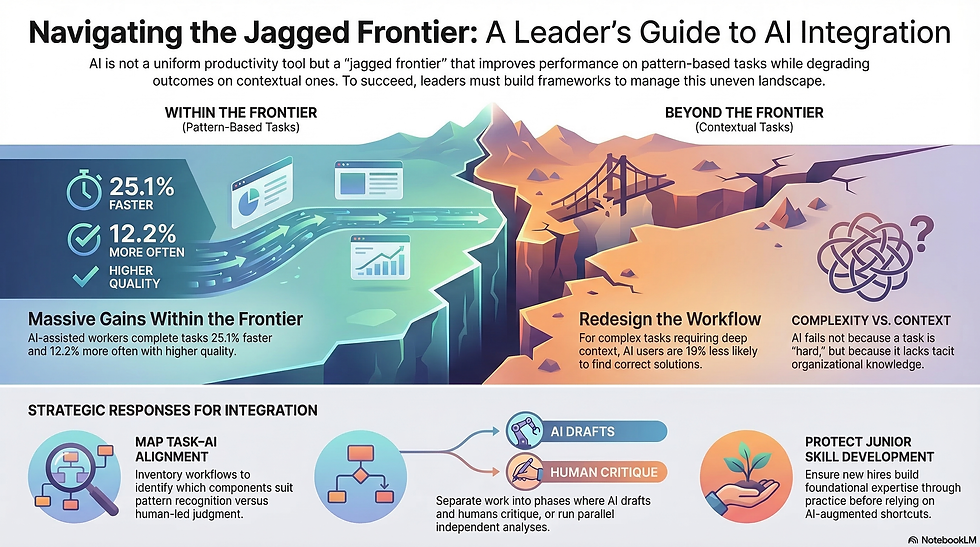
Abstract: Artificial intelligence has entered the workplace not as a uniform productivity tool but as a "jagged frontier"—improving performance dramatically on some knowledge tasks while degrading outcomes on others. Drawing on field experimental evidence from 758 consultants at Boston Consulting Group and emerging organizational implementations across industries, this article examines how AI transforms knowledge work performance. The research reveals that AI assistance enabled workers to complete 12.2% more tasks 25.1% faster with higher quality—but only for tasks within AI's capability frontier. For complex tasks beyond that frontier, AI users were 19% less likely to produce correct solutions, suggesting overreliance risks. This article synthesizes experimental findings with organizational responses, offering evidence-based guidance for leaders navigating AI integration. Organizations succeeding with AI are those implementing structured evaluation frameworks, building human judgment capabilities alongside AI tools, and redesigning workflows to leverage AI's uneven strengths while protecting against its contextual weaknesses. The jagged frontier metaphor provides a practical lens for understanding where AI creates value and where human expertise remains irreplaceable in knowledge-intensive work.
The integration of generative AI into organizational knowledge work represents not merely an incremental technology adoption but a fundamental restructuring of how cognitive labor gets performed. Unlike previous automation waves that primarily affected routine tasks with clear decision rules, large language models like GPT-4 now tackle work previously reserved for highly educated professionals—generating strategic recommendations, drafting complex analyses, synthesizing research, and producing creative content (Dell'Acqua et al., 2023). The promise is compelling: faster outputs, augmented creativity, and democratized access to expert-level reasoning.
Yet emerging evidence suggests AI's impact follows what Dell'Acqua and colleagues term a "jagged technological frontier"—a metaphor describing how AI capabilities create uneven performance landscapes even within similar knowledge domains. This jaggedness challenges conventional technology adoption frameworks that assume consistent benefits across task types. A consultant might use AI to dramatically improve the quality of a market sizing analysis, then experience degraded performance when applying the same tool to a nuanced organizational change scenario requiring contextual judgment (Dell'Acqua et al., 2023).
For organizational leaders, this frontier presents both opportunity and peril. Early AI adopters report productivity gains of 20-40% for specific knowledge workflows, yet organizations also document concerning patterns: professionals becoming overreliant on AI suggestions, declining performance on complex judgment tasks, and erosion of fundamental analytical skills among newer employees who learned their craft with AI assistance (Noy & Zhang, 2023). The challenge extends beyond selecting which AI tools to deploy; it requires fundamentally rethinking how organizations structure knowledge work, develop talent, and maintain quality control when human and machine intelligence collaborate.
This article synthesizes experimental evidence on AI's jagged impact with organizational implementation strategies across consulting, healthcare, legal services, financial analysis, and technology development. The goal is to provide leaders with evidence-based frameworks for navigating AI integration—understanding where AI creates genuine value, recognizing where it introduces risk, and building organizational capabilities that leverage AI's strengths while protecting against its limitations. As AI capabilities continue advancing rapidly, the organizations that thrive will be those that develop sophisticated understanding of this jagged frontier and build adaptive systems around it.
The Knowledge Work AI Landscape
Defining the Jagged Frontier in Knowledge Work
The jagged frontier metaphor captures a specific characteristic of generative AI that distinguishes it from previous workplace technologies: its performance envelope is neither linear nor predictable based on conventional measures of task complexity or expertise requirements. Traditional automation followed relatively smooth capability curves—as systems improved, they progressively handled more complex variations of similar tasks. AI's frontier behaves differently (Dell'Acqua et al., 2023).
Consider two consulting tasks of ostensibly similar difficulty: developing a market entry strategy for a footwear company and designing an organizational change initiative for a manufacturing firm. Both require analytical reasoning, business knowledge, and structured problem-solving. Yet in the Boston Consulting Group field experiment, AI assistance improved performance dramatically on the market entry task while significantly degrading outcomes on the organizational change scenario. The difference lay not in surface complexity but in whether the task involved well-structured problems with patterns abundant in training data versus contextualized judgment requiring tacit organizational knowledge (Dell'Acqua et al., 2023).
This jaggedness manifests across several dimensions. AI excels at tasks involving pattern recognition, information synthesis from large datasets, standard analytical frameworks, creative ideation within established genres, and rapid iteration on defined problems. It struggles with tasks requiring deep contextual understanding of specific organizational cultures, integration of unstated stakeholder constraints, evaluation of novel situations lacking clear precedents, and judgment calls balancing competing values without explicit decision criteria (Mollick & Mollick, 2023).
The frontier's jaggedness creates several organizational challenges. First, it resists simple rules about when to use AI—task complexity alone provides insufficient guidance. Second, it makes AI's errors unpredictable; professionals accustomed to catching automation mistakes in low-complexity scenarios may not recognize when AI fails on superficially similar higher-complexity tasks. Third, the frontier shifts as AI capabilities advance, meaning organizational guidance developed for current models may become outdated as new versions deploy.
State of Practice: AI Adoption in Knowledge Work
Enterprise adoption of generative AI has accelerated dramatically since late 2022, though with considerable variation in organizational maturity and strategic intentionality. Survey data from early 2024 indicates approximately 60% of knowledge-intensive organizations have deployed AI tools in some capacity, with consulting firms, technology companies, and financial services leading adoption (Brynjolfsson et al., 2023).
Current implementation patterns cluster into several categories. Some organizations pursue individual augmentation approaches, providing AI tools to knowledge workers with minimal structural changes to workflows or quality processes. This approach enables rapid experimentation but risks the overreliance patterns observed in the BCG study. Other organizations implement workflow redesign, restructuring how tasks get divided between human and AI contributions—for example, having AI generate initial analytical frameworks that senior professionals then critique and refine. A smaller subset pursues capability transformation, fundamentally rethinking their value proposition around AI-enhanced service models (Noy & Zhang, 2023).
Professional services firms demonstrate instructive variation. Strategy consulting firms like BCG and McKinsey have developed proprietary AI platforms integrating multiple models with firm-specific knowledge bases, reflecting substantial investment in controlled deployment. Law firms show more fragmented adoption—large corporate practices deploying AI for contract analysis and legal research, while litigation and advisory practices remain more cautious given concerns about AI hallucinations in high-stakes contexts. Healthcare organizations increasingly use AI for clinical documentation and diagnostic support, though physician adoption varies significantly by specialty and comfort with technology.
The adoption gap between organizations appears less about access to tools—most knowledge workers can easily obtain AI subscriptions—and more about organizational infrastructure for effective deployment. Leading adopters distinguish themselves through systematic evaluation of which tasks suit AI assistance, structured training in AI collaboration skills, quality control mechanisms detecting AI errors, and cultures encouraging experimentation while maintaining professional judgment (Brynjolfsson et al., 2023).
Several barriers slow broader adoption. Concerns about data privacy and confidentiality limit deployment in client-facing work. Uncertainty about AI-generated output ownership and liability creates hesitation in regulated industries. Perhaps most significantly, many organizations lack frameworks for evaluating when AI improves versus degrades performance, leading to either overly conservative underutilization or uncritical overreliance.
Organizational and Individual Consequences of AI Integration
Organizational Performance Impacts
The performance implications of AI integration in knowledge work manifest across multiple organizational dimensions, with effects varying substantially based on implementation approach and task alignment with AI capabilities.
Productivity effects within AI's capability frontier prove substantial and consistent across contexts. The BCG field experiment documented that consultants with AI access completed 12.2% more tasks and finished them 25.1% faster while maintaining or improving quality on tasks within the frontier (Dell'Acqua et al., 2023). Similar magnitudes appear in other knowledge domains. Professional writers using AI assistance increased output by 37% with comparable quality ratings, while customer service representatives resolved 13.8% more issues per hour with higher customer satisfaction scores (Noy & Zhang, 2023).
Quality improvements extend beyond speed gains. In the BCG study, external evaluators rated AI-assisted work as significantly higher quality on dimensions including creativity, depth of analysis, and persuasiveness of recommendations—specifically for frontier-appropriate tasks. This quality enhancement appears driven by AI's ability to rapidly generate diverse analytical frameworks and creative options that humans then curate and refine, effectively expanding the solution space professionals consider (Dell'Acqua et al., 2023).
However, performance degradation outside the frontier introduces substantial risks. The 19% reduction in correct solutions for the complex organizational task in the BCG experiment represents more than a statistical curiosity—it signals systematic failure modes when professionals misapply AI assistance. Post-experimental interviews revealed that AI-assisted participants spent less time on independent analysis, demonstrated lower skepticism toward AI suggestions, and showed reduced engagement with contradictory information. These patterns suggest AI may degrade performance through multiple mechanisms: displacing more effective problem-solving approaches, reducing critical evaluation, and creating anchoring effects around initial AI outputs (Dell'Acqua et al., 2023).
The economic implications vary considerably by organizational context. For organizations performing high volumes of relatively standardized knowledge work—legal document review, financial report preparation, market research synthesis—productivity gains translate directly to cost reduction or revenue expansion. Estimates suggest 20-30% efficiency gains for tasks well-suited to AI assistance. For organizations whose value proposition centers on handling truly novel or highly contextualized challenges, the calculus becomes more complex. Productivity gains on routine components must be weighed against risks of degraded performance on high-stakes judgment tasks and potential erosion of the professional development pathways that build expertise (Brynjolfsson et al., 2023).
Competitive dynamics are shifting as AI capabilities democratize access to previously scarce analytical and creative capacities. Organizations whose differentiation relied primarily on executing standard analytical frameworks faster than competitors find their advantages compressed. Conversely, organizations that effectively combine AI augmentation with distinctive human judgment, proprietary contextual knowledge, or superior integration across the jagged frontier may widen performance gaps. The strategic question becomes not whether to adopt AI but how to build organizational capabilities that exploit AI's uneven advantages while protecting against its contextual limitations.
Individual Wellbeing and Professional Development Impacts
Beyond organizational metrics, AI integration creates significant implications for knowledge worker experience, professional identity, and career development—effects that prove more ambiguous than simple productivity statistics suggest.
Workload and autonomy effects demonstrate complex patterns. On one hand, AI assistance reduces time spent on routine analytical tasks, potentially creating capacity for more strategic or creative work. Survey data indicates that knowledge workers using AI report decreased time pressure on standard deliverables and increased opportunity to tackle challenging problems. On the other hand, some professionals describe AI assistance as introducing new forms of cognitive burden—the need to constantly evaluate AI suggestions, correct errors, and maintain vigilance against overreliance creates its own form of mental taxation (Mollick & Mollick, 2023).
The impact on professional identity and meaning proves particularly nuanced. For some knowledge workers, AI assistance enhances professional satisfaction by removing tedious components and enabling focus on higher-value judgment. Others experience AI as threatening core aspects of their professional identity—the distinctive analytical or creative capabilities that defined their expertise and value. Interviews with professionals in fields like strategic analysis and creative writing reveal concerns that AI commoditizes skills developed over years of practice, potentially undermining the professional accomplishment that provided career meaning (Noy & Zhang, 2023).
Skills development trajectories face significant disruption. The traditional arc of professional development in knowledge work—junior professionals building foundational skills through repetitive practice on routine tasks, progressively tackling more complex challenges as competence grows—encounters friction when AI handles much routine work. Organizations report concerns that junior professionals who rely heavily on AI assistance may not develop the deep pattern recognition and judgment that comes from extensive practice on foundational tasks. The risk is creating a generation of professionals who can effectively use AI for routine work but lack the underlying expertise to recognize when AI fails on complex challenges or to perform effectively when AI assistance proves unavailable (Dell'Acqua et al., 2023).
This skills development challenge creates a potential organizational paradox. AI's greatest immediate value often comes from augmenting less experienced workers—the BCG study found AI assistance most beneficial for consultants below the 50th percentile of baseline performance, essentially raising the performance floor. However, if AI assistance prevents these same professionals from developing expert-level judgment through deliberate practice, organizations may face a future talent pipeline problem: plenty of AI-augmented capable performers, but insufficient development of the truly exceptional judgment that AI cannot replicate (Dell'Acqua et al., 2023).
Work design implications extend to team dynamics and collaboration patterns. As some team members adopt AI assistance more extensively than others, questions arise about work allocation, credit attribution, and evaluation criteria. Organizations struggle to fairly assess individual contribution when productivity measures may reflect AI capability as much as human skill. Some knowledge workers report feeling pressured to adopt AI tools to maintain competitive productivity, even when they question whether AI assistance suits their specific tasks or working style.
The psychological phenomenon of deskilling merits particular attention. Research on human-automation interaction demonstrates that as people rely on automated systems, their unaided performance often degrades—a pattern observed in contexts from aviation to medical diagnosis. Early evidence suggests similar dynamics may emerge with AI assistance in knowledge work. Professionals who extensively use AI for routine analysis may experience erosion of their capacity to perform that analysis independently, creating dependence on AI and vulnerability when AI tools prove unavailable or inappropriate (Brynjolfsson et al., 2023).
Evidence-Based Organizational Responses
Table 1: Organizational AI Integration Case Studies and Research Findings
Organization or Study Name | Sector | AI Application Use Case | Performance Impact Type | Key Productivity or Quality Metric | Reported Risks or Challenges | Strategic Implementation Approach |
Boston Consulting Group (BCG) Field Experiment | Management Consulting | Creative ideation and market entry strategy (within frontier); complex organizational change scenarios (outside frontier) | Productivity and quality gain (within frontier); accuracy degradation (outside frontier) | $12.2\%$ more tasks completed, $25.1\%$ faster execution, higher quality; $19\%$ less likely to produce correct solutions on complex tasks | Overreliance, failure to recognize AI errors on high-complexity tasks, and anchoring effects | Developing proprietary AI platforms and systematic evaluation of task-AI alignment |
Noy & Zhang Study | Professional Services | Professional writing tasks and customer service resolution | Productivity and satisfaction gain | Writers increased output by $37\%$ ; support agents resolved $13.8\%$ more issues per hour | Erosion of fundamental analytical skills and professional identity concerns | Workflow redesign and exploring capability transformation |
Morgan Stanley | Financial Services | AI assistants for financial advisors | Productivity and service capacity gain | Increase in clients served per advisor | Compliance risks and potential degradation of advice quality | Balanced technology budget with human capability building and relationship depth maintenance |
Deloitte | Consulting Services | Market analysis and competitive benchmarking | Efficiency gain with maintained quality | Not in source | AI struggles with tasks requiring deep contextual understanding (e.g., culture assessment) | Structured assessment framework classifying tasks by pattern recognition vs. contextual judgment |
McKinsey | Management Consulting | Research synthesis and analytical framework population | Productivity gain with quality protection | Not in source | Contextual misunderstandings and overconfident conclusions | Parallel workstreams (AI vs. traditional) and senior review of AI-assisted outputs |
Reed Smith | Legal Services | Legal research and document analysis | Efficiency gain | Not in source | AI hallucinations and incorrect legal citations | Comprehensive training including modules on verification and spotting contextual misunderstandings |
Salesforce | Technology | Consultant development and technical/analytical tasks | Long-term skill preservation | Not in source | Deskilling of junior staff and loss of foundational expertise | Staged development program limiting AI for juniors to build core skills before full access |
PwC | Professional Services | Task-specific automation across multiple service lines | Sustained value through organizational learning | Not in source | Repeatedly discovering similar lessons across different units | Cross-practice working group maintaining a detailed, evidence-based task taxonomy |
Cleveland Clinic | Healthcare | Diagnostic support tools | Augmented decision making | Not in source | Misleading AI suggestions in non-standard clinical cases | Calibration sessions for physicians to compare clinical reasoning with AI patterns |
Kaiser Permanente | Healthcare | Clinical decision support | Clinical accountability and trust maintenance | Not in source | Data privacy, bias across demographic groups, and professional accountability | Comprehensive governance framework with ethics review boards and transparency standards |
Organizations navigating AI integration in knowledge work demonstrate varying sophistication in their approaches, but emerging patterns of effective practice provide useful guidance for leaders. The following interventions draw from both experimental evidence and documented organizational implementations across industries.
Structured Task-AI Alignment Evaluation
Rather than deploying AI broadly across knowledge workflows, leading organizations implement systematic frameworks for evaluating which specific tasks align with AI capabilities—effectively mapping their internal work against the jagged technological frontier.
The most developed approaches involve creating task taxonomies that classify knowledge work along relevant dimensions: degree of pattern recognition versus contextual judgment required, availability of task-relevant training data, standardization of analytical frameworks, stakes of errors, and verification feasibility. Organizations then assess AI performance on representative examples within each taxonomy category before broad deployment (Mollick & Mollick, 2023).
Evidence from controlled deployment supports this careful matching. When organizations implement AI selectively for high-alignment tasks while maintaining traditional approaches for low-alignment work, they capture substantial productivity gains while avoiding performance degradation risks. The key is resisting the temptation to assume AI capability based on surface task characteristics—complexity alone proves insufficient as a decision criterion (Dell'Acqua et al., 2023).
Effective approaches to task-AI alignment include:
Capability mapping workshops where cross-functional teams systematically inventory knowledge workflows and evaluate AI suitability for distinct task components
Pilot testing protocols requiring controlled performance comparison between AI-assisted and traditional approaches before broad deployment, with explicit criteria for declaring AI suitable
Red teaming exercises where experienced professionals deliberately attempt to surface scenarios where AI assistance degrades rather than improves outcomes
Continuous frontier monitoring as AI capabilities advance, regularly reassessing tasks previously deemed unsuitable to identify new opportunities
Task decomposition strategies breaking complex knowledge work into components, applying AI to suitable elements while maintaining human-centered approaches for contextual judgment components
Deloitte's approach to AI integration in consulting services illustrates this systematic evaluation. Rather than broadly deploying AI across all analytical work, the firm developed a structured assessment framework examining client task characteristics. For market analysis, competitive benchmarking, and standard financial modeling—tasks involving pattern recognition with abundant training data—AI assistance became standard practice with appropriate oversight. For organizational culture assessment, stakeholder alignment challenges, and novel strategic scenarios—tasks requiring deep contextual understanding—the firm maintained traditional consultant-driven approaches while exploring whether AI could assist with specific sub-components like literature synthesis or framework generation. This selective deployment enabled productivity gains on suitable tasks while protecting quality on high-stakes contextual challenges.
Capability Building for AI-Augmented Work
Organizations achieving strong outcomes from AI integration invest substantially in developing human capabilities for effective AI collaboration—moving beyond simply providing access to tools toward building genuine proficiency in AI-augmented knowledge work.
The BCG field experiment provides direct evidence of training effectiveness. Participants who received prompt engineering instruction—guidance on how to effectively structure queries and iteratively refine AI outputs—demonstrated superior performance compared to those with AI access but minimal training. This finding suggests that simply distributing AI tools without developing collaboration skills leaves substantial performance gains unrealized (Dell'Acqua et al., 2023).
More sophisticated capability building extends beyond prompt engineering to encompass several competencies: recognizing tasks suitable versus unsuitable for AI assistance, evaluating AI output quality across different work types, iteratively refining AI-generated drafts effectively, integrating AI suggestions with independent analysis, and maintaining professional judgment when AI suggestions prove compelling but incorrect.
Organizations building AI collaboration capabilities implement:
Structured training programs covering both technical AI interaction skills and cognitive strategies for maintaining critical evaluation, often delivered through practice-based workshops rather than passive instruction
Peer learning communities where knowledge workers share experiences distinguishing effective from ineffective AI collaboration approaches, building collective wisdom about the frontier
Performance feedback mechanisms that specifically evaluate quality of human-AI integration, not simply output volume, helping professionals understand when their AI usage improved versus degraded outcomes
Skill development pathways ensuring junior professionals still build foundational capabilities through deliberate practice on tasks where AI assistance is intentionally limited
Cross-disciplinary exposure helping professionals understand AI's technical limitations and failure modes, not just its interface, enabling better judgment about reliability
The law firm Reed Smith developed a comprehensive training program when deploying AI for legal research and document analysis. Beyond teaching attorneys how to query their AI research platform, the program included modules on AI hallucination patterns in legal contexts, techniques for verifying AI-generated citations, strategies for spotting contextual misunderstandings in AI analysis, and decision frameworks for when AI assistance should be avoided entirely. Attorneys completed practical exercises where they deliberately worked with flawed AI outputs to develop error detection skills. This investment in capability building enabled the firm to achieve research efficiency gains while maintaining the quality standards essential in legal practice.
In healthcare, the Cleveland Clinic's approach to deploying AI diagnostic support tools emphasizes building physician capability alongside technology implementation. Beyond training on the AI interface itself, physicians participate in calibration sessions examining cases where AI suggestions proved accurate versus misleading. These sessions explore the clinical reasoning patterns that make certain cases suitable for AI augmentation and others requiring traditional diagnostic approaches. The clinic explicitly treats AI deployment not as replacing physician judgment but as expanding the information available to that judgment—a framing that maintains professional agency while capturing AI benefits.
Workflow Redesign and Quality Control Architecture
Rather than simply inserting AI into existing workflows, organizations realizing greatest value from AI assistance often fundamentally redesign knowledge work processes to leverage AI strengths while building appropriate quality controls around its limitations.
Effective workflow redesign typically involves separating knowledge work into distinct phases with clear human versus AI contributions. Common patterns include AI-generated initial drafts that humans then critique and refine, human-created analytical frameworks that AI then populates with data and examples, or parallel human and AI analysis with explicit comparison and synthesis phases. These approaches capture AI productivity benefits while ensuring human judgment remains central (Mollick & Mollick, 2023).
Quality control architecture proves particularly critical given AI's unpredictable failure modes. Unlike traditional automation that fails consistently in identifiable circumstances, AI may produce confident-seeming outputs that prove subtly incorrect in ways that expertise is required to detect. Organizations address this through multi-layered verification approaches appropriate to task stakes.
Workflow redesign and quality control strategies include:
Staged review processes where all AI-assisted work receives human review, with review intensity calibrated to task stakes and AI reliability patterns for that task type
Parallel analysis protocols for high-stakes decisions, conducting both AI-assisted and traditional analysis independently then comparing outputs to identify discrepancies requiring investigation
Explicit verification requirements such as independent citation checking for AI-generated research, original source review for AI-synthesized analyses, or external data validation for AI-generated projections
Red flag checklists helping knowledge workers identify characteristics of their specific task that suggest unusually high AI error risk, triggering additional verification steps
Output auditing systems randomly sampling AI-assisted work for detailed quality evaluation, tracking error patterns to inform training and deployment decisions
Client disclosure protocols establishing when and how organizations inform clients about AI assistance in deliverables, maintaining transparency while capturing AI benefits
McKinsey's approach to integrating AI into consulting project work illustrates sophisticated workflow redesign. For client deliverables, the firm implemented a structured process where AI assists with initial research synthesis, analytical framework population, and draft content generation—tasks within its capability frontier. However, all client-facing recommendations undergo review by senior consultants who did not use AI assistance, specifically checking for contextual misunderstandings, inappropriate analogies, or overconfident conclusions typical of AI failure modes. For particularly high-stakes or novel client challenges, the firm maintains parallel workstreams—one AI-augmented and one traditional—with explicit comparison before final recommendations. This approach captures productivity gains while protecting the quality reputation essential to consulting business models.
Financial Structures and Investment Allocation
Organizations successfully navigating AI integration make deliberate choices about resource allocation, balancing technology investment with the human capability building and quality infrastructure required for effective deployment.
A common pitfall involves allocating substantial budget to AI tool subscriptions and technical infrastructure while underinvesting in the training, process redesign, and quality control mechanisms that evidence suggests prove essential for value realization. Leading organizations typically budget comparable amounts for capability building and workflow redesign as for the AI technology itself (Brynjolfsson et al., 2023).
Investment decisions also address the talent strategy implications of AI integration. Some organizations reduce hiring of junior knowledge workers, assuming AI can substitute for entry-level contributions. Others maintain or increase junior hiring while redesigning development pathways, recognizing that today's junior professionals are tomorrow's experts whose judgment AI cannot replicate. The latter approach appears more sustainable for organizations whose competitive advantage depends on maintaining pipeline of exceptional human judgment.
Financial and investment approaches include:
Balanced technology and capability budgets allocating comparable resources to AI tools, training programs, workflow redesign, and quality infrastructure rather than technology-heavy spending
Pilot program funding structures enabling controlled experimentation with AI in specific workflows before enterprise-wide deployment, with clear performance metrics for scale decisions
Talent development maintenance continuing investment in traditional skill-building approaches for junior professionals even as AI handles routine work, protecting long-term capability pipeline
Quality infrastructure investment in verification systems, expert review capacity, and error detection mechanisms proportional to AI deployment scope and risk profile
Continuous evaluation funding for ongoing assessment of which tasks benefit from AI assistance as capabilities evolve, rather than one-time deployment decisions
The financial services firm Morgan Stanley's approach to AI investment demonstrates this balanced perspective. When deploying AI assistants for financial advisors, the firm allocated significant resources not only to the AI platform but also to advisor training, client communication frameworks, compliance review processes, and continuous monitoring of advice quality. The firm explicitly framed AI as augmenting rather than replacing advisors, maintaining investment in advisor development and client relationship capabilities. This comprehensive investment enabled the firm to achieve productivity gains—advisors served more clients with AI assistance—while maintaining the advice quality and relationship depth that differentiate premium financial services.
Governance Frameworks and Ethical Guardrails
As AI capabilities advance and deployment scales, organizations require governance structures addressing the distinctive challenges of AI in knowledge work—data privacy, output ownership, bias and fairness, client transparency, and professional accountability.
Governance approaches vary by industry and regulatory context, but effective frameworks typically address several core elements: clear policies on what data can be used for AI training or prompts given confidentiality obligations, standards for disclosing AI assistance to clients or stakeholders, accountability structures clarifying that professionals remain responsible for AI-assisted work, bias monitoring given AI tendency to reflect training data patterns, and mechanisms for updating policies as AI capabilities and uses evolve (Mollick & Mollick, 2023).
Governance and ethical framework components include:
Data usage policies specifying what organizational, client, or proprietary information can be included in AI queries, addressing confidentiality and competitive concerns
Transparency standards determining when and how organizations disclose AI assistance to clients, balancing honesty with avoiding unnecessary concerns
Accountability frameworks making explicit that professionals using AI assistance remain fully responsible for outputs, preventing AI from becoming a shield against quality obligations
Bias evaluation protocols regularly assessing whether AI-assisted work exhibits problematic patterns across demographic groups, geographic contexts, or other dimensions
Emerging risk monitoring staying current with AI capability evolution and failure modes, updating policies as new AI models deploy or new use cases emerge
Ethics review boards providing structured forums for evaluating edge cases and ambiguous situations where existing policies provide insufficient guidance
The healthcare system Kaiser Permanente developed comprehensive governance for AI clinical decision support deployment. The framework includes strict data privacy protocols ensuring patient information in AI queries is appropriately de-identified, transparency requirements that patients be informed when AI contributes to clinical decisions, accountability standards holding physicians responsible for diagnoses regardless of AI input, bias monitoring specifically examining whether AI performance varies across demographic groups, and regular ethics review of new AI applications. This governance infrastructure enabled the organization to deploy AI support tools while maintaining patient trust and clinical accountability.
Building Long-Term AI Integration Capability
Beyond immediate implementation tactics, organizations achieving sustained value from AI integration build institutional capabilities that enable continuous adaptation as AI capabilities evolve and organizational understanding of the jagged frontier deepens.
Organizational Learning Systems and Frontier Mapping
The jagged frontier's defining characteristic—its unpredictability and instability—requires organizations to treat AI integration not as a one-time implementation but as continuous learning. Leading organizations build systematic mechanisms for capturing, analyzing, and disseminating insights about what works and what fails in AI-augmented knowledge work.
Effective learning systems combine multiple information streams. Structured post-project reviews explicitly examine which AI-assisted tasks delivered value versus where AI assistance proved ineffective or counterproductive. Analysis of quality incidents investigates whether AI involvement contributed to errors and how those failure modes might be prevented. Surveys of knowledge workers capture qualitative insights about workflow friction, unexpected benefits, and concerning patterns. Quantitative performance tracking compares outcomes between AI-assisted and traditional approaches across task categories.
Organizations synthesize these insights into evolving frontier maps—internal documentation categorizing specific work types by AI suitability based on accumulating evidence rather than assumptions. These maps become institutional knowledge, guiding deployment decisions and training emphasis. Critically, frontier maps are treated as provisional and frequently updated as AI capabilities advance and organizational experience grows (Brynjolfsson et al., 2023).
PwC's approach to building AI learning systems illustrates this systematic knowledge development. The firm established a cross-practice working group continuously collecting AI implementation experiences across audit, tax, consulting, and advisory services. The group maintains a detailed taxonomy of task types with evidence-based assessments of AI effectiveness, failure mode patterns, and deployment guidance. As new AI models deploy or new use cases emerge, the taxonomy updates, and implications are communicated to practitioners. This infrastructure enables the firm to learn systematically rather than having each practice unit repeatedly discover similar lessons.
Distributed Expertise and Community Practice
Given AI's rapid evolution and contextual variability, no centralized authority can effectively determine optimal AI usage across all organizational contexts. Organizations succeeding with AI integration cultivate distributed expertise—communities of practitioners who develop deep understanding of AI collaboration within their specific domains and share insights across the organization.
Community practice approaches typically involve creating forums where knowledge workers share experiences, troubleshoot challenges, and develop collective wisdom about effective AI collaboration. These communities prove particularly valuable for surfacing edge cases, identifying emerging failure modes, and developing practical techniques that formal training may miss. They also provide social support for professionals navigating the identity and meaning challenges that AI integration can create.
Effective practice communities require active organizational support—dedicated time for participation, explicit recognition of community contributions, and leadership engagement signaling importance. Without such support, communities often wither as immediate work pressures take priority over knowledge sharing.
Accenture's "AI Collaborators" community program demonstrates this distributed expertise approach. The firm established practice communities within each major service line, bringing together professionals actively using AI in client work. Communities meet regularly to share experiences, with structured protocols for documenting lessons and effective techniques. Particularly valuable insights are synthesized into practice guidance that the broader organization can access. The communities also serve as feedback loops to central AI strategy teams, surfacing patterns that should inform tool selection, training design, or policy updates. This distributed structure enables rapid learning while maintaining coherence.
Adaptive Capability Development and Career Pathways
The longer-term talent development challenge requires organizations to rethink professional development pathways in light of AI capabilities—ensuring new professionals still build foundational expertise while developing the distinctively human judgment that AI cannot replicate.
Progressive organizations implement adaptive development approaches that deliberately vary AI access during different career stages. Junior professionals might have limited AI assistance for certain foundational tasks, ensuring they build core skills through deliberate practice. As professionals advance, AI access expands, but training emphasis shifts toward developing the contextual judgment, creative synthesis, and stakeholder understanding that remain distinctively human. Senior professionals engage extensively with AI while also serving as quality reviewers specifically checking for AI failure modes.
Career pathway redesign also addresses changing skill premiums. As AI handles routine analysis, organizational value increasingly concentrates in capabilities AI struggles to replicate: integrating information across domains, understanding tacit organizational dynamics, building stakeholder relationships, exercising values-based judgment in ambiguous situations, and generating genuinely novel insights rather than pattern recombination. Development programs increasingly emphasize these capabilities while treating AI collaboration as a baseline technical skill.
The technology company Salesforce redesigned its consultant development program around AI integration. New consultants spend their first months building foundational technical and analytical skills with intentionally limited AI assistance, ensuring they develop deep understanding of core concepts. As they advance, AI access expands, but training emphasis shifts toward client relationship building, change management, and strategic judgment—capabilities where AI provides limited value. Senior consultants receive advanced training in detecting AI mistakes and understanding AI's technical limitations, positioning them as quality governors. This staged approach captures AI productivity benefits while maintaining the expertise pipeline essential for sustained competitive advantage.
Institutional Reflexivity and Values Alignment
Perhaps most fundamentally, organizations navigating AI integration successfully maintain institutional reflexivity—ongoing examination of whether AI adoption aligns with organizational values, professional identity, and strategic positioning.
This reflexivity involves regularly asking fundamental questions: Does AI integration enhance or undermine our core value proposition? Are we maintaining the professional quality standards that define our reputation? Are we developing our people or inadvertently deskilling them? Does AI usage align with our commitments to clients, patients, or other stakeholders? Are we capturing AI benefits while protecting against risks we may not yet fully understand?
Such questioning requires forums where these issues receive serious attention rather than being dismissed as resistance to innovation. Ethics committees, professional development councils, or leadership retreats can provide structured space for examining AI integration's broader implications beyond immediate productivity metrics.
Organizations demonstrating this reflexivity often develop distinctive positions on AI integration that reflect their values and strategic identity. Rather than simply maximizing AI deployment, they make deliberate choices about where AI fits their model and where human-centered approaches remain essential to who they are as organizations.
The Mayo Clinic's approach to AI in healthcare exemplifies this values-aligned reflexivity. While deploying AI diagnostic support and clinical documentation tools, the clinic maintains explicit commitment that AI serves physicians and patients rather than displacing human judgment. Regular reviews examine whether AI implementation aligns with Mayo's patient-centered care values. When AI tools risk undermining patient-physician relationships or reducing time for human connection, deployment is reconsidered regardless of efficiency gains. This values-anchored approach enables the clinic to selectively capture AI benefits while preserving the human elements central to its care philosophy and reputation.
Conclusion
The jagged technological frontier metaphor captures a fundamental reality of AI integration in knowledge work: AI's impact is neither uniformly positive nor systematically predictable based on conventional task complexity measures. Organizations navigating this frontier effectively recognize that AI is not simply a productivity tool to be broadly deployed, but a capability requiring sophisticated organizational infrastructure—careful task alignment evaluation, substantial capability building, redesigned workflows with appropriate quality controls, balanced investment across technology and human development, robust governance frameworks, and continuous learning systems.
The experimental evidence from Boston Consulting Group demonstrates both AI's substantial promise and its genuine risks. The 12.2% increase in task completion, 25.1% speed improvement, and quality gains on frontier-appropriate tasks represent meaningful performance enhancements that organizations cannot afford to ignore. However, the 19% reduction in correct solutions for tasks beyond the frontier signals that uncritical AI adoption creates substantial downside risk. The difference between success and failure lies not in whether organizations adopt AI but in how they implement it.
Several principles emerge for organizational leaders:
First, resist uniform deployment. The jagged frontier means AI suitability varies dramatically even within similar knowledge domains. Invest in systematic evaluation of which specific tasks benefit from AI assistance rather than assuming broad applicability.
Second, build human capabilities alongside AI tools. Simply providing AI access leaves substantial performance gains unrealized and creates overreliance risks. Capability development in AI collaboration proves as important as the technology itself.
Third, maintain quality infrastructure. AI's unpredictable failure modes require multi-layered verification appropriate to task stakes. Organizations that reduce quality oversight in pursuit of efficiency gains risk performance degradation that outweighs productivity benefits.
Fourth, protect professional development. Today's junior knowledge workers are tomorrow's experts whose judgment AI cannot replicate. Ensure development pathways still build foundational capabilities even as AI handles routine work.
Fifth, cultivate institutional learning. The frontier shifts as AI advances and organizational experience accumulates. Build systematic mechanisms for capturing insights and updating deployment approaches rather than treating AI integration as static.
Finally, maintain reflexivity about AI's broader implications. Beyond immediate productivity metrics, consider whether AI adoption aligns with organizational values, professional identity, and long-term strategic positioning. The organizations thriving with AI will be those that develop sophisticated understanding of its uneven capabilities while preserving the distinctively human judgment that remains irreplaceable in complex knowledge work.
The jagged frontier will continue evolving as AI capabilities advance. Organizations investing now in the infrastructure for navigating this frontier—evaluation frameworks, capability building, quality systems, learning mechanisms, and values alignment—position themselves to adapt as the frontier shifts. Those treating AI as simply another technology to be broadly deployed risk capturing modest gains while incurring substantial hidden costs in quality erosion, professional development, and strategic positioning. The path forward requires neither uncritical AI enthusiasm nor reflexive resistance, but rather sophisticated organizational capability for leveraging AI's uneven strengths while protecting against its contextual limitations.
Research Infographic
References
Brynjolfsson, E., Li, D., & Raymond, L. R. (2023). Generative AI at work. National Bureau of Economic Research Working Paper Series, No. 31161.
Dell'Acqua, F., McFowland, E., Mollick, E. R., Lifshitz-Assaf, H., Kellogg, K., Rajendran, S., Krayer, L., Candelon, F., & Lakhani, K. R. (2023). Navigating the jagged technological frontier: Field experimental evidence of the effects of AI on knowledge worker productivity and quality. Harvard Business School Technology & Operations Management Unit Working Paper, No. 24-013.
Mollick, E. R., & Mollick, L. (2023). New modes of learning enabled by AI chatbots: Three methods and assignments. SSRN Electronic Journal.
Noy, S., & Zhang, W. (2023). Experimental evidence on the productivity effects of generative artificial intelligence. Science, 381(6654), 187-192.

Jonathan H. Westover, PhD is Chief Research Officer (Nexus Institute for Work and AI); Associate Dean and Director of HR Academic Programs (WGU); Professor, Organizational Leadership (UVU); OD/HR/Leadership Consultant (Human Capital Innovations). Read Jonathan Westover's executive profile here.
Suggested Citation: Westover, J. H. (2026). The Personal Meaning Penalty: A Multidimensional Framework for Understanding the Costs of Meaning-Deficient Work. Human Capital Leadership Review, 34(3). doi.org/10.70175/hclreview.2020.34.3.1


