





When AI Meets Command-and-Control: Why Traditional Hierarchies Are Failing the Intelligence Revolution
- Jonathan H. Westover, PhD
- May 19
- 24 min read


Listen to a review of this article:
Abstract: Organizations are deploying artificial intelligence systems at unprecedented scale while operating within organizational structures designed for industrial-era consistency and control. This fundamental mismatch creates systematic dysfunction: senior leaders equipped with AI-powered visibility resort to micromanagement rather than strategic guidance, while middle managers remain trapped in information-processing roles precisely when their judgment and coaching capacity become most valuable. Drawing on research spanning two million workforce surveys, interviews with over fifty cross-sector leaders, and analysis of organizations actively building AI-native cultures, this article examines the organizational consequences of retrofitting intelligent systems onto hierarchical architectures. The evidence reveals quantifiable performance penalties, ranging from delayed decision cycles to talent attrition, alongside individual wellbeing costs including role ambiguity and diminished autonomy. Evidence-based organizational responses center on redefining authority structures, recalibrating managerial roles, establishing intelligent governance frameworks, and building adaptive capabilities. Organizations that successfully navigate this transition demonstrate that AI implementation is fundamentally an organizational design challenge rather than a technology deployment problem, requiring deliberate reconstruction of power distribution, decision rights, and leadership practice.
The corporate world faces a peculiar paradox. Organizations invest billions in artificial intelligence capabilities that promise speed, adaptability, and distributed intelligence, then deploy these systems within organizational structures engineered for the opposite: centralized control, standardized processes, and hierarchical information flow (Davenport & Ronanki, 2018). The result is not merely inefficiency but systematic organizational dysfunction that undermines both the technical potential of AI and the human capacity it was meant to augment.
Consider the typical enterprise AI implementation. An organization acquires sophisticated machine learning platforms capable of processing thousands of customer interactions, identifying market shifts in real time, or optimizing resource allocation across global operations. These systems generate insights continuously and enable rapid response to changing conditions. Yet the organizational structure surrounding these systems operates on approval chains, quarterly planning cycles, and information flows designed for a world where knowledge moved slowly and control resided at the top (Brynjolfsson & McAfee, 2014).
This structural mismatch manifests in predictable ways. Senior executives, suddenly equipped with unprecedented operational visibility through AI-powered dashboards, find the temptation to intervene in frontline decisions almost irresistible. Middle managers, whose traditional role centered on information aggregation and transmission, discover their function automated away yet lack clarity about their evolving purpose. Frontline workers, theoretically empowered by intelligent tools, instead experience increased surveillance and reduced autonomy as visibility becomes the instrument of micromanagement rather than trust (Kellogg et al., 2020).
The stakes extend beyond operational efficiency. Organizations that fail to resolve this structural tension face measurable consequences: delayed decision-making despite faster information, higher talent attrition despite increased investment in capabilities, and diminished innovation despite expanded analytical capacity. The problem is particularly acute because AI implementation typically accelerates before organizational adaptation can occur, widening the gap between technical capability and structural readiness.
This article examines the organizational implications of deploying AI within command-and-control hierarchies, drawing on research spanning two million workforce surveys, interviews with over fifty leaders across sectors, and analysis of organizations actively building AI-native structures (Brill & Wortham, 2024). The evidence reveals that successful AI integration requires not incremental adjustment but fundamental reconsideration of how authority flows, how roles function, and how leadership operates in environments where intelligence is distributed rather than concentrated.
The Command-and-Control Hierarchy Landscape
Defining Command-and-Control in the AI Era
Traditional organizational hierarchies emerged from military and industrial contexts where effectiveness depended on consistent execution of centrally designed plans (Morgan, 2006). These structures concentrate decision authority at senior levels, establish clear chains of command, standardize procedures to minimize variation, and route information upward for analysis and decision. The model proved remarkably effective for its original purpose: coordinating large-scale operations when information moved slowly, tasks remained relatively stable, and competitive advantage derived from efficient execution of proven processes.
The introduction of AI fundamentally challenges these structural assumptions. Intelligent systems process information continuously rather than periodically, identify patterns across contexts rather than within standardized categories, and enable rapid response to local conditions rather than centralized deliberation (Kolbjørnsrud et al., 2016). When these capabilities encounter command-and-control structures, the result is neither traditional hierarchy nor genuine distribution of authority but rather what organizational researchers term "digital Taylorism"—the use of intelligent systems to intensify rather than transform centralized control (Brown et al., 2011).
This phenomenon manifests distinctly across organizational levels. Senior leaders gain real-time operational visibility without corresponding changes in decision rights or accountability structures. Middle managers retain hierarchical position while losing their traditional function as information processors and decision gatekeepers. Frontline workers acquire powerful analytical tools while experiencing reduced discretion over their application. The organization becomes simultaneously more visible and less adaptable, more instrumented and less intelligent.
Prevalence, Drivers, and Distribution
The scale of this structural mismatch is substantial. Research examining enterprise AI adoption across industries indicates that approximately 70% of organizations implementing AI systems report minimal changes to decision-making structures or authority distribution, despite deploying technologies explicitly designed to enable distributed intelligence (Ransbotham et al., 2020). The majority of AI implementations focus narrowly on automating existing processes or augmenting current workflows rather than reconsidering how work and authority might be reorganized (Fountaine et al., 2019).
Several forces sustain command-and-control structures despite their poor fit with intelligent systems. Regulatory frameworks in sectors like financial services and healthcare embed hierarchical accountability, creating legitimate concerns about distributed decision-making even when technology enables it. Risk management practices emphasize control and audit trails, favoring centralized oversight over distributed autonomy. Performance management systems reward individual accountability rather than collaborative judgment, reinforcing hierarchical rather than networked structures. Perhaps most fundamentally, existing power distributions create natural resistance: senior leaders retain authority that AI could redistribute, while middle management roles provide employment and status that organizational flattening threatens (Autor, 2015).
The impact varies significantly by organizational context. Highly regulated industries face genuine compliance constraints that complicate authority distribution, though these constraints are often overstated as barriers to any structural change. Organizations with strong professional cultures—consulting firms, research institutions, healthcare systems—typically show greater structural adaptability because professional judgment and distributed expertise are already valued. Conversely, organizations with strong operational control cultures—large-scale retail, logistics, manufacturing—often find the transition more challenging because existing structures are deeply embedded in operating procedures and performance systems.
Geographic patterns also emerge. Organizations headquartered in regions with flatter cultural norms around authority—Nordic countries, Netherlands, parts of North America—tend toward faster structural adaptation than those in regions with stronger hierarchical cultural traditions. However, organizational culture typically proves more determinative than national culture, suggesting that structural evolution is more a matter of intentional leadership choice than cultural inevitability.
Organizational and Individual Consequences of Structural Mismatch
Organizational Performance Impacts
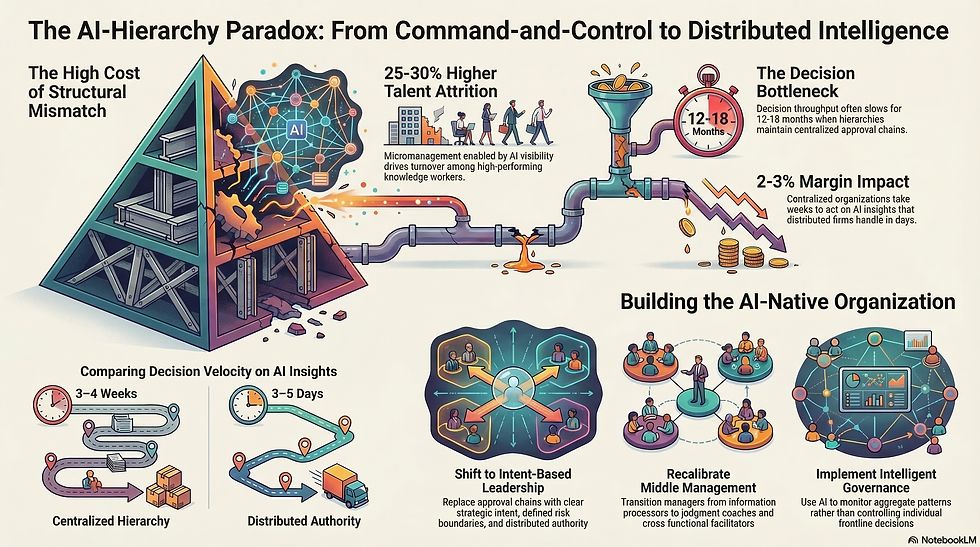
The consequences of deploying AI within misaligned structures manifest in measurable organizational costs. Research tracking decision velocity across organizations implementing AI systems reveals a counterintuitive pattern: despite faster information processing, actual decision throughput often slows during the first 12-18 months of AI deployment (Bughin et al., 2017). The cause is structural rather than technical. Information reaches decision-makers faster, but decision rights, approval processes, and accountability structures remain unchanged. The result is information accumulation rather than decision acceleration—dashboards proliferate while decision latency persists or increases as overwhelmed executives become bottlenecks.
This decision bottleneck carries financial consequences. Analysis of retail organizations implementing AI-powered demand forecasting and inventory systems showed that those maintaining centralized decision structures took, on average, 3-4 weeks to translate forecast insights into stocking decisions, compared to 3-5 days for organizations that coupled AI implementation with distributed decision authority at store or regional level (Wamba et al., 2020). The slower response directly impacted inventory costs and stockout rates, with estimated margin impact of 2-3 percentage points despite identical AI system capability.
Innovation capacity suffers similarly. Organizations implementing AI within rigid hierarchies report significantly lower rates of bottom-up innovation and cross-functional experimentation than those actively distributing authority alongside AI deployment (Amabile & Pratt, 2016). When frontline workers gain access to powerful analytical tools but lack authority to act on insights, or when middle managers can identify process improvements but require multiple approval layers to test changes, organizational learning slows precisely when AI should accelerate it. This pattern is particularly evident in industries facing rapid market evolution, where delayed innovation compounds over time.
Talent attrition represents another measurable consequence. Survey research examining knowledge worker sentiment in organizations deploying AI systems found that perceived micromanagement—specifically, leaders using AI-enabled visibility to increase intervention in operational decisions—emerged as a primary driver of turnover intention among high-performing employees (Kellogg et al., 2020). The relationship is dose-dependent: organizations in the highest quartile of reported micromanagement intensity showed voluntary turnover rates 25-30% higher than those in the lowest quartile, controlling for compensation and role level. The economic impact is substantial given replacement costs for knowledge workers typically range from 100-150% of annual compensation.
Individual Wellbeing and Stakeholder Impacts
The structural tension between AI capability and hierarchical control creates distinct wellbeing costs across organizational levels. For senior leaders, AI-powered visibility often generates anxiety rather than confidence. Executives who previously received filtered, aggregated reports now observe operational variation in real time. Without frameworks for determining which variation warrants intervention versus represents healthy local adaptation, leaders report feeling simultaneously more informed and less certain about when and how to act (Kolbjørnsrud et al., 2016). This uncertainty frequently defaults to increased intervention, paradoxically reducing the autonomy and judgment that creates value from distributed intelligence.
Middle managers experience perhaps the most acute role ambiguity. Organizations implementing AI systems typically automate the information aggregation, analysis, and transmission functions that historically defined middle management work. Yet few organizations clearly articulate the evolving purpose and value of middle management in AI-augmented environments (Autor, 2015). The result is widespread middle management anxiety about obsolescence, compounded by lack of investment in developing the coaching, judgment facilitation, and boundary-spanning capabilities that represent middle management's distinctive value in intelligent organizations. Research examining middle manager stress levels during digital transformation initiatives consistently identifies role ambiguity and unclear value proposition as primary stressors, often exceeding concerns about job security itself (Carsten et al., 2014).
Frontline workers face their own wellbeing challenges. Many report that AI implementation increases surveillance and reduces autonomy without corresponding increases in capability or authority (Kellogg et al., 2020). When AI systems generate performance metrics visible to management but workers lack authority to act on AI-generated insights or adapt processes based on AI analysis, the experience is one of intensified monitoring rather than augmented capacity. This dynamic is particularly pronounced in customer-facing roles where AI provides real-time coaching or next-best-action recommendations—workers describe feeling "micromanaged by algorithm" when the system's suggestions become de facto requirements rather than decision support.
Customers and external stakeholders also experience consequences of structural mismatch. Organizations with rigid hierarchies typically implement AI systems that optimize for consistency and control rather than contextual responsiveness. The result is often technically sophisticated but experientially rigid service delivery—chatbots that cannot escalate to humans, recommendation systems that cannot accommodate unusual circumstances, or service protocols that sacrifice judgment for standardization (Huang & Rust, 2021). Customer satisfaction research consistently shows that perceived lack of employee empowerment to resolve issues ranks among the top drivers of service dissatisfaction, even when technical capabilities are advanced.
Evidence-Based Organizational Responses
Table 1: Organizational Case Studies and Examples of AI Structure Adaptation
Organization Name | Industry | Structural Change or Framework | AI/Technology Implementation | Key Outcomes or Performance Impacts | Leadership or Governance Approach |
Handelsbanken | Banking / Financial Services | Radical decentralization; branch managers hold authority over lending and pricing. | Sophisticated analytics for local decisions and AI-powered risk monitoring. | Consistently outperformed industry averages on profitability and customer satisfaction. | Intent-based authority; risk monitoring provides visibility without requiring central approval. |
Deloitte | Professional Services | Redesigned middle management roles from resource allocation to judgment development. | Enterprise AI deployment to augment project management. | $15-20\%$ higher client satisfaction scores and significantly better retention of high performers. | Coaching and facilitation behaviors focused on human expertise integration. |
Zara | Retail | Distributed authority; store managers have autonomy over merchandising and inventory. | AI-powered demand forecasting and real-time sales visibility. | Industry-leading inventory turnover and market responsiveness. | Intelligent governance; corporate monitors aggregate patterns rather than approving individual decisions. |
Haier | Manufacturing / Appliances | Restructured into more than 2,000 microenterprises (platform organization). | AI systems for customer behavior data, market trends, and operational performance. | Successful launch of new offerings in smart home integration and customized appliances. | Distributed sensing and adaptive capacity; governance maintains coherence without central approval. |
Microsoft | Technology | Redistribution of authority to support cloud and AI market speed. | AI-enabled operational visibility used for learning and questions. | Faster movement in cloud and AI markets; higher learning velocity. | "Learn-it-all" culture; coaching-based leadership development over traditional oversight. |
Adobe | Technology / Software | Eliminated annual reviews and stack ranking; moved to frequent "check-ins". | AI deployed throughout products and operations; technology platforms for continuous feedback. | Significant improvement in high-performer retention; faster innovation cycles; higher engagement. | Managers as coaches; assessment based on collaborative contribution and peer input. |
McKinsey & Company | Professional Services / Consulting | Distributed analytical and judgment capability throughout consultant teams. | AI tools for teams; machine learning output interpretation. | Improved judgment quality and learning velocity in ambiguous situations. | Apprenticeship models and structured reflection on decision outcomes. |
Tencent | Technology / Gaming | Modular organizational design with frequent reconfiguration of business units. | Stable platforms and interfaces between units enabling rapid reconfiguration. | Rapid structural adaptation (multiple reorganizations over five years) without typical disruption. | Structural flexibility; viewing arrangements as temporary solutions to current challenges. |
U.S. Navy (Submarine Operations) | Military | Intent-based leadership; delegated tactical decision authority to junior officers. | Not in source | Higher operational effectiveness, faster response times, and higher personnel retention. | Defining outcomes and constraints rather than controlling through approval chains. |
W.L. Gore | Manufacturing | Distributed authority principles. | Not in source | Enables distributed decisions through strategic clarity. | Senior leaders spend $30-40\%$ of time in communication and context-setting rather than decision-making. |
Thoughtworks | Technology Consulting | Managers focused on coaching-augmented teams. | Work increasingly augmented by AI. | Not in source | 80 hours per year invested in manager development focused on coaching and facilitation. |
Redefining Authority Through Intent-Based Frameworks
Organizations successfully navigating the transition from command-and-control to AI-augmented structures consistently implement what military organizational theorists term "intent-based leadership"—distributing decision authority while clarifying strategic intent, boundaries, and accountability (Marquet, 2013). Rather than attempting to control decisions through approval chains, leaders define the outcomes sought, establish clear constraints within which decisions can be made, ensure decision-makers have relevant information and capability, and create rapid feedback loops that enable learning without requiring prior approval.
Research on high-performing military units offers instructive evidence. Analysis of U.S. Navy submarine operations compared performance under traditional command structures versus intent-based approaches where senior officers articulated strategic goals and operational boundaries but delegated tactical decision authority to junior officers and crew members closest to specific situations (Marquet, 2013). Intent-based crews showed measurably higher operational effectiveness, faster response to unexpected conditions, and significantly higher retention of high-performing personnel. These outcomes manifested specifically because distributed authority enabled those with best information to make time-sensitive decisions without delay, while clear boundaries prevented decisions that could compromise broader objectives.
Effective approaches for implementing intent-based authority include:
Strategic clarity initiatives: Senior leaders invest substantially more time defining and communicating organizational purpose, strategic priorities, and critical boundaries than under traditional models. Manufacturing firm W.L. Gore, which has operated on distributed authority principles since its founding, requires senior leaders to spend 30-40% of their time in communication and context-setting rather than decision-making, explicitly recognizing that clarity about intent enables distributed decisions (Hamel, 2011).
Risk band frameworks: Organizations establish explicit categories of decision types based on reversibility, scale of impact, and knowledge requirements. Decisions within defined risk parameters proceed without approval, while those crossing thresholds trigger consultation or escalation protocols. This approach preserves necessary oversight while eliminating unnecessary approval bottlenecks.
Transparency systems: Rather than using AI visibility to control decisions, leading organizations use it to create shared context. When everyone can see relevant performance data, market signals, and operational patterns, distributed decision-makers operate from common understanding rather than requiring centralized coordination.
Authority mapping: Organizations explicitly document which roles hold authority for which decision categories, replacing informal authority with clear decision rights. This mapping exercise frequently reveals that many approval requirements serve no real purpose beyond historical practice, enabling immediate elimination of unnecessary control points.
Swedish bank Handelsbanken provides a sustained demonstration of intent-based authority in a highly regulated industry. The bank operates with radical decentralization, giving branch managers broad authority over lending decisions, pricing, and resource allocation within clearly defined risk parameters and strategic guidelines (Hamel & Breen, 2007). Rather than being undermined by AI implementation, this structure has been strengthened by it—branch managers use sophisticated analytics to inform local decisions while AI-powered risk monitoring provides enterprise visibility without requiring central approval. The bank has consistently outperformed industry averages on both profitability and customer satisfaction measures over multiple decades.
Recalibrating Middle Management for Judgment and Coaching
Organizations that successfully transform middle management roles share a common insight: AI eliminates middle management's traditional function as information processor but dramatically increases the value of their judgment development, coaching capability, and boundary-spanning roles (Kolbjørnsrud et al., 2016). Rather than aggregating data and implementing senior leaders' decisions, middle managers in AI-augmented organizations focus on developing frontline judgment capability, facilitating collaboration across boundaries that AI cannot bridge, and identifying contextual factors that predictive models miss.
The shift requires deliberate role redesign backed by capability investment. Research examining organizations that maintained or improved middle management engagement during AI implementation found that successful transitions involved three consistent elements: explicit articulation of middle management's evolving value proposition, substantial investment in coaching and facilitation capabilities, and redesign of performance metrics to emphasize team development and collaborative outcomes rather than individual operational metrics (Carsten et al., 2014).
Effective approaches for recalibrating middle management include:
Coaching capability development: Organizations invest in training middle managers in developmental coaching methods, feedback techniques, and facilitation skills. These investments acknowledge that managing AI-augmented teams requires different capabilities than managing standardized processes. Technology consulting firm Thoughtworks invests approximately 80 hours per year in manager development focused specifically on coaching and team development capabilities, recognizing these as core skills in environments where technical work is increasingly augmented by AI (Reeves et al., 2017).
Judgment facilitation roles: Rather than making decisions, middle managers facilitate decision-making among those closest to problems. This involves ensuring decision-makers have relevant context, helping teams interpret AI-generated insights in light of situational factors, and creating forums for rapid collective learning when AI recommendations miss important nuances.
Horizontal integration responsibility: Middle managers increasingly own integration across functional or unit boundaries that AI systems cannot navigate independently. While AI can optimize within domains, middle managers add value by recognizing dependencies, facilitating cross-functional collaboration, and ensuring local optimizations don't create system-level problems.
Exception identification and escalation: Rather than implementing standard procedures, middle managers develop expertise in recognizing when situations require exception handling, ensuring unusual circumstances receive appropriate human judgment rather than algorithmic processing.
Global professional services firm Deloitte redesigned its middle management structure explicitly around judgment development and coaching during enterprise AI deployment (Volini et al., 2020). Project managers, traditionally focused on resource allocation and timeline management, shifted toward developing team members' analytical judgment and facilitating integration of AI-generated insights with human expertise. The firm measured this transition through engagement scores and project outcome metrics, finding that teams with managers exhibiting strong coaching and facilitation behaviors showed 15-20% higher client satisfaction scores and significantly better retention of high performers, compared to teams where managers remained focused on traditional oversight functions.
Establishing Intelligent Governance and Risk Frameworks
Organizations deploying AI within evolving authority structures require governance frameworks fundamentally different from traditional control mechanisms. Rather than preventing decisions through approval requirements, intelligent governance enables distributed decisions while creating rapid learning feedback, ensures decisions align with strategic intent and risk parameters, and identifies patterns that warrant strategic attention without micromanaging individual cases (Fountaine et al., 2019).
This approach inverts traditional governance logic. Instead of asking "What decisions can we safely delegate?" organizations ask "What decisions must we centralize?" The default shifts from control to empowerment, with explicit frameworks defining the boundaries of distributed authority rather than the permissions for specific actions.
Effective intelligent governance approaches include:
Real-time pattern monitoring: Rather than approving individual decisions, governance systems use AI to monitor for patterns that suggest misalignment with intent or risk parameters. This enables distributed authority while maintaining strategic coherence and risk management.
Rapid learning loops: Governance frameworks create structured processes for capturing and distributing lessons from distributed decisions. Organizations learn from the aggregate pattern of decisions rather than attempting to control each decision individually.
Escalation protocols: Clear frameworks define situations requiring consultation or elevation to broader authority, based on impact scale, irreversibility, or strategic significance. These protocols preserve judgment hierarchy where valuable while eliminating it where unnecessary.
Outcome accountability systems: Rather than controlling decisions through prior approval, governance systems focus accountability on outcomes and learning. This shifts attention from compliance with process to quality of judgment and speed of learning from results.
Global retailer Zara's operational model demonstrates intelligent governance enabling distributed authority at scale. Store managers have broad autonomy over merchandising and inventory decisions, supported by AI-powered demand forecasting and real-time sales visibility (Ferdows et al., 2004). Rather than approving individual store decisions, corporate governance monitors aggregate patterns—if multiple stores reduce orders for a product line, that signals potential design or pricing issues for strategic attention. This approach enables rapid local response to customer preferences while maintaining strategic coherence across the enterprise, contributing to Zara's industry-leading inventory turnover and market responsiveness.
Building Organizational Sensing and Adaptive Capacity
Organizations successfully deploying AI within evolving structures invest heavily in what organizational theorists term "sensing capability"—the capacity to continuously detect meaningful signals in complex environments and adapt strategy and operations accordingly (Teece, 2007). This capability is distinct from traditional strategic planning, which assumes relatively stable environments and periodic adjustment. Sensing requires distributed awareness, rapid information sharing, structured interpretation frameworks, and authority to act on emerging patterns.
AI enhances sensing capability primarily by processing information volume and velocity beyond human capacity, identifying patterns across contexts that humans miss, and enabling real-time visibility across organizational boundaries. However, AI's contribution to sensing depends entirely on organizational structures that enable humans to interpret AI-generated insights, act on emerging patterns without delay, and learn collectively from distributed responses (Brynjolfsson & McAfee, 2014).
Effective approaches for building sensing and adaptive capacity include:
Distributed sensing networks: Organizations create formal mechanisms for frontline workers to contribute observations and insights to organizational awareness. This recognizes that frontline workers often detect market shifts, operational problems, or innovation opportunities before they appear in formal data or reach senior attention.
Rapid experimentation frameworks: Rather than requiring extensive analysis and approval before testing new approaches, organizations enable bounded experiments with rapid evaluation cycles. This shifts learning from slow, high-stakes decisions to fast, low-stakes experiments.
Cross-boundary sense-making forums: Organizations create regular forums where people spanning different functions, levels, and contexts collectively interpret signals and patterns. This addresses AI's limitation in synthesizing insights across domains with different data characteristics or evaluating implications requiring human judgment.
Strategic agility routines: Organizations establish regular processes for testing strategic assumptions, evaluating emerging threats or opportunities, and adjusting direction. This makes adaptation routine rather than crisis-driven.
Technology company Haier transformed from traditional appliance manufacturer to platform organization through systematic development of sensing and adaptive capability (Zhang, 2016). The company restructured into more than 2,000 microenterprises with authority to sense customer needs and adapt products and services rapidly. AI systems enable microenterprises to access customer behavior data, market trends, and operational performance, while governance frameworks maintain strategic coherence without requiring central approval. This structure has enabled Haier to launch successful new offerings in smart home integration and customized appliances—markets requiring rapid adaptation to evolving customer preferences—while maintaining efficiency in traditional manufacturing operations.
Developing Transparent Leadership Practices
Leaders navigating the transition from command-and-control to AI-augmented structures face a fundamental psychological challenge: AI provides unprecedented operational visibility precisely when effective leadership requires resisting the temptation to intervene in operational decisions. Research on leader behavior during digital transformation consistently finds that executive use of AI-powered visibility falls into two distinct patterns, with dramatically different organizational outcomes (Kolbjørnsrud et al., 2016).
The first pattern, "visibility-enabled micromanagement," involves leaders using real-time dashboards to identify operational variations and direct corrections. This pattern initially feels effective to leaders—they see problems and solve them—but systematically undermines distributed authority, discourages frontline initiative, and creates learned helplessness where capable people wait for direction rather than exercising judgment. The second pattern, "visibility-enabled confidence," involves leaders using operational transparency to build confidence that distributed decisions align with intent while focusing their attention on patterns requiring strategic response rather than individual operational issues.
Effective transparent leadership practices include:
Public decision rules: Leaders explicitly define and communicate the categories of issues they will engage versus delegate. This provides clarity about authority boundaries and prevents subordinates from unnecessarily escalating decisions or, conversely, making decisions beyond appropriate scope.
Coaching-focused interventions: When leaders observe concerning patterns, their default response involves asking questions that develop judgment rather than issuing directives. This preserves authority with decision-makers while improving decision quality.
Visible restraint practices: Leaders deliberately model restraint from intervention even when they see issues, using transparency to understand but not control. Some organizations formalize this through "cooling off" protocols where leaders wait specified periods before intervening in operational issues, creating space for distributed solutions.
Pattern recognition responsibilities: Leaders shift attention from individual cases to patterns across cases, recognizing that their primary value-add is identifying systemic issues and strategic opportunities that emerge from aggregate data rather than managing individual situations.
Microsoft's transformation under CEO Satya Nadella provides a sustained example of leadership practice evolution supporting organizational structure change (Nadella, 2017). Nadella explicitly articulated a "learn-it-all" rather than "know-it-all" culture, using AI-enabled visibility to ask questions and promote learning rather than enforce compliance. Leadership development programs throughout the company emphasized coaching over directing, with managers evaluated significantly on team development and learning velocity rather than merely operational metrics. This cultural shift, enabled by deliberate leadership practice change, supported redistribution of authority that allowed Microsoft to move faster in cloud computing and enterprise AI markets despite the company's scale and complexity.
Building Long-Term Organizational Intelligence Capabilities
Cultivating Distributed Sensemaking Competence
Organizations building sustained capability for AI-augmented operation recognize that distributed intelligence requires broadly distributed sensemaking competence—the ability of people throughout the organization to interpret complex signals, synthesize information across contexts, and make sound judgments in ambiguous situations (Weick, 1995). Traditional hierarchies concentrated sensemaking at senior levels, with operational roles focused on execution. AI-augmented organizations require the opposite: frontline workers who combine AI-generated insights with contextual understanding to make informed decisions, middle managers who facilitate collective sensemaking across boundaries, and senior leaders who synthesize strategic patterns from distributed intelligence.
Building distributed sensemaking capability requires sustained investment in several areas. Organizations must develop analytical literacy that enables workers to interpret AI outputs, understand confidence levels and limitations, and recognize situations where algorithms miss important context (Brynjolfsson & McAfee, 2014). They must cultivate judgment capability through deliberate practice in ambiguous situations, structured reflection on decision outcomes, and coaching relationships that develop wisdom rather than merely procedural compliance. Finally, they must create psychological safety that enables people to acknowledge uncertainty, raise concerns about AI recommendations, and learn from mistakes without fear of punishment (Edmondson, 2018).
Key elements of distributed sensemaking development include:
Judgment skill curricula: Organizations develop structured learning experiences focused on decision-making in ambiguous contexts, interpretation of imperfect information, and integration of algorithmic recommendations with human judgment. These programs treat judgment as a learnable skill requiring deliberate practice rather than innate talent.
Reflective practice forums: Teams regularly analyze decisions and outcomes collectively, examining what worked, what didn't, and why. This creates organizational learning from distributed experience rather than relying on central experts to accumulate and distribute wisdom.
Apprenticeship models: Organizations pair less experienced workers with skilled judgment practitioners, enabling observation and mentorship in real contexts. This recognizes that judgment capability develops through guided experience rather than classroom learning alone.
Safe-to-fail experimentation: Organizations create explicit spaces for bounded experimentation where people can test judgments and learn from outcomes without career risk. This accelerates judgment development by compressing the experience cycle.
Professional services firm McKinsey & Company has invested substantially in distributed analytical and judgment capability as it deploys AI tools throughout consulting teams (Bughin et al., 2017). The firm created extensive training programs focused on interpreting machine learning outputs, synthesizing algorithmic insights with business context, and developing frameworks for judgment in situations where data is ambiguous or incomplete. Performance evaluation explicitly assesses judgment quality and learning velocity, not merely analytical technical skills. This investment acknowledges that the firm's competitive advantage increasingly depends on judgment capability distributed throughout consultant teams rather than concentrated in senior partners.
Redesigning Performance and Reward Systems
Traditional performance management systems reinforce hierarchical structures by emphasizing individual accountability, standardized metrics, and top-down evaluation. These systems fundamentally conflict with AI-augmented organizations that depend on collaborative intelligence, rapid learning from experimentation, and distributed authority (Cappelli & Tavis, 2016). Organizations building sustained AI-native capabilities consistently redesign performance and reward systems to align with rather than contradict the collaborative, learning-focused behaviors they seek.
The shift involves several fundamental changes in performance management philosophy. Organizations move from evaluating compliance with procedure to assessing quality of judgment and learning velocity. They shift from purely individual accountability to team and network performance, recognizing that value in intelligent organizations emerges from collaboration rather than individual activity. They replace annual review cycles with continuous feedback, acknowledging that rapid learning requires rapid feedback rather than delayed evaluation. Finally, they broaden evaluation to include contribution to collective capability—coaching others, sharing insights, and improving systems—rather than merely individual output.
Effective performance system redesigns include:
Outcome and learning metrics: Organizations balance accountability for results with evaluation of learning velocity, judgment improvement, and knowledge sharing. This prevents risk aversion and encourages experimentation while maintaining performance standards.
Peer and team-based evaluation: Performance assessment includes substantial input from peers and team members, not merely hierarchical managers. This recognizes that in collaborative environments, those working most closely with someone often have better insight into contribution quality than distant supervisors.
Rapid feedback mechanisms: Organizations implement continuous or frequent feedback rather than annual reviews, enabling faster learning and adaptation. Technology platforms facilitate ongoing input from multiple sources rather than consolidated annual judgments.
Contribution diversity recognition: Reward systems explicitly value multiple contribution types—coaching, knowledge sharing, system improvement—not merely individual output. This prevents narrowing to easily measured individual metrics while ignoring collaborative behaviors essential to organizational intelligence.
Adobe's transformation of its performance management system demonstrates these principles in practice (Cappelli & Tavis, 2016). The company eliminated annual performance reviews and stack ranking, replacing them with frequent "check-in" conversations focused on goals, development, and feedback. Managers shifted from judges allocating ratings to coaches supporting performance and growth. Compensation decisions incorporated peer input and assessment of collaborative contribution, not merely individual output metrics. Adobe reported that this redesign correlated with significant improvement in voluntary turnover among high performers, faster innovation cycles, and higher employee engagement—outcomes particularly valuable as the company deployed AI throughout its products and operations.
Creating Structural Flexibility and Evolution Mechanisms
Organizations successfully sustaining AI-native capabilities recognize that structural adaptation is continuous rather than one-time. As AI capabilities evolve, markets shift, and organizational learning accumulates, the optimal distribution of authority, role definitions, and governance frameworks must evolve correspondingly (Reeves et al., 2017). This requires building what organizational theorists term "structural flexibility"—the capacity to reconfigure organizational design without crisis or massive disruption.
Traditional organizations treat structure as stable, with infrequent major reorganizations that are traumatic and disruptive. AI-native organizations treat structure as continuously evolving, with smaller, more frequent adjustments based on emerging needs and opportunities. This approach reduces the risk of any single change while enabling faster collective learning about what structures work well in practice versus theory.
Mechanisms for enabling continuous structural evolution include:
Modular organizational design: Organizations structure work around relatively autonomous units with clear interfaces, enabling reconfiguration of particular modules without requiring system-wide reorganization. This architectural principle, borrowed from software engineering, enables evolutionary rather than revolutionary structural change.
Regular structure reviews: Organizations establish routine processes for evaluating whether current structural arrangements still serve strategic purpose, involving people at multiple levels in identifying friction points and improvement opportunities. This makes structural dialogue routine rather than threatening.
Experimental authority: Some organizations grant explicit authority for structural experimentation within bounded contexts—teams can reorganize their internal structure, units can test different authority distributions—enabling learning about effective arrangements before enterprise-wide implementation.
Transparent design principles: Rather than treating organizational structure as mysterious leadership prerogative, organizations articulate the principles guiding structural choices. This enables productive dialogue about structure and prevents cynicism that reorganizations serve political rather than strategic purposes.
Chinese technology and gaming company Tencent operates with notable structural flexibility, regularly reconfiguring business units, authority relationships, and reporting structures based on strategic priorities and market evolution (Iansiti & Lakhani, 2020). The company maintains relatively stable platforms and interfaces between units while allowing substantial variation in internal organization. This enables rapid structural adaptation—the company reorganized significantly multiple times over a five-year period—without the typical disruption and cynicism associated with frequent reorganization. Leadership explicitly articulates that structural arrangements are temporary solutions to current challenges rather than permanent designs, reducing resistance to evolution.
Conclusion
The central insight emerging from organizational experience with AI implementation is that intelligence technologies create value primarily through organizational transformation rather than process automation. Organizations that treat AI as a tool to accelerate existing structures and practices capture only a fraction of potential value while incurring substantial wellbeing costs and competitive vulnerabilities. Those that recognize AI as catalyst for fundamental reconsideration of how authority flows, how roles function, and how leadership operates position themselves to achieve both superior performance and enhanced human flourishing.
The evidence demonstrates several consistent patterns across successful implementations. First, AI visibility should build confidence in distributed authority rather than enable micromanagement—leaders who use real-time operational transparency to resist intervention rather than justify it unlock both faster adaptation and higher talent retention. Second, middle management's evolution from information processor to judgment coach and boundary spanner represents opportunity rather than obsolescence when organizations deliberately invest in role redesign and capability development. Third, intelligent governance that monitors patterns while enabling distributed decisions proves far more effective than traditional control through prior approval. Finally, sustained capability requires treating sensemaking competence, performance system alignment, and structural flexibility as core organizational capabilities requiring deliberate investment rather than side effects of technology deployment.
For practitioners, several actionable implications emerge. Begin organizational transformation before technical implementation rather than attempting to retrofit structure after deploying AI systems. Invest substantially in leadership practice evolution, recognizing that leader behavior often determines whether AI enables or undermines distributed intelligence. Redesign middle management roles deliberately and early, creating clarity about evolving value proposition before anxiety and resistance solidify. Implement intent-based authority frameworks that define boundaries and ensure capability rather than attempting to control decisions through approval chains. Finally, treat organizational learning velocity as a primary success metric alongside technical performance, acknowledging that sustained advantage emerges from collective intelligence rather than algorithmic sophistication.
The transition from command-and-control to AI-augmented organization is fundamentally a leadership challenge rather than a technical problem. The structures that served industrial-era efficiency cannot contain digital-era intelligence. Organizations that recognize this reality and act accordingly position themselves to achieve performance and adaptability that neither traditional hierarchy nor pure automation could enable alone. Those that attempt to preserve control while deploying intelligence will find themselves increasingly disadvantaged by competitors willing to embrace the organizational implications of the technologies they deploy.
Research Infographic
References
Amabile, T. M., & Pratt, M. G. (2016). The dynamic componential model of creativity and innovation in organizations: Making progress, making meaning. Research in Organizational Behavior, 36, 157–183.
Autor, D. H. (2015). Why are there still so many jobs? The history and future of workplace automation. Journal of Economic Perspectives, 29(3), 3–30.
Brill, J., & Wortham, R. (2024). AI and the octopus organization: Thriving with distributed intelligence. Wiley.
Brown, P., Lauder, H., & Ashton, D. (2011). The global auction: The broken promises of education, jobs, and incomes. Oxford University Press.
Brynjolfsson, E., & McAfee, A. (2014). The second machine age: Work, progress, and prosperity in a time of brilliant technologies. W. W. Norton.
Bughin, J., Hazan, E., Ramaswamy, S., Chui, M., Allas, T., Dahlström, P., Henke, N., & Trench, M. (2017). Artificial intelligence: The next digital frontier? McKinsey Global Institute.
Cappelli, P., & Tavis, A. (2016). The performance management revolution. Harvard Business Review, 94(10), 58–67.
Carsten, M. K., Uhl-Bien, M., West, B. J., Patera, J. L., & McGregor, R. (2014). Exploring social constructions of followership: A qualitative study. The Leadership Quarterly, 21(3), 543–562.
Davenport, T. H., & Ronanki, R. (2018). Artificial intelligence for the real world. Harvard Business Review, 96(1), 108–116.
Edmondson, A. C. (2018). The fearless organization: Creating psychological safety in the workplace for learning, innovation, and growth. Wiley.
Ferdows, K., Lewis, M. A., & Machuca, J. A. D. (2004). Rapid-fire fulfillment. Harvard Business Review, 82(11), 104–110.
Fountaine, T., McCarthy, B., & Saleh, T. (2019). Building the AI-powered organization. Harvard Business Review, 97(4), 62–73.
Hamel, G. (2011). First, let's fire all the managers. Harvard Business Review, 89(12), 48–60.
Hamel, G., & Breen, B. (2007). The future of management. Harvard Business School Press.
Huang, M. H., & Rust, R. T. (2021). A strategic framework for artificial intelligence in marketing. Journal of the Academy of Marketing Science, 49(1), 30–50.
Iansiti, M., & Lakhani, K. R. (2020). Competing in the age of AI: Strategy and leadership when algorithms and networks run the world. Harvard Business Review, 98(1), 60–67.
Kellogg, K. C., Valentine, M. A., & Christin, A. (2020). Algorithms at work: The new contested terrain of control. Academy of Management Annals, 14(1), 366–410.
Kolbjørnsrud, V., Amico, R., & Thomas, R. J. (2016). How artificial intelligence will redefine management. Harvard Business Review Digital Articles, 2–6.
Marquet, L. D. (2013). Turn the ship around! A true story of turning followers into leaders. Portfolio/Penguin.
Morgan, G. (2006). Images of organization (Updated ed.). Sage Publications.
Nadella, S. (2017). Hit refresh: The quest to rediscover Microsoft's soul and imagine a better future for everyone. Harper Business.
Ransbotham, S., Kiron, D., Gerbert, P., & Reeves, M. (2017). Reshaping business with artificial intelligence: Closing the gap between ambition and action. MIT Sloan Management Review, 59(1), 1–17.
Ransbotham, S., Khodabandeh, S., Fehling, R., LaFountain, B., & Kiron, D. (2020). Expanding AI's impact with organizational learning. MIT Sloan Management Review, 61(1), 1–21.
Reeves, M., Levin, S., & Ueda, D. (2017). The biology of corporate survival: Natural ecosystems hold surprising lessons for business. Harvard Business Review, 94(1), 46–55.
Teece, D. J. (2007). Explicating dynamic capabilities: The nature and microfoundations of (sustainable) enterprise performance. Strategic Management Journal, 28(13), 1319–1350.
Volini, E., Schwartz, J., Roy, I., Hauptmann, M., Van Durme, Y., Denny, B., & Bersin, J. (2020). 2020 Deloitte Global Human Capital Trends: The social enterprise at work: Paradox as a path forward. Deloitte Insights.
Wamba, S. F., Dubey, R., Gunasekaran, A., & Akter, S. (2020). The performance effects of big data analytics and supply chain ambidexterity: The moderating effect of environmental dynamism. International Journal of Production Economics, 222, 107498.
Weick, K. E. (1995). Sensemaking in organizations. Sage Publications.
Zhang, R. (2016). The Haier model: How to build an entrepreneur platform. Ivey Business Journal, 80(5), 1–6.

Jonathan H. Westover, PhD is Chief Research Officer (Nexus Institute for Work and AI); Associate Dean and Director of HR Academic Programs (WGU); Professor, Organizational Leadership (UVU); OD/HR/Leadership Consultant (Human Capital Innovations). Read Jonathan Westover's executive profile here.
Suggested Citation: Westover, J. H. (2026). When AI Meets Command-and-Control: Why Traditional Hierarchies Are Failing the Intelligence Revolution. Human Capital Leadership Review, 34(2). doi.org/10.70175/hclreview.2020.34.2.4


