





Direct Lines to Loyalty: Why Generation Z's Commitment Is Built in the Daily Experience of Work

Download the article here

Listen to a review of this article:
Abstract: Generation Z now makes up a large and growing share of the workforce, and organizations are searching for reliable ways to earn and keep its commitment. This article draws on a recent study of 150 Generation Z employees in Surabaya, Indonesia (Noerchoidah et al., 2026), which found that work-life balance, the work environment, and job satisfaction each had positive, significant effects on work commitment, yet job satisfaction did not carry those effects indirectly. The pattern suggests that younger employees form commitment through direct, lived experiences of flexibility, support, and workplace quality rather than through a general sense of contentment alone. Integrating that finding with social exchange theory, perceived organizational support research, and field experiments on flexibility, supervisor training, psychological safety, and onboarding, the article outlines four evidence-based organizational responses and three long-term capabilities. It concludes that commitment among early-career employees is best treated as an ongoing exchange that organizations demonstrate daily, and it notes limits in generalizing from single-site, cross-sectional evidence.
Ask a room of managers what worries them about their youngest employees and you will hear some version of the same complaint: they don't stay. Sometimes the complaint comes with a story about a promising 23-year-old who left after eleven months for a job that paid only slightly more. Sometimes it comes with a theory about attention spans, social media, or a generation that supposedly expects too much. Rarely does it come with a careful look at what those employees actually experienced at work before they left.
That gap matters, because the stakes are rising. Generation Z, broadly people born from the late 1990s through the early 2010s, is now entering the workforce in large numbers. In Indonesia, for example, national census survey data place Generation Z as the single largest generational group, accounting for roughly a quarter of the population (Badan Pusat Statistik, 2026, as cited in Noerchoidah et al., 2026). Similar demographic turnovers are underway in many economies. For organizations, the question is no longer whether to adapt to this cohort but how to build the kind of employment relationship that earns its loyalty.
A recent study published in the International Journal of Economics, Business and Accounting Research offers a useful and somewhat surprising lens on that question. Noerchoidah, Rossitika, Wijayadne, and Harjanti (2026) surveyed 150 Generation Z employees aged 18 to 25 in Surabaya, Indonesia's second-largest city, and tested how work-life balance and the work environment shape job satisfaction and work commitment. Much of what they found aligns with conventional wisdom: better balance and better workplaces were associated with higher satisfaction and higher commitment. The surprise was in the mechanism. The researchers expected job satisfaction to act as a bridge, carrying the benefits of balance and a good environment through to commitment. It did not. Instead, balance and environment appeared to influence commitment directly.
That finding deserves practitioners' attention for a simple reason. A great deal of human resources practice is built on the logic of satisfaction: run an engagement or satisfaction survey, find the low scores, fix them, and expect retention to follow. If, for younger employees, commitment is formed more directly by the concrete experience of being supported, trusted with flexibility, and working in a good environment, then the satisfaction score may be a lagging and incomplete signal. The levers that matter are the daily ones.
This article builds on Noerchoidah et al. (2026) to offer a practitioner's guide to earning Generation Z commitment. It begins by defining the core concepts and describing what the evidence shows. It then examines the organizational and individual consequences of getting this right or wrong, outlines four evidence-based organizational responses with concrete examples from several industries, and closes with three long-term capabilities organizations can build. Throughout, the aim is to stay honest about what the evidence can and cannot tell us. Generational research is notoriously prone to overstatement, and a single cross-sectional study, however well executed, is a starting point rather than a verdict.
The Generation Z Commitment Landscape
Defining Work Commitment, Work-Life Balance, and the Work Environment
Before turning to findings, it helps to be precise about terms, because each of the core concepts is used loosely in everyday management conversation.
Work commitment, often discussed in the research literature as organizational commitment, refers to the psychological bond that ties an employee to an organization. The most influential framework, developed by Meyer and Allen (1991), distinguishes three components. Affective commitment is emotional attachment: staying because you want to. Continuance commitment is a calculation of costs: staying because leaving would cost too much. Normative commitment is a sense of obligation: staying because you feel you ought to. Noerchoidah et al. (2026) measured work commitment with three items that map closely onto these components, capturing emotional attachment, the weighing of costs and benefits of leaving, and a sense of obligation to remain. This matters because the components have different consequences. Meta-analytic evidence shows that affective commitment has the strongest and most consistently positive relationships with performance, attendance, and organizational citizenship, while continuance commitment is weakly or even negatively related to some desirable outcomes (Meyer et al., 2002). In other words, the kind of commitment an organization earns matters as much as the amount.
Work-life balance describes an individual's ability to manage the demands of work and personal life without one consistently crowding out the other. Its conceptual roots lie in research on work-family conflict, which Greenhaus and Beutell (1985) defined as a form of inter-role conflict in which pressures from work and family roles are mutually incompatible, whether because of time, strain, or conflicting behavioral expectations. Noerchoidah et al. (2026) measured work-life balance through four facets adapted from Harjanti et al. (2025, as cited in Noerchoidah et al., 2026): time balance, work flexibility, organizational support for balance, and overall satisfaction with balance. Notice that two of these facets, flexibility and organizational support, describe things the organization does rather than things the individual feels. That detail becomes important when we interpret the results.
The work environment encompasses the physical and psychosocial conditions of work. Noerchoidah et al. (2026) drew on Wagdi and Sayed (2023, as cited in Noerchoidah et al., 2026) to measure four aspects: workplace comfort, relationships among employees, organizational support, and working conditions that enable productivity. Earlier research has linked these features to satisfaction across many settings; a frequently cited study of employees in Pakistan, for instance, found that working conditions, supportive supervision, and coworker relationships were associated with higher job satisfaction (Raziq & Maulabakhsh, 2015).
Job satisfaction is an employee's overall evaluative judgment about the job, a sense of how favorably one regards one's work, rewards, coworkers, and conditions. It has a long research history and moderate, reliable correlations with job performance (Judge et al., 2001).
Finally, the theoretical glue for the whole model is social exchange theory. Originating with Blau (1964), it holds that relationships develop through reciprocal exchanges of resources, both tangible and intangible, and that people tend to return benefits they receive. In the workplace, the logic runs like this: when an organization invests in employees through support, fair treatment, and care for their wellbeing, employees reciprocate with positive attitudes and behaviors, including commitment (Cropanzano & Mitchell, 2005). Noerchoidah et al. (2026) used this theory to frame their hypotheses, and it provides a useful vocabulary for practitioners because it frames commitment as something earned through an exchange rather than something demanded.
State of Practice: What the Surabaya Evidence Shows
Noerchoidah et al. (2026) used a quantitative survey design, collecting responses in person and online from Generation Z employees in Surabaya selected through purposive sampling. They analyzed the data with partial least squares structural equation modeling (PLS-SEM), a statistical technique well suited to testing networks of relationships among latent constructs in relatively modest samples (Hair et al., 2021). The sample was 60% male, with nearly half of respondents aged 24 to 25, and most (68%) had between one and five years of work experience.
The measurement properties were strong. All items loaded well on their intended constructs, and reliability indicators exceeded conventional thresholds, suggesting that the four concepts were measured consistently (Noerchoidah et al., 2026).
The core findings can be summarized in plain language:
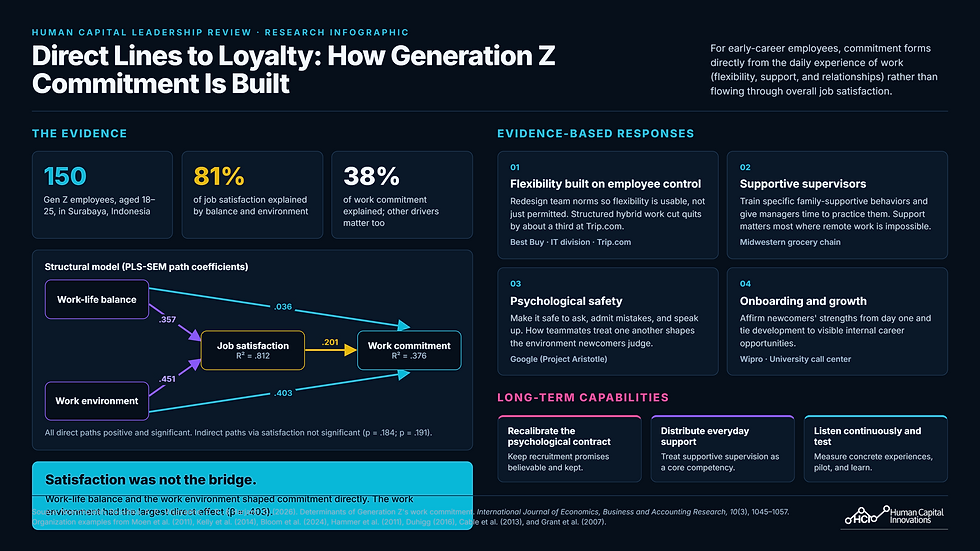
Work-life balance and the work environment together explained most of the variation in job satisfaction. The model accounted for about 81% of the variance in satisfaction, a very high figure for organizational research. Both balance (β = 0.357) and the environment (β = 0.451) had positive, significant effects.
All three predictors had significant direct effects on commitment. The work environment had the largest direct effect (β = 0.403), followed by job satisfaction (β = 0.201). Work-life balance also had a statistically significant direct effect, though its estimated coefficient was small (β = 0.036).
The model explained a moderate share of commitment. About 38% of the variance in work commitment was accounted for, which means much of what drives commitment lies outside these three factors.
Job satisfaction did not mediate either relationship. Neither the indirect path from work-life balance through satisfaction to commitment nor the indirect path from the environment through satisfaction to commitment reached statistical significance.
The authors interpret this last finding as evidence that, for Generation Z, commitment is "shaped more by direct work experiences, such as flexibility, organizational support, and the quality of workplace social relationships" (Noerchoidah et al., 2026, p. 1055). Their interpretation runs counter to some prior studies that did find a mediating role for satisfaction, including research on the link between work-life balance and commitment among Nigerian employees (Inegbedion, 2024) and work on small and medium enterprise employees in Bangladesh (Susanto et al., 2022).
Two notes of interpretive caution are worth adding for practitioners. First, in the language of modern mediation analysis, a pattern in which direct effects are significant but indirect effects are not is described as direct-only nonmediation (Zhao et al., 2010). That label does not mean satisfaction is irrelevant; satisfaction still had its own direct effect on commitment. It means that, in this sample, the route from balance and environment to commitment did not reliably run through satisfaction. Second, some of the reported indirect-effect values are difficult to reconcile arithmetically with the component paths, and the small direct coefficient for work-life balance sits alongside a relatively large test statistic. Neither point overturns the overall picture, but both suggest that practitioners should lean on the broad pattern, namely that the work environment matters a great deal and that commitment does not simply follow satisfaction, rather than on any single coefficient. The authors themselves are appropriately modest, noting that their sample is limited to one city, that the cross-sectional design cannot capture change over time, and that other variables such as perceived organizational support, leadership, and culture deserve inclusion in future work (Noerchoidah et al., 2026).
Why might direct experience matter so much? Social exchange theory offers one answer. The facets measured under "work-life balance" and "work environment" are largely observable organizational actions: Was I given flexibility? Did my supervisor support me? Do my colleagues treat me well? These are precisely the signals that research on perceived organizational support, employees' global beliefs about the extent to which the organization values their contributions and cares about their wellbeing, has identified as powerful drivers of affective commitment (Eisenberger et al., 1986; Rhoades & Eisenberger, 2002). A large meta-analysis confirmed that perceived organizational support is strongly related to affective commitment and that supportive supervision, fair treatment, and favorable job conditions are among its most important antecedents (Kurtessis et al., 2017). If young employees read daily experiences as direct evidence of how the organization regards them, commitment may form without needing to pass through a broader evaluation of overall satisfaction.
Is this really about Generation Z? Here, a healthy skepticism is warranted. Noerchoidah et al. (2026) frame their findings around Generation Z's distinctive emphasis on flexibility and wellbeing, consistent with a systematic review that highlighted work-life balance as especially salient for millennial and Generation Z employees (Waworuntu et al., 2022). There is some evidence of cohort shifts in work values; one large time-lag study found that the value placed on leisure rose across successive American cohorts (Twenge et al., 2010). However, a meta-analysis of generational differences in job attitudes found that differences between generations were generally small and that many apparent generational effects may reflect age, career stage, or period effects instead (Costanza et al., 2012). A critical review of leadership and generations similarly cautioned against designing management practices around generational stereotypes (Rudolph et al., 2018). The practical upshot is that the Surabaya findings may say as much about early-career employees in today's labor market as about a distinct generational psychology. That framing is actually more useful for practitioners, because it points to experiences organizations can shape rather than traits they must accommodate.
Organizational and Individual Consequences of Generation Z Commitment
Organizational Performance Impacts
Why should leaders care about commitment, rather than simply accepting higher turnover among young employees as a cost of doing business? The research case is substantial.
Turnover and its costs. Commitment is among the most consistent predictors of turnover. A widely cited meta-analysis of turnover antecedents found that organizational commitment and job satisfaction were among the strongest attitudinal predictors of quitting, operating largely through intentions to leave (Griffeth et al., 2000). An earlier meta-analysis likewise established that organizational commitment is related to lower turnover and higher attendance (Mathieu & Zajac, 1990). For organizations that invest heavily in recruiting and training young employees, early departures mean losing that investment before it pays off.
Performance and discretionary effort. Affective commitment is positively associated with job performance and with organizational citizenship behavior, the discretionary helping and extra-role effort that keeps teams functioning (Meyer et al., 2002). Satisfaction matters for performance too; a comprehensive meta-analysis estimated a moderate average correlation between job satisfaction and job performance (Judge et al., 2001).
Business-unit outcomes. Evidence at the unit level suggests these attitudes aggregate into results that executives track. A meta-analysis of nearly 8,000 business units found that employee satisfaction and engagement were related to customer satisfaction, productivity, profit, employee turnover, and safety outcomes (Harter et al., 2002). While the causal direction in such studies is not always clear, the pattern is consistent enough to justify treating employee experience as a performance variable rather than a soft "nice to have."
Evidence from flexibility experiments. Some of the most compelling organizational evidence comes from randomized field experiments that changed the experience of work and measured the consequences. In a well-known experiment at Ctrip, a large Chinese travel agency, call-center employees randomly assigned to work from home showed a 13% performance increase and their attrition rate fell by about half relative to the control group (Bloom et al., 2015). A later, larger randomized trial at the same company, by then known as Trip.com, tested a hybrid arrangement in which graduate employees in engineering, marketing, and finance worked from home two days a week. Quit rates fell by about one-third, and the researchers found no damage to performance reviews or promotion rates over two years (Bloom et al., 2024). Notably, the retention benefits in the hybrid trial were concentrated among non-managers, women, and employees with long commutes, groups for whom the flexibility made the most practical difference.
These experiments do not speak specifically to Generation Z, but they illustrate a principle that aligns closely with the Surabaya findings: concrete changes in how work is organized can affect retention directly and substantially.
Employee Wellbeing and Career Impacts
The consequences of the employment experience extend well beyond the organization's balance sheet. For employees early in their careers, the first few jobs shape health, skills, professional identity, and expectations of what work can be.
Strain and wellbeing. The job demands-resources model proposes that job demands such as workload and time pressure drain energy and contribute to burnout, while job resources such as support, autonomy, and feedback buffer those demands and foster engagement (Bakker & Demerouti, 2007). The facets that Noerchoidah et al. (2026) grouped under work-life balance and work environment, including flexibility, organizational support, good relationships, and enabling conditions, are classic job resources. Research on workplace environments similarly links their quality to employee wellbeing; a recent large study in Romania found that workplace environment characteristics were meaningfully associated with employee wellbeing (Dumitriu et al., 2025).
Work-family conflict. When work and personal life collide, the costs show up at home and in health. Field research has shown that interventions increasing employees' control over their work time can reduce work-family conflict (Kelly et al., 2014). Meta-analytic work on flexible work arrangements also suggests that flexibility in when people work tends to be more strongly linked to reduced work-family conflict than flexibility in where they work, although the effects are modest overall (Allen et al., 2013). For early-career employees who may be completing education, supporting family members, or establishing independent households, these effects can be especially meaningful.
Broken promises and the psychological contract. Young employees enter organizations with beliefs about what they have been promised, what researchers call the psychological contract, the individual's beliefs about the terms of the reciprocal exchange between themselves and their employer (Rousseau, 1995). When employees perceive that the organization has failed to deliver on these implicit promises, the consequences are significant. A meta-analysis found that perceived psychological contract breach was associated with lower trust, lower job satisfaction, lower commitment, higher turnover intentions, and reduced performance (Zhao et al., 2007). For a newly hired employee told in recruitment that the company "values work-life balance," a culture of late-night messages and unpredictable schedules is not simply an inconvenience; it is a breach that undermines the exchange relationship at its foundation.
Career development. Finally, commitment is tied to perceived opportunity. Research has found that employees' perceptions of organizational support for their development are related to commitment and retention, but especially when employees also see real career opportunities inside the organization (Kraimer et al., 2011). Support for development that leads nowhere can actually increase the likelihood of leaving, as employees take their newly built skills elsewhere. For a cohort early in its career, the question "Where can I grow here?" is part of the daily experience of work.
Evidence-Based Organizational Responses
If commitment among younger employees forms through direct experience, then the most effective organizational responses are those that change daily experience in visible, credible ways. The following four interventions draw on both the Surabaya findings and the broader research base.
Table 1: Organizational Case Studies and Strategies for Building Early-Career Employee Commitment
Organization | Sector | Commitment Intervention | Key Strategy or Implementation Detail | Evaluation Approach | Outcomes or Lessons Learned |
Best Buy | Retail | Flexibility Designed Around Employee Control | Introduced a Results-Only Work Environment (ROWE) at corporate headquarters, shifting expectations from visible hours to results and challenging team norms that made flexibility feel risky. | Natural experiment comparing departments that adopted the initiative earlier with those that adopted it later | Substantially lower turnover in participating departments; greater schedule control and reduced work-family conflict. |
TOMO (Fortune 500 IT division) | Information Technology | Flexibility Designed Around Employee Control | Implemented the STAR intervention, combining team sessions to redesign work practices with supervisor training on supporting employees' personal and family lives. | Group-randomized field trial | Greater schedule control and perceived supervisor support; lower work-family conflict, showing flexibility is a team design problem. |
Travel | Flexibility Designed Around Employee Control | Offered graduate employees in engineering, marketing, and finance a structured hybrid schedule with two work-from-home days per week. | Randomized trial with 1,612 employees tracked over two years | Quit rates fell by about one-third with no detectable harm to performance reviews or promotions; hybrid working later expanded company-wide. | |
Midwestern U.S. grocery chain | Grocery Retail | Building Supportive Supervisors | Trained store managers in family-supportive supervisor behaviors through computer-based instruction, face-to-face sessions, and structured self-monitoring. | Field evaluation across 12 stores | Benefits concentrated among employees with high work-family conflict, including job satisfaction and turnover intentions; supervisors become the main support channel when remote work is not possible. |
Technology | Cultivating Psychological Safety and Relational Quality | Studied its own teams through Project Aristotle and made psychological safety a focus of team development. | Internal research on the norms of effective teams | How team members treated one another mattered more than team composition; psychological safety emerged as the most important norm. | |
Wipro | IT and Business Process Outsourcing | Onboarding and Development That Affirm Identity and Growth | Redesigned call-center onboarding to invite newcomers to reflect on and share their personal strengths rather than focusing only on organizational identity. | Field experiment comparing onboarding conditions | Higher retention and customer satisfaction after six months from roughly an hour of onboarding time. |
U.S. university fundraising call center | Higher Education | Onboarding and Development That Affirm Identity and Growth | Arranged brief contact between student callers and a scholarship recipient funded by previous donations. | Series of field experiments | Callers spent substantially more time on the phone and raised substantially more money, showing the value of making impact visible. |
Flexibility Designed Around Employee Control
The work-life balance construct in Noerchoidah et al. (2026) explicitly included flexibility and organizational support for balance, and the authors recommend that organizations "strengthen flexible work policies and manage balanced workloads" to sustain Generation Z commitment. The broader evidence suggests an important refinement: flexibility works best when it gives employees genuine control over their time and when it is supported by the team's way of working, not merely tolerated as an individual exception. Meta-analytic research on telecommuting found that it was associated with greater perceived autonomy and lower work-family conflict, with modest positive effects on satisfaction and performance and lower turnover intentions (Gajendran & Harrison, 2007). As noted earlier, flexibility in timing appears to have a stronger link to reduced work-family conflict than flexibility in location alone (Allen et al., 2013).
Effective flexibility approaches include:
Team-level redesign rather than individual accommodation: Work with whole teams to identify which meetings, handoffs, and response-time expectations are truly necessary, so that flexibility does not depend on each employee negotiating alone.
Schedule predictability and control: Give employees advance notice of schedules and, where possible, input into them, especially in shift-based and frontline roles where location flexibility is not an option.
Structured hybrid arrangements: Set clear, consistent in-office days for collaboration while protecting remote days for focused work, an approach shown to improve retention without harming performance (Bloom et al., 2024).
Results-based expectations: Shift performance conversations toward outcomes and quality of work rather than visible hours, reducing the pressure to perform "face time."
Workload calibration: Pair flexibility with honest workload reviews, since flexibility cannot compensate for chronically excessive demands.
Best Buy offers an instructive example of team-level redesign. At its corporate headquarters in Minnesota, the retailer introduced a Results-Only Work Environment (ROWE) initiative that encouraged employees to change when and where they worked based on results rather than hours, and that challenged the team norms which made schedule flexibility feel risky. Because the initiative rolled out to some departments before others, researchers were able to treat it as a natural experiment. Employees in departments that adopted ROWE showed substantially lower turnover than those in departments that had not yet adopted it (Moen et al., 2011). Related research at the same site found that the initiative increased employees' sense of schedule control and reduced work-family conflict (Kelly et al., 2011).
A large IT division of a Fortune 500 company, given the pseudonym TOMO by researchers, extended this logic into a rigorous group-randomized trial. Teams assigned to the STAR intervention (Support. Transform. Achieve. Results.) participated in sessions that helped them rethink work practices to increase employees' control over their time, while managers received training on supporting employees' personal and family lives. Compared with control teams, employees in STAR teams reported greater schedule control and supervisor support and lower work-family conflict (Kelly et al., 2014). The core lesson from both cases is that flexibility is a team design problem as much as a policy problem.
Trip.com, the travel company described earlier, provides the most direct evidence on hybrid work and retention. In a randomized trial involving 1,612 graduate employees in engineering, marketing, and finance, the company allowed employees in the treatment group to work from home on Wednesdays and Fridays. Over the following two years, quit rates fell by roughly a third among those on the hybrid schedule, with no detectable harm to performance reviews or promotions (Bloom et al., 2024). The company subsequently expanded hybrid working to its broader workforce. For organizations employing large numbers of young graduates, this is perhaps the clearest available evidence that a well-structured flexibility arrangement can directly improve retention.
Building Supportive Supervisors
In the Surabaya model, "organizational support" appeared both in the work-life balance measure and in the work environment measure, and the authors' discussion repeatedly emphasizes supervisor support and supervisor-subordinate relationships (Noerchoidah et al., 2026). For most employees, and especially for those early in their careers, the supervisor is the organization in day-to-day terms. The research on family-supportive supervisor behaviors, which include emotional support, practical help with scheduling, role modeling of healthy boundaries, and creative problem-solving around work-life demands, offers a well-validated framework for building this capability (Hammer et al., 2009). A meta-analysis found that supervisor and organizational support specifically focused on work-family issues was more strongly related to reduced work-family conflict than general support (Kossek et al., 2011). Susanto et al. (2022) similarly found that family-supportive supervisor behaviors strengthened the relationship between work-life balance and job satisfaction among SME employees.
Effective supervisor capability approaches include:
Targeted behavioral training: Train supervisors in specific, observable supportive behaviors, such as asking about scheduling constraints, offering practical solutions, and modeling reasonable working hours.
Self-monitoring and practice: Ask supervisors to set goals for supportive behaviors and track their own actions over several weeks, since behavior change requires repetition rather than a single workshop.
Regular one-on-one conversations: Make brief, frequent check-ins a standard expectation, giving young employees a predictable channel to raise workload and personal concerns.
Supervisor accountability metrics: Include team retention, team-level experience scores, and upward feedback in supervisor evaluations.
Span-of-control realism: Ensure supervisors have manageable team sizes and enough time to provide genuine support rather than adding "support" to an already overloaded role.
A chain of grocery stores in the Midwestern United States illustrates how supervisor capability can be built deliberately. Researchers worked with 12 stores, training managers in family-supportive behaviors through computer-based instruction, face-to-face sessions, and a structured period of self-monitoring in which supervisors tracked their own supportive actions. The evaluation found that the intervention benefited employees, particularly those experiencing high levels of work-family conflict, with improvements in outcomes such as job satisfaction and reduced turnover intentions for that group (Hammer et al., 2011). Grocery retail is a sector with many young, hourly workers and limited room for location flexibility, which makes this example particularly relevant: when the job cannot be done from home, the supervisor's behavior becomes the main source of work-life support.
Cultivating Psychological Safety and Relational Quality
The work environment had the largest direct effect on commitment in the Surabaya study (Noerchoidah et al., 2026), and the authors describe a supportive environment as one characterized by strong interpersonal relationships, open communication, and psychological safety. Psychological safety, a shared belief within a team that it is safe to take interpersonal risks such as asking questions, admitting mistakes, or offering ideas, has been shown to support team learning and performance (Edmondson, 1999). It connects closely to the conditions for personal engagement at work, which include feeling safe to express oneself without fear of negative consequences (Kahn, 1990). For newer employees who are still learning and may be reluctant to speak up, the presence or absence of safety strongly shapes whether work feels like a place they belong.
Effective relational climate approaches include:
Leader modeling of fallibility: Encourage team leaders to openly acknowledge uncertainty and their own mistakes, signaling that admitting errors is normal.
Structured voice opportunities: Build regular moments into meetings where junior members are explicitly invited to contribute before senior members speak.
Constructive responses to bad news: Train managers to respond to problems and mistakes with curiosity rather than blame, since a single punitive reaction can silence a team.
Peer connection structures: Create cohort groups, buddy systems, and cross-team projects that help young employees build relationships beyond their immediate team.
Team climate diagnostics: Measure psychological safety at the team level and use the results for team development rather than individual evaluation.
Google's internal research effort known as Project Aristotle is perhaps the most widely discussed organizational example. The company studied a large number of its teams to understand what distinguished effective ones. According to journalistic accounts of the project, researchers initially expected that team composition, such as the mix of skills or personalities, would be the key. Instead, they found that how team members treated one another mattered more, and psychological safety emerged as the most important factor among the team norms they identified (Duhigg, 2016). Google subsequently made psychological safety a focus of team development. For a technology company competing intensely for young talent, the finding reinforced that relational quality is not a peripheral concern but a core feature of the work environment.
Onboarding and Development That Affirm Identity and Growth
Noerchoidah et al. (2026) highlight opportunities for development as part of a supportive work environment, recommending that organizations "provide an environment that supports the development of Generation Z employees." Two strands of research sharpen this recommendation. First, newcomer socialization research shows that early experiences, including role clarity, self-efficacy, and social acceptance, predict later satisfaction, commitment, and retention (Bauer et al., 2007). Second, development support builds commitment most effectively when it is linked to visible career opportunities within the organization (Kraimer et al., 2011). Mentoring is one well-supported mechanism; a meta-analysis found that mentored employees reported greater career satisfaction, commitment to their careers, and expectations for advancement than non-mentored employees (Allen et al., 2004).
Effective onboarding and development approaches include:
Identity-affirming onboarding: Begin onboarding by inviting new hires to reflect on and share their personal strengths and how they might apply them at work, rather than focusing only on organizational rules and values.
Early meaningful contact: Connect new employees with the people their work serves so that the purpose of the job becomes concrete.
Visible internal pathways: Publish clear information about internal mobility, promotion criteria, and skill requirements so that development efforts connect to real opportunities.
Structured mentoring: Pair young employees with mentors outside their reporting line, with clear expectations for frequency and focus.
Development conversations separate from performance reviews: Hold regular career discussions focused on growth and aspirations rather than evaluation.
Wipro, the Indian IT and business process outsourcing company, provided the setting for one of the most striking field experiments on onboarding. In its call centers, which employed large numbers of young workers and faced high turnover, researchers compared a standard onboarding approach emphasizing the organization's identity with an approach emphasizing newcomers' personal identity, in which new hires reflected on their individual strengths and how they could bring them to the job. Six months later, employees who experienced the personal-identity approach were more likely to have stayed and had higher customer satisfaction ratings than those in the organization-focused or control conditions (Cable et al., 2013). The intervention took only about an hour during onboarding, which demonstrates how much leverage early experiences can carry.
A university fundraising call center in the United States illustrates the power of meaningful contact. In a series of studies, callers who briefly met a student whose scholarship had been funded by previous donations later spent substantially more time on the phone and raised substantially more money than callers who had not had such contact (Grant et al., 2007). Call-center roles are often staffed by students and young workers and are known for monotony and turnover. The study suggests that helping young employees see the direct impact of their work is a low-cost way to strengthen their connection to it.
Building Long-Term Commitment Capacity
The interventions above address immediate experience. Sustaining commitment over time requires organizational capabilities that keep the exchange relationship healthy as people, markets, and expectations change. Three pillars stand out.
Recalibrating the Psychological Contract
If commitment is formed through a reciprocal exchange, then organizations need to be clear and honest about what that exchange involves. Psychological contract research shows that perceived breaches are common and corrosive. In one study of graduates, a majority reported that their employers had failed to fulfill at least one promised obligation within their first two years (Robinson & Rousseau, 1994), and breaches are reliably associated with lower commitment and higher turnover intentions (Zhao et al., 2007). The Surabaya findings reinforce the importance of this point: if young employees build commitment directly from what they experience, the distance between what was promised and what is delivered is especially consequential.
Recalibrating the psychological contract involves several practices. Organizations can audit recruitment messaging against actual practice, asking whether claims about flexibility, development, and culture match what recent hires report. They can make the terms of flexibility explicit rather than leaving them to individual managers' discretion, which reduces the chance that two employees in the same organization experience completely different "deals." And they can revisit expectations at predictable intervals, such as at the end of the first year, so that adjustments are made through conversation rather than discovered through disappointment. The goal is not to promise less but to ensure that promises are believable and kept, which is the foundation of the norm of reciprocity on which social exchange depends (Gouldner, 1960).
Distributing Support Through Everyday Leadership
Because commitment forms through daily experience, the most important people in sustaining it are not executives or HR business partners but the frontline and middle managers who shape that experience. Perceived organizational support is driven heavily by employees' interactions with their supervisors, whom they tend to see as agents of the organization (Kurtessis et al., 2017; Rhoades & Eisenberger, 2002). Long-term capability, therefore, means treating supportive supervision as a core leadership competency rather than a personality trait.
In practice, this involves selecting and promoting people into supervisory roles partly on the basis of their capacity to support others, not only their technical expertise. It means building supportive behaviors into leadership development programs with the same seriousness given to financial or operational skills, drawing on validated frameworks such as family-supportive supervisor behaviors (Hammer et al., 2009). It also means distributing support beyond the formal hierarchy through peer mentors, team rituals, and cohort networks, so that a young employee's experience does not hinge entirely on a single relationship. Finally, organizations need to protect supervisors' capacity to provide support. Asking overloaded managers to also be attentive coaches is a recipe for performative compliance rather than genuine care.
Continuous Listening and Learning Systems
The non-mediation finding in Noerchoidah et al. (2026) carries a practical warning for measurement. If commitment does not simply follow satisfaction, then an annual satisfaction survey may be a weak early-warning signal for disengagement among younger employees. Organizations need measurement systems that capture the concrete experiences that build commitment directly: Did you have the flexibility you needed this month? Did your supervisor help you solve a scheduling problem? Do you feel safe raising concerns on your team? Do you see a path to grow here?
Building a continuous listening system involves several components. Short, frequent pulse surveys focused on specific experiences can supplement broader annual surveys. Team-level reporting allows managers to see and act on their own data, consistent with evidence that psychological safety and climate are properties of teams (Edmondson, 1999). Stay interviews, structured conversations with current employees about what keeps them and what might lead them to leave, can surface issues before they become resignations. Exit data, analyzed by tenure band and team, can reveal where early departures cluster.
Equally important is a commitment to learning from these data. The field experiments described in this article, at Best Buy, TOMO, Trip.com, Wipro, and the grocery chain, share a feature that is rare in everyday HR practice: they tested interventions and measured their consequences. Organizations can adopt a similar discipline at a smaller scale by piloting changes with some teams, comparing outcomes with similar teams, and scaling what works. This approach also guards against overgeneralizing from any single study, including the one on which this article builds. As Noerchoidah et al. (2026) themselves recommend, longitudinal tracking and the inclusion of factors such as leadership and organizational culture will deepen understanding of how commitment forms over time.
Conclusion
The study by Noerchoidah et al. (2026) of Generation Z employees in Surabaya offers a deceptively simple insight with significant implications. Work-life balance and the work environment shape both satisfaction and commitment, but for younger employees, commitment does not appear to depend on satisfaction as a bridge. It forms more directly from the lived experience of work: whether flexibility is real, whether the supervisor helps, whether colleagues are supportive, and whether the environment enables good work.
This finding fits well with decades of research on social exchange and perceived organizational support, which frame commitment as a response to the organization's demonstrated care (Blau, 1964; Kurtessis et al., 2017). It is also consistent with field experiments showing that changes in how work is organized can directly improve retention (Bloom et al., 2024; Moen et al., 2011). At the same time, practitioners should hold the evidence with appropriate humility. The Surabaya study is cross-sectional, single-site, and based on self-reports, and generational differences in work attitudes are often smaller than popular discussion implies (Costanza et al., 2012). The safest reading is that early-career employees in today's labor market build commitment from concrete experience, a principle that likely benefits employees of every age.
For leaders seeking to act on this evidence, several takeaways stand out:
Treat flexibility as a team design challenge. Policies matter less than whether teams' actual working norms allow employees to use them without penalty.
Invest in supervisors as the primary channel of support. Train specific supportive behaviors, give supervisors the time to practice them, and hold them accountable for team experience.
Make psychological safety a performance priority. The work environment had the largest direct effect on commitment, and relational quality is at its heart.
Start strong and connect development to real opportunity. Onboarding that affirms newcomers' strengths and development tied to visible internal pathways signal that the organization is invested in their future.
Keep promises and measure experience, not just satisfaction. Align recruitment messages with reality, and build listening systems that capture the specific experiences that build commitment.
Commitment, in the end, is not a trait that one generation has and another lacks. It is the result of an exchange that organizations demonstrate every day. Leaders who design the daily experience of work with care are likely to find that young employees reciprocate with exactly the loyalty and effort that many organizations fear they have lost.
Research Infographic
References
Allen, T. D., Eby, L. T., Poteet, M. L., Lentz, E., & Lima, L. (2004). Career benefits associated with mentoring for protégés: A meta-analysis. Journal of Applied Psychology, 89(1), 127–136.
Allen, T. D., Johnson, R. C., Kiburz, K. M., & Shockley, K. M. (2013). Work–family conflict and flexible work arrangements: Deconstructing flexibility. Personnel Psychology, 66(2), 345–376.
Bakker, A. B., & Demerouti, E. (2007). The job demands-resources model: State of the art. Journal of Managerial Psychology, 22(3), 309–328.
Bauer, T. N., Bodner, T., Erdogan, B., Truxillo, D. M., & Tucker, J. S. (2007). Newcomer adjustment during organizational socialization: A meta-analytic review of antecedents, outcomes, and methods. Journal of Applied Psychology, 92(3), 707–721.
Blau, P. M. (1964). Exchange and power in social life. Wiley.
Bloom, N., Han, R., & Liang, J. (2024). Hybrid working from home improves retention without damaging performance. Nature, 630(8018), 920–925.
Bloom, N., Liang, J., Roberts, J., & Ying, Z. J. (2015). Does working from home work? Evidence from a Chinese experiment. The Quarterly Journal of Economics, 130(1), 165–218.
Cable, D. M., Gino, F., & Staats, B. R. (2013). Breaking them in or eliciting their best? Reframing socialization around newcomers' authentic self-expression. Administrative Science Quarterly, 58(1), 1–36.
Costanza, D. P., Badger, J. M., Fraser, R. L., Severt, J. B., & Gade, P. A. (2012). Generational differences in work-related attitudes: A meta-analysis. Journal of Business and Psychology, 27(4), 375–394.
Cropanzano, R., & Mitchell, M. S. (2005). Social exchange theory: An interdisciplinary review. Journal of Management, 31(6), 874–900.
Duhigg, C. (2016, February 25). What Google learned from its quest to build the perfect team. The New York Times Magazine.
Dumitriu, S., Bocean, C. G., Vărzaru, A. A., Al-Floarei, A. T., Sperdea, N. M., Popescu, F. L., & Băloi, I. C. (2025). The role of the workplace environment in shaping employees' well-being. Sustainability, 17(6), Article 2613.
Edmondson, A. (1999). Psychological safety and learning behavior in work teams. Administrative Science Quarterly, 44(2), 350–383.
Eisenberger, R., Huntington, R., Hutchison, S., & Sowa, D. (1986). Perceived organizational support. Journal of Applied Psychology, 71(3), 500–507.
Gajendran, R. S., & Harrison, D. A. (2007). The good, the bad, and the unknown about telecommuting: Meta-analysis of psychological mediators and individual consequences. Journal of Applied Psychology, 92(6), 1524–1541.
Gouldner, A. W. (1960). The norm of reciprocity: A preliminary statement. American Sociological Review, 25(2), 161–178.
Grant, A. M., Campbell, E. M., Chen, G., Cottone, K., Lapedis, D., & Lee, K. (2007). Impact and the art of motivation maintenance: The effects of contact with beneficiaries on persistence behavior. Organizational Behavior and Human Decision Processes, 103(1), 53–67.
Greenhaus, J. H., & Beutell, N. J. (1985). Sources of conflict between work and family roles. Academy of Management Review, 10(1), 76–88.
Griffeth, R. W., Hom, P. W., & Gaertner, S. (2000). A meta-analysis of antecedents and correlates of employee turnover: Update, moderator tests, and research implications for the next millennium. Journal of Management, 26(3), 463–488.
Hair, J. F., Hult, G. T. M., Ringle, C. M., & Sarstedt, M. (2021). A primer on partial least squares structural equation modeling (PLS-SEM) (3rd ed.). Sage.
Hammer, L. B., Kossek, E. E., Anger, W. K., Bodner, T., & Zimmerman, K. L. (2011). Clarifying work–family intervention processes: The roles of work–family conflict and family-supportive supervisor behaviors. Journal of Applied Psychology, 96(1), 134–150.
Hammer, L. B., Kossek, E. E., Yragui, N. L., Bodner, T. E., & Hanson, G. C. (2009). Development and validation of a multidimensional measure of family supportive supervisor behaviors (FSSB). Journal of Management, 35(4), 837–856.
Harter, J. K., Schmidt, F. L., & Hayes, T. L. (2002). Business-unit-level relationship between employee satisfaction, employee engagement, and business outcomes: A meta-analysis. Journal of Applied Psychology, 87(2), 268–279.
Inegbedion, H. E. (2024). Work-life balance and employee commitment: Mediating effect of job satisfaction. Frontiers in Psychology, 15, Article 1349555.
Judge, T. A., Thoresen, C. J., Bono, J. E., & Patton, G. K. (2001). The job satisfaction–job performance relationship: A qualitative and quantitative review. Psychological Bulletin, 127(3), 376–407.
Kahn, W. A. (1990). Psychological conditions of personal engagement and disengagement at work. Academy of Management Journal, 33(4), 692–724.
Kelly, E. L., Moen, P., Oakes, J. M., Fan, W., Okechukwu, C., Davis, K. D., Hammer, L. B., Kossek, E. E., King, R. B., Hanson, G. C., Mierzwa, F., & Casper, L. M. (2014). Changing work and work-family conflict: Evidence from the Work, Family, and Health Network. American Sociological Review, 79(3), 485–516.
Kelly, E. L., Moen, P., & Tranby, E. (2011). Changing workplaces to reduce work-family conflict: Schedule control in a white-collar organization. American Sociological Review, 76(2), 265–290.
Kossek, E. E., Pichler, S., Bodner, T., & Hammer, L. B. (2011). Workplace social support and work–family conflict: A meta-analysis clarifying the influence of general and work–family-specific supervisor and organizational support. Personnel Psychology, 64(2), 289–313.
Kraimer, M. L., Seibert, S. E., Wayne, S. J., Liden, R. C., & Bravo, J. (2011). Antecedents and consequences of perceived organizational support for development: The critical role of career opportunities. Journal of Applied Psychology, 96(3), 485–500.
Kurtessis, J. N., Eisenberger, R., Ford, M. T., Buffardi, L. C., Stewart, K. A., & Adis, C. S. (2017). Perceived organizational support: A meta-analytic evaluation of organizational support theory. Journal of Management, 43(6), 1854–1884.
Mathieu, J. E., & Zajac, D. M. (1990). A review and meta-analysis of the antecedents, correlates, and consequences of organizational commitment. Psychological Bulletin, 108(2), 171–194.
Meyer, J. P., & Allen, N. J. (1991). A three-component conceptualization of organizational commitment. Human Resource Management Review, 1(1), 61–89.
Meyer, J. P., Stanley, D. J., Herscovitch, L., & Topolnytsky, L. (2002). Affective, continuance, and normative commitment to the organization: A meta-analysis of antecedents, correlates, and consequences. Journal of Vocational Behavior, 61(1), 20–52.
Moen, P., Kelly, E. L., & Hill, R. (2011). Does enhancing work-time control and flexibility reduce turnover? A naturally occurring experiment. Social Problems, 58(1), 69–98.
Noerchoidah, Rossitika, A. R., Wijayadne, D. R., & Harjanti, D. (2026). Determinants of Generation Z's work commitment: The role of work-life balance, work environment, and job satisfaction. International Journal of Economics, Business and Accounting Research, 10(3), 1045–1057.
Raziq, A., & Maulabakhsh, R. (2015). Impact of working environment on job satisfaction. Procedia Economics and Finance, 23, 717–725.
Rhoades, L., & Eisenberger, R. (2002). Perceived organizational support: A review of the literature. Journal of Applied Psychology, 87(4), 698–714.
Robinson, S. L., & Rousseau, D. M. (1994). Violating the psychological contract: Not the exception but the norm. Journal of Organizational Behavior, 15(3), 245–259.
Rousseau, D. M. (1995). Psychological contracts in organizations: Understanding written and unwritten agreements. Sage.
Rudolph, C. W., Rauvola, R. S., & Zacher, H. (2018). Leadership and generations at work: A critical review. The Leadership Quarterly, 29(1), 44–57.
Susanto, P., Hoque, M. E., Jannat, T., Emely, B., Zona, M. A., & Islam, M. A. (2022). Work-life balance, job satisfaction, and job performance of SMEs employees: The moderating role of family-supportive supervisor behaviors. Frontiers in Psychology, 13, Article 906876.
Twenge, J. M., Campbell, S. M., Hoffman, B. J., & Lance, C. E. (2010). Generational differences in work values: Leisure and extrinsic values increasing, social and intrinsic values decreasing. Journal of Management, 36(5), 1117–1142.
Waworuntu, E. C., Kainde, S. J. R., & Mandagi, D. W. (2022). Work-life balance, job satisfaction and performance among millennial and Gen Z employees: A systematic review. Society, 10(2), 384–398.
Zhao, H., Wayne, S. J., Glibkowski, B. C., & Bravo, J. (2007). The impact of psychological contract breach on work-related outcomes: A meta-analysis. Personnel Psychology, 60(3), 647–680.
Zhao, X., Lynch, J. G., Jr., & Chen, Q. (2010). Reconsidering Baron and Kenny: Myths and truths about mediation analysis. Journal of Consumer Research, 37(2), 197–206.

Jonathan H. Westover, PhD, Chief Research Officer (Nexus Institute for Work and AI); Co-Founder & Chief Workforce and Learning Officer (Future State University); Founder & CEO (Human Capital Innovations); Professor of Organizational Leadership & Change (UVU). Read Jonathan Westover's executive profile here.
Suggested Citation: Westover, J. H. (2026). Direct Lines to Loyalty: Why Generation Z's Commitment Is Built in the Daily Experience of Work. Human Capital Leadership Review, 39(2). doi.org/10.70175/hclreview.2020.39.2.5


