Preparing Organizations for AI's Economic Disruption: Evidence-Based Strategies for Workforce Transition and Strategic Adaptation
- Jonathan H. Westover, PhD
- 4 hours ago
- 31 min read


Listen to a review of this article:
Abstract: Organizations face unprecedented uncertainty as artificial intelligence capabilities advance rapidly while economic trajectories remain unclear. This article examines emerging evidence on AI's economic impacts and synthesizes research-backed organizational responses to workforce displacement, skills obsolescence, and structural economic shifts. Drawing from a 2025 forecasting study involving 69 leading economists, 52 AI experts, and additional expert panels, we explore the apparent disconnect between expectations of significant AI capability improvements and modest near-term economic projections—alongside the 14% probability experts assign to rapid-progress scenarios featuring substantial GDP growth, declining labor force participation, and accelerating wealth inequality. The article presents evidence-based organizational interventions spanning workforce retraining architecture, transparent transition planning, strategic capability repositioning, and long-term resilience building. Organizations that proactively address AI's workforce implications through systematic retraining, procedural fairness, and adaptive organizational design can better navigate technological disruption while supporting employee wellbeing and maintaining operational continuity during periods of profound economic transformation.
The boardroom conversations happening today across industries share a common thread of profound uncertainty: What will artificial intelligence actually mean for our workforce, our business model, and our sector—and when? While headlines oscillate between predictions of transformative upheaval and dismissals of AI as mere productivity tooling, organizational leaders face concrete decisions about workforce planning, capital allocation, skills development, and strategic positioning that cannot wait for consensus to emerge.
Recent large-scale forecasting research provides crucial context for these decisions. In late 2025 and early 2026, researchers from the Forecasting Research Institute, Federal Reserve Bank of Chicago, Yale School of Management, Stanford University, and University of Pennsylvania surveyed 69 leading economists, 52 AI industry and policy experts, 38 highly accurate forecasters, and 401 members of the general public about AI's economic trajectory (Forecasting Research Institute, 2025). Their findings reveal a striking paradox: while experts anticipate AI capabilities will advance significantly by 2030—with systems potentially managing semi-autonomous research laboratories, completing complex coding tasks, and controlling sophisticated robotics—these same economists predict key economic indicators will largely track historical trends, with GDP growth, total factor productivity, and labor force participation remaining close to baseline projections.
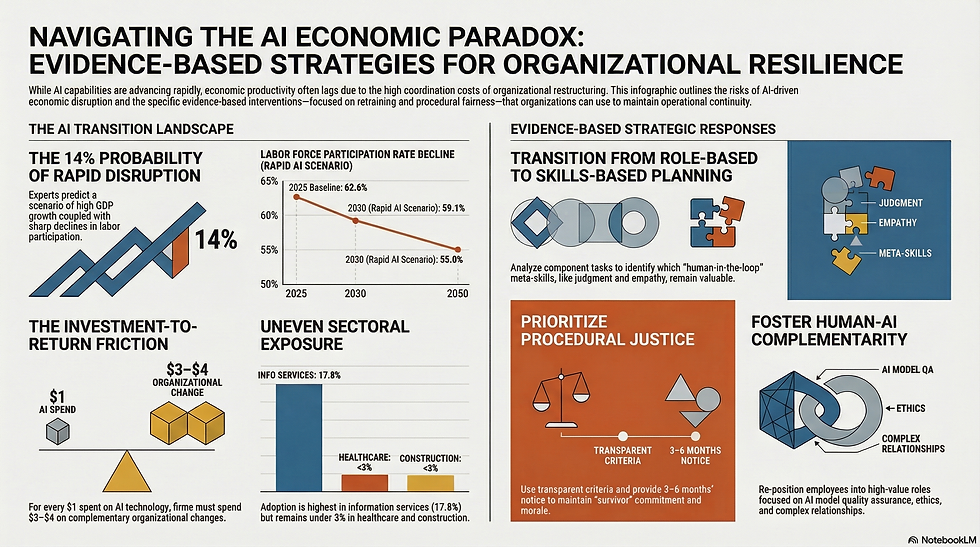
Yet beneath these consensus forecasts lies substantial uncertainty and a non-trivial probability of dramatic disruption. Economists assign a 14% chance to a rapid-progress scenario materializing by 2030, which they predict could deliver major increases in GDP growth alongside concerning declines in labor force participation and sharp increases in wealth concentration (Forecasting Research Institute, 2025). This represents economic transformation on a scale not seen since the post-World War II productivity surge—or potentially the pre-Depression inequality peaks of the 1930s.
For organizational leaders, this uncertainty demands a dual response: preparing for the most likely scenario of gradual AI integration while building resilience and adaptive capacity for more transformative possibilities. The stakes are considerable. Organizations that fail to anticipate workforce displacement may face talent crises, reputational damage, and operational disruption. Those that over-invest in AI capabilities without corresponding process transformation may see limited returns. And companies that neglect the human dimensions of AI adoption risk employee disengagement, skills atrophy, and organizational rigidity precisely when adaptability becomes paramount.
This article examines the organizational and workforce implications of AI's economic emergence, synthesizes evidence on effective organizational responses, and provides frameworks for building long-term adaptive capacity. We focus particularly on workforce transition support, which economists in the forecasting study identified as the most promising policy intervention—predicting it could maintain an additional 2.76 million Americans in the labor force during rapid AI progress while modestly boosting GDP growth. While that research addressed public policy, the principles translate directly to organizational practice: investing in human capability development during technological transition yields both humanitarian and performance dividends.
The AI Economic Transition Landscape
Defining AI's Organizational Impact in Context
Understanding AI's likely organizational impacts requires distinguishing between technological capability advancement and economic productivity realization—a distinction that expert forecasts suggest may create significant temporal lags. The moderate AI progress scenario that economists deemed most probable (47% likelihood) by 2030 describes systems capable of running semi-autonomous research laboratories, completing five-day coding projects, producing high-quality creative works, managing complex business functions, and enabling robots that navigate homes and perform basic tasks (Forecasting Research Institute, 2025). This represents capabilities far exceeding current AI systems across research, problem-solving, creativity, agency, and physical embodiment.
Yet the same economists predicting these capability gains forecast annualized GDP growth of just 2.5% by 2030 in their unconditional scenarios—only modestly above the 2.4% baseline from 2025 (Forecasting Research Institute, 2025). This apparent paradox—substantial technological advancement producing modest economic gains—reflects several critical insights about how transformative technologies actually diffuse through economies and organizations.
Research on general-purpose technology adoption demonstrates consistent patterns of multi-decade lags between technological availability and productivity improvements. Examining electrification, David (1990) found that despite electricity's availability in the 1880s, manufacturing productivity gains didn't materialize until the 1920s, requiring fundamental reorganization of factory layouts and work processes. Similarly, Brynjolfsson and Hitt (2000) documented how the personal computer revolution of the 1980s produced minimal productivity gains until the late 1990s, after organizations had restructured workflows, trained personnel, and developed complementary organizational practices. The delay reflected not technological limitations but organizational and institutional adaptation requirements.
For AI, several factors suggest similar lags may characterize near-term organizational impacts:
Uneven sectoral adoption: AI capabilities may transform knowledge work and digital services rapidly while leaving labor-intensive service sectors, regulated professions, and physical production relatively unchanged in the near term. Organizations in healthcare, education, construction, and hospitality face regulatory barriers, safety requirements, and human-interaction dependencies that slow AI integration regardless of technical capabilities.
Complementary asset requirements: Realizing AI productivity gains requires substantial complementary investments in data infrastructure, computing resources, process redesign, training programs, and organizational restructuring. Research by Brynjolfsson et al. (2021) examining AI adoption in firms found that for every dollar spent on AI technology, organizations spent approximately three to four dollars on complementary organizational investments. These coordination costs create natural adoption friction.
Skills and workforce transition: Even where AI can perform tasks effectively, workforce displacement and redeployment require time, training resources, and organizational change management. Rapid displacement without corresponding reskilling creates capability gaps, morale problems, and knowledge loss that can offset AI productivity gains.
Capital reallocation dynamics: Shifting resources from labor toward computing infrastructure, data systems, and AI services may not manifest as GDP growth until productivity improvements materialize. This creates an investment-before-returns dynamic that depresses near-term economic indicators.
Prevalence, Drivers, and Sectoral Distribution of AI Adoption
Understanding where and how rapidly AI adoption is occurring—and where it remains limited—provides crucial context for organizational planning. Current evidence suggests highly uneven adoption patterns driven by task characteristics, regulatory environments, capital availability, and organizational readiness.
Research by Felten et al. (2023) analyzing AI's task-level exposure across occupations found that roles involving routine cognitive tasks, information processing, and digital interaction face highest near-term exposure to AI capabilities. This includes significant portions of software development, customer service, financial analysis, legal research, marketing, and administrative coordination. However, occupations requiring physical dexterity, face-to-face social interaction, complex judgment in unpredictable environments, and creative problem-solving in novel contexts show substantially lower exposure in the near term.
Industry-level adoption data reveals this unevenness clearly. The 2024 U.S. Census Bureau Business Trends and Outlook Survey found that while 5.4% of businesses reported using AI for producing goods or services, adoption concentrated heavily in information services (17.8%), finance and insurance (8.7%), and professional and technical services (9.1%), while remaining below 3% in construction, healthcare, education, and hospitality sectors (U.S. Census Bureau, 2024). Even in high-adoption sectors, usage remains limited to specific functions—primarily customer service, content generation, and data analysis—rather than comprehensive operational transformation.
Several organizational factors consistently predict AI adoption speed:
Scale and resources: Larger organizations with greater capital availability, technical talent access, and risk-bearing capacity adopt AI earlier. Research by Babina et al. (2024) examining AI adoption across U.S. firms found that organizations in the top decile by employee count showed adoption rates more than five times higher than median-sized firms. This creates competitive dynamics where resource-constrained organizations may fall behind in capability development.
Technical infrastructure maturity: Organizations with existing data architecture, cloud computing capabilities, and technical talent pools integrate AI more readily. Legacy technology environments, fragmented data systems, and limited technical capacity create adoption barriers regardless of AI capability improvements.
Regulatory and safety constraints: Healthcare providers, financial institutions, educational organizations, and government agencies face compliance requirements, liability concerns, and safety standards that slow AI adoption despite potential efficiency gains. Research by Acemoglu et al. (2022) examining healthcare AI adoption found that regulatory approval processes, malpractice liability concerns, and patient safety requirements substantially delayed adoption relative to comparable unregulated sectors.
Workforce composition and labor relations: Organizations with strong labor representation, specialized professional workforces, or cultures emphasizing employment stability adopt AI more cautiously and with greater emphasis on workforce transition support. This can paradoxically create better long-term adoption outcomes by maintaining organizational capability and employee engagement during transitions.
Organizational and Individual Consequences of AI Adoption
Organizational Performance Impacts
The economic forecasting data reveals substantial uncertainty about AI's organizational performance impacts, with outcomes appearing highly dependent on adoption speed, organizational preparedness, and broader economic conditions. In baseline scenarios, economists predict modest productivity gains—annualized total factor productivity growth of 1.5% by 2030, compared to 1% historically—suggesting incremental rather than transformative near-term impacts (Forecasting Research Institute, 2025). However, in rapid-progress scenarios, projected productivity gains become substantial, with total factor productivity growth reaching 2% by 2030 and 2.5% by 2050.
To contextualize these projections, research by Gordon (2017) examining historical productivity patterns found that U.S. total factor productivity growth averaged approximately 2% annually during the post-World War II golden age (1947-1973), declined to roughly 0.5% during the productivity slowdown (1973-1995), then briefly accelerated to 1.5% during the late-1990s IT boom before declining again. The rapid AI scenario forecasts thus describe productivity acceleration comparable to the most dynamic periods in modern U.S. economic history—the postwar boom and IT revolution—sustained over multiple decades.
For individual organizations, research suggests AI adoption produces highly variable performance outcomes depending on implementation quality. Examining AI adoption across manufacturing firms, Babina et al. (2024) found that early AI adopters showed 3-4% higher productivity growth in the three years following adoption compared to non-adopters. However, this average masked substantial heterogeneity: approximately 40% of adopters showed no meaningful productivity improvement, while top-quartile implementers achieved productivity gains exceeding 10%. The difference correlated with organizational investments in worker training, process redesign, and management practice changes accompanying technological adoption.
Similar patterns emerge in service sectors. Research by Brynjolfsson et al. (2023) examining AI implementation in customer service operations found that organizations pairing AI tools with substantial agent training and discretion showed 14% increases in issue resolution per hour and 25% improvements in customer satisfaction scores. Organizations simply deploying AI tools without training or workflow redesign achieved minimal productivity gains and often experienced customer satisfaction declines due to escalated complaints and agent frustration.
The organizational performance implications thus appear critically dependent on how AI adoption occurs rather than simply whether it occurs:
Integration quality matters more than speed: Organizations that deliberately integrate AI with careful attention to workforce impacts, process redesign, and complementary capability building consistently outperform rapid deployments focused solely on labor substitution. Research on automation more broadly by Acemoglu and Restrepo (2020) found that automation strategies emphasizing worker augmentation rather than replacement generated substantially higher productivity gains and organizational performance improvements.
Workforce capability determines realization: AI tools' productivity potential depends entirely on workforce ability to use them effectively. Organizations that invest in training, experimentation support, and skill development capture substantially greater value from AI investments. Research by Bessen et al. (2020) examining software technology adoption found that every dollar of technology investment generated approximately four dollars of training and skill development investment in high-performing organizations.
Leadership and culture enable adaptation: Organizations with cultures emphasizing learning, experimentation, and change readiness adapt to AI more effectively. Research by Davenport and Kirby (2016) examining AI adoption across organizations found that cultural factors—particularly psychological safety, tolerance for experimentation, and trust between management and workers—predicted successful AI integration more strongly than technical factors.
Individual Wellbeing and Workforce Impacts
While organizational performance metrics capture economic dimensions of AI adoption, the human impacts on workers and communities deserve equal attention. The forecasting data provides sobering projections for workforce participation, particularly in rapid-progress scenarios. Economists predict labor force participation could decline from a 2025 baseline of 62.6% to 59.1% by 2030 and 55% by 2050 in rapid AI progress scenarios, with approximately half of this decline—equivalent to 10 million jobs—attributable directly to AI (Forecasting Research Institute, 2025). This would represent labor force participation levels not seen since the 1960s, before women's large-scale workforce entry.
Research on technological unemployment and workforce displacement provides crucial context for understanding these projections and their human consequences. Examining manufacturing automation's impacts, Acemoglu and Restrepo (2022) found that robot adoption in U.S. manufacturing between 1990 and 2007 reduced employment by approximately 400,000 workers and decreased wages by 0.2-0.4% across affected commuting zones. Importantly, displaced workers faced substantial long-term consequences: average earnings declined 11% in the year following displacement and remained 15% lower even six years afterward, with older workers and those with specialized skills facing particularly severe impacts.
The psychological and health consequences of displacement extend well beyond income losses. Research by Brand (2015) examining job loss consequences found that involuntary job loss during early and middle career increases mortality risk by 50-100% in the year following displacement, with elevated mortality persisting for 20 years. Mechanisms include increased stress, depression, substance abuse, cardiovascular disease risk, and reduced healthcare access. Sullivan and von Wachter (2009) estimated that job displacement reduces life expectancy by approximately 1.0-1.5 years on average, with effects concentrated among displaced workers who experience prolonged unemployment or substantial wage declines upon re-employment.
Community-level impacts compound individual harms. Research by Autor et al. (2013) examining Chinese import competition's effects on U.S. labor markets found that manufacturing employment declines in affected communities produced cascading effects including reduced housing values, increased government transfer program utilization, declining marriage rates, and increased single-parent households. More recent research by Acemoglu et al. (2022) examining automation's community impacts found similar spillover effects, with manufacturing automation reducing local labor demand and suppressing service sector employment in affected commuting zones.
For AI specifically, several factors may intensify displacement impacts relative to historical technological transitions:
Speed and scale: While manufacturing automation occurred over decades, AI capabilities may advance more rapidly, compressing adjustment timelines and making workforce transition more difficult. The forecasting data's rapid-progress scenario envisions capabilities transforming multiple sectors simultaneously by 2030—a five-year horizon offering minimal adjustment time.
White-collar vulnerability: Unlike previous automation waves concentrated in manufacturing and routine physical tasks, AI particularly affects knowledge work, professional services, and cognitive tasks. Many affected workers possess substantial formal education and specialized skills—credentials that previously provided displacement protection but may offer less security as AI capabilities advance.
Geographic concentration: Knowledge work concentrates in metropolitan areas with high costs of living, potentially creating displacement-driven housing crises and concentrated economic distress in high-cost regions. Research by Muro et al. (2019) examining AI exposure across U.S. labor markets found that major metropolitan areas show 20-30% higher AI task exposure than rural areas, suggesting displacement may concentrate where housing costs and cost-of-living adjustments create particular financial stress.
Skill specificity and transferability: Many knowledge workers possess highly specialized skills with limited transferability across sectors. Accountants displaced by AI financial analysis tools or radiologists displaced by AI diagnostic systems face challenges identifying adjacent roles where their expertise remains valuable. Research by Deming and Noray (2020) examining skill portability found that workers in specialized professional roles face substantially greater earning declines upon displacement compared to workers with more general skills.
The wealth inequality projections in the forecasting data further underscore distributional concerns. Economists forecast that in rapid AI progress scenarios, the wealthiest 10% of households could control 75% of national wealth by 2030 and 80% by 2050, compared to 71.2% currently (Forecasting Research Institute, 2025). These projections approach levels last seen in 1939, before decades of policy interventions moderating inequality. Research by Aghion et al. (2019) examining automation's distributional effects found that technology-driven productivity growth increasingly accrues to capital owners and highly educated workers while reducing labor's income share, mechanically increasing wealth concentration absent countervailing policies.
Evidence-Based Organizational Responses
Table 1: Evidence-Based Organizational Strategies for AI Workforce Transition
Organization | Transition Strategy/Program | Implementation Details | Employee Outcomes | Organizational Performance Impacts | Key Evidence-Based Principles |
IBM | Transparent Transition Planning | Provided public acknowledgement of AI impact and committed to 3-year advance notice for AI-driven layoffs alongside retraining support. | Reduced individual anxiety regarding displacement and created planning certainty for the workforce. | Reduced anxiety-driven attrition and enabled systematic skills development prior to displacement. | Procedural justice through advance notice and transparent criteria. |
Salesforce | Pathfinder Program | Identified 2,000+ employees in at-risk CRM roles and created individualized development plans based on adjacent-role mapping. | Approximately 80% of identified employees successfully transitioned to new roles within three years. | Preserved institutional knowledge and maintained productivity levels during technological shifts. | Early identification of at-risk roles and skills-based adjacent-role mapping. |
USAA | Financial Advocate Roles | Deployed AI chatbots for routine inquiries while retraining human staff for complex, high-empathy scenarios such as disability claims. | Enhanced staff proficiency in financial planning and empathetic communication for high-value service interactions. | Reduced operational costs while simultaneously improving member satisfaction scores. | Human-AI complementarity: AI for routine tasks and humans for complex or emotional service. |
Amazon | Career Choice Program | Pre-pays 95% of tuition and fees (up to $12,000 annually) for certificates or degrees in high-demand fields, including non-Amazon roles. | Supported 50,000+ employees; participants achieved 30% higher internal promotion rates compared to non-participants. | Improved internal mobility and gained a recruitment advantage through investment in development. | Structured learning pathways supported by meaningful financial assistance. |
AT&T | Workforce 2020 | Invested $1 billion in a retraining program focusing on leadership, strategic thinking, and business acumen alongside technical skills. | Participants reported an improved ability to adapt to changing environments by applying new problem-solving frameworks. | Enhanced organizational adaptability and resilience to technological disruption. | Human-AI complementarity through the development of leadership and strategic thinking. |
Accenture | Back-office AI Transition Support | Offered 3,000 affected employees a choice of internal roles, external placement with financial guarantees, or entrepreneurship training. | Preserved employee relationships and supported diverse career outcomes, including successful entrepreneurship. | Maintained workforce morale and established the firm as a responsible adopter of AI. | Generous transition support and procedural justice. |
Siemens USA | Mechatronics Apprenticeship Program | Implemented a three-year program combining classroom instruction with 80% on-the-job training and structured wage progressions. | High rate of skill acquisition and 95% retention rates for participating workers. | Successfully transitioned production workers into higher-skilled technical roles to manage automated systems. | Apprenticeship and experiential learning models with expert coaching. |
ING Bank | Agile Transformation / Distributed Leadership | Eliminated traditional hierarchies in favor of autonomous "squads" with end-to-end responsibility and strategic objectives. | Increased employee engagement and empowerment through autonomous decision-making authority. | Reduced decision cycle times by 30–50% and improved adaptation to banking sector disruption. | Distributed leadership and decentralized decision-making authority. |
Prudential Financial | Career Transition Accounts | Provided affected employees with 6–12 months of base pay specifically designated for job searches, retraining, or entrepreneurship. | Participants reported lower financial stress and higher confidence during career exploration phases. | Improved re-employment outcomes and maintained positive brand reputation during restructuring. | Transition income support to facilitate optimal job matching. |
Organizations face both moral and strategic imperatives to address AI's workforce implications proactively. The following interventions reflect converging evidence from research on technological transitions, workforce development, organizational change management, and economic policy.
Comprehensive Workforce Retraining Architecture
The forecasting research identified job retraining as the highest-support policy intervention among economists (71.8% support), with predictions it could increase labor force participation by 1 percentage point—approximately 2.76 million workers—in rapid AI progress scenarios while providing modest GDP growth benefits (Forecasting Research Institute, 2025). While that research addressed public policy, organizational-level retraining programs can deliver substantial individual and collective benefits.
Effective retraining programs share several evidence-based characteristics:
Early identification of at-risk roles: Organizations that systematically assess which positions face AI displacement risk and begin transition planning early achieve better outcomes than reactive approaches. This requires honest capability forecasting—acknowledging which tasks AI will likely automate rather than wishful thinking about irreplaceable human elements.
Salesforce provides instructive example of proactive skills assessment. In 2019, recognizing that AI-powered CRM features would reduce demand for certain implementation roles, the company launched its "Pathfinder" program, identifying 2,000+ employees in potentially at-risk positions and creating individualized skill development plans (Salesforce, 2020). The program combined AI exposure assessment with adjacent-role mapping, identifying positions requiring similar foundational skills where displaced workers could transition. Three years later, approximately 80% of identified employees had successfully transitioned to new roles, with the company maintaining productivity while preserving institutional knowledge.
Skills-based rather than role-based planning: Rather than categorizing entire positions as "safe" or "at-risk," effective programs analyze component tasks and identify which specific skills remain valuable, which require upgrading, and which new capabilities workers need developing. This granular approach recognizes that most jobs contain both automatable and distinctly human elements.
Research by Deming and Kahn (2018) examining skill transitions following technological change found that workers who successfully transitioned emphasized transferable meta-skills—complex problem-solving, coordination, judgment in ambiguity, and interpersonal capabilities—rather than attempting to preserve specific technical competencies. Organizations can facilitate these transitions by explicitly identifying which current-role skills transfer to adjacent positions and which gaps require closing.
Structured learning pathways with financial support: Effective programs provide clear curriculum pathways, dedicated learning time, financial support covering tuition or certification costs, and performance expectations adapted to recognize learning investments. Research by Heckman et al. (2010) examining workforce training program effectiveness found that programs providing financial support, structured curricula, and credential attainment assistance generated substantially higher completion rates and wage gains compared to programs offering training without financial backing.
Amazon's Career Choice program illustrates this approach at scale. The company pre-pays 95% of tuition and fees for employees pursuing certificates or degrees in high-demand fields, including options outside Amazon's direct operations (Amazon, 2021). While criticized by some as inadequate given warehouse working conditions, the program has supported 50,000+ employees pursuing education, with participants showing 30% higher internal promotion rates than non-participants. The program works because it provides meaningful financial support (up to $12,000 annually), structures pathways toward recognized credentials, and doesn't restrict training to Amazon-specific skills.
Peer learning and cohort-based approaches: Individual learning programs often suffer from isolation, lack of peer support, and difficulty sustaining motivation. Cohort-based approaches where groups of employees pursue development together create mutual accountability, peer learning opportunities, and social support networks that improve completion rates and skill retention.
Research by Kulik and Bainbridge (2006) examining organizational training effectiveness found that cohort-based programs with peer learning components generated 40% higher skill application rates compared to individual training, with participants reporting greater confidence applying new skills and more sustained behavior change. Organizations can foster these benefits by organizing retraining around cohorts, creating peer mentoring structures, and building communities of practice where learners support each other.
Apprenticeship and experiential learning: The most effective skill development combines formal instruction with structured practice opportunities, mentoring relationships, and graduated responsibility increases. Research on skill acquisition consistently demonstrates that experiential learning with expert coaching produces more durable, transferable skills than classroom instruction alone.
Several organizations have pioneered internal apprenticeship models. Siemens USA created a three-year mechatronics apprenticeship program combining classroom instruction with on-the-job training, certifications, and wage progressions, explicitly designed to transition production workers into higher-skilled technical roles as automation advanced (Siemens, 2018). Participants spend 80% of program time in supervised work settings, receiving coaching from experienced technicians while earning wages. The program reports 95% retention rates and has become a recruitment advantage as workers value development investment.
Leadership development and strategic thinking: As AI automates routine cognitive tasks, distinctly human contributions increasingly involve strategic judgment, creative problem-solving, cross-functional coordination, and leadership. Organizations preparing workers for AI-augmented environments should emphasize these capabilities.
AT&T's "Workforce 2020" initiative, launched in 2013 anticipating technological disruption, invested $1 billion in employee retraining with particular emphasis on leadership development, strategic thinking, and business acumen (AT&T, 2016). The program combined technical skill development with leadership training, project management capabilities, and strategic planning exposure. Participants reported that leadership and strategic thinking components—teaching them to think differently about problems rather than simply execute technical tasks—proved most valuable in adapting to changing work environments.
Transparent Communication and Procedural Justice
Organizations implementing AI-driven changes that affect workforce composition face crucial decisions about communication transparency, change process design, and how they balance efficiency with fairness. Research on organizational justice provides clear guidance: transparency, voice, and procedural fairness during difficult transitions produce better outcomes for both organizations and individuals.
Procedural justice research examines how process fairness affects employee responses to organizational decisions, particularly adverse outcomes like layoffs, restructuring, or role changes. Foundational work by Folger and Konovsky (1989) found that employees who perceived layoff decisions as procedurally fair—involving advance notice, explanation of decision criteria, opportunities for input, and consistent application of standards—showed significantly lower anger, litigation intentions, and negative word-of-mouth compared to employees experiencing similar outcomes through unfair processes.
Subsequent research has consistently confirmed these findings. Brockner et al. (1994) examined "layoff survivor" reactions, finding that remaining employees' organizational commitment, performance, and retention strongly depend on how organizations treated departed colleagues. When organizations used transparent processes, provided generous severance, and treated displaced workers with dignity, survivors maintained commitment and performance. When organizations handled layoffs poorly—providing minimal notice, offering inadequate explanations, or treating displaced workers disrespectfully—survivors showed substantial engagement declines, performance deterioration, and voluntary turnover increases.
Key procedural justice principles for AI-driven workforce transitions include:
Advance notice and transparent criteria: Organizations should communicate AI adoption plans and potential workforce implications as early as feasible, explaining which roles face displacement risk and why. Research by Datta et al. (2010) found that advance notice of 3-6 months before layoffs substantially reduced displaced workers' earnings losses and unemployment duration compared to shorter notice periods, allowing time for job search and skills development.
Several technology companies have modeled transparent communication during AI-driven transitions. IBM, beginning in 2016, publicly acknowledged that AI would reduce demand for certain IT services roles and committed to three-year advance notice before any AI-driven layoffs, alongside retraining support for affected employees (IBM, 2016). The policy created planning certainty, reduced anxiety-driven attrition, and allowed systematic skills development before displacement materialized.
Employee voice and participation: Allowing employees to provide input on transition processes, express concerns, and participate in solution development improves perceived fairness and often generates valuable implementation insights. Research by Lind et al. (1990) found that employees who received opportunities for voice during adverse organizational decisions showed substantially higher post-decision acceptance, even when their input didn't alter final outcomes.
Organizations can create voice through multiple mechanisms: town halls where leaders answer employee questions, working groups including employee representatives in transition planning, surveys gathering employee input on concerns and preferences, and individual consultations where affected workers discuss their specific situations. The key is genuine voice—actual consideration of employee input—rather than performative consultation.
Generous transition support: Organizations facing AI-driven workforce reductions should provide meaningful support including extended notice periods, substantial severance packages, comprehensive outplacement services, healthcare continuation, and retraining funding. While costly, such investments protect organizational reputation, maintain workforce morale, and constitute ethical obligations to longtime employees.
Research by Autor and Wasserman (2013) examining employer responses to technological displacement found that organizations providing generous transition support maintained substantially stronger employer brand strength, experienced lower voluntary turnover among remaining employees, and reported easier recruitment compared to organizations handling displacement through minimal support. The reputational consequences of poor treatment can persist for decades.
When Accenture implemented AI-driven changes in back-office operations affecting 3,000 employees over 2017-2019, it committed to offering every affected employee either alternative internal positions, structured external placement support with financial guarantees, or entrepreneurship training with seed capital for starting independent consultancies (Accenture, 2019). While expensive, leadership credited the approach with maintaining morale, preserving critical relationships, and positioning the company as a responsible AI adopter.
Consistent and objective standards: Displacement decisions should apply transparent, objective criteria consistently across the organization. Research by Greenberg (1990) found that employees who perceived layoff decisions as based on clear, consistently applied criteria showed substantially higher fairness perceptions than those who believed decisions reflected favoritism, politics, or inconsistent standards.
Organizations should establish clear criteria for identifying at-risk positions, evaluating employee capabilities, and determining transition support. These criteria should relate demonstrably to business requirements rather than subjective judgments, and should apply consistently regardless of employee characteristics or managerial preferences.
Strategic Capability Building and Adjacent Role Development
Beyond supporting workers facing displacement, forward-thinking organizations actively develop new high-value roles where human capabilities complement AI systems. Research on human-AI complementarity suggests that optimal deployment involves pairing AI's pattern recognition, computational speed, and consistency with human judgment, creativity, contextual understanding, and ethical reasoning.
Effective approaches include:
AI trainer and quality assurance roles: As organizations deploy AI systems, they require personnel who can train models, evaluate output quality, identify edge cases requiring human review, and continuously improve system performance. These roles leverage domain expertise while developing new technical capabilities.
Healthcare systems provide instructive examples. As AI diagnostic tools entered radiology departments, forward-thinking hospitals created "AI liaison" positions where experienced radiologists supervised AI systems, validated predictions, flagged problematic cases, and worked with technical teams to improve algorithms (Hartnett et al., 2020). Rather than simply replacing radiologists, these roles combined medical expertise with AI oversight, improving both AI system quality and diagnostic accuracy.
Human oversight and ethical governance: AI systems making consequential decisions about hiring, credit, healthcare, criminal justice, and other sensitive domains require human oversight ensuring fairness, accountability, and alignment with ethical principles. Research by Kleinberg et al. (2018) examining AI decision systems found that purely automated approaches consistently underperformed hybrid models with structured human review, particularly for edge cases requiring contextual judgment.
Organizations should develop governance roles where individuals with domain expertise, ethical training, and decision-making authority review AI system recommendations, audit for bias, and intervene when systems produce problematic outputs. These roles require substantial judgment and ethical reasoning—distinctly human capabilities.
Customer relationship and complex service roles: While AI can handle routine customer interactions efficiently, complex problems, emotionally charged situations, and relationship-building remain human strengths. Organizations should develop differentiated service models where AI handles routine requests while specialized human teams manage complexity.
Several financial services firms have pioneered this approach. USAA, an insurance and banking company serving military families, deployed AI chatbots for routine account inquiries while creating specialized "financial advocate" roles for members facing complex situations like deployment-related moves, disability claims, or survivor benefits (USAA, 2019). These advocates received enhanced training in financial planning, empathetic communication, and benefits navigation—capabilities AI couldn't replicate. The model reduced operational costs while improving member satisfaction scores.
Creative and strategic roles: AI systems can generate content, analyze data, and identify patterns, but strategic problem-solving, creative innovation, and conceptual thinking remain human advantages. Organizations should cultivate roles emphasizing these capabilities.
IBM's transformation of its consulting practice illustrates this transition. As AI tools automated routine analysis and reporting, IBM restructured consultant roles toward strategic advisory work emphasizing business model innovation, organizational design, and executive coaching—work requiring deep contextual understanding, relationship building, and creative problem-solving (IBM, 2018). The company invested heavily in training consultants on strategic facilitation, design thinking, and executive communication, positioning human consultants as strategic partners while AI handled analytical and documentation tasks.
Financial and Benefit Support Programs
Beyond retraining and role development, organizations can provide direct financial and benefit support helping employees navigate AI-driven transitions. While the forecasting research found economists skeptical of universal basic income policies at the societal level—predicting labor force participation declines without corresponding GDP gains—targeted organizational support programs differ substantially in design and effects.
Effective organizational approaches include:
Transition income support: Organizations implementing substantial AI-driven workforce changes can provide financial stipends supporting employees during retraining periods or job searches, reducing financial stress and allowing more deliberate career planning. Research by Schmieder and von Wachter (2016) examining unemployment insurance programs found that adequate income support during job displacement substantially improved re-employment outcomes, allowing workers to find better job matches rather than accepting the first available position.
Several organizations have piloted transition support programs. When Prudential Financial restructured operations in 2018-2019, affecting 2,500 positions, it created "Career Transition Accounts" providing affected employees with 6-12 months' base pay (depending on tenure) specifically designated for supporting job search, retraining, or entrepreneurship exploration (Prudential, 2019). The program required no work-search activities, allowed employees to extend timelines through part-time work, and could supplement other income sources. Participants reported substantially lower financial stress and greater confidence exploring career options compared to traditional severance approaches.
Education and certification funding: Organizations can establish tuition reimbursement programs, certification funding, or learning stipends supporting employees pursuing credentials that enhance employability. These programs create goodwill, support broader human capital development, and contribute to regional economic resilience.
Healthcare continuation and benefits protection: Given that U.S. healthcare access depends heavily on employment, organizations should ensure displaced workers maintain coverage during transitions. Research by Strully (2009) found that job loss substantially reduces healthcare utilization and increases delayed care, with significant health consequences. Organizations can extend healthcare coverage, provide COBRA subsidy payments, or assist workers securing marketplace coverage.
Relocation and geographic mobility support: When AI-driven changes concentrate in particular regions or when displaced workers would benefit from relocating to stronger labor markets, organizations can provide moving assistance, housing support, or geographic search services. Research by Notowidigdo (2020) examining local labor market shocks found that relocation support substantially improved displaced workers' employment and earnings outcomes by enabling movement to opportunity.
Building Long-Term Organizational Resilience and Adaptive Capacity
Beyond immediate transition support, organizations should cultivate long-term capabilities for navigating ongoing technological change. The forecasting data's substantial uncertainty—with economists' 80% credible intervals for 2050 GDP growth spanning 1.0% to 7.0% in rapid scenarios—underscores that organizations face fundamental unpredictability requiring adaptive capacity rather than fixed strategies.
Continuous Learning Culture and Growth Mindset
Organizations that thrive amid technological change cultivate cultures emphasizing continuous learning, experimentation, and adaptability as core values. Research on organizational learning provides clear guidance on fostering these cultures.
Carol Dweck's research on growth versus fixed mindsets demonstrates that individuals who believe capabilities can develop through effort and learning (growth mindset) outperform those viewing abilities as fixed traits, particularly during challenges (Dweck, 2006). Organizations can foster growth mindsets through several mechanisms:
Normalizing experimentation and failure: Organizations that treat failures as learning opportunities rather than performance deficiencies encourage risk-taking and innovation. Research by Edmondson (1999) on psychological safety found that teams where members felt safe admitting mistakes, asking questions, and proposing ideas showed substantially higher learning rates and performance improvements compared to psychologically unsafe teams.
Leaders can foster psychological safety by modeling vulnerability—discussing their own learning challenges and mistakes—explicitly framing failures as data for improvement, and ensuring no adverse consequences for reasonable experiments that don't succeed. Google's long-running research on team effectiveness identified psychological safety as the single strongest predictor of team performance across the organization (Rozovsky, 2015).
Structured learning time and resources: Organizations should provide dedicated time, resources, and infrastructure supporting employee learning and skill development. Research by Davenport et al. (2011) found that organizations allocating structured learning time—even small amounts like four hours monthly—showed substantially higher skill development rates than organizations expecting learning during personal time.
Several technology companies have institutionalized learning time. Atlassian provides "ShipIt Days"—quarterly 24-hour periods where employees work on any project of interest, building new skills and exploring ideas (Atlassian, 2020). While initially focused on engineering, the program has expanded across functions, becoming a key mechanism for experimentation and cross-functional collaboration.
Recognition and reward systems aligned with learning: Performance evaluation and advancement criteria should explicitly value learning, skill development, and adaptability alongside task execution. Research by Lawler (1990) examining performance management systems found that employees consistently prioritize behaviors that recognition and reward systems incentivize, regardless of espoused organizational values.
Organizations can align reward systems with learning by incorporating skill development into performance evaluations, creating advancement pathways that reward capability growth, and celebrating learning achievements organizationally. Microsoft's shift from "stacked ranking" performance systems to growth-focused evaluation—emphasizing learning, collaboration, and development alongside results—helped transform organizational culture and contributed to its successful cloud transition (Nadella, 2017).
Distributed Leadership and Decision-Making
As AI and technological change create greater environmental uncertainty and faster decision requirements, hierarchical decision-making structures become bottlenecks. Research on organizational design during uncertainty suggests that distributed leadership approaches—pushing decision authority and strategic thinking throughout organizations—generate more adaptive, resilient organizations.
Research by Aghion et al. (2014) examining organizational structure effects on innovation found that organizations with decentralized decision authority showed substantially higher innovation rates and faster adaptation to environmental changes compared to centralized organizations. Mechanisms include faster information transmission, local knowledge utilization, and employee empowerment effects.
Effective distributed leadership approaches include:
Clear decision authority frameworks: Organizations should explicitly define which decisions require hierarchical approval and which individuals or teams can make autonomously, based on decision scope and reversibility. Research by Bresman and Zellmer-Bruhn (2013) found that teams with clear authority boundaries—understanding what they could decide independently—showed higher performance and satisfaction than teams with ambiguous authority.
Investment in leadership capabilities broadly: Organizations should develop strategic thinking, decision-making, and leadership skills across levels rather than restricting leadership development to senior ranks. Research by Day (2000) on leadership development found that organizations training leadership capabilities widely created more adaptive, resilient structures than those limiting development to designated leadership tracks.
Cross-functional collaboration structures: Technological change often requires coordinated responses across traditional functional boundaries. Organizations should create mechanisms enabling cross-functional collaboration including shared goals, matrixed responsibilities, and cross-functional teams addressing strategic challenges.
ING Bank's organizational transformation in 2015-2017 illustrates distributed leadership principles. The company eliminated traditional hierarchical structures in favor of autonomous "squads" with end-to-end responsibility for customer experiences, supported by shared platforms and resources (ING, 2017). Squads received strategic objectives but substantial autonomy in execution approaches. The restructuring reduced decision cycle times by 30-50% and improved employee engagement scores while better positioning ING for technological disruption in banking.
Purpose, Meaning, and Organizational Identity
During periods of disruption, organizations that maintain clear purpose and meaning—helping employees understand how their work contributes to valued outcomes beyond profit—show greater resilience, engagement, and retention. Research on meaningful work demonstrates that employees who experience their work as meaningful show substantially higher engagement, performance, and wellbeing.
Rosso et al. (2010) synthesized research on meaningful work, identifying four key sources: connection to valued impact, alignment with personal values, positive interpersonal relationships, and sense of significance and recognition. Organizations can strengthen these dimensions during AI transitions:
Emphasizing human impact and purpose: Organizations should clearly articulate how their work creates value for customers, communities, and society, and how specific roles contribute to this purpose. Research by Grant (2008) found that employees who understood their work's impact on beneficiaries showed substantially higher motivation and performance compared to those without this understanding.
Reframing AI as augmentation rather than replacement: Organizations can position AI as enabling employees to focus on higher-value, more meaningful work by automating routine tasks. Research by Jarrahi (2018) found that employees who viewed AI as augmenting capabilities showed positive attitudes and effective AI utilization, while those viewing AI as threatening showed resistance and minimal engagement.
Investing in community and relationships: Organizations should foster interpersonal connections, collaborative relationships, and community feeling, which become particularly valuable during uncertainty. Research by Dutton and Ragins (2007) on high-quality workplace connections found that strong interpersonal relationships buffer stress, improve wellbeing, and enhance adaptation during organizational change.
Patagonia, the outdoor apparel company, demonstrates purpose-driven culture during change. When implementing automation in warehouse operations, leadership emphasized how automation enabled employees to focus on customer experience, product quality, and environmental sustainability rather than repetitive tasks (Patagonia, 2021). The company invested in training workers for quality control, customer service, and environmental advocacy roles while positioning automation as supporting the company's environmental mission. Employee engagement remained high despite substantial operational changes, with workers expressing that automation enabled more meaningful contributions.
Conclusion
Organizations face profound uncertainty about AI's economic trajectory, with expert forecasts revealing substantial disagreement about both technological capability advancement and economic impact realization. While consensus projections suggest gradual AI integration producing modest near-term productivity gains, a non-trivial probability exists of much more transformative scenarios featuring rapid capability advancement, substantial workforce displacement, accelerating inequality, and either explosive economic growth or significant disruption.
This uncertainty demands organizational responses balancing preparation for gradual change with resilience-building for more dramatic possibilities. The evidence reviewed suggests several clear conclusions:
First, workforce transition support represents the highest-value organizational investment during AI adoption. Comprehensive retraining programs providing financial support, structured learning pathways, peer cohorts, and experiential learning opportunities can maintain workforce attachment, preserve institutional knowledge, and support individuals through career transitions. Economists surveyed predicted that robust retraining policies could maintain millions of additional workers in the labor force while supporting economic growth—benefits that organizational-level programs can deliver at smaller scales.
Second, process matters as much as outcomes during workforce transitions. Organizations that communicate transparently, provide voice opportunities, apply consistent standards, and treat displaced workers with dignity and support maintain stronger organizational culture, reputation, and performance among remaining employees compared to organizations prioritizing efficiency over fairness during transitions.
Third, strategic capability development should emphasize human-AI complementarity rather than wholesale automation. Organizations that develop roles leveraging distinctly human capabilities—judgment, creativity, ethical reasoning, relationship building, contextual understanding—while pairing them with AI efficiency and pattern recognition achieve better outcomes than purely substitution-focused approaches.
Fourth, long-term resilience requires continuous learning cultures, distributed leadership, and purpose-driven identity. Organizations that cultivate growth mindsets, psychological safety, clear purpose, and adaptive structures navigate technological uncertainty more effectively than those relying on fixed strategies and hierarchical decision-making.
The stakes of organizational responses extend beyond individual firm performance to broader economic and social outcomes. If organizations collectively adopt proactive transition support, emphasize human capability development, and prioritize worker wellbeing alongside efficiency, AI's economic transition can maintain workforce participation, moderate inequality pressures, and distribute productivity gains broadly. If organizations pursue narrow efficiency optimization without addressing workforce implications, the forecasting data's concerning scenarios—declining labor force participation, accelerating inequality, and concentrated wealth—become more probable.
The choice facing organizational leaders is not whether AI will transform work—expert consensus suggests substantial capability advancement regardless of individual organizational choices. Rather, the choice concerns how this transformation occurs: whether through managed transitions supporting workers and communities, or through purely efficiency-driven approaches creating broader disruption. Evidence clearly demonstrates that investments in human capability, procedural fairness, and long-term resilience generate both moral and strategic value. Organizations that embrace this evidence position themselves to thrive through technological change while contributing to broadly shared prosperity.
Research Infographic
References
Acemoglu, D., Autor, D., Hazell, J., & Restrepo, P. (2022). Artificial intelligence and jobs: Evidence from online vacancies. Journal of Labor Economics, 40(S1), S293-S340.
Acemoglu, D., & Restrepo, P. (2020). Robots and jobs: Evidence from US labor markets. Journal of Political Economy, 128(6), 2188-2244.
Acemoglu, D., & Restrepo, P. (2022). Demographics and automation. Review of Economic Studies, 89(1), 1-44.
Aghion, P., Akcigit, U., Lequien, M., & Stantcheva, S. (2017). Tax simplicity and heterogeneous learning. NBER Working Paper No. 24049.
Aghion, P., Antonin, C., Bunel, S., & Jaravel, X. (2019). What are the labor and product market effects of automation? New evidence from France. Working paper, Collège de France.
Aghion, P., Bloom, N., Blundell, R., Griffith, R., & Howitt, P. (2014). Competition and innovation: An inverted-U relationship. Quarterly Journal of Economics, 120(2), 701-728.
Amazon. (2021). Career Choice program overview. Amazon Corporate News.
AT&T. (2016). Workforce 2020: The AT&T story. AT&T Corporate Communications.
Atlassian. (2020). ShipIt: Atlassian's approach to innovation. Atlassian Team Playbook.
Autor, D. H., Dorn, D., & Hanson, G. H. (2013). The China syndrome: Local labor market effects of import competition in the United States. American Economic Review, 103(6), 2121-2168.
Autor, D. H., & Wasserman, M. (2013). Wayward sons: The emerging gender gap in labor markets and education. Third Way Report.
Babina, T., Fedyk, A., He, A. X., & Hodson, J. (2024). Artificial intelligence, firm growth, and product innovation. Journal of Financial Economics, 151, 103745.
Bessen, J., Impink, S. M., Reichensperger, L., & Seamans, R. (2020). The business of AI startups. Boston University School of Law, Law and Economics Research Paper No. 20-29.
Brand, J. E. (2015). The far-reaching impact of job loss and unemployment. Annual Review of Sociology, 41, 359-375.
Bresman, H., & Zellmer-Bruhn, M. (2013). The structural context of team learning: Effects of organizational and team structure on internal and external learning. Organization Science, 24(4), 1120-1139.
Brockner, J., Konovsky, M., Cooper-Schneider, R., Folger, R., Martin, C., & Bies, R. J. (1994). Interactive effects of procedural justice and outcome negativity on victims and survivors of job loss. Academy of Management Journal, 37(2), 397-409.
Brynjolfsson, E., & Hitt, L. M. (2000). Beyond computation: Information technology, organizational transformation and business performance. Journal of Economic Perspectives, 14(4), 23-48.
Brynjolfsson, E., Li, D., & Raymond, L. R. (2023). Generative AI at work. NBER Working Paper No. 31161.
Brynjolfsson, E., Rock, D., & Syverson, C. (2021). The productivity J-curve: How intangibles complement general purpose technologies. American Economic Journal: Macroeconomics, 13(1), 333-372.
Congressional Budget Office. (2026). The budget and economic outlook: 2026 to 2036. CBO Publication 58346.
Datta, D. K., Guthrie, J. P., Basuil, D., & Pandey, A. (2010). Causes and effects of employee downsizing: A review and synthesis. Journal of Management, 36(1), 281-348.
Davenport, T. H., & Kirby, J. (2016). Only humans need apply: Winners and losers in the age of smart machines. HarperBusiness.
Davenport, T. H., Thomas, R. J., & Cantrell, S. (2011). The mysterious art and science of knowledge-worker performance. MIT Sloan Management Review, 44(1), 23-30.
David, P. A. (1990). The dynamo and the computer: An historical perspective on the modern productivity paradox. American Economic Review, 80(2), 355-361.
Day, D. V. (2000). Leadership development: A review in context. Leadership Quarterly, 11(4), 581-613.
Deming, D. J., & Kahn, L. B. (2018). Skill requirements across firms and labor markets: Evidence from job postings for professionals. Journal of Labor Economics, 36(S1), S337-S369.
Deming, D. J., & Noray, K. L. (2020). Earnings dynamics, changing job skills, and STEM careers. Quarterly Journal of Economics, 135(4), 1965-2005.
Dutton, J. E., & Ragins, B. R. (Eds.). (2007). Exploring positive relationships at work: Building a theoretical and research foundation. Lawrence Erlbaum Associates.
Dweck, C. S. (2006). Mindset: The new psychology of success. Random House.
Edmondson, A. (1999). Psychological safety and learning behavior in work teams. Administrative Science Quarterly, 44(2), 350-383.
Felten, E., Raj, M., & Seamans, R. (2023). Occupational heterogeneity in exposure to generative AI. Available at SSRN 4414065.
Folger, R., & Konovsky, M. A. (1989). Effects of procedural and distributive justice on reactions to pay raise decisions. Academy of Management Journal, 32(1), 115-130.
Forecasting Research Institute. (2025). Forecasting the economic effects of AI: Predictions from economists, AI experts, and the public. Working paper.
Gordon, R. J. (2017). The rise and fall of American growth: The U.S. standard of living since the Civil War. Princeton University Press.
Grant, A. M. (2008). The significance of task significance: Job performance effects, relational mechanisms, and boundary conditions. Journal of Applied Psychology, 93(1), 108-124.
Greenberg, J. (1990). Organizational justice: Yesterday, today, and tomorrow. Journal of Management, 16(2), 399-432.
Hartnett, B., Mehta, P., & Kohli, M. (2020). Radiologist–AI collaboration in breast imaging: Lessons learned. Journal of the American College of Radiology, 17(1), 150-154.
Heckman, J. J., Moon, S. H., Pinto, R., Savelyev, P. A., & Yavitz, A. (2010). The rate of return to the HighScope Perry Preschool Program. Journal of Public Economics, 94(1-2), 114-128.
ING. (2017). ING's agile transformation. ING Bank Corporate Communications.
Jarrahi, M. H. (2018). Artificial intelligence and the future of work: Human-AI symbiosis in organizational decision making. Business Horizons, 61(4), 577-586.
Jorgenson, D. W., & Stiroh, K. J. (2000). Raising the speed limit: US economic growth in the information age. Brookings Papers on Economic Activity, 2000(1), 125-235.
Kleinberg, J., Lakkaraju, H., Leskovec, J., Ludwig, J., & Mullainathan, S. (2018). Human decisions and machine predictions. Quarterly Journal of Economics, 133(1), 237-293.
Kulik, C. T., & Bainbridge, H. T. (2006). HR and the line: The distribution of HR activities in Australian organisations. Asia Pacific Journal of Human Resources, 44(2), 240-256.
Lawler, E. E. (1990). Strategic pay: Aligning organizational strategies and pay systems. Jossey-Bass.
Lind, E. A., Kanfer, R., & Earley, P. C. (1990). Voice, control, and procedural justice: Instrumental and noninstrumental concerns in fairness judgments. Journal of Personality and Social Psychology, 59(5), 952-959.
Muro, M., Maxim, R., & Whiton, J. (2019). Automation and artificial intelligence: How machines are affecting people and places. Brookings Institution.
Nadella, S. (2017). Hit refresh: The quest to rediscover Microsoft's soul and imagine a better future for everyone. HarperBusiness.
Notowidigdo, M. J. (2020). The incidence of local labor demand shocks. Journal of Labor Economics, 38(3), 687-725.
Rosso, B. D., Dekas, K. H., & Wrzesniewski, A. (2010). On the meaning of work: A theoretical integration and review. Research in Organizational Behavior, 30, 91-127.
Rozovsky, J. (2015). The five keys to a successful Google team. re:Work blog, Google.
Schmieder, J. F., & von Wachter, T. (2016). The effects of unemployment insurance benefits: New evidence and interpretation. Annual Review of Economics, 8, 547-581.
Shackleton, R. (2013). Total factor productivity growth in historical perspective. Congressional Budget Office Working Paper 2013-01.
Strully, K. W. (2009). Job loss and health in the U.S. labor market. Demography, 46(2), 221-246.
Sullivan, D., & von Wachter, T. (2009). Job displacement and mortality: An analysis using administrative data. Quarterly Journal of Economics, 124(3), 1265-1306.
U.S. Census Bureau. (2024). Business Trends and Outlook Survey. Census Bureau News Release CB24-TPS.148.

Jonathan H. Westover, PhD is Chief Research Officer (Nexus Institute for Work and AI); Associate Dean and Director of HR Academic Programs (WGU); Professor, Organizational Leadership (UVU); OD/HR/Leadership Consultant (Human Capital Innovations). Read Jonathan Westover's executive profile here.
Suggested Citation: Westover, J. H. (2026). Preparing Organizations for AI's Economic Disruption: Evidence-Based Strategies for Workforce Transition and Strategic Adaptation. Human Capital Leadership Review, 35(2). doi.org/10.70175/hclreview.2020.35.2.6