


Bridging the Education-to-Employment Divide: What Employers Really Want from Higher Education


Listen to a review of this article:
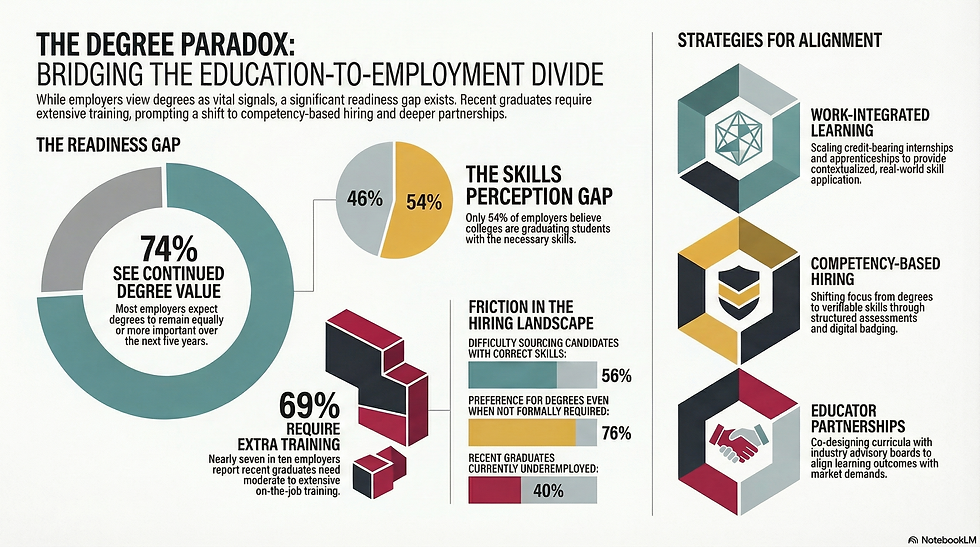
Abstract: Despite declining public confidence in higher education, U.S. employers consistently signal that postsecondary credentials remain central to workforce success and organizational competitiveness. This analysis synthesizes findings from a 2025 Lumina Foundation–Gallup survey of 2,000 U.S. employers with hiring authority to examine the persistent misalignment between higher education outcomes and employer expectations. Results indicate that while nearly half of employers view college degrees as essential for most roles in their organizations, and three-quarters anticipate degrees will remain equally or more important over the next five years, only 54% believe colleges are graduating students with requisite skills. Furthermore, 69% report that recent graduates require moderate to extensive additional training, and 56% experience difficulty sourcing candidates with appropriate competencies. These tensions are compounded by the paradox of skills-based hiring rhetoric: even as organizations publicly eliminate degree requirements, approximately three-quarters of employers prefer candidates possess associate or bachelor's degrees for roles that do not formally mandate them. The findings underscore an urgent need for tighter curriculum-to-workplace integration, expanded experiential learning, more transparent competency signaling, and policy frameworks—including workforce training access and immigration pathways—that respond to documented talent shortages while preserving the enduring labor-market value of postsecondary attainment.
Higher education in the United States stands at a crossroads. Public skepticism about college affordability, relevance, and return on investment has intensified, even as the labor market continues to reward postsecondary credentials with wage premiums and employment stability (Carnevale et al., 2021). Meanwhile, employers face mounting pressure to fill roles in an environment characterized by rapid technological change, demographic shifts, and evolving skill demands. The rhetoric of "skills over degrees" has gained traction in policy circles and corporate communications, yet the empirical reality of hiring practices tells a more complex story.
This article examines that complexity through the lens of employer perceptions and practices, drawing on a representative 2025 survey of 2,000 U.S. employers conducted by Gallup in partnership with Lumina Foundation. These employers—spanning industries, organization sizes, and geographies—hold hiring authority and are therefore positioned to translate labor-market signals into tangible hiring decisions. Their responses reveal both the persistent value employers ascribe to formal education and the frustrations they encounter when graduates lack the competencies required for immediate workplace effectiveness.
Why Now?
Several forces converge to make this moment particularly consequential for education-to-employment alignment:
Policy flux: Federal initiatives such as Workforce Pell and changes to H-1B visa requirements directly affect how quickly workers can access training and how employers fill critical shortages with international talent.
Technological disruption: The acceleration of artificial intelligence and automation is reshaping task structures, skill obsolescence rates, and the very definition of "job-ready."
Demographic pressures: An aging workforce, declining birth rates, and regional migration patterns are tightening labor markets in key sectors, heightening the urgency of talent development.
Credential proliferation: Alternative credentials, micro-credentials, and competency-based education models promise flexibility and responsiveness but also introduce ambiguity about quality and comparability.
Understanding employer perspectives is essential not only for institutional leaders seeking to refine curricula but also for policymakers balancing access, equity, and workforce competitiveness. The stakes are practical and immediate: misalignment translates into unfilled positions, productivity losses, and constrained economic growth, while well-prepared graduates experience smoother transitions, higher earnings, and greater career satisfaction.
The Higher Education and Workforce Alignment Landscape
Defining Alignment in the Education-to-Employment Context
Alignment in this context refers to the degree of correspondence between the competencies, dispositions, and credentials that higher education institutions cultivate and the skills, attitudes, and qualifications that employers require for effective job performance. Alignment is multidimensional, encompassing:
Cognitive skills: Critical thinking, problem-solving, quantitative reasoning.
Technical competencies: Field-specific knowledge and applied capabilities.
Interpersonal and intrapersonal skills: Communication, teamwork, adaptability, resilience.
Credentialing transparency: The clarity with which degrees and certificates signal competence to external evaluators.
Perfect alignment is neither achievable nor necessarily desirable—higher education serves broader purposes than workforce preparation alone, including civic engagement, personal development, and knowledge creation (Bok, 2013). Yet substantial misalignment imposes costs: employers bear training expenses, graduates experience underemployment or delayed career entry, and society foregoes economic and social returns on educational investment.
State of Practice: Employer Attitudes Toward Higher Education
The Lumina–Gallup survey reveals a nuanced portrait. On one hand, employers express sustained confidence in the structural value of postsecondary credentials. Approximately 48% agree that most jobs in their organizations require a college degree for success, and 74% anticipate that degrees will be at least as important five years hence. These figures suggest that despite public debates questioning college's worth, employers continue to view formal education as a reliable signal of trainability, persistence, and baseline competence (Spence, 1973).
On the other hand, only 54% believe that U.S. colleges and universities are graduating students with the skills their businesses need—a bare majority that implies nearly half perceive a significant gap. This perception gap is consequential: it shapes recruitment strategies, influences investment in training infrastructure, and affects organizational willingness to partner with education providers.
The Skills Gap: Real, Perceived, or Both?
The "skills gap" has become a staple of workforce discourse, yet its precise nature remains contested. Some scholars argue that employers' complaints reflect unrealistic expectations, wage suppression strategies, or reluctance to invest in training (Cappelli, 2015). Others point to genuine shifts in occupational skill requirements driven by technology and globalization (Autor et al., 2003).
The survey data support a middle interpretation: employers are not abandoning higher education, but they are dissatisfied with graduates' readiness for immediate contribution. Sixty-nine percent report that recent college hires require moderate to extensive additional training—a finding that suggests degrees may certify foundational knowledge but often fall short on applied, contextual, or firm-specific competencies. This pattern is consistent with broader research showing that employers value both credentials (as screening devices) and competencies (as performance enablers), but find the two imperfectly correlated (Burning Glass Technologies & Strada Institute, 2018).
Organizational and Individual Consequences of Misalignment
Organizational Performance Impacts
When graduates arrive underprepared, organizations incur measurable costs. These include:
Extended onboarding timelines: Firms must allocate resources to bridge skill deficits, delaying productivity gains. Research by the Society for Human Resource Management estimates that the average cost-per-hire in the U.S. exceeds $4,700, with longer time-to-productivity multiplying these costs (SHRM, 2022).
Recruitment difficulties: Fifty-six percent of surveyed employers report that finding candidates with the right skills is difficult or very difficult. Persistent vacancies constrain output, strain existing employees, and can lead to lost revenue.
Reliance on foreign-born talent: Thirty-eight percent of employers say they must hire foreign-born workers due to perceived domestic skill shortages. While international talent enriches organizations, over-reliance on immigration pathways introduces vulnerability to policy shifts—36% of employers anticipate negative impacts from changes to H-1B visa processes.
Training expenditures: U.S. organizations spent approximately $92.3 billion on employee training in 2020–2021 (Training Industry, 2021). While some training is inevitable and desirable, a significant share compensates for gaps that postsecondary institutions could address more cost-effectively.
These costs aggregate into broader economic inefficiencies. A McKinsey Global Institute analysis estimated that better education-to-employment alignment could unlock an additional $1.5 trillion in global GDP growth (Mourshed et al., 2012).
Individual and Stakeholder Impacts
Misalignment also disadvantages graduates and prospective students:
Underemployment: Graduates may accept roles below their credential level, forgoing wage premiums and experiencing slower career progression. Recent estimates suggest that approximately 40% of recent U.S. bachelor's degree holders are underemployed in their first job (Burning Glass Institute & Strada Education Foundation, 2024).
Debt burden without commensurate returns: When degrees do not translate into expected employment outcomes, borrowers face financial strain. The psychological toll—stress, diminished wellbeing—is well-documented (Walsemann et al., 2015).
Equity implications: Misalignment disproportionately harms students from underrepresented backgrounds who may have less access to informal networks, internships, and career guidance that compensate for curricular gaps (Carnevale & Strohl, 2013).
For employers, the individual-level consequences manifest as higher turnover, lower engagement, and reputational risks when diversity and social mobility commitments are undermined by opaque hiring practices.
Evidence-Based Organizational Responses
Table 1: Corporate Initiatives for Education-to-Employment Alignment
Organization | Initiative Name | Alignment Strategy | Program Features | Educational Partners | Reported Outcomes | Primary Skill Focus (Inferred) |
AT&T | Future Ready initiative | Upskilling and Reskilling Investments | $1 billion investment; provides access to online degrees, nanodegrees, and professional certificates; utilizes career frameworks mapping new skills to internal opportunities. | Universities; Udacity; Coursera; edX; Guild Education | Retrained tens of thousands of employees; reduced attrition; positioned workforce for digital transformation. | Technical and Leadership |
IBM | New Collar roles / P-TECH schools | Competency-Based Hiring and Transparent Skill Signaling | Eliminated degree requirements for approximately 50% of openings; utilizes skills validated through internal training, industry certifications, and public education models integrating high school, college, and mentorship. | Community colleges; P-TECH schools | Increased workforce diversity and access to untapped talent pools. | Technical |
Siemens USA | Federally registered apprenticeship program | Work-Integrated Learning and Structured Internships | Combines classroom instruction with on-the-job training; participants earn associate degrees and industry-recognized credentials while receiving wages. | Community colleges (over a dozen postsecondary institutions) | Retention rates exceeding 90%; expanded model across multiple facilities. | Technical |
Northeastern University | Cooperative education model | Employer–Educator Partnerships and Curriculum Co-Design | Integrates six-month paid work experiences into undergraduate degree programs; employers co-design learning objectives; students complete reflective assignments. | Northeastern University (with global employer partners) | Graduates command wage premiums and report higher career satisfaction. | Interpersonal and Technical |
Deloitte | Competency Model | Transparent Communication and Expectation Setting | Published detailed capabilities across career stages shared with university partners; used in recruitment communications and development planning. | University partners (unnamed) | Enhanced diversity and inclusion; reduced reliance on informal networks; enabled student self-assessment. | Leadership and Interpersonal |
Organizations are not passive recipients of education outcomes; many are proactively addressing alignment challenges through recruitment innovation, partnership models, and internal capability building. The following interventions reflect both scholarly evidence and documented practice.
Work-Integrated Learning and Structured Internships
Co-operative education, internships, and apprenticeships improve employment outcomes by providing contextualized skill application, professional socialization, and employer visibility (Drewery et al., 2016). A longitudinal study found that students completing internships were 15% more likely to be employed within six months of graduation and earned 6% higher starting salaries (National Association of Colleges and Employers, 2021).
Effective approaches:
Paid, credit-bearing internships that integrate reflection and academic assessment, rather than purely transactional placements.
Rotational programs exposing participants to multiple functions, fostering adaptability.
Apprenticeship expansion beyond traditional trades into technology, healthcare, and professional services.
Siemens USA operates a federally registered apprenticeship program in advanced manufacturing, combining classroom instruction at community colleges with on-the-job training. Participants earn associate degrees and industry-recognized credentials while receiving wages. Siemens reports retention rates exceeding 90% and has expanded the model across multiple facilities, partnering with over a dozen postsecondary institutions. The program addresses both immediate skill needs and longer-term talent pipeline development, exemplifying how employers can co-invest in education when structures align incentives (Lerman, 2019).
Competency-Based Hiring and Transparent Skill Signaling
While 23% of surveyed employers report removing degree requirements from select roles over the past three years, the survey also reveals that 76% still prefer candidates possess associate or bachelor's degrees even when not required. This paradox suggests that credentialing transparency—clear, verifiable signals of specific competencies—remains underdeveloped. Skills-based hiring can reduce bias and expand candidate pools when coupled with reliable assessment (Fuller et al., 2021).
Effective approaches:
Structured behavioral and situational interviews that assess demonstrated capabilities rather than proxies.
Skills assessments and simulations embedded in application processes.
Digital badging and micro-credentials issued by reputable providers, offering granular evidence of competency.
Job architecture redesign to distinguish roles genuinely requiring degrees from those where experience or alternative credentials suffice.
IBM eliminated degree requirements for approximately half of its U.S. job openings, emphasizing skills validated through its own training programs, industry certifications, and community college partnerships. The company developed "new collar" roles in cybersecurity, data analytics, and cloud computing, emphasizing competencies over pedigree. IBM's initiative is supported by investments in P-TECH schools—public education models integrating high school, community college, and workplace mentorship—demonstrating how competency-based hiring can be paired with upstream talent development (Fuller & Raman, 2017). While outcomes are still emerging, IBM reports increased workforce diversity and access to untapped talent pools.
Employer–Educator Partnerships and Curriculum Co-Design
When employers actively shape curricula—providing input on skill priorities, guest instruction, and project sponsorship—graduates are better prepared (Van Noy et al., 2016). Effective partnerships are reciprocal: educators gain labor-market intelligence; employers influence talent pipelines.
Effective approaches:
Industry advisory boards with substantive authority over program design and assessment.
Capstone and project-based learning addressing real organizational challenges.
Faculty externships where instructors spend time in workplaces to understand evolving practices.
Shared curriculum mapping aligning learning outcomes with competency frameworks (e.g., EMSI, O*NET).
Northeastern University's cooperative education model, established over a century ago, integrates six-month paid work experiences into undergraduate degree programs. Employer partners co-design learning objectives, and students complete reflective assignments linking theory to practice. Northeastern's model has been studied extensively, showing that graduates command wage premiums and report higher career satisfaction (Drewery et al., 2016). The university has expanded globally, partnering with employers in technology, finance, healthcare, and public service. By embedding employers as stakeholders in educational design, Northeastern aligns incentives and continuously adapts curricula to shifting demands.
Upskilling and Reskilling Investments
Employers increasingly recognize that initial degrees provide foundations but ongoing learning is essential for sustained relevance (World Economic Forum, 2020). Organizations that invest in continuous learning report higher innovation, employee engagement, and retention (Bersin, 2019).
Effective approaches:
Tuition assistance and educational benefits encouraging employees to pursue additional credentials.
Internal academies and certification programs tailored to firm-specific or sector-specific needs.
Learning management systems offering micro-learning, just-in-time resources, and personalized pathways.
Partnerships with online education providers (e.g., Coursera, edX, Guild Education) to scale access.
AT&T launched its Future Ready initiative in response to technological shifts threatening to obsolete existing skill sets. The company invested over $1 billion, providing employees access to online degrees, nanodegrees, and professional certificates through partnerships with universities and platforms like Udacity. AT&T coupled financial support with career frameworks showing how new skills map to internal opportunities. The initiative retrained tens of thousands of employees, reduced attrition, and positioned the workforce for digital transformation (Lohr, 2016). While initially focused on technical roles, the model expanded to encompass leadership and customer-facing competencies, illustrating scalable upskilling aligned with strategic priorities.
Transparent Communication and Expectation Setting
When employers clearly articulate competency expectations and hiring criteria, candidates can better target their development efforts, and educators can align programming (Burning Glass Technologies & Strada Institute, 2018). Opacity perpetuates misalignment.
Effective approaches:
Detailed job descriptions specifying required versus preferred competencies, with examples.
Public competency frameworks (e.g., digital literacy, data fluency) accessible to students and educators.
Feedback loops where employers share hiring data and graduate performance trends with partner institutions.
Campus engagement through career fairs, panels, and mentorship programs that demystify pathways.
Deloitte publishes a detailed "Competency Model" outlining capabilities across career stages and service lines. The model is shared with university partners, integrated into recruitment communications, and used internally for development planning. By making expectations explicit, Deloitte enables students to self-assess and educators to design curricula addressing identified gaps. The transparency also enhances diversity and inclusion by reducing reliance on informal networks and insider knowledge. Deloitte's approach reflects broader movement toward open, standards-based talent ecosystems where clarity replaces ambiguity (Schwartz et al., 2019).
Building Long-Term Workforce Readiness and Institutional Responsiveness
Addressing education-to-employment misalignment requires more than tactical adjustments; it demands systemic shifts in how institutions, employers, and policymakers conceive of and enact workforce preparation. The following pillars outline a forward-looking agenda.
Competency Transparency and Portable Credentialing
The proliferation of credentials—certificates, badges, bootcamps, MOOCs—offers promise but also confusion. Without agreed-upon standards and transparent quality assurance, employers struggle to evaluate non-degree credentials, and students face information asymmetry.
Strategic imperatives:
Interoperable credentialing frameworks: Initiatives like the Credential Transparency Description Language and Comprehensive Learner Record aim to create machine-readable, verifiable records of competencies. Widespread adoption would enable employers to search for specific skills rather than proxies (Fain, 2019).
Third-party validation: Employers and industry associations can endorse credentials meeting quality thresholds, much as accreditation functions for degrees. Examples include CompTIA certifications in IT and Project Management Institute credentials.
Lifelong learning records: As careers lengthen and skills evolve, individuals need cumulative, portable records integrating formal and informal learning. Blockchain-based solutions, while nascent, promise tamper-proof, individual-controlled credential wallets.
Distributed Ownership and Cross-Sector Collaboration
No single actor can solve alignment challenges. Responsibility is distributed across:
Higher education institutions: Must balance liberal learning with applied skill development, invest in career services, and cultivate agility in curriculum revision.
Employers: Should articulate clear competency needs, invest in training, and collaborate authentically with educators rather than treating them as vendors.
Policymakers: Can incentivize partnerships (e.g., tax credits for apprenticeships), fund innovation (e.g., Department of Labor grants), and ensure equity in access to workforce programs.
Intermediaries: Organizations like Jobs for the Future, National Skills Coalition, and regional workforce boards convene stakeholders, pilot models, and disseminate evidence.
Effective collaboration requires trust, shared metrics, and aligned incentives. Multi-stakeholder initiatives—such as the Markle Foundation's Skillful initiative, which worked with states to redesign workforce systems—demonstrate that sustained commitment can shift practices at scale (Markle Foundation, 2020).
Continuous Feedback Loops and Data-Driven Improvement
Institutions historically have limited post-graduation labor-market data, relying on voluntary alumni surveys with low response rates. Improved data infrastructure enables evidence-based refinement.
Strategic imperatives:
Administrative data linkages: States increasingly connect education records with unemployment insurance wage data, providing near-census employment and earnings outcomes by program. These data inform program review, accountability, and student choice (Rosenboom, 2021).
Real-time labor market analytics: Tools like Emsi Burning Glass aggregate job postings to reveal emerging skill demands, geographies with unmet needs, and occupational trajectories.
Employer satisfaction surveys: Systematically gathering employer feedback on graduate preparedness—disaggregated by program, institution, and competency—creates actionable intelligence.
Continuous quality improvement cultures: Institutions adopting improvement science methodologies (Plan-Do-Study-Act cycles) can iteratively refine curricula based on feedback (Bryk et al., 2015).
Purpose, Belonging, and Holistic Development
While competencies matter, employers also value dispositions: adaptability, curiosity, ethical reasoning, and cultural competence. These qualities are cultivated through holistic educational experiences—mentorship, co-curricular engagement, exposure to diverse perspectives—not narrow technical training (Arum & Roksa, 2011).
Strategic imperatives:
Integration of liberal and applied learning: "T-shaped" professionals combine deep expertise with broad contextual understanding. Curricula should resist false dichotomies between humanities and vocational preparation (Humphreys, 2013).
Emphasis on metacognition and learning how to learn: As specific skills obsolete, the capacity to self-direct learning and adapt becomes paramount (Bransford et al., 2000).
Attention to wellbeing and resilience: Stress, burnout, and mental health challenges undermine both learning and workplace performance. Institutions and employers share responsibility for supportive environments (Eisenberg et al., 2016).
Conclusion
The Lumina Foundation–Gallup employer survey illuminates a fundamental paradox: U.S. employers overwhelmingly value higher education credentials, anticipate their continued importance, and prefer candidates possess degrees—even as they express dissatisfaction with graduates' readiness and struggle to find adequately skilled talent. This tension is not evidence of employer irrationality or institutional failure alone; it reflects the complexity of aligning dynamic labor markets with education systems characterized by long development cycles, diverse missions, and distributed governance.
The path forward requires multi-pronged action:
For higher education leaders: Deepen engagement with employers through work-integrated learning, transparent competency articulation, and data-driven continuous improvement. Embrace agility without sacrificing the liberal arts foundation that cultivates adaptable, critical thinkers.
For employers: Move beyond credential screening to assess and develop competencies directly. Invest in partnerships, upskilling, and clear communication of expectations. Recognize that co-investment in talent yields strategic returns.
For policymakers: Support infrastructure—data systems, financial aid for short-term credentials, apprenticeship expansion, equitable immigration pathways—that enables responsive, inclusive workforce development. Balance accountability with flexibility, ensuring that institutions serve both labor-market and broader societal purposes.
For intermediaries and researchers: Continue generating evidence on effective practices, facilitating cross-sector dialogue, and advocating for systems change.
The stakes are high. In an era of accelerating technological change, geopolitical uncertainty, and demographic transformation, the capacity to align education and employment effectively will shape national competitiveness, social mobility, and individual flourishing. The survey findings affirm that employers remain committed partners in this endeavor—but partnership requires clarity, reciprocity, and sustained commitment to closing the gap between aspiration and reality.
Research Infographic
References
Arum, R., & Roksa, J. (2011). Academically adrift: Limited learning on college campuses. University of Chicago Press.
Autor, D. H., Levy, F., & Murnane, R. J. (2003). The skill content of recent technological change: An empirical exploration. Quarterly Journal of Economics, 118(4), 1279–1333.
Bersin, J. (2019). The future of corporate learning: How technology is revolutionizing employee development. Deloitte Insights.
Bok, D. (2013). Higher education in America. Princeton University Press.
Bransford, J. D., Brown, A. L., & Cocking, R. R. (Eds.). (2000). How people learn: Brain, mind, experience, and school (Expanded ed.). National Academy Press.
Bryk, A. S., Gomez, L. M., Grunow, A., & LeMahieu, P. G. (2015). Learning to improve: How America's schools can get better at getting better. Harvard Education Press.
Burning Glass Institute & Strada Education Foundation. (2024). The permanent detour: Underemployment's long-term effects on the careers of college grads.
Burning Glass Technologies & Strada Institute. (2018). The permanent detour: Underemployment among recent college graduates.
Cappelli, P. (2015). Skill gaps, skill shortages, and skill mismatches: Evidence and arguments for the United States. ILR Review, 68(2), 251–290.
Carnevale, A. P., Jayasundera, T., & Gulish, A. (2016). America's divided recovery: College haves and have-nots. Georgetown University Center on Education and the Workforce.
Carnevale, A. P., & Strohl, J. (2013). Separate and unequal: How higher education reinforces the intergenerational reproduction of white racial privilege. Georgetown University Center on Education and the Workforce.
Carnevale, A. P., Campbell, K. P., Gulish, A., Peltier Quinn, M., & Hanson, A. R. (2021). The monetary value of economic mobility. Georgetown University Center on Education and the Workforce.
Drewery, D., Nevison, C., & Pretti, T. J. (2016). The influence of cooperative education and reflection upon previous work experiences on university graduates' vocational self-concept. Education + Training, 58(2), 179–192.
Eisenberg, D., Hunt, J., & Speer, N. (2016). Mental health in American colleges and universities: Variation across student subgroups and across campuses. Journal of Nervous and Mental Disease, 204(1), 60–67.
Fain, P. (2019). Giving college credit its due. Inside Higher Ed.
Fuller, J. B., & Raman, M. (2017). Dismissed by degrees: How degree inflation is undermining U.S. competitiveness and hurting America's middle class. Harvard Business School.
Fuller, J. B., Langer, C., Nitschke, J., Sigelman, M., Steer, M., & Su, R. (2021). Skills-based hiring is on the rise. Harvard Business School & Burning Glass Institute.
Humphreys, D. (2013). What's wrong with the completion agenda—and what we can do about it. Liberal Education, 99(1).
Lerman, R. I. (2019). Do firms benefit from apprenticeship investments? IZA World of Labor.
Lohr, S. (2016). AT&T's $1 billion gambit: Retraining nearly half its work force. The New York Times.
Markle Foundation. (2020). Skillful: Closing the skills gap.
Mourshed, M., Farrell, D., & Barton, D. (2012). Education to employment: Designing a system that works. McKinsey Center for Government.
National Association of Colleges and Employers. (2021). The class of 2021 student survey report.
Rosenboom, V. (2021). Using unemployment insurance wage records to assess postsecondary outcomes. State Higher Education Executive Officers Association.
Schwartz, J., Eaton, K., Gomes, R., & Poynton, S. (2019). From jobs to superjobs: 2019 global human capital trends. Deloitte Insights.
Society for Human Resource Management. (2022). Average cost-per-hire for companies.
Spence, M. (1973). Job market signaling. Quarterly Journal of Economics, 87(3), 355–374.
Training Industry. (2021). 2021 Training industry report.
Van Noy, M., Jacobs, J., Korey, S., Bailey, T., & Hughes, K. L. (2016). Noncredit enrollment in workforce education: State policies and community college practices. American Association of Community Colleges & Community College Research Center.
Walsemann, K. M., Gee, G. C., & Gentile, D. (2015). Sick of our loans: Student borrowing and the mental health of young adults in the United States. Social Science & Medicine, 124, 85–93.
World Economic Forum. (2020). The future of jobs report 2020.

Jonathan H. Westover, PhD is Chief Research Officer (Nexus Institute for Work and AI); Associate Dean and Director of HR Academic Programs (WGU); Professor, Organizational Leadership (UVU); OD/HR/Leadership Consultant (Human Capital Innovations). Read Jonathan Westover's executive profile here.
Suggested Citation: Westover, J. H. (2026). Bridging the Education-to-Employment Divide: What Employers Really Want from Higher Education. Human Capital Leadership Review, 35(2). doi.org/10.70175/hclreview.2020.35.2.4