





Building Pro-Worker AI: Expanding Human Capabilities in the Age of Automation
- Jonathan H. Westover, PhD
- May 4
- 26 min read


Listen to a review of this article:
Abstract: This analysis examines the concept of pro-worker artificial intelligence, defined as technologies that increase the value of human skills and expertise by expanding worker capabilities rather than merely replacing them. Drawing on recent scholarship and workplace examples, the paper distinguishes among five categories of technological change—labor-augmenting, capital-augmenting, automating, expertise-leveling, and new task-creating—and argues that only new task-creating technologies unambiguously enhance worker value. The essay presents evidence from multiple sectors demonstrating AI's collaborative potential in electrical services, custodial work, education, patent examination, and accessibility accommodations. Market failures including misaligned incentives, path dependence, and pro-automation ideology currently constrain pro-worker AI development. Nine policy interventions are proposed to redirect AI investment toward worker-enhancing applications, with particular emphasis on healthcare and education sectors where public leverage is substantial. The analysis concludes that while automation receives disproportionate attention and investment, AI's capacity to collaborate with workers represents an equally transformative yet underexploited opportunity for expanding employment and elevating the value of human expertise.
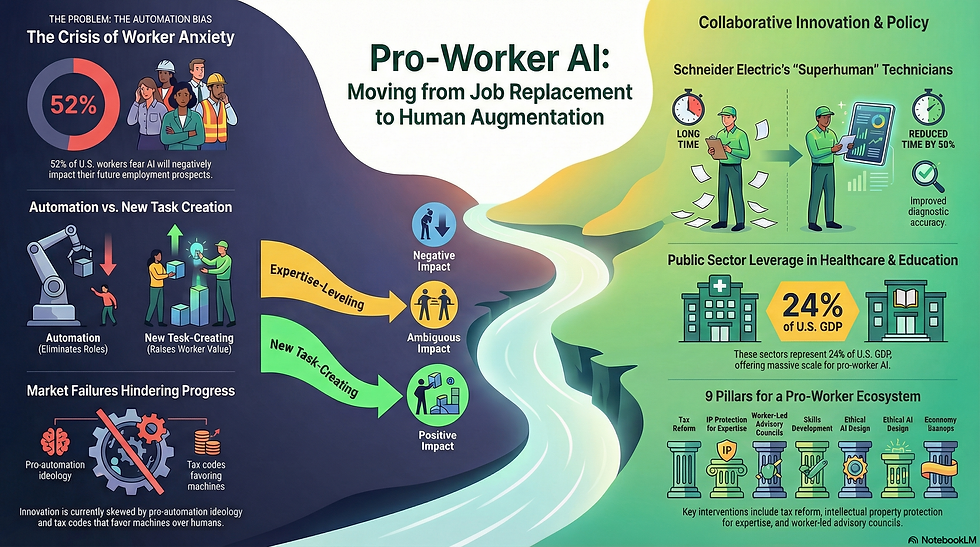
The technological anxiety pervading today's workforce is neither irrational nor unprecedented. When 52 percent of U.S. workers express concern about how artificial intelligence will affect their employment prospects, and 42 percent of current AI users believe it will diminish their future opportunities, they are responding to signals that merit serious attention (Lin & Parker, 2025). These workers understand something fundamental: AI is being positioned not as their partner but as their replacement.
The narrative surrounding artificial intelligence has become remarkably consistent across both its champions and critics. OpenAI's definition of Artificial General Intelligence as "highly autonomous systems that outperform humans at most economically valuable work" encapsulates the prevailing vision (OpenAI, n.d.). Whether one celebrates or fears this prospect, the underlying assumption remains constant—AI will progressively eliminate the need for human expertise by replicating and surpassing human capabilities. This framing treats expertise as a commodity to be automated rather than as a renewable resource to be cultivated and extended.
Yet this automation-centric vision represents only one possible trajectory for AI development. The technology's ability to learn from unstructured data, synthesize vast information repositories, and support nuanced decision-making positions it equally well for a fundamentally different role: as a collaborator that amplifies rather than replaces human capabilities. Six decades after computer scientist J.C.R. Licklider envisioned human-computer symbiosis that would "think as no human brain has ever thought," contemporary AI has finally achieved the technical sophistication to realize this collaborative potential (Licklider, 1960).
The stakes in this choice extend far beyond individual job security. Four decades of rising inequality, wage stagnation among non-college workers, and declining labor shares of national income have already strained the social fabric of industrialized democracies (Acemoglu & Restrepo, 2022). Automation-heavy AI deployment threatens to accelerate these trends, potentially with devastating consequences for democratic governance and social cohesion. Conversely, AI designed to expand human capabilities could reverse these patterns by creating new forms of valuable expertise, generating novel employment opportunities, and increasing workers' productive capacity across the economy.
This essay presents a framework for understanding and advancing pro-worker AI—technologies that make human skills and expertise more valuable by expanding worker capabilities. We examine how different technological approaches affect labor market outcomes, present concrete examples of pro-worker AI already deployed in diverse sectors, analyze why market forces currently underinvest in these applications, and propose policy interventions to redirect AI development toward worker-enhancing trajectories.
The Pro-Worker Technology Landscape
Defining Pro-Worker AI in Economic Context
Not all productivity-enhancing technologies benefit workers equally, nor do they affect the labor market through identical mechanisms. To understand what makes technology pro-worker requires distinguishing among several economically distinct categories of innovation. Building on recent scholarship in labor economics and the economics of technological change, we can identify five broad types: labor-augmenting technologies, capital-augmenting technologies, automating technologies, expertise-leveling technologies, and new task-creating technologies (Acemoglu et al., 2025).
Labor-augmenting technologies make workers more productive at tasks they already perform without changing the fundamental division of labor between humans and machines. An electric cable stripper enables electricians to work faster, but it neither creates new tasks for electricians nor automates their core functions. While such tools raise productivity, their impact on wages is ambiguous—higher output may lower prices faster than it raises labor demand, leaving worker earnings unchanged or even reduced despite increased productivity.
Capital-augmenting technologies improve the performance of machines and algorithms rather than directly enhancing human capabilities. Upgrading an electric cable stripper to a more efficient model benefits electricians indirectly through their equipment. Like labor-augmenting tools, capital-augmenting innovations may boost aggregate welfare through lower prices and increased output, but their effects on worker earnings remain uncertain. When machines become more productive, the resulting price reductions can outpace any wage gains, potentially leaving workers worse off even as consumers benefit.
Automating technologies fundamentally restructure the division of labor by transferring tasks from humans to machines. Consider a hypothetical dexterous robot that autonomously installs electrical cabling at construction sites. Rather than augmenting worker or machine productivity within existing task allocations, automation directly reduces labor demand by substituting capital for human effort. Automation's impact on workers operates through two distinct channels: first, by eliminating jobs even when aggregate demand for the product rises; second, by commodifying specialized expertise—rendering valuable skills redundant by providing cheap machine substitutes. When automation targets tasks requiring substantial expertise, it doesn't merely displace workers but devalues their entire skill base, affecting their earning potential even in alternative employment.
Expertise-leveling technologies enable less-experienced workers to perform tasks previously requiring greater expertise from other domains. A pulse oximeter illustrates this category: it allows medical technicians to quickly measure blood oxygen levels, a task that once required a phlebotomist, laboratory technician, and physician working in sequence. While expertise-leveling technologies typically raise productivity and expand opportunities for less-expert workers, they simultaneously intensify competition for more-expert workers whose specialized knowledge becomes less scarce. These technologies create both winners and losers among different worker groups, making their net effect on labor ambiguous.
New task-creating technologies generate demand for novel human expertise by enabling activities that were previously infeasible or non-existent. The proliferation of ethernet networks, fiber optic cabling, and intelligent building systems vastly increased both the quantity and complexity of electrical infrastructure in modern buildings. Workers now require specialized expertise to plan, install, and maintain these systems—expertise that had no market value before these technologies emerged. Unlike the previous categories, new task-creating technologies unambiguously enhance worker value by expanding both the variety and quantity of work that demands human expertise, creating new occupational specialties and sustaining demand for skills that automation might otherwise eliminate.
Prevalence, Drivers, and Distribution of Pro-Worker AI
The current distribution of AI development investment heavily favors automation over worker collaboration. While comprehensive data on AI investment by application type remains limited, several indicators suggest pro-worker AI receives disproportionately little attention and funding relative to its potential. Industry surveys consistently show AI developers prioritizing applications that reduce labor costs through automation rather than tools that enhance worker capabilities (Ahmed et al., 2023). The stated missions of leading AI companies explicitly emphasize creating systems that match or exceed human performance across broad task domains, implicitly positioning human labor as something to be superseded rather than amplified.
This automation bias reflects multiple reinforcing factors. First, the business case for automation appears more straightforward than the value proposition for worker augmentation. Automation promises quantifiable cost reductions through headcount savings, while worker augmentation requires demonstrating that enhanced human capabilities generate value exceeding the technology's cost plus the workers' compensation. Second, path dependence in technology development creates momentum toward automation—firms with established capabilities in developing automation software naturally pursue incremental improvements within that domain rather than pivoting to collaborative tools requiring different expertise. Third, the concentration of AI development within a handful of dominant firms whose business models emphasize data monetization and targeted advertising further skews investment toward applications aligned with those revenue streams rather than toward worker productivity enhancement.
The prevailing ideology within computer science and AI research communities reinforces these economic incentives. Since its founding, the AI field has oriented itself toward creating machines that replicate and ultimately surpass human cognitive capabilities across all domains—the Artificial General Intelligence goal. This framing treats human-machine collaboration as a transitional stage rather than a destination, implicitly devaluing research into collaborative tools that might maximize joint human-AI performance rather than pure machine capability (Acemoglu & Johnson, 2023).
Yet pockets of pro-worker AI development have emerged, often in contexts where worker expertise is essential, difficult to automate fully, or where enhancing human capabilities offers clear competitive advantages over pure automation. These applications concentrate in healthcare, skilled trades, education, and complex decision-making domains where the stakes of errors remain high and human judgment remains difficult to replicate reliably. Examining these examples reveals not only AI's collaborative potential but also the conditions under which pro-worker applications emerge despite prevailing market incentives.
Organizational and Individual Consequences of Technology Choice
Organizational Performance Impacts
The choice between automation-focused and worker-enhancing AI creates divergent organizational outcomes extending beyond simple cost calculations. While automation typically offers measurable short-term savings through reduced labor expenses, worker-enhancing AI can generate less visible but potentially larger returns through improved decision quality, enhanced service delivery, and expanded organizational capabilities.
Organizations deploying pro-worker AI tools report measurable productivity gains. Schneider Electric's Electrician's Assistant, which helps field technicians troubleshoot electrical equipment, reduced average maintenance report completion time by 50 percent while simultaneously improving report quality and consistency (Godemel, 2024). The U.S. Patent and Trademark Office's AI-enhanced search tools enabled patent examiners to conduct more thorough prior art searches in significantly less time, potentially improving patent quality by helping examiners identify relevant precedents they might otherwise miss (United States Patent and Trademark Office, 2025). These examples demonstrate how AI collaboration can simultaneously boost worker productivity and output quality—outcomes often presumed to require tradeoffs.
The performance advantages of worker-enhancing AI may prove particularly significant in domains where pure automation faces fundamental limitations. Healthcare, education, skilled trades, and complex professional services involve high-stakes decisions requiring contextual understanding, ethical judgment, and creative problem-solving—capabilities that remain challenging to fully automate. In these sectors, tools that amplify human expertise while preserving human oversight may deliver superior outcomes compared to either unassisted humans or autonomous AI systems. Research on human-AI collaboration confirms this pattern: some human-AI combinations outperform either humans or AI working independently, though achieving this complementarity requires careful tool design (Vaccaro et al., 2024).
Organizations pursuing worker-enhancing strategies may also realize competitive advantages through workforce development and retention. Workers gain portable skills when using collaborative AI tools that expand their capabilities, potentially reducing turnover costs while increasing organizational human capital. Firms investing in pro-worker AI signal their commitment to workforce development, potentially attracting higher-quality talent and strengthening employment relationships.
Individual Wellbeing and Worker Impacts
The divergent technological paths create starkly different experiences for workers. Automation-focused AI threatens not only immediate job displacement but also the long-term devaluation of workers' accumulated expertise. When decades of craft knowledge or professional training can be replicated by algorithms, the market value of that expertise collapses—affecting workers' earning potential even when they find alternative employment. Hollywood screenwriters' resistance to generative AI reflects this fundamental concern: AI threatens to commodify the storytelling expertise that constitutes screenwriters' core value proposition, potentially transforming a skilled profession into low-wage content editing (personal communication cited in Acemoglu et al., 2026).
The psychological and social consequences of expertise devaluation extend well beyond individual earnings losses. Workers derive identity, purpose, and community from their occupational expertise. Job displacement concentrated within communities contributes to family dissolution, substance abuse, and premature mortality—outcomes documented extensively in deindustrialized regions (Autor et al., 2019; Case & Deaton, 2022). When technological change eliminates not only jobs but the entire occupational identity and social networks built around specific forms of expertise, the human costs compound beyond what economic metrics capture.
Conversely, worker-enhancing AI offers a fundamentally different experience. Rather than threatening workers' expertise, collaborative AI extends its reach and applicability. The Empowerment Companion tool deployed with custodial workers with disabilities illustrates this potential: by providing real-time guidance and task verification, the AI enables workers to perform their jobs more effectively while documenting their accomplishments (personal communication cited in Acemoglu et al., 2026). Similarly, the AI-powered communication tool enabling hearing-impaired delivery workers in China to compete on equal terms with their peers demonstrates how relatively simple AI applications can remove barriers that previously limited workers' productivity and earning potential (Chen et al., 2025).
Workers using pro-worker AI tools report both productivity gains and expanded capabilities. Field technicians using collaborative AI assistance can tackle more complex troubleshooting tasks, teachers can provide more personalized instruction, and healthcare workers can make better-informed clinical decisions. These expanded capabilities not only increase immediate productivity but also accelerate skill acquisition—workers learn faster when AI tools provide real-time feedback and tailored guidance. This learning acceleration represents a crucial but often overlooked benefit: pro-worker AI doesn't merely enhance current performance but helps workers more rapidly develop the expertise required for increasingly sophisticated work.
The distinction between technologies that enhance expertise and those that commodify it matters profoundly for workers' bargaining power and earnings potential. When workers possess scarce, valuable expertise, they command higher wages and greater employment security. Technologies that extend expertise without flooding the market with substitutes preserve or enhance this scarcity value. Conversely, technologies that enable anyone to perform expert-level work—whether through automation or extreme expertise-leveling—inevitably undercut the compensation previously justified by expertise scarcity.
Evidence-Based Organizational Responses
Table 1: Pro-Worker AI Applications and Sector Examples
Sector | Application Name | Target Users | Key AI Features | Worker Impact | Organizational Outcome | Pro-Worker Classification |
Education | AI-Enhanced Teacher's Assistant | K-12 Educators | Continuous quiz assessment, diagnostic analysis of student difficulties, adaptive student grouping, and personalized lesson plan generation | Enables teachers to deliver personalized education at scale; creates new tasks like interpreting analytics and selecting instructional strategies | More responsive instruction and the ability to manage diverse classroom preparedness levels effectively | New Task-Creating |
Skilled Trades / Electrical Services | Electrician's Assistant | Electrical engineers and field technicians | Large language models, diagnostic data input, equipment photo analysis, troubleshooting recommendations, automated report drafting, and multilingual translation | Reduces maintenance report time by 50%, provides real-time troubleshooting guidance, and functions as an interactive training tool | Improved report quality and consistency, halved maintenance completion times, and enhanced service delivery in client's preferred languages | Labor-Augmenting / New Task-Creating |
Service / Custodial Work | Empowerment Companion | Low-wage workers, including people with disabilities | Real-time task prompts, video demonstrations, computer vision for quality verification, and corrective feedback | Provides step-by-step guidance, reduces the need for constant supervision, and enables workers with disabilities to perform jobs more effectively | Reduced training costs and supervisory requirements while expanding inclusive employment opportunities | Labor-Augmenting |
Government Services / Legal | More Like This (PE2E Search Tool) | Patent examiners | Semantic search, machine learning for conceptual similarity identification, weighted queries, and iterative refinement | Reduces time spent on manual document review, allowing focus on high-value evaluation of patentability | Potential for higher patent quality through more thorough prior art searches and faster processing times | Labor-Augmenting |
Gig Economy / Delivery Services | AI-powered voice chatbot | Hearing-impaired delivery workers | Real-time text-to-speech and speech-to-text communication | Removes auditory communication barriers with customers, enabling workers to complete orders and navigate complexes independently | Eliminated the customer review gap and allowed hearing-impaired workers to outperform peers with similar experience | Labor-Augmenting |
Collaborative Electrical Services: Schneider Electric's Field Technician Assistant
Schneider Electric, a global leader in electrical services and energy management, developed an AI assistant specifically to enhance the capabilities of its electrical engineers and field technicians. The tool employs large language models to provide real-time troubleshooting assistance for electrical equipment maintenance and repair. Field technicians interact with the system by inputting diagnostic data and equipment photographs, receiving in return specific recommendations for tests and procedures drawn from an extensive database of machinery specifications and solutions documented by experienced technicians.
The system's impact extends across multiple dimensions:
Diagnostic support: Technicians access comprehensive equipment information and troubleshooting protocols without manually searching documentation
Report generation: The AI drafts maintenance recommendations from field data, reducing report completion time by approximately 50 percent
Multilingual capability: Automated translation enables technicians to deliver reports in clients' preferred languages
Training acceleration: The system functions as an interactive learning tool, exposing less-experienced technicians to expert problem-solving approaches
What makes this application distinctly pro-worker rather than automation-focused? The engineer or technician remains central to the process—reviewing AI-generated recommendations for accuracy, exercising judgment about specific circumstances, and taking responsibility for final decisions. The AI extends rather than replaces human expertise, enabling technicians to handle more complex assignments than they could tackle independently while simultaneously accelerating their skill development.
Schneider Electric's experience suggests that similar collaborative tools could support numerous other skilled trades—plumbers, HVAC technicians, building contractors, and specialized healthcare workers all perform comparable work requiring field judgment informed by extensive technical knowledge.
Empowering Service Workers: AI for Inclusive Employment
A startup partnered with a social enterprise employing people with disabilities in the Pacific Northwest to develop the Empowerment Companion, a personalized AI assistant designed for low-wage workers in factory and service occupations. Currently deployed with custodial workers, the tool analyzes work orders and provides tailored task prompts adjusted to each worker's needs, repeating instructions as necessary during task completion.
Key features include:
Real-time task management: Workers receive step-by-step guidance matched to specific work orders, including video demonstrations when appropriate
Quality verification: Computer vision confirms task completion according to contract specifications
Corrective feedback: The system redirects workers to address remaining issues before moving to subsequent tasks
On-demand reference: Workers access guidance about appropriate materials and techniques for specific cleaning challenges
This application illustrates pro-worker AI's potential in domains often assumed to offer limited opportunities for technological enhancement. The tool doesn't deskill custodial work but rather supports workers in performing their responsibilities more effectively and consistently. Importantly, the technology reduces training costs and supervisory requirements for employers while simultaneously expanding employment opportunities for workers who might otherwise face barriers to job success.
The contrast with Amazon's Flex driver management system proves instructive. Both applications use smartphone-based AI to guide and monitor workers performing relatively standardized tasks. Yet Amazon Flex emphasizes surveillance and control, reportedly using the system to enforce performance standards and terminate workers without human oversight (Crispin, 2021). The Empowerment Companion instead emphasizes support and skill-building, providing guidance that workers can use to improve their performance rather than primarily monitoring for compliance.
This comparison highlights a crucial point: the distinction between pro-worker and anti-worker AI often lies not in the underlying technology but in design intentions and implementation choices. The same technical capabilities can either enhance worker autonomy and self-efficacy or intensify managerial control and reduce worker discretion.
Personalized Education: AI-Enhanced Teaching
Educators face a perennial challenge: delivering instruction matched to each student's current understanding and learning needs within classroom settings accommodating diverse preparedness levels. A teacher's assistant tool currently under development illustrates how AI might address this challenge through genuine human-AI collaboration.
The envisioned system operates as follows:
Continuous assessment: Students complete periodic short quizzes providing real-time data on their understanding
Diagnostic analysis: AI parses quiz responses alongside classroom observations to identify specific difficulties each student faces
Adaptive grouping: The system recommends classroom reorganization into smaller groups based on students' current needs
Differentiated instruction: AI generates lesson plan menus tailored to each group's composition and learning challenges
Teacher discretion: Educators review and modify AI recommendations based on their professional judgment
This application exemplifies pro-worker technology through several mechanisms. First, it enables teachers to perform more sophisticated instructional tasks—delivering truly personalized education at scale rather than teaching to the middle of the distribution. Second, it creates new tasks for teachers: interpreting AI-generated student assessments, selecting among recommended instructional strategies, and monitoring implementation effectiveness. Third, it potentially demands that teachers develop new expertise in learning analytics, adaptive instruction, and effective AI tool utilization.
The model could extend beyond education to any domain requiring team leadership, training, or coaching. Managers supervising production teams, healthcare workers training junior staff, or corporate trainers developing employee capabilities could all benefit from similar AI collaboration supporting more sophisticated, individualized guidance.
Successful implementation would likely prove more effective with additional teaching staff—an important observation given common concerns that technology primarily enables headcount reduction. The most powerful application may not be giving one teacher AI tools to manage 30 students but rather giving three teachers with AI support collaborative responsibility for the same 30 students, enabling even more responsive instruction.
Enhanced Government Services: Patent Examination Support
The U.S. Patent and Trademark Office introduced AI-powered search capabilities into its patent examination workflow in 2021, providing patent examiners with tools to conduct more comprehensive prior art searches. The More Like This system employs machine learning to suggest documents conceptually similar to references examiners have identified as relevant, even when those documents use different terminology (United States Patent and Trademark Office, 2022).
Traditional Boolean search methods—searching by author names, publication dates, or specific keyword combinations—poorly distinguish between genuinely relevant prior art and tangentially related patents. Examiners might spend entire days manually reviewing thousands of documents during a single examination. More Like This transforms this process by:
Semantic search: Identifying conceptually related documents regardless of terminology differences
Weighted queries: Allowing examiners to emphasize novel aspects of applications while de-emphasizing common industry terms
Rapid results: Returning relevant documents in seconds rather than hours
Iterative refinement: Enabling examiners to progressively narrow searches based on emerging patterns
By June 2024, approximately 80 percent of USPTO patent examiners had incorporated AI-enhanced search into their workflow (United States Patent and Trademark Office, 2025). The tool reduces time spent on supporting tasks, enabling examiners to focus more attention on the high-value specialized work of evaluating patentability and comparing applications against prior art.
Whether this tool proves definitively pro-worker depends partly on factors beyond the technology itself. If reduced search time merely enables processing more applications without deeper analysis, the tool functions primarily as labor-saving rather than expertise-enhancing. However, if the tool enables examiners to conduct more thorough examinations or tackle more complex applications requiring deeper expertise, it would clearly qualify as pro-worker by expanding the scope and sophistication of work examiners can perform.
Accessibility and Inclusion: Communication Tools for Delivery Workers
China's gig economy employed more than 200 million workers in 2025, with substantial numbers performing food delivery—work that surprisingly proves challenging for hearing-impaired workers despite requiring primarily physical rather than auditory capabilities (The Economist, 2025). Delivery workers must communicate with customers via voice calls to gain building access or locate units within large complexes. This communication requirement placed hearing-impaired workers at substantial disadvantage: they completed fewer orders and received more negative reviews than workers with similar platform experience (Chen et al., 2025).
One Chinese gig platform addressed this disparity by embedding a simple AI-powered voice chatbot in the delivery app, providing real-time text-to-speech and speech-to-text communication for hearing-impaired workers. The intervention's effects proved dramatic: the tool eliminated the customer review gap between hearing-impaired and other drivers, and hearing-impaired workers subsequently outperformed others with comparable experience (Chen et al., 2025).
This example illustrates several important principles:
Barrier removal: Pro-worker AI need not be sophisticated to be transformative—sometimes simple applications addressing specific constraints yield significant impacts
Capability extension: The tool made hearing-impaired workers newly capable of performing an essential job task
Inclusion expansion: By removing a critical barrier, the technology opened a major employment sector to workers previously excluded
Market value: The AI made workers' core expertise (efficient food delivery) more valuable by eliminating a peripheral limitation
The accessibility application seems almost prosaic given AI's touted sophistication. Yet that apparent simplicity underscores an important reality: pro-worker AI doesn't require achieving artificial general intelligence or revolutionizing entire industries. Targeted applications addressing specific workplace challenges can dramatically enhance worker capabilities and employment opportunities.
Patterns Across Pro-Worker Applications
Several common themes emerge across these diverse applications. First, pro-worker AI preserves human decision-making authority while enhancing the information and analysis supporting those decisions. Workers using these tools remain responsible for outcomes rather than merely executing AI directives. Second, successful applications extend expertise to new contexts rather than simply accelerating existing work. Third, many effective tools combine productivity enhancement with accelerated learning—workers not only perform better immediately but also develop expertise faster. Fourth, the most promising applications often target domains where pure automation faces fundamental limitations due to high stakes, need for contextual judgment, or ethical considerations requiring human oversight.
Building Long-Term Pro-Worker AI Ecosystems
Sector-Specific Development: Healthcare and Education Leadership
Strategic development of pro-worker AI requires focus. While the concept applies broadly, concentrating initial efforts on specific sectors where opportunities abound and public influence is substantial offers the most realistic path forward. Healthcare and education represent ideal starting points.
These sectors command enormous economic resources—approximately 18 percent and 6 percent of U.S. GDP respectively (Organisation for Economic Co-operation and Development, 2025; Peter G. Peterson Foundation, 2025). Both employ vast numbers of skilled decision-makers performing largely artisanal work: individualized patient care and personalized instruction. This artisanal character has contributed to notoriously slow productivity growth in both sectors, suggesting substantial room for improvement (Chandra & Skinner, 2012; Hoxby, 2004).
AI's capacity to support expert decision-making at scale positions it to address precisely these sectors' core challenges. Moreover, government influence in healthcare and education provides unusual leverage for shaping technology development and deployment. In 2023, government programs funded 43 percent of U.S. healthcare expenditure—2.1trillionof2.1 trillion of 2.1trillionof4.9 trillion total spending (Peter G. Peterson Foundation, 2025). Public funding accounts for 92 percent of K-12 education spending and 39 percent of tertiary education spending (Organisation for Economic Co-operation and Development, 2025).
Targeted strategies for sector development include:
Goal-setting and procurement specifications: Government agencies could articulate clear objectives for how AI should support healthcare practitioners and educators, then procure tools meeting those specifications
Reimbursement policy: Medicare and Medicaid could establish reimbursement rates for healthcare services delivered by non-physician professionals using AI support tools
Quality standards: Regulatory bodies could define minimum performance standards for AI collaboration tools, ensuring they genuinely enhance rather than replace professional judgment
Professional development: Public funding could support training programs helping healthcare workers and educators effectively utilize collaborative AI tools
The federal government has previously demonstrated capacity to reshape healthcare and education technology adoption through targeted intervention. The 2009 HITECH Act accelerated electronic health record adoption from roughly 10 percent to near-universal implementation within a decade through financial incentives and penalties (Office of the National Coordinator for Health Information Technology, 2017). The federal E-Rate program, providing ongoing subsidies for school Internet connectivity since 1996, helped achieve 95 percent WiFi availability in U.S. public school classrooms by 2021 (Munson, 2023). Similar focused efforts could dramatically advance pro-worker AI development in these sectors.
State Capacity: Building Government AI Expertise
Effectively shaping AI development in healthcare, education, and beyond requires substantial government expertise currently lacking. AI will touch essentially every area of government investment, regulation, and oversight—from transportation and energy to labor conditions and environmental protection. Seizing opportunities to guide AI toward pro-worker applications demands state capacity that public agencies presently lack.
Developing this capacity requires:
Dedicated AI expertise units: Establishing consultative divisions within federal government to support agencies and regulators addressing AI in their domains
Cross-sector coordination: Creating mechanisms for sharing knowledge and strategies across agencies facing similar AI challenges
Academic partnerships: Building formal relationships with university researchers studying human-AI collaboration, worker impacts, and effective tool design
Talent recruitment: Developing career paths enabling government to attract and retain professionals with technical AI expertise
Ongoing evaluation: Creating systems for monitoring how deployed AI tools affect worker capabilities, employment outcomes, and service quality
Building state capacity represents investment infrastructure—it generates returns over decades rather than quarters. Yet without this capacity, government will lack ability to effectively deploy its considerable purchasing power and regulatory authority to shape AI's trajectory.
Incentive Realignment: Grant-Making and Tax Reform
Federal research funding, which until recently supported approximately one-fifth of U.S. R&D investment, has fundamentally shaped American innovation since World War II (National Science Board, 2025). Though private sector AI investment now dominates, federal research funding of roughly $3 billion annually in AI research and development remains sufficient to influence technology trajectories (U.S. Networking and Information Technology Research and Development Program, n.d.).
Strategic research priorities include:
Human-AI collaboration design: Funding research on how to design AI systems that effectively support rather than undermine human decision-making and learning
Domain-specific applications: Supporting development of collaborative tools for specific occupations and sectors where pure automation faces fundamental limitations
Implementation science: Studying how organizations can successfully deploy pro-worker AI tools, including training requirements, workflow integration, and performance measurement
Workforce development: Researching how AI tools can accelerate skill acquisition and support transitions to new occupational specializations
Grant-making could employ competitive prize models similar to DARPA's approach rather than traditional procurement specifications, fostering innovation while maintaining accountability. This approach allows multiple teams to pursue diverse solutions while ensuring unsuccessful approaches fail without generating political backlash.
Tax code reform offers another lever for realigning incentives. Current U.S. tax structure places substantially heavier burdens on firms hiring labor than on those investing in automation (Acemoglu et al., 2020). Creating more symmetric treatment—equating marginal taxes for human capital investment with those for physical capital and software—could shift technological choices toward pro-worker applications by removing the existing automation bias.
Market Structure: Fostering Competition
Concentration of power among a handful of dominant AI firms extends beyond typical competition concerns. Network effects in AI markets grant such extraordinary advantage to incumbents that their business models and technology choices propagate throughout entire ecosystems. Start-ups naturally gravitate toward technologies sellable to large incumbents or that position them as attractive acquisition targets. When dominant firms derive profits primarily from automation and data monetization through digital advertising, this dynamic discourages development of pro-worker alternatives.
Antitrust approaches include:
Merger scrutiny: Applying stricter review to acquisitions that eliminate potential competitors developing alternative AI business models
Predatory pricing prevention: Blocking below-cost pricing designed to eliminate competitors offering pro-worker AI tools
Interoperability requirements: Mandating technical standards enabling workers and organizations to integrate AI tools from multiple providers
Data portability: Ensuring workers and organizations can transfer training data and model customizations when switching AI service providers
Enhanced competition could create space for business models more conducive to pro-worker AI development. If firms can profitably serve markets that dominant players neglect—such as collaborative tools for specific occupations—diversified competition may naturally generate more pro-worker applications.
Worker Voice: Civil Society and Labor Organization Engagement
Workers themselves understand most clearly which tasks AI could helpfully support versus which capabilities define their occupational expertise. Yet workers currently lack meaningful voice in shaping AI development and deployment affecting their livelihoods. Establishing institutional mechanisms for worker input could prove invaluable.
Mechanisms for worker engagement include:
Sector-specific advisory councils: Creating formal bodies bringing together workers, employers, technology developers, and researchers to guide AI development in specific industries
Labor organization participation: Ensuring unions and worker organizations help articulate needs and evaluate proposed AI tools
Workplace AI standards: Developing health and safety regulations limiting deployment of insufficiently tested AI in applications creating worker risks
Surveillance limitations: Establishing boundaries on workplace monitoring intensity, ensuring AI tools support rather than control workers
Civil society organizations and labor unions can advance pro-worker AI by articulating workers' needs, advocating for protective frameworks, and helping members navigate technological change. These organizations possess unique capacity to distinguish between tools genuinely enhancing worker capabilities and those primarily intensifying managerial control under collaboration rhetoric.
Intellectual Property: Protecting Worker Expertise
Current intellectual property law offers minimal protection against AI's industrial-scale harvesting of human expertise. AI systems freely scrape content from websites, social media, journalism, and countless other sources, then statistically recombine this material to generate outputs that compete with their sources. Authors, journalists, artists, musicians, and numerous other creators find their work appropriated as training data without compensation or control (Kasy, 2025).
The challenge extends beyond publicly available content. Firms increasingly train AI models on their own employees' expert performance—an appealing shortcut with dangerous implications. Few workers would willingly train an apprentice designed to replace them, yet this describes exactly what occurs when companies use worker expertise to build automation systems.
Intellectual property reforms could include:
Training data compensation: Requiring AI developers to compensate creators whose work trains commercial AI systems
Opt-in defaults: Reversing current presumptions to require explicit permission before using creative works or worker expertise as training data
Expertise ownership protections: Establishing workers' rights to control whether their occupational knowledge trains AI systems
Derivative work standards: Clarifying when AI outputs constitute derivative works requiring licensing from original creators
We don't assert all AI training constitutes theft—reasonable people can disagree about where to draw boundaries. But neither should we accept the opposite extreme, now widely assumed in the AI industry, that creators deserve no compensation when their work trains machines that ultimately compete with them. Building frameworks supporting workers' ownership of their capabilities would preserve incentives for skill development while giving workers greater control over how their expertise is deployed.
Occupational Licensing: Removing Barriers to Expanded Capability
Pro-worker AI's central promise involves enabling workers to accomplish broader task arrays by leveraging expertise with superior tools. If this vision proves correct, AI will inevitably instigate additional competition among workers of different expertise levels. Nurse practitioners using better tools might perform tasks traditionally assigned to physicians; paralegals might handle work previously requiring attorneys; junior craft workers might accomplish what senior craft workers once exclusively performed.
Such transitions create friction as entrants battle for occupational turf and incumbents erect barriers thwarting entrance. Professional licensure, scope-of-practice boundaries, and certification requirements often serve less to protect service quality than to soften competition and preserve incumbent advantages (Allensworth, 2025; Kleiner & Soltas, 2023). The American Medical Association's decades-long resistance to expanding nurse practitioners' scope of practice illustrates this dynamic—organized medicine has consistently opposed allowing nurse practitioners to independently perform tasks they demonstrably handle competently (Avi-Yonah, 2023).
Policy responses include:
Evidence-based licensing: Requiring demonstrable quality or safety justification for occupational restrictions, with periodic review
Scope-of-practice modernization: Updating practice boundaries to reflect workers' AI-enhanced capabilities rather than historical limitations
Interstate reciprocity: Enabling licensed workers to practice across state lines, reducing geographic monopolies
Alternative certification pathways: Recognizing AI-supported skill development as legitimate qualification route alongside traditional credentials
Policymakers must attend closely to this dynamic, ensuring that potential gains from newly-empowered workers aren't thwarted by incumbent resistance. Conversely, reasonable concerns about service quality and worker protection shouldn't be dismissed as mere rent-seeking—the challenge involves distinguishing legitimate quality safeguards from unjustified entry barriers.
Conclusion
The prevailing narrative surrounding artificial intelligence emphasizes a single trajectory: progressive automation of human work culminating in artificial general intelligence that surpasses human capabilities across all economically valuable domains. This vision treats human expertise as something to be replicated and ultimately superseded, with workers serving at best as temporary placeholders until machines become sufficiently capable.
Yet the same technological capabilities enabling automation also position AI to serve a fundamentally different purpose: amplifying human expertise rather than rendering it obsolete. AI's capacity to process unstructured data, identify relevant patterns, generate informed recommendations, and support complex decisions makes it an invaluable collaborator for human decision-makers. Rather than automating expertise into irrelevance, collaborative AI can extend that expertise to new domains, enable workers to tackle novel tasks, and accelerate skill acquisition.
The case for this alternative trajectory rests not on precaution but on practicality. While automation has delivered genuine benefits, its limitations have become increasingly apparent. AI cannot yet reliably perform most expert work autonomously—the stakes are too high and the decisions too nuanced in domains like healthcare, education, skilled trades, and professional services to fully delegate responsibility to opaque systems operating independently. Conversely, opportunities for human-AI collaboration are immediately available and have demonstrated substantial value in diverse applications already deployed.
The choice between automation and collaboration need not be absolute—both approaches have appropriate applications. The concern is that market incentives, path dependence, and prevailing ideology within the AI community have created systematic bias toward automation when collaboration might often prove more effective. Misaligned firm incentives, concentration within a handful of dominant companies pursuing similar business models, and an explicit ideological commitment to artificial general intelligence combine to underinvest in pro-worker AI relative to its potential.
Redirecting some portion of AI development toward worker-enhancing applications requires intentional intervention. Government possesses multiple levers for shaping this trajectory: leveraging its enormous purchasing power in healthcare and education to demand collaborative tools; funding research on effective human-AI collaboration design; reforming tax code to remove automation bias; enforcing competition to create space for diverse business models; establishing worker voice in AI development; protecting worker expertise through intellectual property reform; and modernizing occupational licensing to enable AI-enhanced worker capabilities.
None of these interventions guarantees success—technological development involves irreducible uncertainty and unintended consequences. But maintaining current course almost certainly perpetuates underinvestment in pro-worker applications. Four decades of rising inequality, wage stagnation, and declining labor share have already strained democratic societies. Automation-heavy AI deployment threatens to accelerate these trends with potentially devastating consequences. Conversely, AI designed to expand human capabilities could reverse these patterns by creating new forms of valuable expertise, generating novel employment opportunities, and increasing workers' productive capacity.
The fundamental question facing technologists, policymakers, business leaders, and workers themselves involves not whether AI will prove transformative—that outcome appears certain—but rather how that transformation unfolds. Will we pursue maximum automation wherever possible, accepting whatever employment and distributional consequences follow? Or will we deliberately develop AI systems that learn from human decision-making, augment human judgment, and work alongside workers to improve outcomes? Getting this balance right across capabilities represents a formidable and ever-evolving challenge. Building tools that make human skills and expertise more valuable should stand as one principal strategy for meeting that challenge.
The workers expressing anxiety about AI's impact on their livelihoods have correctly identified high stakes. The majority need not resign themselves to technological displacement and expertise devaluation. An alternative path exists, one that harnesses AI's revolutionary capabilities not to eliminate the need for human expertise but to expand its scope, increase its value, and extend it to domains currently beyond reach. Realizing this alternative requires acknowledging that the choice between these paths is ours to make—neither technological determinism nor market forces alone will select the trajectory that best serves workers and society. The decisions we make today about how to develop and deploy AI will shape labor markets, determine distributional outcomes, and affect the quality of democratic governance for decades to come.
Research Infographic
References
Acemoglu, D. (2026). What happened to liberal democracy? Remaking a politics of shared prosperity. Penguin Random House.
Acemoglu, D., & Autor, D. (2011). Skills, tasks and technologies: Implications for employment and earnings. In D. Card & O. Ashenfelter (Eds.), Handbook of Labor Economics (Vol. 4). Elsevier.
Acemoglu, D., & Johnson, S. (2023). Power and progress: Our thousand-year struggle over technology and prosperity. PublicAffairs.
Acemoglu, D., & Restrepo, P. (2022). Tasks, automation, and the rise in U.S. wage inequality. Econometrica, 90(5), 1973–2016.
Acemoglu, D., Manera, A., & Restrepo, P. (2020). Does the U.S. tax code favor automation? Brookings Papers on Economic Activity, Spring, 231–300.
Acemoglu, D., Kong, F., & Restrepo, P. (2025). Tasks at work: Comparative advantage, technology and labor demand. In C. Dustmann & T. Lemieux (Eds.), Handbook of Labor Economics (Vol. 6). Elsevier.
Ahmed, N., Wahed, M., & Thompson, N. C. (2023). The growing influence of industry in AI research. Science, 379(6635), 884–886.
Allensworth, R. H. (2025). The licensing racket: How we decide who is allowed to work, and why it goes wrong (1st ed.). Harvard University Press.
Autor, D., Dorn, D., & Hanson, G. (2019). When work disappears: Manufacturing decline and the falling marriage market value of young men. American Economic Review: Insights, 1(2), 161–178.
Avi-Yonah, S. (2023, August). Medicine without doctors? State laws are changing who treats patients. The Washington Post.
Case, A., & Deaton, A. (2022). Deaths of despair and the future of capitalism. Princeton University Press.
Chandra, A., & Skinner, J. (2012). Technology growth and expenditure growth in health care. Journal of Economic Literature, 50(3), 645–680.
Chen, Y., Hoffman, M., Xu, H., & Yuan, Z. (2025). Empowering inclusive work. Preprint.
Crispin, J. (2021, July). Welcome to dystopia: Getting fired from your job as an Amazon worker by an app. The Guardian.
Godemel, F. (2024, May). Three ways generative AI is helping our services experts become superheroes. Schneider Electric Blog.
Hoxby, C. M. (2004). Productivity in education: The quintessential upstream industry. Southern Economic Journal, 71(2), 209–231.
Kasy, M. (2025). The means of prediction: How AI really works (and who benefits). University of Chicago Press.
Kleiner, M. M., & Soltas, E. J. (2023). A welfare analysis of occupational licensing in U.S. states. The Review of Economic Studies, 90(5), 2481–2516.
Licklider, J. C. R. (1960). Man-computer symbiosis. IRE Transactions on Human Factors in Electronics, HFE-1, 4–11.
Lin, L., & Parker, K. (2025). U.S. workers are more worried than hopeful about future AI use in the workplace. Pew Research Center.
Munson, E. (2023, December). 95 percent of public-school classrooms have Wi-Fi. Government Technology.
National Science Board. (2025). Discovery: R&D activity and research publications (NSB-2025-7).
Office of the National Coordinator for Health Information Technology. (2017, September). Non-federal acute care hospital electronic health record adoption. Health IT Quick-Stat #47.
OpenAI. (n.d.). OpenAI charter. Retrieved January 5, 2026.
Organisation for Economic Co-operation and Development. (2025). Education at a glance 2025: United States. OECD Publishing.
Peter G. Peterson Foundation. (2025). How does government healthcare spending differ from private insurance?
The Economist. (2025, September). China's 200m gig workers are a warning for the world.
United States Patent and Trademark Office. (2022). New PE2E search tool using AI search features.
United States Patent and Trademark Office. (2025). Artificial intelligence strategy.
U.S. Networking and Information Technology Research and Development Program. (n.d.). Artificial intelligence R&D investments: Fiscal year 2019–fiscal year 2025. Retrieved January 5, 2026.
Vaccaro, M., Almaatouq, A., & Malone, T. (2024). When combinations of humans and AI are useful: A systematic review and meta-analysis. Nature Human Behaviour, 8(12), 2293–2303.

Jonathan H. Westover, PhD is Chief Research Officer (Nexus Institute for Work and AI); Associate Dean and Director of HR Academic Programs (WGU); Professor, Organizational Leadership (UVU); OD/HR/Leadership Consultant (Human Capital Innovations). Read Jonathan Westover's executive profile here.
Suggested Citation: Westover, J. H. (2026). Building Pro-Worker AI: Expanding Human Capabilities in the Age of Automation. Human Capital Leadership Review, 33(3). doi.org/10.70175/hclreview.2020.33.3.3


