





Theory-First Strategy: Creating Competitive Advantage in the AI Era


Listen to a review of this article:
Abstract: Organizations increasingly rely on data-driven decision-making and artificial intelligence to guide strategy, assuming that superior analytics and computational power will generate competitive advantage. However, emerging evidence from venture capital markets, innovation studies, and strategic management research suggests this assumption may be fundamentally flawed. Data and AI excel at pattern recognition within existing paradigms but systematically fail to identify breakthrough opportunities that diverge from historical patterns. This article examines the limitations of data-first approaches to strategy and introduces theory-first thinking as a complementary capability for value creation. Drawing on philosophy of science, cognitive psychology, and strategic management literature, the analysis demonstrates how organizational theories—explicit frameworks about future value creation—enable firms to transcend the constraints of historical data. The article presents evidence-based interventions across multiple industries showing how theory-first capabilities can be developed, integrated with analytical tools, and institutionalized to create sustainable competitive advantage in environments characterized by discontinuous change.
The contemporary business landscape operates under a powerful orthodoxy: decisions should be data-driven, evidence-based, and algorithmically optimized. This conviction has intensified with the proliferation of big data analytics and artificial intelligence, creating what might be called a "data-first imperative" across industries (McAfee & Brynjolfsson, 2012). The logic appears unassailable—more data, better algorithms, superior decisions. Organizations invest billions in data infrastructure, hire armies of data scientists, and restructure decision processes around quantitative metrics and machine learning models (Davenport & Harris, 2017).
Yet a paradox persists at the heart of this data-centric worldview. The organizations that create the most value—the disruptive innovators, the category creators, the firms that fundamentally reshape industries—consistently make decisions that contradict available data. Airbnb defied data suggesting strangers would not rent homes to each other. Tesla ignored data indicating electric vehicles would remain a niche market. Netflix rejected data-driven advice to maintain its DVD rental focus (Christensen et al., 2016). These organizations succeeded not by following data, but by developing theories about future states that existing data could not validate.
This article introduces theory-first strategy as a critical organizational capability for value creation in the age of data and AI. We define theory-first thinking as the deliberate development of explicit frameworks about future value creation that precede and guide data collection, interpretation, and application. While data-driven approaches optimize within known solution spaces, theory-first capabilities enable organizations to envision and navigate toward novel solution spaces where historical data provides limited guidance (Gavetti, 2012).
The stakes are substantial. As AI systems become more sophisticated at pattern recognition and prediction, the strategic question shifts from "What does the data say?" to "What theories guide our interpretation and application of data?" Organizations that develop robust theory-first capabilities alongside their analytical infrastructure will be positioned to identify breakthrough opportunities while data-focused competitors optimize themselves into competitive stasis.
The Strategic Decision-Making Landscape
Defining Theory-First Versus Data-First Approaches
The distinction between data-first and theory-first approaches centers on the epistemological question of how organizations generate knowledge about valuable future states. Data-first approaches assume that patterns in historical data, when properly analyzed, reveal optimal future actions. This perspective treats decision-making as fundamentally a prediction problem—if we can accurately forecast future conditions based on past patterns, we can select actions that maximize expected value (Agrawal et al., 2018).
Theory-first approaches, by contrast, position decision-making as fundamentally a creation problem. Theories are frameworks that specify causal mechanisms linking actions to outcomes in domains where historical patterns may not apply (Felin & Zenger, 2017). As Felin and Zenger argue, theory represents "a path to value"—a conceptual model of how value might be created under conditions that differ from historical experience. Theory-first thinking acknowledges that the most valuable opportunities often involve bringing into existence states that have not previously existed, rendering historical data an unreliable guide.
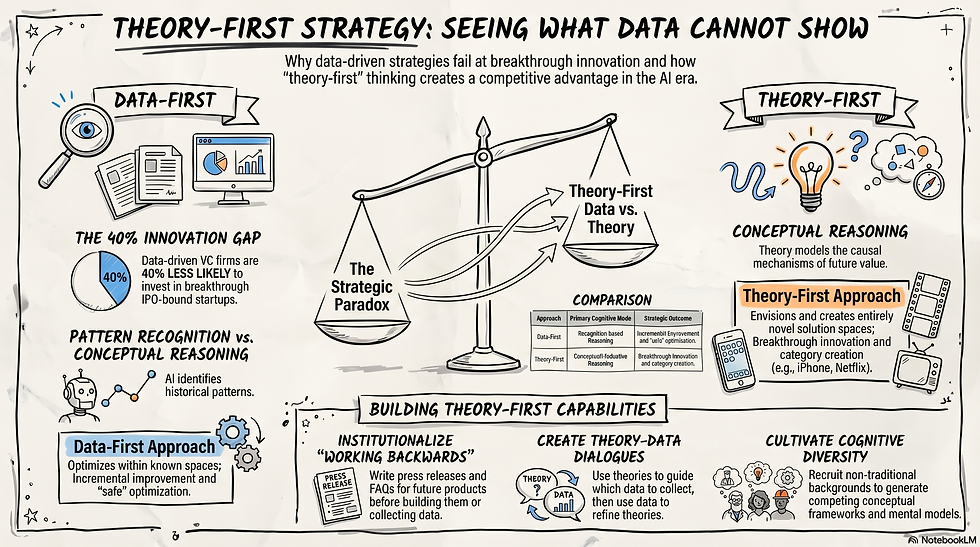
This distinction maps onto fundamental differences in cognitive processes. Data-first approaches rely heavily on recognition-based reasoning—identifying patterns in current situations that match patterns from past experience and applying previously successful solutions (Klein, 1998). Theory-first approaches engage conceptual reasoning—developing abstract models of causal relationships that can be applied to novel contexts (Gavetti et al., 2005). Both modes have value, but they excel in different strategic contexts.
State of Practice: The Data-First Dominance
Contemporary organizational practice strongly favors data-first approaches. A 2023 survey of Fortune 500 companies found that 94% had invested in big data and AI capabilities, with average annual spending exceeding $20 million (NewVantage Partners, 2023). The consulting industry has reinforced this orientation, with major firms developing specialized analytics practices and promoting data-driven transformation as essential for competitiveness (Ransbotham et al., 2020).
This data-centric orientation reflects several converging forces. First, the exponential growth in available data creates both opportunity and competitive pressure—organizations that fail to leverage data risk being outmaneuvered by more analytically sophisticated competitors (Mayer-Schönberger & Cukier, 2013). Second, advances in machine learning dramatically reduce the cost of extracting insights from data, making analytical approaches economically attractive (Brynjolfsson & McAfee, 2014). Third, behavioral economics research has highlighted systematic biases in human judgment, suggesting that algorithmic decision-making may outperform human intuition in many contexts (Kahneman, 2011).
However, this data-first dominance has created blind spots. Research on algorithmic decision-making reveals that while algorithms often outperform humans in stable, well-defined environments, they systematically fail in contexts involving novelty, ambiguity, or structural change (Burton et al., 2020). The very pattern-recognition capabilities that make AI powerful in prediction tasks create brittleness when underlying patterns shift.
Organizational and Strategic Consequences of Data-First Dominance
Strategic Performance Impacts
The limitations of data-first approaches become particularly acute in strategic contexts involving discontinuous change or novel value creation. Bonelli's (2023) large-scale study of venture capital decision-making provides quantitative evidence of this phenomenon. Analyzing over 220,000 investment decisions globally, Bonelli found that venture capital firms that adopted data-driven screening methods—using machine learning algorithms to evaluate startup opportunities—were significantly less likely to invest in ventures that achieved breakthrough success through IPOs or major acquisitions.
The performance gap was substantial. Data-driven VC firms were approximately 40% less likely to invest in startups that subsequently filed for IPO compared to firms relying on traditional judgment-based evaluation. The effect was most pronounced for the most innovative ventures—those filing larger numbers of patents and pursuing genuinely novel business models. The algorithmic screening processes systematically filtered out precisely the opportunities that generated the highest returns.
This pattern extends beyond venture capital. Research on corporate innovation demonstrates that firms relying heavily on data-driven project selection processes tend to produce incremental innovations that improve existing products and processes, while struggling to identify radical innovations that create new categories or business models (Verganti, 2016). A study of pharmaceutical R&D found that data-driven prioritization systems favored drug candidates with clear precedents in existing therapies, systematically underweighting novel mechanisms of action that later proved most valuable (Sams-Dodd, 2013).
The strategic cost appears in forgone opportunities rather than visible failures. Data-first approaches do not necessarily produce bad decisions—they produce safe decisions that optimize within existing paradigms. The problem is that in dynamic competitive environments, optimizing within existing paradigms while competitors discover new paradigms leads to progressive marginalization (Christensen, 1997).
Innovation and Market Creation Challenges
Perhaps the most significant consequence of data-first dominance is its effect on market-creating innovation. By definition, new markets lack the historical data that algorithmic approaches require. Every revolutionary product category—personal computers, smartphones, social networks, sharing economy platforms—initially appeared inconsistent with available data. Customers could not articulate demand for products they had never imagined. Market research yielded negative signals. Financial projections lacked credible foundations.
Historical analysis reveals that breakthrough innovations consistently emerge from theory-first rather than data-first processes. When Steve Jobs developed the iPhone, market research data suggested that consumers were satisfied with existing mobile phones and separate music players. Jobs' theory—that consumers would value an integrated device that merged computing, communication, and entertainment—contradicted available evidence but proved transformative (Isaacson, 2011). Similarly, Reed Hastings' vision of streaming entertainment required investing billions in content and technology before data could validate the approach (Keating, 2012).
The venture capital example from Fred Wilson illustrates this dynamic. Wilson's decision to pass on Airbnb reflected rational data-driven analysis—existing data suggested minimal market potential for peer-to-peer accommodation rental. Wilson's retrospective analysis is revealing: "We focused too much on what they were doing at the time and not enough on what they could do, would do, and did do" (Wilson, 2011). The critical failure was not analytical sophistication but theoretical imagination—the inability to envision a future market state that differed fundamentally from the present.
This challenge intensifies as AI systems become more powerful. Machine learning algorithms excel at interpolating within known data distributions but struggle with extrapolation beyond those distributions (Marcus, 2018). An algorithm trained on historical consumer behavior will identify incremental improvements to existing products but cannot envision entirely new product categories. The more organizations rely on AI for strategic decision-making, the more they risk optimizing themselves into increasingly narrow solution spaces while missing transformative opportunities.
Evidence-Based Organizational Responses
Table 1: Theory-First vs. Data-First Organizational Strategies and Examples
Organization or Entity | Strategy Type | Core Theoretical Concept | Strategic Outcome or Benefit | Decision-Making Mechanism | Specific Evidence or Example |
Apple (Steve Jobs) | Theory-first | Integration of computing, communication, and entertainment | Transformative innovation; created the smartphone category | Conceptual reasoning / Theory-building | Development of the iPhone despite market research suggesting satisfaction with existing phones |
Amazon Web Services (AWS) | Theory-first | Variable cost, scalable infrastructure as a future utility | Multi-billion dollar category creation before market validation | Institutionalized theory-first protocols (Working Backwards methodology) | AWS launch years before data supported enterprise cloud outsourcing |
Netflix | Theory-Data Dialogue | Emerging audience preferences and storytelling innovations | Successful investment in unconventional content like 'Squid Game' | Abductive reasoning and theory-testing through viewing data | Content development process that uses data to test aspects of overall theoretical frameworks |
Theory-first (20% Time) | Quality and novelty of value creation theory | Creation of Gmail and other breakthrough projects | Theory-based capital allocation (theoretical quality vs. market data) | Gmail launch despite data suggesting market satisfaction with existing email | |
Pixar Animation Studios | Theory-first (Creative Review) | Theoretical coherence of story structure and character motivation | Consistent production of innovative films that redefine audience expectations | Institutionalized protocols (Braintrust process) | Braintrust sessions focusing on story theory rather than market preference data |
IDEO | Theory-first (Human-centered design) | Latent user needs and future contexts of use | Discovery of novel value propositions users cannot yet articulate | Abductive reasoning / Multidisciplinary theory-building | Use of design researchers to develop theories about user needs instead of collecting current behavior data |
Alphabet (Other Bets) | Theory-first (Structural Separation) | Speculative future value creation in novel domains | Development of Waymo, Verily, and Wing | Institutionalized protocols (Protected spaces for theory incubation) | Structural separation of speculative ventures from core business data metrics |
Bell Labs | Theory-first (Basic Research) | Theoretical elegance and fundamental impact | Invention of transistors, lasers, and information theory | Theoretical evaluation criteria independent of commercial probability | Research evaluations based on potential impact that no data could have predicted |
Procter & Gamble (P&G) | Theory-first (Connect + Develop) | Cross-domain value creation mechanisms | Institutionalized external innovation sourcing | Abductive reasoning (inferring value from external domains) | P&G's model for seeking connections between external innovations and business applications |
Venture Capital Firms | Data-first (algorithmic screening) | Pattern recognition in historical data | 40% less likely to invest in breakthrough IPOs; filtered out innovative ventures | Machine learning algorithms / Pattern-based prediction | Bonelli's (2023) study of over 220,000 investment decisions globally |
Pharmaceutical R&D | Data-first (prioritization systems) | Precedents in existing therapies | Favored incremental drug candidates; underweighted novel mechanisms of action | Data-driven prioritization protocols | Sams-Dodd (2013) study on declining productivity in the pharmaceutical industry |
Airbnb (Fred Wilson) | Data-first (initial rejection) | Historical peer-to-peer market potential | Forgone breakthrough investment opportunity | Rational data-driven analysis of existing market states | Fred Wilson's retrospective analysis of passing on the Airbnb investment |
Develop Explicit Theory-Building Capabilities
Organizations can systematically develop theory-building capabilities rather than treating theoretical insight as mysterious or random. Theory-building involves explicitly articulating causal models that explain how and why specific actions might create value under specified conditions (Gavetti & Rivkin, 2007). This requires different cognitive skills and organizational processes than data analysis.
Effective approaches to building organizational theory-building capabilities include:
Structured speculation sessions where teams develop explicit hypotheses about future market states, customer needs, or technological trajectories without immediate concern for data validation
Analogical reasoning workshops that identify successful patterns from distant domains and explore their potential application in current contexts
Counterfactual scenario development that challenges teams to articulate how current assumptions might be wrong and what alternative mechanisms might operate
Assumption surfacing protocols that make implicit theories underlying data analysis explicit and subject to critique
Theory documentation practices that require teams to articulate the causal logic connecting actions to outcomes before collecting supporting data
Amazon Web Services exemplifies institutionalized theory-building. Before AWS launched, no data supported the hypothesis that enterprises would outsource computing infrastructure to a retailer's cloud platform. Amazon developed an explicit theory about future computing economics—that variable cost, scalable infrastructure would be more valuable than owned infrastructure for most organizations. This theory guided a multi-billion dollar investment years before data could validate the approach (Vogels, 2019). The company's "working backwards" methodology institutionalizes theory-first thinking by requiring teams to write press releases and FAQ documents for new products before building them, forcing explicit articulation of customer value theories (Bryar & Carr, 2021).
Create Theory-Data Dialogue Structures
Rather than positioning theory and data as competing approaches, leading organizations create structured processes where theoretical frameworks and empirical evidence inform each other iteratively. This recognizes that theories guide what data to collect and how to interpret it, while data provides feedback that refines theories (Popper, 1959).
Organizations implement theory-data dialogue through several mechanisms:
Hypothesis-driven analytics where data collection and analysis are explicitly tied to testing specific theoretical propositions rather than general exploration
Disconfirmation protocols that actively seek data that challenges prevailing theories rather than confirming them
Theory revision processes that treat inconsistencies between theory and data as opportunities for learning rather than failures
Staged validation approaches that start with minimal viable data to test core theoretical assumptions before scaling data collection
Multiple theory testing where competing theoretical frameworks are evaluated against the same data sets
Netflix demonstrates sophisticated theory-data dialogue in content development. The company does not simply let viewing data dictate content decisions—that would produce only incremental variations on existing successful shows. Instead, content teams develop theories about emerging audience preferences, cultural trends, or storytelling innovations. They then use viewing data to test specific aspects of those theories while maintaining the overall theoretical framework (Alvarez, 2020). This approach enabled Netflix to invest in unconventional content like "House of Cards" or "Squid Game" that data alone would not have recommended.
Establish Theory-Focused Organizational Roles
As organizations have created specialized roles for data analysis—chief data officers, data scientists, analytics teams—they can similarly create roles focused on theory development and strategic imagination. These roles differ from traditional strategic planning functions by emphasizing conceptual model-building rather than extrapolative forecasting.
Theory-focused roles and structures include:
Chief Theory Officer or equivalent responsible for ensuring major strategic decisions are grounded in explicit, critiqued theories
Strategic imagination teams whose primary responsibility is developing novel theories about value creation rather than analyzing current operations
Theory review boards that evaluate strategic proposals based on the quality and novelty of underlying theoretical frameworks
Cross-functional theory workshops that bring together diverse perspectives to challenge and enrich theoretical models
External theory advisors from academia or other domains who can introduce conceptual frameworks from outside traditional industry boundaries
IDEO, the innovation consultancy, has institutionalized theory-building through specialized roles focused on human-centered design research. These researchers do not primarily collect data about current user behavior—they develop theories about latent user needs, future contexts of use, and potential value propositions that users cannot yet articulate (Brown, 2008). This theory-building capability differentiates IDEO from consultancies focused primarily on data-driven optimization.
Implement Theory-First Investment Processes
Organizations can redesign capital allocation and investment processes to complement data-driven evaluation with theory-first assessment. This is particularly important for innovation investments where historical data provides limited guidance.
Theory-first investment processes incorporate:
Theory articulation requirements that mandate explicit description of the causal model underlying investment proposals
Dual-track evaluation where proposals are assessed both for data-driven risk-adjusted returns and for theoretical novelty and potential
Portfolio balancing that explicitly allocates capital to both data-validated opportunities and theory-driven speculative investments
Theory-based milestones that track learning about theoretical assumptions rather than only financial metrics
Failure analysis focused on theory revision rather than blame allocation
Google's "20% time" policy and subsequent structured innovation programs represent theory-first investment approaches. Rather than requiring data demonstrating market potential for new ideas, Google allocates resources based on the theoretical quality of proposals—the novelty and potential impact of the underlying value creation theory. This approach enabled projects like Gmail, which contradicted data suggesting users were satisfied with existing email services (Levy, 2011).
Build Theory-Literacy Across the Organization
Just as organizations invest in data literacy—training employees to understand and work with data—they can invest in theory literacy: the ability to construct, critique, and apply theoretical frameworks. Theory literacy enables distributed strategic thinking rather than concentrating theoretical capability in specialized roles.
Theory literacy development includes:
Training in causal reasoning that helps employees distinguish correlation from causation and articulate mechanisms linking actions to outcomes
Exposure to diverse theoretical frameworks from multiple disciplines that can be adapted to business contexts
Practice in analogical reasoning that builds skill in transferring insights across domains
Critical thinking development focused on identifying assumptions and challenging conventional wisdom
Scenario construction exercises that build capability in imagining alternative futures
Pixar Animation Studios exemplifies organization-wide theory literacy. The company's "Braintrust" process brings together diverse creative voices to critique films in development, with explicit focus on the theoretical coherence of story structure, character motivation, and audience engagement rather than data about market preferences (Catmull & Wallace, 2014). This collective theory-building capability has enabled Pixar to consistently produce innovative films that create new audience expectations rather than following existing formulas.
Building Long-Term Theory-First Capabilities
Cultivate Cognitive Diversity
Theory-first capabilities depend fundamentally on cognitive diversity—the presence of different conceptual frameworks, mental models, and ways of seeing problems within the organization (Page, 2017). Homogeneous organizations tend toward consensus theories that reinforce existing approaches, while cognitively diverse organizations generate competing theories that expand the solution space.
Building cognitive diversity requires going beyond demographic diversity to actively cultivate diversity of thought:
Organizations can foster cognitive diversity by recruiting from non-traditional backgrounds, bringing in talent from different industries, academic disciplines, or life experiences who carry different theoretical frameworks. They can create cross-functional collaboration structures that force interaction between people with different expertise and perspectives. They can implement devil's advocate processes that institutionalize challenge to prevailing theories. They can use rotation programs that expose employees to multiple organizational contexts and theoretical frameworks.
The challenge is that cognitive diversity creates friction and disagreement in the short term, which data-driven cultures often interpret as inefficiency. Organizations must reframe this friction as productive tension that generates theoretical innovation.
IDEO's multidisciplinary team structure exemplifies institutionalized cognitive diversity. Project teams combine industrial designers, psychologists, engineers, business strategists, and anthropologists who bring fundamentally different theoretical frameworks to problems. This diversity generates theoretical richness that single-discipline teams cannot achieve (Kelley & Kelley, 2013).
Develop Abductive Reasoning Capabilities
While data analysis relies on inductive reasoning (generalizing from observations) and theory testing uses deductive reasoning (deriving predictions from premises), theory creation requires abductive reasoning—generating plausible explanations for observed phenomena or envisioning novel possibilities (Dunne & Martin, 2006). Abductive reasoning is the cognitive process that generates new theories by inferring the best explanation or imagining what might be.
Organizations can develop abductive capabilities through:
Design thinking methodologies that emphasize possibility-focused rather than probability-focused reasoning
Prototyping practices that make theories tangible for evaluation before full data validation
Narrative construction that articulates theories as compelling stories rather than only analytical models
Question-driven rather than answer-driven processes that frame challenges as mysteries to be explained rather than problems to be solved
Tolerance for ambiguity in early stages of theory development before empirical validation
Procter & Gamble's "Connect + Develop" innovation approach represents institutionalized abductive reasoning. Rather than relying only on internal R&D data, P&G explicitly seeks connections between external innovations and potential applications in their business, requiring abductive leaps about how technologies or approaches from one domain might create value in another (Huston & Sakkab, 2006).
Establish Theory Evaluation Criteria
While data-driven decisions have clear evaluation criteria (statistical significance, prediction accuracy, ROI), theory-first approaches require different evaluation frameworks. Organizations need explicit criteria for assessing the quality and potential of theories independent of immediate data validation.
Effective theory evaluation criteria include:
Novelty: Does the theory suggest possibilities not captured by existing frameworks?
Logical coherence: Are the causal mechanisms specified clearly and consistently?
Scope: What range of phenomena does the theory potentially explain or enable?
Testability: Can the theory be validated or refined through experience?
Generativity: Does the theory suggest further questions, experiments, or applications?
Competitive distinctiveness: Does the theory suggest value creation approaches that competitors are unlikely to pursue?
Bell Labs in its innovative heyday evaluated research proposals substantially on theoretical elegance and potential impact rather than immediate commercial probability. This enabled fundamental research that created entire industries—transistors, lasers, information theory—that no data could have predicted (Gertner, 2012).
Create Protected Spaces for Theory Development
Data-first organizational cultures often inadvertently suppress theory development by demanding immediate empirical justification for ideas. Breakthrough theories require protected spaces where they can be developed and refined before facing data-driven scrutiny.
Protected spaces for theory development include:
Innovation labs or studios operating with different evaluation criteria than core business units
Theory incubation periods where new ideas receive resources and protection from standard ROI requirements
Exploration budgets explicitly allocated to pursuing theoretical possibilities rather than optimizing known approaches
Academic or research partnerships that provide external validation for theoretical work
Executive sponsorship of specific theories to shield them during development
Alphabet's "Other Bets" structure creates protected space for theory-driven ventures like Waymo (autonomous vehicles), Verily (life sciences), or Wing (drone delivery) that would struggle to meet Google's core business performance metrics. This structural separation enables theory development at scales requiring billions in investment before data validation (Mims, 2021).
Institutionalize Theoretical Reflection
Finally, organizations can build theory-first capabilities by institutionalizing regular reflection on the theories that guide decisions. Most organizations operate on implicit theories that are rarely examined or articulated. Making theories explicit and subjecting them to scrutiny strengthens both theoretical quality and organizational learning.
Theoretical reflection practices include:
Pre-mortem analyses that articulate theories about how decisions might fail before implementation
Post-mortems focused on theory revision after decisions yield unexpected results
Strategy review sessions that evaluate the theoretical assumptions underlying strategic plans
Documentation of decision rationale including theoretical frameworks, not only data analysis
Learning histories that capture how organizational theories evolved over time
Intel's famous "strategic inflection point" concept, developed by Andy Grove, represents institutionalized theoretical reflection. Grove created processes for recognizing when underlying assumptions about the business environment had fundamentally changed, requiring new theories rather than incremental adjustments to existing theories (Grove, 1996).
Conclusion
The data-first imperative that dominates contemporary business practice contains a fundamental limitation: data describes what has been, while strategy concerns what might be. In stable environments where the future resembles the past, data-driven approaches excel. In dynamic environments characterized by discontinuous change and novelty, they systematically fail.
The rise of artificial intelligence intensifies rather than resolves this challenge. AI's extraordinary pattern-recognition capabilities make algorithms increasingly powerful at optimization within known solution spaces. But precisely these capabilities create brittleness—inability to envision solution spaces that differ from historical patterns. As algorithmic decision-making proliferates, the strategic premium shifts to the distinctly human capability of developing novel theories about value creation.
Theory-first strategy does not reject data or dismiss the value of analytical rigor. Rather, it recognizes that theories and data play complementary roles in organizational decision-making. Theories guide what data to collect, how to interpret it, and when to look beyond it. Data provides feedback that tests and refines theories. The highest-performing organizations will be those that develop sophisticated capabilities in both modes while understanding when each applies.
The practical implication is clear: organizations must invest in theory-building capabilities with the same seriousness they have invested in data analytics infrastructure. This requires new roles, new processes, new evaluation criteria, and ultimately a new organizational culture that values theoretical imagination alongside empirical rigor. The organizations that develop these capabilities will be positioned to identify breakthrough opportunities while data-focused competitors optimize themselves into obsolescence.
The ultimate competitive advantage in the age of data and AI may be the ability to see what data cannot show—and to act on that vision with commitment and clarity.
Research Infographic
References
Agrawal, A., Gans, J., & Goldfarb, A. (2018). Prediction machines: The simple economics of artificial intelligence. Harvard Business Review Press.
Alvarez, E. (2020). How Netflix uses data to create hit shows. Harvard Business Review Digital Articles, 2-5.
Bonelli, M. (2023). Data-driven venture capital and the devaluation of novel business models. Strategic Management Journal, 44(3), 645-672.
Brown, T. (2008). Design thinking. Harvard Business Review, 86(6), 84-92.
Bryar, C., & Carr, B. (2021). Working backwards: Insights, stories, and secrets from inside Amazon. St. Martin's Press.
Brynjolfsson, E., & McAfee, A. (2014). The second machine age: Work, progress, and prosperity in a time of brilliant technologies. W.W. Norton & Company.
Burton, J. W., Stein, M. K., & Jensen, T. B. (2020). A systematic review of algorithm aversion in augmented decision making. Journal of Behavioral Decision Making, 33(2), 220-239.
Catmull, E., & Wallace, A. (2014). Creativity, Inc.: Overcoming the unseen forces that stand in the way of true inspiration. Random House.
Christensen, C. M. (1997). The innovator's dilemma: When new technologies cause great firms to fail. Harvard Business School Press.
Christensen, C. M., Raynor, M. E., & McDonald, R. (2016). What is disruptive innovation? Harvard Business Review, 93(12), 44-53.
Davenport, T. H., & Harris, J. G. (2017). Competing on analytics: Updated, with a new introduction. Harvard Business Review Press.
Dunne, D., & Martin, R. (2006). Design thinking and how it will change management education: An interview and discussion. Academy of Management Learning & Education, 5(4), 512-523.
Felin, T., & Zenger, T. R. (2017). The theory-based view: Economic actors as theorists. Strategy Science, 2(4), 258-271.
Gavetti, G. (2012). Perspective—Toward a behavioral theory of strategy. Organization Science, 23(1), 267-285.
Gavetti, G., Levinthal, D. A., & Rivkin, J. W. (2005). Strategy making in novel and complex worlds: The power of analogy. Strategic Management Journal, 26(8), 691-712.
Gavetti, G., & Rivkin, J. W. (2007). On the origin of strategy: Action and cognition over time. Organization Science, 18(3), 420-439.
Gertner, J. (2012). The idea factory: Bell Labs and the great age of American innovation. Penguin.
Grove, A. S. (1996). Only the paranoid survive: How to exploit the crisis points that challenge every company. Currency Doubleday.
Huston, L., & Sakkab, N. (2006). Connect and develop: Inside Procter & Gamble's new model for innovation. Harvard Business Review, 84(3), 58-66.
Isaacson, W. (2011). Steve Jobs. Simon & Schuster.
Kahneman, D. (2011). Thinking, fast and slow. Farrar, Straus and Giroux.
Keating, G. (2012). Netflixed: The epic battle for America's eyeballs. Portfolio/Penguin.
Kelley, T., & Kelley, D. (2013). Creative confidence: Unleashing the creative potential within us all. Crown Business.
Klein, G. (1998). Sources of power: How people make decisions. MIT Press.
Levy, S. (2011). In the plex: How Google thinks, works, and shapes our lives. Simon & Schuster.
Marcus, G. (2018). Deep learning: A critical appraisal. arXiv preprint arXiv:1801.00631.
Mayer-Schönberger, V., & Cukier, K. (2013). Big data: A revolution that will transform how we live, work, and think. Houghton Mifflin Harcourt.
McAfee, A., & Brynjolfsson, E. (2012). Big data: The management revolution. Harvard Business Review, 90(10), 60-68.
Mims, C. (2021). Alphabet's 'Other Bets' are mostly busts—and that's okay. The Wall Street Journal, February 6.
NewVantage Partners. (2023). Data and AI leadership executive survey 2023. NewVantage Partners.
Page, S. E. (2017). The diversity bonus: How great teams pay off in the knowledge economy. Princeton University Press.
Popper, K. (1959). The logic of scientific discovery. Hutchinson.
Ransbotham, S., Kiron, D., Gerbert, P., & Reeves, M. (2020). The cultural benefits of artificial intelligence in the enterprise. MIT Sloan Management Review, 61(4), 1-8.
Sams-Dodd, F. (2013). Is poor research the cause of the declining productivity of the pharmaceutical industry? An industry in need of a paradigm shift. Drug Discovery Today, 18(5-6), 211-217.
Verganti, R. (2016). The innovative power of criticism. Harvard Business Review, 94(1-2), 88-95.
Vogels, W. (2019). Amazon.com: 10 lessons from 10 years of Amazon Web Services. All Things Distributed blog.
Wilson, F. (2011). Airbnb. AVC blog, March 16.

Jonathan H. Westover, PhD is Chief Research Officer (Nexus Institute for Work and AI); Associate Dean and Director of HR Academic Programs (WGU); Professor, Organizational Leadership (UVU); OD/HR/Leadership Consultant (Human Capital Innovations). Read Jonathan Westover's executive profile here.
Suggested Citation: Westover, J. H. (2026). Theory-First Strategy: Creating Competitive Advantage in the AI Era. Human Capital Leadership Review, 35(2). doi.org/10.70175/hclreview.2020.35.2.2


