





The Rehiring Trap: Why AI-Era Workforce Strategy Must Shift from Automation to Amplification

Download the article here:

Listen to a review of this article:
Abstract: Organizations are moving quickly to capture cost savings from artificial intelligence, often by reducing headcount in roles that appear automatable. Recent analysis from Gartner (2026) challenges that logic, predicting that by 2029 nearly a third of employees laid off because of AI replacement will need to be rehired, frequently at higher cost, and that firms treating AI gains purely as savings will be outpaced by competitors that reinvest them. This article examines that forecast alongside Gartner's 2026 Hype Cycle for the Future of Work and its four proposed shifts: expanding human capability, building adaptive workforces, preserving context and judgment, and creating compound value. Integrating research on downsizing, task-based labor economics, automation ironies, and field experiments with generative AI, the article argues that workforce amplification rather than replacement is the more durable strategy. It outlines four evidence-based organizational responses, illustrated with examples from financial services, banking, technology, telecommunications, and healthcare, and proposes three long-term capabilities for building AI-shaped organizations that compound human and machine value over time.
Every major technology wave produces a moment when leaders confuse what a tool can do with what an organization should do with it. In the current wave of artificial intelligence, that confusion has a recognizable shape. A capability demonstration impresses the executive team. A business case is built around the number of roles the tool could absorb. Headcount comes out, savings are booked, and the transformation is declared a success. Then, quietly and often months later, the costs begin to surface: customers who cannot reach a human, processes nobody fully understands anymore, a talent pipeline that has dried up just as the technology matures enough to need it.
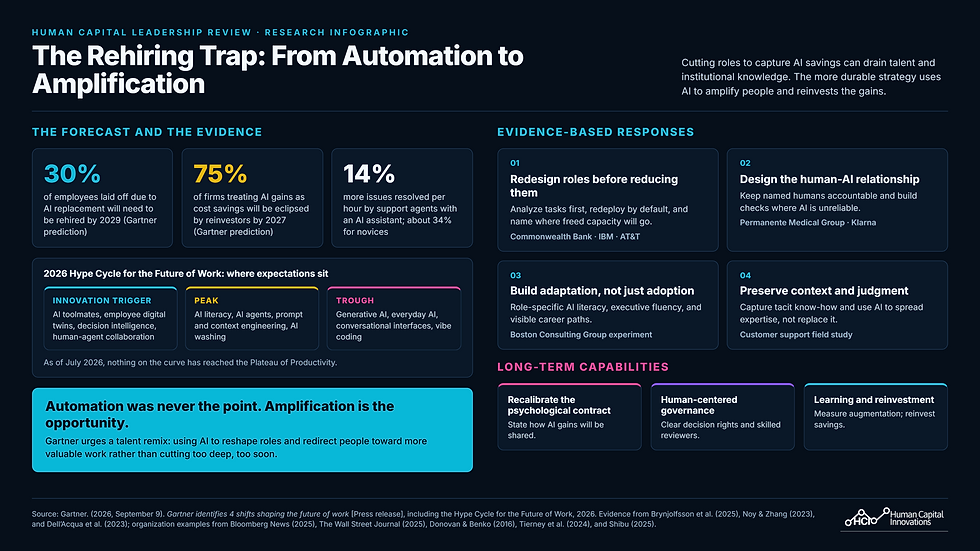
A September 2026 announcement from Gartner puts a number on that pattern. The research and advisory firm predicted that by 2029, 30% of employees laid off due to replacement by AI will need to be rehired, often at significantly higher cost (Gartner, 2026). Its reasoning is straightforward. Workforce cuts can deliver short-term financial gains, but they deplete talent pipelines and erode institutional knowledge, and with labor force growth flat or declining in much of the world, rebuilding that capability later means competing for scarce talent and paying more to recruit, train, and onboard it.
The same announcement framed the strategic mistake more sharply. Tori Paulman, a vice president analyst at Gartner, argued that executives will eventually recognize their greatest early-AI error as believing "work automation was the point, when workforce amplification was the opportunity" (Gartner, 2026). Rather than treating AI primarily as a cost-cutting instrument, Gartner recommended what it calls a talent remix strategy, using AI to reshape roles and redirect people from less productive work toward new opportunities.
This is not a fringe position. It echoes a long line of economic and organizational research on how technology changes work, and it aligns with a growing body of field evidence on generative AI in real workplaces. What makes the Gartner analysis useful for practitioners is that it connects these ideas to concrete organizational shifts and to a map of specific technologies, the 2026 Hype Cycle for the Future of Work, that leaders are evaluating right now.
This article builds on that analysis. It first defines the core concepts and reads the current state of practice through the Hype Cycle. It then examines the organizational and human consequences of automation-first strategies, outlines four evidence-based responses illustrated with organizational examples, and closes with three capabilities that support long-term, compounding value. Throughout, the aim is to separate what the evidence supports from what remains forecast. Gartner's predictions are informed judgments about the future, not measured outcomes, and they deserve to be weighed alongside the research that can be tested.
The AI-Shaped Workforce Landscape
Defining Amplification, Talent Remix, and the Hype Cycle
Several terms carry the argument of this article, and each is worth defining carefully.
Workforce automation refers to using technology to perform tasks previously performed by people, typically with the aim of reducing labor input. Workforce amplification, or augmentation, refers to using technology to extend what people can do, increasing the quality, speed, or scope of their work while keeping humans responsible for judgment and outcomes. The distinction is not always clean. Raisch and Krakowski (2021) describe an automation–augmentation paradox: in practice, the two are intertwined, because augmenting a task often involves automating parts of it, and an exclusive focus on either one can produce harmful outcomes. Augmentation without attention to efficiency can waste resources, while automation without human involvement can strip organizations of the learning and adaptation that keep them competitive.
Economists have offered a complementary frame. Acemoglu and Restrepo (2019) describe technology as having two effects on labor. A displacement effect occurs when machines take over tasks people used to do. A reinstatement effect occurs when technology creates new tasks in which human labor has a comparative advantage. Whether a technology is good or bad for workers, and ultimately for productivity, depends heavily on the balance between the two. Brynjolfsson (2022) has gone further, warning of a Turing trap in which an excessive focus on building AI that imitates and replaces humans leaves both firms and societies poorer than a focus on technologies that complement human capabilities.
Gartner's talent remix concept sits squarely in this tradition. It describes a deliberate strategy of using AI to reshape roles and redirect workers from less productive tasks toward new opportunities, rather than eliminating roles wholesale (Gartner, 2026). In the language of labor economics, it is an organizational strategy for maximizing reinstatement.
Finally, the Hype Cycle is Gartner's graphical model of how expectations for a technology evolve over time. Developed and popularized by Gartner analysts, it describes a typical path through five phases: an Innovation Trigger in which early proofs of concept attract attention; a Peak of Inflated Expectations in which publicity outruns demonstrated value; a Trough of Disillusionment in which interest wanes as implementations fail to deliver; a Slope of Enlightenment in which practical benefits become better understood; and a Plateau of Productivity in which mainstream adoption takes hold (Fenn & Raskino, 2008). Gartner describes the tool as a way to understand the maturity and adoption of technologies and how they might help solve real business problems (Gartner, 2026). Scholars have noted that not every technology follows this canonical curve and that the empirical evidence for its universality is mixed (Dedehayir & Steinert, 2016). It is best treated as a structured expert judgment about expectations, not a law of technological development, which is exactly how it is used here.
State of Practice: Reading the 2026 Hype Cycle for the Future of Work
Gartner's 2026 Hype Cycle for the Future of Work, current as of July 2026, plots several dozen technologies and practices that bear on how work gets done (Gartner, 2026). Reading its overall shape tells a story that matters for workforce strategy.
The front of the curve is crowded with agentic and human-AI collaboration technologies. Many items sit on the rising slope of the Innovation Trigger: human-agent experience, agentic browsers, employee digital twins, agent marketplaces, AI toolmates, AI avatars of the employee, decision intelligence platforms, AI-enabled cognitive offloading, human-agent collaboration workspaces, and AI agent identity, among others. These are technologies whose promise is still largely ahead of their proof.
The peak is dominated by AI capability and literacy themes. Clustered near the Peak of Inflated Expectations are items such as AI literacy, AI-augmented leadership, AI skills currency, prompt and context engineering, digital coaching applications, domain-specific generative AI models, multimodal generative AI, and AI agents. Notably, the peak also includes AI washing, the practice of overstating the AI content of products or initiatives, a reminder that inflated expectations are themselves a workforce risk.
Early generative AI investments are sliding into the trough. Generative AI itself, along with everyday AI, conversational user interfaces, vibe coding, emotion AI, and digital dexterity, appears in or near the Trough of Disillusionment. GenAI virtual assistants appear at the very beginning of the Slope of Enlightenment. Nothing on this particular curve has yet reached the Plateau of Productivity.
Gartner draws a pointed conclusion from this shape. As early AI investments hit the trough, the firm argues, the central challenge for executives is no longer technological but organizational: using AI to amplify human intelligence, expertise, and creativity (Gartner, 2026). That interpretation fits the trough's traditional meaning. Disillusionment rarely means a technology is useless. It usually means early adopters underestimated the complementary investments in skills, processes, and work design needed to realize value.
Economic research supports that reading. Brynjolfsson et al. (2021) describe a productivity J-curve for general-purpose technologies: because firms must make large, often unmeasured investments in intangible assets such as new processes, training, and organizational redesign, measured productivity can initially stagnate or fall before rising substantially. An organization that cuts headcount during the dip of that curve may be removing exactly the people whose learning is needed to climb out of it.
Gartner organizes its recommendations around four shifts and associates each with technologies on the curve. Table 1 summarizes that mapping, with approximate curve positions and Gartner's estimated time to mainstream adoption as shown in the published graphic.
Table 1: Gartner's Four Future-of-Work Shifts and Associated Technologies on the 2026 Hype Cycle
Shift (Gartner, 2026) | Technologies Gartner associates with the shift | Approximate position on the 2026 Hype Cycle | Estimated time to plateau |
1. Expand human capability through the human-AI relationship | Employee digital twin; AI toolmate; AI avatar of the employee; digital coaching applications; emotion AI | Mostly Innovation Trigger; digital coaching near the Peak; emotion AI in the Trough | 2–5 years for most; 5–10 years for AI avatar and emotion AI |
2. Empower an AI-ready workforce that adapts, not just adopts | AI literacy; workstyle analytics; digital dexterity; executive AI fluency (Gartner also names AI-enabled skills management) | AI literacy at the Peak; workstyle analytics rising toward it; digital dexterity at the bottom of the Trough; executive AI fluency on the Innovation Trigger | Less than 2 years for executive AI fluency; 2–5 years for most others |
3. Deepen context, judgment, and meaning | Decision intelligence platforms; generative UI; conversational user interfaces | Decision intelligence on the Innovation Trigger; generative UI near the Peak; conversational UIs in the Trough | 2–5 years for most; 5–10 years for generative UI |
4. Build a foundation for compound value | Embodied AI; domain-specific GenAI models; AI-powered wearables; vibe coding | Embodied AI on the Innovation Trigger; domain-specific models and wearables at or just past the Peak; vibe coding in the Trough | Less than 2 years for vibe coding; 2–5 years for embodied AI; 5–10 years for the others |
Note. Positions and time horizons are approximate readings of the published Hype Cycle graphic (Gartner, 2026) and reflect Gartner's expert assessment as of July 2026, not measured adoption outcomes.
Two features of this mapping stand out. First, the technologies most closely tied to human capability, adaptability, and judgment are mostly early or in the trough, which means organizations cannot simply buy their way into the benefits Gartner describes; they have to build capability alongside the tools. Second, the time horizons are long. Several enabling technologies are estimated to be five to ten years from mainstream productivity. Workforce decisions made today will play out over the same horizon, which is why short-term headcount reduction can be such a costly bet.
Organizational and Human Consequences of Automation-First Strategies
Organizational Performance Impacts
Gartner's rehiring forecast is a prediction, but the mechanisms behind it are well documented in organizational research on downsizing, knowledge, and technology adoption.
Downsizing frequently fails to deliver the expected gains. Decades before generative AI, Cascio (1993) reviewed evidence on corporate downsizing and found that many firms that cut staff failed to achieve the cost reductions, productivity improvements, or profitability gains they anticipated. A later comprehensive review reached a similarly cautious conclusion: the financial and organizational effects of downsizing are mixed at best, and frequently negative, depending on how and why cuts are made (Datta et al., 2010). AI does not change the underlying logic. If anything, it can make the problem worse by encouraging leaders to estimate savings from what a tool can do in a demonstration rather than what an organization can absorb in practice.
Cuts trigger the departure of people organizations want to keep. Research on voluntary turnover after layoffs shows that downsizing tends to increase subsequent voluntary departures, as survivors reassess their own prospects, although human resource practices that support embeddedness and fairness can soften the effect (Trevor & Nyberg, 2008). In the AI context, this means that cutting roles thought to be automatable may also drive out talent in roles that are not.
Institutional knowledge is harder to rebuild than to lose. Much of the knowledge that makes organizations effective is tacit, held in people's experience rather than written down. Polanyi (1966) famously observed that "we can know more than we can tell," and Autor (2015) has argued that this gap, sometimes called Polanyi's paradox, is a central reason automation has historically complemented rather than replaced many forms of human work. Research on organizational knowledge shows that knowledge is embedded in members, tools, and tasks, and that knowledge carried by people is particularly difficult to transfer or reconstitute once those people leave (Argote & Ingram, 2000). Gartner's warning that workforce cuts erode institutional knowledge (Gartner, 2026) is grounded in this research.
Competitive position depends on reinvestment, not just savings. Gartner also predicts that by 2027, 75% of organizations that prioritize capturing AI productivity gains as cost savings will be eclipsed by competitors that aggressively reinvest those gains into innovation, modernization, and upskilling (Gartner, 2026). This is again a forecast, but it fits the economic logic of reinstatement: technology creates value for firms over time largely by enabling new tasks, products, and services, not merely by reducing the cost of existing ones (Acemoglu & Restrepo, 2019). History offers a familiar illustration. When automated teller machines spread through U.S. banking, many expected bank teller employment to collapse. Instead, by lowering the cost of operating branches, ATMs helped banks open more of them, and teller roles shifted toward relationship and sales work while teller employment grew for years (Bessen, 2015).
Field evidence shows the productivity case for augmentation is strong. Some of the best evidence on generative AI at work comes from studies where AI was deployed to support people rather than replace them. In a study of more than 5,000 customer support agents at a large software firm, access to a generative AI assistant increased productivity, measured as issues resolved per hour, by 14% on average, with gains of about 34% for novice and lower-skilled workers and minimal effects for the most experienced (Brynjolfsson et al., 2025). The same study found improvements in customer sentiment and employee retention. A preregistered experiment with professional writers found that access to a generative AI tool reduced task time by about 40% and raised output quality by about 18% (Noy & Zhang, 2023). These are augmentation gains, achieved with humans still in the loop.
But AI's competence is jagged, and misplaced trust is costly. A field experiment with 758 consultants at Boston Consulting Group found that for tasks within the AI's capabilities, consultants using the tool completed more tasks, worked faster, and produced substantially higher-quality output. For a task deliberately chosen to fall outside the AI's capability frontier, however, consultants using AI were significantly less likely to reach the correct answer than those working without it (Dell'Acqua et al., 2023). The authors describe this uneven boundary as a jagged technological frontier. For workforce planning, the implication is clear: the line between tasks AI can safely absorb and tasks that still require human judgment is irregular and hard to see in advance, which is precisely why removing the humans who can detect the difference is risky.
Employee and Stakeholder Impacts
The consequences of automation-first strategies extend beyond the balance sheet to employees who leave, employees who stay, and the customers and communities they serve.
Survivors' effort and commitment can suffer. Research on layoff survivors has found that heightened job insecurity affects work effort in complex ways; in one well-known study, the relationship followed an inverted U, with moderate insecurity associated with increased effort and high insecurity associated with reduced effort (Brockner et al., 1992). When AI-driven cuts are announced without a clear account of what the organization intends for remaining roles, insecurity can easily tip into the range that reduces engagement and discretionary effort.
Broken implicit promises erode trust. Employees hold beliefs about the reciprocal obligations between themselves and their employers, what Rousseau (1995) calls the psychological contract. Cutting roles under the banner of AI efficiency, particularly when the organization has also encouraged employees to adopt AI tools, can be experienced as a breach of that contract: employees are asked to help train or adopt the systems that may then be used to justify eliminating their roles.
Remaining humans can be left with the hardest work and the least practice. Bainbridge (1983) identified what she called the ironies of automation: when routine tasks are automated, humans are often left to monitor systems and intervene in exceptional situations, yet the very automation that removed routine practice also erodes the skills needed to handle exceptions well. Later research on human-automation interaction found that people working with reliable automated aids tend toward complacency and automation bias, under-monitoring systems and accepting their outputs too readily (Parasuraman & Manzey, 2010). In an AI-shaped organization, a thinly staffed team overseeing agentic systems is exposed to both problems at once.
Algorithmic management reshapes control and autonomy. As AI systems increasingly direct, evaluate, and discipline work, they shift the balance of control between managers and workers. A review of algorithmic control in organizations described it as a new "contested terrain," in which algorithms can expand managerial control while workers respond with forms of resistance and workarounds (Kellogg et al., 2020). Work design research emphasizes that how technology is introduced, including how much autonomy, skill use, and social connection it preserves, shapes its effects on wellbeing and performance at least as much as the technology itself (Parker & Grote, 2022).
Customers notice. Automation decisions are ultimately tested in customer experience. As the organizational examples below illustrate, several prominent organizations that moved aggressively to replace human service roles with AI later reversed course after service quality or operational realities fell short of expectations.
Exposure is broad, not narrow. Finally, the scale of potential impact means these are not niche concerns. One widely cited analysis estimated that around 80% of the U.S. workforce could have at least 10% of their work tasks affected by large language models, and around 19% could see at least half of their tasks affected (Eloundou et al., 2024). Exposure, however, is not the same as replacement. Whether exposure becomes displacement or amplification is largely an organizational choice, which is the central point of Gartner's analysis.
Evidence-Based Organizational Responses
If automation-first strategies carry predictable risks, what does the alternative look like in practice? The following four responses translate Gartner's (2026) four shifts into evidence-based organizational practices.
Redesign Roles Before Reducing Them: The Talent Remix
Gartner's central recommendation is a talent remix strategy that uses AI to reshape roles and redirect workers toward more productive work (Gartner, 2026). The research base supports a role-redesign approach for several reasons. Task-based economics shows that technology reshapes jobs by changing their task composition rather than simply eliminating them (Acemoglu & Restrepo, 2019; Autor, 2015). Work design research shows that the way tasks are recombined determines whether technology enriches or impoverishes jobs (Parker & Grote, 2022). And research on job crafting shows that employees themselves actively reshape the boundaries of their work when given room to do so, often in ways that increase meaning and effectiveness (Wrzesniewski & Dutton, 2001).
Effective talent remix approaches include:
Task-level analysis before headcount decisions: Break roles into constituent tasks and assess which are candidates for full automation, which for augmentation, and which should remain human-led, rather than estimating savings at the job level.
Redeployment-first policies: Commit to offering affected employees redeployment pathways before considering exits, especially where they hold institutional knowledge relevant to the processes being automated.
Capacity reinvestment plans: Specify in advance where capacity freed by AI will be redirected, such as customer relationships, quality improvement, innovation, or growth markets.
Employee participation in redesign: Involve people who do the work in identifying where AI helps and where it creates new problems, drawing on their tacit knowledge of exceptions and edge cases.
Staged reductions tied to evidence: Where reductions are warranted, phase them according to demonstrated performance in production rather than projected capability.
Commonwealth Bank of Australia offers a cautionary illustration of what happens when the analysis comes after the decision. In mid-2025, the bank announced it would cut 45 customer service roles after introducing an AI voice bot for inbound inquiries. The Finance Sector Union challenged the decision before Australia's workplace relations tribunal, arguing that call volumes were in fact rising and that the bank was relying on overtime and team leaders to cover calls. In August 2025, the bank reversed the cuts, acknowledging that its initial assessment had not adequately considered all relevant business factors and that the roles were not in fact redundant (Bloomberg News, 2025). The episode shows how a role-level assumption about what an AI tool would absorb can diverge from operational reality, and how costly that divergence can be in trust and reputation even when it is corrected.
IBM illustrates a different approach. In May 2025, chief executive Arvind Krishna told The Wall Street Journal that the company had used AI and AI agents to take over work previously done by a couple hundred human resources employees, yet IBM's total employment had increased because the savings were reinvested in hiring for programming, sales, and other roles requiring critical thinking and human interaction ("IBM CEO Says AI Has Replaced Hundreds of Workers," 2025). Whatever one's view of the specific numbers, the logic Krishna described is essentially a talent remix: automating routine process work and redirecting capacity toward work where human judgment and relationships create value.
AT&T's earlier reskilling initiative shows what talent remix can look like at scale and before a crisis. Facing a shift from hardware-centered telecommunications to software and cloud-based networks, the company concluded that it could not simply hire its way into the skills it needed. It invested heavily in an internal reskilling program, gave employees visibility into which roles were growing and shrinking and what skills each required, and restructured roles and career paths around the capabilities the business would need (Donovan & Benko, 2016). The approach treated the existing workforce as the primary source of future capability rather than as a cost to be removed.
Design the Human-AI Relationship for Amplification
Gartner's first shift calls on organizations to treat AI as a "toolmate" that strengthens employees' judgment, creativity, leadership, and decision making while preserving accountability (Gartner, 2026). The evidence on augmentation supports this framing, with a crucial caveat: the benefits depend on how the relationship is designed. Augmentation produced strong gains in customer support (Brynjolfsson et al., 2025) and professional writing (Noy & Zhang, 2023), but it degraded performance when people relied on AI for tasks outside its competence (Dell'Acqua et al., 2023). Daugherty and Wilson (2018) describe the most valuable territory as a "missing middle" in which humans and machines each do what they do best, with humans training, explaining, and sustaining AI systems and machines amplifying human cognition and reach.
Effective human-AI design approaches include:
Clear accountability allocation: Specify which decisions AI may make autonomously, which it may recommend, and which remain fully human, and make a named person accountable for each outcome.
Designed friction at the frontier: Build verification steps into workflows for tasks where AI reliability is uncertain, so users are prompted to check outputs rather than accept them by default.
Skill-preserving rotation: Ensure people continue to perform core tasks manually at intervals, countering the skill erosion Bainbridge (1983) warned about.
Augmentation for novices, with mentoring: Use AI to accelerate the learning of less experienced employees, as observed by Brynjolfsson et al. (2025), while pairing them with experienced colleagues who can explain why the AI's suggestions work.
Human escalation guarantees: For customers and employees alike, guarantee access to a human when stakes, complexity, or emotion warrant it.
The Permanente Medical Group, part of Kaiser Permanente in Northern California, offers a healthcare example of amplification by design. In October 2023, the group made ambient AI scribe technology available to 10,000 physicians and staff. The tool listens to clinical conversations, with patient consent, and drafts documentation for the physician to review and edit. In the early evaluation, physicians who used the tool reported that it reduced after-hours clerical work and enabled more personal and meaningful patient interactions, and assessments of the draft notes indicated high-quality documentation for physician editing (Tierney et al., 2024). Importantly, the deployment kept the physician responsible for every note. The technology took on clerical burden; the clinician retained clinical judgment and accountability.
Klarna, the Swedish payments company, illustrates the risks of designing the relationship the other way. In early 2024, the company reported that its AI assistant had taken on about three-quarters of customer service chats and doing work equivalent to hundreds of human agents. By May 2025, however, chief executive Sebastian Siemiatkowski told Bloomberg that the cost-focused approach had resulted in lower-quality service and that the company was recruiting human customer service staff again, emphasizing that customers should always be able to reach a human if they want one (Shibu, 2025). The company did not abandon AI; it rebalanced toward a model in which AI and people each handle what they do best. The reversal is a vivid, real-world instance of the pattern Gartner's rehiring forecast describes.
Build Adaptive Capability, Not Just Adoption
Gartner's second shift emphasizes building a workforce that adapts rather than merely adopts, through AI literacy, AI-enabled skills management, digital dexterity, workstyle analytics, and executive AI savviness (Gartner, 2026). The distinction matters. Adoption measures whether people use tools; adaptation measures whether they can continuously learn, collaborate across disciplines, and redesign their own work as tools change. Research on job crafting suggests that employees are capable of substantial self-directed redesign when they have autonomy and support (Wrzesniewski & Dutton, 2001), and research on team learning shows that psychological safety, a shared belief that it is safe to take interpersonal risks such as asking questions or admitting mistakes, is a key condition for the experimentation adaptation requires (Edmondson, 1999).
Effective adaptive capability approaches include:
Role-specific AI literacy: Go beyond generic AI training to teach people how AI behaves in their specific tasks, including where it tends to fail.
Executive AI fluency: Ensure senior leaders understand AI capabilities and limits well enough to evaluate claims critically, guarding against the inflated expectations and AI washing visible on the Hype Cycle.
Skills visibility and internal mobility: Map skills across the organization and make growth roles and skill requirements transparent so employees can steer their own development.
Protected experimentation time: Give teams structured time to test AI in their workflows and share what they learn, including failures.
Learning measured by outcomes: Track whether new capabilities change performance and mobility, not just training completion.
The Boston Consulting Group experiment described earlier is instructive here as well. The consultants who performed worst with AI were not unskilled; they were skilled professionals who trusted the tool on a task where it was confidently wrong (Dell'Acqua et al., 2023). The researchers also observed distinct patterns of effective collaboration, with some professionals dividing work cleanly between themselves and the AI and others integrating it tightly into their workflow. The lesson for organizations in professional services is that AI readiness is less about access to tools and more about the judgment to know when, and how, to use them, which is a capability that must be deliberately developed.
AT&T's reskilling effort is relevant here too, because it combined skill development with transparency about where the business was heading, enabling employees to make informed choices about which capabilities to build (Donovan & Benko, 2016). That combination of capability and visibility is what distinguishes adaptation from adoption.
Preserve Context, Judgment, and Institutional Knowledge
Gartner's third shift warns that as AI becomes embedded in business processes, organizations risk losing context, human judgment, and institutional knowledge. Future-ready organizations, the firm argues, will design systems that strengthen decision quality, maintain human oversight, and ensure workers understand not only how a process is performed but why (Gartner, 2026). Research on tacit knowledge (Polanyi, 1966; Autor, 2015), knowledge transfer (Argote & Ingram, 2000), and automation complacency (Parasuraman & Manzey, 2010) all point in the same direction: the knowledge that allows people to recognize exceptions, explain decisions, and improve processes is fragile, and it erodes quickly when people stop exercising it or leave.
Effective context-preservation approaches include:
Knowledge capture before automation: Before automating a process, document the reasoning behind it, its known exceptions, and the judgment calls experienced staff make, and keep those people involved in the transition.
Explainability requirements: Require that AI-supported decisions in consequential areas can be explained in terms that the accountable human understands and can defend.
Human review of edge cases: Route unusual or high-stakes cases to experienced reviewers, and use those cases to keep their skills sharp.
"Why" training: Teach new employees the purpose and logic of processes, not just the steps, so they can detect when an AI-supported process is going wrong.
Knowledge-retention metrics: Monitor indicators such as dependence on a few remaining experts and time to resolve novel issues.
The customer support deployment studied by Brynjolfsson et al. (2025) provides a useful illustration from the software industry. The AI assistant in that study was trained on the conversations of the firm's most effective agents, effectively capturing and disseminating their tacit problem-solving patterns. Its largest benefits went to newer and less-skilled agents, who learned faster and performed closer to their experienced colleagues. In other words, the organization used AI to spread institutional knowledge rather than to replace the people who held it. The design depended on keeping those experienced agents in place; the system was only as good as the human expertise it learned from.
Commonwealth Bank's reversal, described earlier, also carries a lesson about context. The dispute turned on whether the bank's understanding of its own call volumes and service needs was accurate (Bloomberg News, 2025). Frontline employees and their representatives held operational knowledge that the initial automation decision did not adequately reflect. Preserving context means building channels for that knowledge to inform decisions before, not after, roles are cut.
Building Long-Term AI-Shaped Capability
Gartner's fourth shift calls for building a foundation for compound value, creating conditions in which each AI use case is faster, cheaper, and safer than the one before it (Gartner, 2026). That kind of compounding depends less on any single technology than on durable organizational capabilities. Three pillars stand out.
Recalibrating the Psychological Contract for the AI Era
The employment relationship rests on implicit expectations about what each side owes the other (Rousseau, 1995). AI is rewriting those expectations in real time, often without anyone stating the new terms. When employees suspect that adopting AI tools will be used to justify eliminating their roles, the rational response is to adopt cautiously, conceal productivity gains, or withhold the tacit knowledge that makes AI systems useful. Organizations that want compounding value need employees to share what they learn, and that requires trust.
Recalibrating the psychological contract means stating the terms explicitly. Leaders can commit to how productivity gains from AI will be shared, whether through reinvestment in roles, development opportunities, or other benefits; to how decisions about role changes will be made and communicated; and to what support will be available to employees whose work changes significantly. The Gartner recommendation that organizations reinvest AI gains into innovation, modernization, and upskilling (Gartner, 2026) is, in this light, not only a competitive strategy but also a trust-building one. Employees are far more likely to contribute to AI initiatives that visibly benefit them and their colleagues.
Distributing Judgment Through Human-Centered Governance
As agentic systems proliferate, a growing share of operational decisions will be made, or heavily shaped, by AI. Long-term capability depends on governance that keeps humans meaningfully in charge of those decisions, not as rubber stamps but as informed, accountable judges. Research on automation bias (Parasuraman & Manzey, 2010) and the ironies of automation (Bainbridge, 1983) suggests that nominal human oversight is not enough; oversight must be designed so that people have the information, skills, time, and authority to intervene effectively.
Human-centered governance has several elements. It defines clear decision rights for AI systems and for the people who supervise them. It invests in the expertise of reviewers rather than treating oversight as a low-skill monitoring task. It establishes feedback loops so that human corrections improve the system over time, which is one of the most direct routes to the compounding value Gartner describes. And it attends to the distributional effects of algorithmic management on autonomy and fairness (Kellogg et al., 2020). Governance designed this way does not slow AI adoption; it makes each successive deployment safer and more trusted, which is precisely what allows organizations to scale with confidence.
Continuous Learning and Reinvestment Systems
The productivity J-curve (Brynjolfsson et al., 2021) implies that the payoff from AI depends on sustained investment in complementary capabilities through the dip. Organizations that build systematic ways to learn from each deployment, and to reinvest the gains, are positioned to climb the curve faster.
A continuous learning and reinvestment system has three components. The first is measurement that captures augmentation, not just cost reduction: quality, customer outcomes, learning speed, innovation, and employee mobility, alongside efficiency. The second is structured experimentation, piloting AI in specific workflows, comparing outcomes with similar teams, and scaling what works, rather than committing to sweeping changes based on demonstrations. The third is a reinvestment rule, an explicit commitment to channel a defined share of AI-enabled savings into upskilling, new products, and role redesign. Without such a rule, savings tend to be absorbed into short-term margins, the pattern Gartner predicts will leave many organizations eclipsed by more aggressive reinvestors (Gartner, 2026).
Conclusion
Gartner's (2026) prediction that nearly a third of employees laid off due to AI replacement will need to be rehired by 2029 is a forecast, not a finding. But it is a forecast grounded in mechanisms that organizational research has documented for decades: downsizing that fails to deliver promised gains (Cascio, 1993; Datta et al., 2010), institutional knowledge that is easier to lose than to rebuild (Argote & Ingram, 2000; Polanyi, 1966), and automation that leaves humans with the hardest work and the least practice (Bainbridge, 1983). The 2026 Hype Cycle for the Future of Work adds a timely warning: as early generative AI investments move through the Trough of Disillusionment, the decisive factor is not the technology but how organizations reshape work around it.
The evidence on augmentation is encouraging. When AI is designed to support people, it can raise productivity, accelerate learning, and improve quality, sometimes dramatically (Brynjolfsson et al., 2025; Noy & Zhang, 2023). When it is used beyond its competence or as a substitute for judgment, it can make performance worse (Dell'Acqua et al., 2023). The organizational examples reviewed here, from Klarna and Commonwealth Bank to IBM, AT&T, and The Permanente Medical Group, suggest that the difference lies in whether leaders treat AI as a way to remove people or as a way to amplify them.
For leaders navigating this transition, several practical takeaways follow:
Analyze tasks before cutting roles. Decide what to automate, augment, and keep human at the task level, and test assumptions against operational reality before committing to reductions.
Make redeployment the default. Treat the existing workforce as the primary source of future capability, and specify in advance where freed capacity will go.
Design for amplification with accountability. Keep named humans responsible for outcomes, build verification into uncertain tasks, and preserve the skills people need to catch AI errors.
Build adaptation, not just adoption. Invest in role-specific AI literacy, executive fluency, skills transparency, and the psychological safety that experimentation requires.
Reinvest the gains. Commit a defined share of AI-enabled savings to upskilling and innovation, and say so publicly to employees.
The organizations that will look back on this period with the fewest regrets are unlikely to be those that automated the most. They will be those that used AI to make their people more capable, their decisions better informed, and each successive deployment more valuable than the last.
Research Infographic
References
Acemoglu, D., & Restrepo, P. (2019). Automation and new tasks: How technology displaces and reinstates labor. Journal of Economic Perspectives, 33(2), 3–30.
Argote, L., & Ingram, P. (2000). Knowledge transfer: A basis for competitive advantage in firms. Organizational Behavior and Human Decision Processes, 82(1), 150–169.
Autor, D. H. (2015). Why are there still so many jobs? The history and future of workplace automation. Journal of Economic Perspectives, 29(3), 3–30.
Bainbridge, L. (1983). Ironies of automation. Automatica, 19(6), 775–779.
Bessen, J. (2015). Learning by doing: The real connection between innovation, wages, and wealth. Yale University Press.
Bloomberg News. (2025, August 21). Australia's biggest bank reverses plan to replace jobs with AI. Bloomberg.
Brockner, J., Grover, S., Reed, T. F., & DeWitt, R. L. (1992). Layoffs, job insecurity, and survivors' work effort: Evidence of an inverted-U relationship. Academy of Management Journal, 35(2), 413–425.
Brynjolfsson, E. (2022). The Turing trap: The promise & peril of human-like artificial intelligence. Daedalus, 151(2), 272–287.
Brynjolfsson, E., Li, D., & Raymond, L. R. (2025). Generative AI at work. The Quarterly Journal of Economics, 140(2), 889–942.
Brynjolfsson, E., Rock, D., & Syverson, C. (2021). The productivity J-curve: How intangibles complement general purpose technologies. American Economic Journal: Macroeconomics, 13(1), 333–372.
Cascio, W. F. (1993). Downsizing: What do we know? What have we learned? Academy of Management Executive, 7(1), 95–104.
Datta, D. K., Guthrie, J. P., Basuil, D., & Pandey, A. (2010). Causes and effects of employee downsizing: A review and synthesis. Journal of Management, 36(1), 281–348.
Daugherty, P. R., & Wilson, H. J. (2018). Human + machine: Reimagining work in the age of AI. Harvard Business Review Press.
Dedehayir, O., & Steinert, M. (2016). The hype cycle model: A review and future directions. Technological Forecasting and Social Change, 108, 28–41.
Dell'Acqua, F., McFowland, E., III, Mollick, E. R., Lifshitz-Assaf, H., Kellogg, K., Rajendran, S., Krayer, L., Candelon, F., & Lakhani, K. R. (2023). Navigating the jagged technological frontier: Field experimental evidence of the effects of AI on knowledge worker productivity and quality (Working Paper No. 24-013). Harvard Business School.
Donovan, J., & Benko, C. (2016). AT&T's talent overhaul. Harvard Business Review, 94(10), 68–73.
Edmondson, A. (1999). Psychological safety and learning behavior in work teams. Administrative Science Quarterly, 44(2), 350–383.
Eloundou, T., Manning, S., Mishkin, P., & Rock, D. (2024). GPTs are GPTs: Labor market impact potential of LLMs. Science, 384(6702), 1306–1308.
Fenn, J., & Raskino, M. (2008). Mastering the hype cycle: How to choose the right innovation at the right time. Harvard Business Press.
Gartner. (2026, September 9). Gartner identifies 4 shifts shaping the future of work [Press release].
IBM CEO says AI has replaced hundreds of workers but created new programming, sales jobs. (2025, May 5). The Wall Street Journal.
Kellogg, K. C., Valentine, M. A., & Christin, A. (2020). Algorithms at work: The new contested terrain of control. Academy of Management Annals, 14(1), 366–410.
Noy, S., & Zhang, W. (2023). Experimental evidence on the productivity effects of generative artificial intelligence. Science, 381(6654), 187–192.
Parasuraman, R., & Manzey, D. H. (2010). Complacency and bias in human use of automation: An attentional integration. Human Factors, 52(3), 381–410.
Parker, S. K., & Grote, G. (2022). Automation, algorithms, and beyond: Why work design matters more than ever in a digital world. Applied Psychology, 71(4), 1171–1204.
Polanyi, M. (1966). The tacit dimension. Doubleday.
Raisch, S., & Krakowski, S. (2021). Artificial intelligence and management: The automation–augmentation paradox. Academy of Management Review, 46(1), 192–210.
Rousseau, D. M. (1995). Psychological contracts in organizations: Understanding written and unwritten agreements. Sage.
Shibu, S. (2025, May 9). Klarna is hiring customer service agents after AI couldn't cut it on calls, according to the company's CEO. Entrepreneur.
Tierney, A. A., Gayre, G., Hoberman, B., Mattern, B., Ballesca, M., Kipnis, P., Liu, V., & Lee, K. (2024). Ambient artificial intelligence scribes to alleviate the burden of clinical documentation. NEJM Catalyst Innovations in Care Delivery, 5(3).
Trevor, C. O., & Nyberg, A. J. (2008). Keeping your headcount when all about you are losing theirs: Downsizing, voluntary turnover rates, and the moderating role of HR practices. Academy of Management Journal, 51(2), 259–276.
Wrzesniewski, A., & Dutton, J. E. (2001). Crafting a job: Revisioning employees as active crafters of their work. Academy of Management Review, 26(2), 179–201.

Jonathan H. Westover, PhD, Chief Research Officer (Nexus Institute for Work and AI); Co-Founder & Chief Workforce and Learning Officer (Future State University); Founder & CEO (Human Capital Innovations); Professor of Organizational Leadership & Change (UVU). Read Jonathan Westover's executive profile here.
Suggested Citation: Westover, J. H. (2026). The Rehiring Trap: Why AI-Era Workforce Strategy Must Shift from Automation to Amplification. Human Capital Leadership Review, 39(2). doi.org/10.70175/hclreview.2020.39.2.7


