

The Creative Advantage: How Organizations Can Future-Proof Their Workforce by Investing in Creativity

Download the article here:

Listen to a review of this article:
Abstract: This article examines the relationship between occupational creativity and resilience to automation, drawing on a landmark study by Bakhshi, Frey, and Osborne (2015) which found that 86–87 percent of workers in highly creative occupations face low or no risk of computerization. The article situates these findings within the broader landscape of workforce disruption, including recent advances in generative artificial intelligence, and explores both organizational and individual consequences of the accelerating automation trend. Five evidence-based organizational responses are identified—creative skills development, human–AI collaboration models, design-thinking integration, creative industry ecosystem investment, and workforce transition support—each illustrated with practitioner examples spanning technology, entertainment, and professional services. The article concludes by articulating three forward-looking pillars for building long-term creative resilience: continuous creative learning systems, adaptive organizational design, and purpose-driven talent strategies. Implications for leaders seeking to future-proof their organizations against technological displacement are discussed throughout.
Few questions in contemporary management command as much attention—and anxiety—as the future of work. Since Frey and Osborne (2017) published their widely cited study estimating that 47 percent of U.S. jobs were at high risk of automation, the conversation about technological displacement has become a fixture of boardroom strategy sessions, government policy papers, and dinner-table debates alike. That estimate, whether one considers it alarming or merely illustrative, has been the single most cited number in the automation discourse for over a decade.
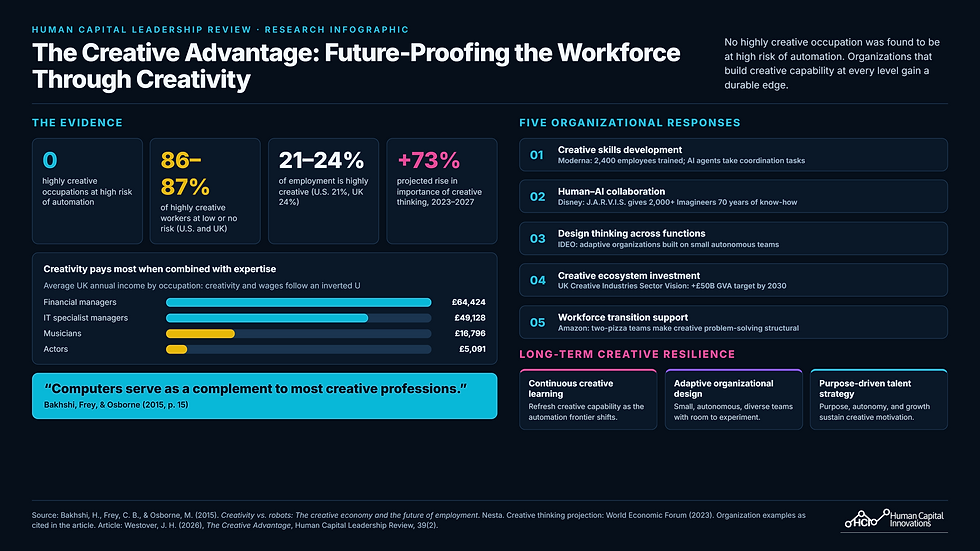
But there is a second, less publicized finding from the same research programme that deserves at least as much strategic attention. In a companion study for the UK innovation charity Nesta, Bakhshi, Frey, and Osborne (2015) turned the automation lens on creativity. Their results were striking: none of the occupations classified as highly creative were at high risk of automation—not some, not a few, but zero. In the United States, 86 percent of workers in the highly creative category were at low or no risk of computerization; in the United Kingdom, the equivalent figure was 87 percent. If automation is the storm, creativity appears to be the sturdiest shelter available.
This finding matters now more than ever. The World Economic Forum's Future of Jobs Report 2023 identified creative thinking as the second most important core skill for workers—and the single fastest-growing skill in employer demand, projected to increase in importance by 73 percent over the 2023–2027 period (World Economic Forum, 2023). The more recent 2025 edition of the same report confirmed that creative thinking remains among the top skills expected to rise in importance through 2030 (World Economic Forum, 2025). Meanwhile, McKinsey Global Institute (2023) estimated that generative AI could accelerate automation to affect activities accounting for up to 30 percent of hours worked in the U.S. economy by 2030—but also suggested that AI is more likely to enhance the way creative professionals work than to eliminate their jobs outright.
The practical stakes for organizational leaders are substantial. If creativity is indeed a durable competitive advantage in the age of automation, then organizations need to understand what makes creative work resistant to displacement, how to cultivate creative capacity at scale, and how to manage the transition for workers whose roles are more vulnerable. This article addresses each of these questions, drawing on the Bakhshi et al. (2015) study as its empirical foundation and weaving in contemporary research and practitioner examples to offer actionable guidance for leaders navigating the creative economy.
The Automation and Creativity Landscape
Defining Creativity in the Workforce Context
What do we actually mean when we say a job is "creative"? The term is used promiscuously in popular discourse—every job posting seems to require a "creative problem solver"—but Bakhshi, Frey, and Osborne (2015) adopted a deliberately broad and clear definition, taken from Oxford Dictionaries: creativity as "the use of imagination or original ideas to create something" (p. 5). This definition goes beyond the arts. It encompasses architects, software developers, biochemical engineers, IT specialists, and public relations professionals alongside musicians, actors, and graphic designers.
The study's methodology was rigorous. Using detailed task descriptions from the O*NET database—an online service developed for the U.S. Department of Labor that characterizes skills required for over 900 occupations—the researchers hand-labeled 120 U.S. occupations as creative or non-creative. They then trained a Gaussian process classifier, a machine learning algorithm, to predict the creative probability of all 702 occupations in the dataset based on their task characteristics (Bakhshi et al., 2015). The resulting classification could assign each occupation a probability of being creative on a continuous scale from 0 to 1, rather than forcing a binary yes-or-no determination.
This approach yielded a broader view of creativity than the UK Department for Culture, Media and Sport's (DCMS) official classification, which identified 30 creative occupations. Bakhshi et al. (2015) found 47 occupations with a high probability of being creative, confirming that creativity extends well beyond the arts and culture into engineering, education, management, and the sciences.
Prevalence, Drivers, and Distribution of Creative Employment
The scale of creative employment is significant and growing. According to the Bakhshi et al. (2015) analysis, 21 percent of U.S. employment and 24 percent of UK employment fell into the highly creative category—defined as having a probability of creativity greater than 70 percent. The UK's higher share stemmed largely from its proportionally larger workforce in education, legal services, community services, arts, and media, with the share of the UK workforce in arts and media being more than twice that of the U.S. (Bakhshi et al., 2015).
More recent data confirms this trajectory. The UK creative industries contributed over £124 billion to the economy in 2023, accounting for approximately 5.2 percent of Gross Value Added and employing 2.4 million people—growing at 1.6 times the national employment rate between 2010 and 2023 (Skills England, 2024). Globally, UNCTAD (2024) reported that creative services exports surged to $1.4 trillion in 2022, marking a 29 percent increase since 2017, with creative services' share of all service exports rising from 12 to 19 percent over the past decade.
Perhaps most relevant for practitioners, creative employment is not evenly distributed geographically. Bakhshi et al. (2015) found that 31 percent of London employment had a high creative probability, compared to only 24 percent for the UK as a whole. This concentration mirrors a broader pattern: cities and regions that specialize in creative work tend to have lower exposure to automation risk. London's creative workforce was found to be more secure than other parts of the UK, with only 30 percent of London employment at high risk of computerization compared to 35 percent nationally (Bakhshi et al., 2015).
Organizational and Individual Consequences of Automation
Organizational Performance Impacts
The consequences of automation exposure are far from theoretical. Organizations concentrated in automatable occupations face disruption to their operating models, talent pipelines, and competitive positioning. Frey and Osborne (2017) estimated that the occupations most vulnerable to computerization span transport, logistics, manufacturing production, construction, and office administration—sectors that collectively employ tens of millions of workers.
The financial implications are significant. McKinsey Global Institute (2023) projected that generative AI alone could add between $2.6 trillion and $4.4 trillion annually to the global economy—but capturing this value requires significant workforce restructuring. Organizations that fail to anticipate which roles are at risk and which are automation-resistant may find themselves scrambling to recruit creative talent in an increasingly competitive market. As Brynjolfsson and McAfee (2014) argued, the second machine age rewards those who can work with technology to create new value, not those who merely perform tasks that technology can replicate.
For creative industries specifically, the news is encouraging but nuanced. Bakhshi et al. (2015) found that while only 15 percent of jobs in the DCMS-defined creative industries were at high risk of automation, not all creative sub-sectors were equally protected. Computer programming activities exhibited the highest fraction of employment in the low-risk category (85 percent), while motion picture projection activities had 75 percent of employment at risk—a reminder that even within "creative" industries, routine and non-creative roles remain vulnerable (Bakhshi et al., 2015).
Individual Worker and Stakeholder Impacts
For individual workers, the automation landscape creates a profoundly uneven set of outcomes—what Goos and Manning (2007) memorably described as jobs being either "lousy" or "lovely." The polarization of labour markets, with growth at the high-skill and low-skill ends but hollowing out in the middle, has contributed to rising income inequality in countries like the United States and United Kingdom (Autor & Dorn, 2013).
Creative workers, however, occupy a distinctive and largely favorable position. Bakhshi et al. (2015) reported that creative occupations on average earn higher wages than those in the medium and low creative-probability categories—with a notable and important exception. Some of the most obviously creative occupations, including musicians, actors, and artists, earn relatively low wages. In the UK, the Annual Survey of Hours and Earnings showed average annual income for musicians at £16,796 and for actors at just £5,091, compared to £49,128 for IT specialist managers and £64,424 for financial managers (Bakhshi et al., 2015). The relationship between creativity and income follows an inverted U-shape: moderately creative occupations that combine creative tasks with managerial or technical expertise tend to command the highest wages.
This pattern has clear implications for workers contemplating career transitions. Moving into creative work does not automatically mean higher pay, but it does dramatically reduce automation risk. And when creative skills are combined with domain expertise in technology, management, or engineering, the earnings premium is substantial. As the World Economic Forum (2023) noted, analytical and creative thinking together constituted the two most important core skills for 2023 and beyond.
Evidence-Based Organizational Responses
Table 1: Organizational Responses to Automation and Creative Skills Development
Organization / Strategy Model | Organizational Response Type | Description of Approach | Key Outcomes & Implementation Details |
Moderna | Creative Skills Development | Trained all 2,400 employees to be data-driven decision-makers and deployed thousands of custom AI agents to automate coordination tasks. | Freed human workforce to focus on creative and strategic work; trained 2,400 employees and deployed thousands of custom AI agents. |
Walt Disney Company | Human-AI Collaboration | Invested in AI development for Industrial Light & Magic and Pixar while keeping work human-centered, artist-driven, and creator-led, providing internal AI tool J.A.R.V.I.S. to Imagineers. | J.A.R.V.I.S. made available to over 2,000 Imagineers, leveraging 70+ years of institutional knowledge to augment decision-making. |
IDEO | Design-Thinking Integration | Evolved into an organizational transformation practice helping companies build "Adaptive Organizations" structured around small, highly autonomous teams rather than rigid hierarchies. | Organized around small, autonomous teams focusing on experimentation, perspective, and ownership to achieve sustained growth. |
The UK Government's Creative Industries Sector Vision | Ecosystem Investment | Policy-level strategy and investment recognizing high sector growth to expand the creative industries economy. | Targeted growing creative industries to contribute an additional £50 billion GVA by 2030; noted sector filled jobs grew by 54.9% between 2011 and 2023. |
Amazon | Workforce Transition | Implemented a "two-pizza teams" organizational model of small, autonomous groups with end-to-end product ownership to structure creative problem-solving requirements into everyday roles. | Teams restricted to no more than ten people; eliminated layers of management to require holistic thinking about customer needs, product design, and competitive positioning. |
ElevenLabs | Workforce Transition | Adopted an adaptive organizational structure with high team autonomy and minimal coordination overhead. | Organized 400 employees into 20 "micro teams" consisting of five to ten people each. |
Creative Skills Development and Upskilling Programs
The evidence is clear: organizations that invest in building creative capabilities across their workforce are better positioned to withstand automation pressures. Bakhshi et al. (2015) showed that the cognitive processes involved in software development and biochemical engineering are "arguably similar to those of choreographers in that they involve an element of originality" (p. 14). Creativity, in other words, is not the exclusive province of artists—it can be cultivated in any function where workers are asked to generate novel solutions.
Effective approaches to creative skills development include:
Structured creativity training that teaches divergent thinking, ideation techniques, and problem reframing across all business functions, not just designated "creative" departments
Cross-functional rotation programs that expose employees to diverse task environments, building the kind of cognitive flexibility that Autor et al. (2003) identified as characteristic of non-routine work
Apprenticeship models that pair junior employees with experienced creative practitioners, enabling tacit knowledge transfer that cannot be codified or automated
Digital creativity platforms that give employees access to tools for prototyping, design, and experimentation as part of their everyday work
Moderna has adopted one of the most ambitious creative upskilling strategies in the pharmaceutical sector. The company has trained all 2,400 of its employees to be data-driven decision-makers and deployed thousands of custom AI agents to automate coordination tasks, explicitly freeing its human workforce to focus on the creative and strategic work that AI cannot replicate (IDEO, 2026). This approach embodies the complementarity that Bakhshi et al. (2015) described: rather than replacing creative workers, technology makes creative skills more productive.
Human–AI Collaboration Models
One of the most important insights from the Bakhshi et al. (2015) study is that creative occupations are not merely resistant to automation—they are complemented by technology. "While many creative occupations have undoubtedly been affected by computers," the authors wrote, "computer-controlled equipment is unlikely to substitute for labour in creative domains. Rather, computers serve as a complement to most creative professions, making creative skills more productive" (p. 15).
Effective approaches to human–AI collaboration include:
Augmentation-first design in which AI tools are deployed to handle routine sub-tasks within creative roles—data gathering, pattern recognition, initial drafts—while human workers retain control over judgment, originality, and emotional resonance
Creative AI sandboxes where employees can experiment with generative AI tools in low-stakes environments before integrating them into production workflows
Clear role delineation protocols that specify which aspects of a creative process are AI-assisted and which require human oversight, preventing the erosion of creative judgment over time
Feedback loops that allow creative professionals to evaluate AI-generated outputs and train algorithms toward higher-quality results
Walt Disney Company has named both Industrial Light & Magic and Pixar among the teams receiving investment in AI development, while committing to shareholders that the work will remain "human-centered, artist-driven, and creator-led." Disney's internal J.A.R.V.I.S. AI tool has been made available to over 2,000 Imagineers, providing access to more than 70 years of institutional knowledge to augment—not replace—creative decision-making (AWN, 2025). This aligns with the complementarity thesis: AI handles the connective tissue and institutional memory, while human creatives retain authority over storytelling and design.
Design-Thinking Integration Across Functions
If creativity is the best defense against automation, then organizations need systematic methods for embedding creative thinking into non-creative functions. Design thinking—the human-centered approach to innovation popularized by IDEO and the Stanford d.school—offers one such method. By training employees to empathize with end users, define problems from multiple perspectives, ideate freely, prototype rapidly, and test iteratively, design thinking transforms routine roles into ones with higher creative content (Brown, 2009).
Effective approaches to design-thinking integration include:
Organization-wide design thinking training that reaches beyond product development teams to include finance, operations, human resources, and customer service
Innovation sprints that bring cross-functional teams together to tackle specific organizational challenges using creative methodologies
Physical and virtual spaces designed for creative collaboration, including maker spaces, design studios, and digital whiteboarding platforms
Metrics that value creative output, including measures of idea generation, experimentation velocity, and successful prototyping alongside traditional efficiency metrics
IDEO itself has evolved from a product design consultancy into an organizational transformation practice that helps companies build what it calls "Adaptive Organizations"—structures that integrate both efficiency and innovation, organized around small, highly autonomous teams rather than rigid hierarchies (IDEO, 2026). Their research suggests that organizations scoring highly on experimentation (prototyping with real users), perspective (anticipating future trends), and ownership (empowering teams to act) are significantly more likely to achieve sustained growth—and these are precisely the capabilities that resist automation.
Creative Industry Ecosystem Investment
Organizations do not develop creative capability in isolation. The Bakhshi et al. (2015) finding that creative employment clusters geographically—with London hosting 31 percent highly creative employment versus 24 percent nationally—points to the importance of ecosystem-level investment. Cities and regions with dense networks of creative industries, educational institutions, and cultural organizations generate spillover effects that benefit all employers in the area.
Effective approaches to ecosystem investment include:
University–industry partnerships that support research in creative technologies, arts-based STEM education, and interdisciplinary innovation
Creative incubators and accelerators that nurture early-stage ventures at the intersection of technology and creative production
Participation in industry clusters and associations that facilitate knowledge sharing and talent mobility across creative sub-sectors
Sponsorship of arts, culture, and maker communities that enrich the local talent pipeline and contribute to the place-based factors that attract creative workers
The UK Government's Creative Industries Sector Vision, published in 2023, set a target of growing the creative industries to contribute £50 billion additional GVA by 2030. The strategy recognizes that creative industries have grown at 1.6 times the national rate and that filled jobs in the sector grew by 54.9 percent between 2011 and 2023—4.3 times the rate of the UK economy as a whole (Skills England, 2024). This policy-level investment reflects the Bakhshi et al. (2015) conclusion that "economies like the UK and US where creative occupations make up a large proportionate of the workforce may be better placed than others to resist the employment fallouts from future advances in computerisation" (p. 6).
Workforce Transition and Support Structures
Perhaps the most challenging organizational response is supporting workers in non-creative, automation-exposed roles to transition into more creative and resilient occupations. Bakhshi et al. (2015) found that 42 percent of U.S. employment and 36 percent of UK employment was in the low creative-probability category—occupations concentrated in production, transportation, construction, and office administration that are also most susceptible to automation.
Effective approaches to workforce transition include:
Internal mobility programs that create pathways from automation-exposed roles into creative and hybrid functions, supported by targeted training
Career coaching and skills assessment that help workers identify transferable creative competencies they may not recognize in themselves
Transition funding and income support during retraining periods, recognizing that creative skill development takes time and cannot be rushed
Micro-credentialing and portfolio-based assessment that validate creative capabilities acquired through non-traditional routes, reducing barriers to entry into creative occupations
Amazon's "two-pizza teams" model—small, autonomous groups of no more than ten people—illustrates how organizational restructuring can simultaneously improve efficiency and increase the creative demands on every team member. By eliminating layers of management and giving small teams end-to-end ownership of products, Amazon has created an environment where creative problem-solving is not optional but structural. Workers who might have performed narrow, automatable tasks in a traditional hierarchy are instead required to think holistically about customer needs, product design, and competitive positioning.
Building Long-Term Creative Resilience
Continuous Creative Learning Systems
The Bakhshi et al. (2015) finding that "jobs that are considered creative today may not be so tomorrow" (p. 5) is a crucial reminder that creative resilience requires ongoing investment, not a one-time intervention. As machine learning and mobile robotics continue to advance, the boundary between automatable and non-automatable tasks will continue to shift. Organizations need learning systems that continuously refresh creative capabilities.
This means moving beyond periodic training programs toward what the World Economic Forum (2025) calls a culture of "curiosity and lifelong learning"—one of the fastest-growing skills in employer demand. It means investing in learning platforms that teach not just technical skills but the dispositions of creative work: comfort with ambiguity, tolerance for failure, willingness to experiment, and the ability to synthesize insights from diverse domains.
It also means rethinking who is included in creative learning. Bakhshi et al. (2015) found that creative occupations are typically characterized by higher levels of education, but noted that "some of the most creative jobs are less so" (p. 17)—suggesting that formal education is neither necessary nor sufficient for creative capability. Organizations that restrict creative development to credentialed employees miss the opportunity to unlock creative potential across their entire workforce.
Adaptive Organizational Design
The three bottlenecks to automation identified by Frey and Osborne (2013)—perception and manipulation in unstructured environments, the creation of novel products of value, and tasks requiring high social intelligence—are all characteristics of creative work that thrive in particular organizational conditions. Bakhshi et al. (2015) described creative workers as forming "motley crews," borrowing Caves's (2000) term for the diverse, project-based teams required to produce creative outputs like films or music recordings where "every performer along with every technician has to perform at some minimum level at the same time to produce a valuable outcome" (Bakhshi et al., 2015, p. 20).
Adaptive organizational design takes these insights seriously. Rather than optimizing for efficiency and predictability—conditions that favor automation—adaptive organizations optimize for the conditions that make creative work productive. These include:
High team autonomy with minimal coordination overhead, as exemplified by organizations like ElevenLabs, which organizes its 400 employees into 20 "micro teams" of five to ten people (IDEO, 2026)
Rich information flows that connect small teams to broader organizational knowledge without requiring hierarchical intermediation
Tolerance for productive failure, recognizing that creative work inherently involves experimentation and that not all experiments will succeed
Diverse team composition that brings together specialists from different domains, mirroring the "motley crew" model that Caves (2000) identified as characteristic of creative production
Purpose-Driven Talent Strategy
Finally, building long-term creative resilience requires attending to the motivational foundations of creative work. Research consistently shows that intrinsic motivation—the drive to do work because it is inherently interesting, challenging, or meaningful—is a more powerful predictor of creative performance than extrinsic rewards alone. Bakhshi et al.'s (2015) finding that some of the most creative occupations command relatively low wages, while workers in those occupations remain highly engaged, suggests that purpose and meaning play a critical role in sustaining creative talent.
Organizations seeking to attract and retain creative workers need talent strategies that go beyond compensation to address purpose, autonomy, and growth. This means articulating a compelling organizational purpose that creative workers can connect to, providing meaningful autonomy over how work is done, and creating visible pathways for professional development and impact. It also means recognizing that creative talent increasingly expects to work with—not be replaced by—AI tools, and that the organizations most likely to win the competition for creative talent are those that demonstrate a genuine commitment to the complementary model that Bakhshi et al. (2015) envisioned.
Conclusion
The evidence assembled in this article points to a clear and actionable conclusion: creativity is not merely a "nice to have" in the age of automation—it is a strategic imperative. The Bakhshi et al. (2015) finding that none of the highly creative occupations faced high automation risk remains one of the most powerful data points available to organizational leaders seeking to future-proof their workforce. A decade later, with generative AI dramatically expanding the scope of automatable tasks, that finding has only become more relevant.
For practitioners, the implications are threefold. First, audit your workforce for creative intensity. Understand which roles in your organization involve the use of imagination and original ideas to create something—and which are concentrated in the routine, well-specified tasks that automation excels at replacing. Second, invest in building creative capability at every level. Creative skills can be developed through design-thinking training, cross-functional collaboration, human–AI augmentation models, and continuous learning systems. They are not the exclusive property of designated "creative" departments. Third, redesign your organization to support creative work. Small, autonomous teams; rich information flows; tolerance for experimentation; and diverse, purpose-driven talent strategies create the conditions in which creative resilience flourishes.
As Ada Lovelace observed in the nineteenth century—and as Bakhshi et al. (2015) reminded us—"The Analytical Engine has no pretensions whatever to originate anything" (p. 21). While the scope of what machines can do has expanded enormously since then, the human capacity for valued originality remains our most durable competitive advantage. The organizations that recognize this—and act on it—will be the ones that thrive.
Research Infographic
References
Autor, D. H. (2014). Polanyi's paradox and the shape of employment growth. Federal Reserve Bank of Kansas City Symposium on Re-evaluating Labor Market Dynamics.
Autor, D. H., & Dorn, D. (2013). The growth of low-skill service jobs and the polarization of the US labor market. American Economic Review, 103(5), 1553–1597.
Autor, D. H., Levy, F., & Murnane, R. J. (2003). The skill content of recent technological change: An empirical exploration. Quarterly Journal of Economics, 118(4), 1279–1334.
Bakhshi, H., Frey, C. B., & Osborne, M. (2015). Creativity vs. robots: The creative economy and the future of employment. Nesta.
Brown, T. (2009). Change by design: How design thinking transforms organizations and inspires innovation. HarperBusiness.
Brynjolfsson, E., & McAfee, A. (2014). The second machine age: Work, progress, and prosperity in a time of brilliant technologies. W.W. Norton & Company.
Caves, R. E. (2000). Creative industries: Contracts between art and commerce. Harvard University Press.
Frey, C. B., & Osborne, M. A. (2017). The future of employment: How susceptible are jobs to computerisation? Technological Forecasting and Social Change, 114, 254–280.
Goos, M., & Manning, A. (2007). Lousy and lovely jobs: The rising polarization of work in Britain. The Review of Economics and Statistics, 89(1), 118–133.
IDEO. (2026). The AI dividend. IDEO Journal.
McKinsey Global Institute. (2023). Generative AI and the future of work in America. McKinsey & Company.
Skills England. (2024). Sector skills needs assessments: Creative industries. UK Department for Education.
UNCTAD. (2024). Creative economy outlook 2024. United Nations Conference on Trade and Development.
World Economic Forum. (2023). The future of jobs report 2023. World Economic Forum.
World Economic Forum. (2025). The future of jobs report 2025. World Economic Forum.

Jonathan H. Westover, PhD, Chief Research Officer (Nexus Institute for Work and AI); Co-Founder & Chief Workforce and Learning Officer (Future State University); Founder & CEO (Human Capital Innovations); Professor of Organizational Leadership & Change (UVU). Read Jonathan Westover's executive profile here.
Suggested Citation: Westover, J. H. (2026). The Creative Advantage: How Organizations Can Future-Proof Their Workforce by Investing in Creativity. Human Capital Leadership Review, 39(3). doi.org/10.70175/hclreview.2020.39.3.3