





Navigating AI-Driven Workforce Transitions: Measuring Adaptive Capacity Beyond Job Exposure


Listen to this article:
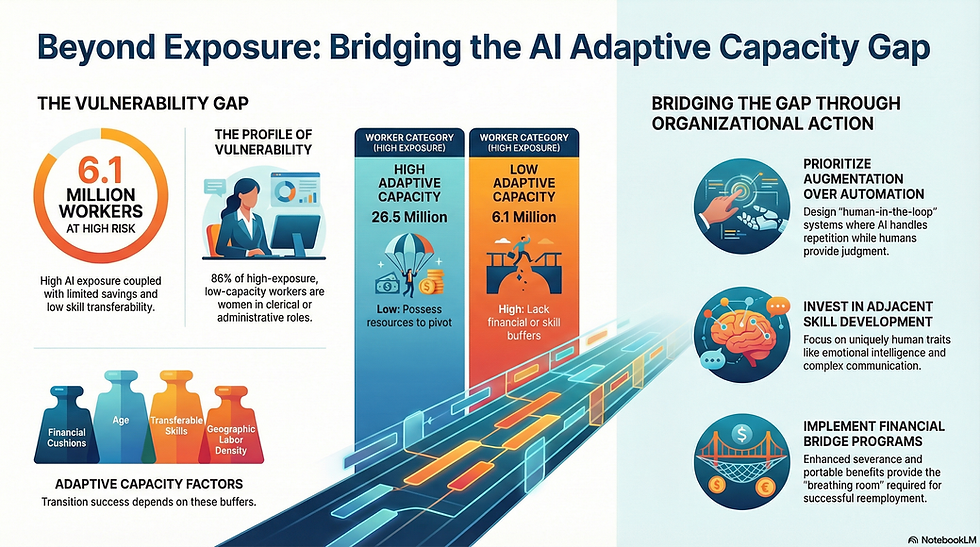
Abstract: Artificial intelligence (AI) is reshaping labor markets worldwide, yet most analyses focus narrowly on which occupations face the highest AI "exposure" while overlooking workers' varied capacity to navigate potential job displacement. This article synthesizes emerging research that combines AI exposure measures with adaptive capacity indicators—including financial resources, age, geographic density, and skill transferability—to identify which workers face the greatest vulnerability if AI-driven disruption leads to job loss. The findings reveal a nuanced landscape: while approximately 70% of highly AI-exposed workers (26.5 million of 37.1 million) possess strong adaptive capacity, roughly 6.1 million workers—predominantly women in clerical and administrative roles—face both high AI exposure and limited means to weather transitions. The article explores evidence-based organizational and policy responses, emphasizing targeted support, skill development, and systemic resilience-building to ensure that AI's labor market transformation promotes broadly shared prosperity rather than concentrated hardship.
The rapid advancement of artificial intelligence, particularly large language models (LLMs) and generative AI systems, has ignited urgent conversations about the future of work. Headlines frequently warn of mass automation, while academic studies catalog which occupations face the highest "exposure" to AI capabilities (Eloundou et al., 2024; Felten et al., 2023). Yet these exposure measures—while valuable—tell only part of the story. They estimate which jobs AI systems might technically augment or replace, but reveal little about how different workers would actually fare if displacement occurs.
The stakes are substantial. Recent research by Manning and Aguirre (2026) demonstrates that adaptive capacity—workers' ability to navigate job transitions successfully—varies dramatically across the workforce. While many highly AI-exposed professionals possess financial cushions, transferable skills, and robust networks that position them to weather disruption, millions of other workers face a precarious combination: high technical exposure to AI automation coupled with limited savings, narrow skill sets, advanced age, and sparse local labor markets. For these workers, AI-driven job loss could trigger cascading welfare costs that standard exposure metrics fail to capture.
This article examines the intersection of AI exposure and adaptive capacity, drawing on recent National Bureau of Economic Research findings and broader labor economics scholarship. The goal is to move beyond simplistic automation forecasts toward a more granular understanding of who faces genuine vulnerability—and what organizations and policymakers can do about it. As Manning and Aguirre (2026) argue, bridging AI exposure research with displacement adjustment literature enables stakeholders to distinguish between workers who can pivot relatively smoothly and those who will struggle most, allowing for better-targeted interventions that minimize human costs while harnessing AI's productivity potential.
The AI Workforce Exposure Landscape
Defining AI Exposure in Contemporary Labor Markets
AI exposure refers to the degree to which AI systems—especially LLMs and related technologies—can perform or augment the tasks that constitute a given occupation. Unlike earlier automation waves that primarily affected routine manual tasks, modern AI demonstrates strength in cognitive domains: language processing, pattern recognition, data synthesis, and even creative tasks like writing and visual design (Brynjolfsson et al., 2018; Webb, 2020).
Recent studies employ task-based methodologies, mapping detailed occupational task descriptions from databases like O*NET against AI capability assessments. Eloundou and colleagues (2024) estimate that approximately 80% of the U.S. workforce has at least 10% of their work tasks exposed to LLMs, while 19% of workers have at least 50% exposure. Critically, this research reveals a counterintuitive pattern: higher-wage, white-collar occupations requiring postsecondary education—software developers, financial analysts, lawyers, marketing managers—often show the highest exposure rates (Muro et al., 2019; Kinder et al., 2024).
This pattern differs markedly from previous automation waves. Industrial robotics primarily displaced manufacturing workers; computerization automated routine clerical tasks. AI, by contrast, demonstrates particular strength in tasks involving language, analysis, and pattern recognition—precisely the domains where college-educated professionals concentrate their efforts. A financial analyst synthesizing earnings reports, a lawyer reviewing contracts, or a marketing manager drafting campaign copy all perform tasks increasingly within AI's technical reach.
State of Practice: Adoption Patterns and Implementation Dynamics
Despite high technical exposure, actual AI adoption and displacement remain uneven and uncertain. Goldman Sachs economists estimate that AI could eventually automate tasks equivalent to 300 million full-time jobs globally, while simultaneously creating substantial new roles and productivity gains (Briggs & Kodnani, 2023). Yet adoption depends on factors beyond pure technical capability: regulatory environments, organizational readiness, workforce acceptance, implementation costs, and whether AI complements or substitutes human labor.
Early adopters concentrate in technology, finance, and professional services—sectors with strong digital infrastructure and data availability. Customer service operations deploy conversational AI; legal firms pilot contract analysis tools; marketing departments experiment with content generation. However, implementation frequently reveals that AI augmentation (enhancing human productivity) proves more tractable than full automation, as human judgment, client relationships, and contextual understanding remain critical (Acemoglu & Restrepo, 2020).
Manufacturing and logistics sectors, already highly automated, now layer AI-powered optimization atop existing systems. Healthcare explores diagnostic support and administrative automation, though clinical deployment faces rigorous validation requirements. Creative industries grapple with generative AI's disruption of illustration, copywriting, and media production—domains previously considered automation-resistant.
Geographic patterns matter too. Tech hubs like San Jose, Seattle, and Boston show both high AI exposure and rapid adoption, while smaller metros lag in both dimensions. This geographic dispersion influences not just which workers face exposure, but also their adaptive capacity—a theme explored in depth below.
Organizational and Individual Consequences of AI-Driven Displacement
Organizational Performance Impacts
When AI adoption triggers workforce restructuring, organizations face complex performance tradeoffs. Potential productivity gains must be weighed against implementation costs, morale impacts, knowledge loss, and reputational risks.
Productivity and cost dynamics: Organizations implementing AI-driven automation can realize substantial efficiency gains. Consulting firm McKinsey estimates that generative AI alone could contribute 2.6to2.6 to 2.6to4.4 trillion annually to the global economy through productivity enhancements (Chui et al., 2023). Cost savings from labor substitution appeal to financially constrained organizations, though implementation expenses—including technology acquisition, integration, training, and change management—often exceed initial projections.
Knowledge retention and human capital: Displacement strategies risk losing institutional knowledge embedded in departing workers. Organizations that emphasize wholesale replacement over thoughtful augmentation may discover that tacit expertise, client relationships, and contextual judgment prove difficult to replicate artificially. Research on organizational learning suggests that abrupt workforce reductions impair innovation capacity and operational resilience (Argote & Miron-Spektor, 2011).
Reputational and stakeholder considerations: Displacement decisions carry reputational consequences. Organizations perceived as prioritizing automation over worker welfare risk talent attraction difficulties, customer backlash, and regulatory scrutiny. Conversely, firms investing in thoughtful transitions—retraining, redeployment, transparent communication—can strengthen employer brand and social license to operate.
Individual Wellbeing and Worker Impacts
For workers facing AI-driven displacement, consequences extend far beyond immediate earnings loss. The human costs depend critically on adaptive capacity—the constellation of resources and circumstances that shape transition outcomes.
Financial security and stress: Workers with minimal savings face acute financial distress following job loss. Chetty (2008) demonstrates that individuals with greater liquid wealth weather unemployment more effectively, taking time to secure better job matches rather than accepting suboptimal positions out of desperation. For workers in highly exposed, low-adaptive-capacity occupations—often characterized by modest wages and limited savings—AI-driven displacement threatens immediate financial crisis, cascading into housing instability, healthcare disruption, and household strain.
Age and reemployment prospects: Older workers face particularly severe displacement costs. Farber (2017) finds that workers aged 55-64 who lost jobs during the Great Recession were approximately 16 percentage points less likely to find reemployment than workers aged 35-44. Older displaced workers confront age discrimination, reduced training incentives, lower mobility, and greater difficulty adapting to new technologies or sectors. For the many clerical and administrative workers in their 50s and 60s facing high AI exposure, displacement could effectively end careers prematurely.
Psychological and social dimensions: Beyond financial impacts, job loss impairs mental health, self-identity, and social connection. Research consistently documents elevated depression, anxiety, and diminished life satisfaction among displaced workers (Brand, 2015). For workers whose identity centers on occupational roles—the devoted executive assistant, the skilled paralegal—AI-driven displacement can trigger profound psychological disruption, especially when transitions force acceptance of lower-status or lower-paying work.
Geographic concentration of impacts: Workers in smaller metros face thinner labor markets with fewer alternative employers. Manning and Aguirre (2026) find that highly exposed, low-adaptive-capacity workers concentrate in college towns and mid-sized markets, particularly across the Mountain West and Midwest. In these communities, major employers' AI adoption decisions can ripple through local economies, multiplying displacement impacts across interconnected businesses and social networks.
Evidence-Based Organizational Responses
Table 1: Organizational and Policy Strategies for AI Workforce Transitions
Strategy Category | Specific Intervention | Target Population | Evidence Foundation/Benefit | Organizational Example | Implementation Type (Inferred) |
Skill Development and Internal Mobility | Future Ready initiative (online platform for education and reskilling) | Telecom workers facing technological change | Workers with broader skill portfolios experience smaller earnings losses and faster reemployment after displacement. | AT&T | Internal Organizational Policy |
Augmentation-First Operating Models | AI Copilot as a developer assistant for boilerplate tasks | Software programmers and engineers | Augmentation generates stronger productivity gains and more equitable outcomes than pure substitution strategies. | Microsoft | Internal Organizational Policy |
Transparent Communication and Participatory Planning | Augmentation-focused communication and retraining for legal operations | Legal operations staff | Procedural justice (perceived fairness) predicts employee trust, commitment, and cooperation during transitions. | JPMorgan Chase (COiN system) | Internal Organizational Policy |
Targeted Support for Vulnerable Populations | Labor Management Partnership for retraining and redeployment | Lower-wage, predominantly female workers in administrative roles | Vulnerability concentrates among workers with high AI exposure but limited savings and narrow skill sets; targeted resources mitigate costs. | Kaiser Permanente | Collaborative Partnership |
Income Support and Financial Bridge Programs | Enhanced severance and early retirement packages with healthcare extension | Legacy copper-network technicians | Financial security during transitions enables workers to avoid desperation-driven decisions and secure better job matches. | Verizon | Internal Organizational Policy |
Geographic Resilience | Regional Innovation Strategies and place-based transition support | Workers in smaller metros and college towns (Mountain West/Midwest) | Thicker labor markets offer more alternative employment; regional diversification broadens local opportunity structures. | European Structural Funds | National/Regional Public Policy |
Strengthening Social Insurance | Unemployment insurance modernization and Universal Skills Accounts | Displaced and mid-career workers | Publicly funded accounts empower workers to build adaptive capacity independently rather than relying on fragmented systems. | Not in source | National/Regional Public Policy |
Organizations deploying AI need not choose between productivity gains and worker welfare. Evidence from labor economics, organizational psychology, and change management literatures illuminates effective approaches that balance technological advancement with human dignity and adaptive capacity enhancement.
Transparent Communication and Participatory Planning
Organizational justice research emphasizes that how change unfolds shapes outcomes as much as what changes (Colquitt et al., 2001). Procedural justice—perceived fairness in decision-making processes—predicts employee trust, commitment, and cooperation during transitions. When workers understand rationales, participate in planning, and receive honest assessments, they exhibit greater resilience and engagement.
Effective practices include:
Early disclosure of automation plans: Rather than announcing displacement decisions abruptly, organizations should communicate AI adoption strategies early, explaining business drivers, expected timelines, and anticipated workforce impacts
Worker input on implementation: Involving affected employees in piloting AI tools, identifying augmentation opportunities, and designing transition support demonstrates respect and captures valuable frontline insight
Regular progress updates: Ongoing communication—acknowledging uncertainties, sharing developments, soliciting feedback—maintains trust and reduces anxiety during ambiguous transition periods
Leadership visibility and accessibility: Senior leaders engaging directly with affected teams signals commitment to equitable outcomes and creates channels for workers to voice concerns
JPMorgan Chase provides an instructive example. When deploying COiN (Contract Intelligence), an AI system reviewing commercial loan agreements, the bank emphasized augmentation over replacement, retraining affected legal operations staff for higher-value analytical work rather than eliminating positions. Leadership communicated that technology would handle repetitive document review while humans focused on judgment-intensive tasks. This transparent, augmentation-focused approach maintained workforce stability while capturing efficiency gains.
Skill Development and Internal Mobility Programs
Skill transferability research demonstrates that workers with broader skill portfolios experience smaller earnings losses and faster reemployment after displacement (Nawakitphaitoon & Ormiston, 2016). Organizations can deliberately build adaptive capacity by investing in training that expands workers' capabilities beyond narrow technical functions toward more generalizable competencies.
Effective practices include:
Adjacent skill development: Training programs helping workers acquire skills complementary to AI—such as data interpretation, prompt engineering, quality assurance, or ethical oversight—position employees to work alongside AI systems rather than being replaced
Cross-functional rotation: Exposing workers to diverse roles and departments broadens skill sets and reveals alternative internal opportunities when home departments automate
Leadership and soft skill emphasis: As AI handles more technical tasks, uniquely human capabilities—emotional intelligence, complex communication, creative problem-solving, ethical judgment—gain relative value; training in these areas enhances worker resilience
Credentialing and certification support: Funding external credentials that signal workforce quality to future employers increases workers' marketability beyond current organization
Internal talent marketplaces: Digital platforms connecting workers with internal opportunities, projects, and stretch assignments promote mobility and skill diversification
AT&T's Future Ready initiative exemplifies large-scale capability building. Facing rapid technological change threatening traditional telecom roles, AT&T invested over $1 billion in employee education and reskilling. The company created an online platform helping workers identify emerging roles, assess skill gaps, and access relevant training—from coding boot camps to advanced degrees. While certainly not without critics regarding execution and outcomes, the initiative demonstrates organizational commitment to building adaptive capacity proactively rather than simply managing displacement reactively.
Income Support and Financial Bridge Programs
Chetty's (2008) research on unemployment insurance and job search demonstrates that financial security during transitions enables better long-term outcomes. Workers with adequate resources avoid desperation-driven decisions, invest in skill development, and secure better job matches. Organizations can enhance workers' financial adaptive capacity through targeted support during transitions.
Effective practices include:
Enhanced severance packages: Extending severance beyond statutory minimums provides displaced workers breathing room for effective job searches, especially for older workers and those in specialized roles requiring longer reemployment timelines
Continued benefits coverage: Maintaining health insurance, retirement contributions, and other benefits during transition periods prevents disruption of critical services and reduces financial stress
Placement assistance funding: Covering costs of resume services, interview coaching, relocation if needed, or skill certification demonstrates organizational commitment to successful transitions
Retention bonuses and phased transitions: For workers operating AI systems during implementation—training algorithms, validating outputs, managing changeover—retention bonuses and gradual transitions (rather than abrupt termination) respect contribution while enabling knowledge transfer
Verizon's early retirement and voluntary severance programs illustrate structured financial bridge approaches. When restructuring to emphasize 5G and fiber-optic deployment, Verizon offered enhanced packages to legacy copper-network technicians—including extended healthcare coverage, pension supplements, and retraining stipends. While voluntary programs favor workers already possessing some adaptive capacity, coupling them with mandatory placement assistance for involuntary separations can extend support more equitably.
Augmentation-First Operating Models
Research by Acemoglu and Restrepo (2020) distinguishes between automation (machines substituting for labor) and augmentation (technology complementing human capabilities). Their analysis suggests augmentation generates stronger productivity gains and more equitable labor market outcomes than pure substitution strategies. Organizations prioritizing augmentation design systems amplifying human judgment rather than eliminating human roles.
Effective practices include:
Human-in-the-loop system design: Architecting AI systems requiring human oversight, approval, and intervention maintains employment while improving accuracy and accountability
Task reallocation rather than role elimination: Assigning AI to repetitive, high-volume tasks while redirecting human workers toward complex, judgment-intensive, or relationship-centered activities preserves employment while boosting productivity
AI literacy and co-working training: Teaching workers how to collaborate effectively with AI tools—understanding capabilities and limitations, crafting effective prompts, validating outputs, identifying errors—positions employees as essential AI supervisors rather than displaced workers
Gradual automation pacing: Phasing AI deployment gradually rather than deploying wholesale automation allows iterative learning, reduces disruption, and creates time for workforce adaptation
Microsoft's Copilot deployment in its own operations illustrates augmentation-focused approaches. Rather than replacing programmers with code-generation AI, Microsoft positioned Copilot as an assistant that handles boilerplate code, documentation, and testing, freeing developers for architecture, design, and complex problem-solving. Early assessments suggest productivity gains without workforce reduction, as engineers redirect time toward higher-value contributions that AI cannot replicate.
Targeted Support for High-Exposure, Low-Capacity Workers
Manning and Aguirre's (2026) analysis demonstrates that vulnerability concentrates disproportionately among workers—especially women—in clerical and administrative occupations combining high AI exposure with limited savings, advanced age, narrow skill sets, and sparse local opportunities. Equitable AI transitions require recognizing this heterogeneity and targeting resources where adaptive capacity is weakest.
Effective practices include:
Proactive identification: Using workforce analytics to identify high-exposure, low-capacity populations—considering age, tenure, skill profiles, compensation levels, geographic location—enables early intervention before displacement occurs
Intensive case management: Providing individualized transition support—career counseling, financial planning, mental health resources, job search assistance—addresses the complex, multifaceted challenges facing vulnerable workers
Cohort-based reskilling programs: Designing training specifically for administrative and clerical workers emphasizes relevant adjacent skills (data analytics, digital tools proficiency, project coordination) rather than generic curricula poorly matched to starting skill levels
Partnership with community resources: Connecting displaced workers with public workforce development systems, community colleges, union retraining programs, and non-profit employment services leverages external expertise and funding
Gender-responsive design: Recognizing that 86% of highly exposed, low-adaptive-capacity workers are women (Manning & Aguirre, 2026) requires addressing gender-specific barriers—caregiving responsibilities, occupational segregation, wage gaps—in transition support design
Kaiser Permanente's Labor Management Partnership offers relevant lessons, though predating current AI disruptions. Facing healthcare industry transformation, Kaiser engaged unions in jointly designing workforce adaptation strategies emphasizing retraining, redeployment, and income security for lower-wage, predominantly female workers in administrative and support roles. While not specifically addressing AI, the partnership model demonstrates how identifying vulnerable populations and co-designing targeted supports can mitigate transition costs.
Building Long-Term Workforce Resilience and Adaptive Capacity
Beyond managing immediate AI-driven transitions, organizations and policymakers must build systemic resilience—creating labor market structures and workforce capabilities that enable continuous adaptation as AI and other technologies evolve.
Cultivating Continuous Learning Systems
Future-proof capability building: Rather than episodic training responses to specific technological shocks, organizations should embed continuous learning into operations. This includes dedicating work time for skill development, creating learning cultures where experimentation and growth are expected, and designing career paths emphasizing breadth and adaptability rather than narrow specialization.
Research on organizational learning suggests that companies fostering continuous development outperform competitors during disruptive change (Argote & Miron-Spektor, 2011). For workers, career-long learning builds the skill transferability that Manning and Aguirre (2026) identify as critical to adaptive capacity. Beyond formal training programs, learning systems encompass mentorship networks, communities of practice, job rotation, and deliberate exposure to emerging technologies.
Micro-credential ecosystems: Traditional degree programs often prove too lengthy and expensive for mid-career workers needing rapid reskilling. Micro-credentials—short, focused certifications in specific competencies—offer more agile skill development. Organizations can partner with educational providers, industry associations, or platform providers like Coursera and edX to create stackable credentials aligned with emerging skill demands. Public policy can support micro-credential ecosystems through quality assurance frameworks, funding mechanisms, and recognition in hiring and promotion decisions.
Anticipatory skill forecasting: Rather than reacting to automation after deployment, organizations can analyze emerging technologies, forecast skill implications, and begin proactive development. Workforce analytics combining AI capability roadmaps with employee skill profiles can identify vulnerable populations years before displacement risk materializes. This anticipatory approach transforms adaptive capacity from reactive crisis management into strategic capability building.
Strengthening Financial Resilience Foundations
Asset-building initiatives: Since liquid savings strongly predict post-displacement outcomes (Chetty, 2008), policies and practices that help workers accumulate financial buffers enhance adaptive capacity systemically. Employer-sponsored emergency savings accounts—with automatic enrollment, employer matching, and accessibility for urgent needs—show promise in behavioral economics research (Grinstein-Weiss et al., 2015). Tax-advantaged accounts dedicated to training and transition expenses could encourage workers to build both financial and skill-development resources.
Progressive benefit structures: Traditional benefits like health insurance, paid leave, and retirement savings often tie entirely to specific employers, making job transitions particularly costly. Portable benefit systems—where benefits follow workers across jobs—reduce transition friction and displacement costs. While comprehensive reform requires policy action, individual organizations can design benefits emphasizing portability (e.g., immediate vesting, continuation assistance) and supplement gaps in public systems.
Living wages and income adequacy: Workers earning wages barely covering immediate needs cannot accumulate savings buffers. Organizations committed to building workforce adaptive capacity must examine whether compensation structures enable financial security. Recent research demonstrates that higher minimum wages improve worker wellbeing without necessarily reducing employment (Cengiz et al., 2019), suggesting wage adequacy complements rather than conflicts with competitiveness.
Distributed Opportunity and Geographic Resilience
Spatial concentration of vulnerability: Manning and Aguirre (2026) find that highly exposed, low-adaptive-capacity workers concentrate geographically in smaller metros, college towns, and certain regions—particularly the Mountain West and Midwest. Geographic density matters because thicker labor markets offer more alternative employment opportunities when displacement occurs (Bleakley & Lin, 2012).
Regional economic diversification: Communities dependent on narrow economic bases—state capitals dominated by government administration, college towns reliant on university employment—face concentrated vulnerability when those sectors automate. Economic development strategies emphasizing diversification, entrepreneurship support, and attraction of varied industries can broaden local opportunity structures, enhancing aggregate adaptive capacity.
Remote work and geographic arbitrage: AI adoption coincides with expanded remote work normalization. For some displaced workers, remote opportunities can compensate for sparse local labor markets. However, access to remote work correlates with education and occupation—precisely the dimensions where low-adaptive-capacity workers already face disadvantages. Policies and practices ensuring equitable remote work access—digital infrastructure investment, remote work training, inclusive hiring—can leverage geography-independent opportunity to offset local market thinness.
Place-based transition support: Federal and state workforce development systems can channel resources toward regions with high concentrations of vulnerable workers. Targeted investments in community college capacity, industry partnership programs, and economic diversification initiatives can strengthen regional adaptive capacity where it's weakest. Models like Regional Innovation Strategies programs in the U.S. or European Structural Funds demonstrate place-based approaches to economic resilience building.
Strengthening Social Insurance and Safety Nets
Unemployment insurance modernization: U.S. unemployment insurance systems, designed for cyclical layoffs in manufacturing, often fail workers facing structural displacement. Low benefit levels, short durations, and complex eligibility rules undermine the financial security that supports effective job search (Rothstein, 2011). Modernization could include higher replacement rates for lower-wage workers, extended durations for older workers and those in declining occupations, and integration with training programs allowing benefit receipt during reskilling.
Universal skills accounts: Policy proposals for individual training accounts—publicly funded accounts workers control for approved education and training throughout careers—could democratize access to skill development. Rather than relying on employer-provided training (which favors already-advantaged workers) or navigating fragmented public workforce systems, universal accounts would empower workers to build adaptive capacity continuously and independently.
Stakeholder governance and worker voice: Beyond specific programs, building resilient labor markets requires mechanisms ensuring workers' voices shape decisions affecting them. This may include strengthened labor unions, works councils, or other representative structures that give workers input on automation strategies, transition support design, and benefit structures. Research on industrial relations suggests participatory governance improves both transition outcomes and organizational performance by surfacing tacit knowledge and building trust (Freeman & Lazear, 1995).
Conclusion
The challenge of AI-driven workforce transitions extends far beyond identifying which jobs face technical automation risk. As Manning and Aguirre's (2026) research demonstrates, workers' actual vulnerability depends on a complex interplay of financial resources, age, skills, geographic context, and local opportunity structures—what we term adaptive capacity. While many highly AI-exposed workers possess strong means to weather potential displacement, roughly 6.1 million workers, concentrated in clerical and administrative roles and predominantly women, face the precarious combination of high exposure and limited adaptive capacity.
This nuanced understanding demands equally sophisticated responses. Organizations deploying AI should prioritize transparent communication, skill development, augmentation-first operating models, and targeted support for vulnerable populations. Policymakers must strengthen social insurance systems, support place-based resilience building, and foster continuous learning infrastructures. Both must recognize that adaptive capacity is not fixed—it can be deliberately built through thoughtful investment and systemic reform.
The ultimate policy and practice imperative is this: measure what matters most. Exposure metrics alone obscure who actually faces hardship. By accounting for adaptive capacity, stakeholders can target interventions where they'll reduce suffering and improve outcomes most effectively. In doing so, society can harness AI's productivity potential while honoring commitments to workers who—through no fault of their own—find their occupations increasingly exposed to automation. The goal is not to stop AI adoption, but to ensure its benefits flow broadly while its costs concentrate nowhere.
Building workforce resilience in the age of AI requires moving from reactive crisis management to proactive capability building, from generic workforce programs to targeted support for the genuinely vulnerable, and from narrow technical assessments to comprehensive understanding of human experience. The evidence base exists; the challenge now is implementation at scale, with urgency proportionate to the stakes.
Research Infographic
References
Acemoglu, D., & Restrepo, P. (2020). Robots and jobs: Evidence from US labor markets. Journal of Political Economy, 128(6), 2188–2244.
Argote, L., & Miron-Spektor, E. (2011). Organizational learning: From experience to knowledge. Organization Science, 22(5), 1123–1137.
Bleakley, H., & Lin, J. (2012). Thick-market effects and churning in the labor market: Evidence from US cities. Journal of Urban Economics, 72(2–3), 87–103.
Brand, J. E. (2015). The far-reaching impact of job loss and unemployment. Annual Review of Sociology, 41, 359–375.
Briggs, J., & Kodnani, D. (2023). The potentially large effects of artificial intelligence on economic growth. Goldman Sachs Economics Research.
Brynjolfsson, E., Mitchell, T., & Rock, D. (2018). What can machines learn and what does it mean for occupations and the economy? AEA Papers and Proceedings, 108, 43–47.
Cengiz, D., Dube, A., Lindner, A., & Zipperer, B. (2019). The effect of minimum wages on low-wage jobs. Quarterly Journal of Economics, 134(3), 1405–1454.
Chetty, R. (2008). Moral hazard versus liquidity and optimal unemployment insurance. Journal of Political Economy, 116(2), 173–234.
Chui, M., Hazan, E., Roberts, R., Singla, A., Smaje, K., Sukharevsky, A., Yee, L., & Zemmel, R. (2023). The economic potential of generative AI: The next productivity frontier. McKinsey Global Institute.
Colquitt, J. A., Conlon, D. E., Wesson, M. J., Porter, C. O., & Ng, K. Y. (2001). Justice at the millennium: A meta-analytic review of 25 years of organizational justice research. Journal of Applied Psychology, 86(3), 425–445.
Eloundou, T., Manning, S., Mishkin, P., & Rock, D. (2024). GPTs are GPTs: An early look at the labor market impact potential of large language models. Science, 383(6681), eadj9337.
Farber, H. S. (2017). Employment, hours, and earnings consequences of job loss: US evidence from the Displaced Workers Survey. Journal of Labor Economics, 35(S1), S235–S272.
Felten, E., Raj, M., & Seamans, R. (2023). Occupational heterogeneity in exposure to generative AI. SSRN Electronic Journal.
Freeman, R. B., & Lazear, E. P. (1995). An economic analysis of works councils. In J. Rogers & W. Streeck (Eds.), Works councils: Consultation, representation, and cooperation in industrial relations (pp. 27–52). University of Chicago Press.
Grinstein-Weiss, M., Russell, B. D., Tucker, C., Comer, K., & Baltes, J. (2015). Employer-facilitated emergency savings: A promising approach to improving household financial security. Journal of Consumer Affairs, 49(3), 485–516.
Hampole, V., Mehrotra, A., & Rothwell, J. (2025). Which workers are most exposed to AI? Brookings Institution.
Kinder, M., Stateler, L., & Du, J. (2024). AI's likely impact on jobs: Industry- and occupation-level forecasts. Brookings Metro.
Manning, S., & Aguirre, T. (2026). Measuring U.S. workers' capacity to adapt to AI-driven job displacement (NBER Working Paper). National Bureau of Economic Research.
Muro, M., Maxim, R., & Whiton, J. (2019). Automation and artificial intelligence: How machines are affecting people and places. Brookings Institution.
Nawakitphaitoon, K., & Ormiston, R. (2016). An examination of the relationship between the use and breadth of managerial skills and organizational performance. ILR Review, 69(4), 837–865.
Rothstein, J. (2011). Unemployment insurance and job search in the Great Recession. Brookings Papers on Economic Activity, 2011(2), 143–213.
Webb, M. (2020). The impact of artificial intelligence on the labor market. SSRN Electronic Journal.

Jonathan H. Westover, PhD is Chief Research Officer (Nexus Institute for Work and AI); Associate Dean and Director of HR Academic Programs (WGU); Professor, Organizational Leadership (UVU); OD/HR/Leadership Consultant (Human Capital Innovations). Read Jonathan Westover's executive profile here.
Suggested Citation: Westover, J. H. (2026). Navigating AI-Driven Workforce Transitions: Measuring Adaptive Capacity Beyond Job Exposure. Human Capital Leadership Review, 33 (3). doi.org/10.70175/hclreview.2020.33.3.3


