





Automation Won't Save You—Workflow Redesign Will: The Strategic Imperative for Value Capture in the Age of Agentic AI


Listen to a review of this article:
Abstract: Artificial intelligence has transitioned from a productivity tool to a strategic inflection point, yet most organizations fail to capture enterprise value from individual efficiency gains because workflows remain unchanged. This article synthesizes evidence from large-scale organizational studies, randomized controlled trials, and industry observations to examine why isolated AI adoption yields marginal returns while integrated workflow redesign unlocks substantial competitive advantage. Drawing on documented productivity improvements of 26–40% in knowledge work and the emergence of agentic AI systems, we analyze the organizational, labor market, and capability development consequences of the current deployment gap. Evidence-based responses include experimental workflow redesign, capability expansion strategies, apprenticeship model recalibration, and distributed AI governance structures. The article concludes that leadership mindset—choosing expansion over efficiency—determines whether AI diminishes or amplifies organizational capacity. Organizations that redesign work systems to augment human judgment, not merely automate tasks, position themselves for sustained value creation in an environment where AI capability evolves faster than institutional adaptation.
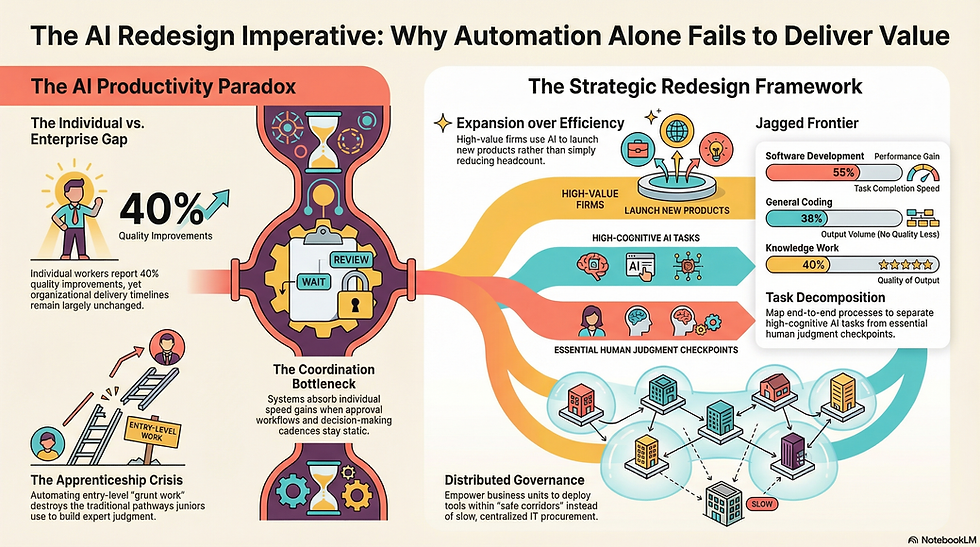
We are living through a paradox. Individual workers report threefold productivity gains when using AI tools, coding output has surged 38% without quality degradation, and knowledge workers achieve 40% quality improvements alongside 26% speed gains in controlled studies (Mollick, 2024). Yet organizational performance improvements remain elusive, merger integration timelines have not compressed, and most enterprises report minimal bottom-line impact from AI investments. The disconnect is structural: productivity tools require workflow continuity, but strategic inflection points demand organizational redesign.
The stakes are immediate and asymmetric. Approximately 50% of American workers now use AI, often through consumer-facing tools deployed without institutional oversight (Mollick, 2024). Employees are capturing individual gains while enterprises absorb costs and risks—misaligned incentives, fragmented data governance, and eroding entry-level apprenticeship pathways. CEOs face a defining choice: deploy AI for short-term cost reduction or redesign the firm to expand human capability, innovation, and long-term value creation.
This article examines why automation alone fails to deliver enterprise value, what organizational and individual consequences emerge from misaligned AI adoption, and how evidence-based workflow redesign—paired with capability expansion strategies—can transform AI from a productivity incremental into a strategic asset. The analysis draws on randomized controlled trials, labor market studies, and documented organizational transformations across healthcare, financial services, technology, and professional services sectors.
The AI Deployment Landscape
Defining the Jagged Frontier and Agentic AI
AI capability does not distribute evenly across tasks. Researchers describe a "jagged frontier" where AI excels unpredictably at high-cognitive tasks—legal contract analysis, code generation, complex writing—while failing at seemingly simpler ones, such as nuanced stakeholder negotiation or ambiguous problem framing (Dell'Acqua et al., 2023). This uneven terrain means blanket deployment strategies fail; organizations must map capability boundaries experimentally, task by task.
Agentic AI represents the next capability leap. Unlike static tools that respond to prompts, agentic systems combine large language models with tool access, memory, and goal-directed autonomy (Mollick, 2024). An agent tasked with competitive market analysis can search databases, synthesize reports, draft summaries, and iterate based on feedback—without human intervention at each step. Enterprise leverage lies not in automating discrete tasks but in delegating multi-step workflows to semi-autonomous systems, freeing human judgment for higher-order synthesis, strategic trade-offs, and stakeholder alignment.
This distinction matters organizationally. Task automation preserves existing workflows; agentic delegation requires redesigning accountability structures, quality assurance mechanisms, and human-AI collaboration norms. Firms that treat agents as enhanced automation tools encounter coordination failures, accountability gaps, and diminished trust. Those that redesign workflows around human-agent collaboration unlock new capability frontiers.
Prevalence, Drivers, and the Adoption Gap
Adoption is widespread but uncoordinated. Half of U.S. workers use AI, predominantly through consumer tools like ChatGPT, Claude, or Gemini, often without enterprise licenses or governance frameworks (Mollick, 2024). This shadow adoption creates risk: intellectual property leakage, inconsistent quality standards, and compliance blind spots. Meanwhile, C-suite executives systematically underestimate internal usage, believing AI remains experimental when it has already become operational.
What drives this gap? Three forces converge. First, AI tools have crossed usability thresholds; non-technical workers can access frontier capabilities through natural language interfaces. Second, individual incentives reward productivity gains—employees capture time savings, performance improvements, and career advantages without waiting for institutional coordination. Third, organizational inertia slows formal adoption: procurement cycles, IT security reviews, change management protocols, and workflow redesign efforts take quarters or years, while employees need solutions today.
The result is a bifurcated reality. Individual productivity surges while organizational productivity stagnates because gains remain isolated, unscaled, and unintegrated. The bottleneck is not technology—it is organizational redesign.
Organizational and Individual Consequences of Misaligned AI Adoption
Organizational Performance Impacts
The failure to translate individual productivity into organizational value manifests in several measurable ways. Despite widespread AI tool usage, many firms report minimal changes in delivery timelines, margin expansion, or revenue per employee (Mollick, 2024). Why? Because work is embedded in interdependent systems. If one analyst completes reports 40% faster but approval workflows, cross-functional coordination, and decision-making cadences remain unchanged, the system absorbs the slack without accelerating outcomes.
Consider a mid-sized consulting firm where associates use AI to draft client deliverables 30% faster. Without redesigning review processes, partner bandwidth constraints become the new bottleneck. The firm captures no cycle time reduction, no capacity expansion, and no margin improvement—yet incurs costs from fragmented tool adoption, inconsistent quality, and intellectual property exposure through unsecured external platforms.
Quantified effects from early adopters illustrate the redesign imperative. Organizations that have successfully integrated AI into development workflows report productivity gains only after restructuring collaboration norms, redefining role boundaries, and implementing AI-assisted review processes. GitHub Copilot users saw 55% faster task completion in controlled studies, but enterprise value required integrating AI outputs into continuous integration pipelines, adjusting quality gates, and retraining developers to supervise rather than generate code (Peng et al., 2023).
The organizational cost of misalignment extends beyond lost productivity. Shadow AI adoption creates compliance risks, data governance gaps, and quality inconsistencies. When employees use consumer-grade tools for sensitive work, enterprises lose visibility into what data leaves the organization, how outputs are validated, and whether legal or regulatory obligations are met. The short-term convenience of unsanctioned tools compounds into long-term institutional risk.
Individual Wellbeing and Labor Market Impacts
For individual workers, the AI transition creates asymmetric exposure. High performers who adopt AI tools early capture disproportionate productivity gains, enhancing career trajectories and compensation (Dell'Acqua et al., 2023). But those same gains quietly erode traditional skill-building pathways. Entry-level roles—the grunt work that built tacit knowledge—are being automated. If junior analysts no longer draft memos, conduct literature reviews, or prepare financial models, how do they develop judgment, domain fluency, and professional identity?
The apprenticeship crisis is not hypothetical. Industry observers report that AI-generated contract drafts appear to be reducing junior associate workloads in legal practice, potentially compressing the experiential learning curve that historically built legal reasoning. Similar patterns emerge in investment banking, where AI-generated financial models may reduce traditional analyst training opportunities, raising questions about how future cohorts will develop deep fluency in the underlying craft.
This dynamic extends beyond elite professions. Customer service representatives using AI co-pilots achieve higher resolution rates in initial deployments, but the cognitive offloading may reduce their ability to handle novel or ambiguous cases independently (Brynjolfsson et al., 2023). The immediate productivity gain risks masking a longer-term capability erosion—workers may become dependent on AI guardrails, losing the problem-solving muscle memory that once defined expertise.
For organizations, this creates a hidden liability. If AI-augmented junior staff never build deep capability, who becomes the next generation of senior leaders, subject matter experts, and strategic decision-makers? The apprenticeship model evolved over centuries precisely because tacit knowledge—judgment, contextual fluency, stakeholder intuition—cannot be taught abstractly. It must be lived. AI adoption without workflow redesign risks hollowing out the capability pipeline, creating a generation of supervisors without mastery.
Labor market consequences remain uncertain but directionally clear. Large firms change slowly; no immediate mass displacement has occurred (Mollick, 2024). But anecdotal evidence suggests entry-level hiring may be softening in sectors where AI substitutes for early-career labor. Some consulting firms, legal practices, and financial services organizations appear to be adjusting intern-to-analyst conversion rates and restructuring career ladders to reflect new task distributions. The social compact—education → entry-level work → apprenticeship → mastery—is fracturing without a replacement model.
Evidence-Based Organizational Responses
Table 1: AI Integration Case Studies and Strategic Frameworks
Sector | Organization Type | AI Application Area | Workflow Redesign Strategy | Reported Productivity/Quality Gains | Organizational Outcome (Inferred) |
Pharma | Biopharma Firm | Literature review for drug discovery | AI agents automate database scanning and summary generation, enabling scientists to pivot to hypothesis generation and experimental design. | Substantial reduction in review time; expanded research scope to multiple additional therapeutic targets. | Acceleration of early-stage pipeline development and increased innovation capacity without increasing headcount. |
Healthcare | Integrated Health System | Diagnostic support (Radiology and Pathology) | AI performs first-pass analysis and anomaly detection; radiologists focus on complex cases and direct patient communication. | Increased diagnostic throughput; decreased turnaround times; improved clinician job satisfaction. | Enhanced patient care capacity and clinician retention by elevating roles toward high-value cognitive tasks. |
Technology | Software Development / Enterprise | Code generation and development | Integration of AI outputs into continuous integration pipelines with adjusted quality gates; developers retrained for system supervision. | faster task completion. | Strategic shift from manual coding to system-wide oversight, ensuring faster delivery cycles while maintaining code integrity. |
Professional Services | Global Consulting Firm | Deliverable drafting and analyst tasks | Restructured development programs utilizing 'judgment labs' to review AI outputs and preserve experiential learning. | Significant reduction in traditional junior analyst workload. | Mitigation of long-term leadership capability risks by protecting the apprenticeship pipeline from automation-led erosion. |
Finance | Global Bank | Contract analysis and regulatory document review | Implementation of distributed governance via cross-functional AI councils and automated validation checkpoints. | Accelerated adoption through safe corridors; reduced 'shadow AI' risks. | Balanced agility and institutional control, enabling rapid innovation while maintaining strict regulatory compliance. |
Customer Service | Not in source | AI co-pilots for representatives | Cognitive offloading for routine inquiries to assist representatives. | Higher resolution rates in initial deployments. | Short-term efficiency gains at the risk of long-term loss in independent problem-solving expertise for complex cases. |
Experimental Workflow Redesign
Organizations capturing enterprise value from AI share a common pattern: they treat deployment as a redesign challenge, not a technology rollout. Experimental workflow redesign starts with task decomposition—mapping end-to-end processes to identify which steps involve high-cognitive work suited to AI, which require human judgment, and which demand human-AI collaboration.
Effective approaches include:
Process mining and task mapping: Use workflow analytics to identify bottlenecks, handoffs, and low-value tasks. Target AI deployment where automation unblocks downstream capacity.
Pilot-driven iteration: Deploy AI in controlled environments with tight feedback loops. Measure cycle time, quality, error rates, and user satisfaction. Iterate before scaling.
Role boundary redefinition: Shift human workers from task execution to supervision, quality assurance, and strategic synthesis. Train employees to evaluate AI outputs critically, not accept them passively.
Integrated tooling: Replace shadow AI adoption with enterprise-licensed, governance-compliant platforms. Ensure outputs feed directly into downstream workflows without manual rework.
Pharmaceutical R&D at a Leading Biopharma Firm: A major pharmaceutical company piloted AI-assisted literature review for drug discovery, recognizing that value would come not from isolated automation but from workflow transformation. Rather than deploying AI as a standalone tool, researchers redesigned the entire discovery workflow. AI agents scanned vast publication databases, flagged relevant findings, and generated annotated summaries. Human scientists focused on hypothesis generation, experimental design, and cross-disciplinary synthesis—tasks requiring creativity and contextual judgment. Early results from the pilot suggested literature review time could be reduced substantially, but more importantly, the redesign appeared to expand research scope: teams could potentially explore multiple additional therapeutic targets within the same timeline, accelerating early-stage pipeline development.
The lesson: AI's value lies not in replacing scientists but in expanding what science teams can explore.
Capability Expansion vs. Cost Reduction Strategies
Leadership mindset determines AI's organizational impact. Firms pursuing cost reduction strategies automate tasks, reduce headcount, and harvest short-term margin gains. Firms pursuing capability expansion use AI to do more—launch new products, serve new markets, deepen customer engagement, or tackle previously uneconomical problems.
Effective expansion strategies include:
Revenue-adjacent AI deployment: Use AI to personalize customer experiences, expand service offerings, or enter adjacent markets. Measure success by revenue growth, not cost reduction.
Innovation capacity building: Redirect time saved through automation toward R&D, strategic experimentation, or new business model exploration.
Customer insight deepening: Deploy AI to analyze unstructured feedback, identify emerging needs, and inform product development. Treat AI as a customer intelligence amplifier.
Operational resilience enhancement: Use AI to model scenarios, stress-test strategies, and improve decision-making under uncertainty. Expand strategic foresight capacity.
Healthcare Diagnostics at a Major Health System: A leading integrated health system implemented AI-powered diagnostic support across radiology and pathology departments, framing the initiative explicitly as capability expansion rather than cost reduction. Rather than reducing radiologist headcount, the organization redesigned workflows so AI handled first-pass analysis, flagged potential anomalies, and prioritized urgent cases. Radiologists focused on complex cases, multi-disciplinary consultations, and patient communication. Early program results suggested diagnostic throughput could increase meaningfully, turnaround times could drop, and radiologist job satisfaction appeared to improve because clinicians spent more time on cognitively rewarding work. The health system expanded capacity without expanding staff—a demonstration of capability expansion philosophy in practice.
The strategic insight: AI enables healthcare providers to serve more patients, improve outcomes, and enhance clinician experience simultaneously. The alternative—using AI to cut radiologist FTEs—would have reduced capacity, lowered quality, and triggered workforce resistance.
Apprenticeship Model Recalibration
If entry-level grunt work disappears, organizations must redesign how employees build expertise. Traditional apprenticeship relied on progressive task complexity: juniors handled routine work, absorbed tacit knowledge through observation and feedback, and gradually took on higher-stakes responsibilities. AI disrupts this progression by automating the routine work that once anchored learning.
Effective recalibration approaches include:
Deliberate practice frameworks: Replace passive task execution with structured learning exercises that build judgment, not just output. Juniors should analyze AI-generated outputs, identify weaknesses, and understand why certain approaches work.
Rotational exposure models: Ensure early-career employees experience the full workflow, including tasks AI now handles. Understanding what AI does—and how it can fail—builds critical supervision skills.
Mentorship intensification: If fewer routine tasks provide natural mentorship moments, formalize coaching, shadowing, and feedback structures. Allocate senior time explicitly to capability development.
Simulation and scenario-based training: Use AI to generate realistic case studies, edge cases, and adversarial scenarios. Train juniors to handle ambiguity, navigate trade-offs, and exercise judgment under pressure.
Professional Services at a Global Consulting Firm: A major professional services firm restructured its analyst development program after observing that AI-generated deliverables appeared to reduce traditional junior workload significantly. Rather than celebrate efficiency alone, leadership recognized a potential capability gap emerging. The firm introduced structured "judgment labs"—weekly sessions where analysts reviewed AI outputs, identified logical flaws, and debated alternative approaches. Senior consultants facilitated these labs, treating them as deliberate practice forums rather than quality control checkpoints. The program aimed to preserve the experiential learning curve while embracing AI's productivity benefits, recognizing that expertise cannot be shortcut even when routine work disappears.
The takeaway: Expertise cannot be shortcut. If AI removes routine work, organizations must create alternative learning pathways—or risk a capability crisis within five years.
Distributed AI Governance and Quality Assurance
Shadow AI adoption thrives because centralized IT governance moves too slowly. Employees need solutions today; procurement takes months. The solution is not tighter control—it is distributed governance with clear guardrails.
Effective governance approaches include:
Federated AI stewardship: Empower business units to select and deploy tools within pre-approved frameworks. Central IT defines security, compliance, and data handling standards; units choose tools that meet them.
Transparent risk classification: Categorize use cases by risk (low: drafting internal memos; high: client-facing financial advice). Apply governance rigor proportionate to risk, not uniformly.
Quality assurance by design: Embed validation checkpoints into workflows. AI outputs should trigger human review before downstream consumption. Make supervision the norm, not the exception.
Usage visibility and learning: Instrument AI tool usage to understand what employees do, where they struggle, and what works. Use data to refine training, improve tools, and identify high-value use cases.
Financial Services at a Global Bank: A leading financial institution deployed internal AI tools to automate contract analysis and regulatory document review, recognizing that governance structure would determine adoption success. Rather than impose top-down restrictions that would drive usage underground, the bank established a cross-functional responsible AI council with representatives from legal, compliance, risk, and business units. The council defined acceptable use policies, approved tools within defined risk boundaries, and monitored usage patterns through centralized dashboards. Business units could deploy AI rapidly within approved guardrails, accelerating adoption while maintaining institutional control. The governance model balanced agility with oversight—enabling innovation without creating ungoverned risk.
The lesson: effective AI governance is not about control, but about creating safe corridors for rapid experimentation.
Financial and Operational Investment in AI Infrastructure
AI capability is limited by infrastructure, not just algorithms. Energy constraints, data center capacity, and chip supply are emerging as binding constraints for frontier model development (Mollick, 2024). Organizations serious about AI must invest in operational foundations, not just software licenses.
Effective infrastructure strategies include:
On-premise or hybrid cloud deployments: For sensitive data or regulated industries, cloud-only solutions may not suffice. Invest in secure, high-performance on-premise infrastructure.
Energy cost modeling: AI workloads consume significant compute. Model long-term energy costs, explore renewable energy partnerships, and optimize for efficiency.
Talent pipeline development: Infrastructure, MLOps, and AI engineering talent is scarce. Build internal capability through training, rotational programs, and partnerships with academic institutions.
Vendor diversification: Avoid single-vendor lock-in. Maintain optionality across model providers, cloud platforms, and tooling ecosystems. The AI landscape evolves rapidly; flexibility is strategic.
Technology Infrastructure at an AI Research Organization: Leading AI research labs have designed infrastructure strategies around energy efficiency and computational sustainability from inception. Some organizations have invested in custom chip partnerships, optimized inference pipelines, and developed novel training techniques that reportedly reduce compute requirements substantially compared to standard approaches. This allows continued model capability scaling without proportional cost increases, maintaining economic viability while competitors may face escalating infrastructure expenses.
The broader lesson: AI's long-term value depends on operational sustainability. Firms that neglect infrastructure face runaway costs and capacity constraints.
Building Long-Term Organizational Resilience
Human-AI Collaboration Culture
Sustainable AI adoption requires cultural shifts, not just technical deployment. Organizations must cultivate norms where humans and AI collaborate, each contributing distinct strengths. Humans bring judgment, contextual fluency, ethical reasoning, and stakeholder empathy. AI brings speed, consistency, pattern recognition, and tireless execution. The goal is not replacement—it is augmentation.
Pillars of collaboration culture include:
Critical AI literacy: Train employees to understand AI strengths, limitations, and failure modes. Treat AI outputs as drafts requiring validation, not finished products.
Psychological safety for experimentation: Encourage employees to test AI tools, share failures, and iterate publicly. Innovation requires permission to explore without penalty.
Transparent communication about impact: Address workforce concerns directly. Acknowledge that roles will change, provide retraining resources, and commit to capability expansion over headcount reduction.
Organizations that frame AI as a partner—not a replacement—unlock higher adoption rates, better outputs, and sustained competitive advantage.
Continuous Learning and Skill Evolution Systems
AI capability evolves faster than organizational training cycles. What works today may be obsolete in six months. Traditional annual training programs cannot keep pace. Organizations need continuous learning systems that embed skill development into daily workflows.
Effective continuous learning approaches include:
Just-in-time microlearning: Provide bite-sized training modules triggered by context—when an employee uses a new AI feature, surface a two-minute tutorial.
Peer learning networks: Create internal communities of practice where early adopters share insights, troubleshoot challenges, and demonstrate effective techniques.
Skill adjacency mapping: Identify which existing skills translate to AI-augmented roles. Redeploy talent based on adjacency, not obsolescence.
External partnership ecosystems: Collaborate with universities, bootcamps, and training providers to build custom curriculum aligned to organizational needs.
The shift from episodic training to continuous learning is not optional. AI's pace of change demands adaptive capability development.
Expanding Strategic Capacity Through AI
The highest-value AI use cases are not task automation—they are strategic capacity expansion. AI enables organizations to tackle problems previously considered too complex, too time-consuming, or too resource-intensive.
Strategic expansion opportunities include:
Scenario modeling and foresight: Use AI to simulate market dynamics, stress-test strategies, and explore counterfactuals. Expand strategic planning rigor without ballooning staff.
Personalization at scale: Deliver individualized customer experiences, content, or product recommendations across millions of interactions. Achieve enterprise-scale intimacy.
Innovation portfolio expansion: Explore more product concepts, test more hypotheses, and iterate faster. Treat AI as an innovation accelerant.
Organizations that redirect AI-freed capacity toward strategic exploration—not cost reduction—build durable competitive moats.
Conclusion
Automation alone will not save organizations; it will hollow them out. The evidence is unambiguous: individual productivity gains are real, substantial, and widespread, yet organizational performance improvements remain elusive because workflows remain unchanged. Enterprises that deploy AI as a cost-reduction tool may harvest short-term margin gains, but they sacrifice long-term capability, workforce engagement, and competitive positioning.
The path forward requires workflow redesign, not tool deployment. Organizations must decompose processes, redefine roles, and rebuild collaboration norms around human-AI partnership. They must choose capability expansion over headcount reduction, apprenticeship recalibration over entry-level elimination, and distributed governance over centralized control. They must invest in infrastructure, cultivate continuous learning systems, and expand strategic capacity.
The leadership mindset matters decisively. CEOs who view AI as a threat to manage will automate cautiously, cut costs incrementally, and watch capability erode slowly. CEOs who view AI as a capability frontier to explore will redesign boldly, expand ambitiously, and build organizations capable of tackling challenges that were unimaginable five years ago.
The choice is not whether to adopt AI—that decision is already made by employees using consumer tools in the workflow's shadow. The choice is whether to lead the transformation deliberately, redesigning work systems to unlock enterprise value, or to let adoption fragment into isolated productivity gains that never compound into competitive advantage.
Organizations that redesign workflows, expand capabilities, and invest in human-AI collaboration culture will define the next decade of competitive performance. Those that automate incrementally without systemic redesign will find themselves outpaced, not by AI, but by competitors who understood that the technology is not the transformation—the workflow redesign is.
Research Infographic
References
Brynjolfsson, E., Li, D., & Raymond, L. R. (2023). Generative AI at work. National Bureau of Economic Research Working Paper Series, No. 31161.
Dell'Acqua, F., McFowland, E., Mollick, E. R., Lifshitz-Assaf, H., Kellogg, K., Rajendran, S., Krayer, L., Candelon, F., & Lakhani, K. R. (2023). Navigating the jagged technological frontier: Field experimental evidence of the effects of AI on knowledge worker productivity and quality. Harvard Business School Working Paper, No. 24-013.
Mollick, E. (2024). Why CEOs are getting AI wrong [Interview]. Prof G Conversations Podcast.
Peng, S., Kalliamvakou, E., Cihon, P., & Demirer, M. (2023). The impact of AI on developer productivity: Evidence from GitHub Copilot. arXiv preprint arXiv:2302.06590.

Jonathan H. Westover, PhD is Chief Research Officer (Nexus Institute for Work and AI); Associate Dean and Director of HR Academic Programs (WGU); Professor, Organizational Leadership (UVU); OD/HR/Leadership Consultant (Human Capital Innovations). Read Jonathan Westover's executive profile here.
Suggested Citation: Westover, J. H. (2026).Automation Won't Save You—Workflow Redesign Will: The Strategic Imperative for Value Capture in the Age of Agentic AI. Human Capital Leadership Review, 33(3). doi.org/10.70175/hclreview.2020.33.3.1


