


Mobility, Not Scarcity: Why Employers Hold the Keys to the AI-Era Workforce Reallocation

Download the article here:

Listen to a review of this article:
Abstract: Much public commentary on artificial intelligence and employment forecasts large-scale job loss. A September 2026 report from the McKinsey Global Institute offers a more hopeful and more demanding picture (Ramírez et al., 2026). Its base estimate suggests that automation could reduce U.S. labor demand by the equivalent of about 36 million jobs by 2035, while demographic change, rising living standards, infrastructure investment, and AI itself could generate demand for about 41 million. Roughly 25 million affected workers could remain in their occupations as the work changes, but about 11 million, around 7% of the workforce, may need to move into different occupations entirely. This article examines that reallocation through the lens of pathway quality, skills, and barriers, with particular attention to credential requirements that employers impose voluntarily. Drawing on research on job displacement, skills-based hiring, internal labor markets, sectoral training, and occupational licensing, it presents five evidence-based organizational responses illustrated with examples from government, telecommunications, workforce development, healthcare, and software, and proposes three long-term capabilities for organizations navigating a decade defined by mobility rather than scarcity.
The dominant story about artificial intelligence and work is a story about subtraction. Machines learn to write, analyze, summarize, and code; therefore, the reasoning goes, there will be less work for people to do. It is an intuitive narrative, and it generates headlines. But it leaves out half of the ledger.
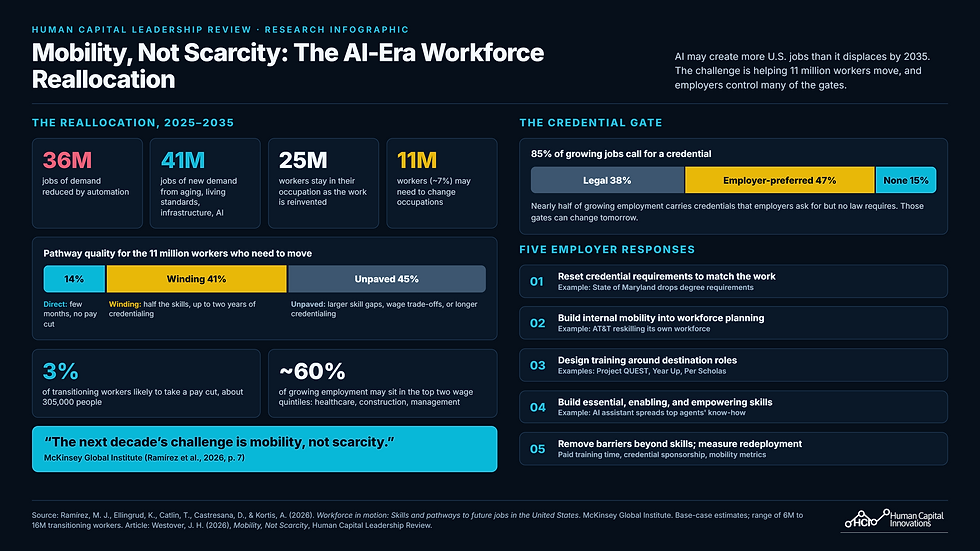
A major report published in September 2026 by the McKinsey Global Institute, Workforce in Motion: Skills and Pathways to Future Jobs in the United States, puts the other half back in (Ramírez et al., 2026). Its authors model how automation, AI, and broader structural forces will reshape U.S. labor demand between 2025 and 2035. Their base estimate is that automation could reduce labor demand by the equivalent of roughly 36 million jobs, about 21% of current work hours. Over the same decade, an aging population, rising living standards, infrastructure renewal, the expansion of the digital economy, and AI-related investment could generate demand for roughly 41 million jobs. On net, the economy comes out ahead.
The more consequential findings concern who moves and how. For roughly 25 million of the workers whose tasks are affected by automation, growth in their own occupations could offset the reduction, allowing them to stay in the same type of work even as the work itself changes. The remaining 11 million, about 7% of current employees, may need to move into different occupations altogether. The authors frame the implication in a single sentence: "The next decade's challenge is mobility, not scarcity" (Ramírez et al., 2026, p. 7).
That reframing matters for leaders. If the central problem were a shortage of jobs, the policy and management response would focus on job creation and income support. If the central problem is mobility, the focus shifts to the routes between declining and growing work: how long they take, what they cost, what they pay at the end, and who controls the gates along the way. On that last question, the report's findings point squarely at employers. About 85% of growing jobs call for some kind of credential or certification, and for nearly half of growing employment the credential is an employer preference rather than a legal requirement (Ramírez et al., 2026). Those are barriers organizations can redesign themselves.
This article builds on the McKinsey Global Institute analysis to offer practical guidance for organizations. It first defines the report's core concepts and summarizes its key estimates, then examines the organizational and human consequences of getting the reallocation right or wrong. It presents five evidence-based responses, each illustrated with organizational examples, and concludes with three long-term capabilities for a decade in which moving talent may matter as much as deploying technology. Throughout, it treats the report's figures as what they are: model-based projections under stated assumptions, not certainties. The authors themselves present a range of roughly 6 million to 16 million workers who may need to transition, depending on how quickly automation is adopted and how strongly it affects labor demand.
The Workforce Reallocation Landscape
Defining Reallocation, Pathways, and Reinvention
Several concepts from the report provide a useful vocabulary for leaders, and each benefits from a precise definition.
Workforce reallocation refers to the large-scale movement of labor demand across occupations as some work declines and other work grows. It differs from simple job loss because demand does not disappear so much as move. Labor economists have long described technology's effect on work in similar terms, distinguishing between the displacement of tasks that machines take over and the reinstatement of labor through new tasks in which humans have an advantage (Acemoglu & Restrepo, 2019). The report's contribution is to estimate how much of that movement can happen within occupations and how much requires people to change occupations altogether (Ramírez et al., 2026).
A pathway, in the report's terms, is a practical route from one occupation to another. Its quality depends on four conditions: whether the destination occupation is growing, how many of the required skills the worker already has, whether the destination wage preserves or improves the worker's pay, and how long it takes to obtain any legally required credentials. The authors classify pathways into three types (Ramírez et al., 2026):
Direct pathways: The worker already has at least 75% of the skills the destination requires, the new job pays at least as much, and legally required credentials take less than six months to obtain. About 14% of transitioning workers, roughly one in seven, fall into this category.
Winding pathways: The worker has at least half the required skills, the new wage preserves at least 90% of current pay, and legally required training takes less than 24 months. About 41% of transitioning workers fall here.
Unpaved pathways: All remaining routes, which involve larger skill gaps, lower wages, or extended credentialing. About 45% of transitioning workers face this kind of route.
Any pathway, the authors note, can also be blocked by barriers that are too large to overcome in practice, including credentials, geography, language, and the cost of training.
Reinvention refers to change within jobs rather than between them. The report estimates that more than 70% of workers could require some level of reinvention because new tasks may account for more than 15% of their time (Ramírez et al., 2026). In other words, even the 25 million workers who stay in their occupations will not keep doing their jobs the same way.
Finally, the report distinguishes three categories of skills that shape mobility. Essential skills, such as problem-solving and interpersonal communication, are required across many occupations and widen the range of jobs within reach. Enabling skills, such as leadership, decision-making, and people and process management, transfer across occupations and are concentrated in higher-paying roles. Empowering skills, including AI fluency, adaptability, resilience, curiosity, and willingness to learn, help workers keep adapting as work changes. Demand for these empowering skills is already rising sharply in job postings: since 2022, demand for AI fluency has increased roughly elevenfold, demand for adaptability fivefold, and demand for resilience, curiosity, and willingness to learn threefold (Ramírez et al., 2026).
The State of Play: Where Demand Falls, Grows, and Nets Out
Table 1 summarizes the report's principal estimates for the U.S. labor market from 2025 to 2035.
Table 1: Key Estimates from the McKinsey Global Institute's Workforce in Motion Report, United States, 2025–2035
Dimension | Estimate | What it means for organizations |
Reduction in labor demand from automation | About 36 million full-time-equivalent jobs, roughly 21% of current work hours | Significant task change across most functions, not only technical roles |
New labor demand from structural growth and AI | About 41 million jobs, including roughly 18 million from rising living standards, 8 million from demographic change, and several million each from construction, energy, the digital economy, and technology infrastructure | Net demand growth, concentrated in specific occupations and places |
Workers who may stay in the same occupation | About 25 million | Large-scale reinvention of existing roles |
Workers who may need to change occupations | About 11 million (range of 6 to 16 million), about 7% of current employees | The core mobility challenge |
Pathway quality for transitioning workers | 14% direct, 41% winding, 45% unpaved | Most transitions need structured support |
Workers whose transition may require a pay cut | About 3%, roughly 305,000 workers | Most feasible moves preserve or raise pay |
Growing employment requiring a credential | About 85% (38% legally required; 47% employer-preferred only; 15% none) | A large share of barriers is under employer control |
Change in demand for empowering skills since 2022 | AI fluency about 11x; adaptability about 5x; resilience, curiosity, and willingness to learn about 3x | Skill priorities are already shifting in hiring |
Note. Figures are base-case model estimates reported by Ramírez et al. (2026). Estimates depend on assumptions about the pace of automation adoption and its impact on labor demand; the report presents a range of roughly 6 million to 16 million transitioning workers.
Several features of these estimates deserve emphasis.
The growth is real but concentrated. The new demand is not spread evenly. The report finds that roughly 60% of growing employment may fall in the top two wage quintiles, with much of the increase in healthcare, construction, and management occupations, while more than 70% of declining employment sits in the bottom two quintiles, primarily in office and administrative support, retail and sales, and transportation and logistics (Ramírez et al., 2026). The economy as a whole may shed lower-wage work and add higher-wage work.
Most moves preserve or improve pay. When the authors match transitioning workers to feasible destination occupations, only about 3% of the 11 million, roughly 305,000 people, follow a pathway that requires a pay cut (Ramírez et al., 2026). The authors note that this analysis holds current wage levels within occupations constant and does not capture potential wage changes as supply and demand rebalance, but the overall direction is encouraging.
Better jobs ask more of workers. The same growing occupations that pay more also demand more. Employers in growing occupations seek an average of 68 distinct skills in job postings, compared with 47 in declining occupations, and 84% of growing occupations require postsecondary education, compared with 45% of declining occupations (Ramírez et al., 2026). The authors also highlight the cognitive load that accompanies broader, more judgment-intensive work and argue that managing it is increasingly an employer responsibility.
Timing matters within occupations. The 25 million jobs that "net out" within occupations do so only if growth arrives in step with automation. The authors caution that when automation outpaces demand growth, displacement can occur before offsetting jobs are created (Ramírez et al., 2026). Even within-occupation adjustment, in other words, can involve real disruption for individual workers and employers.
Pathway quality is unequal. Only about 10% of workers in the lowest wage quintile, earning less than $38,000 a year, are likely to have a direct pathway, compared with almost 40% in the highest quintile. Workers with more than a bachelor's degree are about 50% more likely than others to have a direct pathway, and men are about 30% more likely than women (Ramírez et al., 2026). Without deliberate intervention, the reallocation could widen existing gaps.
The overall picture is neither utopian nor catastrophic. It describes an economy with enough work to go around, a workforce in which most people keep their occupations but change how they work, and a significant minority who face meaningful journeys to new occupations, journeys whose difficulty depends heavily on choices that employers, educators, and governments make.
Organizational and Human Consequences of the Reallocation
Organizational Performance Impacts
For organizations, the reallocation presents both a talent risk and a talent opportunity.
Growing occupations may face persistent shortages. The report emphasizes that the United States may have more jobs available in 2035 than today but fewer workers relative to demand, because the population is aging (Ramírez et al., 2026). Organizations in growing fields such as healthcare, construction, and technology infrastructure may struggle to fill roles if they rely only on traditional hiring channels and credential filters. The 11 million workers leaving declining occupations represent a large potential talent pool, but only if organizations can see and recognize their transferable skills.
External hiring is often a costly substitute for internal mobility. Organizations that respond to shifting skill needs by hiring externally rather than redeploying existing staff often pay more for less. A widely cited study of an investment bank found that external hires were paid substantially more than internal workers promoted into similar jobs, received lower performance evaluations during their first two years, and were more likely to leave (Bidwell, 2011). Research on internal labor markets has further shown that the way organizations fill internal positions, through open posting versus managerial slotting, affects the quality of hires and the fairness of opportunity (Keller, 2018). Organizations facing reallocation have a strong economic case for treating their own workforce as the first source of talent.
Credential inflation narrows the talent pool unnecessarily. Long before AI, researchers documented degree inflation: employers requiring four-year degrees for jobs that had not previously required them and that many current incumbents performed without them (Fuller & Raman, 2017). Such requirements exclude large numbers of capable workers. One analysis estimated that about 70 million U.S. workers have developed skills through alternative routes such as community college, military service, bootcamps, and on-the-job experience, and that many have the skills required for higher-wage jobs from which degree requirements screen them out (Blair et al., 2020). The McKinsey Global Institute's finding that nearly half of growing employment carries employer-preferred credentials without any legal requirement suggests that this problem extends well beyond bachelor's degrees (Ramírez et al., 2026).
Announcing change is not the same as achieving it. Evidence on skills-based hiring offers a cautionary note. An analysis of thousands of large firms found that although many removed degree requirements from job postings between 2014 and 2023, the change affected fewer than 1 in 700 actual hires in 2023 (Sigelman et al., 2024). A subset of firms, about 37% of those that removed requirements, did substantially increase hiring of workers without degrees, and at those firms non-degreed hires showed retention rates about 10 percentage points higher than degree holders. Organizations that change practices, not just postings, appear to gain both access to talent and more durable employment relationships.
AI value depends on reallocation. Finally, the economic returns to AI depend on how effectively organizations reshape work around it. Research on general-purpose technologies shows that productivity gains often lag adoption because firms must invest in complementary assets such as new skills, processes, and organizational designs (Brynjolfsson et al., 2021). The report's authors make a related point: the economies and organizations that realize AI's full potential will be those that move talent as effectively as they deploy technology (Ramírez et al., 2026).
Worker and Stakeholder Impacts
For workers, the consequences of the reallocation depend heavily on pathway quality and on the support available along the way.
Displacement without a good pathway is costly and lasting. Decades of research show that involuntary job loss can carry long-term earnings consequences. A classic study of displaced workers found that high-tenure workers who lost their jobs in mass layoffs experienced earnings losses that persisted for years after displacement (Jacobson et al., 1993). Later research found that the present-value earnings losses from job displacement are large and are especially severe when displacement occurs during periods of high unemployment (Davis & von Wachter, 2011). The report's estimate that only 3% of transitioning workers face a pay cut assumes that workers can complete their pathways to growing occupations (Ramírez et al., 2026). Workers who are displaced without a viable route, or who cannot afford the time to complete one, may experience outcomes closer to the historical displacement evidence.
The burden of retraining falls unevenly. Winding and unpaved pathways require time, money, and confidence. The report notes that these demands are especially burdensome for lower-wage workers, older workers, caregivers, and others with fewer resources, who tend to participate less in retraining (Ramírez et al., 2026). Because lower-wage workers are also least likely to have direct pathways, the same groups face both the longest journeys and the fewest resources for making them.
Licensing can lock workers in place. Occupational licensing protects public safety in many fields, but it also shapes mobility. Research has estimated that a substantial share of U.S. workers, roughly three in ten in one widely cited survey, required a government-issued license to do their jobs (Kleiner & Krueger, 2013). Licenses with state-specific requirements have been found to reduce interstate migration among licensed workers (Johnson & Kleiner, 2020). Because the report finds that about 38% of growing employment carries a legally required credential, and that 96% of growing healthcare professional occupations require mandated licenses or certifications, licensing will shape which pathways are walkable in practice (Ramírez et al., 2026).
Workers who stay also face change. For the majority who remain in their occupations, reinvention brings its own demands. New tasks, new tools, and broader responsibilities can increase cognitive load even without a change in job title (Ramírez et al., 2026). Field evidence suggests that AI tools can help here, especially for less experienced workers: in one large study of customer support agents, access to a generative AI assistant raised productivity most for novice and lower-skilled agents (Brynjolfsson et al., 2025). But the same research base shows that AI can also lead skilled professionals astray when used outside its capabilities (Dell'Acqua et al., 2023), which makes training in when and how to use AI an essential part of reinvention.
Communities and families feel the effects. Because many growing jobs require physical presence, roughly 76% of growing employment according to the report, and because declining and growing work may be located in different places, reallocation has geographic consequences (Ramírez et al., 2026). Families may face decisions about relocation, commuting, and caregiving, and communities may experience uneven gains and losses.
Evidence-Based Organizational Responses
The report concludes that no single actor can build these pathways alone, assigning roles to companies, governments, educators, and workers (Ramírez et al., 2026). The following five responses focus on what organizations, especially employers, can do, drawing on the report's recommendations and the broader research base.
Reset Credential Requirements to Match the Work
The single most direct lever available to employers is the credential gate. The report finds that 85% of growing jobs call for a credential, that 47% of growing employment has employer-preferred credentials with no legal requirement, and that only 15% of growing jobs have no credential requirement at all (Ramírez et al., 2026). The authors suggest that companies can lower these barriers by resetting degree requirements, using skills assessments, recognizing prior experience, and creating apprenticeships. Research on degree inflation (Fuller & Raman, 2017), on workers skilled through alternative routes (Blair et al., 2020), and on skills-based hiring outcomes (Sigelman et al., 2024) supports this direction, while warning that removing requirements from postings is only the first step.
Effective credential-reset approaches include:
Requirement audits: Review every credential requirement in growing roles and distinguish those mandated by law from those that reflect habit or convenience.
Skills-based assessments: Replace credential screens with validated work samples, structured interviews, and practical assessments of the skills a role actually requires.
Recognition of prior learning: Create formal processes for crediting relevant experience, military service, and non-degree training.
Hiring-manager enablement: Train and incentivize hiring managers to evaluate skills rather than defaulting to credential proxies, since practice often lags policy.
Outcome tracking: Measure how many hires actually come through skills-based routes and how those hires perform and stay.
The State of Maryland offers a public-sector example. In March 2022, the state announced that it would remove four-year degree requirements from thousands of state government positions, initially focusing on information technology, administrative, and customer service roles. State officials estimated that more than half of the state's roughly 38,000 jobs could substitute relevant experience, training, or community college education for a bachelor's degree, and the state partnered with the nonprofit Opportunity@Work to recruit workers skilled through alternative routes ("Maryland Governor Announces Elimination," 2022). The initiative illustrates how an employer can open pathways at scale by redefining what qualifies a candidate. The research on skills-based hiring suggests that the long-term impact of such moves depends on whether hiring managers and processes change to match the new policy (Sigelman et al., 2024).
Build Internal Mobility into Workforce Planning
The report urges companies to use skills rather than job titles to identify where talent can move next, to build internal mobility into workforce planning and organizational culture, and to treat redeployment as a measurable business outcome (Ramírez et al., 2026). The authors suggest that companies can distinguish among employees able to move quickly into growing roles, those who need targeted upskilling, those requiring longer pathways, and roles that cannot be filled internally. Research on internal labor markets supports this approach: internal moves can reduce the cost and risk associated with external hiring (Bidwell, 2011), and open internal posting systems can improve the quality and fairness of internal placements (Keller, 2018).
Effective internal mobility approaches include:
Skills inventories: Map the skills of the current workforce, not just their job titles, to identify adjacencies between declining and growing roles.
Pathway segmentation: Classify affected employees by pathway type, direct, winding, or unpaved, and design support accordingly.
Talent marketplaces: Give employees visibility into internal openings and the skills each requires, with open posting rather than informal slotting.
Redeployment-first policies: Offer internal pathways before external hiring or exits when roles decline.
Manager incentives: Reward managers for developing and releasing talent to other parts of the organization rather than hoarding it.
AT&T's earlier transformation offers a large-scale example from telecommunications. As the company shifted from hardware-centered networks toward software and cloud-based infrastructure, leaders concluded that they could not hire their way into the skills they needed. The company invested heavily in retraining its existing workforce, gave employees visibility into which roles were growing and shrinking and what skills each required, and restructured careers around the capabilities the business would need (Donovan & Benko, 2016). In the language of the McKinsey Global Institute report, AT&T treated its own workforce as the primary source of talent for growing occupations and built the information systems that allowed employees to see their pathways.
Design Training Around Pathways and Destinations
Because 86% of transitioning workers face winding or unpaved pathways, most will need more than a short course (Ramírez et al., 2026). The report calls on educators to design training "backward," starting from the skills a growing occupation requires, the capabilities workers already have, and the gaps that must be closed, and to use modular and stackable credentials that allow workers to progress in steps. Rigorous evidence supports this destination-driven approach. Evaluations of sectoral training programs, which partner closely with employers in specific industries and train for in-demand occupations, have found substantial and lasting earnings gains for participants, in contrast to the weaker results of many generic training programs (Katz et al., 2022).
Effective pathway-based training approaches include:
Destination clarity: Tie every training investment to specific growing roles with known wages and openings.
Gap-based curricula: Assess what workers already know and train only for the gaps, shortening winding pathways.
Stackable credentials: Break long pathways into shorter credentials that each carry labor market value.
Earn-while-you-learn models: Combine training with paid work through apprenticeships or rotations so workers can afford longer pathways.
Wraparound supports: Provide career coaching, childcare assistance, transportation support, and other help that keeps workers in training.
Project QUEST in San Antonio, Texas, illustrates what pathway-based training can achieve in healthcare, one of the report's largest growth areas. The program partners with employers and community colleges to train low-income adults for in-demand occupations, primarily in healthcare, while providing financial assistance and intensive support services. Together with other sectoral programs such as Year Up and Per Scholas, which prepare participants for information technology and related careers, Project QUEST was among the programs that produced substantial and persistent earnings gains in randomized evaluations (Katz et al., 2022). Researchers attributed these results to features that map closely onto the report's pathway framework: training aimed at specific growing occupations, employer involvement in program design, screening for fit, and support that helps participants finish.
Build Essential, Enabling, and Empowering Skills Together
The report argues that skills determine which pathways workers can travel and how far they can go, and it identifies three categories that matter for different reasons (Ramírez et al., 2026). Essential skills widen the range of reachable jobs, enabling skills open higher-paying roles, and empowering skills, including AI fluency and adaptability, help workers keep moving as work changes. Because more than 70% of workers may face significant reinvention, these skills matter for those who stay as well as those who move. Evidence on AI at work reinforces the value of pairing tool proficiency with judgment. Generative AI can substantially accelerate learning and performance, particularly for less experienced workers (Brynjolfsson et al., 2025), but professionals who rely on it outside its capabilities can perform worse than those working without it (Dell'Acqua et al., 2023).
Effective skill-building approaches include:
Role-specific AI fluency: Teach employees how AI performs in their particular tasks, including where it tends to fail, rather than offering only generic awareness training.
Transferable skill development: Invest in essential and enabling skills such as problem-solving, communication, and decision-making that open multiple pathways.
Learning-agility support: Build adaptability, curiosity, and resilience through stretch assignments, rotations, and supportive feedback.
Cognitive load management: Redesign work so that broader responsibilities come with the time, tools, and support to manage them.
Skills signaling: Help employees document and demonstrate the skills they build so that they are recognized in internal and external hiring.
A large software company's customer support operation shows how AI can accelerate skill building when designed thoughtfully. In the study by Brynjolfsson et al. (2025), the firm introduced a generative AI assistant trained on the conversations of its most effective agents. The tool raised productivity by 14% on average and by about 34% for novice and lower-skilled agents, effectively spreading top performers' tacit knowledge to newer colleagues. The researchers also observed improvements in customer sentiment and employee retention. For organizations navigating reallocation, the example suggests that AI can shorten the learning curve on new pathways, provided it is deployed to support skill development rather than replace the people from whom the system learns.
Remove Barriers Beyond Skills and Measure Transitions
The report stresses that skills alone are not enough. Credentials, training time, wages, geography, language, and hiring practices determine whether a pathway that looks possible on paper is walkable in practice (Ramírez et al., 2026). Some of these barriers sit outside any single organization's control, such as state licensing rules, but employers can reduce many others and can advocate for changes to the rest. Research on licensing suggests that state-specific requirements impede worker mobility (Johnson & Kleiner, 2020), while research on displacement shows that the absence of a viable route can carry long-lasting costs for workers (Davis & von Wachter, 2011; Jacobson et al., 1993).
Effective barrier-reduction approaches include:
Paid training time: Compensate workers for some or all of the time spent on longer pathways so that lower-wage workers can participate.
Credential sponsorship: Pay for and schedule legally required licenses and certifications for employees moving into regulated roles.
Location flexibility: Offer relocation support, remote options where feasible, or local training sites tied to where growing jobs are located.
Language support: Provide workplace language training where language proficiency stands between workers and growing roles.
Transition metrics: Track redeployment rates, internal fill rates, and post-transition wages alongside productivity and cost savings, as the report recommends.
Healthcare provides a clear illustration of why barriers must be addressed together. The report notes that a transitioning worker may have strong communication, service, and coordination skills and still be unable to enter a credentialed healthcare role without completing training and licensing (Ramírez et al., 2026). Sectoral programs such as Project QUEST address this combination directly by pairing occupational training with financial assistance and support services (Katz et al., 2022). Employers in healthcare and other regulated fields can adopt similar combinations internally: sponsoring credentials, paying for training time, and creating supervised roles that let workers build experience while completing licensing requirements.
Building Long-Term Capability for a Decade of Mobility
The report describes the coming reallocation as potentially the largest and most sustained workforce transformation in U.S. history (Ramírez et al., 2026). Navigating it requires capabilities that outlast any single program. Three pillars stand out.
Skills-Based Workforce Planning as a Core Discipline
The report's recommendation to use skills, not job titles, to identify where talent can move next implies a fundamental shift in how organizations plan their workforces (Ramírez et al., 2026). Traditional workforce planning projects headcount by role. Skills-based planning instead maps the capabilities an organization has, the capabilities its future work requires, and the adjacencies that connect them. This allows leaders to see that a declining customer service role and a growing project coordination role may share a large proportion of their required skills, or that a gap in one critical capability could block an otherwise direct pathway.
Building this discipline requires investment in skills data, regular reassessment as AI changes task content, and integration with business strategy. It also requires new metrics. The report suggests that redeployment, internal fill rates, and employee outcomes should become core business measures alongside productivity (Ramírez et al., 2026). When organizations measure only the cost savings from automation, they systematically undervalue the capabilities they lose by failing to redeploy people.
A Recalibrated Psychological Contract Built on Continuous Reinvention
If more than 70% of workers will need to reinvent their work to some degree, the implicit agreement between employers and employees must change as well. Employees can no longer expect that the job they were hired to do will remain stable, and employers can no longer expect that workers will build new capabilities entirely on their own time and at their own expense. The report argues that successful mobility requires that workers have clear destination roles, credible future wages, and confidence that employers will recognize the skills they acquire (Ramírez et al., 2026).
A recalibrated contract makes these expectations explicit. Employers commit to transparency about how work is changing, to investment in learning tied to real opportunities, and to recognition of skills acquired through nontraditional routes. Employees commit to ongoing learning and adaptability. The evidence that skills-based hiring leaders retain non-degreed hires at higher rates (Sigelman et al., 2024) suggests that when organizations keep their side of this bargain, employees reciprocate with commitment.
Multi-Stakeholder Ecosystems and Labor Market Transparency
No organization can build every pathway alone. The report assigns complementary roles to companies, governments, educators, and workers, from better labor market information and portable credentials to outcome-based training programs and funding models that support transitions (Ramírez et al., 2026). For employers, this means participating actively in ecosystems rather than waiting for them to deliver ready-made talent.
In practice, ecosystem participation can include co-designing curricula and stackable credentials with community colleges and training providers, sharing data on skill demand, partnering with sectoral training organizations whose models have demonstrated results (Katz et al., 2022), and working with policymakers on licensing reciprocity and recognition of prior learning. Employers in growing sectors, such as healthcare and construction, have particularly strong incentives to invest in these partnerships, because the report's projections suggest that their future workforce will come substantially from people now working in declining occupations.
Conclusion
The McKinsey Global Institute's Workforce in Motion report offers a more hopeful account of AI and employment than much of what circulates in public debate (Ramírez et al., 2026). Its base estimate suggests that automation may reduce demand for about 36 million U.S. jobs by 2035 while structural growth and AI create demand for about 41 million. Most affected workers, about 25 million, may stay in their occupations as their work changes. About 11 million may need to change occupations, and while only about one in seven of them has a direct pathway, only about 3% are likely to face a pay cut if they complete their transitions. Much of the growth is in healthcare, construction, and management, which tend to pay better.
The difficulty lies in the journey. Most transitioning workers face winding or unpaved pathways that require meaningful retraining, sometimes up to two years or more, and the workers with the fewest resources tend to face the longest routes. Among the largest barriers are credentials, and a large share of those credentials are employer preferences rather than legal mandates. That places substantial power, and responsibility, in employers' hands. As the report's authors put it, the next decade's challenge is mobility, not scarcity (Ramírez et al., 2026).
For organizational leaders, several practical takeaways follow:
Audit credential requirements now. Separate legal mandates from habits, replace unnecessary credential screens with skills assessments, and ensure hiring practices change along with job postings.
Look inside first. Build skills inventories and internal mobility systems so that employees in declining roles can see and pursue pathways to growing ones.
Train for destinations. Tie learning investments to specific growing roles, break long pathways into stackable steps, and support workers through earn-while-you-learn models.
Develop all three skill types. Combine role-specific AI fluency with transferable essential and enabling skills and the empowering skills that sustain continuous reinvention.
Remove the non-skill barriers. Pay for training time and credentials, address geographic and language barriers, and partner with educators and governments on the barriers you cannot remove alone.
Measure mobility. Track redeployment, internal fill rates, and post-transition wages as seriously as productivity and cost savings.
The organizations that rethink their requirements and help their own people move into new roles are likely to face a much easier decade than those that wait for the labor market to deliver ready-made talent. The reallocation is already under way. Whether it becomes, in the report's words, an expansion of human opportunity depends substantially on how employers choose to open, or close, the gates along the way.
Research Infographic
References
Acemoglu, D., & Restrepo, P. (2019). Automation and new tasks: How technology displaces and reinstates labor. Journal of Economic Perspectives, 33(2), 3–30.
Bidwell, M. (2011). Paying more to get less: The effects of external hiring versus internal mobility. Administrative Science Quarterly, 56(3), 369–407.
Blair, P. Q., Castagnino, T. G., Groshen, E. L., Debroy, P., Auguste, B., Ahmed, S., Garcia Diaz, F., & Bonavida, C. (2020). Searching for STARs: Work experience as a job market signal for workers without bachelor's degrees (NBER Working Paper No. 26844). National Bureau of Economic Research.
Brynjolfsson, E., Li, D., & Raymond, L. R. (2025). Generative AI at work. The Quarterly Journal of Economics, 140(2), 889–942.
Brynjolfsson, E., Rock, D., & Syverson, C. (2021). The productivity J-curve: How intangibles complement general purpose technologies. American Economic Journal: Macroeconomics, 13(1), 333–372.
Davis, S. J., & von Wachter, T. (2011). Recessions and the costs of job loss. Brookings Papers on Economic Activity, 2011(2), 1–72.
Dell'Acqua, F., McFowland, E., III, Mollick, E. R., Lifshitz-Assaf, H., Kellogg, K., Rajendran, S., Krayer, L., Candelon, F., & Lakhani, K. R. (2023). Navigating the jagged technological frontier: Field experimental evidence of the effects of AI on knowledge worker productivity and quality (Working Paper No. 24-013). Harvard Business School.
Donovan, J., & Benko, C. (2016). AT&T's talent overhaul. Harvard Business Review, 94(10), 68–73.
Fuller, J. B., & Raman, M. (2017). Dismissed by degrees: How degree inflation is undermining U.S. competitiveness and hurting America's middle class. Accenture, Grads of Life, and Harvard Business School.
Jacobson, L. S., LaLonde, R. J., & Sullivan, D. G. (1993). Earnings losses of displaced workers. American Economic Review, 83(4), 685–709.
Johnson, J. E., & Kleiner, M. M. (2020). Is occupational licensing a barrier to interstate migration? American Economic Journal: Economic Policy, 12(3), 347–373.
Katz, L. F., Roth, J., Hendra, R., & Schaberg, K. (2022). Why do sectoral employment programs work? Lessons from WorkAdvance. Journal of Labor Economics, 40(S1), S249–S291.
Keller, J. R. (2018). Posting and slotting: How hiring processes shape the quality of hire and compensation in internal labor markets. Administrative Science Quarterly, 63(4), 848–878.
Kleiner, M. M., & Krueger, A. B. (2013). Analyzing the extent and influence of occupational licensing on the labor market. Journal of Labor Economics, 31(S1), S173–S202.
Maryland governor announces elimination of four-year degree requirement for thousands of state jobs. (2022, March). Diverse: Issues In Higher Education.
Ramírez, M. J., Ellingrud, K., Catlin, T., Castresana, D., & Kortis, A. (2026). Workforce in motion: Skills and pathways to future jobs in the United States. McKinsey Global Institute.
Sigelman, M., Fuller, J., & Martin, A. (2024). Skills-based hiring: The long road from pronouncements to practice. Burning Glass Institute and Harvard Business School Project on Managing the Future of Work.

Jonathan H. Westover, PhD, Chief Research Officer (Nexus Institute for Work and AI); Co-Founder & Chief Workforce and Learning Officer (Future State University); Founder & CEO (Human Capital Innovations); Professor of Organizational Leadership & Change (UVU). Read Jonathan Westover's executive profile here.
Suggested Citation: Westover, J. H. (2026). Mobility, Not Scarcity: Why Employers Hold the Keys to the AI-Era Workforce Reallocation. Human Capital Leadership Review, 39(3). doi.org/10.70175/hclreview.2020.39.3.6