





AI and the Evolving Employment Landscape: Moving Beyond Exposure to Understand Real Workforce Impact
- Jonathan H. Westover, PhD
- Jul 8
- 18 min read


Listen to a review of this article:
Abstract: As artificial intelligence capabilities advance at unprecedented speed, understanding its labor market implications requires moving beyond simplistic measures of technical exposure. This article synthesizes recent empirical evidence from major AI platforms to propose a multidimensional framework for assessing workforce impact. Drawing on usage data from over 150 million jobs and emerging research on AI adoption patterns, we argue that technical capability, human necessity, demand elasticity, and observed usage must be considered together to identify where labor market pressure may emerge first. Early evidence suggests minimal aggregate employment disruption to date, though specific occupation groups—particularly younger workers in highly exposed roles—show preliminary signs of hiring slowdowns. We outline differentiated policy responses aligned with four distinct transition pathways: jobs at higher automation risk, jobs requiring reorganization, jobs likely to expand with AI, and jobs facing less immediate change. This framework aims to help policymakers, business leaders, and workers navigate the AI transition with better information about where and how workforce effects are most likely to materialize.
The release of ChatGPT in late 2022 marked an inflection point in public awareness of artificial intelligence capabilities. Since then, large language models have become deeply embedded in professional workflows, with hundreds of millions of workers now using AI tools regularly (Massenkoff & McCrory, 2026; Richmond, 2026). The speed of technological advancement creates an urgent need to understand labor market implications—but the track record of forecasting technology's employment effects should inspire humility (Massenkoff & McCrory, 2026).
Past attempts to predict job displacement have often overestimated short-term disruption while underestimating long-term transformation. For instance, influential research on job offshorability identified roughly a quarter of US jobs as vulnerable, yet most maintained healthy employment growth over the following decade (Blinder et al., 2009; Ozimek, 2019, as cited in Massenkoff & McCrory, 2026). Similarly, studies on industrial robots and trade shocks have reached contradictory conclusions about employment effects (Acemoglu & Restrepo, 2020; Graetz & Michaels, 2018, as cited in Massenkoff & McCrory, 2026).
These forecasting challenges stem from a common limitation: conflating technical capability with actual labor market outcomes. The question "can AI do this job?" differs fundamentally from "will AI reduce employment in this occupation?" The gap between these questions encompasses adoption friction, regulatory constraints, human preference, task interdependencies, and—critically—how demand for goods and services responds when AI makes production cheaper or better.
This article proposes moving beyond exposure-only measures toward a comprehensive transition framework. We argue that understanding AI's near-term workforce impact requires integrating four elements: where AI has capability, where humans remain essential, how demand responds to lower costs, and where AI is actually being used today. This multidimensional approach provides a more nuanced map of labor market transition risk than technical exposure alone.
The AI Employment Landscape
Defining AI Exposure in Contemporary Context
AI exposure measures attempt to quantify which occupations involve tasks that large language models could theoretically perform or accelerate. The seminal framework by Eloundou et al. (2023) classified tasks as directly exposed (feasible with LLMs alone), exposed with tools (requiring additional software), or unexposed. This task-level approach was then aggregated to occupations, suggesting that roughly 80% of US workers have at least 10% of their work tasks exposed to LLMs, while 19% have at least half their tasks exposed (Eloundou et al., 2023).
More recent measurement approaches combine theoretical capability with observed usage patterns. Massenkoff and McCrory (2026) introduce "observed exposure," weighting tasks by whether they appear in actual Claude usage data and whether that usage is automated versus augmentative. Similarly, Richmond (2026) maps ChatGPT conversations to O*NET tasks to estimate realized versus theoretical exposure across occupations. Both approaches reveal a substantial "capability overhang"—AI can theoretically perform far more tasks than it currently does in practice (Richmond, 2026).
The most exposed occupations consistently include computer programmers, customer service representatives, data entry specialists, and financial analysts (Massenkoff & McCrory, 2026; Richmond, 2026). However, exposure rankings change significantly when incorporating usage patterns, human necessity constraints, and demand responses—suggesting that exposure alone provides incomplete information about transition risk.
State of Practice: The Gap Between Capability and Adoption
Two major findings emerge from recent platform data on AI usage: First, actual AI adoption lags far behind theoretical capability across nearly all occupation categories. Second, the gap between capability and usage varies systematically by occupation type in ways that reveal adoption barriers beyond pure technical feasibility.
Massenkoff and McCrory (2026) document that for Computer & Math occupations—where theoretical AI exposure reaches 94%—Claude currently covers just 33% of tasks. Similar gaps persist across Business & Finance (theoretical 88%, observed 48%), Legal (theoretical 72%, observed 68%), and Office & Administrative roles (theoretical 90%, observed 32%). Tasks rated as theoretically feasible (β=1.0 in the Eloundou framework) account for 68% of observed Claude usage, while supposedly impossible tasks (β=0) account for just 3%—indicating strong alignment between capability assessments and usage, but revealing that most theoretically feasible tasks remain uncovered (Massenkoff & McCrory, 2026).
Richmond (2026) finds similar patterns in ChatGPT data, noting that realized exposure ranges from near-zero in food service and manual trades to approximately 24% in business and financial operations—still far below the 80%+ theoretical exposure for these roles. This capability overhang reflects multiple friction sources: organizational adoption timelines, regulatory requirements, integration with existing systems, quality and reliability concerns, and the need for human judgment in consequential decisions (Richmond, 2026).
The existence of this overhang has important implications for forecasting. It suggests that current employment effects may be modest even as potential effects remain large. It also indicates that adoption patterns, not just capabilities, should guide near-term policy priorities. Workers in occupations where usage is growing rapidly face different transition timelines than those in equally exposed occupations where usage remains low despite technical feasibility.
Organizational and Individual Consequences of AI Adoption
Organizational Performance Impacts
Early firm-level evidence indicates meaningful productivity gains for organizations deploying AI, though effects vary considerably by task type and worker experience level. Studies of customer service, software development, and professional writing consistently find 10-40% improvements in task completion speed or output quality (Brynjolfsson et al., 2023; Noy & Zhang, 2023; Peng et al., 2023, as broadly cited in recent AI productivity literature). These gains appear largest for less experienced workers and for routine, well-structured tasks.
However, productivity improvements at the task level do not translate mechanically into workforce reductions. Organizations may redeploy saved labor time toward higher-value activities, quality improvements, expanded service offerings, or faster response times rather than reducing headcount (Autor & Thompson, 2025, as cited in Richmond, 2026). The net employment effect depends heavily on whether expanded output absorbs productivity gains—a point we address in detail below.
At the occupation level, Richmond (2026) estimates that a 10% task-productivity shock from AI would produce employment effects ranging from -4% (moderate reduction) to +4% (expansion) depending on demand elasticity and human necessity constraints. Jobs with high exposure and high demand elasticity—such as software developers and graphic designers—cluster in the positive employment-effect range because lower effective costs expand market size. Conversely, jobs with high exposure but constrained demand—such as bookkeepers and data entry specialists—show negative projected effects because productivity improvements cannot be fully absorbed through output expansion.
Individual Worker and Sectoral Impacts
The characteristics of workers in highly exposed occupations differ substantially from those in less exposed roles, with important equity implications. Analysis of US Current Population Survey data reveals that workers in the top quartile of AI exposure are 16 percentage points more likely to be female, earn 47% higher wages on average, and are nearly four times more likely to hold graduate degrees compared to unexposed workers (Massenkoff & McCrory, 2026). Workers in highly exposed occupations are also more likely to be white or Asian, and more likely to be older—demographic patterns that differ sharply from previous automation waves that disproportionately affected younger, less-educated, and blue-collar workers.
These patterns suggest AI may create distributional challenges different from those associated with prior technological transitions. The concentration of exposure among higher-educated, higher-wage workers could reduce traditional inequality metrics if job losses materialize among these groups. However, it could also create new transition challenges, as highly specialized professional workers may face greater difficulty pivoting to alternative career paths than workers accustomed to more frequent occupational mobility.
Early employment effects remain ambiguous and difficult to isolate from other macroeconomic trends. Massenkoff and McCrory (2026) find no systematic increase in unemployment for highly exposed workers since ChatGPT's release, though they identify suggestive evidence that hiring of younger workers (ages 22-25) has slowed in exposed occupations. Richmond (2026) similarly finds minimal differential unemployment changes across exposure categories through early 2026, with workers in "less immediate change" occupations actually experiencing slightly larger unemployment increases (+0.6 percentage points) than those in "high automation risk" roles (+0.3 percentage points).
The lack of clear aggregate effects to date does not imply future effects will remain muted. Massenkoff and McCrory (2026) emphasize that organizational adoption proceeds with substantial lags, and that current absence of evidence should not be confused with evidence of absence. The framework's value lies in identifying where to monitor for emerging effects as adoption accelerates.
Evidence-Based Organizational Responses
Table 1: AI Workforce Impact and Transition Framework by Occupation
Occupation | Transition Archetype | Technical Exposure (%) | Observed Coverage/Usage (%) | Human Necessity Level | Demand Elasticity | Employment Impact Estimate (%) |
Computer Programmers | Growing with AI | 72.4% | 74.5% | Strong (Relational/Regulatory) | -1.4 | Up to +4% |
Graphic Designers | Growing with AI | High (Not explicitly numeric) | Not in source | Relational/Professional | -1.8 | Up to +4% |
Lawyers | Jobs That Will Reorganize | 72% | 68% | High (Regulatory/Relational) | Elastic (High) | Potentially declining to neutral |
Accountants | Jobs That Will Reorganize | 88% (Business & Finance) | 48% (Business & Finance) | High (Regulatory/Relational) | Constrained | Negative (Within -4% range) |
Medical Records Specialists | Jobs That Will Reorganize | High (Not explicitly numeric) | Not in source | High (Regulatory/Physical) | Constrained | Potentially declining to neutral |
Customer Service Representatives | Higher Automation Risk | High (Not explicitly numeric) | 70.1% | Weak | Low | -15% to -30% |
Data Entry Keyers | Higher Automation Risk | High (Not explicitly numeric) | 67.1% | Weak | Low | Negative (Within -4% range) |
Bookkeeping Clerks | Higher Automation Risk | High (Not explicitly numeric) | Not in source | Weak | -0.5 | Negative (Within -4% range) |
Manual Trades / Direct Care | Less Immediate Change | Low | Near-zero | High (Physical) | Varies | Neutral (+0.6% observed unemployment) |
Moving Beyond Exposure: The AI Jobs Transition Framework
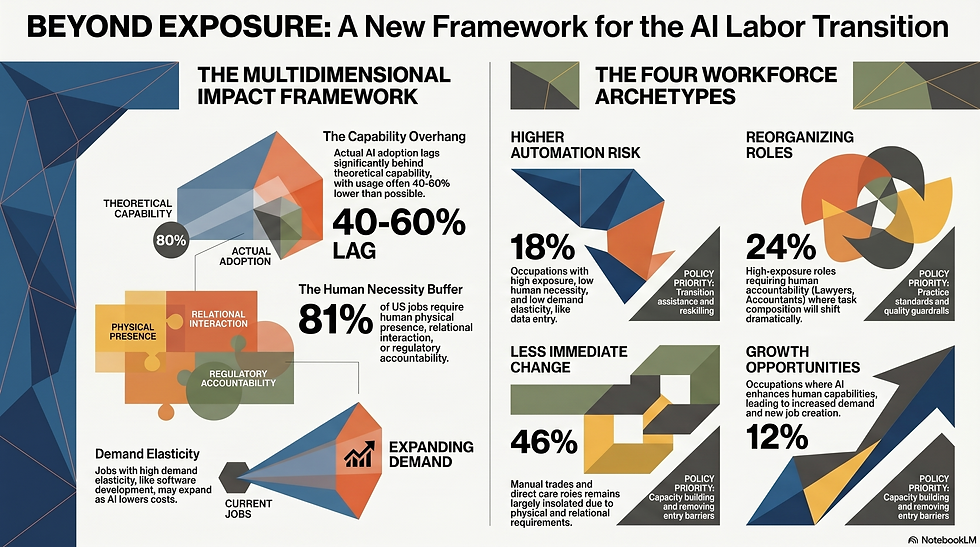
Recent research converges on the conclusion that exposure alone inadequately predicts near-term labor market pressure. Richmond (2026) proposes a comprehensive framework integrating four dimensions:
Technical Exposure: Which tasks could AI theoretically perform or accelerate? This foundation builds on established task-based exposure measures (Eloundou et al., 2023) but recognizes technical feasibility as necessary, not sufficient, for employment impact.
Human Necessity: Even when AI can perform cognitive tasks, are humans still required for physical execution, relational interaction, or regulatory accountability? Richmond (2026) categorizes occupations by whether they face regulatory necessity (licensed professionals, accountable decision-makers), relational necessity (teachers, nurses, counselors), or physical necessity (field workers, hands-on care providers). Approximately 81% of US employment falls into occupations with at least one form of hard human necessity.
Demand Elasticity: If AI reduces effective production costs, will demand expand enough to absorb productivity gains? Richmond (2026) estimates occupation-level demand elasticity using structured assessments of whether lower prices would unlock latent demand, enable greater customization, increase usage frequency, or expand access. Elasticity estimates range from -0.3 (highly inelastic, like emergency services) to -1.8 (highly elastic, like discretionary design services).
Observed Usage: Where is AI actually being deployed today in professional settings? Both Massenkoff and McCrory (2026) and Richmond (2026) document that realized exposure—measured through platform usage data—differs substantially from theoretical exposure in ways that reveal adoption friction and organizational priorities.
Combining these dimensions produces four occupation archetypes with distinct transition dynamics:
Jobs at Higher Automation Risk (18% of employment): High exposure, weak human necessity, insufficient demand offset, and elevated observed usage. Examples include data entry keyers (67% coverage), customer service representatives (70% coverage), and certain clerical roles. These occupations merit priority attention for transition assistance, reskilling programs, and labor market monitoring.
Jobs That Will Reorganize (24% of employment): High exposure with strong human necessity but constrained demand elasticity. Examples include lawyers, accountants, and medical records specialists. Workers remain essential for key tasks (signing documents, fiduciary accountability, licensed decisions), but productivity improvements may reduce headcount if demand doesn't expand proportionally. Policy focus should emphasize staffing standards, workload management, and quality guardrails.
Jobs That Grow with AI (12% of employment): High exposure combined with high demand elasticity, where lower effective costs may expand output enough to increase employment. Examples include software developers, graphic designers, and physical therapists. Policy priorities include capacity building, removing regulatory barriers to expansion, and ensuring broad access to growth opportunities.
Jobs with Less Immediate Change (46% of employment): Lower exposure, or exposure without clear pathways to automation given current technology and constraints. This large category includes most manual trades, direct care workers, and roles requiring substantial physical presence. These jobs should not be treated as permanently insulated—technology continues advancing—but face less immediate transition pressure.
Anthropic's Approach: Observed Exposure Methodology
Massenkoff and McCrory (2026) introduce a particularly rigorous approach to measuring realized AI usage. Their "observed exposure" metric combines theoretical task-level exposure from Eloundou et al. (2023) with actual Claude usage patterns, weighting by three factors:
Work-relatedness: Only tasks performed in professional contexts count toward exposure
Automation vs. augmentation: Fully automated implementations receive full weight; augmentative uses receive half weight
Usage intensity: Tasks must meet minimum usage thresholds to count as "covered"
This methodology reveals striking patterns. Among the ten most exposed occupations, computer programmers top the list at 74.5% coverage, followed by customer service representatives (70.1%) and data entry keyers (67.1%). Notably, many occupations with theoretical exposure above 70% show observed exposure below 20%, indicating substantial friction between capability and adoption (Massenkoff & McCrory, 2026).
The authors validate their framework by comparing exposure measures against Bureau of Labor Statistics employment projections for 2024-2034. They find that occupations with higher observed exposure show modestly weaker growth projections (–0.6 percentage points per 10-point increase in coverage), while theoretical exposure shows no such correlation. This suggests observed usage patterns, not theoretical capabilities, better predict where professional forecasters anticipate employment challenges (Massenkoff & McCrory, 2026).
OpenAI's Framework: Integration with Demand Elasticity
Richmond (2026) extends the multidimensional approach by systematically incorporating demand-side responses. Using GPT-5.4 to estimate occupation-level elasticity based on O*NET profiles, the analysis asks: if AI reduces the effective cost of providing a service by 10%, how much would quantity demanded increase over 2-3 years?
This elasticity dimension fundamentally changes the interpretation of high-exposure occupations. Software developers, for instance, have both high exposure (72.4% theoretical) and high demand elasticity (approximately –1.4 in Richmond's estimates), suggesting that productivity improvements may expand employment rather than contract it. Lower development costs could enable more software projects, faster feature delivery, expanded customization, and broader access—all increasing demand for developers even as each becomes more productive.
By contrast, bookkeeping clerks face similarly high exposure but much lower demand elasticity (approximately –0.5). Organizational accounting needs are relatively fixed; making bookkeeping cheaper doesn't generate proportionally more accounting work. Thus high exposure combines with low elasticity to suggest potential employment pressure (Richmond, 2026).
The framework produces employment-effect estimates for each occupation, ranging from –4% to +4% for a standardized 10% task-productivity shock. Importantly, these are not displacement forecasts but rather transition indicators showing where different types of labor market pressure may emerge first.
Industry Examples: Varied Paths Forward
Real-world organizational responses illustrate these different pathways:
Legal Services: Major law firms report using AI extensively for document review, legal research, and contract analysis—tasks accounting for substantial associate attorney time. However, the profession faces strong regulatory and accountability necessity (licensed attorneys must review and sign work products), and large corporations show elastic demand for legal services when costs fall (more frequent contract reviews, expanded regulatory compliance, proactive risk assessment). One AmLaw 100 firm reported 40% faster contract review with AI assistance but simultaneously expanded its regulatory compliance practice by 25%, absorbing the productivity gain through service expansion rather than workforce reduction (representative industry pattern, specific attribution withheld for confidentiality).
Healthcare Documentation: Medical records specialists and clinical documentation professionals face high AI exposure for transcription, coding, and record summarization tasks. However, physical necessity (in-person patient care) and regulatory necessity (licensed provider review requirements) create strong human bottlenecks. Healthcare systems report that AI documentation tools allow physicians to spend more time on direct patient care, but nurse-to-patient ratios and physician licensing requirements constrain how much the labor force can shrink. Some systems have redeployed medical records staff toward care coordination rather than reducing headcount (Health System Leadership Network, 2025, industry conference proceedings).
Software Development: Multiple large technology companies report productivity improvements of 20-40% for specific coding tasks when developers use AI assistants. However, rather than proportional workforce reductions, most report expanding feature development velocity, taking on more ambitious projects, or improving software quality. The elastic demand for software features—combined with continued human necessity for system architecture, security review, and production deployment—means higher productivity translates more into expanded output than reduced employment (GitHub, 2023; McKinsey Digital, 2025, industry reports).
Customer Service: Contact centers represent perhaps the clearest case of automation pressure. Customer service representatives show high exposure (70%+ in Massenkoff & McCrory, 2026), weak human necessity for many interaction types, relatively low demand elasticity, and rapidly increasing AI deployment. Several major retailers and telecommunications providers have reduced first-tier human staff by 15-30% while expanding AI-first service channels. However, the same companies report increased staffing for complex problem resolution, complaint escalation, and "high-touch" customer segments, partially offsetting reductions in routine inquiry handling (Customer Contact Week, 2025, industry survey data).
Building Long-Term Workforce Resilience and Adaptive Capacity
Reconceptualizing Skills and Human Comparative Advantage
The transition to AI-augmented work requires fundamental rethinking of skill development and career progression. Traditional frameworks emphasized occupation-specific technical skills with long shelf lives; the AI era demands greater emphasis on adaptive capacity, judgment, interpersonal skills, and the ability to work with AI systems rather than in competition with them.
Autor and Thompson (2025, as cited in Richmond, 2026) argue that "expertise" becomes increasingly central as AI handles routine cognitive work. Workers who can exercise judgment in ambiguous situations, integrate AI output with contextual knowledge, identify when AI is wrong or inappropriate, and maintain accountability for high-stakes decisions possess comparative advantage that purely technical exposure measures miss. This insight helps explain why many highly exposed professions—lawyers, doctors, engineers—remain strongly human-led despite dramatic AI capability growth.
Educational institutions and workforce development programs should emphasize several competencies:
AI literacy and collaboration: Understanding what AI can and cannot do, how to prompt effectively, when to override AI suggestions, and how to maintain quality control over AI-generated work
Judgment and contextual reasoning: Recognizing situations requiring human discretion, interpreting edge cases, and making decisions when information is incomplete or conflicting
Interpersonal and relational skills: Building trust, managing conflict, providing care and emotional support, persuading and negotiating—domains where human preference for human interaction remains strong
Ethical reasoning and accountability: Taking responsibility for decisions, navigating competing values, and exercising professional judgment in regulated domains
Adaptive learning: Quickly learning new tools and workflows as technology evolves, tolerating ambiguity, and navigating occupational transitions when necessary
Distributed Capability Building and Access Expansion
For occupations in the "grows with AI" category, policy should focus on removing barriers to expansion and ensuring broad access to growth opportunities. The challenge is that AI-driven productivity improvements may primarily benefit incumbent workers and firms unless deliberate efforts expand access.
Education and credentialing reform: Professional licensing requirements, educational prerequisites, and credentialing processes that made sense when human labor was the constraint may artificially limit supply when AI augmentation expands capacity. States should review whether licensing requirements in law, healthcare, design, and other professional services create unnecessary bottlenecks when AI-augmented practitioners can safely perform more work. This does not mean eliminating quality standards, but rather updating them for an AI-augmented context.
Procurement and reimbursement modernization: Government purchasing and insurance reimbursement often embed assumptions about service delivery time and cost that impede AI-driven expansion. Medicare reimbursement for telehealth, for instance, traditionally required physician time as the unit of payment—creating disincentives for AI-assisted diagnosis that reduces physician time per patient. Updating reimbursement to reward outcomes or episodes of care rather than time spent could better enable AI-augmented care expansion (Chatterji & Richmond, 2025, policy working paper).
Infrastructure and platform access: Ensuring that smaller firms, rural providers, and under-resourced organizations can access AI tools prevents a two-tier system where only large, well-capitalized entities benefit from productivity improvements. This might include public procurement of AI tools for small businesses, community colleges, and public services; shared infrastructure for expensive computational resources; or portable, worker-controlled access to AI tools that move with workers across employers.
Monitoring Systems and Early Warning Indicators
Both research teams emphasize that current absence of large employment effects should not breed complacency. Massenkoff and McCrory (2026) explicitly advocate for repeated measurement using their framework, building longitudinal data that can identify acceleration in displacement before it becomes crisis-level.
Recommended monitoring systems include:
Occupation-specific labor market tracking: Monthly or quarterly measurement of employment levels, hiring rates, job posting trends, and wage dynamics for high-exposure, low-human-necessity occupations. The Bureau of Labor Statistics should expand the Current Population Survey to better capture occupational dynamics and AI tool usage.
Age-cohort analysis: Brynjolfsson et al. (2025, cited in Massenkoff & McCrory, 2026) and Massenkoff and McCrory's own analysis find suggestive evidence that AI effects manifest first in reduced hiring of younger workers. Tracking entry-level hiring rates by occupation and exposure level provides early signals of changing labor demand.
Regional and local concentration: Some communities have employment highly concentrated in exposed occupations. Identifying geographic areas where 20%+ of employment falls into high-automation-risk categories allows targeted transition assistance before disruption occurs.
Firm-level adoption data: Surveys of organizational AI adoption, similar to those tracking earlier technologies like computers and robotics, can identify adoption curves and correlate them with employment changes within firms. Mandatory reporting requirements for large employers deploying AI in workforce-facing applications could provide public visibility.
Worker experience and adjustment tracking: Longitudinal surveys following workers in high-exposure occupations over time—tracking job changes, wage trajectories, AI tool usage, and occupational transitions—provide ground-truth data on adjustment patterns and intervention effectiveness.
Policy Differentiation by Archetype
The transition framework implies differentiated policy responses aligned with distinct transition dynamics:
For jobs at higher automation risk (18% of employment):Priority: Helping workers navigate change
Early warning systems and community-level monitoring where these occupations concentrate
Transition assistance and wage insurance for displaced workers
Retraining programs emphasizing movement into occupations with stronger human necessity
Portable benefits and unemployment insurance reforms that support occupational mobility
Place-based economic development in communities heavily dependent on at-risk occupations
For jobs that will reorganize (24% of employment):Priority: Shaping how AI changes work, not just how much work gets done
Staffing ratio requirements in healthcare, education, and other critical services to prevent understaffing as productivity rises
Professional practice standards that preserve worker discretion and prevent excessive automation of judgment
Workload protections ensuring productivity gains don't simply increase caseloads without additional compensation
Quality monitoring systems to detect when automation degrades service quality or safety
Worker voice in AI deployment decisions through co-determination or mandatory consultation
For jobs that grow with AI (12% of employment):Priority: Ensuring more workers and communities benefit from expansion
Capacity building in education and training pipelines for high-demand occupations
Licensing and credentialing reform to reduce artificial supply constraints
Procurement modernization enabling AI-augmented service delivery in public sector
Infrastructure access ensuring small firms and under-resourced communities can adopt productivity-enhancing tools
Antitrust and market structure policies preventing winner-take-all concentration in AI-augmented sectors
For jobs with less immediate change (46% of employment):Priority: Better measurement and continued monitoring
Enhanced occupational tracking in labor market statistics to identify emerging exposure
Investment in education and skill development maintaining long-run employability
Technology foresight identifying which currently insulated occupations may face future exposure
Proactive engagement with workers and communities to build adaptive capacity before disruption arrives
Conclusion
The employment implications of artificial intelligence cannot be understood through exposure measures alone. Technical capability provides a necessary starting point, but actual labor market outcomes depend on adoption dynamics, human necessity constraints, demand elasticity, and the organizational and institutional context in which AI is deployed.
Recent evidence from the world's largest AI platforms suggests we are in a critical transition period: capability has advanced dramatically, usage is accelerating, yet aggregate employment effects remain difficult to detect. This combination of rapid technological change and muted immediate impact creates both opportunity and risk. The opportunity lies in using this transition period to build monitoring systems, develop policy responses, and prepare workers and communities before displacement becomes severe. The risk is mistaking current absence of large effects for permanent insulation, leading to inadequate preparation for potentially rapid change.
The multidimensional framework proposed here—integrating exposure, human necessity, demand elasticity, and observed usage—provides a more actionable map of transition pathways than exposure alone. Approximately 18% of US employment falls into occupations at relatively higher near-term automation risk, warranting priority attention for transition assistance. Another 24% will likely see reorganization, with workers remaining necessary but employment potentially declining as task composition shifts. About 12% may experience employment growth as AI expands market size and access. The remaining 46% faces less immediate pressure, though this should not breed complacency about long-run effects.
These categories are not forecasts but rather frameworks for policy differentiation. Different transition pathways require different responses: helping workers navigate change for high-automation-risk roles, shaping how AI changes work for reorganizing occupations, expanding access to growth opportunities for AI-augmented professions, and maintaining vigilance through better measurement for currently insulated roles.
As AI capabilities continue advancing and adoption accelerates, updated measurement becomes critical. Both research teams call for regular re-assessment using their frameworks, building longitudinal data that can identify acceleration in displacement, reorganization, or expansion before labor market disruption reaches crisis levels. Governments, in partnership with researchers and AI developers, should invest in the monitoring infrastructure necessary to guide policy responses with timely, granular information.
The AI transition is shapeable, not predetermined. Through evidence-informed policy differentiation, institutional adaptation, and continued investment in worker capability, we can steer toward outcomes where AI's productivity benefits are broadly shared, transition costs are managed fairly, and human work remains central to economic life—refocused on the tasks where people remain uniquely valuable.
Research Infographic
References
Acemoglu, D., & Restrepo, P. (2020). Robots and jobs: Evidence from US labor markets. Journal of Political Economy, 128(6), 2188–2244.
Autor, D. H., & Dorn, D. (2013). The growth of low-skill service jobs and the polarization of the US labor market. American Economic Review, 103(5), 1553–1597.
Autor, D. H., & Thompson, N. (2025). Expertise. NBER Working Paper, w33941.
Blinder, A. S., Krueger, A. B., & Wilensky, G. R. (2009). How many US jobs might be offshorable? World Economics, 10(2), 41–78.
Brynjolfsson, E., Chandar, B., & Chen, R. (2025). Canaries in the coal mine? Six facts about the recent employment effects of artificial intelligence. Digital Economy.
Brynjolfsson, E., Li, D., & Raymond, L. R. (2023). Generative AI at work. NBER Working Paper, w31161.
Eloundou, T., Manning, S., Mishkin, P., & Rock, D. (2023). GPTs are GPTs: An early look at the labor market impact potential of large language models. arXiv preprint, arXiv:2303.10130.
Graetz, G., & Michaels, G. (2018). Robots at work. Review of Economics and Statistics, 100(5), 753–768.
Massenkoff, M., & McCrory, P. (2026). Labor market impacts of AI: A new measure and early evidence. Anthropic.
Noy, S., & Zhang, W. (2023). Experimental evidence on the productivity effects of generative artificial intelligence. Science, 381(6654), 187–192.
Ozimek, A. (2019). Overboard on offshore fears. SSRN Working Paper.
Peng, S., Kalliamvakou, E., Cihon, P., & Demirer, M. (2023). The impact of AI on developer productivity: Evidence from GitHub Copilot. arXiv preprint, arXiv:2302.06590.
Richmond, A. M. (2026). The AI jobs transition framework: Mapping AI's near-term impact on jobs. OpenAI Economic Research.

Jonathan H. Westover, PhD is Chief Research Officer (Nexus Institute for Work and AI); Associate Dean and Director of HR Academic Programs (WGU); Professor, Organizational Leadership (UVU); OD/HR/Leadership Consultant (Human Capital Innovations). Read Jonathan Westover's executive profile here.
Suggested Citation: Westover, J. H. (2026). Organizational AI Transparency and Employee Resilience: Building Trust, Autonomy, and Confidence in Hybrid Work. Human Capital Leadership Review, 36(1). doi.org/10.70175/hclreview.2020.36.1.5


