





When Capability Meets Consequence: How Business Risk, Not Technology, Dictates AI's Real Labor Market Impact
- Jonathan H. Westover, PhD
- Jul 7
- 19 min read


Listen to a review of this article:
Abstract: The deployment of large language models has sparked anxieties about widespread technological unemployment, yet existing evaluations predominantly assess theoretical "exposure" to AI capabilities while ignoring critical adoption frictions. This article synthesizes recent empirical research demonstrating that occupational displacement is not instantaneous but incremental, constrained less by algorithmic limits than by liability, compliance, and physical safety considerations. Drawing on the Tech-Risk Dual-Factor Model framework, we examine how organizations navigate the tension between technical feasibility and commercial viability when integrating AI into work processes. Evidence reveals a profound "Cognitive Risk Asymmetry": non-routine cognitive roles dependent on symbolic manipulation face unprecedented exposure, while unstructured physical trades and high-stakes caregiving remain structurally insulated. Rather than mass extinction, the immediate future involves aggressive task reallocation toward legally mandated Human-in-the-Loop systems, where human value shifts from execution to auditing and risk absorption—potentially heralding a "Compliance Premium" in wage structures.
The arrival of highly capable generative AI has fundamentally disrupted assumptions about which jobs technology can replace. Historically, innovations like steam power, electricity, and early computing reshaped economies by automating physical labor and routine clerical work (Autor et al., 2003). Today's large language models exhibit something qualitatively different: unprecedented proficiency in symbolic manipulation, semantic generation, and non-routine cognitive processing—precisely the domains once considered the ultimate sanctuary of human capital (Floridi & Chiriatti, 2020; Noy & Zhang, 2023).
Yet viewing AI integration through the lens of sudden occupational extinction is analytically flawed. Occupations are not monolithic entities but complex bundles of heterogeneous tasks and actions. As technological capabilities expand, occupations are gradually encroached upon, action by action, in what researchers term "task encroachment" (Gao & Huang, 2026). The critical question is not whether AI can perform a task, but whether organizations will adopt it given real-world frictions.
The Exposure Fallacy
Recent empirical evaluations have converged on measuring the "latent exposure" of the labor market to generative AI, establishing consensus that non-routine cognitive tasks are now the primary automation frontier (Eloundou et al., 2023; Felten et al., 2023; Brynjolfsson et al., 2023). This "Exposure School" quantifies the percentage of task workflows susceptible to large language model integration. However, these assessments suffer from a structural limitation: they conflate technical feasibility with commercial viability.
As Acemoglu (2024) explicitly warns, projecting explosive productivity gains directly from task exposure fundamentally overlooks micro-frictions and "hard-to-learn" tasks that dictate real-world integration. While a generative model may possess the technical capability to draft binding legal contracts or diagnostic medical scripts, adopting this technology introduces severe legal, ethical, and physical liabilities. In high-stakes environments, the probabilistic nature of current AI—functioning as "stochastic parrots" rather than causal reasoners (Bender et al., 2021)—confronts the absolute inflexibility of human legal accountability.
Beyond RBTC: A New Vulnerability Paradigm
The traditional Routine-Biased Technological Change (RBTC) hypothesis successfully explained the "hollowing out" of middle-class jobs during the late 20th and early 21st centuries (Autor & Dorn, 2013). Information technology uniquely targeted routine tasks—both cognitive and manual—because these could be explicitly codified into deterministic algorithms. Conversely, non-routine tasks requiring abstract problem-solving or complex physical adaptability were deemed safe harbors.
The emergence of large language models between 2023 and 2026 has decisively ruptured this paradigm. Recent literature emphasizes that modern generative AI's primary targets are precisely the non-routine cognitive tasks previously considered immune to automation (Cheng et al., 2023). Yet high exposure does not seamlessly translate into productivity gains or outright substitution. The current wave of optimism often ignores the micro-level frictions of technology deployment, suggesting a need for more granular, risk-adjusted measurement frameworks.
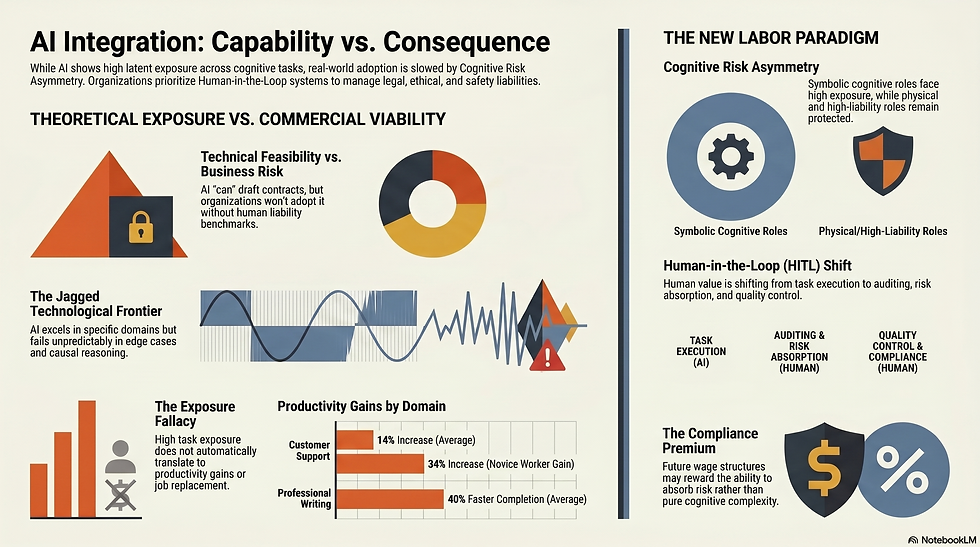
This article examines how organizations balance algorithmic capability against institutional risk when deciding where, when, and how to deploy AI. Drawing on Gao and Huang's (2026) Tech-Risk Dual-Factor Model and related empirical research, we explore the evidence for a profound "Cognitive Risk Asymmetry" in the labor market—where job security increasingly depends not on cognitive complexity but on the magnitude of real-world risk associated with task execution.
The AI Adoption Landscape: Capability Versus Deployment
Defining the Technology Frontier in 2024–2026
The contemporary AI landscape is characterized by rapid advancement in generative capabilities. Large language models like GPT-4, Claude, and Llama 3 have demonstrated remarkable proficiency in:
Symbolic manipulation and pattern recognition: Generating coherent code, drafting technical documentation, synthesizing research summaries
Semantic understanding: Translating languages, summarizing complex documents, extracting structured data from unstructured text
Creative generation: Writing marketing copy, designing visual concepts, composing narrative content
Complex reasoning tasks: Multi-step mathematical problem-solving, logical inference, strategic game-playing
These capabilities suggest that tasks previously requiring years of specialized human training can now be executed by algorithms in seconds. Empirical studies confirm substantial productivity gains when knowledge workers use AI assistance (Dell'Acqua et al., 2023; Brynjolfsson et al., 2023).
The Jagged Technological Frontier
Yet capability is uneven. As Dell'Acqua and colleagues (2023) demonstrate through field experiments, AI performance exhibits a "jagged frontier"—excelling dramatically in some domains while failing unpredictably in others. Large language models:
Struggle with long-tail edge cases and novel scenarios absent from training data
Generate plausible but factually incorrect "hallucinations" (Ji et al., 2023)
Lack robust causal reasoning and physical world understanding (Pearl & Mackenzie, 2018)
Cannot reliably handle unstructured physical environments (Moravec, 1988)
Depend on human judgment for ethical, legal, and safety-critical decisions
This epistemological limitation is fundamental. Current deep learning architectures remain trapped on the lowest rung of Pearl and Mackenzie's (2018) "Ladder of Causation"—capable of association and observation but mathematically incapable of performing true interventions or contemplating counterfactuals. This deficit is the root of their inability to operate autonomously in high-risk environments.
Prevalence of AI Adoption: The Early Evidence
Organizations are moving rapidly but selectively. Survey evidence from major consulting firms suggests:
High adoption in digital-native domains: Software companies, marketing agencies, and financial services report aggressive integration of AI copilots for coding, content generation, and data analysis
Cautious deployment in regulated industries: Healthcare, legal services, and financial auditing maintain strict human oversight due to liability concerns
Minimal penetration in physical domains: Construction, manufacturing, and infrastructure maintenance see limited AI impact beyond predictive maintenance and scheduling optimization
Critically, even in high-exposure occupations, full replacement remains rare. Instead, the dominant pattern is augmentation—AI handles routine subtasks while humans retain responsibility for quality control, final judgment, and accountability (Raisch & Krakowski, 2021).
Organizational and Individual Consequences of AI Integration
Organizational Performance Impacts
The productivity effects of generative AI vary significantly by context and implementation approach. Controlled experiments provide quantifiable evidence:
Efficiency gains in constrained domains. Brynjolfsson et al. (2023) studied customer support agents using AI-assisted chatbots and found productivity increases of 14% on average, with the largest gains (34%) accruing to novice workers. Similarly, Noy and Zhang (2023) demonstrated that professionals using ChatGPT completed writing tasks 40% faster with marginally higher quality ratings.
Quality-speed tradeoffs in creative work. Dell'Acqua et al.'s (2023) field experiment with Boston Consulting Group consultants revealed that AI assistance improved both speed and quality for tasks within the algorithm's capability frontier but degraded performance for tasks requiring nuanced judgment beyond current AI competence. This "jagged frontier" creates management challenges in determining appropriate use cases.
Heterogeneous impacts by skill level. Evidence consistently shows that AI tools disproportionately benefit less experienced workers by providing access to expert-like capabilities, potentially compressing skill premiums (Brynjolfsson et al., 2023). However, top performers often see smaller relative gains, as their existing expertise already approaches the AI's ceiling in many domains.
Cost structures and capital substitution. While labor cost savings can be substantial—Eloundou et al. (2023) estimate that 80% of the U.S. workforce could have at least 10% of tasks affected by large language models—organizations face significant implementation costs including infrastructure, training, integration, and ongoing monitoring. Return on investment remains uncertain for many applications.
Individual Wellbeing and Workforce Impacts
The human consequences of AI integration extend beyond simple employment statistics to encompass job quality, skill development, and psychological wellbeing:
Task reallocation and skill obsolescence. As AI absorbs routine execution tasks, human workers increasingly focus on oversight, exception handling, and tasks requiring emotional intelligence or physical presence. This reallocation can be experienced positively (liberation from tedious work) or negatively (deskilling and loss of autonomy). Autor (2024) argues that the "expertise economy" may require rebuilding middle-class jobs around tasks that complement rather than compete with AI.
Algorithmic aversion and trust dynamics. Research in behavioral economics reveals that humans often exhibit "algorithm aversion"—resistance to delegating decisions to AI systems, particularly after observing errors (Dietvorst et al., 2015). This aversion is especially pronounced in high-stakes domains and among professionals with strong accountability pressures (Castelo et al., 2019). Organizations must navigate this tension between theoretical efficiency and human comfort.
Anxiety and job insecurity. Even when jobs are not eliminated, the psychological impact of perceived replaceability creates stress and reduces morale. Younger workers entering fields with high AI exposure face particular uncertainty about career trajectories and the value of educational investments.
Wage polarization risks. If AI predominantly affects middle-skill cognitive work while leaving high-skill strategic roles and low-skill physical jobs relatively untouched, we may observe accelerated wage polarization (Acemoglu & Restrepo, 2018). The traditional U-shaped distribution may evolve into a new configuration where "compliance capacity"—the ability to absorb institutional risk—commands premium compensation.
Evidence-Based Organizational Responses
Table 1: Corporate Case Studies and Best Practices in AI Implementation
Organization | Initiative or Program Name | AI Application/Use Case | Implementation Strategy | Risk Mitigation Measures | Observed Impact or Outcome | Targeted Workforce Groups |
Microsoft | Copilot Internal Frameworks | AI assistance across Office applications for financial data, legal, and external communications | Augmentation | Explicit capability mapping, communication of failure modes, and required human review for accuracy | Reduced algorithmic aversion and prevented excessive confidence by highlighting limitations | All employees using Microsoft Office |
Goldman Sachs | AI-assisted candidate screening revision | Resume evaluation and candidate screening | Augmentation | Mandatory secondary human review for all AI-flagged candidates and actionable feedback for rejected applicants | Improved fairness and mitigated potential algorithmic bias discovered in internal reviews | Recruitment teams and job applicants |
JPMorgan Chase | AI Risk Council / Contract Intelligence platform | NLP analysis of legal documents and customer-facing AI applications | Augmentation | Mandatory attorney verification of AI-extracted clauses and council approval for customer-facing deployment | Managed liability exposure and reputational risks through strict human-in-the-loop requirements | Attorneys and customer-facing divisions |
Accenture | AI Fluency program | Foundational AI education and hands-on practice with client-safe tools | Reskilling | Education on training data, pattern matching, identifying hallucinations, and critical evaluation skills | Measurable improvements in AI utilization rates and quality of outputs | All 750,000 employees |
Amazon | Upskilling 2025 | Transitioning warehouse workers to technical roles as automation advances | Reskilling | Machine learning technician training, data science certifications, and software engineering bootcamps | Commitment to employee retention through transition (notably $700 million investment) | 100,000 warehouse pickers and associates |
Siemens | Redesigned Engineering Training Programs | Evaluating AI-generated engineering designs | Reskilling | Training on communicating machine limitations and making safety-critical overrides | Enhanced human-AI collaboration skills and safety-critical judgment | Engineers |
Deloitte | Skills Inference Engine | AI-powered analysis of project work and client feedback to map capabilities | Reskilling | Tracking skill half-lives and identifying emerging adjacencies to proactively identify AI-exposed workers | Facilitates targeted reskilling before roles become obsolete | Internal employees |
Unilever | AI Guilds | Cross-functional communities sharing AI experiments in marketing, supply chain, HR, and R&D | Augmentation / Reskilling | Knowledge transfer and distributed innovation to prevent isolated failures | Balanced innovation with centralized knowledge transfer to prevent redundant mistakes | Marketers, supply chain analysts, HR professionals, and R&D scientists |
Netflix | AI Experiment Registry | Documentation of model deployments, metadata, and results | Augmentation | Structured knowledge capture of failure mode patterns and human override triggers | Enabled rapid knowledge transfer and prevents redundant mistakes across the organization | Data scientists and product teams |
Organizations are not passive recipients of technological change but active agents shaping how AI integrates into work processes. Effective responses balance productivity gains against risk management, workforce development, and strategic positioning.
Transparent Communication and Expectation Management
Establishing realistic capability boundaries. Leading organizations invest heavily in educating employees about what AI can and cannot reliably do. This involves:
Explicit capability mapping: Creating internal guides that categorize tasks by AI readiness (e.g., "fully automatable," "AI-assisted," "human-required")
Transparent failure modes: Openly discussing where and why AI systems make errors, including hallucination risks and edge case vulnerabilities
Regular capability updates: As models improve rapidly, maintaining current documentation prevents both over-reliance and under-utilization
Microsoft has developed comprehensive internal frameworks for its Copilot products, providing employees with detailed guidance on appropriate use cases across Office applications. The company explicitly communicates that AI suggestions require human review for accuracy, particularly in domains involving financial data, legal implications, or external communications. This transparency reduces both algorithmic aversion (by building trust through honesty) and excessive confidence (by highlighting limitations).
Involving employees in deployment decisions. Participatory design approaches that include frontline workers in AI implementation planning improve both system effectiveness and employee acceptance. Organizations that unilaterally impose AI systems often encounter resistance, workarounds, and suboptimal utilization. By contrast, co-design processes leverage worker expertise about task complexity and context-specific requirements.
Addressing job security concerns directly. Rather than avoiding difficult conversations, effective organizations explicitly commit to redeployment rather than replacement strategies. This might involve:
Public commitments to retraining: Guarantees that workers whose roles change will receive training for new responsibilities
Internal mobility programs: Proactive identification of alternative roles where displaced workers can add value
Attrition-based adjustment: Using natural turnover rather than layoffs to resize workforce
Procedural Justice in AI-Augmented Decision Systems
When AI influences high-stakes decisions—hiring, performance evaluation, resource allocation—procedural justice principles become critical for maintaining legitimacy and trust.
Explainability and contestability mechanisms. Organizations deploying AI decision support must provide:
Meaningful explanations: Not just technical model outputs but contextually relevant justifications that humans can evaluate
Appeal processes: Formal mechanisms for challenging AI-influenced decisions with human review
Bias auditing: Regular testing for discriminatory patterns across protected categories
Goldman Sachs revised its AI-assisted candidate screening processes after internal reviews revealed potential bias in resume evaluation algorithms. The firm now requires that all AI-flagged candidates receive secondary human review and provides rejected applicants with specific, actionable feedback rather than algorithmic black-box decisions. This approach balances efficiency gains with fairness considerations.
Preserving human agency in hybrid systems. Research demonstrates that optimal human-AI collaboration maintains meaningful human control rather than reducing people to rubber-stamps (Kleinberg et al., 2018). Effective designs:
Support rather than dictate: AI provides recommendations with confidence levels; humans make final calls
Allow overrides: Workers can reject AI suggestions without penalty when context warrants
Maintain skill engagement: Even with AI assistance, humans perform substantive work that preserves expertise development
Capability Building and Workforce Reskilling
The transition to AI-augmented work requires systematic investment in human capital development across three horizons:
Immediate AI literacy programs. All employees need foundational understanding of:
How generative AI works: Basic concepts of training data, pattern matching, probabilistic generation
Effective prompting techniques: Crafting inputs that elicit useful outputs; iterative refinement
Critical evaluation skills: Identifying hallucinations, assessing quality, recognizing limitations
Accenture implemented a global "AI Fluency" program requiring all 750,000 employees to complete modules on generative AI fundamentals within six months of ChatGPT's public release. The program combines conceptual education with hands-on practice using client-safe AI tools. Early assessments show measurable improvements in both AI utilization rates and quality of outputs generated.
Role-specific technical upskilling. Beyond general literacy, organizations must invest in deep capability development for roles being substantially transformed:
Data scientists → AI orchestrators: Training to design multi-agent systems, evaluate model performance, implement guardrails
Writers → content strategists: Shifting from drafting to oversight, brand voice consistency, strategic messaging
Analysts → insight synthesizers: Moving from data manipulation to interpretation, business context integration, recommendation formulation
Meta-skills for the AI era. Deming (2017) demonstrates the growing premium on social skills in technology-rich environments. Organizations should prioritize developing:
Complex communication: Explaining technical concepts to non-technical stakeholders; navigating ambiguity
Emotional intelligence: Reading human needs that AI cannot detect; providing empathetic support
Ethical reasoning: Making judgment calls in gray areas where algorithmic logic proves insufficient
Creative problem-solving: Generating novel approaches to challenges outside AI training data
Siemens redesigned its engineering training programs to emphasize human-AI collaboration skills. Rather than focusing purely on technical engineering knowledge, the curriculum now includes modules on evaluating AI-generated designs, communicating machine limitations to clients, and making safety-critical overrides when automated systems produce questionable recommendations.
Operating Model and Control Framework Design
Effective AI governance requires systematic organizational infrastructure:
Risk-tiered deployment policies. Organizations should categorize AI use cases by consequence severity and apply proportionate controls:
Low-risk applications (e.g., internal draft generation, brainstorming support): Permissive policies with minimal oversight
Medium-risk applications (e.g., customer-facing content, preliminary analysis): Required human review before external deployment
High-risk applications (e.g., financial decisions, legal advice, safety-critical systems): Strict human-in-the-loop requirements with documented accountability
JPMorgan Chase operates an internal "AI Risk Council" that must approve all customer-facing AI applications before deployment. The council evaluates potential failure modes, liability exposure, and reputational risks. For its Contract Intelligence platform (which uses NLP to analyze legal documents), the bank mandates that all AI-extracted clauses receive attorney verification before relying on the output for material decisions.
Audit trails and accountability mechanisms. When AI influences consequential outcomes, organizations need:
Version control: Tracking which model version generated which output, enabling investigation of errors
Human-in-the-loop documentation: Recording which person reviewed and approved AI-generated content
Performance monitoring: Systematic evaluation of accuracy, bias, and drift over time with defined thresholds for intervention
Clear liability assignment. Legal ambiguity about who bears responsibility when AI systems fail creates organizational paralysis. Effective frameworks explicitly designate:
Primary accountability: The human who approved deployment of the AI output
Secondary accountability: The AI governance team that certified the use case as appropriate
Vendor accountability: Contractual provisions defining model provider responsibilities for defects
Financial Support and Transition Assistance
When AI deployment does result in workforce reduction, responsible organizations provide robust support:
Extended severance and benefits. Beyond legal minimums, leading firms offer:
Extended health coverage: Continuing insurance during job search periods
Outplacement services: Professional job search assistance, resume development, interview coaching
Educational subsidies: Tuition support for reskilling programs aligned with emerging labor market demands
Internal redeployment priority. Before external hiring for new roles, organizations should:
Skills assessments: Proactive evaluation of displaced workers' capabilities and interests
Internal talent marketplaces: Platforms connecting workers with alternative opportunities across divisions
Trial assignments: Temporary rotations allowing workers to demonstrate potential fit in new domains
Amazon announced in 2019 a $700 million "Upskilling 2025" initiative to train 100,000 employees for higher-skilled roles as warehouse automation advanced. Programs included machine learning technician training for former pickers and associates, data science certifications, and software engineering bootcamps. While implementation has faced challenges, the program represents an organizational commitment to employee retention through transition.
Building Long-Term Organizational Resilience in the AI Era
Beyond immediate tactical responses, organizations must develop strategic capabilities for navigating ongoing technological disruption. The arrival of large language models is not a one-time shock but the beginning of sustained transformation as AI capabilities continue advancing.
Adaptive Workforce Planning Systems
Traditional workforce planning—projecting headcount needs based on historical growth rates—proves inadequate when technological capabilities evolve exponentially. Organizations need:
Scenario-based capacity modeling. Rather than single-point forecasts, develop multiple workforce scenarios based on AI capability trajectories:
Conservative case: Slow adoption due to regulatory constraints and organizational inertia
Base case: Steady integration in low-risk domains with gradual expansion
Aggressive case: Rapid automation breakthrough requiring major workforce restructuring
For each scenario, model implications for:
Skill composition requirements
Organizational structure changes
Financial impacts on labor costs and productivity
Timeline for transitions
Dynamic skills taxonomy management. As AI capabilities shift, so do the definitions of valuable human skills. Organizations should:
Continuously update competency frameworks: Moving beyond static job descriptions to fluid capability maps
Track skill half-lives: Measuring how quickly specific expertise becomes obsolete or AI-replicable
Identify emerging adjacencies: Detecting new human-AI collaborative roles before they become obvious
Deloitte developed an AI-powered "skills inference engine" that analyzes project work, client feedback, and learning activities to continuously map employees' evolving capabilities. This dynamic system enables proactive identification of workers whose core skills are becoming AI-exposed and facilitates targeted reskilling before roles become obsolete.
Distributed Intelligence Architecture
Rather than centralizing AI adoption through IT departments, leading organizations distribute responsibility while maintaining coherent governance:
Domain-expert ownership of AI tools. Subject matter specialists—not just technologists—should drive AI integration within their functions:
Marketing teams evaluate and deploy generative content tools
Legal departments assess document analysis AI and contract automation
Finance groups implement AI-assisted forecasting and anomaly detection
This distributed model ensures that AI deployment reflects genuine workflow needs and domain-specific risk considerations rather than technology-push dynamics.
Centers of excellence for cross-functional support. While ownership is distributed, organizations benefit from centralized expertise providing:
Technical infrastructure: Shared platforms, security frameworks, compliance guardrails
Best practice sharing: Lessons learned across use cases; failure mode libraries
Vendor management: Consolidated relationships with AI providers for cost efficiency
Risk governance: Consistent standards for impact assessment and approval
Unilever restructured its digital organization to create AI "guilds"—cross-functional communities of practice where marketers, supply chain analysts, HR professionals, and R&D scientists share AI experiments and learnings. The guild model balances distributed innovation with knowledge transfer, preventing isolated failures from repeating across divisions.
Rapid experimentation infrastructure. Organizations that thrive amid disruption maintain systematic capabilities for testing new approaches quickly and safely:
Sandbox environments: Isolated systems where teams can experiment with AI tools without risking production data or customer exposure
Micro-pilots: Small-scale trials with defined success metrics and off-ramps if results disappoint
Fast-fail culture: Explicit organizational permission to abandon unsuccessful experiments without penalty
Ethical Frameworks and Values Alignment
As AI systems make increasingly consequential recommendations, organizations must develop robust ethical infrastructure:
Articulated AI principles. Leading firms publish explicit commitments governing AI use, typically including:
Fairness and non-discrimination: Proactive testing and mitigation of bias
Transparency: Disclosure when AI influences decisions affecting stakeholders
Privacy protection: Data minimization and security safeguards
Human agency: Preserving meaningful human control in high-stakes domains
Accountability: Clear responsibility assignment when systems fail
Microsoft, Google, and IBM have each published comprehensive AI ethics frameworks. While specific provisions vary, common elements include regular bias audits, impact assessments for high-risk applications, and escalation procedures when systems produce questionable outputs.
Ethics review boards. For particularly sensitive applications, organizations establish formal governance:
Independent review: Diverse panels including external ethicists, domain experts, and affected stakeholder representatives
Pre-deployment approval: Required sign-off before launching AI systems with significant social impact
Ongoing monitoring mandates: Periodic reassessment of deployed systems for drift or emergent harms
Stakeholder engagement processes. Beyond internal governance, responsible organizations consult with:
Affected workers: Those whose roles will change or disappear
Customer advocates: Representatives of user populations impacted by AI decisions
Regulatory bodies: Proactive collaboration with government oversight agencies
Civil society groups: Organizations focused on AI ethics, labor rights, or specific community impacts
Continuous Learning and Knowledge Management
The rapidity of AI advancement makes organizational learning velocity a competitive differentiator:
Structured knowledge capture from AI experiments. Organizations should systematically document:
Use case results: What worked, what failed, and under what conditions
Failure mode patterns: Where and why AI systems generate problematic outputs
Human override triggers: Situations where human judgment reliably outperforms algorithms
Integration lessons: Technical and organizational factors enabling or hindering adoption
Netflix maintains an internal "AI experiment registry" where data scientists and product teams record all model deployments with structured metadata about objectives, results, and lessons learned. This registry enables rapid knowledge transfer and prevents redundant mistakes across the organization's numerous AI initiatives.
External ecosystem engagement. No single organization can track all AI developments internally. Effective learning strategies include:
Academic partnerships: Collaborative research with universities studying human-AI collaboration, labor impacts, or sector-specific applications
Industry consortia: Participation in sector-wide initiatives sharing best practices and setting standards
Regulatory dialogue: Proactive engagement with policymakers developing AI governance frameworks
Startup monitoring: Tracking emerging AI vendors and tools that might provide new capabilities or threaten competitive position
Conclusion
The integration of artificial intelligence into organizational work processes represents not a sudden apocalyptic transformation but a complex, gradual, and highly contingent evolution. The evidence examined in this article demonstrates that technological capability alone does not dictate labor market outcomes. Rather, the interaction between algorithmic sophistication and institutional constraints—legal liability, safety requirements, compliance obligations, and human risk aversion—determines actual displacement patterns.
Several critical insights emerge from current research and practice:
Task encroachment, not occupational extinction. AI erodes jobs incrementally by absorbing specific activities rather than eliminating entire roles overnight. This granular process creates opportunities for adaptation but also generates prolonged uncertainty for workers whose roles are being hollowed out over time.
The Cognitive Risk Asymmetry. Contrary to RBTC assumptions, cognitive complexity no longer guarantees job security. Instead, a profound inversion has occurred: purely cognitive work dependent on symbolic manipulation faces high exposure, while physically embodied or liability-intensive work remains structurally protected. Data scientists and editors face greater immediate disruption than roofers and surgical nurses.
Augmentation dominates substitution in high-stakes domains. Even for highly AI-capable tasks, organizational and regulatory realities enforce Human-in-the-Loop architectures in domains where errors carry severe consequences. This creates a new division of labor where humans primarily audit, override, and absorb accountability for AI outputs rather than executing tasks from scratch.
The emerging Compliance Premium hypothesis. If job security increasingly depends on risk-absorption capacity rather than pure cognitive capability, we may observe wage restructuring where compensation tethers to liability rather than intellectual complexity. Occupations commanding the ability to legally and ethically navigate ambiguity may command premiums previously associated with specialized expertise.
Organizational responses matter profoundly. The evidence from leading firms demonstrates that proactive, humane management of AI integration—through transparent communication, participatory design, systematic reskilling, and robust governance—can mitigate workforce disruption while capturing productivity benefits. By contrast, organizations that impose AI unilaterally while ignoring human factors face resistance, quality problems, and institutional risk.
The Road Ahead
The current moment represents merely the opening chapter of a longer transformation. Several developments will shape subsequent phases:
Technological evolution beyond statistical pattern matching. Current large language models remain fundamentally limited by their probabilistic nature and lack of causal reasoning (Marcus, 2020; Pearl & Mackenzie, 2018). The anticipated transition toward "Logical AI"—systems capable of robust reasoning, counterfactual thinking, and physical world understanding—would dramatically expand the automation frontier, potentially collapsing the protective moat currently insulating physical and high-risk work.
Regulatory crystallization. Governments worldwide are developing AI governance frameworks that will substantially shape commercial viability. Strict liability regimes, mandatory human oversight requirements, and algorithmic accountability laws could reinforce human employment in sensitive domains regardless of technical capabilities.
Labor market adjustment mechanisms. As Acemoglu and Restrepo (2019) demonstrate, technological shocks trigger complex equilibrium responses including new task creation, labor reallocation across sectors, and capital-labor substitution dynamics. The ultimate employment impact depends on whether job destruction from automation exceeds job creation from complementary tasks and productivity-driven demand expansion.
Educational system adaptation. The "skills escalator" that historically allowed workers to stay ahead of automation by acquiring higher-level capabilities may be fundamentally disrupted when AI targets advanced cognitive work. Educational institutions face profound challenges in preparing students for careers where the nature of valuable human contribution remains uncertain and rapidly shifting.
Organizations navigating this landscape effectively will cultivate several core capabilities: adaptive workforce planning that scenarios multiple futures rather than extrapolating the past; distributed innovation architectures that push AI experimentation to domain experts while maintaining coherent governance; ethical infrastructure that balances productivity with fairness and human dignity; and continuous learning systems that capture and disseminate knowledge from ongoing experiments.
The transformation ahead is neither utopian nor apocalyptic but rather contingent—shaped by technological trajectories, regulatory choices, organizational decisions, and societal values. By understanding how capability and consequence interact to determine actual AI adoption patterns, leaders can navigate this transition more humanely and effectively, building organizations that harness algorithmic power while preserving essential human agency and institutional resilience.
Research Infographic
References
Acemoglu, D. (2024). The simple macroeconomics of AI. National Bureau of Economic Research Working Paper, 32487.
Acemoglu, D., & Restrepo, P. (2018). The race between man and machine: Implications of technology for growth, factor shares, and employment. American Economic Review, 108(6), 1488–1542.
Acemoglu, D., & Restrepo, P. (2019). Automation and new tasks: How technology displaces and reinstates labor. Journal of Economic Perspectives, 33(2), 3–30.
Autor, D. (2024). The expertise economy: How AI can rebuild the middle class. National Bureau of Economic Research Working Paper, 32140.
Autor, D. H., & Dorn, D. (2013). The growth of low-skill service jobs and the polarization of the US labor market. American Economic Review, 103(5), 1553–1597.
Autor, D. H., Levy, F., & Murnane, R. J. (2003). The skill content of recent technological change: An empirical exploration. The Quarterly Journal of Economics, 118(4), 1279–1333.
Bender, E. M., Gebru, T., McMillan-Major, A., & Shmitchell, S. (2021). On the dangers of stochastic parrots: Can language models be too big? In Proceedings of the 2021 ACM Conference on Fairness, Accountability, and Transparency (pp. 610–623).
Brynjolfsson, E., Li, D., & Raymond, L. R. (2023). Generative AI at work. National Bureau of Economic Research Working Paper, 31161.
Castelo, N., Bos, M. W., & Lehmann, D. R. (2019). Task-dependent algorithm aversion. Journal of Marketing Research, 56(5), 809–825.
Cheng, H., et al. (2023). How AI affects the labor market: A review of the micro evidence. China Economic Review, 82, 102046.
Dell'Acqua, F., McFowland, E., Mollick, E. R., Lifshitz-Assaf, H., Kellogg, K., Rajendran, S., Krayer, L., Madani, F., & Lakhani, K. R. (2023). Navigating the jagged technological frontier: Field experimental evidence of the effects of AI on knowledge worker productivity and quality. Harvard Business School Technology & Operations Management Unit Working Paper, 24-013.
Deming, D. J. (2017). The growing importance of social skills in the labor market. The Quarterly Journal of Economics, 132(4), 1593–1640.
Dietvorst, B. J., Simmons, J. P., & Massey, C. (2015). Algorithm aversion: People erroneously avoid algorithms after seeing them err. Journal of Experimental Psychology: General, 144(1), 114–126.
Eloundou, T., Manning, S., Mishkin, P., & Rock, D. (2023). GPTs are GPTs: An early look at the labor market impact potential of large language models. arXiv preprint arXiv:2303.10130.
Felten, E., Raj, M., & Seamans, R. (2023). How will language modelers like ChatGPT affect occupations and industries? arXiv preprint arXiv:2303.01157.
Floridi, L., & Chiriatti, M. (2020). GPT-3: Its nature, scope, limits, and consequences. Minds and Machines, 30(4), 681–694.
Gao, S., & Huang, M. (2026). Bounded by risk, not capability: Quantifying AI occupational substitution rates via a Tech-Risk Dual-Factor Model. arXiv preprint arXiv:2604.04464.
Ji, Z., Lee, N., Frieske, R., Yu, T., Su, D., Xu, Y., Ishii, E., Bang, Y., Madotto, A., & Fung, P. (2023). Survey of hallucination in natural language generation. ACM Computing Surveys, 55(12), 1–38.
Kleinberg, J., Lakkaraju, H., Leskovec, J., Ludwig, J., & Mullainathan, S. (2018). Human decisions and machine predictions. The Quarterly Journal of Economics, 133(1), 237–293.
Marcus, G. (2020). The next decade in AI: Four steps towards robust artificial intelligence. arXiv preprint arXiv:2002.06177.
Moravec, H. (1988). Mind children: The future of robot and human intelligence. Harvard University Press.
Noy, S., & Zhang, W. (2023). Experimental evidence on the productivity effects of generative artificial intelligence. Science, 381(6653), 37–42.
Pearl, J., & Mackenzie, D. (2018). The book of why: The new science of cause and effect. Basic Books.
Raisch, S., & Krakowski, S. (2021). Artificial intelligence and management: The automation–augmentation paradox. Academy of Management Review, 46(1), 192–210.

Jonathan H. Westover, PhD is Chief Research Officer (Nexus Institute for Work and AI); Associate Dean and Director of HR Academic Programs (WGU); Professor, Organizational Leadership (UVU); OD/HR/Leadership Consultant (Human Capital Innovations). Read Jonathan Westover's executive profile here.
Suggested Citation: Westover, J. H. (2026). When Capability Meets Consequence: How Business Risk, Not Technology, Dictates AI's Real Labor Market Impact. Human Capital Leadership Review, 36(1). doi.org/10.70175/hclreview.2020.36.1.4


