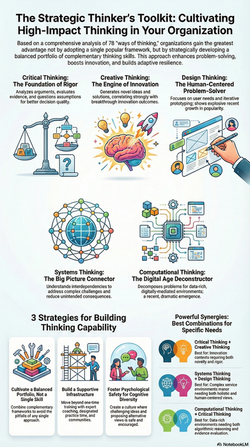
Think Smarter, Win Faster: 5 Frameworks You Need Now This video discusses the rapidly evolving nature of work and the growing complexity of challenges faced by organizations worldwide. It emphasizes the importance of developing new cognitive capabilities—specifically five fundamental disciplines of thinking—that are essential for building resilient, adaptive enterprises. These five disciplines are critical thinking, creative thinking, design thinking, systems thinking, and computational thinking. Each offers a unique perspective and toolset to address problems effectively. The video further illustrates how these thinking styles complement each other through a practical healthcare example, demonstrating the power of integrating multiple approaches to generate holistic solutions. Leaders are encouraged not to make everyone an expert in all disciplines but to foster teams capable of blending these thinking styles thoughtfully and flexibly. Finally, it stresses the need for organizational infrastructure, including coaching, protected time for deep thinking, shared resources, and leadership modeling, to embed these capabilities into the culture sustainably.
Highlights
🌍 The world of work is transforming rapidly, demanding new thinking capabilities for complex challenges.
🧠 Five fundamental thinking disciplines: critical, creative, design, systems, and computational thinking.
💡 Critical thinking ensures rigor, logic, and sound judgment, protecting against bias and error.
🎨 Creative thinking drives innovation by imagining novel possibilities beyond conventional patterns.
🤝 Design thinking centers solutions on human needs through empathy and iterative prototyping.
🔄 Systems thinking reveals interconnected patterns and root causes for lasting change.
⚙️ Computational thinking breaks down problems systematically and complements other disciplines.
Key Insights
🔍 Critical thinking as the foundation of sound judgment: Critical thinking empowers teams to rigorously question assumptions and assess evidence, which is essential for avoiding costly mistakes and overcoming cognitive biases. In an era of information overload and misinformation, this discipline safeguards decision-making quality and ensures that actions rest on verified truths rather than unexamined beliefs. Organizations lacking critical thinking risk strategic missteps and operational failures.
🎨 Creative thinking fuels innovation and competitive advantage: Amidst saturated markets and recurring challenges, creative thinking enables organizations to break free from conventional constraints by asking “what if?” This discipline cultivates the ability to see common situations through unique lenses, generating novel ideas that can disrupt industries or create new value. It is the engine that powers transformation in stagnant environments, providing a crucial edge in today’s dynamic economy.
🤝 Design thinking connects innovation to human experience: By starting with empathy and involving users throughout the problem-solving journey, design thinking ensures that solutions are not only innovative but also desirable, feasible, and usable. This human-centered approach bridges the gap between abstract ideas and practical impact, making it indispensable for creating products, services, or processes that truly meet people’s needs rather than imposing top-down solutions.
🔄 Systems thinking uncovers hidden interdependencies and leverage points: Complex challenges often arise from interconnected factors and unintended consequences of past decisions. Systems thinking enables leaders to map these relationships over time, revealing feedback loops and structural drivers behind recurring problems. This perspective helps identify high-impact intervention points, facilitating deep, sustainable change rather than quick fixes that fail to address root causes.
⚙️ Computational thinking breaks complexity into manageable parts: By decomposing problems into smaller steps and using algorithmic approaches, computational thinking complements other disciplines by bringing clarity and structure to multifaceted issues. It is particularly valuable when dealing with dynamic systems or data-driven environments, enabling precise modeling, simulation, and iterative refinement of solutions.
If this helped, please like and share the video to spread evidence-based thinking practice.
#CriticalThinking #DesignThinking #SystemsThinking #CreativeThinking #ComputationalThinking #OrganizationalPerformance #Innovation
OUTLINE:
00:00:00 - A New Foundation for Work
00:00:39 - The Five Core Disciplines of Thought
00:01:44 - Design, Systems, Computational Thinking
00:02:41 - Real-World Examples
00:04:12 - How to Blend + Action Plan for Leaders