top of page
Home
Bio
Pricing
Merch
Podcast Network
Advertise with Us
Be Our Guest
Academy
Learning Catalog
Learners at a Glance
The ROI of Certification
Corporate L&D Solutions
Research
Research Initiatives
Nexus Institute
Catalyst Center
Adadptive Organization Lab
Future of Work Collective
Renaissance Project
Collaboration Form
Research Models and Tools
Research One Sheets
Research Snapshots
Research Videos
Research Briefs
Research Articles
Free Educational Resources
HCL Review
Contribute to the HCL Review
HCL Review Archive
HCL Review Slide Decks and Infographics
HCL Review Process
HCL Review Reach and Impact
HCI Press
From HCI Academic Press
From HCI Popular Press
Publish with HCI Press
Free OER Texts
Our Impact
Invest with HCI
Industry Recognition
Philanthropic Impact
Kiva Lending Impact
More
Use tab to navigate through the menu items.
When AI Becomes a Crutch: How Instant Help Erodes Human Capability and Persistence
NEXUS INSTITUTE FOR WORK AND AI
1 day ago
20 min read
When Algorithms Replace Credentials: Navigating Labor Commoditization in the AI Era
NEXUS INSTITUTE FOR WORK AND AI
2 days ago
19 min read
AI Agents and the Future of Work: How Early Adopters Are Building Competitive Moats Through Intelligent Collaboration
NEXUS INSTITUTE FOR WORK AND AI
3 days ago
22 min read
The Workforce AI Literacy Imperative: Building Competitive Advantage Through Evidence-Based Upskilling
NEXUS INSTITUTE FOR WORK AND AI
4 days ago
23 min read
Cognitive Surrender in the Age of AI: How Organizations Can Navigate the Rise of Artificial Reasoning
NEXUS INSTITUTE FOR WORK AND AI
5 days ago
19 min read
Rebuilding Campus Dialogue: Evidence-Based Strategies for Higher Education in a Polarized Era
CATALYST CENTER FOR WORK INNOVATION
6 days ago
22 min read
Preparing the Workforce for AI Integration: Evidence-Based Strategies for Organizations and Workers
NEXUS INSTITUTE FOR WORK AND AI
6 days ago
27 min read
Breaking Through the Discovery Bottleneck: Why Mapping AI into Your Organization is the Key to Unlocking Real Value
NEXUS INSTITUTE FOR WORK AND AI
Jun 24
20 min read
The Hidden Motives Behind Return-to-Office Mandates: How Narcissistic Leadership Drives Remote Work Resistance
CATALYST CENTER FOR WORK INNOVATION
Jun 24
23 min read
The Generative AI Transformation: Evidence-Based Insights on Labor Market Disruption and Organizational Adaptation
CATALYST CENTER FOR WORK INNOVATION
Jun 23
33 min read
Human Capital Leadership Review
The Retention Risk Your Engagement Survey Cannot See
9 hours ago
6 min read
Why Growth Problems Are Often Process Problems
12 hours ago
6 min read
AI won’t steal your job, but it will expose whether you can think, warns former MF Global executive
12 hours ago
4 min read
When AI Becomes a Crutch: How Instant Help Erodes Human Capability and Persistence
NEXUS INSTITUTE FOR WORK AND AI
1 day ago
20 min read
11+ HR Social Media Best Practices for Enterprise Brands
2 days ago
12 min read
When Algorithms Replace Credentials: Navigating Labor Commoditization in the AI Era
NEXUS INSTITUTE FOR WORK AND AI
2 days ago
19 min read
Rising Workplace Tensions: What Managers Can Do to Support Their Teams
3 days ago
2 min read
The Real Reason Your AI Initiative Stalled Has Nothing to Do With the Model
3 days ago
7 min read
Expert Warns Remote Working Could Increase Feelings of Loneliness Despite Growing Work-From-Home Trend
3 days ago
2 min read
1
2
3
4
5
HCL Review Research Videos
HCL Review Research Infographics
Blog: HCI Blog
Human Capital Leadership Review
Featuring scholarly and practitioner insights from HR and people leaders, industry experts, and researchers.
Human Capital Innovations
Play Video
Play Video
29:55
Driving Organizational Change from Within, with Benji Wiedemann and Alex Lampe
In this HCI Webinar, I talk with Benji Wiedemann and Alex Lampe about driving organizational change from within. Benji Wiedemann is co-founder and Executive Creative Director at brand and business consultancy Wiedemann Lampe. He brings over two decades of experience to help brands and organizations unlock cultural impact at scale. Alongside co-founder Alex Lampe, Benji created Lemonade, an enterprise-grade digital platform designed to enhance collaboration and communication between teams, businesses, and communities throughout the creative process, driving deep-rooted and meaningful business transformation. Alex Lampe is co-founder and Executive Strategy & Innovation Director at brand and business consultancy Wiedemann Lampe. He brings over two decades of experience in building brands, digital ecosystems and tools that help organizations unlock transformation through design thinking, innovation, service design, and experiential design, while crafting and protecting their unique cultural identities.
Play Video
Play Video
04:24
AI Adoption Boosting Jobs, Not Cutting Them!
The widespread narrative that artificial intelligence (AI) will eliminate human jobs and make workers obsolete is challenged by Dr. Jonathan H. Westover's research, which analyzes data from over 21,000 U.S. firms. Contrary to fears of AI-triggered job losses, companies that deeply invest in AI experience significant employment growth. These high-intensity adopters of AI integrate the technology into core operations, redesign workflows, and invest in employee training, which leads to about a 10% increase in employment within two years. Importantly, entry-level jobs are not disappearing but growing by 12% in these AI-driven firms, as automation of routine tasks frees workers for more meaningful, human-centric roles. The AI-related job growth is especially pronounced in sectors like information software, internet services, and data, where a tech-savvy culture accelerates AI integration. Highlights 🤖 Data from 21,000 U.S. firms shows AI adoption leads to employment growth, not layoffs. 📈 High-intensity AI adopters see a 10% workforce increase within two years. 👶 Entry-level jobs grow by 12% in firms deeply utilizing AI. 💼 AI automates routine tasks, freeing humans for higher-value work. 💡 The biggest AI benefits require strategic, deep integration and employee training. ⏳ Job growth effects appear 6 to 12 months after AI investment; patience is key. 🌐 Tech sectors lead AI-driven employment growth due to culture and readiness for change. Key Insights 🤝 AI as a Job Creator, Not a Job Destroyer: Dr. Westover's extensive research reveals a fundamental shift in understanding AI’s economic impact. Instead of replacing employees, companies that invest seriously in AI create new roles and expand their workforce. This runs counter to the dominant public narrative and suggests policymakers and businesses should rethink fears about AI-induced unemployment. 🎯 High-Intensity vs. Low-Intensity AI Adoption: The intensity of AI use drastically alters its impact on jobs. Firms that just dabble with AI see minimal change, but companies that commit deeply—embedding AI into workflows, training employees, and building strategy around it—unlock significantly higher employment growth (10% in two years). This implies that AI's benefits are contingent on organizational readiness and vision. 🚀 Entry-Level Job Growth and Workforce Accessibility: Rather than eliminating entry jobs, AI firms actually boost entry-level opportunities by 12%. This challenges concerns that AI displaces newcomers, instead showing that automation of routine work allows human workers to focus on higher-value, creative, or interpersonal tasks, thus expanding the foundation of career ladders. For new workforce entrants, becoming adept at working alongside AI is critical. ⏳ Delayed Impact and Integration Time: AI-driven job growth is not immediate; it typically takes 6 to 12 months post-investment before employment benefits emerge. During this period, companies undergo workflow redesign, employee training, and technology integration, shifting the perception of AI adoption from a quick fix to a long-term strategic transformation requiring patience and ongoing capacity building. 🌍 Sector-Specific Growth Patterns: The strongest employment growth associated with AI adoption is concentrated in tech-savvy industries like information software, internet services, and data. These sectors benefit from a culture of innovation, clearer use cases for AI, and openness to rapid change, which accelerates growth. Other sectors must prepare to replicate these conditions to harness similar benefits. 📚 Worker Adaptability and Continuous Learning: The new landscape demands AI literacy for all workers—not necessarily programming skills but the ability to use AI tools effectively to augment uniquely human capabilities. This shifts the paradigm of job security toward continuous upskilling and adaptability, emphasizing lifelong learning and proactive engagement with AI technologies. 🌟 Human-AI Collaboration as the Future of Work: AI is not a substitute but a partner to human labor. The future described by Dr. Westover is one of enhanced collaboration where AI handles routine or data-intensive tasks while humans take on complex, creative, strategic, or interpersonal roles. This collaboration expands opportunities and redefines human labor in an AI-driven economy, fostering a more dynamic and inclusive job market.
Play Video
Play Video
02:55
The AI Growth Paradox
This research investigates how corporate AI investment affects hiring and job growth by analyzing spending data from over 20,000 American companies. The findings reveal that high-intensity AI adoption correlates with a 10% increase in employment, directly contradicting fears of immediate workforce displacement. These gains are primarily concentrated in the Information sector and among firms that move beyond experimentation to make substantial, sustained financial commitments. Interestingly, the growth extends to entry-level positions and various business functions, including sales and engineering, rather than just technical roles. However, the study notes that these positive effects emerge gradually and are currently limited to well-resourced organizations capable of supporting significant technological integration. Ultimately, the research suggests that AI acts more as a catalyst for organizational expansion than a tool for labor reduction.
Play Video
Play Video
54:01
A Conversation about Reimagining Workforce Learning in an Era of Disruption
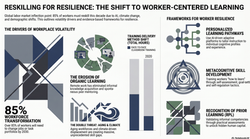
This research examines the necessary shift from organization-centered training to person-centered learning in response to a volatile modern workforce. It identifies five primary drivers of disruption: technological acceleration, demographic aging, climate change displacement, precarious work arrangements, and the rise of remote environments. The research argues that traditional models fail to support marginalized populations, such as gig workers and migrants, who lack access to formal corporate resources. Consequently, the research advocates for integrated frameworks that prioritize individual self-directed learning and metacognitive skills to ensure long-term employability. Finally, the research offers evidence-based recommendations for leaders and policymakers to build more equitable learning ecosystems that can withstand continuous economic and environmental change. See Privacy Policy at https://art19.com/privacy and California Privacy Notice at https://art19.com/privacy#do-not-sell-my-info.
Play Video
Play Video
23:27
A Conversation about Reimagining Workforce Learning in an Era of Disruption
This research examines the necessary shift from organization-centered training to person-centered learning in response to a volatile modern workforce. It identifies five primary drivers of disruption: technological acceleration, demographic aging, climate change displacement, precarious work arrangements, and the rise of remote environments. The research argues that traditional models fail to support marginalized populations, such as gig workers and migrants, who lack access to formal corporate resources. Consequently, the research advocates for integrated frameworks that prioritize individual self-directed learning and metacognitive skills to ensure long-term employability. Finally, the research offers evidence-based recommendations for leaders and policymakers to build more equitable learning ecosystems that can withstand continuous economic and environmental change. See Privacy Policy at https://art19.com/privacy and California Privacy Notice at https://art19.com/privacy#do-not-sell-my-info.
Play Video
Play Video
23:27
Reimagining Workforce Learning: Building Capability in an Era of Continuous Disruption
Abstract: The contemporary workplace confronts unprecedented transformation driven by technological acceleration, demographic shifts, climate-induced displacement, and the exponential growth of non-traditional work arrangements. This article examines how the convergence of these forces necessitates a fundamental reconceptualization of workplace learning—one that transcends conventional organization-centric training paradigms to embrace holistic, person-centered approaches to lifelong capability development. Drawing from recent research in industrial-organizational psychology, adult learning theory, and workforce development practice, we argue that effective responses to future-of-work challenges require integrated frameworks that address both organizational imperatives and individual learning agency. We explore evidence-based interventions spanning self-directed learning support, personalized skill development pathways, recognition of informal learning systems, and technology-enabled adaptive instruction. The article concludes by identifying critical research gaps and proposing practice-oriented recommendations for fostering sustainable workforce capability across organizational boundaries, with particular attention to vulnerable and marginalized worker populations. See Privacy Policy at https://art19.com/privacy and California Privacy Notice at https://art19.com/privacy#do-not-sell-my-info.
Play Video
Play Video
22:34
A Debate about Reimagining Workforce Learning in an Era of Disruption
This research examines the necessary shift from organization-centered training to person-centered learning in response to a volatile modern workforce. It identifies five primary drivers of disruption: technological acceleration, demographic aging, climate change displacement, precarious work arrangements, and the rise of remote environments. The research argues that traditional models fail to support marginalized populations, such as gig workers and migrants, who lack access to formal corporate resources. Consequently, the research advocates for integrated frameworks that prioritize individual self-directed learning and metacognitive skills to ensure long-term employability. Finally, the research offers evidence-based recommendations for leaders and policymakers to build more equitable learning ecosystems that can withstand continuous economic and environmental change. See Privacy Policy at https://art19.com/privacy and California Privacy Notice at https://art19.com/privacy#do-not-sell-my-info.
Play Video
Play Video
27:10
Driving Organizational Change from Within, with Benji Wiedemann and Alex Lampe
In this podcast episode, Dr. Jonathan H. Westover talks with Benji Wiedemann and Alex Lampe about driving organizational change from within. Benji Wiedemann is co-founder and Executive Creative Director at brand and business consultancy Wiedemann Lampe. He brings over two decades of experience to helpbrands and organizations unlock cultural impact at scale. Alongsideco-founder Alex Lampe, Benji created Lemonade, an enterprise-grade digitalplatform designed to enhance collaboration and communication between teams,businesses, and communities throughout the creative process, drivingdeep-rooted and meaningful business transformation. Alex Lampe is co-founder and Executive Strategy & Innovation Director at brand and business consultancy Wiedemann Lampe. He brings over two decades of experience in building brands, digital ecosystems and tools that help organizations unlock transformation through design thinking, innovation, service design, and experiential design, while crafting and protecting their unique cultural identities. See Privacy Policy at https://art19.com/privacy and California Privacy Notice at https://art19.com/privacy#do-not-sell-my-info.
HCL Review Articles
All Articles
Nexus Institute for Work and AI
Catalyst Center for Work Innovation
Adaptive Organization Lab
Work Renaissance Project
Research Briefs
Research Insights
Webinar Recaps
Book Reviews
Transformative Social impact
Search
Jul 21, 2025
8 min read
RESEARCH INSIGHTS
Building Your Confidence from the Inside Out
bottom of page