When AI Becomes a Crutch: How Instant Help Erodes Human Capability and Persistence


Listen to a review of this article:
Abstract: Artificial intelligence assistants promise unprecedented support for learning and problem-solving, yet emerging evidence suggests these tools may carry hidden cognitive costs. This article examines recent experimental findings demonstrating that even brief exposure to AI assistance—approximately 10–15 minutes—significantly impairs subsequent independent performance and reduces persistence when AI support is withdrawn. Drawing on randomized controlled trials involving over 1,200 participants across mathematical reasoning and reading comprehension tasks, we explore how AI systems optimized for immediate helpfulness may inadvertently undermine the very capabilities they aim to support. The analysis integrates cognitive science research on persistence, scaffolding theory, and human-AI collaboration frameworks to illuminate mechanisms driving this erosion of skill and motivation. Organizations deploying AI assistance tools—from educational institutions to professional training programs—face urgent questions about balancing short-term productivity gains against long-term capability development. This article synthesizes empirical evidence with organizational best practices, offering evidence-based strategies for designing AI systems that scaffold genuine competence rather than cultivating dependency.
Imagine a mentor who always provides complete solutions, never refuses a request for help, and responds instantly to every query. At first glance, this seems ideal. Yet experienced educators recognize this pattern as fundamentally problematic: such unconditional assistance prevents learners from developing the struggle, persistence, and problem-solving capacity that underpin genuine skill acquisition (Koedinger & Aleven, 2007; Soderstrom & Bjork, 2015).
Current AI assistants embody precisely this dynamic. Language models like ChatGPT, Claude, and similar systems deliver comprehensive answers on demand, across virtually any domain—mathematics, writing, coding, analysis—without ever declining to help unless safety guardrails intervene (Brynjolfsson et al., 2025). These systems are engineered for one objective: immediate user satisfaction through instant, complete responses.
The stakes extend far beyond individual learning contexts. Organizations increasingly integrate AI assistants into workflows spanning education, professional development, customer service, healthcare, and knowledge work (OECD, 2026). Yet a critical question remains largely unexamined: What happens to human capabilities when AI support suddenly becomes unavailable? If people routinely offload cognitive work to AI during training or daily practice, can they perform effectively when operating independently?
Recent experimental evidence provides concerning answers. Liu and colleagues (2026) conducted large-scale randomized controlled trials demonstrating that brief AI-assisted problem-solving sessions—lasting merely 10–15 minutes—produce measurable impairments in subsequent unassisted performance. More troublingly, participants exposed to AI assistance showed significantly reduced persistence, giving up more frequently when facing challenges without AI support. These effects emerged across different cognitive domains, from fraction arithmetic to reading comprehension, suggesting a general phenomenon rather than task-specific quirk.
This article examines the organizational and individual consequences of this "AI dependency trap." We synthesize emerging empirical evidence with established research on cognitive offloading, skill acquisition, and motivation to illuminate why instant AI assistance may erode human capability. Subsequently, we present evidence-based organizational responses—drawing on scaffolding theory, instructional design principles, and human-AI collaboration frameworks—to guide practitioners in deploying AI tools that genuinely enhance long-term competence rather than creating brittle dependencies.
The AI Assistance Landscape
Defining Cognitive Offloading in the AI Era
Cognitive offloading refers to the use of external actions or tools to reduce the information-processing demands of a task (Risko & Gilbert, 2016). Humans have always employed cognitive offloading strategies: writing notes to remember information, using calculators for arithmetic, consulting maps for navigation. These external supports demonstrably improve immediate task performance by reducing working memory load and computational burden (Goldin-Meadow et al., 2001; Gilbert et al., 2020).
However, offloading carries documented costs. When cognitive aids become unavailable, people often exhibit diminished independent capacity. Classic research by Sparrow and colleagues (2011) demonstrated that knowing information will be accessible online reduces people's ability to recall that information later—a phenomenon colloquially termed the "Google effect." Similar patterns emerge with GPS navigation: regular users show impaired spatial memory and reduced ability to form cognitive maps of their environment (Richmond & Taylor, 2025).
AI assistants accelerate and amplify these dynamics across virtually every reasoning domain. Unlike calculators or search engines—which handle specific, bounded functions—contemporary language models provide comprehensive support for open-ended cognitive work. They draft essays, debug code, explain concepts, analyze data, generate arguments, and solve multi-step problems. The scope of offloading expands from discrete calculations to entire reasoning processes.
This expansion matters because persistence and effortful problem-solving are not merely means to task completion; they constitute essential mechanisms for skill acquisition and metacognitive development (Metcalfe & Mischel, 1999; Bjork et al., 2011). When AI completes the cognitive work, users miss opportunities to develop both domain knowledge and accurate self-knowledge about their own capabilities—a form of metacognitive erosion that undermines long-term learning (Fleming & Daw, 2017; Dubey et al., 2021).
Prevalence and Drivers of AI Assistance Adoption
AI assistant adoption has grown with remarkable speed. ChatGPT reached 100 million users within two months of launch, making it the fastest-growing consumer application in history (Brynjolfsson et al., 2025). Educational institutions report widespread student use for homework assistance, essay writing, and test preparation (OECD, 2026). In professional contexts, surveys indicate substantial proportions of knowledge workers now regularly employ AI for drafting documents, analyzing data, and generating code (Lee et al., 2025).
Several factors drive this rapid uptake:
Immediate effectiveness: AI assistance demonstrably improves task completion speed and accuracy in the moment, creating positive reinforcement
Accessibility: Modern interfaces require minimal technical expertise; users simply type questions in natural language
Breadth of capability: Unlike specialized tools, language models handle diverse tasks within a single interface
Cost and availability: Many capable AI assistants are free or low-cost, operating 24/7 without scheduling constraints
Organizations face competing pressures. On one hand, AI tools promise productivity gains, cost reductions, and enhanced service delivery. On the other, emerging evidence suggests these short-term benefits may come at the expense of workforce capability, learning capacity, and organizational resilience when AI systems fail or prove unavailable.
Organizational and Individual Consequences of AI Dependency
Organizational Performance Impacts
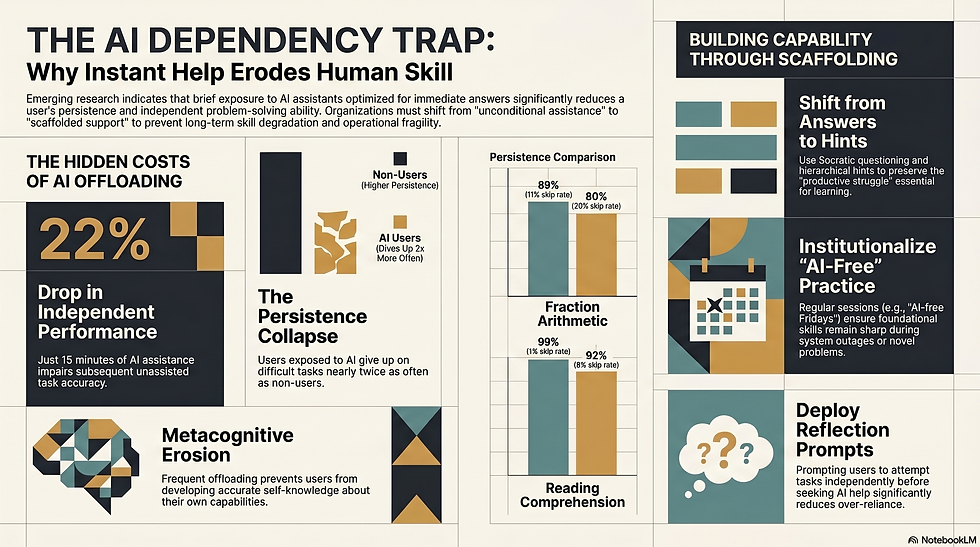
The organizational consequences of AI-induced skill erosion manifest across multiple dimensions. Most immediately, organizations face operational fragility: when AI systems experience outages, employees accustomed to AI support struggle to maintain productivity. Liu and colleagues (2026) document this pattern experimentally—participants who completed math problems with AI assistance performed 22% worse on subsequent unassisted problems compared to control participants who never received AI help (Cohen's d = –0.42, p < 0.001).
Extrapolating to organizational contexts: if employees routinely rely on AI for analysis, decision-making, or problem-solving, temporary AI unavailability could trigger cascading productivity losses. Unlike traditional software failures—where workarounds typically exist—cognitive dependencies create performance gaps that cannot be quickly bridged. Employees have not merely lost a tool; they have lost practiced capability.
Second, organizations face training and development challenges. Traditional apprenticeship models assume that junior employees develop expertise through supported practice—receiving guidance while working through problems independently (Koedinger & Aleven, 2007; Van de Pol et al., 2010). AI assistance short-circuits this process. When junior staff immediately offload cognitive work to AI, they miss formative struggles that build both competence and confidence. Over time, organizations may find they have difficulty developing senior-level talent, as employees never acquired foundational problem-solving capabilities.
Medical contexts illustrate these risks concretely. Budzyn and colleagues (2025) examined endoscopist performance after exposure to AI diagnostic assistance during colonoscopy. They found that physicians who trained with AI showed significantly reduced detection accuracy when AI was unavailable—a pattern they term "deskilling risk." In high-stakes domains where independent judgment matters critically, AI-induced skill degradation carries severe consequences.
Third, organizations experience innovation and adaptation constraints. Novel problems—by definition—fall outside the distribution of scenarios on which AI systems were trained. When organizational capabilities atrophy through disuse, creative problem-solving suffers. Employees who habitually offload thinking to AI may struggle when facing challenges requiring genuine cognitive flexibility, original synthesis, or judgment under uncertainty (Doshi & Hauser, 2024). Organizations become less adaptive precisely when adaptation matters most.
Individual Wellbeing and Capability Impacts
At the individual level, AI dependency manifests through multiple mechanisms affecting both competence and motivation. The most direct impact involves performance degradation: people simply become worse at tasks when AI support vanishes. Liu and colleagues (2026) demonstrated this across three experiments spanning different cognitive domains. Participants assisted by AI during learning phases consistently underperformed control groups during subsequent unassisted testing.
Perhaps more concerning, AI exposure significantly reduced persistence. In fraction arithmetic tasks, participants with prior AI access skipped problems at nearly double the rate of controls (20% vs. 11%, p = 0.031). In reading comprehension tasks, this gap widened further (8% vs. 1%, p = 0.008). Critically, participants received explicit instructions that payment did not depend on correctness and that skipping carried no penalty—yet AI-exposed participants disengaged more frequently.
This motivational erosion matters profoundly because persistence represents a foundational predictor of long-term achievement. Duckworth and colleagues (2007) demonstrated that "grit"—the tendency to sustain effort despite setbacks—predicts academic success, career advancement, and skill acquisition more reliably than cognitive ability measures. Similarly, research on self-regulation consistently identifies persistence as central to effective learning (Maddux, 2009; Andersson & Bergman, 2011).
Multiple psychological mechanisms likely contribute to reduced persistence following AI exposure. Reference point shifts represent one pathway: when AI routinely solves problems in seconds, unassisted work feels subjectively more effortful by comparison—an adaptation phenomenon structurally analogous to hedonic treadmills (Brickman et al., 1978; Frederick & Loewenstein, 1999). Each instance of AI offloading recalibrates expectations about appropriate effort expenditure, making future independent work feel increasingly aversive.
Metacognitive erosion represents another mechanism. Effective persistence depends on accurate self-knowledge—understanding one's actual capabilities, recognizing when breakthrough is imminent versus when problems genuinely exceed current skill (Metcalfe, 2009; Yeung & Summerfield, 2012). When AI handles cognitive work, people never develop this calibrated self-understanding. They cannot distinguish problems they could solve with sustained effort from those truly beyond reach, leading to premature disengagement.
Liu and colleagues (2026) found that persistence costs concentrated among participants who used AI to obtain direct solutions rather than hints. This pattern aligns with scaffolding theory: support that reveals complete answers prevents the productive struggle essential for learning, while support that guides reasoning—without eliminating challenge—can enhance development (Koedinger & Aleven, 2007; Kapur, 2014). The implication: not all AI assistance proves equally harmful, but unconditional answer-provision carries particularly severe costs.
Evidence-Based Organizational Responses
Table 1: Strategies for Mitigating AI Dependency and Skill Erosion
Organization or Entity | Intervention Category | Specific Strategy or Program | Implementation Details | Core Objective |
Khan Academy | Scaffolding | Khanmigo | An adaptive AI tutoring system that refuses to provide direct answers, instead asking guiding questions and adjusting hint specificity based on student responses. | Ensuring superior learning outcomes on independent assessments by preventing direct answer-provision. |
Microsoft | Policy and Training | AI etiquette training | Exercises where employees first attempt tasks independently, then observe how AI changes their approach; addresses appropriate use contexts and emphasizes AI as a co-pilot. | Reducing over-reliance and fostering metacognitive awareness about offloading patterns. |
UK National Health Service (NHS) | Governance | AI governance frameworks | Mandatory evaluation of clinical decision-support systems for effects on physician skill development; requires restricted deployment if deskilling is detected. | Protecting physician independent judgment and preventing long-term deskilling risk. |
Deloitte Consulting | Policy and Practice | AI-free Fridays | Consultants complete analyses and develop recommendations without any AI assistance during scheduled sessions. | Improving consultant confidence, building capability, and reducing anxiety about AI system outages. |
Anthropic | Scaffolding and Governance | Claude (Educational Reflection Prompts) | Integrated reflection prompts that ask users about prior attempts and suggest trying problems independently before providing help. | Enhancing learning outcomes and increasing student confidence in independent abilities. |
IBM | Skill Development | AI+Skills initiatives | Combines technical AI tool training with deliberate practice in core analytical capabilities; frames AI as amplifying human judgment. | Cultivating both independent competence and effective AI collaboration for solving novel problems. |
Patagonia | Policy and Practice | Maker Fridays | Design teams work on personally meaningful projects without AI assistance to connect with craft traditions. | Preserving intrinsic motivation, building creative confidence, and maintaining independence. |
Salesforce | Governance and Policy | Human-Centered AI philosophy | Leadership communications and metrics that track both productivity and skill-development indicators to treat capability as a strategic objective. | Preserving the psychological contract by framing AI as a tool for elevating rather than replacing human work. |
Transparent Communication and Expectation-Setting
Organizations must establish clear norms around AI assistant use, communicating both benefits and limitations explicitly. Research on human-AI collaboration emphasizes that effective integration requires shared understanding of system capabilities, appropriate reliance calibration, and metacognitive awareness about when AI support proves beneficial versus detrimental (Ibrahim et al., 2025; Kim et al., 2025).
Effective approaches include:
Explicit use policies: Organizations should articulate when AI assistance is encouraged, permitted, or prohibited. Educational institutions might specify that AI can be used for brainstorming and initial drafting but not for final submission work. Professional contexts might distinguish between AI support for routine tasks versus high-stakes decisions requiring human judgment.
Capability transparency: Users need accurate mental models of AI strengths and weaknesses. Training programs should demonstrate both impressive capabilities and characteristic failure modes—showing where AI excels and where it produces plausible-sounding but incorrect outputs.
Dependency awareness campaigns: Organizations can adapt anti-deskilling messaging similar to public health campaigns. Just as "use it or lose it" campaigns encourage physical activity, "think without AI" initiatives could encourage regular unassisted practice.
Microsoft has implemented "AI etiquette" training across its workforce, explicitly addressing appropriate use contexts and emphasizing that AI serves as a co-pilot rather than autopilot. The training includes exercises where employees first attempt tasks independently, then observe how AI assistance changes their approach, fostering metacognitive awareness about offloading patterns. Early internal assessments suggest this training reduces over-reliance while maintaining productivity benefits.
Scaffolded AI Assistance Design
Rather than providing instant complete solutions, organizations can deploy AI systems designed to scaffold learning through progressive support withdrawal. This approach aligns with extensive research on instructional scaffolding, which demonstrates that optimal support initially provides substantial assistance, then gradually transfers responsibility to learners as competence develops (Van de Pol et al., 2010; Soderstrom & Bjork, 2015).
Evidence-based scaffolding strategies include:
Hint-based progression: AI systems can offer hierarchical hints—starting with general guidance, progressing to increasingly specific suggestions, only revealing complete solutions as a last resort. This structure preserves productive struggle while preventing total frustration.
Socratic questioning: Rather than providing answers, AI can ask questions that guide reasoning: "What information would help you solve this?" or "Can you break this problem into smaller steps?" This approach mirrors effective human tutoring, which emphasizes eliciting thinking rather than transmitting solutions (Collins et al., 2024).
Delayed assistance: Organizations can introduce intentional delays before AI provides full solutions, requiring users to attempt problems independently first. Research on "desirable difficulties" demonstrates that initial struggle—even when unsuccessful—enhances subsequent learning (Bjork et al., 2011; Kapur, 2014).
Adaptive support: AI systems can monitor user behavior, providing less assistance to users demonstrating growing competence and more support to those genuinely struggling. This responsiveness mirrors expert human mentorship, where support adjusts dynamically based on learner progress.
Khan Academy has pioneered adaptive AI tutoring through "Khanmigo," which explicitly refuses to provide direct answers. Instead, the system asks guiding questions, checks student understanding, and adjusts hint specificity based on response patterns. Early evaluations indicate that students using Khanmigo show superior learning outcomes on independent assessments compared to students with access to traditional answer-providing AI tools.
Structured Independent Practice Requirements
Organizations can institutionalize regular unassisted practice, ensuring employees and learners maintain capability even while benefiting from AI assistance during routine work. This approach parallels athletic training, where athletes use equipment and assistance during practice but must perform independently during competition.
Implementation strategies include:
AI-free assessments: Educational institutions and professional certification programs can require that final evaluations occur without AI access. This creates incentives for maintaining independent capability throughout learning processes.
Periodic capability audits: Organizations can conduct regular assessments of employee performance on representative tasks without AI support, identifying skill gaps before they become critical operational vulnerabilities.
Dual-path assignments: Training programs can assign parallel tasks—some completed with AI assistance to build familiarity with AI collaboration, others completed independently to maintain foundational skills. This balanced approach captures benefits of both modalities.
Deliberate practice protocols: Organizations can schedule dedicated time for effortful independent work, treating it as essential professional development rather than merely a check-box compliance requirement.
Deloitte Consulting has implemented "AI-free Fridays" in certain practice areas, where consultants complete analyses and develop recommendations without AI assistance. The firm positions these sessions as capability-building exercises rather than productivity losses, emphasizing that consultant judgment remains the ultimate value proposition for clients. Preliminary data suggest these sessions improve consultant confidence and reduce anxiety about AI system outages.
AI Assistance with Built-In Reflection Prompts
Organizations can deploy AI systems that explicitly encourage metacognitive reflection, helping users develop awareness of their own thinking processes and dependencies. This approach draws on research demonstrating that metacognitive awareness—thinking about one's own thinking—enhances learning and reduces blind over-reliance on external tools (Fleming & Daw, 2017; Elizondo et al., 2024).
Effective reflection mechanisms include:
Pre-assistance reflection: Before providing help, AI systems can prompt: "Have you attempted this independently? What approaches have you tried?" This pause encourages users to engage cognitively before offloading.
Post-assistance review: After providing solutions, AI can ask: "Do you understand why this approach works? Could you solve a similar problem independently?" These prompts transform passive answer-consumption into active learning.
Periodic self-assessment: AI systems can periodically prompt users to estimate their independent capability: "If I weren't available, how confident are you that you could complete this task?" This fosters calibrated self-knowledge.
Usage transparency: Organizations can provide individuals with dashboards showing their AI assistance patterns over time—how frequently they request help, what types of support they seek, how their usage has changed. This data visibility enables informed decisions about dependency patterns.
Anthropic has integrated reflection prompts into Claude, their AI assistant, specifically for educational contexts. When students request homework help, the system asks about prior attempts and periodically suggests trying problems independently first. Early user research indicates students using reflection-enabled versions demonstrate better learning outcomes and report greater confidence in their independent abilities.
Capability Investments and Skill Development Programs
Organizations must invest proactively in human skill development, recognizing that AI deployment does not eliminate the need for fundamental capabilities—it increases the importance of maintaining those capabilities. This requires explicit resource allocation and leadership commitment, treating human capability as strategic infrastructure rather than residual necessity.
Investment priorities include:
Foundational skills emphasis: Organizations should identify core capabilities essential for effective performance even with AI availability—critical thinking, problem decomposition, solution evaluation, judgment under uncertainty. Training programs should prioritize these enduring competencies.
Hybrid skill development: Rather than choosing between human capability and AI fluency, organizations should cultivate both. Employees need deep domain expertise and sophisticated understanding of how to collaborate effectively with AI tools.
Failure recovery training: Organizations can explicitly teach employees how to recognize and respond to AI limitations, errors, and unavailability. This "AI resilience" training builds organizational robustness against AI system failures.
Communities of practice: Organizations can establish peer learning networks where employees share strategies for maintaining skills while leveraging AI productively. These communities create social accountability and normalize capability-building as ongoing professional development.
IBM has launched comprehensive "AI+Skills" initiatives combining technical training on AI tool use with deliberate practice in core analytical capabilities. The program explicitly frames AI as amplifying human judgment rather than replacing it, requiring employees to demonstrate both independent competence and effective AI collaboration. Internal assessments indicate participants report higher confidence and demonstrate superior performance on complex, novel problems compared to employees receiving only AI tool training.
Building Long-Term Individual and Organizational Resilience
Psychological Contract Recalibration in Human-AI Partnerships
The introduction of AI assistants fundamentally alters psychological relationships between individuals and their work. Traditional employment models emphasize that individuals exchange effort and skill for compensation and development opportunities. AI assistance introduces a third party into this exchange, potentially relieving individuals of effortful cognitive work—the very work that builds capability and creates value (Zhi-Xuan et al., 2025; Kirk et al., 2025b).
Organizations must consciously renegotiate these psychological contracts, articulating a vision where AI amplifies human capability rather than substituting for it. This requires leadership communication emphasizing several principles:
AI as support for human excellence: Framing AI tools as enabling people to tackle more ambitious challenges, operate at higher levels of abstraction, or handle greater complexity—rather than as replacements for human thought
Value of struggle and mastery: Explicitly celebrating instances where individuals persevere through difficult problems without AI assistance, reinforcing that cognitive effort remains valued and essential
Long-term capability as strategic priority: Communicating organizational commitment to employee development even when short-term productivity gains tempt pure efficiency optimization
Salesforce has articulated a "Human-Centered AI" philosophy explicitly addressing these psychological dynamics. CEO communications emphasize that AI serves to elevate human work rather than eliminate it, highlighting employee stories where AI assistance enabled tackling previously impossible challenges. The company tracks both productivity metrics and skill-development indicators, treating long-term capability as a strategic objective equal to operational efficiency.
Distributed Responsibility and Governance Structures
As AI systems become embedded in organizational workflows, responsibility for ensuring appropriate use cannot rest solely with individual users. Organizations require governance structures distributing oversight across multiple stakeholders—leadership, management, users, and AI system designers (Collins et al., 2024; Sucholutsky et al., 2025).
Effective governance elements include:
Cross-functional oversight committees: Organizations can establish bodies including representatives from operations, learning & development, ethics, and technology functions to monitor AI deployment impacts on human capability
Impact assessment requirements: Before deploying new AI tools, organizations can mandate assessments examining potential effects on skill development, motivation, and long-term capability—not merely short-term productivity
Feedback mechanisms: Organizations should create channels through which employees can report concerns about AI dependency, skill erosion, or inappropriate assistance—treating these as safety issues rather than complaints
Transparency and accountability: Organizations can publish regular reports on AI usage patterns, capability assessments, and interventions undertaken to maintain human skills—creating accountability through visibility
The UK National Health Service has implemented AI governance frameworks requiring that any AI clinical decision-support system undergo evaluation not only for immediate diagnostic accuracy but also for potential effects on physician skill development and independent judgment. Systems demonstrating evidence of deskilling require enhanced training protocols or restricted deployment until modified to better support physician capability.
Purpose, Meaning, and Intrinsic Motivation Preservation
Psychological research consistently demonstrates that intrinsic motivation—engagement driven by inherent interest and challenge rather than external rewards—produces superior learning, persistence, and wellbeing compared to purely extrinsic motivation (Maddux, 2009; Mooradian et al., 2016). AI assistance threatens intrinsic motivation by removing the very challenge and accomplishment that make cognitive work meaningful.
Organizations can preserve intrinsic motivation through several approaches:
Emphasizing novel problems: Organizations can reserve AI assistance primarily for routine, repetitive work while directing human effort toward genuinely novel challenges requiring creativity and judgment—the work that remains intrinsically engaging
Highlighting mastery and growth: Organizations can make skill development visible and celebrated, providing individuals with evidence of their growing capabilities over time. Progress tracking, skill badges, and peer recognition reinforce that human capability matters and grows through effort
Connecting work to purpose: Organizations can help individuals understand how their cognitive work—even when difficult—connects to meaningful outcomes, impact on others, or contribution to larger goals. This purpose connection sustains motivation through challenging learning
Autonomy over AI use: Rather than mandating AI usage, organizations can give individuals choice about when and how to employ AI assistance. Research on self-determination theory demonstrates that autonomy enhances intrinsic motivation and engagement (Maddux, 2009)
Patagonia has implemented "Maker Fridays" in their design teams, where designers work on personally meaningful projects without AI assistance. The initiative explicitly frames unassisted creative work as valuable professional development and as connection to craft traditions. Designers report high engagement during these sessions and note that the practice enhances their confidence and independence throughout the workweek.
Conclusion
The research evidence presents an uncomfortable truth: the AI tools designed to make us more capable may, paradoxically, be making us less so. Liu and colleagues (2026) provide rigorous experimental evidence that even brief exposure to AI assistance—10 to 15 minutes—produces measurable degradation in independent performance and significant reduction in persistence. These effects generalize across cognitive domains, from mathematical reasoning to reading comprehension, suggesting fundamental psychological mechanisms rather than task-specific peculiarities.
The implications extend far beyond laboratory experiments. If brief AI interactions produce detectable capability erosion, what happens with sustained daily use over months or years? Organizations deploying AI assistants throughout operations, schools integrating AI into curricula, and individuals routinely offloading cognitive work to language models are conducting an uncontrolled experiment on human capability—one whose long-term consequences remain uncertain but potentially severe.
Yet these findings need not counsel despair or technological rejection. Rather, they highlight a critical design imperative: AI systems must be engineered to optimize for long-term human capability, not merely short-term user satisfaction. This requires fundamental rethinking of how AI assistance operates—moving from unconditional answer-provision toward sophisticated scaffolding that preserves productive struggle while preventing unproductive frustration.
The most effective organizational responses combine multiple interventions. Transparent communication establishes realistic expectations and appropriate use norms. Scaffolded assistance design ensures AI support enhances rather than replaces learning. Structured independent practice requirements maintain capabilities even as AI handles routine work. Reflection prompts build metacognitive awareness about dependencies. Capability investments ensure organizations prioritize long-term skill development alongside short-term productivity gains.
Importantly, these interventions demand more than superficial policy statements. They require genuine organizational commitment—leadership endorsement, resource allocation, measurement systems that track long-term capability alongside short-term efficiency, and cultural change emphasizing mastery and resilience as core values. Organizations optimizing solely for immediate productivity will find themselves with brittle workforces unable to function when AI systems fail, face novel situations, or prove unavailable.
The stakes are particularly high in education, where persistence and productive struggle represent not merely means to task completion but fundamental mechanisms of learning and development (Duckworth et al., 2007; Bjork et al., 2011). If AI assistance erodes students' willingness to persist through challenges, we risk creating a generation that has never experienced the transformative power of sustained effort leading to breakthrough understanding. The long-term societal consequences—reduced innovation, diminished problem-solving capacity, increased fragility—could prove profound.
Looking forward, research priorities should include longitudinal studies examining AI assistance effects over extended timeframes, investigations of individual differences in susceptibility to AI dependency, and rigorous evaluation of intervention effectiveness. We need better understanding of the psychological mechanisms driving persistence erosion—whether reference point shifts, metacognitive degradation, or other pathways—to inform more targeted interventions. Additionally, research should examine AI assistance impacts across diverse populations, domains, and organizational contexts to understand boundary conditions and moderating factors.
The fundamental question organizations face is straightforward: What do we want AI to do to people? If the answer is simply "make them more productive today," current AI systems excel. If the answer is "help them become more capable over time," we face substantial work redesigning these systems to scaffold long-term competence rather than cultivating brittle dependency.
The research reviewed here suggests we currently optimize for the former while neglecting the latter—a misalignment that may prove costly as AI systems proliferate throughout society. Rectifying this misalignment requires treating human capability development as a first-order design objective rather than an afterthought, engineering AI systems that know not only how to help but also when to step back, and building organizational cultures that value the struggle and persistence essential to genuine mastery.
Research Infographic
References
Andersson, H., & Bergman, L. R. (2011). The role of task persistence in young adolescence for successful educational and occupational attainment in middle adulthood. Developmental Psychology, 47(4), 950–960.
Bjork, E. L., Bjork, R. A., & others. (2011). Making things hard on yourself, but in a good way: Creating desirable difficulties to enhance learning. In Psychology and the Real World: Essays Illustrating Fundamental Contributions to Society (2nd ed., pp. 56–64).
Brickman, P., Coates, D., & Janoff-Bulman, R. (1978). Lottery winners and accident victims: Is happiness relative? Journal of Personality and Social Psychology, 36(8), 917–927.
Brynjolfsson, E., Li, D., & Raymond, L. (2025). Generative AI at work. The Quarterly Journal of Economics, 140(2), 889–942.
Budzyn, K., Romańczyk, M., Kitala, D., Kołodziej, P., Bugajski, M., Adami, H. O., Blom, J., Buszkiewicz, M., Halvorsen, N., Hassan, C., & others. (2025). Endoscopist deskilling risk after exposure to artificial intelligence in colonoscopy: A multicentre, observational study. The Lancet Gastroenterology & Hepatology, 10(10), 896–903.
Collins, K. M., Sucholutsky, I., Bhatt, U., Chandra, K., Wong, L., Lee, M., Zhang, C. E., Zhi-Xuan, T., Ho, M., Mansinghka, V., & others. (2024). Building machines that learn and think with people. Nature Human Behaviour, 8(10), 1851–1863.
Doshi, A. R., & Hauser, O. P. (2024). Generative AI enhances individual creativity but reduces the collective diversity of novel content. Science Advances, 10(28), eadn5290.
Dubey, R., Ho, M., Mehta, H., & Griffiths, T. (2021). Aha! moments correspond to metacognitive prediction errors. Available at SSRN 5475080.
Duckworth, A. L., Peterson, C., Matthews, M. D., & Kelly, D. R. (2007). Grit: Perseverance and passion for long-term goals. Journal of Personality and Social Psychology, 92(6), 1087–1101.
Elizondo, K., Valenzuela, R., Pestana, J. V., & Codina, N. (2024). Self-regulation and procrastination in college students: A tale of motivation, strategy, and perseverance. Psychology in the Schools, 61(3), 887–902.
Fleming, S. M., & Daw, N. D. (2017). Self-evaluation of decision-making: A general Bayesian framework for metacognitive computation. Psychological Review, 124(1), 91–114.
Frederick, S., & Loewenstein, G. (1999). Hedonic adaptation. In D. Kahneman, E. Diener, & N. Schwarz (Eds.), Well-Being: The Foundations of Hedonic Psychology (pp. 302–329). Russell Sage Foundation.
Gilbert, S. J., Bird, A., Carpenter, J. M., Fleming, S. M., Sachdeva, C., & Tsai, P.-C. (2020). Optimal use of reminders: Metacognition, effort, and cognitive offloading. Journal of Experimental Psychology: General, 149(3), 501–517.
Goldin-Meadow, S., Nusbaum, H., Kelly, S. D., & Wagner, S. (2001). Explaining math: Gesturing lightens the load. Psychological Science, 12(6), 516–522.
Ibrahim, L., Collins, K. M., Kim, S. S. Y., Reuel, A., Lamparth, M., Feng, K., Ahmad, L., Soni, P., El Kattan, A., Stein, M., & others. (2025). Measuring and mitigating overreliance is necessary for building human-compatible AI. arXiv preprint arXiv:2509.08010.
Kapur, M. (2014). Productive failure in learning math. Cognitive Science, 38(5), 1008–1022.
Kim, S. S. Y., Vaughan, J. W., Liao, Q. V., Lombrozo, T., & Russakovsky, O. (2025). Fostering appropriate reliance on large language models: The role of explanations, sources, and inconsistencies. In Proceedings of the 2025 CHI Conference on Human Factors in Computing Systems (pp. 1–19).
Kirk, H. R., Gabriel, I., Summerfield, C., Vidgen, B., & Hale, S. A. (2025b). Why human–AI relationships need socioaffective alignment. Humanities and Social Sciences Communications, 12(1), 1–9.
Koedinger, K. R., & Aleven, V. (2007). Exploring the assistance dilemma in experiments with cognitive tutors. Educational Psychology Review, 19(3), 239–264.
Lee, H.-P., Sarkar, A., Tankelevitch, L., Drosos, I., Rintel, S., Banks, R., & Wilson, N. (2025). The impact of generative AI on critical thinking: Self-reported reductions in cognitive effort and confidence effects from a survey of knowledge workers. In Proceedings of the 2025 CHI Conference on Human Factors in Computing Systems (pp. 1–22).
Liu, G., Christian, B., Dumbalska, T., Bakker, M. A., & Dubey, R. (2026). AI assistance reduces persistence and hurts independent performance. arXiv preprint arXiv:2604.04721v2.
Maddux, J. E. (2009). Self-efficacy: The power of believing you can. In The Oxford Handbook of Positive Psychology (pp. 335–344). Oxford University Press.
Metcalfe, J. (2009). Metacognitive judgments and control of study. Current Directions in Psychological Science, 18(3), 159–163.
Metcalfe, J., & Mischel, W. (1999). A hot/cool-system analysis of delay of gratification: Dynamics of willpower. Psychological Review, 106(1), 3–19.
Mooradian, T., Matzler, K., Uzelac, B., & Bauer, F. (2016). Perspiration and inspiration: Grit and innovativeness as antecedents of entrepreneurial success. Journal of Economic Psychology, 56, 232–243.
OECD. (2026). OECD Digital Education Outlook 2026: Exploring Effective Uses of Generative AI in Education. OECD Publishing, Paris.
Richmond, L. L., & Taylor, R. G. (2025). The benefits and potential costs of cognitive offloading for retrospective information. Nature Reviews Psychology, 4(5), 312–321.
Risko, E. F., & Gilbert, S. J. (2016). Cognitive offloading. Trends in Cognitive Sciences, 20(9), 676–688.
Soderstrom, N. C., & Bjork, R. A. (2015). Learning versus performance: An integrative review. Perspectives on Psychological Science, 10(2), 176–199.
Sparrow, B., Liu, J., & Wegner, D. M. (2011). Google effects on memory: Cognitive consequences of having information at our fingertips. Science, 333(6043), 776–778.
Sucholutsky, I., Collins, K. M., Jacoby, N., Thompson, B. D., & Hawkins, R. D. (2025). Using LLMs to advance the cognitive science of collectives. Nature Computational Science, 5(9), 704–707.
Van de Pol, J., Volman, M., & Beishuizen, J. (2010). Scaffolding in teacher–student interaction: A decade of research. Educational Psychology Review, 22(3), 271–296.
Yeung, N., & Summerfield, C. (2012). Metacognition in human decision-making: Confidence and error monitoring. Philosophical Transactions of the Royal Society B: Biological Sciences, 367(1594), 1310–1321.
Zhi-Xuan, T., Carroll, M., Franklin, M., & Ashton, H. (2025). Beyond preferences in AI alignment. Philosophical Studies, 182(7), 1813–1863.

Jonathan H. Westover, PhD is Chief Research Officer (Nexus Institute for Work and AI); Associate Dean and Director of HR Academic Programs (WGU); Professor, Organizational Leadership (UVU); OD/HR/Leadership Consultant (Human Capital Innovations). Read Jonathan Westover's executive profile here.
Suggested Citation: Westover, J. H. (2026). When AI Becomes a Crutch: How Instant Help Erodes Human Capability and Persistence. Human Capital Leadership Review, 35(4). doi.org/10.70175/hclreview.2020.35.4.5