





The Trust Collapse: Why Workers and Employers Have Given Up on Each Other


Listen to a review of this article:
Abstract: Over the past six decades, the fundamental relationship between employers and employees in the United States has undergone a profound transformation—a shift this article terms "The Great Decoupling." This decoupling manifests in declining institutional trust, shifting employment security, and a fundamental reframing of the employment contract from mutual commitment to transactional exchange. Trust in organizational leadership has fallen to historic lows, with only 19% of workers expressing confidence in their company's leaders as of recent surveys. Simultaneously, workers have adapted by diversifying income streams, with over 65% maintaining side ventures, while average job tenure has contracted and the expected number of involuntary separations per career has more than doubled since the 1990s. This article examines the economic, regulatory, and technological forces driving this decoupling, documents its consequences for organizational performance and individual wellbeing, and presents evidence-based strategies organizations can deploy to rebuild trust, retain institutional knowledge, and create sustainable competitive advantage through human capital investment. Rather than accepting decoupling as inevitable, forward-thinking organizations can choose a different path—one that balances adaptability with commitment and views workforce investment as strategic, not discretionary.
Every year brings a new organizational imperative: digital transformation, employee wellbeing, hybrid work arrangements, diversity and inclusion, and most recently, artificial intelligence integration. Yet beneath these shifting themes lies a deeper, more troubling trend that has unfolded over six decades—what can be termed "The Great Decoupling" of workers from their employers. This decoupling represents a fundamental shift in the psychological and economic contract between organizations and their workforces, moving from mutual long-term commitment toward transactional, arms-length exchange relationships.
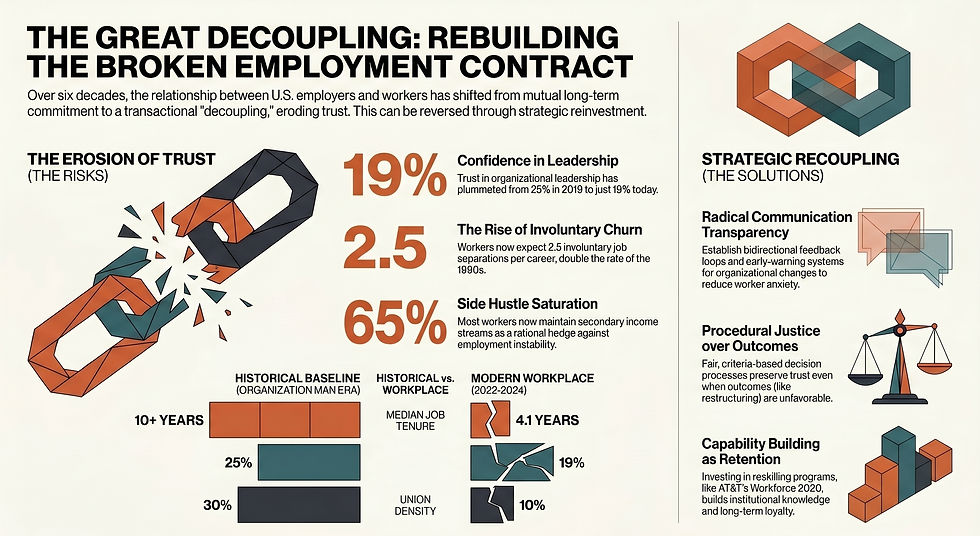
The evidence is stark. Trust in organizational leadership has plummeted from 25% in 2019 to approximately 19% today, with overall employer trust standing at just 67%—and significantly lower among frontline workers who comprise 72% of the workforce (PwC, 2024). The average American worker now expects to experience 2.5 involuntary separations across their career, more than double the rate of three decades prior. Meanwhile, over 65% of workers maintain side income streams, a figure that would have been unthinkable in the era of "organization men" and lifetime employment (Whyte, 1956).
This decoupling was not sudden but rather the cumulative result of regulatory shifts, technological change, financial market pressures, and evolving managerial philosophies that began in earnest during the 1980s. The transition from defined-benefit pensions to 401(k) plans symbolizes a broader transfer of risk and responsibility from institutions to individuals (Ghilarducci, 2008). Globalization and offshoring disaggregated previously integrated employment systems (Autor et al., 2013). Shareholder primacy doctrines reframed labor as cost rather than investment (Lazonick & O'Sullivan, 2000). And most recently, artificial intelligence and platform technologies have made it technically feasible to coordinate work with minimal long-term employment relationships (Kellogg et al., 2020).
Why does this matter now? Because the decoupling has reached an inflection point. Workers increasingly view employers with suspicion rather than loyalty, while organizations treat human capital as a variable expense to be optimized quarterly rather than a strategic asset to be cultivated over years. This mutual withdrawal threatens organizational capabilities, innovation capacity, and social cohesion. As AI introduces both unprecedented productivity potential and workforce anxiety, organizations face a critical choice: accelerate the decoupling or deliberately rebuild employment relationships around renewed trust and mutual investment.
This article maps the landscape of the Great Decoupling, examines its organizational and individual consequences, presents evidence-based strategies for organizations seeking to rebuild trust and commitment, and outlines a path toward long-term organizational resilience that treats human capital as the appreciating asset it truly represents.
The Great Decoupling Landscape
Defining the Employer-Employee Decoupling
The Great Decoupling refers to the systematic weakening of mutual commitment, trust, and long-term orientation in employment relationships that has unfolded across six decades of American economic history. This decoupling operates simultaneously along multiple dimensions:
Psychological decoupling involves the erosion of what Rousseau (1995) termed the relational psychological contract—the implicit understanding that loyalty and performance would be reciprocated with job security, career development, and organizational investment in employee welfare. The shift toward transactional contracts, where employment represents a straightforward exchange of labor for wages with no expectation of longevity or mutual development, has fundamentally altered how both parties view the relationship (Rousseau, 1995).
Economic decoupling manifests in the transfer of financial risks and responsibilities from employers to workers. The transition from defined-benefit pensions—where employers bore investment risk and guaranteed retirement income—to defined-contribution 401(k) plans shifted both financial risk and management burden to individual workers (Ghilarducci, 2008). Similarly, the rise of health savings accounts, the shift from employer-funded family leave to worker-managed leave banks, and the erosion of employment-based benefits all transfer economic risk downstream to individuals with fewer resources and less bargaining power to manage such risks efficiently.
Structural decoupling refers to the organizational and regulatory changes that have loosened the ties binding workers to employers and vice versa. The decline in union membership from over 30% of the workforce in the 1950s to approximately 10% today has reduced workers' collective voice and bargaining power (Rosenfeld, 2014). The rise of contingent work arrangements—contractors, freelancers, gig workers—creates employment relationships with minimal organizational commitment (Kalleberg, 2011). And the dramatic reduction in average firm tenure on the S&P 500 from twelve to thirteen years in the 1970s and 1980s to approximately five years today reflects the instability of organizations themselves, which are less capable of offering long-term employment even when they might wish to do so.
State of the Decoupling: Prevalence, Drivers, and Distribution
Trust erosion as a primary indicator. Trust serves as perhaps the most sensitive barometer of relationship quality, and the data reveal historic lows. Edelman's Trust Barometer has documented sustained declines in employee trust across two decades, with only 67% of employees trusting their employer overall in 2024 and far lower rates among frontline workers (Edelman, 2024). Leadership trust specifically has fallen from 25% in 2019 to 19% in recent measurements—a decline accelerated by pandemic-era experiences in which initial solidarity gave way to aggressive return-to-office mandates, widespread layoffs, and public executive enthusiasm for AI-driven productivity gains that workers interpreted as threats to job security (PwC, 2024).
Labor market churn and portfolio careers. Job tenure has declined substantially across recent decades. In the 1970s and 1980s, median tenure with a single employer often exceeded ten years; by 2022, median employee tenure had fallen to 4.1 years, with younger workers exhibiting even shorter tenure (U.S. Bureau of Labor Statistics, 2022). The expected number of involuntary job losses per career has more than doubled, from approximately one to 1.2 in the 1990s to 2.5 today. Workers have adapted by developing what Arthur and Rousseau (1996) termed "boundaryless careers," cultivating portable skills, maintaining extensive professional networks, and diversifying income sources. The fact that over 65% of workers now maintain side income streams—freelancing, gig work, or independent business ventures—reflects a rational hedging strategy in response to employment instability.
Wage stagnation and the literacy crisis. Real wage growth has failed to keep pace with inflation for most worker segments over four decades. While workers with advanced degrees saw real wage gains through 2020, even this privileged group has experienced stagnation since. Workers with only high school education experienced wage stagnation beginning in the early 1980s, while those with bachelor's degrees plateaued around 2000 (Autor, 2019). Perhaps most troubling, approximately 45% to 55% of U.S. adults do not read at a proficient twelfth-grade level, lacking the ability to synthesize complex information, evaluate dense texts, or navigate multi-step instructions (National Center for Education Statistics, 2019). This literacy gap becomes particularly consequential as AI systems generate complex outputs requiring critical evaluation and as knowledge work increasingly demands higher-order cognitive skills.
Drivers of decoupling. Multiple forces converged to produce the Great Decoupling:
Shareholder primacy and financialization: The shift from stakeholder to shareholder capitalism, particularly following Jensen and Meckling's (1976) agency theory framework and the rise of shareholder value maximization as management orthodoxy, reframed labor as a cost to be minimized rather than an asset to be cultivated (Lazonick & O'Sullivan, 2000). Stock markets began rewarding layoff announcements with price increases, incentivizing cost reduction over capability building.
Globalization and technological change: Trade liberalization through NAFTA and China's WTO accession, combined with information technology enabling globally distributed work, exposed previously sheltered workers to international competition (Autor et al., 2013). Routine cognitive and manual tasks became offshorable, reducing the bargaining power of workers performing such tasks.
Regulatory and policy shifts: The decline in union density following policy changes in the 1980s reduced workers' collective bargaining power (Rosenfeld, 2014). The federal minimum wage has remained at $7.25 since 2009—the longest period without increase in U.S. history—signaling weak political commitment to worker welfare. Weakened enforcement of labor protections and the rise of forced arbitration clauses further tilted power toward employers (Colvin, 2018).
Accounting and financial reporting conventions: Labor expenses appear on financial statements as period costs, while capital investments can be depreciated over multiple years, creating systematic bias toward capital over labor investment in financial analysis and management decision-making (Cascio & Boudreau, 2008).
Organizational and Individual Consequences of Decoupling
Organizational Performance Impacts
The Great Decoupling exacts significant costs on organizational performance, even as quarterly earnings reports may initially reward workforce reductions.
Loss of institutional knowledge and organizational capability. When organizations sever employment relationships—particularly through large-scale reductions in force—they destroy accumulated organizational knowledge, disrupt social networks that enable coordination, and lose tacit expertise that often cannot be quickly reconstituted (Argote & Ingram, 2000). Argote and colleagues have documented that organizational knowledge resides not just in individuals but in the routines, relationships, and shared understandings that emerge over time; workforce disruption destroys these difficult-to-rebuild assets. Research by Cascio (2002) found that organizations conducting layoffs experienced, on average, negative effects on profitability in subsequent years, contrary to the efficiency rationale typically offered.
Reduced innovation and adaptability. Innovation depends fundamentally on psychological safety, trust, and the willingness to experiment with novel approaches that may initially fail (Edmondson, 1999). Decoupled employment relationships—characterized by low trust, high anxiety about job security, and short time horizons—systematically undermine the conditions necessary for innovation. Amabile and Conti (1999) documented significant declines in creativity following downsizing, as survivors experienced heightened stress, reduced risk-taking, and narrowed attention. Organizations caught in cycles of hiring and layoffs signal to workers that long-term investments in organizational-specific capabilities carry high risk, incentivizing workers to invest in portable skills over organizational contribution.
Higher recruitment and development costs. The direct costs of employee turnover—recruiting, onboarding, training, and the productivity ramp-up period—typically range from 50% to 200% of annual salary depending on role complexity (Cascio & Boudreau, 2008). Organizations operating in a decoupled paradigm, with frequent turnover and limited investment in development, incur these costs repeatedly while never realizing the full return on human capital investment that accrues only over time. Empirical work by Ton (2014) on retail operations demonstrated that higher wages, better training, and greater job security—in short, a more coupled employment model—generated superior financial performance through enhanced customer service, operational efficiency, and reduced turnover costs.
Weakened organizational culture and commitment. Organizational culture, which serves as a coordination mechanism and source of competitive advantage, requires time and stability to develop (Schein, 2010). Decoupled employment relationships with high turnover, low trust, and transactional orientation make it difficult to establish and maintain strong cultures. The absence of culture then necessitates greater reliance on formal controls, monitoring, and explicit coordination mechanisms—all of which are more costly and less flexible than cultural coordination. Research by O'Reilly and Chatman (1986) demonstrated that organizational commitment, which depends on trust and identification with the organization, predicts discretionary effort, organizational citizenship behaviors, and retention—all of which suffer in decoupled contexts.
Individual Wellbeing and Worker Impacts
Economic insecurity and financial fragility. Over half of American workers lack sufficient savings to cover three weeks of expenses, leaving them financially fragile and vulnerable to even brief employment disruptions (Pew Research Center, 2022). The transfer of financial risks—retirement savings management, healthcare cost variability, income volatility—from organizations to individuals places these risks on the parties least equipped to manage them efficiently. Workers lack the diversification, expertise, and bargaining power that organizations possess, making risk transfer wealth-destroying in aggregate even if it reduces employer costs. The anxiety produced by economic insecurity has measurable health consequences, including elevated stress hormones, cardiovascular risks, and mental health challenges (Burgard et al., 2012).
Career management burden and skill obsolescence anxiety. In a decoupled employment context, workers bear primary responsibility for skill development, career navigation, and employability maintenance. While proponents frame this as empowering worker agency, the reality for many workers—particularly those with limited education, constrained finances, and demanding caregiving responsibilities—is that self-directed career management represents an additional burden layered atop work and personal obligations. The rapid pace of technological change, particularly with AI, heightens anxiety about skill obsolescence. Workers in roles vulnerable to automation face the prospect of needing to completely retrain—often without employer support or financial resources to do so effectively (Frey & Osborne, 2017).
Psychological contract violation and health consequences. When organizations violate implicit employment promises—through unexpected layoffs, withdrawn benefits, or broken commitments—workers experience psychological contract violation, a phenomenon associated with reduced trust, lower commitment, and increased turnover intentions (Robinson & Morrison, 2000). Importantly, psychological contract violations also produce measurable health consequences: research by Kivimäki and colleagues (2003) found that organizational downsizing and job insecurity were associated with increased cardiovascular disease, mental health challenges, and even mortality. The chronic stress of employment insecurity activates physiological stress responses that, when sustained over time, produce cumulative health damage.
Erosion of work meaning and identity. Work provides not only income but also meaning, social identity, structure, and purpose (Wrzesniewski et al., 1997). Decoupled employment relationships, characterized by short tenure, low organizational identification, and transactional exchange, attenuate these non-economic benefits of work. When workers view employment as temporary, instrumental, and devoid of mutual commitment, work loses much of its meaning-making potential. The gig economy exemplifies this challenge: while platform work offers flexibility, many gig workers report feeling expendable, disconnected, and unable to derive meaningful identity from their work (Ravenelle, 2019).
Evidence-Based Organizational Responses
Table 1: Evidence-Based Strategies for Rebuilding Workplace Trust and Commitment
Response Category | Specific Approach | Evidence Foundation | Corporate Example | Key Outcomes & Benefits | Implementation Difficulty (Inferred) |
Employment Stability | Guaranteed employment policies, redeployment, and cross-training instead of pro-cyclical layoffs. | Stable employers outperform over longer horizons by retaining institutional knowledge and reducing restructuring costs (Ton, 2014; Cascio, 2002). | Lincoln Electric | Extraordinary worker commitment and productivity; avoided layoffs during the 2008–2009 recession. | Extreme; requires a disciplined, multi-decade strategic commitment and rigid workforce planning. |
Capability Building | Structured development programs, tuition assistance, and reskilling initiatives (e.g., Workforce 2020). | Organizational investments in worker skill development generate returns through enhanced productivity and retention (Noe et al., 2014). | AT&T (Workforce 2020 initiative) | Sustained employment for tens of thousands of workers while building necessary strategic capabilities. | High; involves billions in investment and a long-term commitment to human capital over external hiring. |
Procedural Justice | Consistent criteria-based decisions, voice in restructuring, and robust severance and transition support. | Fair processes mitigate negative reactions and preserve trust even when outcomes are unfavorable (Cropanzano et al., 2007; Greenberg, 1990). | General Motors (2008–2009 financial crisis) | Preserved labor relations and community support; higher-than-expected engagement following bankruptcy. | High; requires strict adherence to ethical frameworks and extensive negotiation during high-stress periods. |
Fair Compensation | Paying above industry norms (starting wages $18–19) and providing comprehensive benefits to part-time workers. | Living wages reduce turnover and increase productivity; the 'Good Jobs Strategy' lowers costs through quality (Ton, 2014). | Costco | Turnover rates far below retail averages, higher productivity per worker, and lower inventory shrinkage. | Moderate to High; requires resisting shareholder pressure for immediate labor cost reduction. |
Communication | Regular town halls with structured Q&A, early warning systems for changes, and anonymous feedback channels with leadership response. | Research shows transparent communication regarding strategic direction builds trust and reduces damaging uncertainty (Men, 2014). | Microsoft (under Satya Nadella) | Substantial increase in employee engagement scores and renewed innovation and market performance. | Moderate; requires a significant cultural shift from information hoarding to vulnerability and openness. |
Trust-Building Leadership | Authentic, vulnerable communication and shared sacrifice (e.g., executives taking no salary during crises). | Confidence that leaders act with integrity and care for welfare predicts commitment and effort (Dirks & Ferrin, 2002). | Marriott (Arne Sorenson during COVID-19) | Increased trust in leadership during the crisis and high rates of worker return as business recovered. | Moderate; depends heavily on the individual integrity and emotional intelligence of senior executives. |
Organizations are not passive recipients of decoupling forces; they possess substantial agency in shaping employment relationships. The following evidence-based interventions offer pathways for organizations to rebuild trust, strengthen commitment, and create sustainable competitive advantage through human capital investment.
Transparent, Bidirectional Communication Systems
Research consistently demonstrates that transparent communication—particularly regarding organizational challenges, strategic direction, and employment security—builds trust and reduces damaging uncertainty (Men, 2014). Conversely, communication vacuums breed rumor, anxiety, and defensive behavior. Importantly, communication must be bidirectional: workers need mechanisms to voice concerns, provide feedback, and influence decisions, not simply receive top-down messaging.
Effective approaches for transparent communication:
Regular town halls with structured Q&A: Schedule frequent all-hands sessions where leadership shares business performance, strategic priorities, and emerging challenges, followed by unfiltered question-and-answer periods. The predictability and openness of these forums signal leadership accessibility and willingness to engage authentically.
Early warning systems for organizational changes: Rather than surprising workers with sudden restructuring announcements, establish norms of early communication about business pressures, strategic reviews, and potential organizational changes. Advanced notice allows workers to prepare and reduces the shock and violation associated with sudden announcements.
Anonymous feedback channels with visible leadership response: Implement systems like regular pulse surveys, anonymous suggestion platforms, or third-party listening tools that allow workers to surface concerns without fear of retaliation. Critically, leadership must visibly respond to themes that emerge, closing the feedback loop and demonstrating that voice matters.
Financial transparency and business education: Share key business metrics, competitive challenges, and financial realities with workers, coupled with education to help non-financial employees interpret this information. When workers understand the business context, they can contribute more effectively and are less likely to interpret leadership decisions as arbitrary or self-serving.
Microsoft underwent a cultural transformation beginning in 2014 under Satya Nadella's leadership that centered on transparency and psychological safety. The company moved from a competitive, insular culture characterized by stack ranking and information hoarding to one emphasizing growth mindset, learning, and open communication (Nadella, 2017). Regular company-wide meetings, transparent communication about strategic pivots, and explicit encouragement of experimentation and learning from failure rebuilt trust in leadership. Employee engagement scores increased substantially following these changes, and the company experienced renewed innovation and market performance. The transparency extended to difficult topics: when the company needed to restructure its phone business, leadership communicated early about the challenges, involved employees in solution development, and provided extensive support for affected workers.
Procedural Justice in Workforce Decisions
Procedural justice—the fairness of processes used to make decisions—powerfully influences how workers respond to organizational decisions, including adverse outcomes like restructuring or compensation adjustments (Greenberg, 1990). Cropanzano and colleagues (2007) demonstrated that even when outcomes are unfavorable, fair processes mitigate negative reactions, preserve trust, and maintain organizational commitment. Key elements of procedural justice include consistency across people and time, accuracy of information used in decisions, correctability mechanisms to challenge flawed decisions, and voice opportunities for affected parties.
Effective approaches for procedural justice:
Consistent, criteria-based workforce decisions: Establish and communicate clear criteria for decisions about layoffs, promotions, performance management, and resource allocation. Apply these criteria consistently across organizational units and demographic groups. When workers perceive that decisions follow explicit, defensible criteria rather than favoritism or arbitrary judgment, they are more likely to view outcomes as legitimate.
Voice in restructuring processes: When organizational change requires workforce reductions, provide opportunities for affected workers and their representatives to offer input on decision criteria, alternatives to layoffs, and implementation approaches. While final decisions remain with leadership, meaningful voice in the process enhances procedural fairness.
Explanation and justification for difficult decisions: Social accounts theory demonstrates that adequate explanations for adverse decisions—why the decision was necessary, what alternatives were considered, how it aligns with organizational values—substantially reduce negative reactions (Bies & Shapiro, 1988). Leadership should provide thorough, honest explanations rather than terse announcements or misleading rationales.
Robust severance and transition support: When involuntary separations prove unavoidable, generous severance packages, extended healthcare benefits, outplacement services, and alumni networks signal ongoing organizational concern for worker welfare. These investments preserve organizational reputation, maintain relationships with exiting workers who become potential customers or collaborators, and signal to remaining workers that the organization treats people with dignity.
General Motors faced bankruptcy and massive restructuring during the 2008–2009 financial crisis, a situation requiring extensive workforce reductions. Rather than simply announcing layoffs, GM engaged with the United Auto Workers union in intensive negotiations to identify alternatives, developed voluntary separation packages, invested in retraining programs, and maintained healthcare benefits for displaced workers beyond legal requirements. The company communicated extensively about the business crisis, the actions being taken, and the rationale for difficult decisions. While the restructuring was painful, the procedurally fair approach preserved labor relations, maintained community support, and positioned the company to recruit talent when recovery came. Post-bankruptcy employee surveys showed higher-than-expected engagement given the circumstances, which researchers attributed to perceived fairness in how the crisis was managed (Kochan et al., 2009).
Capability Building and Internal Mobility
Organizational investments in worker skill development generate returns through enhanced productivity, innovation, and retention (Noe et al., 2014). Critically, development opportunities signal organizational commitment to worker success, reciprocating with enhanced loyalty and engagement. Internal mobility systems—career paths, lateral development moves, promotion from within—allow organizations to retain talent, preserve institutional knowledge, and demonstrate commitment to long-term growth.
Effective approaches for capability building:
Structured development programs with career pathways: Design clear career progression paths across multiple tracks (management, technical specialist, project leadership), with transparent requirements for advancement and organizational support for skill development at each stage. Make development a normal part of employment, not a perk available only to high performers.
Tuition assistance and credential programs: Provide financial support for external education, including degree completion, professional certifications, and specialized training. Companies like Starbucks and Walmart have implemented comprehensive tuition assistance programs covering bachelor's degrees, signaling investment in workers' long-term human capital beyond immediate job requirements (Benz & Hopkins, 2018).
Apprenticeship and skill bridge programs: Develop formal apprenticeship systems that allow workers in entry-level or declining skill areas to gain credentials and transition into higher-demand roles within the organization. These programs both address organizational skill needs and provide workers with career stability and growth.
Learning time and expectations: Allocate protected time for learning and development, making it an explicit performance expectation rather than an additional burden workers must pursue outside work hours. Organizations like Google institutionalized "20% time" for self-directed projects and learning; while implementation varied, the principle that development is part of work rather than separate from it matters.
AT&T confronted massive technology shifts in telecommunications that rendered much of its workforce's skill base obsolescent. Rather than wholesale workforce replacement, the company launched its "Workforce 2020" initiative investing billions in reskilling existing employees for cloud, software, and data analytics roles (Lohr, 2016). The program combined online learning platforms, university partnerships, transparent skill mapping showing workers which capabilities were growing versus declining, and career counseling. Workers received clear information about which skills the company would need, resources to develop those skills, and priority consideration for new roles. The initiative sustained employment for tens of thousands of workers while building the capabilities AT&T needed for its strategic transformation. The investment paid dividends in both workforce capability and trust: workers saw that AT&T was willing to invest in their development rather than simply replacing them.
Employment Stability and Layoff Alternatives
Employment stability provides organizations with substantial benefits: retained institutional knowledge, sustained capability development, trust and commitment, and reduced restructuring costs (Cascio, 2002). Research comparing organizations that maintain employment stability through economic cycles with those that conduct pro-cyclical layoffs generally finds that stable employers outperform over longer time horizons (Ton, 2014). Yet employment stability requires advance planning, workforce flexibility, and willingness to sustain short-term costs for long-term advantage.
Effective approaches for employment stability:
Conservative hiring and strategic workforce planning: Avoid euphoric hiring during growth periods, instead planning for sustainable headcount that can be maintained through business cycles. Use sophisticated workforce analytics to forecast skill needs, demographic transitions, and capability gaps, enabling proactive rather than reactive workforce management.
Redeployment and internal flexibility mechanisms: Develop organizational structures and skill-building systems that enable workers to move across projects, departments, or roles as business needs shift. When one area contracts while another expands, redeploy talent internally rather than conducting layoffs in one area while hiring externally in another.
Variable compensation and work-sharing arrangements: During economic downturns, consider work-sharing arrangements (reduced hours across the workforce rather than full layoffs of a subset), temporary compensation adjustments for higher earners, or deferred compensation to reduce costs while preserving employment. These approaches distribute economic pain more equitably while maintaining organizational capability.
Explicit no-layoff or layoff-avoidance policies: Some organizations adopt formal policies committing to employment security absent existential business threats. These policies necessitate disciplined workforce planning and cost management but generate substantial employee commitment and organizational resilience.
Lincoln Electric, a century-old manufacturing company, has maintained a guaranteed employment policy since 1958, promising no layoffs for productivity or economic reasons. The policy requires employees to accept redeployment, cross-training, and temporary work adjustments during downturns. In return, workers receive employment security and profit-sharing tied to company performance (Chilton & Weidenbaum, 1999). This employment guarantee has produced extraordinary worker commitment, productivity, and innovation: workers actively contribute improvement ideas knowing that efficiency gains won't cost them their jobs. During the 2008–2009 recession, when competitors were conducting massive layoffs, Lincoln Electric redeployed manufacturing workers to sales calls, facility maintenance, and special projects while maintaining employment. The policy shapes workforce planning: the company avoids overexpansion and maintains flexible skills across the workforce. The long-term competitive advantage generated by this employment commitment has been substantial.
Fair Compensation and Benefit Investment
Compensation serves both economic and symbolic functions: it provides financial resources and signals organizational valuation of worker contribution (Gerhart & Rynes, 2003). Perceptions of pay fairness—both internal equity (comparable workers receive comparable pay) and external competitiveness (organizational pay matches market rates)—substantially influence attraction, retention, and motivation. Importantly, benefit programs, particularly those addressing healthcare, family support, and financial security, have become increasingly important as employers have historically provided these supports.
Effective approaches for fair compensation:
Transparent pay structures and equity audits: Establish clear pay ranges for roles based on scope, skill requirements, and market data. Conduct regular pay equity audits examining compensation by gender, race, and other demographics to identify and correct unjustified disparities. Communicate the philosophy underlying pay decisions.
Living wage commitments: Move beyond minimum wage compliance to living wage commitments that provide full-time workers sufficient income to meet basic needs in their geography. A growing body of research demonstrates that living wages reduce turnover, increase productivity, and improve organizational reputation (Reich & West, 2015).
Comprehensive healthcare and family benefits: Provide high-quality healthcare coverage with reasonable employee cost-sharing, family and parental leave (paid and job-protected), childcare support, and elder care resources. These benefits directly address major sources of worker stress and economic insecurity.
Retirement benefit adequacy and employer match: Provide generous employer matching for 401(k) contributions (at minimum, dollar-for-dollar match on 6% of salary), financial education to help workers optimize retirement savings, and target date funds or managed options to reduce individual investment management burden.
Costco has consistently paid significantly above retail industry norms—currently around $18–19 starting wages compared to $12–13 at many competitors—and provides comprehensive benefits including health insurance for part-time workers, retirement matching, and generous time-off policies (Ton, 2014). This compensation strategy, which produces higher labor costs as a percentage of revenue, generates substantial returns through reduced turnover (far below retail averages), higher productivity per worker, lower theft and inventory shrinkage, and superior customer service. The company's employment model demonstrates that high wages, far from being unaffordable, can form the basis of competitive advantage when they produce organizational capabilities that competitors cannot easily replicate. Workers view Costco employment as a career rather than a temporary job, generating commitment and discretionary effort.
Trust-Building Leadership Practices
Trust in leadership—workers' confidence that leaders are competent, act with integrity, and care about worker welfare—powerfully predicts organizational outcomes including commitment, discretionary effort, and retention (Dirks & Ferrin, 2002). Trust building requires consistent demonstration of trustworthy behavior over time: keeping commitments, prioritizing long-term over short-term advantage, demonstrating vulnerability, and acting in alignment with stated values.
Effective approaches for trust-building leadership:
Consistency between stated values and resource allocation: Workers assess leadership priorities not through stated values but through resource allocation decisions. When organizations claim "people are our greatest asset" while cutting training budgets and conducting layoffs to meet quarterly earnings targets, workers perceive hypocrisy. Trust requires aligning actions with stated principles.
Leadership vulnerability and authentic communication: Leaders who acknowledge uncertainty, admit mistakes, and show appropriate vulnerability generate higher trust than those who project infallibility (Brown, 2018). Authentic communication—sharing genuine dilemmas, explaining reasoning including doubts, and inviting input—creates psychological safety and connection.
Visible commitment to worker success and development: Leaders who invest personal time in mentoring, attend employee development events, and celebrate worker accomplishments signal genuine care for worker success beyond immediate business contribution. These symbolic actions shape perceptions of leadership priorities.
Restrained executive compensation and shared sacrifice: Executive compensation levels have grown to multiples 300 to 400 times median worker pay in large U.S. corporations, compared to 20 to 30 times in the 1970s (Mishel & Kandra, 2021). This disparity breeds resentment and cynicism. Organizations can build trust by restraining executive compensation growth, ensuring executives share in sacrifice during difficult periods, and linking executive rewards to long-term organizational health including workforce outcomes.
When Marriott faced the catastrophic business collapse during COVID-19 shutdowns, with occupancy rates falling to single digits, the company needed to furlough tens of thousands of workers. CEO Arne Sorenson communicated personally in a raw, emotional video explaining the business reality, the steps being taken, his personal accountability, and his commitment to bringing workers back as business recovered (Sorenson, 2020). He took no salary during the crisis, and the executive team took substantial pay cuts while preserving healthcare benefits for furloughed workers beyond requirements. The authentic, vulnerable communication—Sorenson visibly emotional, acknowledging the pain, promising what he could deliver and refusing to overpromise—built trust even in devastating circumstances. As hotels reopened, workers returned at high rates, and employee surveys showed that trust in leadership had actually increased during the crisis because of how it was managed.
Building Long-Term Organizational Resilience
While the interventions above address immediate workforce challenges, sustained success in a decoupling era requires fundamental organizational capabilities that support human capital investment across economic cycles and leadership transitions.
Redefined Stakeholder Accountability and Performance Metrics
Organizations operate within accountability systems that shape leadership incentives and resource allocation priorities. The shareholder primacy paradigm that dominated recent decades framed organizational purpose narrowly around shareholder value maximization, systematically underweighting stakeholder interests including workforce wellbeing (Stout, 2012). Emerging stakeholder governance frameworks propose rebalancing organizational accountability to include workers, customers, communities, and long-term sustainability alongside shareholder interests.
Operationalizing stakeholder accountability:
Board composition and committee structure: Include workforce representation on boards or establish dedicated board committees focused on human capital strategy, workforce trends, and employment practices. Several European models mandate worker representation on boards; U.S. organizations can voluntarily adopt such structures.
Long-term performance metrics and reporting: Develop human capital metrics tracking workforce stability, internal development and promotion rates, engagement and trust trends, and return on human capital investment. Integrate these metrics into regular board reporting and investor communications, elevating workforce outcomes to strategic importance.
Executive compensation tied to long-term workforce outcomes: Structure executive incentive compensation to reward long-term workforce outcomes such as retention of key talent, development effectiveness, and sustained engagement rather than solely financial metrics that can be temporarily boosted through workforce reduction.
Public transparency and accountability: Publish annual human capital reports detailing workforce composition, mobility patterns, investment in development, compensation equity metrics, and sustainability of employment practices. Such transparency subjects organizational workforce practices to external scrutiny and creates reputational incentives for responsible practices.
Psychological Contract Renegotiation and Employment Value Proposition
The erosion of traditional psychological contracts—job security and paternalistic employer provision in exchange for loyalty and long tenure—has left many employment relationships in ambiguous, unsatisfying limbo. Organizations need explicit, honest employment value propositions that establish mutual expectations and commitments appropriate to contemporary conditions (Rousseau, 1995).
Components of sustainable psychological contracts:
Bounded but real commitment: Rather than pretending to offer lifetime employment (which few organizations can credibly promise) or settling for pure transactionalism, articulate bounded commitments. For example: "We invest significantly in your development and provide challenging work and competitive compensation. We commit to employment stability and will exhaust alternatives before layoffs. In return, we expect high performance, flexibility to redeploy as needs change, and commitment to organizational success while you're here."
Employability investment as shared commitment: Frame skill development as a shared responsibility and mutual benefit: organizations invest in developing capabilities that enhance both immediate performance and long-term employability; workers invest effort in learning and commit to applying new skills on behalf of the organization.
Career pathways with realistic progression: Provide transparent information about realistic career possibilities, including probabilities of advancement, typical timelines, and required capabilities. Avoid overpromising advancement opportunities while showing genuine pathways for growth across multiple dimensions (scope, expertise, leadership).
Mutual transparency about changing circumstances: Establish norms that when business conditions materially change—whether improving or deteriorating—both parties communicate openly. Organizations share early information about business pressures; workers communicate changing career goals or external opportunities.
Distributed Leadership and Local Accountability
Trust and commitment develop through relationships with proximate leaders—direct supervisors and local managers—more than through distant senior executives (Dirks & Ferrin, 2002). Organizations can build resilience by distributing leadership capabilities throughout the organization and empowering local leaders to build relationships, make commitments, and manage teams with flexibility.
Building distributed leadership capacity:
Manager selection for people leadership capability: Shift manager selection criteria to weight interpersonal capability, coaching skill, and people development orientation alongside technical expertise. Many organizations promote top individual contributors into management without assessing people leadership capability, producing poor leadership experiences.
Manager development in coaching and relationship building: Provide extensive manager training in coaching conversations, feedback, conflict resolution, career development discussions, and trust building. Make these capabilities core performance expectations with accountability for team engagement and retention.
Manager autonomy in workforce decisions: Empower local managers with genuine decision authority over hiring, compensation within bands, development opportunities, and workflow design. When local managers have both accountability and authority, they can build authentic relationships and deliver on commitments.
Connectedness across organizational levels: Create mechanisms for cross-level relationship building—skip-level meetings, executive rotations through operational roles, structured listening sessions—that bridge organizational hierarchy and build understanding across levels.
Operational Flexibility Through Workforce Agility
Employment stability need not mean rigidity; organizations can build workforce agility that enables adaptation without constant hiring and layoff cycles (Cascio & Boudreau, 2008). The key lies in building multi-skilled workforces, modular organizational structures, and flexible deployment systems.
Approaches to workforce agility:
Cross-training and skill breadth: Invest in developing skill breadth across the workforce so workers can move across roles, projects, or departments as needs shift. Cross-trained workers provide organizational flexibility while gaining career resilience from skill diversity.
Project-based work structures: Organize work around projects with defined scopes and timelines rather than permanent departmental structures where possible. Workers move across projects as they complete, enabling organic redeployment as organizational priorities shift.
Internal talent marketplaces: Implement technology-enabled internal talent marketplaces where managers post project opportunities and workers apply or express interest. These systems increase internal mobility, surface hidden talent, and enable voluntary redeployment that feels like opportunity rather than forced assignment.
Strategic staffing mix: Maintain core workforces in critical capabilities while using time-bound arrangements (fixed-term employees, contracted expertise) for genuinely temporary or highly variable work. The key is being intentional about which roles genuinely require employment flexibility versus which benefit from stability.
Continuous Learning as Operating Norm
As technology accelerates and business models evolve, continuous learning must shift from episodic training to an embedded organizational operating system (Senge, 1990). Organizations that make learning a daily practice rather than a periodic event build adaptive capacity and signal commitment to worker development.
Embedding continuous learning:
Learning time as standard practice: Allocate regular, protected time for learning—weekly learning hours, monthly development days, learning sabbaticals after tenure milestones. Make learning time visible in calendars and normalize it as essential work.
After-action reviews and knowledge capture: Implement structured reflection practices following projects, product launches, or significant events to capture lessons learned, surface improvement opportunities, and share knowledge across the organization (Baird et al., 1999).
Communities of practice and knowledge sharing: Support communities of practice where workers with similar expertise or challenges convene regularly to share knowledge, solve problems, and develop collective capability. Provide these communities with organizational legitimacy, meeting time, and light coordination support.
Learning-oriented performance management: Shift performance management from evaluative judgment toward learning-oriented development. Frame performance conversations around growth, experimentation, and capability building rather than purely metrics achievement. Celebrate intelligent failures that generate learning.
Conclusion
The Great Decoupling of workers from employers over six decades has produced historic lows in trust, unprecedented employment instability, and a transactional orientation to work that serves neither organizational performance nor individual wellbeing. Yet this decoupling is not inevitable; it represents accumulated choices by organizations, policymakers, and financial markets that privileged short-term cost reduction over long-term capability building.
Organizations possess substantial agency to chart a different course. The evidence-based interventions presented in this article—transparent communication, procedural justice, capability investment, employment stability, fair compensation, and trust-building leadership—are not utopian aspirations but proven practices deployed by successful organizations across industries. Companies like Microsoft, Costco, AT&T, Lincoln Electric, and Marriott demonstrate that investing in workforce relationships generates competitive advantage, not merely social responsibility.
The business case for recoupling—rebuilding committed employment relationships—grows stronger as AI and digital technologies increase the importance of human creativity, judgment, and relationship skills that cannot be easily replicated by machines or contracted on spot markets (Autor, 2019). Organizations that treat workers as appreciating assets, investing in their development and earning their commitment, will attract and retain the talent necessary to navigate technological disruption. Those that continue down the decoupling path will find themselves trapped in vicious cycles of high turnover, weak culture, lost institutional knowledge, and inability to execute strategy.
For organizational leaders, the implication is clear: workforce investment is strategic, not discretionary. Building trust through transparent communication, fair processes, and demonstrated commitment to worker success generates loyalty, institutional knowledge, and discretionary effort that cannot be hired on demand. Resisting quarterly pressure to conduct reactive layoffs in favor of thoughtful workforce planning preserves capabilities that take years to rebuild. Choosing to treat workers as stakeholders whose wellbeing matters, not merely as cost inputs to be optimized, aligns with both ethics and long-term organizational interest.
For workers, understanding the Great Decoupling clarifies the employment landscape and appropriate responses. Developing portable skills, maintaining professional networks, and building financial resilience make sense in a context where most employers offer limited commitment. Yet workers should also seek out and reward employers who buck decoupling trends—those who invest in development, maintain employment stability, and demonstrate genuine commitment to workforce wellbeing. Collective worker voice, whether through traditional unions or emerging models, can counterbalance organizational power and advocate for sustainable employment practices.
The Great Decoupling emerged from decades of accumulated choices; reversing it will require sustained commitment to different choices. Organizations that recognize workers as the only truly appreciating asset—whose capabilities, relationships, and commitment grow over time when nurtured—will build enduring competitive advantage. Those that continue to treat labor as a disposable commodity will find that the costs of decoupling—eroded trust, lost knowledge, weak culture, and inability to attract talent—eventually outweigh any short-term savings.
The choice is ours: accelerate the decoupling or deliberately rebuild employment relationships around trust, investment, and mutual commitment. The evidence points clearly toward the latter as the path to both organizational success and a more flourishing society.
Research Infographic
References
Amabile, T. M., & Conti, R. (1999). Changes in the work environment for creativity during downsizing. Academy of Management Journal, 42(6), 630–640.
Argote, L., & Ingram, P. (2000). Knowledge transfer: A basis for competitive advantage in firms. Organizational Behavior and Human Decision Processes, 82(1), 150–169.
Arthur, M. B., & Rousseau, D. M. (1996). The boundaryless career: A new employment principle for a new organizational era. Oxford University Press.
Autor, D. H. (2019). Work of the past, work of the future. AEA Papers and Proceedings, 109, 1–32.
Autor, D. H., Dorn, D., & Hanson, G. H. (2013). The China syndrome: Local labor market effects of import competition in the United States. American Economic Review, 103(6), 2121–2168.
Baird, L., Holland, P., & Deacon, S. (1999). Learning from action: Imbedding more learning into the performance fast enough to make a difference. Organizational Dynamics, 27(4), 19–32.
Benz, K., & Hopkins, K. (2018). Investing in America's workforce: Improving outcomes for workers and employers (Vol. 3). Federal Reserve Banks.
Bies, R. J., & Shapiro, D. L. (1988). Voice and justification: Their influence on procedural fairness judgments. Academy of Management Journal, 31(3), 676–685.
Brown, B. (2018). Dare to lead: Brave work, tough conversations, whole hearts. Random House.
Burgard, S. A., Ailshire, J. A., & Kalousova, L. (2012). The Great Recession and health: People, populations, and disparities. The ANNALS of the American Academy of Political and Social Science, 650(1), 194–213.
Cascio, W. F. (2002). Responsible restructuring: Creative and profitable alternatives to layoffs. Berrett-Koehler Publishers.
Cascio, W. F., & Boudreau, J. W. (2008). Investing in people: Financial impact of human resource initiatives. FT Press.
Chilton, K. W., & Weidenbaum, M. (1999). A new social contract for the American workplace. Washington University Center for the Study of American Business.
Colvin, A. J. (2018). The growing use of mandatory arbitration. Economic Policy Institute.
Cropanzano, R., Bowen, D. E., & Gilliland, S. W. (2007). The management of organizational justice. Academy of Management Perspectives, 21(4), 34–48.
Dirks, K. T., & Ferrin, D. L. (2002). Trust in leadership: Meta-analytic findings and implications for research and practice. Journal of Applied Psychology, 87(4), 611–628.
Edelman. (2024). Edelman Trust Barometer 2024. Edelman.
Edmondson, A. (1999). Psychological safety and learning behavior in work teams. Administrative Science Quarterly, 44(2), 350–383.
Frey, C. B., & Osborne, M. A. (2017). The future of employment: How susceptible are jobs to computerisation? Technological Forecasting and Social Change, 114, 254–280.
Gerhart, B., & Rynes, S. L. (2003). Compensation: Theory, evidence, and strategic implications. Sage Publications.
Ghilarducci, T. (2008). When I'm sixty-four: The plot against pensions and the plan to save them. Princeton University Press.
Greenberg, J. (1990). Organizational justice: Yesterday, today, and tomorrow. Journal of Management, 16(2), 399–432.
Jensen, M. C., & Meckling, W. H. (1976). Theory of the firm: Managerial behavior, agency costs and ownership structure. Journal of Financial Economics, 3(4), 305–360.
Kalleberg, A. L. (2011). Good jobs, bad jobs: The rise of polarized and precarious employment systems in the United States, 1970s–2000s. Russell Sage Foundation.
Kellogg, K. C., Valentine, M. A., & Christin, A. (2020). Algorithms at work: The new contested terrain of control. Academy of Management Annals, 14(1), 366–410.
Kivimäki, M., Vahtera, J., Pentti, J., & Ferrie, J. E. (2003). Factors underlying the effect of organisational downsizing on health of employees: Longitudinal cohort study. British Medical Journal, 320(7240), 971–975.
Kochan, T. A., Litwin, A. S., Joshi, P., & Blasi, J. R. (2009). Human resource management and business restructuring: A report to the Alfred P. Sloan Foundation. MIT Institute for Work and Employment Research.
Lazonick, W., & O'Sullivan, M. (2000). Maximizing shareholder value: A new ideology for corporate governance. Economy and Society, 29(1), 13–35.
Lohr, S. (2016, February 13). AT&T's talent overhaul. The New York Times.
Men, L. R. (2014). Strategic internal communication: Transformational leadership, communication channels, and employee satisfaction. Management Communication Quarterly, 28(2), 264–284.
Mishel, L., & Kandra, J. (2021). CEO pay has skyrocketed 1,322% since 1978. Economic Policy Institute.
Nadella, S. (2017). Hit refresh: The quest to rediscover Microsoft's soul and imagine a better future for everyone. HarperCollins.
National Center for Education Statistics. (2019). Adult literacy in the United States. U.S. Department of Education.
Noe, R. A., Clarke, A. D., & Klein, H. J. (2014). Learning in the twenty-first-century workplace. Annual Review of Organizational Psychology and Organizational Behavior, 1, 245–275.
O'Reilly, C., & Chatman, J. (1986). Organizational commitment and psychological attachment: The effects of compliance, identification, and internalization on prosocial behavior. Journal of Applied Psychology, 71(3), 492–499.
Pew Research Center. (2022). Economic mobility and the American Dream. Pew Research Center.
PwC. (2024). PwC's Global Workforce Hopes and Fears Survey 2024. PricewaterhouseCoopers.
Ravenelle, A. J. (2019). Hustle and gig: Struggling and surviving in the sharing economy. University of California Press.
Reich, M., & West, R. (2015). The effects of minimum wages on food stamp enrollment and expenditures. Industrial Relations, 54(4), 668–694.
Robinson, S. L., & Morrison, E. W. (2000). The development of psychological contract breach and violation: A longitudinal study. Journal of Organizational Behavior, 21(5), 525–546.
Rosenfeld, J. (2014). What unions no longer do. Harvard University Press.
Rousseau, D. M. (1995). Psychological contracts in organizations: Understanding written and unwritten agreements. Sage Publications.
Schein, E. H. (2010). Organizational culture and leadership (4th ed.). Jossey-Bass.
Senge, P. M. (1990). The fifth discipline: The art and practice of the learning organization. Doubleday.
Sorenson, A. (2020, March 20). A message to our associates [Video]. Marriott International.
Stout, L. (2012). The shareholder value myth: How putting shareholders first harms investors, corporations, and the public. Berrett-Koehler Publishers.
Ton, Z. (2014). The good jobs strategy: How the smartest companies invest in employees to lower costs and boost profits. Houghton Mifflin Harcourt.
U.S. Bureau of Labor Statistics. (2022). Employee tenure summary. U.S. Department of Labor.
Whyte, W. H. (1956). The organization man. Simon & Schuster.
Wrzesniewski, A., McCauley, C., Rozin, P., & Schwartz, B. (1997). Jobs, careers, and callings: People's relations to their work. Journal of Research in Personality, 31(1), 21–33.

Jonathan H. Westover, PhD is Chief Research Officer (Nexus Institute for Work and AI); Co-Founder and Chief Workforce & Learning Officer (Future State University); Professor, Organizational Leadership & Change (UVU); Founder & CEO (Human Capital Innovations). Read Jonathan Westover's executive profile here.
Suggested Citation: Westover, J. H. (2026). Organizational AI Transparency and Employee Resilience: Building Trust, Autonomy, and Confidence in Hybrid Work. Human Capital Leadership Review, 37(1). doi.org/10.70175/hclreview.2020.37.1.3


