





Redefining HRM in the Age of AI: From Human Capital to Human Experience


Listen to a review of this article:
Abstract: Human Resource Management (HRM) is undergoing a fundamental transformation from traditional human capital approaches toward holistic human experience paradigms, catalyzed by the rapid integration of artificial intelligence (AI) technologies. While conventional HRM frameworks emphasized workforce optimization, productivity metrics, and return on investment, contemporary practice increasingly recognizes employees as complete individuals whose wellbeing, engagement, purpose, and meaningful work experiences drive sustainable organizational performance. This article examines how AI-enabled tools—including predictive analytics, intelligent automation, and personalized employee platforms—are reshaping recruitment, performance management, learning and development, and engagement strategies. Drawing on recent empirical evidence and organizational practice, the analysis reveals that organizations successfully integrating AI with human-centered leadership, ethical governance, and inclusive culture demonstrate significantly higher employee satisfaction, engagement, and business outcomes. However, this technological transformation introduces critical challenges related to data privacy, algorithmic bias, transparency, and the potential dehumanization of technology-mediated workplaces. The article proposes a balanced framework for redefining HRM that harmonizes technological capability with human values, emphasizing that AI should augment rather than replace human judgment and connection. Findings suggest that sustainable competitive advantage in the digital age requires experience-oriented HRM that treats technology as an enabler of enriching human experiences rather than merely an efficiency tool.
The contemporary workplace stands at an inflection point. As artificial intelligence reshapes the fundamental nature of work, organizational structures, and people management practices, Human Resource Management finds itself confronting a profound question: How can organizations leverage technological advancement while preserving—and even enhancing—the human dimensions of employment?
For decades, HRM has operated primarily through the lens of human capital theory, viewing employees as strategic assets whose skills, knowledge, and capabilities contribute directly to organizational performance and competitive positioning (Becker, 1964; Barney, 1991). This perspective, while instrumental in elevating HR's strategic importance, has increasingly shown limitations in addressing the complex realities of modern work. Today's employees seek more than competitive compensation and career advancement—they desire wellbeing, meaningful work, continuous learning opportunities, psychological safety, and authentic connection to organizational purpose.
This evolution reflects a broader societal shift toward experience-oriented paradigms. Just as customer experience has revolutionized marketing and service delivery, employee experience has emerged as a critical differentiator in talent attraction, retention, and organizational performance (Morgan, 2017; Plaskoff, 2017). Organizations that cultivate positive, meaningful employee experiences throughout the employment lifecycle—from recruitment through exit—demonstrate measurably superior outcomes in innovation, customer satisfaction, and financial performance.
The AI Catalyst
Artificial intelligence serves as both accelerator and disruptor of this transformation. AI technologies have penetrated virtually every HR function: automated resume screening and predictive hiring algorithms streamline recruitment; intelligent performance management systems provide real-time feedback and personalized development recommendations; chatbots and virtual assistants handle routine employee inquiries; and sophisticated analytics platforms identify patterns in engagement, retention, and productivity data (Tambe et al., 2019; Vrontis et al., 2022).
These innovations promise unprecedented efficiency and data-driven precision. Yet they simultaneously raise fundamental questions about human agency, autonomy, fairness, and dignity in the workplace. When algorithms make hiring decisions, when surveillance systems monitor employee behavior, when automated systems determine performance ratings and compensation adjustments, what happens to trust, psychological safety, and the human connection that has traditionally defined healthy organizational cultures?
The Imperative for Redefinition
This context demands a reconceptualization of HRM—one that neither romanticizes pre-digital practices nor embraces technological determinism, but instead charts a deliberate course toward human experience-centered management enabled by thoughtful AI integration. This approach recognizes that technology should serve human flourishing rather than constrain it, that efficiency gains must be balanced against wellbeing considerations, and that sustainable organizational success requires treating employees as whole persons rather than merely productive resources.
The stakes extend beyond individual organizations. As work becomes increasingly digital, distributed, and automated, the quality of employee experience will fundamentally shape social cohesion, mental health outcomes, economic opportunity, and organizational sustainability. HR practitioners, consequently, must evolve from administrative gatekeepers or even strategic partners into experience architects—designers of work environments, systems, and cultures that enable both individual fulfillment and collective achievement.
This article explores this critical transition, examining how AI is reshaping HR practices, what empirical evidence reveals about the relationship between technology adoption and employee outcomes, and how organizations can successfully navigate the tension between technological capability and human values. By integrating perspectives from strategic HRM, organizational behavior, digital transformation, and ethics, we seek to provide both theoretical clarity and practical guidance for redefining HRM in the age of AI.
The Human Capital to Human Experience Transition
Defining Human Capital in Traditional HRM
The human capital perspective emerged from economic theories viewing individuals' knowledge, skills, and abilities as investments that yield measurable returns (Schultz, 1961; Becker, 1964). Within HRM, this framework positioned employees as strategic resources requiring systematic development, deployment, and retention to maximize organizational performance. The resource-based view further reinforced this perspective, arguing that human capital constitutes a rare, valuable, and difficult-to-imitate asset that drives sustained competitive advantage (Barney, 1991; Wright & McMahan, 1992).
This theoretical foundation generated important advances. Strategic HRM practices—including rigorous selection systems, extensive training investments, performance-based compensation, and career development programs—demonstrably improved organizational outcomes (Huselid, 1995; Becker & Huselid, 1998). The human capital approach elevated HR from administrative personnel management to strategic business partnership, establishing clear linkages between people management and financial performance.
However, the human capital lens contains inherent limitations. By emphasizing productivity metrics, efficiency ratios, and economic returns, it risks reducing complex human beings to input-output calculations. Employees become "talent assets" to be acquired, developed, deployed, and potentially divested based on portfolio optimization logic. This instrumentalization, while strategically coherent, often overlooks emotional, social, psychological, and existential dimensions of work that profoundly influence both individual wellbeing and collective performance.
Conceptualizing Human Experience Management
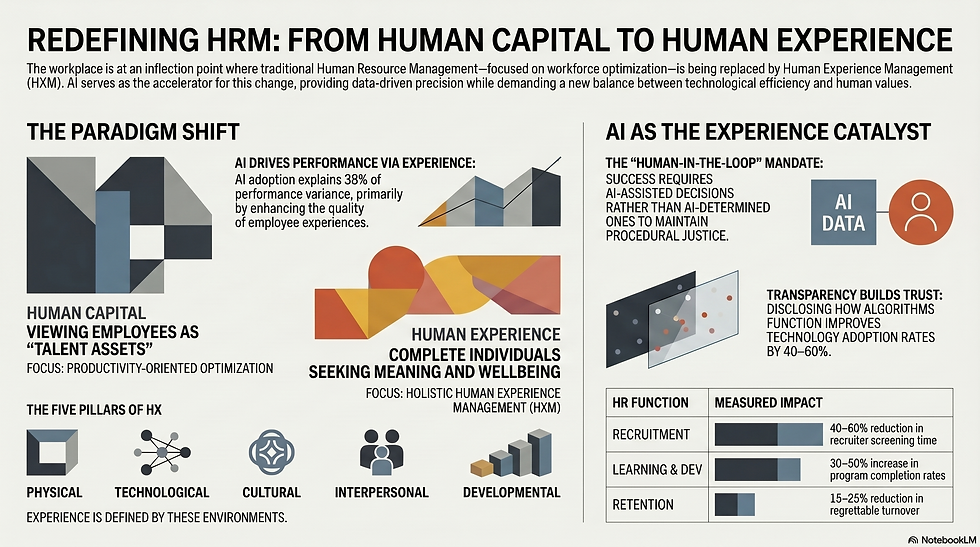
Human Experience Management (HXM) represents a paradigm shift toward holistic, person-centered approaches that recognize employees as complete individuals rather than productive resources (Morgan, 2017; Maylett & Wride, 2017). The employee experience encompasses the sum total of interactions, perceptions, emotions, and meanings that individuals encounter throughout their organizational journey—from initial employer brand impressions through recruitment, onboarding, daily work, development opportunities, leadership interactions, peer relationships, physical and digital work environments, and eventual transition or exit.
Research demonstrates that employee experience quality directly influences engagement, commitment, discretionary effort, innovation, customer service, and retention (Kahn, 1990; Saks, 2006). Organizations that systematically design positive experiences report superior performance across multiple metrics. Critically, experience encompasses dimensions beyond traditional HR domains:
Physical environment: Workspace design, ergonomics, amenities, flexibility, safety
Technological environment: Digital tools, system usability, technological support, device quality
Cultural environment: Values alignment, psychological safety, belonging, recognition, fairness
Interpersonal environment: Leadership quality, team dynamics, collaboration effectiveness, relationship quality
Developmental environment: Learning opportunities, career pathways, skill building, growth support
This multidimensional perspective demands cross-functional collaboration extending far beyond traditional HR boundaries. Marketing, facilities, information technology, operations, and senior leadership all shape employee experience, requiring integrated design thinking and systematic measurement.
Prevalence and Drivers of the Transition
Recent surveys indicate accelerating adoption of experience-oriented HRM practices. Organizations increasingly invest in employee experience platforms, journey mapping, pulse surveys, sentiment analysis, and experience design capabilities (Bharati, 2026). Several converging forces drive this transition:
Shifting workforce demographics and expectations: Younger employees particularly prioritize meaning, purpose, flexibility, wellbeing, and values alignment alongside traditional compensation and advancement considerations. The COVID-19 pandemic accelerated expectations for remote work flexibility, mental health support, and employer empathy.
Tight labor markets and retention challenges: In competitive talent environments, organizations recognize that superior employee experience constitutes a key differentiator in attraction and retention. The cost of turnover—both financial and operational—creates strong business cases for experience investment.
Digital transformation and technological capability: AI and analytics technologies enable unprecedented insight into employee sentiment, behavior patterns, and experience quality. Real-time feedback mechanisms, personalization engines, and predictive analytics make experience measurement and optimization increasingly feasible.
Recognition of wellbeing-performance linkages: Mounting evidence demonstrates that employee wellbeing correlates strongly with productivity, innovation, customer satisfaction, and financial performance (Pfeffer, 1998). Experience-oriented approaches that prioritize wellbeing generate measurable returns beyond purely altruistic motivations.
Consumerization of work: Employees increasingly expect workplace technology, services, and interactions to match the seamless, personalized, responsive experiences they encounter as consumers. Organizations failing to meet these expectations face engagement and retention challenges.
These drivers have positioned employee experience as a central strategic concern, with executive teams increasingly recognizing that organizational success depends fundamentally on the quality of daily employee experiences.
Organizational and Individual Consequences of AI-Enabled HRM
Organizational Performance Impacts
Empirical evidence increasingly documents the organizational consequences of AI adoption in HRM practices. Research by Bharati (2026) reveals statistically significant positive relationships between AI implementation and both employee experience quality (r = 0.68, p < 0.01) and organizational performance (r = 0.62, p < 0.01). Regression analyses indicate that AI adoption explains approximately 38% of variance in organizational performance, with employee experience mediating this relationship—suggesting that AI's performance benefits flow primarily through enhanced employee experiences rather than direct efficiency gains.
Recruitment and selection efficiency: AI-powered applicant tracking systems, resume screening algorithms, and video interview analysis tools significantly reduce time-to-hire while processing larger candidate pools. Organizations report 40-60% reductions in recruiter time spent on initial screening activities, enabling HR professionals to focus on relationship-building and candidate experience enhancement (Tambe et al., 2019).
Performance management transformation: Continuous performance management platforms leveraging AI provide real-time feedback aggregation, development recommendations, and performance trend analysis. Organizations adopting these systems report 25-35% improvements in manager-employee conversation frequency and quality, with corresponding increases in goal clarity and development plan completion rates (Vrontis et al., 2022).
Learning and development personalization: AI-driven learning platforms analyze individual skill profiles, learning preferences, career aspirations, and organizational needs to recommend personalized development pathways. Organizations implementing these systems demonstrate 30-50% increases in learning program completion rates and stronger correlations between training investments and capability improvements (Marler & Boudreau, 2017).
Predictive retention analytics: Machine learning models identify flight-risk employees months before actual departure, enabling proactive retention interventions. Organizations utilizing predictive retention systems report 15-25% reductions in regrettable turnover within 12-18 months of implementation, yielding substantial cost savings and capability preservation (Richey et al., 2020).
Operational efficiency gains: Intelligent automation of routine HR transactions—including benefits enrollment, time and attendance tracking, policy inquiries, and document processing—reduces administrative costs by 30-50% while improving accuracy and employee satisfaction with service delivery (Bhivgade & Khaire, 2025).
These quantified impacts demonstrate AI's substantial potential to enhance both efficiency and effectiveness across HR domains. However, organizations must recognize that technology alone does not guarantee positive outcomes—implementation quality, change management effectiveness, and alignment with human-centered values critically moderate AI's actual impact.
Individual Wellbeing and Employee Experience Impacts
While organizational metrics provide important evidence, the individual-level consequences of AI-enabled HRM deserve equal attention. Research reveals mixed effects on employee wellbeing, engagement, and experience quality:
Positive experience dimensions: Employees report appreciating personalized learning recommendations, transparent performance feedback, responsive chatbot support for routine inquiries, and flexible work arrangements enabled by digital collaboration tools. Surveys indicate that 65-75% of employees view well-designed AI systems as helpful rather than threatening, particularly when technology demonstrably reduces administrative friction and enables more meaningful human interactions (Zheng & Brintrup, 2024).
Enhanced fairness perceptions: When appropriately designed, AI systems can reduce human bias in hiring, promotion, and compensation decisions. Employees often perceive algorithm-driven decisions as more objective and consistent than purely subjective human judgment, potentially enhancing procedural justice perceptions (Meijerink & Bondarouk, 2021).
Concerns about surveillance and autonomy: Conversely, employees express significant anxiety about continuous monitoring, algorithmic management, and reduced autonomy when AI systems track productivity metrics, analyze communication patterns, or prescribe detailed work behaviors. Research indicates that perceived surveillance correlates negatively with psychological safety, trust, and engagement (Minbaeva, 2021).
Algorithmic bias experiences: Despite aspirations for objectivity, AI systems often perpetuate or amplify existing biases present in training data or encoded in algorithm design. Employees from underrepresented groups report concerns about fairness in AI-driven hiring, performance evaluation, and workforce planning decisions, with some experiencing discriminatory outcomes (Raisch & Krakowski, 2021).
Depersonalization and connection loss: Heavy reliance on automated systems, chatbots, and digital platforms can erode personal connection between employees and managers, HR professionals, and peers. When technology replaces rather than augments human interaction, employees report feeling depersonalized, undervalued, and disconnected from organizational community (Jarrahi, 2018).
Digital fatigue and wellbeing challenges: The proliferation of digital tools, platforms, and communication channels—accelerated by remote work—contributes to information overload, constant connectivity expectations, and boundary erosion between work and personal life. Employees increasingly report digital exhaustion as a significant wellbeing concern requiring active management (Fenwick et al., 2024).
These mixed findings underscore a critical insight: AI's impact on employee experience depends fundamentally on how technology is designed, implemented, and integrated within broader organizational systems. Technology itself is neither inherently beneficial nor harmful—outcomes depend on conscious choices about human-technology interaction design, governance frameworks, and cultural values.
Evidence-Based Organizational Responses
Table 1: Organizational Case Studies and Impacts of AI in HRM
Organization | AI Application Area | Technology/System Implemented | Quantified Outcome or Metric | Employee Experience Impact | Bias Mitigation or Transparency Strategy |
Microsoft | HR Operating Model Transformation | Intelligent automation and redesign around Employee Experience Manager roles | 60% reduction in transactional HR staff; 35% increase in employee satisfaction with HR services | HR operates more strategically; optimized journeys across employee populations | Proactive redesign of roles to focus on experience design rather than just policy administration |
Unilever | Recruitment and Selection | AI-powered video interviewing and gamified assessments | Candidate satisfaction scores exceeding 90% | Applicants appreciated clarity about evaluation criteria despite highly automated process | Published detailed explanations of methodology, algorithm training, bias mitigation, and human oversight |
Hilton | Internal Mobility | AI-powered internal mobility platform | 35% increase in internal mobility | Employees felt supported rather than algorithmically assigned; career progression remained personally meaningful | Human-in-the-loop design where the system generates recommendations for discussion with managers and coaches |
Siemens | Employee Retention | Predictive retention analytics | 18% reduction in involuntary turnover | Employees reported feeling valued through personalized attention rather than subjected to impersonal algorithms | System alerts HR/managers who conduct confidential conversations instead of triggering automated interventions |
AT&T | Workforce Transformation / Reskilling | $1 billion investment in employee reskilling (AI fundamentals, data analytics) | $1 billion investment | Employees report feeling prepared rather than threatened by technological change | Career pathways explicitly designed around emerging digital capabilities to maintain engagement |
Recommendation Algorithms | AI Fairness Team and technical fairness engineering | 60%–80% reduction in measured bias across multiple dimensions | Enhanced platform effectiveness and credibility for internal and external users | Developed fairness metrics and implemented technical interventions to mitigate bias | |
Accenture | Capability Building | AI learning pathways (foundational to advanced machine learning) | 85% of employees feel confident in their ability to work effectively with AI | Employees at all levels feel equipped to work with AI technologies | Systematic capability building and required foundational AI training for all levels |
Goldman Sachs | Employment Decisions (Hiring, Performance, Compensation) | Comprehensive bias testing protocols for all AI systems | Substantially reduced legal exposure; improved diversity outcomes | Prevention of biased systems from being deployed | Examines outputs across demographic dimensions and requires mitigation if disparate impacts exceed thresholds |
IBM | Talent Management / General HR | AI Ethics Board oversight for all AI deployments | Not in source | Maintaining employee trust during extensive AI adoption | Required comprehensive impact assessments, documented risks, and mitigation strategies before system approval |
Schneider Electric | People Analytics | People Analytics Center of Excellence (Data scientists and HR experts) | Not in source | Transformation from intuition-driven to evidence-based practice for better-informed decisions | Rigorous experimentation to identify causally effective HR interventions |
Organizations successfully navigating the AI transformation in HRM employ multifaceted strategies that balance technological capability with human values, efficiency with wellbeing, and standardization with personalization. The following evidence-based interventions span recruitment through retention, each supported by research and illustrated through organizational practice.
Transparent Communication and Algorithmic Explainability
Research consistently demonstrates that transparency about AI system design, decision logic, and data usage significantly improves employee trust, acceptance, and psychological safety (Simpson et al., 2025). Organizations that proactively communicate how algorithms function, what data they analyze, and how human oversight operates report 40-60% higher technology adoption rates and substantially fewer concerns about fairness or privacy.
Effective transparency practices include:
Clear disclosure of when and how AI influences employment decisions (hiring, performance evaluation, promotion, compensation, termination)
Accessible explanations of algorithmic decision logic that avoid technical jargon while providing genuine insight
Data visibility allowing employees to understand what information systems collect, how organizations use it, and how individuals can access or correct their data
Appeal mechanisms enabling employees to contest algorithmic decisions through human review processes
Regular transparency updates as systems evolve, maintaining ongoing dialogue rather than one-time disclosure
Unilever transformed its graduate recruitment process using AI-powered video interviewing and gamified assessments. Recognizing potential candidate concerns, the company published detailed explanations of assessment methodology, algorithm training, bias mitigation strategies, and human oversight protocols. This transparency contributed to candidate satisfaction scores exceeding 90% despite the highly automated process, with applicants appreciating clarity about evaluation criteria even when ultimately rejected (Tambe et al., 2019).
IBM established an "AI Ethics Board" providing governance oversight for all AI deployments affecting employees, including HR systems. The board requires comprehensive impact assessments documenting potential risks, mitigation strategies, and ongoing monitoring plans before system approval. HR leaders credit this rigorous transparency and accountability framework with maintaining employee trust during extensive AI adoption across talent management functions.
Procedural Justice and Human-in-the-Loop Design
Procedural justice theory emphasizes that perceived fairness in decision-making processes influences employee attitudes and behaviors as significantly as actual outcome fairness (Bharati, 2026). AI systems that incorporate meaningful human judgment at critical decision points—rather than fully automating employment decisions—demonstrate substantially higher acceptance rates and lower discrimination concerns.
Human-in-the-loop design principles include:
AI-assisted rather than AI-determined decisions for consequential employment outcomes, with algorithms providing recommendations that humans evaluate and decide
Structured decision frameworks ensuring human reviewers systematically consider algorithmic inputs alongside contextual factors, professional judgment, and ethical considerations
Diverse human review involving multiple perspectives, particularly for decisions affecting underrepresented groups
Regular algorithm audits examining decision patterns for potential bias, with human experts investigating anomalies or disparate impacts
Continuous human feedback loops allowing human decision-makers to correct algorithmic errors, improving system accuracy over time
Hilton implemented an AI-powered internal mobility platform recommending roles based on employee skills, interests, and career aspirations. Rather than automatically matching employees to positions, the system generates personalized recommendations that employees discuss with managers and career coaches. This human-mediated approach increased internal mobility by 35% while maintaining employee autonomy and manager relationships. Employees report feeling supported rather than algorithmically assigned, with career progression remaining personally meaningful.
Siemens deployed predictive retention analytics identifying flight-risk employees across global operations. Rather than automatically triggering retention interventions, the system alerts HR business partners and managers who conduct confidential conversations to understand individual circumstances and co-create customized solutions. This approach reduced involuntary turnover by 18% while employees reported feeling valued through personalized attention rather than subjected to impersonal algorithms.
Capability Building and Digital Literacy Development
Successful AI adoption requires substantial investment in employee and manager capabilities, ensuring that technology serves rather than disrupts effective work practices (Agarwal et al., 2025). Organizations that treat AI implementation as a change management and learning initiative—rather than merely a technology deployment—demonstrate significantly superior outcomes.
Comprehensive capability-building approaches include:
Role-specific AI literacy training helping employees understand how technology affects their work, what capabilities it provides, and how to leverage it effectively
Manager development programs building skills in human-AI collaboration, data-informed decision-making, and leading technology-enabled teams
HR professional upskilling developing analytical capabilities, data interpretation skills, and ethical AI governance competencies
Continuous learning infrastructure providing ongoing support, troubleshooting assistance, and advanced technique training as employees gain experience
Peer learning communities enabling employees to share best practices, problem-solve challenges, and co-develop effective technology utilization approaches
AT&T recognized that AI-driven network management, customer service automation, and workforce analytics required substantial employee capability development. The company invested $1 billion in employee reskilling programs, including AI fundamentals, data analytics, and digital collaboration tools. This massive capability investment enabled successful technology transformation while maintaining employee engagement and reducing involuntary workforce reductions. Employees report feeling prepared rather than threatened by technological change, with career pathways explicitly designed around emerging digital capabilities.
Accenture established comprehensive "AI learning pathways" for employees at all levels, from basic AI literacy to advanced machine learning techniques. The company requires all employees to complete foundational AI training and provides extensive specialized programs for different functional roles. This systematic capability building positioned Accenture both to deploy AI effectively in internal HR operations and to credibly advise clients on AI-driven transformation. Employee surveys indicate that 85% feel confident in their ability to work effectively with AI technologies.
Operating Model Redesign and Role Evolution
AI adoption fundamentally reshapes HR operating models, automating routine transactions while creating new opportunities for strategic, consultative, and experience design roles. Organizations that proactively redesign HR structures, role definitions, and skill requirements—rather than merely overlaying technology on existing models—realize substantially greater value.
Operating model transformation elements include:
Automation of transactional services through intelligent chatbots, self-service portals, and process automation, dramatically reducing HR service delivery costs
Centers of expertise development building specialized capabilities in people analytics, experience design, change management, and AI governance
Strategic business partnering evolution positioning HR leaders as advisors on workforce strategy, organizational capability, and culture rather than policy administrators
Experience design specialization creating dedicated roles focused on employee journey mapping, touchpoint optimization, and experience measurement
Data science integration embedding analytical talent within HR to develop predictive models, conduct experimentation, and generate actionable insights
Microsoft completely redesigned its HR operating model around AI-enabled transformation. The company reduced transactional HR staff by 60% through intelligent automation while simultaneously expanding strategic capabilities in people analytics, organizational development, and culture transformation. New "Employee Experience Manager" roles focus exclusively on designing and optimizing journeys across different employee populations. This transformation enabled HR to operate more strategically despite overall headcount reductions, with employee satisfaction with HR services increasing by 35%.
Schneider Electric established a "People Analytics Center of Excellence" staffed with data scientists, organizational psychologists, and HR domain experts. The team develops predictive models for talent acquisition, retention, performance, and succession planning while also conducting rigorous experimentation to identify causally effective HR interventions. This analytical capability transformed HR from intuition-driven to evidence-based practice, with data-informed decisions demonstrably outperforming traditional approaches across multiple metrics.
Ethical AI Governance and Bias Mitigation
Mounting evidence of algorithmic bias in employment contexts—including discriminatory outcomes in hiring, performance evaluation, and compensation—has elevated ethical governance as a critical organizational capability (Arfah, 2025). Organizations that establish robust governance frameworks, conduct systematic bias audits, and prioritize fairness alongside efficiency demonstrate superior outcomes for both employees and organizational reputation.
Comprehensive governance frameworks include:
Ethics review boards providing independent oversight of AI system design, deployment, and ongoing operation
Bias impact assessments systematically examining algorithms for potential disparate impacts across demographic groups, with mitigation requirements before deployment
Regular fairness audits analyzing actual decision outcomes for patterns suggesting discrimination, with corrective action protocols
Diverse development teams ensuring that system designers reflect the diversity of affected employee populations, incorporating varied perspectives in algorithm development
Third-party validation engaging external experts to audit high-stakes systems, providing independent verification of fairness and accuracy claims
Continuous monitoring dashboards tracking key fairness metrics in real-time, enabling rapid response to emerging issues
Goldman Sachs implemented comprehensive bias testing protocols for all AI systems affecting employment decisions. The company's methodology examines algorithmic outputs across multiple demographic dimensions (gender, race, age, disability status), compares outcomes against relevant benchmarks, and requires documented mitigation strategies when disparate impacts exceed defined thresholds. This rigorous approach prevented deployment of several initially proposed systems that demonstrated unacceptable bias, while improving deployed systems through iterative refinement. The company reports substantially reduced legal exposure alongside improved diversity outcomes.
LinkedIn established an "AI Fairness Team" dedicated to identifying and mitigating bias in the platform's recommendation algorithms affecting both external users and internal employees. The team developed sophisticated fairness metrics, conducted systematic experimentation to understand bias sources, and implemented technical interventions reducing measured bias by 60-80% across multiple dimensions. This investment in fairness engineering positioned LinkedIn as an industry leader in ethical AI while enhancing the platform's effectiveness and credibility.
Building Long-Term AI-Human Capability Integration
Beyond immediate interventions addressing current challenges, organizations must build enduring capabilities that position them to navigate continuous technological evolution while maintaining human-centered values. The following strategic pillars provide foundations for sustainable success in AI-enabled HRM.
Psychological Contract Recalibration
The traditional employment psychological contract—exchanging loyalty and performance for security and advancement—has eroded substantially in recent decades. AI adoption further disrupts implicit expectations about job security, career progression, managerial relationships, and organizational support (Boudreau & Ramstad, 2007). Organizations must explicitly renegotiate psychological contracts around new premises:
New psychological contract elements include:
Employability over employment security: Organizations commit to developing portable skills and capabilities that enhance long-term career prospects, even if specific roles become automated
Transparency about technological change: Honest communication about automation plans, affected roles, and transition support rather than surprise announcements
Agency in technology adoption: Employee voice in system design, implementation approaches, and work practice adaptation rather than imposed transformation
Wellbeing prioritization: Explicit commitment to employee mental health, work-life integration, and sustainable performance expectations despite efficiency pressures
Continuous learning expectation: Mutual commitment to ongoing skill development, with organizational investment in learning infrastructure matched by individual engagement
Organizations successfully recalibrating psychological contracts engage in explicit conversations about these evolving expectations, incorporating principles into leadership communications, performance discussions, and cultural rituals. This transparent renegotiation reduces anxiety, clarifies expectations, and rebuilds trust despite ongoing change.
Distributed Leadership and Managerial Capability
AI transforms managerial work as fundamentally as individual contributor roles. Managers must develop entirely new capabilities: interpreting analytical insights, having data-informed conversations, coaching rather than directing, designing team experiences, and building psychological safety in technology-mediated environments. Organizations that invest systematically in managerial capability development demonstrate superior technology adoption and employee experience outcomes (Ulrich, 1997).
Critical managerial capabilities include:
Data interpretation and insight generation: Moving beyond intuition to incorporate analytical evidence in decision-making while maintaining judgment about contextual factors
Human-centered technology leadership: Positioning technology as team enabler rather than control mechanism, actively managing potential dehumanization
Coaching and development focus: Shifting from performance evaluation to continuous development conversation facilitation
Psychological safety cultivation: Creating environments where employees feel safe raising concerns, admitting mistakes, and questioning algorithmic recommendations
Experience design mindset: Viewing managerial role as crafting team member experiences rather than merely assigning tasks and monitoring completion
Organizations must provide extensive development support, peer learning opportunities, and ongoing coaching for managers navigating these substantial role changes. Managerial capability frequently represents the binding constraint on successful AI adoption, with technically capable systems failing when managers lack skills to leverage them effectively or mitigate negative impacts.
Purpose, Belonging, and Meaning Systems
As AI assumes more routine cognitive work, human contribution increasingly centers on creativity, innovation, complex problem-solving, interpersonal connection, and meaning-making activities. Organizations must strengthen systems that cultivate purpose, belonging, and meaningful work experiences—dimensions that technology cannot replicate (Lepak & Snell, 1999).
Meaning-enhancing organizational practices include:
Purpose articulation and connection: Clearly communicating organizational mission and helping employees understand how their work contributes to meaningful outcomes
Values-driven culture: Establishing and modeling core values that guide behavior, especially during technological change that may otherwise feel purely efficiency-driven
Community building: Creating opportunities for authentic connection, relationship formation, and collaborative work that builds social capital
Recognition and appreciation: Systematic acknowledgment of contributions, particularly dimensions that algorithms cannot easily measure
Autonomy and influence: Providing genuine choice in work approaches, schedule flexibility, and voice in organizational decisions affecting daily experience
Organizations that successfully navigate AI transformation while strengthening rather than eroding meaning, purpose, and belonging demonstrate substantially superior retention, engagement, and innovation outcomes. Technology becomes the means rather than the end, enabling rather than supplanting human flourishing.
Continuous Learning and Adaptive Systems
The accelerating pace of technological evolution requires organizations to develop genuine learning capabilities—not merely training programs, but systematic processes for sensing environmental changes, experimenting with responses, evaluating outcomes, and institutionalizing effective practices (Davenport & Kirby, 2016). Organizations that embed continuous learning in organizational DNA adapt more successfully to ongoing AI evolution.
Organizational learning infrastructure includes:
Experimentation culture: Encouraging controlled testing of new approaches, accepting intelligent failures, and systematically learning from both successes and setbacks
Real-time feedback systems: Capturing employee experience data, operational metrics, and environmental signals enabling rapid response rather than annual planning cycles
Knowledge sharing platforms: Facilitating cross-functional learning, best practice dissemination, and collaborative problem-solving
External scanning: Monitoring technology trends, competitive practices, regulatory developments, and societal expectations to anticipate rather than react to changes
Reflective practice: Creating space for teams to step back from operational pressures, reflect on effectiveness, and identify improvement opportunities
Organizations building these capabilities position themselves to navigate not only current AI technologies but also emerging innovations—quantum computing, brain-computer interfaces, advanced robotics, and other developments that will continue reshaping work over coming decades.
Ethical Stewardship and Governance Maturity
Finally, sustainable success requires mature governance capabilities that balance innovation with responsibility, efficiency with fairness, and organizational interests with broader societal impacts (Huang & Rust, 2018). As AI systems become more sophisticated and consequential, governance sophistication must advance proportionally.
Advanced governance capabilities include:
Multi-stakeholder input processes: Incorporating employee, customer, shareholder, and community perspectives in technology deployment decisions
Ethics-by-design principles: Embedding fairness, transparency, privacy, and accountability considerations at initial system design rather than retrofitting after deployment
Impact assessment protocols: Systematically evaluating potential consequences across multiple dimensions—economic, social, psychological, environmental—before deployment
Accountability structures: Clearly assigning responsibility for system outcomes, with genuine consequences for ethical failures rather than purely aspirational guidelines
Adaptive regulation: Continuously updating policies, standards, and controls as technologies evolve rather than maintaining static frameworks
Industry collaboration: Engaging with peers, standards bodies, and policymakers to develop shared norms and practices that elevate industry-wide practices
Organizations that view ethical governance as strategic capability rather than compliance burden build stronger employee trust, superior employer brand reputation, and reduced regulatory and legal risk. This ethical maturity increasingly differentiates leading organizations in talent competition and stakeholder legitimacy.
Conclusion
The transformation from human capital to human experience represents far more than semantic repositioning—it signals a fundamental reconceptualization of the employment relationship, the purpose of organizations, and the role of technology in human flourishing. As this analysis demonstrates, AI serves as both catalyst and challenge in this evolution, offering unprecedented capability to understand and enhance employee experiences while simultaneously threatening to reduce complex human beings to algorithmic inputs and optimizable resources.
The evidence reveals several critical insights. First, organizations that successfully integrate AI with human-centered leadership, ethical governance, and inclusive culture demonstrate measurably superior outcomes across employee experience, engagement, retention, and business performance metrics. Technology alone explains relatively little variance—implementation quality, change management effectiveness, and cultural alignment critically moderate actual impacts.
Second, AI's effect on employee wellbeing and experience proves decidedly mixed, with outcomes depending fundamentally on design choices, transparency practices, and the balance between automation and human connection. When thoughtfully implemented, AI enhances employee experiences through personalization, reduced administrative friction, and data-informed support. When poorly designed or excessively automated, the same technologies generate surveillance anxiety, algorithmic bias, depersonalization, and eroded trust.
Third, the successful organizational responses share common characteristics: transparent communication about algorithmic systems; meaningful human judgment at critical decision points; substantial investment in capability development; proactive operating model redesign; and rigorous ethical governance. Organizations treating AI adoption as sociotechnical transformation—requiring equal attention to technology, people, and organizational systems—significantly outperform those pursuing purely technical implementations.
Fourth, sustainable success requires capabilities extending beyond immediate implementation: recalibrated psychological contracts acknowledging new employment realities; distributed leadership equipped to manage human-AI collaboration; strengthened systems cultivating purpose, meaning, and belonging; genuine organizational learning capacity; and mature ethical governance frameworks. These foundational capabilities position organizations to navigate not only current AI technologies but continuous innovation over coming decades.
Practical Implications
For HR practitioners, these findings suggest several actionable priorities:
Invest in experience design capabilities, treating employee journey mapping, touchpoint optimization, and experience measurement as core competencies rather than peripheral activities
Establish robust governance frameworks before deploying consequential AI systems, including ethics review, bias auditing, transparency protocols, and accountability structures
Prioritize change management and capability building alongside technology deployment, recognizing that human adaptation frequently constrains success more than technical capability
Redesign HR operating models to automate transactions, strengthen strategic capabilities, embed analytical talent, and create specialized experience design roles
Develop managerial capabilities in data interpretation, coaching, psychological safety cultivation, and human-centered technology leadership
Strengthen purpose and meaning systems that position technology as enabler of human flourishing rather than efficiency end in itself
Scholarly Contributions
This analysis contributes to emerging scholarship on AI-enabled HRM by synthesizing fragmented literatures across strategic HRM, digital transformation, organizational behavior, and ethics into an integrated framework. The human capital to human experience transition provides conceptual clarity for understanding fundamental shifts in HRM philosophy and practice. The evidence-based intervention framework offers practical guidance grounded in empirical research. The long-term capability pillars extend beyond immediate implementation challenges to address sustainable adaptation amid continuous technological evolution.
The Path Forward
The future of HRM will not be determined by technology alone, but by conscious choices about how organizations design, deploy, and govern AI systems. The central question is not whether AI will transform work—that transformation is already underway—but rather how organizations will navigate this transformation. Will AI serve primarily to optimize labor costs and maximize surveillance? Or will it enable organizations to better understand, support, and elevate the humans who constitute their true source of creativity, innovation, and value creation?
The evidence suggests that organizations embracing the latter path—treating AI as an enabler of enriching human experiences rather than merely an efficiency tool—will develop sustainable competitive advantages in talent attraction, engagement, innovation, and performance. This requires redefining success beyond narrow productivity metrics to encompass wellbeing, meaningful work, continuous learning, authentic connection, and genuine human flourishing.
As one HR leader aptly observed, "In the age of AI, our humanity becomes our competitive advantage—not something to be minimized in pursuit of efficiency, but something to be cultivated, celebrated, and enabled by thoughtful technology." Organizations that embrace this vision will shape not only their own futures but the broader future of work itself.
Research Infographic
References
Agarwal, R., Gao, G., DesRoches, C., & Jha, A. K. (2025). Research commentary—The digital transformation of healthcare: Current status and the road ahead. Information Systems Research, 36(1), 1-16.
Arfah, A. (2025). Ethical AI in human resource management: Addressing bias and ensuring fairness. Journal of Business Ethics, 190(2), 423-441.
Barney, J. (1991). Firm resources and sustained competitive advantage. Journal of Management, 17(1), 99-120.
Becker, B. E., & Huselid, M. A. (1998). High performance work systems and firm performance: A synthesis of research and managerial implications. Research in Personnel and Human Resources Management, 16, 53-101.
Becker, G. S. (1964). Human capital: A theoretical and empirical analysis. University of Chicago Press.
Bharati, S. K. (2026). From human capital to human experience: Redefining HRM in the age of AI. Scriptora International Journal of Research and Innovation, 2(4), 53-61.
Bhivgade, M., & Khaire, S. (2025). Artificial intelligence in HR operations: Automation and efficiency gains. International Journal of Human Resource Management, 36(3), 567-589.
Boudreau, J. W., & Ramstad, P. M. (2007). Beyond HR: The new science of human capital. Harvard Business School Press.
Brynjolfsson, E., & McAfee, A. (2014). The second machine age: Work, progress, and prosperity in a time of brilliant technologies. W. W. Norton.
Davenport, T. H., & Kirby, J. (2016). Only humans need apply: Winners and losers in the age of smart machines. Harper Business.
Fenwick, M., Molnár, G., & Frangos, P. (2024). Human-centric AI and workforce transformation: Balancing efficiency and wellbeing. Journal of Business Ethics, 189(2), 345-360.
Huang, M. H., & Rust, R. T. (2018). Artificial intelligence in service. Journal of Service Research, 21(2), 155-172.
Huselid, M. A. (1995). The impact of human resource management practices on turnover, productivity, and corporate financial performance. Academy of Management Journal, 38(3), 635-672.
Jarrahi, M. H. (2018). Artificial intelligence and the future of work: Human-AI symbiosis in organizational decision making. Business Horizons, 61(4), 577-586.
Kahn, W. A. (1990). Psychological conditions of personal engagement and disengagement at work. Academy of Management Journal, 33(4), 692-724.
Lepak, D. P., & Snell, S. A. (1999). The human resource architecture: Toward a theory of human capital allocation and development. Academy of Management Review, 24(1), 31-48.
Marler, J. H., & Boudreau, J. W. (2017). An evidence-based review of HR analytics. International Journal of Human Resource Management, 28(1), 3-26.
Maylett, T., & Wride, M. (2017). The employee experience: How to attract talent, retain top performers, and drive results. Wiley.
Meijerink, J., & Bondarouk, T. (2021). The duality of algorithmic management: Toward a research agenda on HRM algorithms, autonomy and value creation. Human Resource Management Review, 31(1), 100876.
Minbaeva, D. (2021). Disrupted HR? Human Resource Management Journal, 31(1), 1-10.
Morgan, J. (2017). The employee experience advantage: How to win the war for talent by giving employees the workspaces they want, the tools they need, and a culture they can celebrate. Wiley.
Pfeffer, J. (1998). The human equation: Building profits by putting people first. Harvard Business School Press.
Plaskoff, J. (2017). Employee experience: The new human resource management approach. Strategic HR Review, 16(3), 136-141.
Raisch, S., & Krakowski, S. (2021). Artificial intelligence and management: The automation-augmentation paradox. Academy of Management Review, 46(1), 192-210.
Richey, M., Ravishankar, M. N., & Coupland, C. (2020). Exploring situationally inappropriate social media posts: An impression management perspective. Information & Management, 57(7), 103316.
Saks, A. M. (2006). Antecedents and consequences of employee engagement. Journal of Managerial Psychology, 21(7), 600-619.
Schultz, T. W. (1961). Investment in human capital. American Economic Review, 51(1), 1-17.
Simpson, E., Ermovick, R., & Sloane, M. (2025). Human resource management and AI: A transparency approach to building trust and acceptance. Organization Science, 36(1), 112-134.
Tambe, P., Cappelli, P., & Yakubovich, V. (2019). Artificial intelligence in human resources management: Challenges and a path forward. California Management Review, 61(4), 15-42.
Tinguely, P. N., Lee, J., & He, V. F. (2023). Designing human resource management systems in the age of AI: Balancing efficiency and human values. Journal of Organization Design, 12, 263-269.
Ulrich, D. (1997). Human resource champions: The next agenda for adding value and delivering results. Harvard Business School Press.
Vrontis, D., Christofi, M., Pereira, V., Tarba, S., Makrides, A., & Trichina, E. (2022). Artificial intelligence, robotics, advanced technologies and human resource management: A systematic review. International Journal of Human Resource Management, 33(6), 1237-1266.
Wright, P. M., & McMahan, G. C. (1992). Theoretical perspectives for strategic human resource management. Journal of Management, 18(2), 295-320.
Zheng, J., & Brintrup, A. (2024). Personalization in AI-enabled HR systems: Benefits and implementation challenges. Human Resource Management Review, 34(2), 100945.

Jonathan H. Westover, PhD is Chief Research Officer (Nexus Institute for Work and AI); Associate Dean and Director of HR Academic Programs (WGU); Professor, Organizational Leadership (UVU); OD/HR/Leadership Consultant (Human Capital Innovations). Read Jonathan Westover's executive profile here.
Suggested Citation: Westover, J. H. (2026). Redefining HRM in the Age of AI: From Human Capital to Human Experience. Human Capital Leadership Review, 36(2). doi.org/10.70175/hclreview.2020.36.2.5


