




Mitigating Algorithmic Bias in AI-Powered Recruitment: A Practitioner's Guide to Ethical Implementation


Listen to a review of this article:
Abstract: The proliferation of artificial intelligence in talent acquisition has introduced both unprecedented efficiency gains and significant ethical challenges. This article examines the mechanisms through which algorithmic bias emerges in automated hiring systems and evaluates evidence-based governance frameworks for promoting fairness, transparency, and accountability. Drawing on interdisciplinary research spanning computer science, organizational behavior, employment law, and ethics, the analysis identifies six critical intervention points: data quality assessment, contextual fairness metrics, algorithmic transparency, human-in-the-loop oversight, structured governance protocols, and continuous monitoring. Through examination of organizational practices across technology, financial services, and healthcare sectors, the article demonstrates that effective bias mitigation requires integrated sociotechnical solutions rather than purely algorithmic fixes. The findings suggest that organizations adopting comprehensive ethical AI frameworks can substantially reduce discriminatory outcomes while maintaining operational efficiency, though implementation challenges around vendor transparency, competing fairness definitions, and resource constraints remain significant barriers to widespread adoption.
The integration of artificial intelligence into human resource management represents one of the most consequential applications of algorithmic decision-making in contemporary organizational life. As companies navigate increasingly competitive talent markets while processing exponentially growing applicant pools, AI-powered recruitment tools promise substantial advantages: reduced time-to-hire, standardized evaluation criteria, broader candidate reach, and liberation of HR professionals from repetitive screening tasks. Industry estimates suggest that over 75% of large enterprises now employ some form of automation in their hiring processes, with AI resume screening, automated interviewing platforms, and predictive analytics becoming standard components of modern talent acquisition infrastructure.
Yet this technological transformation has surfaced profound concerns about fairness and discrimination. High-profile cases have documented AI systems that systematically disadvantaged qualified candidates based on gender, race, age, or other protected characteristics—not through explicit programming but through subtle patterns learned from historical data reflecting decades of workplace inequality. When Amazon discovered its experimental resume screening tool was penalizing applications containing the word "women's" or listing women's colleges, the incident crystallized growing unease about delegating consequential human decisions to opaque algorithmic systems.
The stakes extend beyond individual hiring decisions. Employment serves as the primary mechanism through which individuals access economic opportunity, social mobility, and fundamental life resources. Biased hiring systems don't merely affect isolated job applications—they shape career trajectories, perpetuate socioeconomic disparities, and reinforce structural inequalities across generations. For organizations, the consequences include legal liability under employment discrimination statutes, reputational damage, loss of diverse talent, and erosion of stakeholder trust.
This convergence of technological capability, ethical imperative, and legal obligation has elevated algorithmic fairness from a technical concern to a strategic governance challenge. Organizations require actionable frameworks that bridge the gap between abstract ethical principles and operational hiring practices—frameworks grounded in empirical evidence about what actually works to reduce bias while maintaining the efficiency gains that motivated AI adoption in the first place.
The Automated Hiring Landscape
Defining Algorithmic Recruitment Systems in Practice
Modern AI-powered hiring encompasses a spectrum of technologies applied across the recruitment lifecycle. At the initial screening stage, natural language processing algorithms analyze resume text to identify keywords, extract structured information, and match candidate profiles against job requirements. Machine learning models trained on historical hiring data generate "fit scores" predicting candidate success based on patterns in previous employees' backgrounds. Automated interview platforms use video analysis, voice processing, and text analysis to evaluate recorded candidate responses, assessing factors ranging from word choice to facial expressions.
More sophisticated systems employ predictive analytics that integrate multiple data sources—application materials, assessment results, behavioral data from online interactions, even publicly available social media information—to generate comprehensive candidate evaluations. Some platforms promise to identify "cultural fit" by analyzing personality indicators, while others claim to predict job performance, retention likelihood, or advancement potential based on subtle patterns invisible to human reviewers.
The technical architecture underlying these systems typically involves supervised machine learning, where algorithms learn by analyzing labeled training data showing which candidates were previously hired, which succeeded in their roles, and which attributes correlated with desired outcomes. The model identifies statistical patterns in this historical data and applies them to evaluate new candidates, essentially automating and scaling the implicit decision rules embedded in past hiring practices.
Current State of Adoption and Practice
Adoption patterns vary considerably across industries and organization sizes. Technology companies, financial services firms, and large retailers have been early adopters, motivated by high-volume hiring needs and comfort with data-driven decision-making. Professional services firms, healthcare organizations, and government agencies have proceeded more cautiously, particularly for senior positions where cultural factors and interpersonal dynamics weigh heavily.
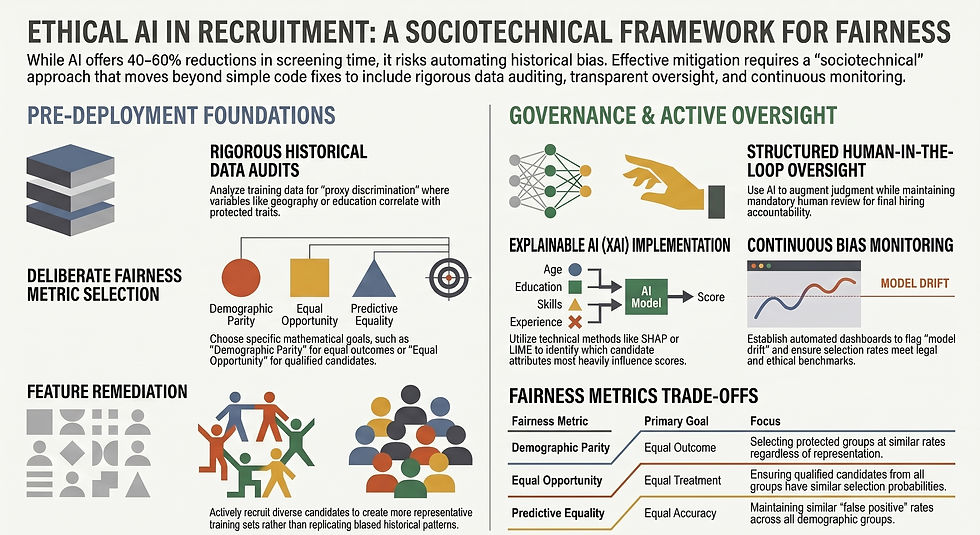
The economic value proposition remains compelling: organizations report 40-60% reductions in time spent on initial screening, ability to process candidate volumes that would overwhelm human reviewers, and standardization that promises to eliminate individual recruiter biases. Vendors market these systems as simultaneously more efficient and more objective than human judgment, framing algorithmic evaluation as a solution to—rather than potential source of—discrimination.
Yet the transparency of these systems varies dramatically. Some organizations develop proprietary algorithms internally, maintaining full visibility into their operation. More commonly, companies purchase commercial platforms where the underlying algorithms constitute protected trade secrets. This "black box" dynamic creates accountability challenges: organizations deploy systems that significantly influence hiring outcomes without fully understanding how they generate their recommendations or whether they harbor problematic biases.
Regulatory oversight remains fragmented and reactive. The U.S. Equal Employment Opportunity Commission has issued guidance affirming that AI systems must comply with existing civil rights laws prohibiting employment discrimination, but enforcement mechanisms are still developing. The European Union's proposed AI Act would classify high-risk applications including employment decisions for enhanced scrutiny, while several U.S. states and municipalities have enacted targeted regulations around automated employment tools. This evolving regulatory landscape creates uncertainty for organizations seeking to deploy these systems responsibly.
Organizational and Candidate Consequences of Algorithmic Bias
Organizational Performance and Legal Exposure
The organizational impacts of biased hiring algorithms extend across multiple dimensions. Most immediately, legal liability looms large. Employment discrimination claims based on disparate impact—where facially neutral practices disproportionately disadvantage protected groups—provide clear cause of action against discriminatory AI systems regardless of intent. Discovery processes in such litigation can expose organizations to significant risk when they cannot explain how their algorithmic systems make decisions or demonstrate they have validated these systems for bias.
Beyond legal exposure, biased hiring systems undermine diversity and inclusion objectives that have become strategic priorities for most large organizations. Research consistently demonstrates that diverse teams produce better decisions, drive innovation, and improve organizational performance across multiple metrics. Algorithmic systems that screen out qualified candidates from underrepresented groups directly contradict these strategic goals, potentially setting back years of diversity initiatives.
The talent acquisition function itself suffers reputational damage when organizations become associated with discriminatory hiring practices. In competitive labor markets where employer brand significantly influences candidate attraction, perception of unfair treatment can deter top talent from applying. Technology workers in particular have shown willingness to avoid employers whose AI practices they view as unethical, creating talent pipeline consequences.
Operational efficiency gains may also prove illusory if biased systems require extensive manual review to catch and correct problematic recommendations. Organizations implementing AI hiring tools often discover the need for human oversight negates much of the promised efficiency improvement, particularly when accuracy problems emerge that weren't apparent in initial pilots.
Impact on Candidates and Workforce Diversity
From the candidate perspective, the proliferation of algorithmic screening creates information asymmetry and power imbalance. Applicants typically receive minimal explanation for rejection decisions, have limited ability to identify or contest algorithmic bias, and cannot easily distinguish between legitimate qualifications gaps and systematic discrimination. This opacity contradicts principles of procedural justice—the expectation that selection processes will be transparent, consistent, and appealable.
The screening effects can be particularly severe for candidates whose backgrounds don't conform to historical patterns. Career changers, self-taught professionals, individuals with non-traditional educational credentials, those with employment gaps due to caregiving or health issues, and candidates from demographic groups underrepresented in the training data all face heightened risk of algorithmic disadvantage. These screening effects compound existing structural inequalities, as candidates with privileged backgrounds more easily navigate systems optimized around historical advantage.
Research on specific algorithmic biases has documented concerning patterns. Systems trained predominantly on resumes of successful employees in male-dominated fields learn to favor masculine-coded language and male-associated credentials. Age bias emerges when algorithms use graduation dates or years of experience in ways that systematically disadvantage older workers. Geographic bias occurs when systems learn location-based patterns reflecting residential segregation. Name-based bias persists when algorithms incorporate or infer demographic information from applicant names.
The cumulative impact affects labor market access and opportunity structure. When biased algorithms operate at scale across many employers, qualified candidates from disadvantaged groups face systematically reduced access to employment opportunities, compounding earnings gaps, wealth disparities, and intergenerational inequality. The automation of bias threatens to entrench discrimination more deeply and durably than individual human prejudice ever could.
Evidence-Based Organizational Responses
Table 1: Corporate Case Studies and Strategies for Ethical AI Recruitment
Organization | Sector | AI Governance Intervention | Key Strategy or Implementation Detail | Fairness Metrics or Tools Used | Outcomes or Lessons Learned |
Salesforce | Tech | Structured Human-in-the-Loop Governance | Implemented bias interrupt protocols where recruiters must document reasoning for diverging from algorithmic recommendations. | Calibration processes and root cause analysis of systematic divergences | Prevented uncritical acceptance of AI outputs and subjective human overrides, creating a structured dialogue between AI and human intelligence. |
IBM | Tech | Ongoing Monitoring and Continuous Improvement | Established an internal AI Ethics Board and applied an open-source toolkit to internal recruiting systems. | AI Fairness 360 | Identified bias against non-traditional educational backgrounds, leading to a fundamental revision of qualification requirements. |
Accenture | Professional Services | Pre-Deployment Data Quality and Bias Assessment | Conducted structured audits of historical hiring data and remediated bias by actively recruiting diverse candidates to create representative training sets. | Diversity benchmarks for training data quality | Prevented algorithms from perpetuating existing biases; required substantial upfront investment in data collection and validation. |
JPMorgan Chase | Financial Services | Context-Appropriate Fairness Metrics and Monitoring | Adopted a hybrid approach combining demographic representation goals with equal opportunity testing and implemented fairness reporting dashboards. | Demographic parity and Equal opportunity metrics | Enabled human reviewers to identify bias issues and exercise override authority; distinguished between qualification differences and algorithmic bias. |
Unilever | Retail/Consumer Goods | Algorithmic Transparency and Explainability | Replaced traditional hiring with digital assessments and AI video analysis; provided candidates with detailed capability profiles instead of pass/fail scores. | Validation studies on predictive validity and adverse impact | Supported candidate perception of procedural fairness and enabled human oversight to catch potential bias issues. |
Tech | Participatory Design and Stakeholder Engagement | Solicited extensive user feedback and provided candidates with visibility into why jobs were recommended and how profile elements influenced matches. | User feedback and demographic experience research | Identified issues technical testing missed, such as undervaluing certain work experiences; built trust in the platform. | |
Microsoft | Tech | Organizational Capability Development and Culture Change | Established the AETHER Committee to provide governance oversight and invested in deep ethics training for engineers. | Fairness, transparency, and accountability frameworks | Integrated ethical considerations into technical decisions from the beginning of development rather than as a post-deployment afterthought. |
Hilton | Hospitality/Retail | Vendor Management and Technical Due Diligence | Negotiated for technical documentation and rights to disable specific AI features (facial/voice analysis) while keeping others. | Independent adverse impact analyses using Hilton's candidate data | Mitigated risks associated with controversial AI features; established channels for candidates to request human review. |
Pre-Deployment Data Quality and Bias Assessment
The foundational intervention for addressing algorithmic bias begins before any model is trained: rigorous assessment of historical data quality and representativeness. Organizations implementing AI hiring systems should conduct structured audits of their training data to identify potential sources of bias that algorithms might amplify.
Effective data assessment approaches include:
Historical hiring outcome analysis: Examining whether past hiring decisions show demographic disparities in selection rates, advancement patterns, or performance evaluations that might introduce bias into training data
Data completeness evaluation: Identifying whether historical records adequately represent all relevant candidate populations or suffer from systematic underrepresentation of particular groups
Feature correlation testing: Analyzing whether variables used in algorithmic models (education credentials, employment history patterns, geographic locations) correlate with protected characteristics in ways that could enable proxy discrimination
Temporal bias detection: Recognizing that hiring practices and workforce composition change over time, so training data from different periods may reflect different bias patterns
External benchmark comparison: Comparing an organization's historical hiring patterns against labor market availability data to identify potential disparities
Accenture's implementation of algorithmic hiring tools demonstrates this data-centric approach. Before deploying AI screening systems, the company conducted comprehensive analysis of its historical hiring data spanning multiple years and geographies. This audit revealed that certain technical skills were disproportionately associated with candidates from particular educational institutions, which in turn showed limited demographic diversity. Rather than training algorithms on this biased historical data, Accenture invested in data remediation—actively recruiting diverse candidates to create more representative training sets and carefully selecting features that predicted job performance without serving as proxies for protected characteristics.
The company's approach included establishing diversity benchmarks for training data quality, requiring that algorithmic training sets reflect demographic composition targets rather than simply replicating historical patterns. This proactive intervention prevented the algorithm from learning and perpetuating existing biases, though it required substantial upfront investment in data collection and validation.
Context-Appropriate Fairness Metrics and Monitoring
Research in machine learning fairness has identified multiple mathematical definitions of algorithmic fairness, each capturing different ethical intuitions and leading to different operational outcomes. Organizations must make deliberate choices about which fairness criteria align with their values and legal obligations, recognizing that satisfying one fairness definition may conflict with others.
Key fairness metrics for hiring contexts include:
Demographic parity: Ensuring that protected groups are selected at similar rates regardless of their representation in the applicant pool—prioritizing equal outcomes
Equal opportunity: Requiring that qualified candidates from all groups have similar probabilities of being selected—prioritizing equal treatment of the qualified
Predictive equality: Ensuring that false positive rates (selecting candidates who won't succeed) are similar across groups—prioritizing equal accuracy of predictions
Calibration: Requiring that candidates with the same predicted success probability actually succeed at similar rates regardless of group membership—prioritizing honest prediction
Individual fairness: Treating similar candidates similarly regardless of group membership—prioritizing consistency at the individual level
JPMorgan Chase's approach to algorithmic fairness in its recruitment process illustrates the practical importance of metric selection. The financial services firm faced a common tension: demographic parity would require selecting from underrepresented groups at rates exceeding their representation among applicants with traditional credentials, while equal opportunity metrics suggested lower selection rates for groups with fewer candidates meeting conventional qualification thresholds.
The company adopted a hybrid approach, establishing demographic representation goals (aiming toward parity) while implementing equal opportunity testing (ensuring that qualified candidates from all groups face similar selection probabilities). This required ongoing monitoring of both overall selection rates by demographic group and qualification-specific selection patterns. When monitoring revealed disparities, JPMorgan Chase conducted root cause analysis to distinguish between legitimate qualification differences and algorithmic bias, adjusting the system when the latter was identified.
The company also implemented fairness reporting dashboards that provided recruitment teams with real-time visibility into demographic patterns in algorithmic recommendations. This transparency enabled human reviewers to identify potential bias issues and exercise override authority when algorithmic outputs suggested concerning patterns, creating a feedback loop for continuous improvement.
Algorithmic Transparency and Explainability
The "black box" nature of many machine learning systems—where even their creators cannot fully articulate why a particular candidate received a specific score—poses fundamental challenges for accountability. Organizations can adopt technical and procedural interventions to enhance transparency and enable meaningful oversight.
Transparency enhancement strategies include:
Explainable AI techniques: Implementing methods like LIME (Local Interpretable Model-Agnostic Explanations) or SHAP (SHapley Additive exPlanations) that identify which candidate attributes most influenced algorithmic scores
Decision documentation: Maintaining detailed records of algorithmic recommendations, including confidence scores, key features driving decisions, and flagged edge cases requiring human review
Simplified model architectures: Where appropriate, using more interpretable models (decision trees, linear models with feature engineering) rather than complex deep learning approaches that offer higher accuracy but less interpretability
Feature importance analysis: Regularly analyzing which variables carry the most weight in algorithmic decisions and validating their job-relevance and non-discriminatory character
Audit trail requirements: Creating technical infrastructure to enable reconstruction of how specific decisions were made, supporting both internal quality control and external compliance review
Unilever's redesign of its graduate recruitment process exemplifies transparency-focused implementation. The consumer goods company replaced its traditional application-and-interview process with a multi-stage digital assessment including AI-powered game-based evaluations and video interview analysis. Recognizing the explainability challenges these novel tools presented, Unilever invested heavily in validation research demonstrating that its assessments predicted job performance while showing no adverse impact against protected groups.
Critically, the company maintained human review at multiple stages and provided candidates with substantive feedback about their performance in the process. Rather than simply generating pass/fail recommendations, the algorithmic system produced detailed capability profiles that hiring managers could interpret and that candidates could understand. This transparency served dual purposes: enabling human oversight to catch potential bias issues and supporting candidate perception of procedural fairness even when ultimate hiring decisions were negative.
Unilever also conducted ongoing validation studies examining whether its algorithmic tools maintained fairness properties as candidate populations evolved and business needs changed, recognizing that a system validated as unbiased at one point could develop problems over time if not continuously monitored.
Structured Human-in-the-Loop Governance
Rather than viewing human judgment and algorithmic evaluation as alternatives, leading organizations are developing sophisticated human-in-the-loop systems where algorithmic tools augment rather than replace human decision-making. This approach preserves the efficiency benefits of automation while maintaining human accountability for ultimate hiring outcomes.
Effective human oversight models include:
Algorithmic recommendations with mandatory human review: Systems provide scored candidate rankings but require human recruiters to make final decisions after reviewing algorithmic inputs alongside other information
Threshold-based escalation: Algorithms autonomously screen out clearly unqualified candidates while flagging borderline cases for human evaluation, focusing human attention where judgment matters most
Diverse review panels: Ensuring that human reviewers examining algorithmic outputs themselves represent diverse backgrounds, reducing the risk that human oversight merely rubber-stamps biased algorithmic recommendations
Structured override protocols: Establishing clear procedures for when and how human reviewers can override algorithmic recommendations, with documentation requirements supporting bias analysis
Feedback incorporation mechanisms: Creating systems where human reviewers can flag problematic algorithmic recommendations, generating training data to improve future model performance
Salesforce's approach to AI in recruiting demonstrates sophisticated human-in-the-loop design. The company's AI-powered recruiting platform provides recruiters with candidate scores and rankings based on algorithmic analysis of applications, assessments, and interviews. However, the system is explicitly designed to support rather than replace human judgment—recruiters see algorithmic inputs as one factor informing their evaluation but maintain full decision-making authority.
Critically, Salesforce established calibration processes where recruiting teams regularly review sets of borderline candidate decisions to ensure consistency between human and algorithmic evaluations. When systematic divergences emerge—cases where recruiters consistently override algorithmic recommendations in particular directions—the company conducts root cause analysis. Sometimes this reveals algorithmic bias requiring model adjustment; other times it identifies valid considerations the algorithm overlooks, suggesting feature additions or model refinement.
The company also implemented bias interrupt protocols where recruiters must explicitly document their reasoning when their final decisions significantly diverge from algorithmic recommendations. This accountability mechanism prevents both uncritical acceptance of algorithmic outputs and purely subjective human overrides, creating a structured dialogue between algorithmic and human intelligence.
Vendor Management and Technical Due Diligence
For organizations purchasing commercial AI hiring platforms rather than developing proprietary systems, vendor management becomes a critical governance mechanism. The opacity of vendor algorithms creates accountability challenges, but organizations can negotiate contractual provisions and establish due diligence processes that mitigate these risks.
Vendor governance best practices include:
Bias testing requirements: Contractually mandating that vendors conduct and share regular adverse impact analyses demonstrating their systems don't discriminate against protected groups
Algorithm documentation: Requiring vendors to provide detailed technical documentation about model architectures, training data characteristics, and feature engineering approaches
Validation study access: Obtaining rights to vendor validation research demonstrating the predictive validity and fairness properties of their tools, including access to underlying data when possible
Customization and monitoring rights: Preserving organizational ability to adjust algorithmic parameters, implement custom fairness constraints, and conduct independent monitoring of system performance
Contractual liability provisions: Structuring agreements to allocate legal and financial risk for discriminatory outcomes, incentivizing vendor attention to fairness
Hilton's implementation of HireVue's video interviewing platform illustrates proactive vendor management. When adopting this AI-powered interview analysis tool, Hilton negotiated for detailed documentation of HireVue's algorithms, access to validation studies, and rights to conduct independent adverse impact analyses using Hilton's own candidate data. The company also maintained internal expertise in algorithmic fairness, enabling meaningful technical evaluation of vendor claims.
When concerns emerged about the use of facial analysis and voice processing—techniques that research suggests may disadvantage certain demographic groups—Hilton worked with HireVue to disable these features while maintaining the text analysis components of the platform. This required understanding the modular architecture of the vendor system and having contractual rights to customize deployment, investments that paid dividends in risk mitigation.
The company also established protocols for escalating candidate concerns about the AI interview process, creating channels for applicants to request human review if they believed the system had evaluated them unfairly. While few candidates actually exercised this option, its availability supported both legal defensibility and candidate perception of procedural justice.
Ongoing Monitoring and Continuous Improvement
Even AI hiring systems validated as unbiased at deployment can develop fairness problems over time as candidate pools evolve, job requirements change, labor market conditions shift, or algorithms learn from biased feedback. Organizations require continuous monitoring systems to detect emerging bias issues and structured improvement processes to address them.
Continuous monitoring frameworks include:
Regular adverse impact testing: Systematically analyzing whether selection rates for protected groups fall below 80% of the rate for majority groups (the threshold for triggering legal concern under EEOC guidance)
Outcome tracking: Following hired candidates through onboarding, performance evaluation, and advancement to assess whether algorithmic predictions prove valid and unbiased across groups
Candidate complaint analysis: Establishing mechanisms for applicants to raise concerns about potentially biased treatment and systematically reviewing these complaints for patterns suggesting system-wide issues
Model drift detection: Implementing technical monitoring that flags when algorithmic behavior changes significantly from its validated baseline, indicating potential emergent bias
Periodic revalidation: Scheduling comprehensive bias audits at regular intervals (annually or semi-annually) rather than relying solely on one-time deployment validation
IBM's adoption of AI Fairness 360, an open-source toolkit the company developed, demonstrates commitment to ongoing monitoring. IBM applies this suite of bias detection and mitigation algorithms to its own internal recruiting systems, generating regular fairness metrics across multiple definitions and demographic dimensions. The company established internal governance processes where significant adverse impact findings trigger mandatory review and remediation before the system continues operating.
IBM also created a formal role—AI Ethics Board with representation from HR, legal, technical, and diversity/inclusion functions—responsible for reviewing monitoring results and making decisions about necessary adjustments. This cross-functional governance structure ensures that fairness concerns receive attention from stakeholders with different expertise and perspectives, preventing purely technical or purely business-focused decision-making that might overlook important considerations.
When monitoring revealed that IBM's resume screening algorithm was disadvantaging candidates with non-traditional educational backgrounds (self-taught programmers, coding bootcamp graduates, career changers from other fields), the company didn't simply adjust the algorithm. Instead, it reconsidered whether its historical hiring patterns—heavily favoring traditional computer science degrees—truly predicted job success or simply reflected convention. Validation studies suggested the latter, leading IBM to fundamentally revise its qualification requirements and retrain algorithms on a more inclusive definition of relevant credentials.
Building Long-Term Algorithmic Accountability
Organizational Capability Development and Culture Change
Sustaining ethical AI in recruitment requires more than implementing specific tools or policies—it demands building institutional capabilities and cultural commitments that persist as technologies evolve and leadership changes. Organizations demonstrating long-term success share several capability-building characteristics.
First, they invest in developing internal expertise at the intersection of technology and fairness. This means training HR professionals in AI fundamentals so they can engage meaningfully with data scientists, while educating technical teams about employment law, organizational dynamics, and the human stakes of algorithmic decisions. Cross-functional teams working on AI recruiting tools include not just engineers and recruiters but also diversity/inclusion specialists, legal experts, and ethicists who can identify concerns technical experts might overlook.
Microsoft exemplifies this integrated capability approach. The company established an AI and Ethics in Engineering and Research (AETHER) Committee that provides governance oversight for AI applications across the organization, including recruiting tools. This committee brings together technical leaders, researchers, legal experts, and business stakeholders to review proposed AI implementations, challenge assumptions, and ensure ethical considerations inform technical decisions from the beginning of development rather than as an afterthought.
Microsoft also invested in ethics training for engineers working on AI systems, ensuring technical teams understand concepts like fairness, bias, transparency, and accountability at a deep level rather than treating them as compliance checkboxes. This cultural investment helps prevent problems from being built into systems in the first place rather than relying purely on post-deployment detection and correction.
Second, successful organizations establish clear accountability for algorithmic fairness outcomes. This means designating specific roles and leaders responsible for monitoring bias, defining success metrics that include fairness alongside efficiency, and creating incentives that reward attention to ethical considerations rather than treating them as constraints on innovation.
Third, they develop learning systems that evolve with experience. Rather than viewing AI ethics as a solved problem once initial governance structures are in place, leading organizations systematically capture lessons from bias incidents, near-misses, and stakeholder feedback, incorporating this learning into updated policies, training, and technical practices. They participate in industry initiatives sharing best practices and conduct research advancing the state of knowledge about algorithmic fairness.
Participatory Design and Stakeholder Engagement
Traditional technology development processes often exclude the perspectives of individuals most affected by algorithmic systems. Leading organizations are experimenting with participatory design approaches that incorporate candidate voices, community input, and diverse stakeholder perspectives into the development and governance of AI recruiting tools.
LinkedIn's approach to AI transparency illustrates stakeholder-focused design. The company provides candidates with substantial visibility into how its job matching algorithms work, including explanations of why particular positions were recommended and how profile elements influenced matching. This transparency serves multiple purposes: it helps candidates understand and potentially improve their match quality, builds trust in the platform, and creates an accountability mechanism where problematic algorithmic behavior becomes visible rather than hidden.
The company also solicited extensive user feedback during algorithm development, conducting research on how different demographic groups experienced its recruiting tools and whether any groups felt systematically disadvantaged. This feedback identified issues that technical testing alone wouldn't have revealed—for instance, that some features candidates viewed as important signals of qualification weren't being weighted appropriately, or that certain types of work experience were being undervalued.
Some organizations have gone further, establishing candidate advisory boards that review and provide input on recruiting technology implementations. These boards—typically including individuals with lived experience of employment discrimination and representatives of communities historically underrepresented in particular industries—serve as an early warning system for fairness concerns and help organizations understand how their technical choices affect real people's opportunities.
Policy Frameworks and External Accountability
While organizational self-governance is essential, the broader challenge of algorithmic fairness in hiring requires policy frameworks and external accountability mechanisms. Organizations operating in this evolving regulatory environment can adopt proactive stances that position them ahead of compliance requirements while shaping reasonable governance norms.
Several companies have advocated publicly for thoughtful regulation of AI hiring tools, recognizing that industry-wide standards can level the playing field and prevent a race to the bottom where competitive pressure incentivizes prioritizing efficiency over fairness. This includes supporting requirements for algorithmic impact assessments before deploying high-stakes AI systems, advocating for transparency obligations that empower candidates to understand how they're evaluated, and endorsing audit requirements that enable independent verification of fairness claims.
Organizations are also engaging with standard-setting initiatives developing technical specifications and best practice frameworks for ethical AI. The IEEE, NIST, ISO, and other standards bodies are creating guidance documents that, while not legally binding, establish professional norms that can inform organizational practices and potentially be incorporated into future regulations.
Some companies have submitted to voluntary third-party audits of their AI recruiting systems, allowing independent experts to examine their algorithms and validate fairness properties. While such audits require substantial transparency that many organizations are reluctant to provide, companies pursuing this approach gain credibility for their fairness commitments and demonstrate confidence in their technical practices.
The development of external accountability infrastructure—including nonprofit watchdog organizations, investigative journalism focused on algorithmic systems, academic research examining AI bias, and legal advocacy supporting discrimination claims—creates pressure and incentives for responsible corporate behavior beyond what self-governance alone would achieve.
Conclusion
The integration of artificial intelligence into recruitment processes represents a consequential test case for society's ability to harness algorithmic systems responsibly. The evidence reviewed in this article demonstrates that algorithmic bias in hiring is neither inevitable nor intractable—organizations implementing comprehensive governance frameworks have achieved substantial bias reduction while maintaining operational efficiency. Yet it equally clearly demonstrates that addressing this challenge requires sustained institutional commitment extending beyond technical fixes to encompass data governance, fairness metric selection, transparency practices, human oversight, vendor management, continuous monitoring, capability development, and cultural change.
The path forward requires recognizing algorithmic fairness as a sociotechnical challenge rather than a purely engineering problem. Data patterns reflect historical discrimination; fairness metrics embed contested ethical choices; transparency enables accountability but requires technical and organizational investments; human judgment must check algorithmic outputs but introduces its own biases; vendors control critical system components but may resist scrutiny; monitoring detects emerging problems but requires responding effectively; and sustained improvement depends on organizational learning and culture that values fairness alongside efficiency.
For organizations currently using or contemplating AI hiring tools, several actionable principles emerge from the evidence base. First, conduct thorough data quality assessment before algorithm development, recognizing that garbage in yields garbage out and biased historical patterns will be learned and amplified by machine learning systems. Second, select and monitor fairness metrics deliberately, understanding that different mathematical definitions capture different ethical intuitions and legal obligations. Third, implement algorithmic transparency through explainable AI techniques, documentation practices, and audit capabilities. Fourth, maintain meaningful human oversight through structured human-in-the-loop processes rather than deferring to algorithmic recommendations uncritically. Fifth, establish robust vendor management practices when purchasing commercial systems, negotiating for transparency, validation access, and customization rights. Sixth, implement continuous monitoring systems and establish governance structures empowered to act on emerging fairness concerns.
Beyond these operational interventions, organizations should invest in developing institutional capabilities that will sustain ethical AI practices as technologies evolve. This means cultivating cross-functional expertise, establishing clear accountability for fairness outcomes, engaging stakeholders affected by algorithmic systems, participating in standard-setting initiatives, and supporting policy frameworks that promote responsible industry-wide practices.
The ultimate measure of success is not eliminating all disparities—labor market inequalities reflect complex historical and structural factors that recruiting algorithms alone cannot solve—but rather ensuring that AI hiring systems do not create additional barriers, that they operate transparably enough to enable accountability, that affected individuals have voice and recourse, and that organizations take responsibility for the consequential decisions they delegate to algorithmic systems.
The challenge of algorithmic fairness in recruitment will remain a moving target as AI capabilities advance, legal requirements evolve, social expectations shift, and organizations learn from experience. The governance approaches described in this article provide a foundation rather than a finished solution, requiring ongoing adaptation and improvement. Organizations that approach this challenge with sustained commitment, acknowledging both the promise and peril of algorithmic hiring, can realize meaningful efficiency gains while advancing rather than undermining equitable access to economic opportunity.
Research Infographic
References
Barocas, S., Hardt, M., & Narayanan, A. (2019). Fairness and machine learning: Limitations and opportunities. MIT Press.
Binns, R. (2018). Fairness in machine learning: Lessons from political philosophy. Proceedings of the 2018 Conference on Fairness, Accountability, and Transparency, 149–159.
Braun, V., & Clarke, V. (2006). Using thematic analysis in psychology. Qualitative Research in Psychology, 3(2), 77–101.
Crawford, K. (2021). Atlas of AI: Power, politics, and the planetary costs of artificial intelligence. Yale University Press.
Eubanks, V. (2018). Automating inequality: How high-tech tools profile, police, and punish the poor. St. Martin's Press.
Floridi, L., Cowls, J., Beltrametti, M., Chatila, R., Chazerand, P., Dignum, V., Luetge, C., Madelin, R., Pagallo, U., Rossi, F., Schafer, B., Valcke, P., & Vayena, E. (2018). AI4People—An ethical framework for a good AI society. Minds and Machines, 28(4), 689–707.
Green, B., & Chen, Y. (2019). Disparate interactions: An algorithm-in-the-loop analysis of fairness in risk assessments. Proceedings of the Conference on Fairness, Accountability, and Transparency, 90–99.
Madaio, M. A., Stark, L., Vaughan, J. W., & Wallach, H. (2020). Co-designing checklists to understand organizational challenges and opportunities around fairness in AI. Proceedings of the 2020 CHI Conference on Human Factors in Computing Systems, 1–14.
Mehrabi, N., Morstatter, F., Saxena, N., Lerman, K., & Galstyan, A. (2021). A survey on bias and fairness in machine learning. ACM Computing Surveys, 54(6), 1–35.
Organisation for Economic Co-operation and Development. (2019). OECD principles on artificial intelligence. OECD Publishing.
Raghavan, M., Barocas, S., Kleinberg, J., & Levy, K. (2020). Mitigating bias in algorithmic hiring: Evaluating claims and practices. Proceedings of the 2020 Conference on Fairness, Accountability, and Transparency, 469–481.
Raji, I. D., Smart, A., White, R. N., Mitchell, M., Gebru, T., Hutchinson, B., Smith-Loud, J., Theron, D., & Barnes, P. (2020). Closing the AI accountability gap: Defining an end-to-end framework for internal algorithmic auditing. Proceedings of the 2020 Conference on Fairness, Accountability, and Transparency, 33–44.
Russell, S., & Norvig, P. (2021). Artificial intelligence: A modern approach (4th ed.). Pearson.
Selbst, A. D., Boyd, D., Friedler, S. A., Venkatasubramanian, S., & Vertesi, J. (2019). Fairness and abstraction in sociotechnical systems. Proceedings of the Conference on Fairness, Accountability, and Transparency, 59–68.
U.S. Equal Employment Opportunity Commission. (2023). The Americans with Disabilities Act and the use of software, algorithms, and artificial intelligence to assess job applicants and employees. EEOC Technical Assistance Document.

Jonathan H. Westover, PhD, Chief Research Officer (Nexus Institute for Work and AI); Co-Founder & Chief Workforce and Learning Officer (Future State University); Founder & CEO (Human Capital Innovations); Professor of Organizational Leadership & Change (UVU). Read Jonathan Westover's executive profile here.
Suggested Citation: Westover, J. H. (2026). Mitigating Algorithmic Bias in AI-Powered Recruitment: A Practitioner's Guide to Ethical Implementation. Human Capital Leadership Review, 39(2). doi.org/10.70175/hclreview.2020.39.2.1


