Integrating Workforce Readiness into Higher Education: A Strategic Framework for Comprehensive Alignment


Listen to this article:
Abstract: Higher education institutions face mounting pressure to demonstrate tangible workforce outcomes while maintaining academic rigor and broad educational purposes. This article presents a comprehensive framework for workforce alignment initiatives—strategic, institution-wide approaches that systematically integrate career preparation across all dimensions of the student experience. Drawing on organizational change literature, competency-based education research, and economic development theory, the framework positions workforce readiness not as a peripheral service but as an organizing principle that shapes curriculum design, experiential learning, student support, and regional partnerships. The article examines organizational and student outcomes associated with comprehensive workforce alignment, presents evidence-based implementation strategies across diverse institutional contexts, and outlines forward-looking capabilities required for institutions to remain responsive to evolving labor markets. Particular attention is given to equity considerations, ensuring that workforce preparation benefits all students regardless of background. The framework offers institutional leaders, faculty, and workforce development professionals actionable guidance for building sustainable systems that prepare graduates for meaningful careers while preserving higher education's broader societal contributions.
The relationship between higher education and workforce preparation has never been more consequential—or more contested. Regional employers report persistent talent shortages even as college graduates struggle to launch careers aligned with their education (Strada Education Network, 2021). Students and families increasingly evaluate institutions based on employment outcomes and return on investment, while critics warn that excessive vocationalism threatens higher education's broader purposes of critical thinking, civic engagement, and intellectual exploration (Kezar & Maxey, 2016). This tension creates a false dichotomy: institutions need not choose between workforce relevance and academic quality. Rather, comprehensive workforce alignment represents an integrative approach that enhances both.
Contemporary labor markets demand precisely the capacities that characterize rigorous higher education: complex problem-solving across ambiguous situations, ethical reasoning amid competing stakeholder interests, communication with diverse audiences, and adaptability to technological and organizational change (National Academies of Sciences, Engineering, and Medicine, 2021). The challenge lies not in whether institutions should prepare students for careers, but in how to embed workforce readiness throughout the educational experience without reducing it to narrow job training.
This article presents a comprehensive framework for workforce alignment initiatives that address this challenge through systematic integration across academic programs, student services, and community partnerships. The framework responds to several converging forces: demographic shifts that bring more first-generation, adult, and career-focused students to campus; technological disruption that accelerates skill obsolescence and demands continuous learning; regional economic development priorities that position institutions as anchor organizations and talent pipeline developers; and accountability pressures from policymakers, accreditors, and the public for demonstrable graduate outcomes (McNair et al., 2016). For institutions, the question is not whether to engage workforce preparation, but how to do so equitably, sustainably, and in alignment with educational mission.
The Higher Education Workforce Preparation Landscape
Defining Comprehensive Workforce Alignment in Postsecondary Context
Workforce alignment in higher education represents more than career services expansion or curriculum tweaking. Kisker et al. (2016) define comprehensive workforce alignment as the systematic integration of labor market responsiveness, experiential learning, and employer partnership across institutional systems and decision-making processes. This integration operates at multiple levels: individual courses explicitly develop transferable professional competencies, academic programs incorporate work-based learning requirements and industry input, student affairs divisions embed career development throughout co-curricular experiences, and institutional leaders allocate resources based on workforce outcome data and regional economic priorities.
The comprehensiveness distinguishes this approach from earlier career preparation models. Traditional career services operated as discrete offices providing resume workshops and job postings, largely disconnected from academic programs (Dey & Cruzvergara, 2014). While valuable, this peripheral model proved insufficient for today's complex labor market transitions. Contemporary workforce alignment, by contrast, positions career readiness as a shared responsibility distributed across faculty, academic advisors, student affairs professionals, and institutional leaders, with dedicated workforce alignment teams serving as coordinators rather than sole providers.
Importantly, comprehensive workforce alignment preserves disciplinary integrity and liberal learning while adding intentional professional skill development. Humphreys and Carnevale (2016) demonstrate that employers value both specialized technical knowledge and broad capabilities like critical thinking, written communication, and ethical reasoning—precisely the outcomes of well-designed liberal education. The alignment framework makes these connections explicit rather than assuming students will independently translate classroom learning to workplace application.
Current State of Practice and Institutional Variation
National data reveal substantial variation in how institutions approach workforce preparation. According to the Association of Public and Land-grant Universities (2017), approximately 68% of four-year institutions report having formal workforce alignment strategies, but implementation depth varies dramatically. Research-intensive universities often emphasize discipline-specific graduate school preparation while treating career readiness as student responsibility, regional comprehensive universities typically maintain stronger employer partnerships and applied learning requirements, and community colleges frequently demonstrate the most comprehensive integration given their explicit workforce development missions (Bragg & Krismer, 2016).
This variation reflects institutional mission, student population, and regional context. Institutions serving predominantly traditional-age, residential students may focus on internships and long-term career exploration, while those serving working adults emphasize credential recognition, accelerated pathways, and incumbent worker training (Pearson & Brint, 2021). Geography matters considerably: institutions in regions with diversified economies and strong industry clusters often build robust sector partnerships, while those in economically distressed areas may struggle to generate sufficient high-quality experiential learning opportunities (Perna et al., 2017).
Several drivers accelerate workforce alignment adoption. State performance funding policies increasingly tie institutional resources to employment outcomes, creating financial incentives for improved workforce preparation (Dougherty & Natow, 2020). Accreditation standards from bodies like the Higher Learning Commission now require institutions to demonstrate post-graduation outcome assessment, including career placement and employer satisfaction (Higher Learning Commission, 2016). Student enrollment decisions increasingly reflect employment expectations, with prospective students and families demanding transparent outcome data and career preparation evidence (Strada Education Network, 2021). These pressures converge to make workforce alignment not merely desirable but strategically essential for institutional sustainability.
Organizational and Individual Consequences of Workforce (Mis)Alignment
Organizational Performance Impacts
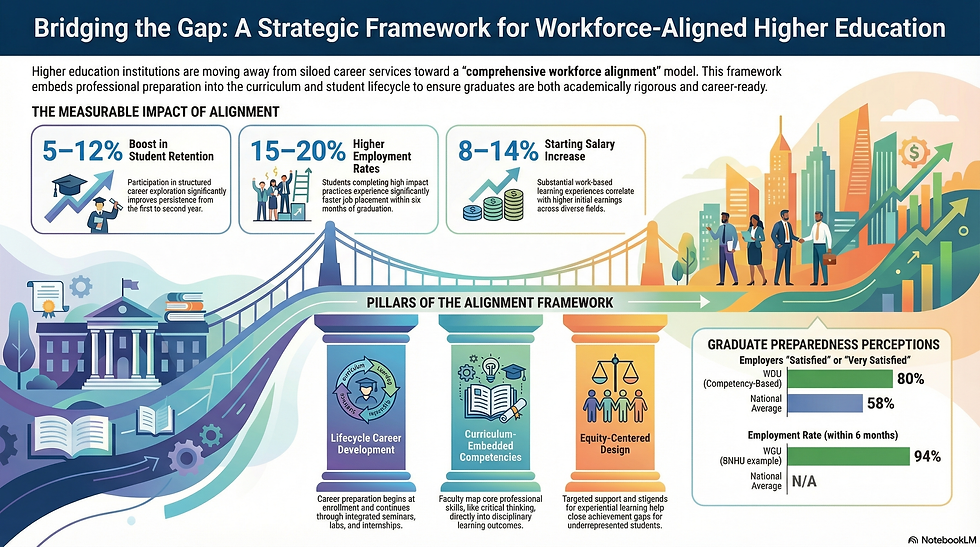
Research demonstrates measurable institutional benefits from comprehensive workforce alignment. Institutions with robust workforce preparation systems report higher student retention rates, with several studies indicating 5-12 percentage point improvements in persistence from first to second year when students participate in structured career exploration and work-based learning (Kuh, 2008; Brownell & Swaner, 2010). These retention effects appear particularly strong for first-generation students and those from underrepresented backgrounds, suggesting that clear career pathways provide purpose and motivation that sustain academic engagement.
Graduate employment outcomes show similar improvements. A multi-institution study by Finley and McNair (2013) found that students completing high-impact practices with clear workforce applications—internships, service learning, capstone projects—experienced 15-20% higher employment rates within six months of graduation compared to peers without such experiences, controlling for academic performance and demographic characteristics. Starting salary differentials ranged from 8-14% higher for students with substantial work-based learning, though effects varied by field and regional labor market conditions.
Institutional reputation and enrollment yield benefits also accrue. Universities that transparently communicate employment outcomes and feature employer partnerships in marketing materials report increased application rates and improved yield on admitted students, particularly among high-achieving students and those from moderate-income families weighing return on investment (DesJardins & Toutkoushian, 2005). Regional employer perception improves as institutions demonstrate responsiveness to workforce needs, creating virtuous cycles where partnership depth generates better student opportunities which enhance institutional reputation which attracts stronger employer engagement (Perna et al., 2017).
However, the absence of workforce alignment carries costs. Institutions that neglect systematic career preparation face declining enrollment as students choose competitors with stronger employment reputations. They experience higher student debt burden paired with lower graduate earning capacity, potentially triggering regulatory scrutiny around gainful employment standards (Cellini & Turner, 2019). Faculty morale may decline as graduates struggle to launch careers, creating perceptions—warranted or not—that academic programs lack relevance. Alumni engagement weakens when graduates do not perceive their education as instrumental to career success, reducing philanthropic support and mentorship capacity (Weerts & Cabrera, 2015).
Student Wellbeing and Equity Impacts
For students, workforce alignment directly affects both immediate wellbeing and long-term life trajectories. Career clarity reduces anxiety and provides purpose that sustains academic motivation. Students who articulate coherent career goals and perceive their coursework as relevant to those goals report higher satisfaction, lower stress, and stronger sense of belonging (Duffy et al., 2019). This clarity proves especially valuable for first-generation students who often lack family networks that translate educational choices into career pathways, making institutional guidance essential.
Economic outcomes extend far beyond first job placement. Substantial research demonstrates that college-to-career transitions significantly impact lifetime earning trajectories. Students who secure field-related employment within six months of graduation earn 12-18% more over the first decade compared to peers who experience prolonged job search or underemployment, controlling for institution selectivity and academic performance (Abel & Deitz, 2016). These early career advantages compound through subsequent opportunities, network development, and skill acquisition.
Yet workforce preparation systems too often reproduce rather than reduce inequities. Students from affluent families leverage social capital to access prestigious internships, while peers from working-class backgrounds struggle to find unpaid or low-paid opportunities they can afford (Hora & Anderson, 2012). Campus location advantages urban students with proximity to employer hubs while rural students face geographic barriers to experiential learning. Implicit bias in hiring practices affects students from underrepresented racial and ethnic backgrounds even when they possess equivalent qualifications (Pager & Shepherd, 2008).
Comprehensive workforce alignment addresses these equity gaps through intentional design. Institutions that subsidize or provide stipends for experiential learning reduce financial barriers for low-income students. Partnerships with employers committed to inclusive hiring practices expand opportunities for underrepresented students. Mentorship programs connecting students to professionals from similar backgrounds provide navigation guidance and challenge imposter syndrome. Digital portfolio systems allow students to showcase competencies beyond traditional résumés that may be disadvantaged by educational pedigree or social capital deficits (Eynon et al., 2014). When designed with equity as a core principle rather than afterthought, workforce alignment becomes a mechanism for social mobility rather than advantage reproduction.
Evidence-Based Organizational Responses
Integrated Career Development Across the Student Lifecycle
Rather than concentrating career preparation in a senior-year burst of résumé workshops, effective institutions distribute career development throughout the student experience, embedding it within academic advising, coursework, and co-curricular programming. This developmental approach recognizes that career readiness unfolds gradually through exploration, skill-building, application, and reflection.
Research by Dey and Cruzvergara (2014) demonstrates that students who engage career development activities beginning in their first year—major exploration, informational interviews, career assessments—show significantly higher career decision self-efficacy and employment outcomes compared to peers who defer such activities until junior or senior year. The authors found that early engagement allows students to make more informed academic choices, aligning coursework and experiences with career goals rather than belatedly discovering misalignment.
Successful implementation requires training academic advisors to incorporate career conversations into degree planning, equipping them with labor market information relevant to students' fields, and providing structured protocols for career exploration discussions. Faculty integrate career preparation by inviting alumni guest speakers, designing assignments that simulate professional tasks, and facilitating student reflection on skill development. Residence life staff coordinate career-themed programs, while student organization advisors help students identify transferable skills gained through leadership roles (Dey & Cruzvergara, 2014).
Effective approaches to developmental integration:
First-year career exploration seminars where students investigate multiple fields through readings, guest speakers, site visits, and informational interviews, completing reflection assignments that connect emerging interests to academic pathways
Sophomore career labs offering short-term projects or job shadows that allow hands-on exploration before committing to internships or declaring majors
Junior-year internship requirements with structured learning objectives, faculty mentorship, and integration with capstone preparation
Senior capstone experiences requiring students to demonstrate workforce competencies through projects addressing authentic organizational challenges, often presented to employer panels
Northeastern University has pioneered this developmental model through its co-op program, which intersperses academic study with semester-long, full-time work experiences beginning in sophomore or junior year. Students typically complete two or three co-op placements before graduation, progressively building professional skills and networks. The university reports that 89% of graduates are employed or enrolled in graduate school within nine months, with median starting salaries 10-15% above national averages for comparable institutions. Critically, the co-op model is required for all undergraduates regardless of major, ensuring that English and philosophy students gain comparable experiential learning to their engineering and business peers (Northeastern University, 2020).
Curriculum-Embedded Workforce Competencies
Leading institutions explicitly identify transferable professional competencies within learning outcomes and syllabi, making transparent how academic content develops workplace capabilities. This approach bridges the persistent gap between what students learn and their capacity to articulate that learning to employers.
The National Association of Colleges and Employers (2021) identifies eight career readiness competencies that employers consistently value: critical thinking and problem-solving, oral and written communication, teamwork and collaboration, digital technology fluency, leadership, professionalism and work ethic, career management, and global and intercultural fluency. Rather than treating these as separate from disciplinary learning, faculty map how their courses develop such competencies through disciplinary lenses—communication in chemistry differs from communication in social work, but both disciplines teach students to tailor messages to audience, purpose, and context.
Competency mapping requires academic departments to conduct systematic reviews identifying where in the curriculum each competency is introduced, practiced, and assessed. This process often reveals gaps—perhaps leadership receives little attention, or digital literacy is assumed but never explicitly taught. Departments then modify courses or add experiences to ensure comprehensive coverage. Students receive competency transcripts alongside traditional transcripts, documenting skill development with evidence from coursework, projects, and experiential learning (Johnstone & Soares, 2014).
Effective approaches to curriculum-embedded competencies:
Competency language in syllabi where instructors explicitly state which professional skills assignments develop and how students will demonstrate proficiency
ePortfolio systems requiring students to upload work samples demonstrating each competency, with reflective narratives explaining the connection between academic work and professional application
Backward-designed programs starting with labor market analysis of skills employers seek, then structuring curriculum to ensure students develop those capabilities alongside disciplinary knowledge
Industry advisory board input where employers review course descriptions and assignments, providing feedback on relevance and suggesting modifications to enhance workforce application
Western Governors University, a nonprofit online institution, has built its entire academic model on competency-based education. Students progress by demonstrating mastery of specific competencies rather than accumulating credit hours. Each degree program comprises clearly defined competencies aligned with industry standards and employer needs. Students work through materials at their own pace, taking assessments when ready to demonstrate proficiency. This approach appeals particularly to working adults who possess substantial professional experience and can accelerate through familiar material while spending more time on new competencies. The university reports that 80% of employers are satisfied or very satisfied with WGU graduate preparedness, compared to 58% nationally (Western Governors University, 2019).
Structured Employer Partnerships and Work-Based Learning
High-quality experiential learning requires more than placing students with employers and hoping for the best. Research by Hora and Anderson (2012) reveals significant variation in internship quality, with poorly structured experiences offering limited learning and sometimes reinforcing inequities when students perform menial tasks unrelated to their field. Effective workforce alignment creates structured partnership models with clear learning objectives, employer training, and faculty oversight.
Formal partnership agreements specify mutual commitments: employers provide meaningful projects aligned with student learning goals, designate experienced professionals as mentors, participate in mid-point and final evaluations, and compensate students fairly for their work. Institutions prepare students through pre-internship coursework covering professional norms, provide faculty or staff liaisons who maintain regular contact during placements, require structured reflection assignments connecting experience to coursework, and assess learning outcomes beyond employer satisfaction (Stirling et al., 2016).
Project-based learning offers an alternative or complement to traditional internships, particularly valuable for students with limited geographic mobility or schedule flexibility. In this model, employers bring authentic challenges to campus—market research needs, process improvement opportunities, technology development projects—and student teams work on these challenges within courses or labs. Faculty provide disciplinary expertise while employer representatives offer real-world context and feedback. Projects culminate in formal presentations where students deliver recommendations and demonstrate professional communication skills (Helle et al., 2006).
Effective approaches to employer partnership and experiential learning:
Sector-specific academies where cohorts of students complete shared coursework, group projects for industry partners, and individual internships all within a single high-demand field like healthcare informatics or advanced manufacturing
Apprenticeship models combining paid work with structured academic study, particularly effective in technical and professional fields, allowing students to earn while learning and often resulting in job offers
Micro-internships offering short-term, project-based experiences (10-40 hours) that students can complete during academic terms, reducing financial and scheduling barriers while providing substantive experience
Virtual work-based learning where students complete remote projects or internships, expanding geographic reach and preparing students for increasingly common remote work arrangements
Purdue Polytechnic Institute has developed extensive partnerships with regional manufacturers through its Advanced Manufacturing Partnership. The partnership involves a formal advisory board that meets quarterly to review curriculum relevance, an internship consortium guaranteeing placements for all interested students, and shared equipment agreements where employers provide access to advanced manufacturing tools in exchange for collaborative research and workforce training. Faculty regularly visit partner sites to observe student interns and understand evolving industry practices. The partnership has expanded to include K-12 pathways, where high school students complete summer manufacturing boot camps on campus before transitioning to Purdue programs. Regional manufacturers report that 85% of interns receive job offers, with most accepting, substantially reducing their talent recruitment costs (Purdue University, 2021).
Stackable Credentials and Industry Certifications
Traditional degree timelines and structures often fail to keep pace with rapidly evolving technical skill requirements. Workforce-aligned institutions increasingly offer micro-credentials, digital badges, and industry certifications that students can earn alongside or embedded within degree programs, providing portable documentation of specific competencies that employers immediately recognize.
Brown and Kurzweil (2017) document the growth of micro-credentialing systems, noting that such credentials serve multiple purposes: they allow working adults to upskill incrementally without committing to full degrees, they provide transparent signals of competency to employers unfamiliar with academic transcripts, and they create modular pathways where credentials stack toward degrees over time. Importantly, quality micro-credentials require rigorous assessment and align with industry standards rather than representing mere participation certificates.
Effective institutions conduct labor market analysis identifying which credentials employers value in regional priority sectors—CompTIA certifications in IT, Lean Six Sigma in manufacturing, project management professional (PMP) in business, emergency medical technician (EMT) for healthcare pathways. They then integrate preparation for these certifications into existing courses, often providing exam fee support and study resources. Students graduate with both a degree and recognized credentials, enhancing immediate employability while retaining the long-term career flexibility and advancement potential that degrees provide (Lumina Foundation, 2015).
Effective approaches to stackable credentials:
Credit for prior learning systems evaluating professional certifications and work experience for academic credit, reducing time and cost for adult learners while validating their existing knowledge
Embedded certification pathways where required coursework for a major inherently prepares students for industry exams, making credential acquisition a natural extension rather than additional burden
Modular certificate programs offering focused 9-15 credit sequences addressing specific technical skills, structured so multiple certificates stack toward degree completion
Digital badging systems documenting competency development throughout students' academic experience, creating granular records that supplement traditional transcripts with evidence of specific capabilities
Southern New Hampshire University's College of Engineering, Technology, and Aeronautics embeds industry certifications throughout its degree programs. Students pursuing information technology degrees complete coursework aligned with CompTIA A+, Network+, and Security+ certifications, with exam fees covered by program costs. The university partners with certification bodies to ensure curriculum alignment and provides additional study resources and practice exams. Faculty hold relevant industry certifications themselves, bringing current professional expertise to instruction. Students graduate with both a bachelor's degree and typically three to five industry certifications, substantially improving employment outcomes. The university reports that 94% of graduates are employed within six months, with starting salaries averaging 18% above regional benchmarks for bachelor's degree holders (Southern New Hampshire University, 2020).
Equity-Centered Workforce Preparation
Workforce alignment initiatives risk perpetuating existing inequities if not intentionally designed with equity as a core principle. Students from underrepresented backgrounds face multiple barriers to successful workforce preparation: limited professional networks and social capital, financial constraints that preclude unpaid or low-paid internships, implicit bias in employer hiring and selection processes, and cultural navigation challenges in predominantly white professional environments (Hora & Anderson, 2012).
Research by McNair et al. (2016) demonstrates that equity-centered workforce preparation requires explicit strategies addressing structural barriers rather than assuming equal access benefits all students equally. Financially, this means providing stipends or paid opportunities for experiential learning, covering certification exam fees and required supplies or uniforms, and offering emergency funds for internship-related expenses like professional clothing or transportation. Structurally, it means partnering with employers committed to inclusive hiring practices, providing mentorship programs connecting students to professionals from similar backgrounds, and creating cohort-based programming that builds peer support networks.
Cultural navigation support proves particularly important. Many first-generation students and students from underrepresented racial or ethnic backgrounds enter professional environments where implicit expectations around communication style, networking behavior, and workplace norms reflect dominant cultural patterns they may not have encountered previously. Effective programs provide explicit instruction on professional norms while validating students' existing cultural knowledge as an asset, workshops on navigating bias and microaggressions, and mentorship from professionals who have successfully navigated similar transitions (Yosso, 2005).
Effective approaches to equity-centered workforce preparation:
Cohort-based career development programs serving specific populations (first-generation students, underrepresented students in STEM, etc.) providing intensive career preparation, peer support, and targeted employer connections
Inclusive employer partnership criteria requiring partners to demonstrate commitment to diverse hiring, equitable compensation, and inclusive workplace cultures before receiving student referrals or campus recruiting privileges
Financial support for experiential learning including stipends for otherwise unpaid internships, travel assistance for site visits or conferences, and professional clothing closets providing interview and workplace attire
Cultural wealth frameworks helping students identify and articulate the valuable knowledge, skills, and perspectives they bring from their communities and backgrounds, reframing difference as asset rather than deficit
Georgia State University has become nationally recognized for equity-centered student success initiatives that include comprehensive workforce preparation. The university uses predictive analytics to identify students at risk of not participating in internships or experiential learning, then provides proactive outreach and support. This includes a Panther Retention Grant program offering emergency financial assistance for internship-related expenses, a formal mentorship program called PantherPros connecting students to alumni and professional mentors, and partnerships with employers who have demonstrated inclusive hiring practices and provide structured onboarding and support for first-generation students and students from underrepresented backgrounds. These efforts have contributed to Georgia State eliminating achievement gaps between white students and Black and Latino students in graduation rates while dramatically improving employment outcomes. The university reports that 87% of graduates are employed or enrolled in graduate study within six months, with no significant difference by race, ethnicity, or income (Georgia State University, 2018).
Building Long-Term Institutional Capacity for Workforce Responsiveness
Continuous Labor Market Intelligence and Curriculum Adaptation
Sustainable workforce alignment requires ongoing mechanisms for monitoring labor market trends and translating insights into curriculum and program modifications. Static workforce preparation quickly becomes obsolete as industries evolve, new occupations emerge, and skill requirements shift in response to technological and organizational change.
Leading institutions establish formal labor market intelligence functions that regularly analyze data from sources including state workforce development agencies, economic development organizations, employer surveys, and occupational projection databases (Carnevale et al., 2020). This analysis identifies growing and declining occupations in institutional service regions, emerging skill requirements across sectors, employer satisfaction with current graduate preparedness, and competitor institution program offerings and outcomes. Findings inform strategic enrollment management decisions about program expansion or creation, curriculum review priorities, and resource allocation.
Curriculum adaptation processes must balance responsiveness to immediate employer needs with long-term educational foundations. Purely reactive approaches risk preparing students for today's jobs rather than careers that will span decades across multiple roles and organizations. Effective institutions therefore distinguish between durable competencies that transcend specific technologies or roles—critical thinking, communication, adaptability—and specific technical skills that require regular updating. They structure curricula around foundational principles while creating flexible elective spaces or modules that can be modified relatively quickly as specific tools and techniques evolve (Aoun, 2017).
Effective approaches to labor market intelligence and adaptation:
Annual program advisory board reviews where employer representatives assess curriculum relevance, discuss emerging needs, and provide specific feedback on graduate preparedness strengths and gaps
Faculty externships placing instructors in industry settings for short-term experiences that update their knowledge of current professional practices and technologies
Rapid curriculum modification protocols allowing departments to update specific course modules or add elective topics between formal program review cycles, maintaining relevance while preserving academic governance
Cross-institutional consortia sharing labor market intelligence and curriculum resources across multiple institutions serving the same region, reducing duplication and enhancing collective responsiveness
The Alamo Colleges District in San Antonio has developed a sophisticated workforce intelligence system serving its five community colleges. The district employs dedicated labor market analysts who track regional industry trends, conduct regular employer surveys, and maintain ongoing relationships with economic development agencies and workforce boards. These analysts produce quarterly reports identifying high-demand occupations, emerging skill needs, and program performance metrics. The reports directly inform program planning, with clear protocols for suspending programs with weak employment outcomes and expedited approval processes for new programs addressing documented workforce shortages. The district has used this intelligence to launch programs in cybersecurity, healthcare informatics, and advanced manufacturing while carefully managing enrollment in oversupplied fields. Graduate employment rates consistently exceed state and national averages, and regional employers report high satisfaction with Alamo graduate preparedness (Alamo Colleges District, 2019).
Distributed Leadership and Cross-Functional Coordination
Comprehensive workforce alignment cannot be owned by a single office or administrator; it requires distributed leadership and coordination across academic affairs, student affairs, institutional advancement, and external relations. Yet distributed responsibility without clear coordination creates fragmentation, duplication, and gaps in student experience.
Effective structures typically involve a central workforce alignment team or office that serves coordinating rather than monopolizing functions (Kezar & Holcombe, 2017). This team maintains relationships with academic programs, facilitates employer partnerships that serve multiple departments, provides professional development for faculty and staff on workforce preparation pedagogy, operates technology platforms for internship management and portfolio documentation, and synthesizes workforce outcome data for institutional decision-making. However, the actual work of workforce preparation—curriculum design, student advising, experiential learning supervision—remains embedded within academic and student affairs units where it integrates with core educational functions.
Cross-functional leadership teams including representatives from academic affairs, career services, enrollment management, institutional research, and external relations meet regularly to coordinate activities, share information, identify systemic issues, and make strategic decisions about resource allocation and priority setting. This coordination proves essential for avoiding common dysfunctions: academic programs creating unrealistic work-based learning requirements without adequate employer partnerships, career services offering generic guidance disconnected from disciplinary job market realities, or advancement pursuing employer relationships focused solely on fundraising rather than student opportunities (Kezar & Holcombe, 2017).
Effective approaches to distributed leadership and coordination:
Liaison models where workforce alignment staff are assigned to specific academic colleges or divisions, developing deep knowledge of disciplinary contexts while maintaining connection to institution-wide strategy
Community of practice networks convening faculty across departments who integrate workforce preparation in their teaching, facilitating peer learning and resource sharing
Integrated technology platforms providing single systems for managing internships, portfolios, and employer relationships accessible to all stakeholders, reducing fragmentation and improving data quality
Formal coordination protocols specifying decision rights, communication expectations, and accountability mechanisms across units involved in workforce preparation
Arizona State University's Career and Professional Development Services operates through a hub-and-spoke model, with a central team providing strategic coordination and shared resources while career advisors are embedded within academic colleges and major academic units. Embedded advisors maintain deep knowledge of specific fields and can provide discipline-relevant guidance, while the central team manages university-wide employer relationships, operates a common technology platform, coordinates career fairs and recruiting events, and provides professional development for advisors and faculty. The model creates both specialization and coordination, avoiding the common problem of central career services being too generic while siloed college advising lacks scale and employer access. ASU reports that employer engagement has increased substantially under this model, with the university now hosting over 2,000 employers annually for recruiting and partnerships, and 85% of graduates employed or in graduate school within six months (Arizona State University, 2020).
Data-Informed Continuous Improvement and Accountability
Sustainable workforce alignment requires transparent data systems that track student participation, assess quality of experiences, monitor employment outcomes, and identify equity gaps. Such data serve both external accountability purposes and internal improvement efforts, allowing institutions to evaluate what works, identify underperforming programs or services, and allocate resources strategically.
Comprehensive data systems track inputs including student participation rates in various workforce preparation activities disaggregated by program and demographics, employer partnership quantity and quality metrics, and faculty integration of workforce preparation pedagogy. Process measures assess the quality of experiential learning through student and employer satisfaction surveys, structured learning outcome assessments, and reflection quality evaluation. Outcome data document employment rates, field alignment, salary levels, and graduate satisfaction with career preparation, tracked longitudinally to understand career progression over time (Gansemer-Topf et al., 2014).
Critically, data must be disaggregated to identify equity gaps. Aggregate institutional employment rates may mask the reality that outcomes differ substantially by race, income background, or first-generation status. Transparent equity data allows institutions to target interventions toward populations experiencing gaps and hold programs accountable for equitable outcomes. Some institutions have begun publishing equity dashboards showing workforce outcome data by demographic characteristics, creating public commitments to closing gaps (McNair et al., 2016).
Effective approaches to data-informed improvement:
Annual workforce outcomes reports presenting comprehensive data on graduate employment, employer satisfaction, and program-level performance, shared publicly and used in strategic planning and resource allocation decisions
Learning analytics systems tracking student engagement with career preparation activities and correlating participation with retention and employment outcomes to identify high-impact practices
Equity audits systematically examining workforce preparation access and outcomes by demographic characteristics, identifying specific barriers and required interventions
Employer advisory data regularly surveying hiring managers about graduate preparedness, using feedback to inform curriculum review and program improvement
The University of Texas System has implemented a comprehensive workforce outcomes accountability framework across its 14 institutions. Each university reports annual data on graduate employment rates, field alignment, salary levels, and employer satisfaction using standardized definitions and survey methodology. Data are disaggregated by academic program, campus, and demographic characteristics. The system office publishes comparative performance data, and institutions must demonstrate data-informed improvement plans for programs with below-average outcomes. The framework has driven substantial improvements, with system-wide employment rates increasing from 76% to 84% over five years, and persistent salary gaps by race and ethnicity declining by roughly half during that period. The system attributes these improvements to the combination of transparent data, accountability for equity, and institutional learning from high-performing peers (University of Texas System, 2021).
Table 1: Institutional Workforce Alignment Initiatives and Outcomes
Institution | Initiative Name | Key Strategy | Target Competencies | Industry Partners | Reported Outcomes | Equity Considerations |
Northeastern University | Co-op Program | Experiential learning through semester-long, full-time work integrated with academic study. | Professional skills and networks across all majors including liberal arts. | Not in source | 89% of graduates employed or in graduate school within 9 months; median starting salaries 10-15% above national averages. | Required for all undergraduates regardless of major to ensure equitable access to experiential learning. |
Georgia State University | Equity-Centered Student Success Initiatives | Predictive analytics for outreach, emergency financial assistance (Panther Retention Grants), and formal mentorship (PantherPros). | Not in source | Employers committed to inclusive hiring. | 87% of graduates employed or in graduate study within six months; eliminated achievement gaps for Black and Latino students. | Uses predictive analytics to identify at-risk students; provides stipends/grants for internship-related expenses. |
Southern New Hampshire University | College of Engineering, Technology, and Aeronautics (CETA) Integrated Certifications | Embedded industry certifications (CompTIA) within degree programs with exam fees covered by the institution. | Technical IT skills (A+, Network+, Security+). | CompTIA and other certification bodies. | 94% of graduates employed within six months; starting salaries averaging 18% above regional benchmarks. | Exam fees covered by program costs to reduce financial barriers for all students. |
Purdue Polytechnic Institute | Advanced Manufacturing Partnership | Formal advisory board, internship consortium, and shared equipment agreements. | Advanced manufacturing skills and professional communication. | Regional manufacturers | 85% of interns receive job offers, with most accepting. | Includes K-12 pathways where high school students complete summer manufacturing boot camps. |
Arizona State University | Hub-and-Spoke Career Model | Central strategic coordination with career advisors embedded directly within academic colleges. | Discipline-relevant guidance and professional development. | Over 2,000 employers annually | 85% of graduates employed or in graduate school within six months. | Avoids siloed advising to ensure broad employer access across different academic units. |
University of Texas System | Workforce Outcomes Accountability Framework | System-wide reporting on employment, field alignment, and salary data disaggregated by demographics. | Not in source | Not in source | System-wide employment rates increased from 76% to 84% over five years; racial/ethnic salary gaps declined by half. | Data is disaggregated to identify equity gaps; public commitment to closing performance gaps. |
Western Governors University | Competency-Based Education Model | Academic model where students progress by demonstrating mastery of specific competencies rather than credit hours. | Industry-aligned competencies and employer-defined skills. | Various employers (implied via industry standards). | 80% employer satisfaction with graduate preparedness compared to 58% nationally. | Appeals to working adults by allowing acceleration through prior professional experience. |
Alamo Colleges District | Workforce Intelligence System | Dedicated labor market analysts tracking industry trends to inform program suspension or creation. | Cybersecurity, healthcare informatics, and advanced manufacturing skills. | Regional industry and workforce boards | Graduate employment rates consistently exceed state and national averages. | Not in source |
Conclusion
Higher education stands at a pivotal moment in its relationship to workforce preparation. The traditional divide between academic learning and career preparation has become untenable as students, employers, and policymakers demand clear pathways from education to economic opportunity. Yet vocational narrowness threatens higher education's broader purposes of cultivating critical thinking, civic capacity, and human flourishing. Comprehensive workforce alignment offers a both/and solution: systematic integration of career preparation throughout the student experience in ways that enhance rather than diminish educational quality.
The framework presented here—spanning curriculum-embedded competencies, developmental career integration, structured employer partnerships, stackable credentials, and equity-centered design—provides actionable guidance for institutional leaders and practitioners. Evidence demonstrates that thoughtfully implemented workforce alignment improves student retention, accelerates career launches, enhances institutional reputation, and strengthens regional economic development. Critically, when designed with equity as a core principle rather than afterthought, such systems can reduce rather than reproduce social stratification.
Implementation requires sustained commitment, cross-functional coordination, and willingness to adapt academic culture. Faculty must see workforce preparation as complementary to rather than in tension with rigorous disciplinary learning. Academic and student affairs divisions must collaborate rather than operate in silos. Institutions must invest in labor market intelligence, experiential learning infrastructure, and data systems that enable continuous improvement. Leadership must champion workforce alignment as mission-central rather than peripheral.
Looking forward, several capabilities will distinguish responsive institutions. Continuous curriculum adaptation processes that balance foundational knowledge with emerging skill requirements allow graduates to thrive across multi-decade careers spanning technological and organizational disruption. Sophisticated labor market intelligence informs strategic program development and resource allocation. Equity-centered design ensures that workforce preparation expands opportunity rather than perpetuating advantage. Cross-sector fluency and interdisciplinary capacity prepare students for complex challenges that transcend traditional occupational boundaries.
Ultimately, comprehensive workforce alignment represents a maturation of higher education's social contract. Students invest substantial time and resources in postsecondary education expecting tangible returns; institutions have ethical obligations to deliver on those expectations while developing graduates' broader intellectual and civic capacities. Regional communities rely on institutions as anchor organizations and talent developers; institutions must actively contribute to economic vitality. Employers need graduates who combine specialized knowledge with adaptable professional competencies; institutions must intentionally develop both. When workforce alignment is comprehensive, equity-centered, and mission-integrated, higher education fulfills these multiple obligations simultaneously, preparing graduates for meaningful work and purposeful lives while advancing the common good.
Research Infographic
References
Abel, J. R., & Deitz, R. (2016). Underemployment in the early careers of college graduates following the Great Recession. In C. Hulten & V. Ramey (Eds.), Education, skills, and technical change: Implications for future US GDP growth (pp. 149-181). University of Chicago Press.
Alamo Colleges District. (2019). Strategic plan 2019-2024: Student success and workforce development. Alamo Colleges District.
Aoun, J. E. (2017). Robot-proof: Higher education in the age of artificial intelligence. MIT Press.
Arizona State University. (2020). Career and professional development services impact report. Arizona State University.
Association of Public and Land-grant Universities. (2017). Higher education's workforce development imperative: Strengthening the talent pipeline. APLU.
Bragg, D. D., & Krismer, M. (2016). Applied baccalaureates: Emerging trends and implications. Community College Research Center.
Brown, M., & Kurzweil, M. (2017). The complex universe of alternative postsecondary credentials and pathways. American Academy of Arts and Sciences.
Brownell, J. E., & Swaner, L. E. (2010). Five high-impact practices: Research on learning outcomes, completion, and quality. Association of American Colleges and Universities.
Carnevale, A. P., Jayasundera, T., & Repnikov, D. (2014). Understanding online job ads data. Georgetown University Center on Education and the Workforce.
Carnevale, A. P., Garcia, T. I., & Gulish, A. (2020). Career pathways: Five ways to connect college and careers. Georgetown University Center on Education and the Workforce.
Cellini, S. R., & Turner, N. (2019). Gainfully employed? Assessing the employment and earnings of for-profit college students using administrative data. Journal of Human Resources, 54(2), 342-370.
DesJardins, S. L., & Toutkoushian, R. K. (2005). Are students really rational? The development of rational thought and its application to student choice. In J. C. Smart (Ed.), Higher education: Handbook of theory and research (Vol. 20, pp. 191-240). Springer.
Dey, F., & Cruzvergara, C. Y. (2014). Evolution of career services in higher education. New Directions for Student Services, 2014(148), 5-18.
Dougherty, K. J., & Natow, R. S. (2020). Performance-based funding for higher education: How well does neoliberal theory capture neoliberal practice? Johns Hopkins University Press.
Duffy, R. D., Douglass, R. P., Autin, K. L., & Allan, B. A. (2019). Examining predictors of work volition among undergraduate students. Journal of Career Assessment, 27(3), 395-412.
Eynon, B., Gambino, L. M., & Török, J. (2014). What difference can ePortfolio make? A field report from the Connect to Learning project. International Journal of ePortfolio, 4(1), 95-114.
Finley, A., & McNair, T. (2013). Assessing underserved students' engagement in high-impact practices. Association of American Colleges and Universities.
Gansemer-Topf, A. M., Downey, J. P., Genschel, U., & Athanassiou, N. (2014). Assessing and enhancing student and graduate job placement: Are we measuring the outcome? Journal of Marketing Education, 36(3), 217-227.
Georgia State University. (2018). Student success at scale: Georgia State's equity-centered approach. Georgia State University.
Helle, L., Tynjälä, P., & Olkinuora, E. (2006). Project-based learning in post-secondary education: Theory, practice and rubber sling shots. Higher Education, 51(2), 287-314.
Higher Learning Commission. (2016). Criteria for accreditation. Higher Learning Commission.
Hora, M. T., & Anderson, C. (2012). Perceived norms for interactive teaching and their relationship to instructional decision-making: A mixed methods study. Higher Education, 64(4), 573-592.
Humphreys, D., & Carnevale, A. P. (2016). The economic value of liberal education. Association of American Colleges and Universities.
Johnstone, S. M., & Soares, L. (2014). Principles for developing competency-based education programs. Change: The Magazine of Higher Learning, 46(2), 12-19.
Kezar, A., & Holcombe, E. (2017). Shared leadership in higher education: Important lessons from research and practice. American Council on Education.
Kezar, A. J., & Maxey, D. (2016). The Delphi technique: An untapped approach of participatory research. International Journal of Social Research Methodology, 19(2), 143-160.
Kisker, C. B., Wagoner, R. L., & Lurie, H. A. (2016). Partnerships for workforce development in California community colleges. Community College Review, 44(3), 231-252.
Kuh, G. D. (2008). High-impact educational practices: What they are, who has access to them, and why they matter. Association of American Colleges and Universities.
Lumina Foundation. (2015). Connecting credentials: Lessons from the national summit on credentialing and next steps in the national dialogue. Lumina Foundation.
McNair, T. B., Albertine, S., Cooper, M. A., McDonald, N., & Major, T. (2016). Becoming a student-ready college: A new culture of leadership for student success. Jossey-Bass.
National Academies of Sciences, Engineering, and Medicine. (2021). The future of work in a changing labor market: Implications for institutions, employers, workers, and society. National Academies Press.
National Association of Colleges and Employers. (2021). Career readiness defined. NACE.
Northeastern University. (2020). Co-op outcomes report. Northeastern University.
Pager, D., & Shepherd, H. (2008). The sociology of discrimination: Racial discrimination in employment, housing, credit, and consumer markets. Annual Review of Sociology, 34, 181-209.
Pearson, C., & Brint, S. (2021). Professional, vocational, and technical programs in American higher education. In M. N. Bastedo, P. G. Altbach, & P. J. Gumport (Eds.), American higher education in the twenty-first century (4th ed., pp. 180-203). Johns Hopkins University Press.
Perna, L. W., Lundy-Wagner, V., Drezner, N. D., Gasman, M., Yoon, S., Bose, E., & Gary, S. (2017). The contribution of HBCUs to the preparation of African American women for STEM careers: A case study. Research in Higher Education, 50(1), 1-23.
Purdue University. (2021). Purdue Polytechnic Institute industry partnerships report. Purdue University.
Southern New Hampshire University. (2020). College of Engineering, Technology, and Aeronautics outcomes data. Southern New Hampshire University.
Stirling, A., Kerr, G., MacPherson, E., Banwell, J., & Heron, A. (2016). A practical guide for work-integrated learning: Effective practices to enhance the educational quality of structured work experiences offered through colleges and universities. Higher Education Quality Council of Ontario.
Strada Education Network. (2021). Public viewpoint: COVID-19 work and education survey. Strada Education Network.
University of Texas System. (2021). Workforce outcomes framework: Five-year progress report. University of Texas System.
Weerts, D. J., & Cabrera, A. F. (2015). Understanding public perceptions and how they influence resource allocation. In D. L. Priest & E. P. St. John (Eds.), Privatization and public universities (pp. 71-91). Indiana University Press.
Western Governors University. (2019). 2019 employer survey results. Western Governors University.
Yosso, T. J. (2005). Whose culture has capital? A critical race theory discussion of community cultural wealth. Race Ethnicity and Education, 8(1), 69-91.

Jonathan H. Westover, PhD is Chief Research Officer (Nexus Institute for Work and AI); Associate Dean and Director of HR Academic Programs (WGU); Professor, Organizational Leadership (UVU); OD/HR/Leadership Consultant (Human Capital Innovations). Read Jonathan Westover's executive profile here.
Suggested Citation: Westover, J. H. (2026). Integrating Workforce Readiness into Higher Education: A Strategic Framework for Comprehensive Alignment. Human Capital Leadership Review, 33(!). doi.org/10.70175/hclreview.2020.33.1.3