





How Purpose-Specific AI Use Builds Organizational Resilience: A Dynamic Capability Perspective


Listen to a review of this article:
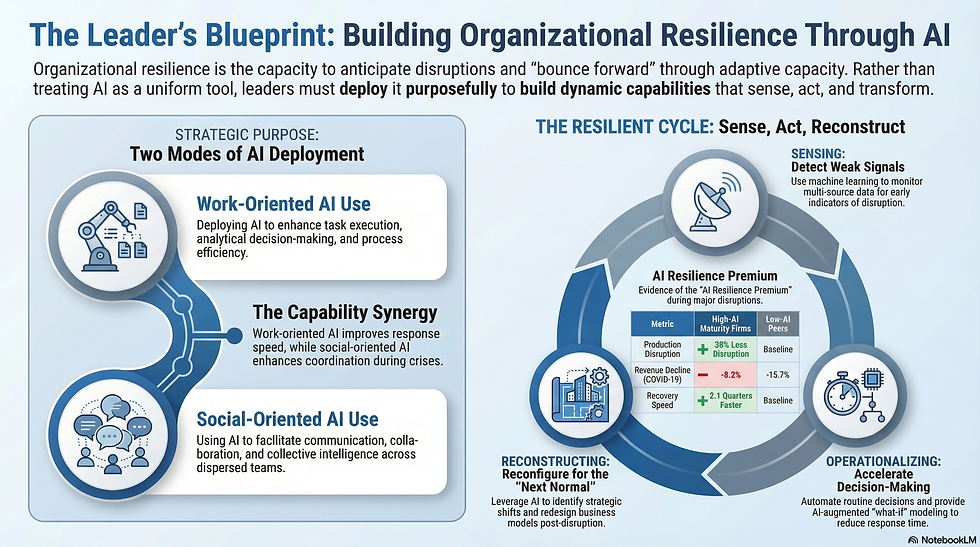
Abstract: Organizational resilience has become essential as enterprises navigate volatility, disruption, and rapid technological change. While artificial intelligence is widely viewed as a resilience enabler, most research treats AI adoption as uniform technological input rather than examining how distinct purposes of AI use shape resilience-building mechanisms. This article synthesizes emerging scholarship on AI-enabled dynamic capabilities to clarify how work-oriented and social-oriented AI applications differentially contribute to organizational resilience. Drawing on dynamic capability theory and configurational analysis, we explore how AI use strengthens sensing, operationalization, and reconstruction capabilities, and how data-driven culture moderates these relationships. The analysis reveals that both forms of AI use enhance resilience through capability development, with work-oriented AI showing stronger direct effects. Moreover, resilience emerges through multiple configurational pathways rather than singular linear mechanisms. These findings offer practitioners evidence-based guidance for purposefully deploying AI to build adaptive capacity, and highlight the importance of aligning AI strategy with organizational culture and capability development objectives.
Organizational resilience—the capacity to anticipate disruptions, absorb shocks, and adapt in real time—has moved from theoretical construct to operational imperative (Linnenluecke, 2017). Events ranging from the COVID-19 pandemic to supply chain crises and geopolitical instability have demonstrated that survival increasingly depends not on stability, but on the ability to sense, respond, and reconfigure under pressure (Williams et al., 2017). In this context, artificial intelligence has emerged as a promising technological lever. AI systems promise enhanced environmental scanning, faster decision-making, and more flexible resource allocation (Dwivedi et al., 2021). Yet despite growing enthusiasm, a critical gap persists: we know relatively little about how AI actually builds resilience, and whether different forms of AI use contribute equally to adaptive capacity.
Most existing research treats AI adoption as a binary or uniform phenomenon—organizations either use AI or they don't. This oversimplification obscures important variation in purpose. In practice, enterprises deploy AI for distinctly different reasons: some applications focus on work tasks such as data analytics, process automation, and decision support (work-oriented AI use), while others facilitate communication, collaboration, and social interaction (social-oriented AI use) (Maedche et al., 2019). These purposes invoke different organizational routines, engage different stakeholders, and likely activate different capability-building mechanisms. Understanding these distinctions matters not just theoretically, but practically: leaders need to know which forms of AI use to prioritize, how to sequence investments, and what organizational conditions enable AI to deliver resilience benefits.
This article addresses that need by examining how purpose-specific AI use influences organizational resilience through the lens of dynamic capability theory. Dynamic capabilities—the organizational processes that enable firms to sense opportunities and threats, seize them through decision and action, and reconfigure resources to maintain fit with the environment—provide a robust framework for understanding adaptive capacity (Teece, 2007). We explore how work-oriented and social-oriented AI use shape three AI-enabled dynamic capabilities: sensing (detecting environmental changes), operationalization (translating insights into coordinated action), and reconstruction (reconfiguring resources and routines). We also examine the moderating role of data-driven culture, recognizing that technological capabilities are enacted within cultural and cognitive contexts that shape how organizations interpret and act on AI-generated insights.
The implications extend beyond academic theory. Leaders investing in AI need clarity on which applications build resilience most effectively, how to cultivate the organizational conditions that allow AI capabilities to flourish, and what combinations of technology, capability, and culture produce robust adaptive capacity. This article synthesizes emerging evidence to provide that guidance, offering a roadmap for purposeful, capability-focused AI strategy in an era of permanent disruption.
The Organizational Resilience and AI Landscape
Defining Organizational Resilience in the AI Era
Organizational resilience refers to an enterprise's capacity to anticipate potential threats, absorb disruptions with minimal harm, and adapt by reconfiguring operations and strategy (Duchek, 2020). Unlike simple robustness—the ability to withstand shocks without changing—resilience emphasizes adaptive capacity, the ability to learn, evolve, and emerge stronger (Linnenluecke, 2017). Resilient organizations don't just bounce back; they bounce forward, using disruption as a catalyst for innovation and transformation (Williams et al., 2017).
In the AI era, resilience takes on new dimensions. Traditional resilience capabilities—supply chain redundancy, financial buffers, crisis communication protocols—remain important, but increasingly insufficient. Modern disruptions unfold faster, involve more interconnected systems, and generate more complex information environments than pre-digital shocks (Belhadi et al., 2021). COVID-19 illustrated this vividly: organizations faced simultaneous demand volatility, supply disruptions, workforce displacement, and regulatory shifts, all while navigating massive uncertainty about disease progression and policy response. Resilience in this context required not just having backup plans, but sensing emerging threats in real time, deciding rapidly amid incomplete information, and reconfiguring operations—shifting to remote work, redesigning supply chains, pivoting product lines—with unprecedented speed (Guo et al., 2023).
AI systems offer capabilities well-suited to these demands. Machine learning algorithms can process vast datasets to detect weak signals of emerging disruption (Haenlein & Kaplan, 2019). Natural language processing can monitor social media, news, and internal communications to gauge stakeholder sentiment and identify emerging risks. Predictive analytics can model "what-if" scenarios to support contingency planning. And automation can enable faster reconfiguration by reducing the coordination costs of operational change (Dwivedi et al., 2021). Yet realizing these potential benefits requires more than technology acquisition. It demands purposeful deployment aligned with organizational capabilities and culture.
Distinguishing Work-Oriented and Social-Oriented AI Use
A key insight from information systems research is that technology's organizational impact depends not just on its features, but on how it is used and for what purposes (Burton-Jones & Grange, 2013). This principle applies acutely to AI. While AI encompasses diverse techniques—machine learning, natural language processing, computer vision, robotics—its organizational role can be usefully categorized by purpose rather than technique.
Work-oriented AI use refers to deploying AI systems to enhance task execution, analytical decision-making, and process efficiency (Maedche et al., 2019). Examples include using machine learning for demand forecasting, deploying recommendation engines to personalize customer experiences, automating routine data entry or quality inspection, and using predictive analytics to optimize inventory or pricing. Work-oriented AI targets task performance: it helps employees complete work faster, more accurately, or at greater scale. These applications tend to focus on structured problems, leverage quantitative data, and support individual or small-group decision-making.
Social-oriented AI use, by contrast, refers to deploying AI to facilitate communication, collaboration, and interpersonal interaction (Maedche et al., 2019). Examples include AI-powered collaboration platforms that surface relevant expertise or connect dispersed team members, chatbots that handle employee questions and reduce information search costs, sentiment analysis tools that gauge team morale, and virtual assistants that schedule meetings and coordinate group activities. Social-oriented AI targets relational processes: it helps people find each other, share knowledge, coordinate action, and maintain connection across boundaries. These applications often handle unstructured communication, leverage natural language, and support collective sense-making.
Both forms matter for resilience, but likely through different mechanisms. Work-oriented AI enhances resilience by improving the speed and quality of threat detection and response execution. When a supply disruption occurs, AI-powered analytics can quickly identify alternative suppliers, forecast demand shifts, and optimize logistics. Social-oriented AI enhances resilience by improving coordination and collective intelligence. When crisis strikes, AI-enabled communication platforms can help dispersed teams share situational updates, surface relevant expertise, and align response efforts. Understanding these distinctions allows organizations to deploy AI more strategically, matching application purposes to resilience needs.
The State of AI Adoption for Resilience
AI adoption for resilience-related purposes has accelerated markedly since 2020, driven by pandemic disruptions and subsequent supply chain and geopolitical volatility (El Khoury et al., 2023). A 2021 McKinsey survey found that 56% of organizations reported AI adoption in at least one business function, up from 50% the prior year, with the largest increases in supply chain management and risk modeling (McKinsey & Company, 2021). Research by Deloitte similarly found that 79% of executives view AI and cognitive technologies as "very important" or "critically important" to organizational success over the next two years, with resilience and agility cited as top strategic drivers (Deloitte, 2020).
Yet adoption remains uneven and often disconnected from resilience goals. Many organizations adopt AI opportunistically—experimenting with pilots, deploying point solutions to address specific pain points—without systematic consideration of how AI might enhance adaptive capacity (Brock & von Wangenheim, 2019). Moreover, work-oriented applications dominate. A PwC survey found that the most common AI use cases focus on process automation (67%), data analytics and business intelligence (53%), and customer service automation (46%), with collaborative and communication-focused applications lagging (PwC, 2019). This pattern likely reflects path dependency: organizations begin with familiar, efficiency-focused applications before exploring more complex, relationship-oriented uses.
Research suggests that realizing resilience benefits requires moving beyond isolated AI applications toward integrated AI strategies that align technology deployment with organizational capabilities and strategic objectives (Canhoto & Clear, 2020). Organizations that treat AI as a collection of tools tend to see localized efficiency gains but limited enterprise-wide resilience impact. Those that embed AI into dynamic capabilities—using AI to systematically enhance sensing, decision-making, and reconfiguration processes—show stronger adaptive performance (Belhadi et al., 2021). This capability perspective, grounded in dynamic capability theory, provides a more robust framework for understanding AI's resilience contribution.
Organizational and Individual Consequences of AI-Enabled Resilience
Organizational Performance Impacts
The performance consequences of AI-enabled resilience manifest across multiple dimensions, from operational continuity to financial outcomes and competitive positioning. Organizations that successfully leverage AI to build resilience capabilities demonstrate measurably stronger crisis performance and post-disruption recovery.
Operational continuity and disruption absorption. Research examining organizational responses to COVID-19 provides natural-experiment evidence of AI's resilience impact. Belhadi and colleagues (2021) surveyed manufacturing firms and found that those with higher AI maturity—measured by AI deployment breadth and integration depth—experienced 30% less production disruption during lockdowns than low-AI peers, controlling for industry and size. The mechanism: AI-enabled supply chain visibility allowed faster identification of alternative suppliers, predictive analytics supported inventory optimization under uncertainty, and automation reduced dependence on physically-present labor. Similarly, research by Guo and colleagues (2023) found that logistics firms using AI for route optimization and demand forecasting maintained 85% of pre-pandemic delivery performance during lockdowns, compared to 62% for non-AI peers.
Financial resilience and recovery speed. Financial performance data reinforces these operational findings. A study by El Khoury and colleagues (2023) analyzed quarterly financial reports from 500 publicly-traded firms across sectors and found that high-AI-adoption firms experienced smaller revenue declines during COVID-19 quarters (−8.2% vs. −15.7% for low-AI peers) and faster recovery, returning to pre-pandemic revenue levels 2.1 quarters faster on average. Importantly, this "AI resilience premium" persisted after controlling for pre-pandemic financial health, indicating that AI contributed explanatory power beyond baseline resources. Another study examining retail firms found that those using AI for demand forecasting and inventory management showed 40% lower stockout rates during panic-buying episodes, translating to approximately 2.3 million in preserved revenue per 1 billion in annual sales (Cui et al., 2020).
Competitive repositioning and post-crisis advantage. Beyond absorbing shocks, AI-enabled resilience contributes to adaptive advantage—the ability to emerge stronger by reconfiguring strategy and operations. Warner and Wäger (2019) documented cases of manufacturers using AI-enabled sensing to identify pandemic-driven demand shifts (e.g., from hospitality to home goods) and reconfigure production accordingly, capturing new market share. A study of financial services firms found that AI-enabled risk modeling allowed faster identification of pandemic-vulnerable loan portfolios, enabling earlier intervention and 25% lower default rates than industry benchmarks (Duan et al., 2021). These examples illustrate how AI-enhanced dynamic capabilities enable not just survival, but strategic repositioning that creates post-crisis competitive advantage.
Workforce and Stakeholder Impacts
AI-enabled resilience also produces important consequences for employees, customers, and other stakeholders, though these effects are more complex and context-dependent than organizational performance outcomes.
Employee experience and wellbeing. Research on AI's workforce implications reveals mixed effects. On one hand, AI-enabled resilience capabilities can enhance employee experience by reducing uncertainty and providing clearer direction during crises. Cheng and Hackett (2021) found that employees in firms with AI-powered internal communication and knowledge management systems reported lower stress and higher sense-making capacity during COVID-19 transitions, attributing this to better access to information and clearer understanding of organizational responses. AI-enabled automation of routine tasks also freed employees to focus on higher-value problem-solving during crisis response.
On the other hand, rapid AI deployment can generate workforce anxiety, particularly when employees perceive AI as replacing rather than augmenting human judgment (Brougham & Haar, 2018). Research by Kellogg and colleagues (2020) found that frontline workers in logistics firms reported increased monitoring anxiety and reduced autonomy when AI systems were used for performance tracking during pandemic operations, even when objective workload remained constant. These findings suggest that AI's workforce impact depends critically on how systems are introduced and whether implementation emphasizes augmentation or replacement.
Customer and stakeholder experience. For external stakeholders, AI-enabled resilience can enhance service quality and reliability during disruptions. Banking customers whose institutions used AI for fraud detection and service personalization reported higher satisfaction and trust during pandemic uncertainty, particularly when AI systems provided consistent service despite branch closures (Ameen et al., 2021). Similarly, patients whose healthcare providers used AI for appointment optimization and remote triage reported better access to care during COVID-19 surges.
Yet stakeholder experience depends on implementation quality. AI systems deployed hastily without adequate testing or human oversight can degrade rather than enhance experience. Research on customer service chatbots deployed during COVID-19 found that poorly-designed systems increased rather than reduced customer frustration, with negative sentiment concentrated around inability to reach human agents for complex issues (Chung et al., 2020). These findings reinforce that AI's stakeholder benefits emerge not from technology alone, but from thoughtful integration with human touchpoints and escalation paths.
Evidence-Based Organizational Responses: Building AI-Enabled Dynamic Capabilities
Table 1: Case Studies of AI-Enabled Organizational Resilience
Organization | AI Application/System | Dynamic Capability Type | Specific Use Case | Key Performance Outcome | Strategic Foundation |
Siemens | Supply Chain Control Tower | Sensing | Mapping deep-tier supplier dependencies and monitoring geographic concentration risks in real-time. | Identified affected components and alternative sources within 48 hours; avoided 40% of production delays vs. competitors. | Data-driven culture / Technology investment in visibility. |
Unilever | AI-powered environmental scanning system | Sensing | Integrating point-of-sale, social media, and weather data to detect demand shifts such as surging hand sanitizer purchases during COVID-19. | Maintained 93% product availability during Q2 2020 despite widespread disruption. | Data-driven culture / Data-informed decision making. |
Target | Machine learning demand sensing | Sensing | Analyzing store-level demand forecasts using POS data, weather, and social media to detect stocking needs for suburban families. | Comparable-store sales grew 10.8% in Q2 2020, outperforming most retail peers. | Data-driven culture / Predictive indicators. |
Maersk | AI-powered decision support system | Operationalization | Vessel routing and cargo allocation optimization by analyzing weather, port congestion, and fuel prices. | Enabled rescheduling decisions in hours rather than days; maintained on-time delivery with only 6% decline vs. 14% industry average. | AI-augmented intelligence / Accelerated decision-making. |
Walmart | Machine learning inventory/workforce systems | Operationalization | Optimizing stocking and staffing daily based on real-time sales and inventory positions during panic buying. | In-stock rates remained above 85% in March-April 2020 vs. industry average of 70-75%. | Agile resource reallocation. |
Chevron | Eureka (AI-powered knowledge management) | Operationalization | Capturing and surfacing operational insights and engineering best practices to support remote problem solving. | Maintained 98% operational reliability despite limited physical presence during COVID-19. | Investing in continuous learning systems. |
Microsoft | Teams (enhanced with AI transcription/expertise recommendation) | Operationalization | Coordinating global shift to remote work by identifying unresolved decisions and connecting subject-matter experts. | Transitioned 160,000 employees to remote work within two weeks while maintaining operational continuity. | Distributed, real-time coordination / Social-oriented AI. |
Schneider Electric | AI-powered market analysis | Reconstruction | Detecting structural shifts in demand for home energy management systems due to permanent remote work. | Residential energy management revenue grew 47% in 2021, offsetting commercial declines. | Identifying strategic reconfiguration opportunities. |
Ford Motor Company | AI-powered scenario modeling | Reconstruction | Evaluating alternative response strategies to auto demand collapse, including accelerating shifts to EVs and mobility services. | Stock price outperformed General Motors by 35 percentage points through 2021-2023. | Rapid business model and operational redesign. |
Cleveland Clinic | Clinical decision support and operational optimization tools | Reconstruction | Optimizing patient flow, ICU capacity, and staffing under surge conditions. | 18% improvement in emergency department throughput and 12% reduction in wait times in 2021-2022. | Embedding learnings in organizational routines. |
The research literature and practitioner experience identify several evidence-based strategies for leveraging AI to build organizational resilience. These strategies align AI deployment with three core dynamic capabilities: sensing (environmental monitoring and threat detection), operationalization (translating insights into coordinated action), and reconstruction (reconfiguring resources and routines to restore fit with the environment). Effective approaches combine technological investment with organizational capability-building and cultural alignment.
Strengthening AI-Enabled Sensing Capabilities
Sensing—detecting environmental changes, emerging threats, and new opportunities—represents the foundation of organizational resilience (Teece, 2007). AI systems excel at processing large-scale, real-time data to identify patterns and anomalies, making them particularly valuable for enhancing sensing capabilities.
Deploying multi-source environmental scanning systems. Organizations can strengthen sensing by deploying AI systems that integrate data from diverse internal and external sources to provide comprehensive situational awareness. Effective implementations include:
Integrating structured and unstructured data streams. Combining transactional data (sales, inventory, operations metrics) with unstructured sources (news feeds, social media, regulatory filings) to detect both quantitative anomalies and qualitative signals of emerging disruption
Implementing anomaly detection and weak signal identification. Using machine learning algorithms to identify deviations from normal patterns that may indicate emerging threats, such as unusual supplier behavior, unexpected demand fluctuations, or shifts in customer sentiment
Creating executive dashboards with predictive indicators. Surfacing AI-generated insights through visualization tools that provide leaders with forward-looking indicators rather than just lagging performance metrics
Establishing alert systems with tunable sensitivity. Configuring AI monitoring systems to generate alerts at multiple thresholds, allowing organizations to balance responsiveness with alert fatigue
Unilever provides a strong example. The consumer goods multinational implemented an AI-powered environmental scanning system in 2019 that integrates point-of-sale data, social media sentiment, weather forecasts, and economic indicators across 190 markets (Ransbotham et al., 2020). During COVID-19, this system detected emerging demand shifts—such as surging hand sanitizer purchases and collapsing restaurant supplier orders—several weeks before traditional reporting systems surfaced these trends. The early warning enabled faster supply chain adjustments and inventory repositioning, helping Unilever maintain 93% product availability during Q2 2020 despite widespread disruption.
Building supplier and partner ecosystem visibility. Supply chain resilience depends critically on visibility beyond first-tier suppliers. AI systems that aggregate and analyze supplier data can identify concentration risks and vulnerability patterns that escape manual analysis:
Mapping deep-tier supplier networks. Using AI to analyze supplier disclosures, shipping records, and public filings to construct visibility into second- and third-tier supplier relationships
Identifying geographic and dependency concentration. Highlighting clusters of suppliers in high-risk regions or excessive dependence on single-source components
Monitoring supplier financial health and operational stability. Using machine learning to analyze supplier financial statements, news coverage, and operational data to identify firms at risk of failure
Simulating disruption scenarios. Modeling "what-if" scenarios to assess supply chain vulnerability to specific disruption types (natural disasters, geopolitical events, pandemic)
Siemens invested heavily in AI-enabled supply chain visibility following semiconductor shortages in 2017-2018. The company deployed a "Supply Chain Control Tower" that uses machine learning to map supplier dependencies across product lines, identify geographic concentration risks, and monitor supplier stability in real time (Bauer et al., 2021). When COVID-19 disrupted Asian suppliers in early 2020, the system identified affected components and suggested alternative sources within 48 hours, enabling Siemens to avoid 40% of the production delays experienced by competitors, according to internal estimates.
Enhancing market and customer sensing. Understanding demand shifts, emerging customer needs, and competitive moves requires continuous market monitoring. AI-enhanced market sensing includes:
Real-time demand signal processing. Analyzing point-of-sale data, web traffic, search trends, and social media to detect demand shifts before they appear in traditional sales reports
Sentiment and needs analysis. Using natural language processing to analyze customer communications, reviews, and social media to identify emerging needs, pain points, and sentiment trends
Competitive intelligence automation. Monitoring competitor announcements, pricing changes, and strategic moves through automated scanning of public sources
Scenario-based demand forecasting. Developing AI models that forecast demand under multiple scenarios (e.g., optimistic, pessimistic, pandemic continuation), providing decision-makers with range rather than point estimates
Target illustrates effective AI-enabled demand sensing. The retailer's machine learning systems analyze point-of-sale data, weather forecasts, local events, and social media sentiment to generate store-level demand forecasts updated daily (Marr, 2019). During COVID-19, these systems detected emerging demand patterns—such as suburban families stocking up on home office supplies—several weeks earlier than aggregate sales data showed, allowing faster inventory repositioning. Target's comparable-store sales grew 10.8% in Q2 2020, outperforming most retail peers, with executives crediting AI-enabled demand sensing as a key contributor.
Enhancing AI-Enabled Operationalization Capabilities
Operationalization—translating environmental insights into coordinated organizational action—represents the crucial link between sensing and response (Teece, 2007). AI systems can enhance operationalization by supporting faster, more distributed decision-making and enabling more flexible coordination.
Accelerating decision-making through AI-augmented intelligence. Resilience often depends on decision speed: identifying response options, evaluating trade-offs, and committing to action before windows close. AI can accelerate decision-making by:
Automating routine decisions under uncertainty. Delegating operational decisions (pricing, inventory allocation, staffing) to AI systems with predefined decision rules and human oversight for edge cases
Generating decision support recommendations. Using AI to analyze situations, identify options, evaluate likely outcomes, and present recommendations to human decision-makers who retain final authority
Providing scenario planning and "what-if" modeling. Enabling decision-makers to rapidly test alternative responses by simulating their likely consequences using AI-powered models
Establishing clear human-AI decision boundaries. Defining which decisions AI systems make autonomously, which require human approval, and which remain fully human-led, based on decision stakes, complexity, and available data quality
Maersk, the global shipping giant, deployed an AI-powered decision support system for vessel routing and cargo allocation in 2019. The system analyzes weather forecasts, port congestion, fuel prices, and cargo priorities to recommend routing decisions that human planners previously made manually over days (Kshetri, 2021). During COVID-19, when port closures and capacity constraints created massive disruption, the system enabled Maersk to evaluate routing alternatives and make rescheduling decisions in hours rather than days. The faster response helped maintain service reliability: Maersk's on-time delivery performance declined only 6 percentage points during Q2 2020, compared to industry average declines of 14 points.
Enabling distributed, real-time coordination. Large-scale disruptions often require coordinating responses across geographically dispersed, functionally diverse teams. AI-enabled communication and knowledge management systems can enhance coordination by:
Surfacing relevant expertise and connecting problem-solvers. Using AI to analyze employee profiles, project histories, and communication patterns to identify and connect people with relevant expertise when novel problems emerge
Facilitating real-time information sharing. Deploying AI-powered collaboration platforms that capture, organize, and surface situational updates, decisions, and action items across distributed response teams
Reducing communication overload through intelligent filtering. Using natural language processing to prioritize messages, route requests, and summarize discussions, reducing coordination costs in high-volume crisis environments
Maintaining institutional memory and learning. Automatically capturing decisions, rationales, and outcomes to support post-crisis learning and future response improvement
Microsoft offers an illustrative example from its own COVID-19 response. The company used its Teams platform, enhanced with AI features for meeting transcription, action item extraction, and expertise recommendation, to coordinate its global shift to remote work in March 2020 (Spataro, 2020). AI-powered features helped dispersed leadership teams stay aligned by automatically generating meeting summaries, identifying unresolved decisions, and connecting subject-matter experts with questions from across the organization. Microsoft leadership credited these capabilities with enabling faster decision-making during the chaotic transition, maintaining operational continuity while transitioning 160,000 employees to remote work within two weeks.
Supporting agile resource reallocation. Operationalization often requires rapidly shifting resources—people, materials, capital—to new priorities. AI can support reallocation by:
Optimizing workforce scheduling and deployment. Using AI to match available workforce capacity with emerging demand patterns, accounting for skills, location, and availability constraints
Enabling dynamic inventory and production optimization. Continuously recalculating optimal inventory levels, production schedules, and logistics flows as demand and supply conditions change
Facilitating rapid reprioritization and reforecasting. Updating financial forecasts, resource plans, and strategic priorities in real time as situations evolve, rather than waiting for monthly planning cycles
Identifying underutilized assets and capabilities. Using AI to scan organizational resources and identify assets that could be redeployed to address emerging needs
Walmart demonstrates effective AI-enabled resource reallocation. The retailer's machine learning systems analyze real-time sales, inventory positions, and workforce schedules across 11,000 stores to optimize stocking and staffing daily (Berthene, 2020). During COVID-19 panic buying, these systems detected surging demand for specific items (cleaning supplies, paper goods) and automatically adjusted store-level orders and staff schedules to prioritize restocking high-demand categories. Walmart's in-stock rates remained above 85% during March-April 2020 despite unprecedented demand volatility, significantly outperforming retail industry averages of 70-75%, according to data from market research firm IRI.
Developing AI-Enabled Reconstruction Capabilities
Reconstruction—reconfiguring organizational resources, routines, and relationships to restore fit with changed environments—represents the deepest form of adaptive response (Teece, 2007). AI can enable reconstruction by identifying new strategic opportunities, supporting organizational redesign, and facilitating rapid capability development.
Identifying strategic reconfiguration opportunities. Disruptions often reveal new market needs, render old business models obsolete, and create opportunities for strategic repositioning. AI can support opportunity identification by:
Analyzing emerging demand patterns and unmet needs. Using AI to detect new customer segments, previously unmet needs, or demand patterns that suggest market repositioning opportunities
Identifying operational inefficiencies revealed by disruption. Leveraging crisis-driven process changes to identify structural inefficiencies in pre-crisis operations
Benchmarking organizational performance against peers. Using AI to analyze public and market data to understand relative performance and identify capability gaps
Modeling "next normal" scenarios. Developing AI-powered simulations of potential post-disruption market structures to guide strategic planning
Schneider Electric, the industrial equipment manufacturer, used AI-powered market analysis during COVID-19 to identify acceleration in demand for home energy management systems as remote work became permanent (Betti & Ni, 2020). The company's AI systems detected surging search volume, online discussions, and early sales indicators for smart thermostats and home energy controllers. Recognizing a structural shift rather than temporary spike, Schneider reconfigured product development priorities and sales strategies to emphasize residential solutions. Revenue from residential energy management grew 47% in 2021, offsetting declines in commercial and industrial segments and positioning Schneider as a leader in the emerging smart home category.
Enabling rapid business model and operational redesign. Reconstruction often requires redesigning core operations, value propositions, or delivery models. AI can accelerate redesign by:
Simulating alternative operating models. Using AI to model financial and operational implications of alternative business models (e.g., shifting from physical retail to e-commerce, from product sales to subscription services)
Optimizing new process designs. Leveraging AI to identify optimal process configurations for new operating models, such as warehouse layouts for e-commerce fulfillment or routing algorithms for delivery services
Enabling rapid prototyping and testing. Using AI-powered simulation to virtually test new business model elements before committing resources to full implementation
Identifying required capability investments. Analyzing capability gaps between current state and desired future state to prioritize capability development investments
Ford Motor Company illustrates AI-enabled business model redesign. When COVID-19 collapsed auto demand in March 2020, Ford used AI-powered scenario modeling to evaluate alternative response strategies, including accelerating its shift toward electric vehicles and mobility services (Wayland, 2020). The company's AI systems modeled financial implications, capability requirements, and market positioning outcomes across scenarios. This analysis informed Ford's decision to accelerate EV investment, restructure manufacturing footprint, and partner with technology firms for autonomous driving capabilities—a strategic reconfiguration that positioned Ford to compete more effectively in the post-pandemic automotive landscape. Ford's stock price outperformed General Motors by 35 percentage points through 2021-2023, with analysts attributing the premium partly to its more decisive strategic repositioning.
Accelerating organizational learning and capability development. Reconstruction depends on organizational learning—capturing lessons from disruption and embedding them in capabilities and routines. AI can accelerate learning by:
Automating post-crisis reviews and lessons capture. Using natural language processing to analyze crisis communications, decisions, and outcomes to identify effective and ineffective response patterns
Identifying capability gaps and development priorities. Analyzing organizational performance during disruption to pinpoint capability weaknesses that require development
Facilitating knowledge transfer and capability building. Using AI-powered learning platforms to deliver targeted capability development content based on individual and team needs
Embedding learnings in organizational routines. Updating standard operating procedures, decision rules, and playbooks based on crisis-derived insights
Cleveland Clinic, one of America's leading healthcare systems, deployed AI-powered clinical decision support and operational optimization tools during COVID-19 that later became embedded capabilities (Berger, 2021). The system used machine learning to optimize patient flow, ICU capacity allocation, and staffing under surge conditions. Post-pandemic, Cleveland Clinic retained and refined these systems, recognizing that capabilities developed under crisis pressure—rapid patient assessment, flexible resource allocation, distributed decision-making—were valuable for routine operations. The AI-enabled capabilities contributed to 18% improvement in emergency department throughput and 12% reduction in patient wait times during 2021-2022, demonstrating how crisis-developed capabilities can enhance baseline performance.
Building Long-Term AI-Enabled Resilience: Strategic Foundations
While the interventions above enhance specific capabilities, building sustained, long-term resilience requires establishing strategic foundations that enable continuous capability evolution. Research and practice identify three critical foundations: cultivating a data-driven culture, establishing adaptive governance structures, and investing in continuous learning systems.
Cultivating a Data-Driven Organizational Culture
Culture—shared values, beliefs, and norms about what matters and how work gets done—shapes how organizations interpret environmental signals and mobilize responses (Schein, 2010). A data-driven culture, where decisions are informed by data and algorithmic insights rather than intuition alone, appears particularly important for realizing AI's resilience potential.
Research by Shao and colleagues (2024) examining 300+ firms found that data-driven culture moderated the relationship between AI capabilities and organizational performance: firms with strong data-driven cultures showed 40% stronger performance effects from equivalent AI investments than firms with weaker data cultures. The mechanism: data-driven cultures legitimize AI-generated insights, reducing organizational resistance to acting on algorithmic recommendations and enabling faster translation of AI outputs into decisions and actions (Kiron & Shockley, 2011).
Cultivating data-driven culture requires deliberate effort across multiple dimensions:
Leadership modeling and expectation-setting. Cultural change requires visible leadership commitment. Effective practices include:
Executives publicly using data and AI insights in decision-making and crediting these inputs when explaining decisions
Leaders asking "what does the data say?" in meetings and questioning decisions lacking data support
Celebrating examples where data-driven decisions produced positive outcomes
Rewarding managers and teams who demonstrate evidence-based decision-making
Capital One, the financial services firm, exemplifies strong leadership commitment to data-driven culture. CEO Richard Fairbank has long emphasized that "Capital One is fundamentally a technology company that happens to be in financial services" and regularly discusses AI and analytics in investor communications (Anders, 2020). This leadership emphasis legitimizes data-driven decision-making throughout the organization. During COVID-19, Capital One's AI-powered credit risk models enabled faster recalibration of lending criteria than competitors using traditional approaches, supporting stronger credit performance: Capital One's net charge-off rate through 2020-2021 averaged 3.2%, compared to peer average of 3.8%.
Building data literacy and analytical skills. Data-driven culture requires that employees understand data, interpret analytical outputs, and feel confident using quantitative insights. Development approaches include:
Providing training in data interpretation, statistical reasoning, and AI system capabilities and limitations
Creating communities of practice where employees share data analysis approaches and learn from peers
Offering "data clinics" or "analytics office hours" where employees can get expert help applying data to decisions
Incorporating data literacy into performance expectations and career development frameworks
Mastercard invested heavily in workforce data literacy as part of its digital transformation. The company created a "Data University" offering courses in data analysis, machine learning basics, and AI ethics to all employees, not just technical staff (Davenport & Foutty, 2021). Over 8,000 employees completed foundational data literacy courses during 2019-2021. This broad-based literacy enabled more effective use of AI-powered fraud detection and transaction optimization systems during COVID-19 disruptions, as frontline staff better understood how to interpret system outputs and escalate edge cases appropriately.
Establishing governance for responsible AI use. Data-driven culture must balance enthusiasm for AI-enabled insights with appropriate governance to address bias, privacy, and accountability concerns. Organizations that neglect governance risk cultural backlash and regulatory issues that undermine AI investments. Effective governance includes:
Creating cross-functional AI ethics committees to review high-stakes AI applications
Establishing clear data governance policies covering data quality, access, privacy, and security
Implementing explainability requirements so users understand why AI systems make particular recommendations
Creating feedback mechanisms so employees can report concerns about AI system behavior
Conducting regular audits of AI systems for bias and unintended consequences
IBM established a comprehensive AI ethics framework following controversies over its facial recognition technology (Hagendorff, 2020). The framework includes ethics review boards, mandatory bias testing for AI models, explainability requirements for customer-facing AI systems, and employee training in AI ethics. This governance approach helps IBM balance innovation with responsible AI use, maintaining employee and customer trust that enables continued AI investment. During COVID-19, IBM's strong governance reputation facilitated partnerships with healthcare systems for AI-powered diagnostic and resource optimization tools, as partners trusted IBM's commitment to responsible data handling.
Establishing Adaptive Governance and Decision Rights
Traditional organizational structures and decision rights—designed for stable environments—often impede rapid response to disruption (Worley et al., 2014). Building resilience requires establishing adaptive governance: structures and processes that enable distributed decision-making, rapid resource reallocation, and flexible coordination.
Implementing modular organizational structures. Modularity—organizing into semi-autonomous units with clear interfaces—enables flexibility by allowing units to respond independently to local conditions while maintaining coordination through standardized interfaces (Baldwin & Clark, 2000). Effective approaches include:
Organizing around products, customer segments, or markets rather than functions, giving units end-to-end accountability
Establishing clear decision rights so units can act autonomously within defined boundaries
Creating standardized data formats and APIs so units can share information and coordinate despite operating independently
Using AI-powered coordination platforms to maintain enterprise visibility while preserving unit autonomy
Haier, the Chinese appliance manufacturer, reorganized into over 4,000 semi-autonomous "microenterprises" (small teams responsible for specific products or market segments) beginning in 2015 (Frynas et al., 2018). These units have substantial autonomy for product development, pricing, and go-to-market decisions, coordinating through standardized digital platforms. During COVID-19, this modular structure enabled rapid, localized response: units serving home office equipment accelerated development and scaled production, while units serving hospitality markets scaled back, all without requiring central coordination. Haier's revenue grew 8.4% during 2020 despite widespread manufacturing disruption, demonstrating resilience benefits of modular organization.
Creating dynamic resource allocation mechanisms. Adaptive governance requires ability to quickly shift resources—people, capital, technology—to emerging priorities. Traditional annual planning cycles are too slow for disrupted environments. Effective dynamic allocation includes:
Implementing rolling resource planning (quarterly or more frequent) rather than annual budgets
Establishing resource "pools" or venture funds that can be allocated rapidly to emerging priorities without requiring full budget re-planning
Using AI-powered capacity management systems to identify underutilized resources that could be redeployed
Empowering middle managers to reallocate resources within defined limits without senior approval
Spotify pioneered dynamic resource allocation through its "squad" model, where engineers self-organize into small teams around specific features or problems (Kniberg & Ivarsson, 2012). Squads form, dissolve, and reform based on strategic priorities, with individuals moving between squads as needs evolve. During COVID-19, Spotify rapidly formed new squads to address emerging needs (e.g., virtual event features, enhanced sharing capabilities for remote socializing), while scaling back squads focused on now-deprioritized initiatives. This fluidity enabled faster response than traditional project-based allocation. Spotify's monthly active users grew 24% during 2020, accelerating from pre-pandemic growth of 18%, suggesting the adaptive structure supported effective response to changed user needs.
Establishing crisis governance protocols before crises hit. Many organizations improvise governance during crises, wasting precious time establishing decision processes and coordination mechanisms. Resilient organizations establish crisis protocols in advance, then activate them when disruption occurs. Effective protocols include:
Pre-designating crisis leadership teams with clear roles and decision authorities
Establishing communication cadences and escalation paths in advance
Creating "crisis playbooks" that define decision frameworks for common disruption types
Conducting periodic simulations to test and refine crisis response protocols
Using AI-powered crisis management platforms to streamline information flow and decision documentation during activation
Johnson & Johnson maintains comprehensive crisis protocols developed over decades of navigating product recalls, natural disasters, and other disruptions (Lerbinger, 2012). When COVID-19 emerged, J&J activated its crisis framework within days, establishing clear roles, communication protocols, and decision rights. This prepared structure enabled faster response than competitors: J&J ramped its COVID-19 vaccine development program in weeks rather than months, and its supply chain organization repositioned inventory and manufacturing capacity ahead of widespread PPE shortages. The speed advantage contributed to J&J being among the first companies to deliver COVID-19 vaccines to market.
Investing in Continuous Learning Systems
Resilience emerges not from single responses, but from continuous learning—systematically capturing insights from experience and embedding them in improved capabilities and routines (Zollo & Winter, 2002). AI can accelerate learning by automating data capture, identifying patterns across experiences, and facilitating knowledge transfer.
Establishing post-event review and learning processes. Organizations often fail to systematically capture lessons from disruptions, losing valuable insights. Formal learning processes include:
Conducting "after action reviews" following disruptions to document what worked, what didn't, and why
Using AI to analyze communications, decisions, and outcomes during disruptions to identify effective response patterns
Creating repositories where lessons learned are documented, tagged, and made searchable
Updating standard operating procedures and playbooks based on lessons learned
Celebrating learning rather than assigning blame, creating psychological safety for honest reflection
U.S. Marine Corps pioneered systematic after-action review processes, which have since been adopted by forward-thinking corporations (Baird et al., 2000). Organizations including FedEx have adapted these military-derived practices, conducting structured reviews following service disruptions and major operational events. During COVID-19, FedEx's post-event review processes captured hundreds of lessons about remote coordination, surge capacity management, and workforce safety that were codified into updated procedures. These embedded learnings contributed to stronger performance during subsequent disruptions: when winter weather caused widespread logistics disruption in February 2021, FedEx maintained service reliability better than competitors, with executives crediting improved procedures developed from COVID-19 lessons learned.
Creating knowledge management and transfer systems. Learning captured but not transferred provides limited value. AI-powered knowledge management systems can facilitate transfer by:
Using natural language processing to analyze and categorize lessons learned, making them discoverable when relevant situations arise
Implementing recommendation engines that surface relevant past experiences when employees face novel problems
Creating AI-powered virtual assistants that answer questions by retrieving relevant organizational knowledge
Identifying experts who have handled similar situations and connecting them with employees facing comparable challenges
Chevron implemented an AI-powered knowledge management system called "Eureka" that captures operational insights from its global oil and gas operations (McAfee & Brynjolfsson, 2017). The system uses natural language processing to analyze incident reports, operational logs, and engineering notes to identify best practices and lessons learned. When engineers encounter problems, Eureka surfaces relevant past experiences and connects them with experts who have addressed similar issues. During COVID-19, when travel restrictions prevented in-person expert deployment, Eureka became critical for maintaining operational quality: engineers solving problems remotely relied on the system to access expertise, contributing to Chevron maintaining 98% operational reliability despite limited physical presence.
Building scenario planning and simulation capabilities. Organizations can accelerate learning by simulating potential disruptions and practicing responses, rather than waiting for real crises. AI-powered simulation enables:
Creating digital twins of operations to model disruption impacts and test response strategies
Conducting virtual crisis exercises where teams practice response to simulated disruptions
Using AI to generate diverse scenario variations, exposing organizations to wider range of potential disruptions
Analyzing simulation results to identify capability gaps and response weaknesses
Singapore, the city-state nation, developed "Virtual Singapore," a comprehensive digital twin of the entire city that integrates real-time data on infrastructure, utilities, transportation, and demographics (Tan & Potts, 2019). Government agencies and infrastructure operators use Virtual Singapore to simulate disruption scenarios—floods, disease outbreaks, infrastructure failures—and test response strategies. This simulation-based learning enabled Singapore to respond faster and more effectively to COVID-19: officials used the digital twin to model disease spread, evaluate contact tracing strategies, and optimize testing site placement. Singapore's COVID-19 outcomes—low mortality and faster economic recovery—were among the world's best, with simulation-based preparedness identified as a contributing factor.
Conclusion
The promise that AI will enhance organizational resilience is no longer speculative—it is increasingly demonstrable through accumulated evidence and organizational experience. Yet realizing this promise requires moving beyond simplistic "adopt AI" prescriptions toward nuanced understanding of how AI builds resilience and under what conditions these benefits materialize.
This article's core message is that AI enhances resilience through purpose-specific, capability-building mechanisms rather than direct technological effects. Work-oriented AI—systems that enhance analytical decision-making, automate execution, and optimize operations—strengthens resilience primarily by improving the speed and quality of sensing and operationalization. Social-oriented AI—systems that facilitate communication, collaboration, and coordination—contributes by enhancing collective sensemaking and distributed response coordination. Both matter, but through different pathways. Organizations seeking to build resilience through AI must therefore think carefully about which purposes their AI investments serve and how those purposes map to capability needs.
Equally important, AI's resilience contribution depends critically on organizational context. A data-driven culture—where algorithmic insights are legitimized, data literacy is widespread, and governance balances innovation with responsibility—amplifies AI's capability-building effects. Without such culture, even sophisticated AI systems may generate insights that organizations fail to act on. Similarly, adaptive governance structures that enable distributed decision-making and dynamic resource allocation allow organizations to translate AI-enabled insights into action faster than rigid, centralized structures. And continuous learning systems ensure that resilience capabilities evolve and strengthen over time rather than remaining static.
For practitioners, these insights suggest several actionable implications:
Match AI investments to capability needs. Before deploying AI, diagnose which dynamic capabilities most constrain your resilience—sensing, operationalization, or reconstruction—and prioritize AI applications that strengthen those specific capabilities.
Diversify AI purposes. Don't focus exclusively on work-oriented efficiency applications. Social-oriented AI that enhances communication and coordination may deliver comparable resilience value, particularly during crises requiring distributed response.
Invest in cultural and governance foundations. Technology alone won't build resilience. Cultivating data-driven culture, establishing adaptive governance, and creating learning systems are equally important and often more difficult than AI deployment itself.
Think configurationally. High resilience emerges from multiple pathways—different combinations of AI use, capabilities, and culture can deliver comparable outcomes. Identify which configuration best fits your organizational context rather than seeking a single "best practice."
Build before crises hit. Resilience capabilities must be developed during calm periods, not improvised during crises. Start building AI-enabled dynamic capabilities now, even if your immediate environment seems stable.
The research frontier continues to evolve. Important questions remain about how AI-enabled resilience capabilities evolve over time, how organizations balance resilience investments against other strategic priorities, and how AI's resilience contribution varies across industries and disruption types. Yet the fundamental insight is clear: AI can meaningfully enhance organizational resilience, but only when deployed purposefully, embedded in capabilities, and supported by appropriate organizational and cultural foundations. Organizations that grasp this distinction—between AI adoption and AI-enabled capability development—will build adaptive capacity that serves them not just in the next crisis, but across the extended era of disruption that defines our time.
Research Infographic
References
Ameen, N., Tarhini, A., Reppel, A., & Anand, A. (2021). Customer experiences in the age of artificial intelligence. Computers in Human Behavior, 114, 106548.
Anders, G. (2020). How Capital One became a leading digital bank. MIT Sloan Management Review, 61(2), 28-33.
Baird, L., Henderson, J. C., & Watts, S. (2000). Learning from action: An analysis of the Center for Army Lessons Learned. Human Resource Management, 36(4), 385-395.
Baldwin, C. Y., & Clark, K. B. (2000). Design rules: The power of modularity. MIT Press.
Bauer, H., Burkacky, O., Kenevan, P., Mahindroo, A., & Patel, M. (2021). Semiconductor shortage: How the automotive industry can succeed. McKinsey & Company.
Belhadi, A., Kamble, S., Jabbour, C. J. C., Gunasekaran, A., Ndubisi, N. O., & Venkatesh, M. (2021). Manufacturing and service supply chain resilience to the COVID-19 outbreak: Lessons learned from the automobile and airline industries. Technological Forecasting and Social Change, 163, 120447.
Berger, Z. D. (2021). Lessons from Cleveland Clinic's pandemic response. Harvard Business Review Digital Articles, 2-5.
Berthene, A. (2020). How Walmart is using AI to improve operations. Retail Customer Experience.
Betti, F., & Ni, J. (2020). How China can rebuild global supply chain resilience after COVID-19. World Economic Forum.
Brock, J. K. U., & von Wangenheim, F. (2019). Demystifying AI: What digital transformation leaders can teach you about realistic artificial intelligence. California Management Review, 61(4), 110-134.
Brougham, D., & Haar, J. (2018). Smart technology, artificial intelligence, robotics, and algorithms (STARA): Employees' perceptions of our future workplace. Journal of Management & Organization, 24(2), 239-257.
Burton-Jones, A., & Grange, C. (2013). From use to effective use: A representation theory perspective. Information Systems Research, 24(3), 632-658.
Canhoto, A. I., & Clear, F. (2020). Artificial intelligence and machine learning as business tools: A framework for diagnosing value destruction potential. Business Horizons, 63(2), 183-193.
Cheng, M., & Hackett, R. D. (2021). Reducing employee stress during a pandemic: The role of organizational culture and leadership. Journal of Business Research, 135, 456-463.
Chung, M., Ko, E., Joung, H., & Kim, S. J. (2020). Chatbot e-service and customer satisfaction regarding luxury brands. Journal of Business Research, 117, 587-595.
Cui, R., Gallino, S., Moreno, A., & Zhang, D. J. (2020). The operational value of social media information. Production and Operations Management, 29(7), 1749-1769.
Davenport, T. H., & Foutty, J. (2021). Becoming an AI-fueled organization. Deloitte Insights.
Deloitte. (2020). State of AI in the enterprise (3rd ed.). Deloitte Insights.
Do, Q., Pham, T., Sheng, M. L., & Hai, T. (2025). Artificial intelligence in project portfolio management: A dynamic capabilities perspective. International Journal of Project Management, 43, 102589.
Duan, Y., Edwards, J. S., & Dwivedi, Y. K. (2021). Artificial intelligence for decision making in the era of Big Data. International Journal of Information Management, 48, 63-71.
Duchek, S. (2020). Organizational resilience: A capability-based conceptualization. Business Research, 13(1), 215-246.
Dwivedi, Y. K., Hughes, L., Ismagilova, E., Aarts, G., Coombs, C., Crick, T., ... & Williams, M. D. (2021). Artificial Intelligence (AI): Multidisciplinary perspectives on emerging challenges, opportunities, and agenda for research, practice and policy. International Journal of Information Management, 57, 101994.
El Khoury, R., Nasrallah, N., & Alareeni, B. (2023). Artificial intelligence adoption and firm performance in the pre and post COVID-19 periods. Research in International Business and Finance, 64, 101829.
Frynas, J. G., Mol, M. J., & Mellahi, K. (2018). Management innovation made in China: Haier's Rendanheyi. California Management Review, 61(1), 71-93.
Guo, H., Yang, Z., Huang, R., & Guo, A. (2023). The digitalization and public crisis responses of small and medium enterprises: Implications from a COVID-19 survey. Frontiers in Public Health, 8, 638971.
Hagendorff, T. (2020). The ethics of AI ethics: An evaluation of guidelines. Minds and Machines, 30(1), 99-120.
Haenlein, M., & Kaplan, A. (2019). A brief history of artificial intelligence: On the past, present, and future of artificial intelligence. California Management Review, 61(4), 5-14.
Han, S., Liu, X., Wang, K., & Chen, J. (2025). How do employees use AI for social interaction? Understanding the role of social AI affordances. Information & Management, 62, 103891.
Kellogg, K. C., Valentine, M. A., & Christin, A. (2020). Algorithms at work: The new contested terrain of control. Academy of Management Annals, 14(1), 366-410.
Kiron, D., & Shockley, R. (2011). Creating business value with analytics. MIT Sloan Management Review, 53(1), 57-63.
Klein, V. B., & Todesco, J. L. (2021). COVID-19 crisis and SMEs responses: The role of digital transformation. Knowledge and Process Management, 28(2), 117-133.
Kniberg, H., & Ivarsson, A. (2012). Scaling agile at Spotify. White Paper, October, 1-34.
Kshetri, N. (2021). Blockchain and sustainable supply chain management in developing countries. International Journal of Information Management, 60, 102376.
Lerbinger, O. (2012). The crisis manager: Facing disasters, conflicts, and failures (2nd ed.). Routledge.
Linnenluecke, M. K. (2017). Resilience in business and management research: A review of influential publications and a research agenda. International Journal of Management Reviews, 19(1), 4-30.
Maedche, A., Legner, C., Benlian, A., Berger, B., Gimpel, H., Hess, T., ... & Söllner, M. (2019). AI-based digital assistants. Business & Information Systems Engineering, 61(4), 535-544.
Marr, B. (2019). The amazing ways Target uses artificial intelligence and big data. Forbes.
McAfee, A., & Brynjolfsson, E. (2017). Machine, platform, crowd: Harnessing our digital future. W. W. Norton & Company.
McKinsey & Company. (2021). The state of AI in 2021. McKinsey Global Survey.
PwC. (2019). 2019 AI predictions. PwC Technology Consulting.
Ransbotham, S., Khodabandeh, S., Fehling, R., LaFountain, B., & Kiron, D. (2020). Winning with AI. MIT Sloan Management Review and Boston Consulting Group.
Schein, E. H. (2010). Organizational culture and leadership (4th ed.). Jossey-Bass.
Shao, Z., Guo, Y., & Feng, Y. (2024). How data-driven culture influences organizational performance: A configurational approach. Information & Management, 61(2), 103891.
Spataro, J. (2020). Remote work trend report: Meetings. Microsoft Work Trend Index.
Tan, S. Y., & Potts, J. (2019). Virtual Singapore: A geospatial platform for smart nation initiatives. Journal of Urban Technology, 26(4), 79-97.
Teece, D. J. (2007). Explicating dynamic capabilities: The nature and microfoundations of (sustainable) enterprise performance. Strategic Management Journal, 28(13), 1319-1350.
Warner, K. S. R., & Wäger, M. (2019). Building dynamic capabilities for digital transformation: An ongoing process of strategic renewal. Long Range Planning, 52(3), 326-349.
Wayland, M. (2020). Ford to invest $11.5 billion in electric vehicles by 2022. CNBC.
Williams, T. A., Gruber, D. A., Sutcliffe, K. M., Shepherd, D. A., & Zhao, E. Y. (2017). Organizational response to adversity: Fusing crisis management and resilience research streams. Academy of Management Annals, 11(2), 733-769.
Worley, C. G., Williams, T., & Lawler III, E. E. (2014). The agility factor: Building adaptable organizations for superior performance. Jossey-Bass.
Zollo, M., & Winter, S. G. (2002). Deliberate learning and the evolution of dynamic capabilities. Organization Science, 13(3), 339-351.

Jonathan H. Westover, PhD is Chief Research Officer (Nexus Institute for Work and AI); Associate Dean and Director of HR Academic Programs (WGU); Professor, Organizational Leadership (UVU); OD/HR/Leadership Consultant (Human Capital Innovations). Read Jonathan Westover's executive profile here.
Suggested Citation: Westover, J. H. (2026). How Purpose-Specific AI Use Builds Organizational Resilience: A Dynamic Capability Perspective. Human Capital Leadership Review, 34(4). doi.org/10.70175/hclreview.2020.34.4.2


