

Ghostwritten Feedback: Managers' Hidden Use of AI in Performance Conversations, and How Leaders Can Protect Trust and Development

Download the article here:

Listen to a review of this article:
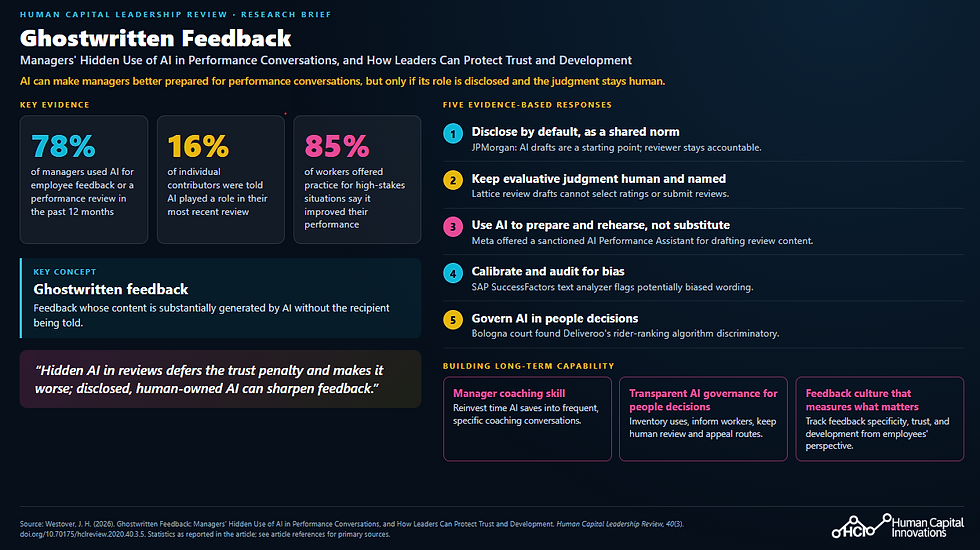
Abstract: Generative AI has moved quietly into one of the most personal tasks in management: writing feedback and performance reviews. A 2026 survey of more than 1,000 U.S. corporate professionals found that 78% of managers had used AI for feedback or reviews in the prior year, yet only 16% of individual contributors had been told that AI played a role in their latest review. This article examines what undisclosed, AI-assisted feedback does to trust, feedback quality, fairness, and employee development. Drawing on research on AI disclosure, AI-mediated communication, feedback intervention theory, organizational justice, automation bias, and gendered review language, it argues that the central risk is less the tool than the substitution of machine fluency for managerial judgment. Five evidence-based responses are outlined: disclosure norms, human ownership of evaluative judgment, AI for preparation and rehearsal, bias calibration, and governance aligned with emerging regulation such as the EU AI Act. Organizational examples span technology, finance, logistics, platform work, and government.
Picture an analyst reading her year-end review. The paragraphs are polished, balanced, and oddly frictionless. The praise is warm but could describe almost anyone on the team. The development section recommends "continuing to build stakeholder influence," a phrase she has seen in a colleague's review as well. She cannot point to anything false. She simply cannot find her manager in it. And so she starts to wonder whether her manager wrote it at all.
That small moment of doubt is now a structural feature of working life. In August 2026, Highwire, the professional development firm founded by Knopman Marks, surveyed 1,034 U.S. full-time corporate professionals at organizations with at least 100 employees. Among the 321 people managers, 78% said they had used an AI tool for employee feedback or a performance review in the previous 12 months. Among the 713 individual contributors, only 16% said they had been told that AI played a role in their most recent review, and about 40% either suspected undisclosed use or were unsure (Highwire, 2026). The survey is unweighted and self-reported, so it should be read as a strong signal rather than a precise population estimate. Still, the shape of the gap is hard to miss: AI is widely present in performance conversations, and largely invisible to the people on the receiving end.
Several forces make this a pressing leadership issue rather than a curiosity. Large employers have begun to treat AI use as a performance expectation in its own right, which nudges managers toward using it everywhere, including in reviews (Bird, 2025; Mann, 2025). HR software vendors now ship features that draft review text from performance data (Sablon, 2026). Managers report entering employee names and performance details into public AI tools (Moody, 2026). Meanwhile, regulators have classified AI used to evaluate workers as high-risk under the European Union's AI Act, with deployer obligations that include telling workers about such systems (European Parliament & Council of the European Union, 2024).
The stakes are practical. Performance feedback shapes pay, promotion, assignments, and how people understand their own growth. It is also one of the clearest signals of whether a manager is paying attention. When that signal is outsourced without acknowledgment, organizations risk a slow erosion of trust that no engagement survey will catch until it is expensive. When it is used thoughtfully, AI can help managers prepare, practice, and write more specific feedback than many would produce alone. The question for leaders is not whether AI belongs anywhere near performance conversations. It is which parts of the conversation it should touch, under what norms, and with whose name on the judgment.
This article maps the landscape of AI-assisted feedback, reviews the evidence on its consequences, and sets out five organizational responses, followed by three pillars for building long-term, human-centered performance capability.
The Ghostwritten Feedback Landscape
Defining Key Terms
AI-assisted feedback refers to any use of generative AI to prepare, draft, edit, or summarize feedback that a manager gives an employee, whether in a formal review or an informal conversation. It sits within the broader category of AI-mediated communication, which Hancock et al. (2020) define as interpersonal communication in which an intelligent agent operates on behalf of a communicator by modifying, augmenting, or generating messages. The defining feature is that the recipient believes they are hearing from a person, while part of what they hear was shaped by software.
Ghostwritten feedback, the term used in this article, describes the narrower case in which AI substantially generates the content of feedback and the recipient is not told. Ghostwriting is not new in organizations; executives have long had speechwriters. What makes feedback different is that its value depends heavily on the recipient's belief that the sender observed them, weighed what they saw, and chose words for them specifically.
Disclosure means telling the recipient, in plain language, what role AI played. Human ownership of judgment means that a named person forms and is accountable for the evaluative conclusions in a review, such as ratings, strengths, and development needs, even when AI helped organize evidence or wording. Automation bias is the tendency to over-rely on automated recommendations, both by missing problems the system fails to flag and by acting on its incorrect suggestions (Parasuraman & Manzey, 2010).
Finally, it helps to distinguish two kinds of AI in performance management. One is algorithmic evaluation, in which a system scores, ranks, or predicts worker performance, as in productivity quotas or rider rankings. The other is generative assistance, in which a manager uses a language model to help write. The second looks harmless next to the first, but the line blurs quickly. A draft that summarizes a year of work, selects which evidence to emphasize, and proposes a rating is doing evaluative work, whatever the interface calls it.
Prevalence, Drivers, and Distribution
The Highwire (2026) data suggest that AI use in feedback has become the norm among managers rather than the exception. Other surveys point in the same direction. In a June 2025 survey of 1,342 U.S. managers commissioned by ResumeBuilder.com, about six in ten said they used AI to make decisions about their direct reports, and among those users large majorities reported using it for raises and promotions (O'Bannon, 2025). The Predictive Index surveyed 399 managers and 208 CEOs and business leaders in 2026 and found that 72% of managers considered public AI tools useful for preparing difficult conversations, 44% had entered employee names and performance details into such tools, and only 45% of organizations had a formal written policy on AI use in performance management (Moody, 2026).
Three drivers stand out. The first is workload. Performance management has long been criticized as a heavy administrative ritual that is disconnected from the daily work of setting expectations and coaching (Pulakos & O'Leary, 2011). Review season compresses that burden into a few weeks, and a tool that turns notes into paragraphs is understandably attractive.
The second driver is skill. Many managers find feedback hard to write and harder to deliver. Managers in the Predictive Index survey said they struggled most with delivering constructive criticism, anticipating reactions, and staying objective (Moody, 2026). Gallup has reported that only 14% of employees strongly agree that their reviews inspire them to improve (Asplund & Wigert, 2021). AI promises to cover the gap between what managers know they should say and what they can comfortably put into words.
The third driver is institutional signaling. In April 2025, Shopify chief executive Tobi Lütke told employees that reflexive AI use was a baseline expectation and that AI use would be built into performance and peer review questions (Bird, 2025). Weeks later, Duolingo announced an AI-first strategy that included assessing AI use in performance reviews (Munis, 2026). At Microsoft, Julia Liuson, who leads the developer division, told managers in mid-2025 that AI use was now core to every role and should factor into assessments of performance and impact (Broomfield, 2025). Meta's head of people informed staff that AI-driven impact would become a core expectation in reviews from 2026, and the company rolled out an internal AI Performance Assistant to help employees draft performance content (Mann, 2025). When the organization rewards AI use, managers reasonably infer that using it to write reviews is not only acceptable but expected.
Distribution is uneven in ways that matter. The Highwire (2026) survey found that 73% of managers had been offered practice for high-stakes situations, compared with 44% of employees. Managers, in other words, are both the heaviest users of AI in the review process and the group with the most support for rehearsing difficult moments. Employees, who receive the output, have the least visibility into how it was produced. The asymmetry is the heart of the trust problem.
The gap between use and disclosure is wide, and perceptions of quality are split. In the Highwire (2026) data, 54% of respondents said feedback became more specific and actionable once AI entered the process, while 34% said it became more generic and 32% said it became less useful. Those figures are not contradictory. They suggest that AI amplifies whatever the manager brings: good notes and real observation become sharper, while thin attention becomes fluent filler.
Organizational and Individual Consequences
Organizational Performance Impacts
The most robust evidence on AI and feedback comes from a field experiment by Tong et al. (2021), who separated two effects that usually travel together. The deployment effect is the benefit of AI-generated feedback itself, which can be more accurate and data-rich than what a human supervisor produces. The disclosure effect is how employees react once they learn the feedback came from AI. Tong et al. (2021) found both: AI feedback improved performance through better quality, but disclosing its AI origin reduced performance as employees viewed it more negatively. The negative disclosure effect was weaker for employees with longer tenure. The lesson is not that organizations should hide AI. It is that the value of feedback depends on both its content and the relationship it signals, and that these can move in opposite directions.
Feedback intervention theory helps explain why. In their meta-analysis of 607 effect sizes, Kluger and DeNisi (1996) found that feedback improved performance on average, but more than one-third of feedback interventions actually reduced it. Their explanation was that feedback works when it directs attention to the task and to learning, and backfires when it shifts attention toward the self. Generic, polished feedback is a poor tool for directing attention to specific behaviors. Worse, a review that triggers suspicion about authorship pulls attention toward exactly the wrong question: not "what should I do differently?" but "does my manager care enough to write this?"
There is also a quieter cost to managerial capability. Writing feedback forces a manager to retrieve observations, weigh them, and commit to a view. When AI does that synthesis, managers may sign conclusions they never formed. Research on automation bias shows that people relying on imperfect decision aids both miss errors the aid does not flag and act on its incorrect advice, and that training and instructions do not reliably prevent this (Parasuraman & Manzey, 2010). In a performance context, the omission error is a missed contribution that never made it into the system; the commission error is an AI-suggested weakness that the manager accepts without checking. Over time, a manager who outsources synthesis may lose some of the observational habits that made their feedback valuable.
Performance appraisal research has long emphasized that ratings serve multiple purposes and are shaped by rater cognition, rater motivation, and organizational context (DeNisi & Murphy, 2017). Generative AI adds a new source of variance to that system: the tool's defaults. If every manager in a function uses the same assistant with similar prompts, reviews may converge on the same vocabulary and structure. That can look like consistency. It can also flatten real differences between employees and make calibration harder, because calibration depends on reviews that carry distinct, evidence-based signals.
Finally, there is a data governance cost. When 44% of managers report entering employee names and performance details into public AI tools (Moody, 2026), confidential personnel information is leaving organizational control. That is a privacy problem, a legal exposure, and a breach of the implicit promise that performance conversations are handled with care.
Individual Wellbeing and Stakeholder Impacts
For employees, the central impact is on trust. Schilke and Reimann (2025) reported 13 experiments, involving supervisors, subordinates, professors, analysts, and other actors, showing that people who disclose AI use are trusted less than those who do not. The mechanism was reduced perceived legitimacy: audiences still expect human effort in work that signals judgment and care. Critically, the trust penalty was larger when AI use was exposed by a third party than when it was self-disclosed. Concealment does not avoid the penalty; it defers it and makes it worse.
Research on AI-mediated communication reinforces the point. In experiments by Hohenstein et al. (2023), AI-suggested replies made conversations more efficient and more positive in tone, but people suspected of using them were rated as less cooperative and evoked less affiliation, even when the suspicion was mistaken. Glikson and Asscher (2023) found that apologies written with AI assistance were perceived as less authentic and drew less willingness to forgive, and that disclosure did not remove the penalty, although limited use of AI tools did not harm authenticity. Liu et al. (2022) found a modest decline in trust as emails were framed as more AI-involved, and interviewees described AI-written personal messages as signaling low effort.
Feedback sits squarely in this territory. It is personal, it carries emotional weight, and its credibility rests on the recipient's sense that the sender paid attention. The roughly 40% of individual contributors in the Highwire (2026) survey who suspect undisclosed use or are unsure are already living with the cost described by Hohenstein et al. (2023): suspicion alone changes how messages are received.
Fairness is the second major impact. Colquitt (2001) validated four distinct dimensions of organizational justice: distributive (fair outcomes), procedural (fair processes), interpersonal (respectful treatment), and informational (adequate explanations). Undisclosed AI in reviews touches at least three. It weakens informational justice, because employees do not know how the evaluation was produced. It threatens procedural justice when they cannot tell whether a person or a model selected the evidence. And it can strain interpersonal justice when generic language reads as indifference.
Bias is a related concern. Correll and Simard (2016) found in reviews from technology and professional services firms that women were less likely than men to receive specific feedback tied to business outcomes, and more likely to receive vague praise or criticism about communication style. Generative models do not necessarily correct this pattern. In an informal analysis of ChatGPT-written feedback, Snyder (2023) found that the model often inferred gender from job titles and that feedback for women ran longer, with the extra length typically adding criticism. In a peer-reviewed study, Wan et al. (2023) documented significant gender bias in both the language style and lexical content of reference letters generated by large language models. A manager who asks AI to "write a balanced review" may receive text that quietly reproduces the very patterns that equitable feedback practices try to eliminate.
The third impact concerns development and the freedom to learn. Highwire (2026) found that only 46% of employees feel they can make mistakes without having them held against them, that 42% of managers say mistakes can lead them to limit future assignments, and that 15% of workers believe AI gets more room than employees to correct a mistake and try again. The last figure deserves attention. When organizations treat AI errors as iterations and employee errors as evidence, people learn to hide their own. That climate also shapes how ghostwritten feedback lands: if employees already doubt that mistakes are safe, a review they suspect was assembled by software feels less like coaching and more like a file being built.
The manager's development is a stakeholder concern too. WTW's 2026 Employee Experience Global Market Study, covering 7,000 employees in five countries, reported that the share of employees saying their manager helps develop their abilities fell from 84% to 78% over four years, while only about 30% of organizations had processes to identify, assess, and track skills (WTW, 2026). AI could help reverse that slide by freeing managers' time for coaching. It could also accelerate it if the time saved on writing reviews is not reinvested in the conversations that matter.
Evidence-Based Organizational Responses
The research and the organizational experience reviewed above point to five responses. None requires banning AI from performance management, and none treats AI as a neutral productivity tool. Each is designed to keep the benefits of better-prepared, more specific feedback while protecting what makes feedback worth receiving: a person's attention and accountable judgment. Table 1 summarizes the responses, their evidence base, key practices, and illustrative examples.
Table 1: Five evidence-based responses to AI in performance conversations
Response | Evidence Base | Key Practices | Illustrative Examples |
Disclose by default | Schilke & Reimann (2025); Tong et al. (2021); Hohenstein et al. (2023) | Plain-language disclosure line; shared norm across managers; explain AI's role and limits | JPMorgan guidance; Meta AI Performance Assistant |
Keep judgment human and named | Parasuraman & Manzey (2010); Colquitt (2001) | Manager forms ratings first; AI cannot set ratings; documented rationale | Lattice review drafts; IBM pay recommendations; OPM email review |
Use AI to prepare and rehearse, not substitute | Highwire (2026); Glikson & Asscher (2023); Kluger & DeNisi (1996) | Evidence gathering; role-play; limited editing; private tools only | Predictive Index findings; JPMorgan in-house tool |
Calibrate and audit for bias | Correll & Simard (2016); Wan et al. (2023); Snyder (2023) | Evidence-linked feedback; language audits; calibration sessions | SAP Text Analyzer; Lattice evidence citations |
Govern AI in people decisions | EU AI Act; Colorado SB 26-189; Deliveroo ruling | Inventory uses; inform workers; appeal routes; review AI-use metrics | Deliveroo Bologna case; California AB 701; Duolingo reversal; Lattice digital workers |
Disclose by Default, as a Shared Norm
The disclosure evidence presents a real dilemma. Schilke and Reimann (2025) show that disclosing AI use lowers trust, while Tong et al. (2021) show that disclosure can reduce the performance benefit of AI feedback. A manager reading only those findings might conclude that silence is safer. The same research argues the opposite. Exposure by others is more damaging than self-disclosure (Schilke & Reimann, 2025), and suspicion alone carries a social cost (Hohenstein et al., 2023). In a workplace where 40% of employees already suspect undisclosed use (Highwire, 2026), the real choice is not between disclosure and invisibility. It is between disclosure on the manager's terms and discovery on someone else's.
The way out of the dilemma is to make disclosure a norm rather than an individual confession. Schilke and Reimann (2025) attribute the trust penalty to reduced legitimacy, and legitimacy is socially constructed. When an organization openly sanctions specific uses of AI in reviews and every manager discloses in the same way, disclosure stops signaling a shortcut and starts signaling compliance with a known standard. Tong et al. (2021) similarly suggest that clear communication about AI's objectives, benefits, and scope can soften the disclosure effect.
Effective approaches:
Standard disclosure language: Provide a short, consistent statement for reviews, such as noting that AI helped organize notes or suggest wording and that the manager wrote and stands behind the assessment.
Specify the role, not just the presence: Distinguish between AI used to summarize evidence, to edit for clarity, and to draft text, since recipients judge these very differently.
Explain the boundaries: Tell employees what AI was not used for, especially ratings, pay, and promotion decisions.
Make it organizational, not personal: Announce the policy before review season so no individual manager carries the burden of being the first to disclose.
Invite questions: Give employees a simple route to ask how their review was prepared without it feeling like an accusation.
JPMorgan Chase began allowing employees in late 2025 to use its in-house large language model to help draft year-end reviews. According to reporting on the bank's internal guidance, AI-generated text was to serve only as a starting point, the person submitting a review remained accountable for its final content, and the tool would not be used in pay or bonus decisions (Dungan, 2025). Whatever one thinks of the tool, the guidance does what individual disclosure cannot: it sets a shared expectation about what AI does and does not do in the review process.
Meta took a comparably open approach for its 2025 review cycle, introducing an AI Performance Assistant and allowing employees to use internal and external assistants to draft performance content (Mann, 2025). Making AI use visible and sanctioned at the company level changes what a disclosure means. It becomes a description of a common process rather than an admission.
A common pitfall is treating disclosure as a legal footnote. A line buried at the bottom of a review form satisfies a checklist but does nothing for trust. Disclosure works when it is specific, consistent, and paired with evidence that the manager engaged personally with the content.
Keep Evaluative Judgment Human and Named
If disclosure addresses how AI's role is communicated, the second response addresses what that role should be. The research on automation bias is sobering: reliance on decision aids produces both missed problems and mistaken actions, among novices and experts alike, and training alone does not prevent it (Parasuraman & Manzey, 2010). In performance reviews, the decisions that matter most are evaluative: what rating, what strengths, what development needs, what consequences. Those decisions should be formed by a person before AI is asked to help express them.
Justice research gives a second reason. Procedural and informational justice depend on employees understanding how decisions were reached and who is responsible for them (Colquitt, 2001). A rating that emerged from a model's summary of a year's data, lightly edited by a busy manager, fails that test even if the rating happens to be accurate.
AI can do substantial work in preparing evidence and rehearsing a conversation. Its role should narrow as the conversation moves toward judgment and delivery, where a named human must own the conclusions.
Effective approaches:
Judgment before drafting: Require managers to record their rating and two or three key observations before opening any AI drafting tool.
No AI-selected ratings: Configure tools so they cannot propose or set ratings, pay outcomes, or promotion recommendations.
Rationale in the manager's words: Ask for a short, unassisted rationale for each rating that can be shared with the employee and calibration panels.
Disagreement as a metric: Track how often managers change AI-suggested content; near-zero editing is a warning sign of rubber-stamping.
Clear accountability: State in policy that the manager is the author of record for every evaluative statement.
Lattice designed its Evidence-based Review Drafts, launched in July 2026, so that its AI agent drafts answers to open-text review questions from data already in the system, but cannot select ratings or submit reviews; the reviewer remains accountable for accuracy, tone, and submission. The agent also flags questions with thin data rather than generating generic text (Sablon, 2026). The design embodies the principle that AI can assemble evidence while a person owns the verdict.
IBM's earlier experience with machine learning in compensation shows why such design choices matter. The company used a system that recommended salary increases while leaving final decisions with managers, and reported that fewer than 5% of managers disagreed with the recommendations (Sammer, 2019). A low disagreement rate can mean the model is good. It can also mean managers have stopped exercising independent judgment, which is precisely the pattern automation bias research predicts (Parasuraman & Manzey, 2010).
The U.S. Office of Personnel Management episode in February 2025 illustrates the opposite extreme. Federal workers were asked by email to list what they had accomplished the previous week, and NBC News reported, citing people familiar with the plan, that responses would be fed into a large language model to help judge whether jobs were mission-critical; OPM did not say whether humans would review the outputs (Kube et al., 2025). Whatever the eventual use, the episode showed how quickly employees lose confidence when it is unclear whether a person or a model is evaluating their work.
A common pitfall is assuming that a human click equals human judgment. A manager who accepts an AI draft with minor edits has technically remained "in the loop" while ceding the substance of the evaluation. Ownership must be designed into the sequence of work, not asserted in a policy.
Use AI to Prepare and Rehearse, Not to Substitute
The most promising uses of AI in performance conversations happen before the conversation, not in place of it. Highwire (2026) found that 25% of professionals had used AI to rehearse a difficult conversation, and among workers who had been offered practice for high-stakes situations, 85% said it improved their performance. Yet practice is unevenly distributed: 50% of managers but only 32% of employees said they get to practice before their performance counts (Highwire, 2026).
Rehearsal fits what feedback intervention theory says effective feedback requires. Kluger and DeNisi (1996) found that feedback helps when it keeps attention on the task and learning. A manager who has practiced a difficult conversation is better able to stay specific, anticipate defensiveness, and keep the discussion on behavior rather than identity. Glikson and Asscher (2023) offer a further clue: limited use of AI tools did not harm the perceived authenticity of a message, whereas heavier reliance did. AI that helps a manager think and practice leaves the final words recognizably theirs.
Interestingly, Highwire (2026) also found that the top ways workers say they would feel most prepared are human: practicing and receiving feedback (22%), watching an experienced person handle the situation (20%), and getting advice from a manager or coach (19%). AI rehearsal is most useful as a bridge to those human forms of preparation, not a replacement for them.
Effective approaches:
Evidence assembly: Use AI to collect and organize a period's goals, notes, and peer input so the manager starts from a complete record rather than recent memory.
Role-play the hard part: Ask AI to play an employee who disagrees, becomes upset, or raises a fairness concern, and practice responses aloud.
Stress-test wording: Have AI flag vague phrases or unsupported claims in a manager's own draft rather than generating the draft.
Extend rehearsal to employees: Offer employees the same tools to prepare for their reviews and career conversations, narrowing the practice gap.
Keep data inside the walls: Restrict personnel data to approved, enterprise-grade tools with clear retention and privacy terms.
The Predictive Index survey illustrates both the appetite and the risk. Close to three in four managers found public AI tools useful for preparing difficult conversations, but 44% had entered employee names and performance details into those tools, and fewer than half of organizations had a written policy on AI in performance management (Moody, 2026). Organizations such as JPMorgan that route review assistance through an in-house model (Dungan, 2025) and Meta, which provided its own AI Performance Assistant and internal Metamate assistant alongside an approved external tool (Mann, 2025), reduce at least the data exposure risk by giving managers sanctioned alternatives to unvetted public tools.
A common pitfall is letting rehearsal tools become scripting tools. A manager who practices with AI and then reads the AI's best lines in the actual meeting has turned preparation into substitution. Rehearsal should end with the manager's own notes, not with a script.
Calibrate and Audit for Bias
AI can help or harm the fairness of feedback, and which one happens depends on how it is used. The baseline problem predates AI. Correll and Simard (2016) showed that women received vaguer, less outcome-linked feedback than men, which deprives them of the specific guidance that supports advancement. Language models trained on human text can reproduce those patterns. Wan et al. (2023) found significant gender differences in AI-generated reference letters, and an analysis of ChatGPT-written feedback by Snyder (2023) found gendered assumptions and more critical content in feedback for women.
The constructive use of AI here is as a checker rather than a writer. The same models that can generate biased text can be used to scan a manager's own draft for vague language, unsupported personality judgments, or inconsistent standards across team members. Calibration sessions, in which managers compare ratings and evidence across a group, become more important in an AI-assisted process because they are one of the few places where tool-induced sameness and subtle bias can be noticed.
Effective approaches:
Evidence-linked statements: Require each piece of developmental feedback to reference a specific outcome, behavior, or example.
Language audits: Run reviews through checks for vague praise, personality labels, and gendered descriptors before submission.
Cross-team comparisons: In calibration, compare the specificity and length of feedback across demographic groups, not just ratings.
Test the tool: Before deployment, give the AI matched prompts that differ only by name or pronoun and compare outputs.
Watch for sameness: Flag reviews that share large blocks of near-identical language, which suggests templated AI output.
SAP added a text analyzer to its SuccessFactors suite in its second-half 2024 release to help employees word goals, comments, and profile content more carefully, and the company describes the tool as flagging potentially biased or harmful wording in workplace feedback and suggesting more inclusive alternatives as people write (SAP, n.d.; Woelke, 2024). The underlying idea, using AI to interrogate human-written text rather than replace it, is the right direction, though organizations should treat vendor claims about impact as hypotheses to test locally.
Lattice's design choice to tie every drafted statement to specific data in the system and to flag thin evidence rather than produce generic text (Sablon, 2026) addresses the vagueness problem that Correll and Simard (2016) identified. Whether it works in practice depends on whether managers fill the evidence gaps the tool exposes or simply accept the draft.
A common pitfall is assuming that a bias-checking tool certifies fairness. Language audits catch surface patterns. They cannot detect whether a manager overlooked someone's best work, or whether the evidence fed into the system was itself skewed by who gets visible assignments.
Govern AI in People Decisions Under Emerging Regulation
The fifth response moves from individual practice to organizational governance, which is increasingly a legal matter. Annex III of the EU AI Act classifies as high-risk any AI system intended to make decisions affecting terms of work relationships, promotion, or termination, to allocate tasks based on individual behavior or traits, or to monitor and evaluate the performance and behavior of workers (European Parliament & Council of the European Union, 2024). Article 26 requires deployers of such systems to assign human oversight to people with the necessary competence and authority, to retain system logs, and, before putting a system into use at the workplace, to inform workers' representatives and affected workers. The 2026 Digital Omnibus on AI moved the application date for stand-alone Annex III obligations from August 2026 to December 2, 2027 (Pearce & Nietsch, 2026). The delay gives organizations time, not an exemption.
In the United States, the regulatory picture is fragmented. Colorado replaced its 2024 AI Act with SB 26-189, signed in May 2026 and effective January 1, 2027, which focuses on disclosure for automated decision-making technology that materially influences consequential decisions, including in employment. Employers must give notice before use and, after an adverse outcome, a plain-language explanation and a route to request human review (Seyfarth Shaw LLP, 2026). Whether a given review-drafting tool is covered will depend on whether it materially influences a consequential decision and produces a score, ranking, or prediction. New York City's Local Law 144, enforced since July 2023, requires bias audits, published audit results, and notices for automated employment decision tools (Hunton Andrews Kurth LLP, 2023). It is aimed at tools that screen candidates for employment decisions rather than at routine feedback, which is a reminder that compliance with one law does not equal governance of AI in performance management.
Effective approaches:
Inventory every use: Map where AI touches performance processes, including unofficial use of public tools, and classify each by its influence on decisions.
Inform before deploying: Tell employees and, where relevant, their representatives what systems are used, for what, and with what human oversight.
Provide an appeal route: Give employees a clear way to request human review of any evaluation they believe was shaped by AI.
Govern AI-use metrics: If AI adoption is itself a review criterion, define it by outcomes rather than usage counts and review its effects.
Assign an owner: Make a cross-functional group, including HR, legal, and employee representatives, accountable for AI in people decisions.
Deliveroo learned the cost of opaque algorithmic evaluation in Italy. In an order dated December 31, 2020, the Bologna labor court found that the company's rider-ranking system, which scored riders on reliability and participation and gave higher scorers first access to work sessions, was discriminatory because it did not distinguish absences for legally protected reasons such as illness or strikes; Deliveroo was ordered to pay €50,000 and said the system was no longer in use (Lomas, 2021). The case predates generative AI, but its logic applies directly: an evaluation system that cannot account for context will treat protected reasons and poor performance alike.
California's AB 701, signed in September 2021, took aim at warehouse productivity quotas at large retailers including Amazon, requiring employers to disclose quotas to workers and allowing workers to request records of their own work-speed data (Associated Press, 2021). Its central principle, that people evaluated by a system have a right to know the standard being applied, is the same one that should guide AI in reviews.
Duolingo offers a lesson in governing AI-use metrics. After announcing in 2025 that AI use would factor into performance reviews, the company backed away in 2026; its chief executive said the most important thing was doing the job well and that AI should not be forced where it does not fit (Munis, 2026). Lattice faced a different governance lesson in July 2024, when it announced plans to give AI "digital workers" employee records and performance management, then paused after public criticism over whether AI tools were being treated like people (DeRose, 2024). Both episodes show that how AI is positioned in the performance system sends a message to employees as loud as any policy text.
A common pitfall is treating governance as a procurement checkbox. Most AI in reviews today enters through general-purpose tools that managers adopt on their own, not through vendor systems that pass a compliance review. Governance that ignores informal use governs the smallest part of the problem.
Building Long-Term Human-Centered Performance Capability
The five responses address immediate risks. Over the longer term, the deeper question is what kind of performance capability organizations want to build as AI becomes a permanent part of management work. Three pillars stand out.
Manager Coaching Skill as a Core Competency
The decline in employees who say their manager helps develop their abilities (WTW, 2026) is a warning that managerial coaching is eroding at the same moment AI is making it easier to skip. Organizations should treat coaching skill as a core management competency, assessed and developed with the same seriousness as financial or technical skill. That means training managers to observe, take notes throughout the year, and hold specific, forward-looking conversations, then using AI as a practice partner rather than a ghostwriter.
The time AI saves on drafting is the most important resource here. If a manager spends three fewer hours writing reviews, leaders should ask where those hours go. The best answer is more frequent, shorter conversations, which is what Pulakos and O'Leary (2011) argued performance management needed long before generative AI. AI can make annual reviews lighter; it should make continuous coaching heavier.
Organizations should also measure the quality of managers' feedback directly, through employee ratings of specificity and usefulness, rather than inferring it from completion rates. A manager whose reviews are finished on time but rated as generic has a development need that no tool will fix.
Transparent AI Governance for People Decisions
The second pillar treats AI in performance management as a standing governance domain rather than a series of tool decisions. That requires a clear inventory of uses, published norms on disclosure, explicit boundaries on what AI may and may not do, and regular review of outcomes. It also requires a decision about AI-use metrics. When companies make AI adoption part of performance evaluation, as Shopify, Microsoft, and Meta signaled they would (Bird, 2025; Broomfield, 2025; Mann, 2025), they create incentives that reach into the review process itself. Duolingo's reversal (Munis, 2026) suggests that outcome-based expectations are more defensible than usage-based ones.
Governance should be prepared for the EU AI Act's December 2027 deadline and Colorado's January 2027 effective date, but it should not be limited to them. The underlying principles of informing workers, assigning competent human oversight, retaining records, and providing routes to human review are good practice anywhere. Organizations that build them now will find compliance easier and, more importantly, will give employees reasons to believe the system is fair.
Transparency should run in both directions. If employees are expected to disclose their AI use in self-reviews, managers should disclose theirs in downward reviews. The Highwire (2026) finding that 15% of workers believe AI gets more room than employees to correct a mistake points to a perceived double standard that governance should address explicitly.
A Feedback Culture That Measures What Matters
The third pillar is cultural. Feedback is valuable only in a climate where people believe it is offered in good faith and can act on it without fear. Highwire (2026) found that fewer than half of employees feel mistakes will not be held against them and that two-thirds have changed their behavior to protect themselves. Ghostwritten feedback lands badly in such a climate because it reinforces the suspicion that the review is a record rather than a conversation.
Building a healthier culture means measuring feedback from the recipient's side. Useful indicators include whether employees understand how their reviews were prepared, whether they found feedback specific and actionable, whether they have had a meaningful development conversation in the past quarter, and whether they trust the fairness of the process. These measures can be tracked over time and compared across teams, providing early warning of where AI is substituting for attention.
Culture also includes how leaders talk about AI. Leaders who describe AI as a way to give managers more time for people, and who model that by disclosing their own use and coaching visibly, set a different tone than those who describe it as a way to get through review season faster.
Conclusion
The rapid spread of AI in performance conversations is not, by itself, a crisis. Managers have always used help to write: templates, HR guidance, a trusted colleague's eye. What is new is the scale, the fluency, and the invisibility. When 78% of managers use AI for feedback and only 16% of employees are told (Highwire, 2026), the organization is running a large, unannounced experiment on trust.
The evidence suggests that experiment is risky. Disclosure carries a trust cost, but discovery carries a larger one (Schilke & Reimann, 2025). Suspicion alone changes how messages are received (Hohenstein et al., 2023). Feedback that pulls attention away from the task can harm performance (Kluger & DeNisi, 1996), and AI can reproduce the vague, gendered patterns that have long disadvantaged some employees (Correll & Simard, 2016; Wan et al., 2023). At the same time, AI can improve feedback quality when it supports rather than replaces a manager's judgment (Tong et al., 2021), and practice before high-stakes conversations makes a measurable difference to the people who get it (Highwire, 2026).
The path forward is to put AI where it strengthens human attention and keep it away from where it replaces it. That means disclosure as a shared norm, judgment that is human and named, AI as a rehearsal partner rather than a ghostwriter, active bias checking, and governance that anticipates regulation rather than reacting to it. Leaders who get this right will not only avoid the costs of ghostwritten feedback. They will have managers who are better prepared, employees who trust what they hear, and a performance system that develops people rather than merely documenting them.
Close the disclosure gap: Set an organization-wide norm for disclosing AI's role in reviews before the next review cycle, so disclosure signals a standard rather than a shortcut.
Judge first, draft second: Require managers to record their own ratings and key observations before using any AI drafting tool.
Invest the time saved: Redirect hours saved on writing into more frequent, shorter coaching conversations.
Practice, don't script: Use AI to rehearse difficult conversations and stress-test wording, and extend the same tools to employees.
Check the language: Audit reviews for vagueness, sameness, and gendered patterns, and compare feedback specificity across groups in calibration.
Protect the data: Keep personnel information out of public AI tools and provide sanctioned enterprise alternatives.
Govern ahead of the law: Inventory AI uses in performance management and prepare to inform workers and offer human review, in line with EU and Colorado requirements.
Research Infographic
References
Asplund, J., & Wigert, B. (2021, July 12). 11 ways to improve performance reviews. Gallup.
Associated Press. (2021, September 23). Newsom signs bill targeting productivity quotas at warehouses run by Amazon, major retailers. CBS News San Francisco.
Bird, J. (2025, April 8). Shopify CEO calls for reflexive AI use as "baseline expectation," no headcount growth until options explored. Workplace Journal.
Broomfield, B. (2025, July 1). "No longer optional": Is it OK for Microsoft to make employee AI usage mandatory? HR Grapevine.
Colquitt, J. A. (2001). On the dimensionality of organizational justice: A construct validation of a measure. Journal of Applied Psychology, 86(3), 386–400.
Correll, S. J., & Simard, C. (2016, April 29). Research: Vague feedback is holding women back. Harvard Business Review.
DeNisi, A. S., & Murphy, K. R. (2017). Performance appraisal and performance management: 100 years of progress? Journal of Applied Psychology, 102(3), 421–433.
DeRose, A. (2024, August 12). Lattice CEO explains "big misunderstanding" over AI rollout. HR Brew.
Dungan, R. (2025, October 27). JPMorgan introduces AI for staff performance reviews. HR Grapevine.
European Parliament & Council of the European Union. (2024). Regulation (EU) 2024/1689 laying down harmonised rules on artificial intelligence (Artificial Intelligence Act). Official Journal of the European Union.
Glikson, E., & Asscher, O. (2023). AI-mediated apology in a multilingual work context: Implications for perceived authenticity and willingness to forgive. Computers in Human Behavior, 140, Article 107592.
Hancock, J. T., Naaman, M., & Levy, K. (2020). AI-mediated communication: Definition, research agenda, and ethical considerations. Journal of Computer-Mediated Communication, 25(1), 89–100.
Highwire. (2026, October 6). Who's managing whom? New research reveals how AI is upending the value of people managers and its effects on the next generation of talent [Press release]. GlobeNewswire.
Hohenstein, J., Kizilcec, R. F., DiFranzo, D., Aghajari, Z., Mieczkowski, H., Levy, K., Naaman, M., Hancock, J., & Jung, M. F. (2023). Artificial intelligence in communication impacts language and social relationships. Scientific Reports, 13, Article 5487.
Hunton Andrews Kurth LLP. (2023, April 26). NYC DCWP adopts rules to implement law governing automated employment decision tools and sets July enforcement date. Privacy & Cybersecurity Law Blog.
Kluger, A. N., & DeNisi, A. (1996). The effects of feedback interventions on performance: A historical review, a meta-analysis, and a preliminary feedback intervention theory. Psychological Bulletin, 119(2), 254–284.
Kube, C., Tsirkin, J., Alcindor, Y., Strickler, L., & Gregorian, D. (2025, February 24). DOGE will use AI to assess the responses of federal workers who were told to justify their jobs via email. NBC News.
Liu, Y., Mittal, A., Yang, D., & Bruckman, A. (2022). Will AI console me when I lose my pet? Understanding perceptions of AI-mediated email writing. In Proceedings of the 2022 CHI Conference on Human Factors in Computing Systems. Association for Computing Machinery.
Lomas, N. (2021, January 4). Italian court rules against "discriminatory" Deliveroo rider-ranking algorithm. TechCrunch.
Mann, J. (2025, November 14). Meta is about to start grading workers on their AI skills. Business Insider.
Moody, K. (2026, August 21). Managers say they are using public AI tools to prepare for hard conversations. HR Dive.
Munis, J. (2026, April 13). "I'm not going to force you": Duolingo CEO backs off from evaluating employees on their AI usage. Fortune.
O'Bannon, I. M. (2025, June 30). Half of managers use AI to determine who gets promoted and fired. CPA Practice Advisor.
Parasuraman, R., & Manzey, D. H. (2010). Complacency and bias in human use of automation: An attentional integration. Human Factors, 52(3), 381–410.
Pearce, S., & Nietsch, T. (2026, July 31). EU Digital Omnibus on AI enters into force. National Law Review.
Pulakos, E. D., & O'Leary, R. S. (2011). Why is performance management broken? Industrial and Organizational Psychology, 4(2), 146–164.
Sablon, A. (2026, July 15). Introducing evidence-based review drafts. Lattice.
Sammer, J. (2019, December 9). Bringing artificial intelligence into pay decisions. SHRM.
SAP. (n.d.). Detect and correct bias in workplace communications with AI. SAP.
Schilke, O., & Reimann, M. (2025). The transparency dilemma: How AI disclosure erodes trust. Organizational Behavior and Human Decision Processes, 188, Article 104405.
Seyfarth Shaw LLP. (2026, May 22). Colorado enacts artificial intelligence replacement law. Seyfarth Shaw LLP.
Snyder, K. (2023, January 25). ChatGPT writes performance feedback. Textio.
Tong, S., Jia, N., Luo, X., & Fang, Z. (2021). The Janus face of artificial intelligence feedback: Deployment versus disclosure effects on employee performance. Strategic Management Journal, 42(9), 1600–1631.
Wan, Y., Pu, G., Sun, J., Garimella, A., Chang, K.-W., & Peng, N. (2023). "Kelly is a warm person, Joseph is a role model": Gender biases in LLM-generated reference letters. In Findings of the Association for Computational Linguistics: EMNLP 2023 (pp. 3730–3748). Association for Computational Linguistics.
Woelke, B. (2024, October 28). SAP SuccessFactors second half 2024 product release: Embedding AI across SAP SuccessFactors HCM. SAP News Center.
WTW. (2026, October 7). Uncertainty about future skills is emerging as the next workforce risk, says WTW [Press release]. GlobeNewswire.

Jonathan H. Westover, PhD, Chief Research Officer (Nexus Institute for Work and AI); Co-Founder & Chief Workforce and Learning Officer (Future State University); Founder & CEO (Human Capital Innovations); Professor of Organizational Leadership & Change (UVU). Read Jonathan Westover's executive profile here.
Suggested Citation: Westover, J. H. (2026). Ghostwritten Feedback: Managers' Hidden Use of AI in Performance Conversations, and How Leaders Can Protect Trust and Development. Human Capital Leadership Review, 40(2). doi.org/10.70175/hclreview.2020.40.2.1