

Change Without End: Why Perpetual Restructuring Is Exhausting Workforces and Eroding Trust, and How Leaders Can Pace Change Wisely

Download the article here:

Listen to a review of this article:
Abstract: Organizations have entered a period of near-continuous restructuring, driven by cost pressure, artificial intelligence, and shifting strategy. Recent global surveys indicate that roughly a third of workers affected by change say they experienced more change in the past year than before, that nearly four in ten employees report a reorganization in the past twelve months, and that trust in top management has fallen year over year. This article examines change fatigue, the perception that too much change is happening too fast, as a distinct and measurable workplace risk. Drawing on longitudinal health studies, meta-analytic and review evidence on job insecurity and change reactions, and documented organizational examples across technology, retail, pharmaceuticals, banking, health care, and automotive manufacturing, it shows how cumulative change load erodes well-being, commitment, and trust. It then outlines five evidence-based responses: governing change as a portfolio, involving employees and adapting plans, applying procedural justice, equipping managers as sensemakers, and protecting recovery and stability anchors. It closes with three long-term capabilities for sustainable adaptation.
Ask almost any employee what work has felt like over the past two years and you are likely to hear some version of the same answer: it never stops. A reorganization lands, then a new operating model, then a technology rollout, then a round of cost reductions, then a return-to-office policy, then another reorganization to fix the first one. Each initiative arrives with its own rationale and its own executive sponsor. Rarely does anyone add them up.
The data now confirm what employees have been saying. PwC's 2026 Global Workforce Hopes and Fears Survey, which gathered responses from 49,364 workers across 48 countries and territories and 29 sectors in May and June 2026, found that 34% of workers affected by change strongly or moderately agreed that they had experienced more change in the past year than in previous years (PwC, 2026). The same survey reported that trust in management fell by seven percentage points year over year, and that fewer than half of workers globally now trust top management (PwC, 2026). A week after PwC's release, Workday's 2026 Global Workforce Report noted that nearly four in ten employees said their company had gone through a reorganization or restructuring in the past year, even as internal moves declined at 57% of employers and promotion rates stayed essentially flat (Workday, 2026).
These numbers sit on top of a longer trend. Research by Gartner, summarized in the Harvard Business Review, found that the average employee experienced 10 planned enterprise changes in 2022, compared with 2 in 2016, while employees' willingness to support enterprise change fell from 74% to 43% over the same period (Ó Morain & Aykens, 2023). In other words, organizations have been asking for far more change while the reservoir of goodwill needed to absorb it has drained.
This matters now for three reasons. First, the drivers of change are not easing. Generative and agentic artificial intelligence are prompting leaders to redesign workflows and roles; Gartner reported in March 2026 that 78% of the chief human resources officers it surveyed said workflows and roles must change to capture the value of AI (Gartner, 2026). Second, the people who must translate change into daily work are themselves strained. PwC found that 24% of managers and 31% of senior executives find change difficult to manage (PwC, 2026). Third, the evidence linking poorly managed, repeated restructuring to sickness absence, turnover, and even cardiovascular mortality is not speculative; it comes from long-running cohort studies and systematic reviews (de Jong et al., 2016; Kivimäki et al., 2000; Vahtera et al., 2004).
The practical stakes are straightforward. Every change initiative is a withdrawal from a finite account of attention, energy, and trust. When leaders treat each initiative as if it were the only one, they overdraw that account without noticing. The result is a workforce that complies on the surface, disengages underneath, and greets each new announcement with a shrug. This article sets out what we know about change fatigue, why it is rising, what it costs, and what leaders can do to keep the capacity to adapt without exhausting the people who make adaptation possible.
The Change Fatigue Landscape
Defining Change Fatigue, Change Load, and Change Saturation
Change fatigue refers to employees' perception that too much change is taking place in their organization. Bernerth, Walker, and Harris (2011) developed and validated a scale to measure it, treating it as a distinct construct rather than simply another word for resistance. That distinction matters. Resistance implies that employees object to a particular change; fatigue implies that they may support the direction of travel but lack the capacity to keep absorbing new demands.
A related idea is change load, the cumulative volume of change an employee experiences at once. Herold, Fedor, and Caldwell (2007), studying 25 organizational changes, found that the amount of simultaneous and overlapping change in an employee's environment shaped how individual changes were received. When turbulence was high, employees' confidence in their own ability to handle change mattered more for whether they committed to a given initiative. The implication is that no change happens in isolation; each one is filtered through everything else that is happening.
Researchers have also distinguished the characteristics of change. Rafferty and Griffin (2006) separated the frequency of change, its impact on the individual, and the quality of its planning, showing that these related differently to uncertainty, job satisfaction, and intention to leave. Johnson (2016), working with health care samples, validated a three-factor model of excessive change that captures frequency, extent, and impact, and found that excessive change predicted exhaustion and change-related uncertainty. Stensaker, Meyer, Falkenberg, and Haueng (2002) used the term excessive change to describe situations in which organizations initiate more change than they can implement, leading employees to cope in ways that undermine the intended outcomes.
Finally, it helps to distinguish episodic from continuous change. Weick and Quinn (1999) described episodic change as intermittent and intentional, typically a planned break from equilibrium, and continuous change as ongoing, evolving, and cumulative. Many organizations now experience a hybrid: continuous adaptation at the front line, punctuated by frequent episodic restructurings imposed from the top. Change fatigue emerges most acutely when episodic shocks arrive before the previous ones have been absorbed.
It also helps to place change fatigue within the broader research on how people react to organizational change. Oreg, Vakola, and Armenakis (2011), reviewing six decades of quantitative studies, organized the field into three sets of factors: what recipients bring before the change (their dispositions and the internal context), features of the change itself (its process, its perceived benefits or harms, and its content), and the work-related and personal consequences that follow. Change fatigue sits at the intersection of these categories. It is partly a feature of the internal context, because it reflects the history of change that people carry into each new initiative, and partly a consequence, because each poorly paced change adds to the load. Seen this way, fatigue is less a character flaw of individual employees than an accumulated organizational condition, and it should be managed as one.
Prevalence, Drivers, and Distribution
The prevalence data point in one direction. Beyond the PwC and Workday figures cited above, Gartner's research showed a fivefold increase in planned enterprise changes per employee between 2016 and 2022 (Ó Morain & Aykens, 2023). Gartner has also reported that only 32% of leaders succeed in getting employees to adopt changes in a healthy way (Gartner, n.d.).
Several forces drive this rise. The first is cost pressure combined with AI investment. Intel's restructuring under its chief executive officer Lip-Bu Tan illustrates the pattern. In 2025, the company largely completed a plan to reduce its workforce by about 15%, targeting a core workforce of roughly 75,000 by the end of the year, down from nearly 109,000 at the end of 2024, as part of a broader cost reduction effort; it also scrapped planned projects in Germany and Poland and slowed construction in Ohio (CNN Newsource, 2025). Microsoft eliminated more than 15,000 roles across 2025, including about 9,000 announced in July, while its overall headcount was described as roughly flat and its chief executive publicly acknowledged that the cuts weighed on him (Novet, 2025).
The second driver is structural redesign aimed at speed, often framed as removing bureaucracy. Amazon's chief executive officer announced in September 2024 a return to five days per week in the office from January, a requirement that each organization increase its ratio of individual contributors to managers by at least 15% by the end of the first quarter of 2025, and a new channel for employees to report unnecessary bureaucracy (Day, 2024). Bayer's "Dynamic Shared Ownership" model, introduced under chief executive officer Bill Anderson, eliminated thousands of roles, many of them managerial, after Anderson pointed to twelve layers of hierarchy and more than 1,300 pages of internal rules as obstacles to speed (Clifford, 2025).
The third driver is strategic reversal, in which organizations restructure to undo prior restructuring. Nike provides a clear example. After shifting heavily toward direct-to-consumer sales from 2020, the company laid off hundreds of employees in 2024, and in August 2025 its new chief executive officer reorganized teams away from consumer categories such as men's, women's, and kids' and toward sport-focused units, telling staff that some would report to a new manager or join a new team (Bugeja-Drinkell, 2025). Starbucks, likewise, cut 1,100 corporate roles in February 2025 as part of a turnaround effort ("Starbucks to Cut," 2025), then announced about 900 further job cuts in September 2025, along with store closures expected to reduce its North American footprint by roughly 1% and a restructuring plan costing about $1 billion (Zahn, 2025).
The fourth driver is public sector reform. In March 2025, the UK government announced the abolition of NHS England and the transfer of its functions to the Department of Health and Social Care, alongside large headcount reductions. A December 2025 analysis by the Nuffield Trust and the Institute for Government described this as the biggest restructure of the health service's central command in more than a decade, and noted that reorganization has been a recurring feature of NHS history that has frequently failed to deliver its stated aims (Dayan et al., 2025).
Change fatigue is not evenly distributed. PwC's 2026 data suggest a striking divide within workforces. The survey identified a group it called "front-runners," about 14% of workers, among whom 75% trust top management and 82% trust their immediate manager, and a much larger "engine room" group, about 56% of workers, among whom only 33% trust top management and 40% trust their immediate manager (PwC, 2026). Only 20% of the engine room said recent changes made them optimistic about their organization's future. Access to learning resources showed a similar split: fewer than 40% of the engine room reported access, compared with nearly 80% of front-runners (PwC, 2026). Change, in other words, feels different depending on whether one is designing it or receiving it, and whether one has the resources to adapt.
Seniority does not immunize anyone. PwC found that 31% of senior executives and 24% of managers said they find change difficult to manage (PwC, 2026), and that managers' confidence in their own job security fell by six points year over year. This matters because managers are the channel through which change reaches most employees. When the channel is itself overloaded, the message degrades.
Organizational and Individual Consequences
Organizational Performance Impacts
The most immediate organizational cost of change fatigue is diminished support for change itself. When willingness to support enterprise change falls from roughly three in four employees to fewer than half, as Gartner's data indicate, the odds that any single initiative will achieve its goals decline accordingly (Ó Morain & Aykens, 2023). Gartner has also reported that organizations with above-average change adoption tend to show stronger revenue growth, though this association is correlational and should be interpreted cautiously (Gartner, n.d.).
A second cost is turnover. Trevor and Nyberg (2008) found that downsizing was followed by higher rates of voluntary turnover among the employees who remained, and that certain human resource practices that tie employees to the organization moderated that effect. The irony is sharp: restructuring undertaken to reduce costs can trigger the exit of precisely the people the organization most wants to keep, generating replacement costs and knowledge loss. Replacement is rarely the only cost. When experienced people leave mid-change, the informal knowledge needed to make a new structure work, such as who to call, which workarounds keep processes running, and how customers prefer to be served, often leaves with them. The American Psychological Association's 2017 Work and Well-Being Survey found that 46% of workers who had experienced recent or current organizational change planned to look for a job outside their organization within the next year, compared with 15% of those who had not experienced change (American Psychological Association [APA], 2017).
A third cost is erosion of trust, which then raises the price of every future change. In the same APA survey, 34% of workers affected by change said they did not trust their employer, compared with 12% of those unaffected. Across the full sample, 29% believed management had a hidden agenda and 28% said the real reasons for changes were covered up (APA, 2017). Brown, Kulik, Cregan, and Metz (2017) described a change–cynicism cycle in which repeated, poorly handled change breeds cynicism, which in turn undermines the next initiative. Kiefer (2005) found that ongoing change generated negative emotions through perceptions of an insecure future, worsening working conditions, and inadequate treatment by the organization, and that those emotions predicted lower trust and greater withdrawal one month later.
A fourth cost is the destruction of what downsizing was meant to create. Datta, Guthrie, Basuil, and Pandey (2010), reviewing the downsizing literature, documented a mix of patterns and contradictions in its organizational outcomes, which means the efficiency and profitability gains leaders expect cannot be taken for granted. Earlier, Cascio (1993) cautioned that downsizing alone rarely produced the long-term financial improvements managers expected. Meta's experience in 2022 and 2023 is instructive. After cutting more than 11,000 roles in November 2022 and announcing a further 10,000 cuts plus the cancellation of about 5,000 open positions in March 2023 as part of what its chief executive officer called a "year of efficiency," reporting described a morale crisis, with employees feeling in limbo as they waited to learn whether their teams would be affected (Peck, 2023).
A fifth, less visible cost might be called initiative decay. When employees expect that a change will be superseded before it is finished, a rational response is to comply minimally and wait. Stensaker et al. (2002) described exactly this kind of coping in organizations facing excessive change. The organization then records the initiative as launched, but the behavioral change it was meant to produce never fully takes hold. Over time, leaders may conclude that their workforce resists change, when the more accurate diagnosis is that the workforce has learned, from experience, that most changes do not last.
Individual Wellbeing and Stakeholder Impacts
For individuals, the evidence is sobering. The most rigorous body of research comes from Finnish municipal employees studied over many years. Kivimäki, Vahtera, Pentti, and Ferrie (2000) followed 764 employees in the town of Raisio who kept their jobs through a period of downsizing. Medically certified sickness absence was 2.17 times higher after major downsizing than after minor downsizing, and changes in work characteristics, including physical demands, job control, and job insecurity, explained about half of that relationship. In a larger study of 22,430 municipal employees, Vahtera et al. (2004) found that major downsizing, defined as a reduction of more than 18% of staff, was associated with a twofold increase in cardiovascular mortality among those who remained, with an even larger relative increase in the first four years.
A systematic review of 39 longitudinal studies concluded that restructuring generally had negative effects on employee well-being, whether or not it involved staff reductions (de Jong et al., 2016). Importantly, the same review identified process factors that shaped those effects, including communication, information sharing, training, procedural justice, job insecurity, job control, and acceptance of the change. This is the hopeful part of the story: harm is not inevitable, and the way change is handled matters as much as the change itself.
Job insecurity is a central mechanism. A meta-analysis by Sverke, Hellgren, and Näswall (2002) found that job insecurity was associated with poorer job attitudes, weaker organizational attitudes, and worse physical and mental health. The APA's 2025 Work in America data showed that 54% of US workers said job insecurity significantly affected their stress at work, rising to 70% among those whose organizations had made fundamental changes in response to government policy, compared with 39% of others (APA, 2025).
The APA's 2017 survey offers a broader picture of the individual toll. Among workers who had experienced recent or current change, 55% reported chronic work stress, compared with 22% of those who had not; 34% reported physical health symptoms during the workday, compared with 8%; and 35% reported feeling cynical and negative toward others during the workday, compared with 11% (APA, 2017). These are cross-sectional associations, and they cannot by themselves prove that change caused the symptoms, but they align closely with the longitudinal evidence.
Qualitative research helps explain the lived experience. Smollan (2015), interviewing staff in a public health organization, found that for most participants the transition phase was the most stressful period, because it combined job insecurity with insufficient information, consultation, and support. For others, stress peaked after the change, when demands rose while resources fell. Change fatigue, then, is not only about the moment of announcement; it accumulates through prolonged uncertainty and through the unglamorous work of making a new structure function.
Stakeholders beyond employees are affected too. Customers experience service disruption when experienced staff leave or when new structures are still bedding in. Communities bear the cost when large employers cut jobs or stall planned investments, as with Intel's paused projects in Europe (CNN Newsource, 2025). Investors may cheer cost reductions in the short term, yet the relationship between restructuring and long-term performance remains contested (Datta et al., 2010).
Evidence-Based Organizational Responses
The evidence does not suggest that organizations should stop changing. It suggests that they should change differently: with greater awareness of cumulative load, greater involvement of the people affected, greater fairness in process, stronger support for the managers who translate strategy into daily work, and deliberate protection of recovery time. Table 1 summarizes five responses.
Table 1. Evidence-based responses to change fatigue
Response | Evidence Base | Key Practices | Illustrative Examples |
Govern change as a portfolio | Herold et al. (2007); Rafferty & Griffin (2006); Johnson (2016); Stensaker et al. (2002); Ó Morain & Aykens (2023) | Inventory all initiatives; map load by team; cap and sequence; stop or defer low-value change | Ford's weekly Business Plan Review; Amazon's simultaneous 2024 changes as a contrast |
Involve people and adapt plans | Wanberg & Banas (2000); Armenakis et al. (1993); Morgan & Zeffane (2003); Gartner (2026) | Co-design; pilot and adjust; feedback loops; local discretion over implementation | Buurtzorg's self-governing nurse teams; ING's squad-based redesign |
Apply procedural justice and honest rationale | Brockner et al. (1994); de Jong et al. (2016); Kiefer (2005); APA (2017) | Explain the why; transparent criteria; advance notice; dignified treatment; consultation | Microsoft's 2025 cuts; Meta's 2023 rounds; EU collective redundancy rules |
Equip managers as sensemakers | Huy (2002); Balogun & Johnson (2004); Maitlis & Christianson (2014); Herold et al. (2008) | Brief managers first; give them latitude; peer forums; attend to emotions | Nike's 2025 sport-unit reorganization; Bayer's reduced management layers |
Protect recovery and stability anchors | Ó Morain & Aykens (2023); Sverke et al. (2002); Smollan (2015); Shin et al. (2012) | Change-free periods; preserve routines; minimize prolonged uncertainty; restore resources | NHS England's recurring reorganizations; Intel's multi-stage cuts |
Govern Change as a Portfolio
The single most important shift leaders can make is to stop evaluating change initiatives one at a time. Herold et al. (2007) showed that the overall level of simultaneous and overlapping change shapes how employees respond to any particular initiative. Rafferty and Griffin (2006) found that the frequency of change carries its own psychological cost, distinct from the impact of any single change. Johnson (2016) linked excessive change to exhaustion. Stensaker et al. (2002) found that when organizations launch more change than they can implement, employees adopt coping strategies such as waiting out initiatives, which can quietly neutralize them. Gartner's guidance, based on its research into change volume, is to prioritize ruthlessly and to schedule deliberate periods of rest (Ó Morain & Aykens, 2023). Abrahamson (2004) made a similar argument two decades ago, describing initiative overload and recommending that organizations recombine existing structures and practices rather than repeatedly tearing them down.
Effective approaches:
Change inventory: Maintain a single, enterprise-wide register of every active and planned initiative, including technology rollouts, policy changes, and restructurings, with the teams each one touches.
Load mapping: For each team, estimate the number and intensity of changes landing in a given quarter, and treat high-load teams as a constraint on further launches.
Sequencing and caps: Set a ceiling on concurrent major changes per population, and stagger launches so that one change can stabilize before the next arrives.
Stop-doing decisions: Require that a new initiative identify what it replaces or defers, making trade-offs explicit rather than additive.
Shared governance forum: Use a regular cross-functional review, chaired by senior leadership, to approve, pace, and retire initiatives.
Measured fatigue: Track change fatigue and readiness directly using validated measures, such as the scale developed by Bernerth et al. (2011), alongside engagement and attrition data.
At Ford, during its turnaround under chief executive officer Alan Mulally, the entire global leadership team met weekly in a Business Plan Review that Mulally described as both a strategic plan and an implementation plan. The forum created a single, shared view of every major initiative and its status, and Mulally emphasized creating a safe environment for honest dialogue when things were not going well (Kirkland, 2013). The plan itself was summarized on a single card, with the plan on one side and expected behaviors on the other. Whatever one thinks of the broader turnaround, the mechanism is instructive: one integrated view of change, reviewed with a regular cadence, makes cumulative load visible.
Amazon's September 2024 announcement provides a contrasting illustration of how multiple changes can be bundled into a single moment. Employees learned of a full return to the office, a requirement to raise the ratio of individual contributors to managers, and a new channel for reporting bureaucracy, all in one memo (Day, 2024). Each element had its own rationale. Together, they asked employees and managers to absorb logistical, structural, and cultural shifts on a compressed timeline. The point is not that any one of these decisions was wrong, but that bundling changes without assessing their combined load raises the risk of fatigue.
A common pitfall: Many organizations create a project management office that tracks initiatives for budget and timeline but never for human load. The register exists, yet no one asks how many of those initiatives land on the same frontline team in the same month. Portfolio governance only works when it measures the receiving end.
Involve People and Adapt Plans to Their Responses
Participation is one of the most consistent predictors of how people respond to change. Wanberg and Banas (2000), studying employees in a reorganizing public housing agency, found that the information employees received, their change-related self-efficacy, and their participation in the change process predicted greater openness to change, and that low acceptance predicted lower satisfaction, more irritation, and stronger intentions to quit. Armenakis, Harris, and Mossholder (1993) argued that readiness for change is built before change begins, through credible messages about why change is needed and active involvement of the people affected. Morgan and Zeffane (2003) found that organizational change was associated with lower trust in management, and that direct employee involvement could soften that effect. Gartner's research among senior leaders found that organizations that adapt their change plans based on employee responses were four times more likely to report change success (Gartner, 2026).
Effective approaches:
Co-design: Bring representatives of affected teams into the design of the change, not merely its communication, especially for decisions about workflows and roles.
Pilot and adjust: Introduce major changes in a limited setting first, gather structured feedback, and visibly revise plans before scaling.
Local discretion: Set the destination centrally but allow teams latitude over how and when they implement, within clear guardrails.
Two-way channels: Use pulse surveys, listening sessions, and manager-led conversations to surface concerns, and report back on what changed as a result.
Visible responsiveness: Publicly acknowledge when employee input altered a plan, which signals that participation is real.
Buurtzorg, the Dutch home care organization, built its model around self-governing teams of around 10 to 12 nurses who organize their own work without managers, supported by a small number of coaches and a lean back office. A Commonwealth Fund case study reported that by 2015 the organization had grown to roughly 8,000 nurses, that a 2009 Ernst & Young study found overhead of about 8% compared with about 25% for other providers, and that Buurtzorg was named the best employer in the Netherlands from 2010 to 2012 (Gray et al., 2015). When teams own their own work design, much of what would otherwise be imposed change becomes self-directed adaptation.
ING's Dutch operation offers a more complicated example of involvement. In 2015, the bank asked roughly 3,500 headquarters employees to reapply for roles in a new agile structure built around small, multidisciplinary squads grouped into tribes. About 2,500 people filled the new organization, nearly 40% of them in different positions, and the bank reported faster software releases and higher engagement scores (Mahadevan, 2017). Executives acknowledged that the bank lost valuable people in the process. The ING example shows that radical redesign can produce more autonomous ways of working once in place, while the transition itself imposed considerable uncertainty. The participatory elements lay mainly in the operating model that followed, not in the decision to restructure.
A common pitfall: Leaders often confuse consultation with announcement. A town hall in which a finished plan is presented and questions are invited is not participation. When employees see that their input changes nothing, involvement efforts can actually deepen cynicism (Brown et al., 2017).
Apply Procedural Justice and Honest Rationale
When change involves losses, such as job cuts, role changes, or relocations, the fairness of the process becomes decisive. Brockner et al. (1994) showed that procedural justice matters most when outcomes are negative: fair process cushioned the reactions of both those who lost their jobs and those who remained. The systematic review by de Jong et al. (2016) identified procedural justice, communication, and information sharing among the factors that shaped whether restructuring harmed well-being. Kiefer (2005) found that perceptions of inadequate treatment by the organization were a key pathway from ongoing change to negative emotion and reduced trust. The APA's finding that nearly three in ten workers believe the real reasons for changes are covered up suggests that many organizations are failing this test (APA, 2017). PwC's 2026 data add that 18% of workers do not understand why changes are happening at all (PwC, 2026). Bordia, Hobman, Jones, Gallois, and Callan (2004) distinguished between uncertainty about the organization's strategic direction, uncertainty about structural arrangements, and uncertainty about one's own job, and proposed that high-quality change communication and participation reduce all three. Their framework is a useful diagnostic: leaders who address only the strategic story while leaving people unsure about their own roles will find that anxiety persists.
Effective approaches:
Explain the real rationale: State the business reasons for change candidly, including uncomfortable ones such as cost reduction, rather than relying on vague language about transformation.
Transparent criteria: Publish the criteria used for selection decisions in restructuring and apply them consistently.
Advance notice and consultation: Give as much notice as possible, and meet or exceed legal consultation requirements.
Dignified treatment: Ensure that people affected by cuts are informed personally, respectfully, and with practical support.
Consistency between words and actions: Check that stated values are visibly reflected in how decisions are made and communicated.
Support for those who remain: Address survivors' concerns directly, including workload redistribution and future security.
Microsoft's 2025 workforce reductions illustrate the challenge of aligning values and decisions. Chief executive officer Satya Nadella's memo acknowledged that the cuts weighed heavily on him and described the situation as an enigma of success, given the company's strong financial results. Reporting noted that some employees posted publicly that the cuts had damaged their loyalty because they did not see the company's stated values guiding the decisions (Novet, 2025). Whatever the merits of the business case, the episode shows how a perceived gap between stated values and decisions can affect trust among those who stay.
Meta's 2022 and 2023 restructuring offers a related lesson about uncertainty. By announcing a major round of cuts and then leaving many employees waiting to learn whether their teams would be affected, the company created an extended period of limbo that reporting linked to a morale crisis (Peck, 2023). Prolonged uncertainty is itself a harm; the research on job insecurity suggests it can be as damaging as the outcome people fear (Sverke et al., 2002).
Legal frameworks set a floor here. In the European Union, Council Directive 98/59/EC requires employers contemplating collective redundancies to begin consultations with workers' representatives in good time, with a view to reaching agreement on ways to avoid or reduce redundancies and mitigate their consequences, and to provide written information on the reasons, numbers, categories of workers affected, and selection criteria (Council Directive 98/59/EC, 1998). Good practice treats this as a starting point rather than a ceiling.
A common pitfall: Organizations frequently invest heavily in the communications rollout for a restructuring but neglect what happens to survivors in the weeks that follow. The workload of departed colleagues gets redistributed informally, the promised benefits of the new structure fail to materialize quickly, and the people who stayed draw their own conclusions.
Equip Managers as Sensemakers
Middle managers play a pivotal role in how change is experienced. Huy (2002), in a three-year field study, found that middle managers who both championed change and attended to the emotions of their teams enabled adaptation. When commitment to change was low, inertia followed; when commitment was high but emotions were ignored, the result was chaos. Balogun and Johnson (2004) showed that middle managers made sense of a restructuring largely through informal, lateral conversations with peers rather than through formal communication from senior leaders. Maitlis and Christianson (2014), reviewing the sensemaking literature, emphasized that people construct meaning from ambiguous events through interaction, and that leaders influence this process through sensegiving. Herold, Fedor, Caldwell, and Liu (2008) found that transformational leadership was more strongly related to commitment to a change than change-specific management practices, particularly when the change had a high personal impact.
PwC's data show why this channel matters: trust in immediate managers is higher than trust in top management across worker groups, yet 24% of managers themselves find change difficult to manage (PwC, 2026).
Effective approaches:
Brief managers first: Give managers advance notice and time to process changes before they are expected to explain them to their teams.
Equip, do not script: Provide managers with the reasoning, the open questions, and the decision rights, not merely talking points.
Peer sensemaking forums: Create structured opportunities for managers to compare notes across units, building on the informal lateral sensemaking that already occurs.
Emotional attention: Train and expect managers to acknowledge loss, anxiety, and frustration rather than suppressing them.
Protect manager capacity: Recognize that managers are both recipients and agents of change, and adjust their own workload accordingly.
Nike's August 2025 reorganization shows how restructuring can directly alter the manager relationships that employees depend on. When the company shifted from consumer categories to sport-focused teams, the chief executive officer's memo indicated that some employees would report to a new manager or join a new team (Bugeja-Drinkell, 2025). Changes of this kind disrupt established relationships at precisely the moment when employees most need a trusted local interpreter of what is happening.
Bayer's Dynamic Shared Ownership model raises a related question. By removing many managerial roles and organizing teams into self-directed 90-day cycles, the company sought to accelerate decisions; the company has reported benefits including faster breeding cycles in its crop science business and lower voluntary attrition, while external observers remained skeptical given the company's share price performance (Clifford, 2025). Whatever its eventual results, a model of this kind places greater demands on the remaining leaders, and on team members themselves, to perform the sensemaking that managers traditionally supplied. Organizations that flatten structures need to plan deliberately for where that work will now happen.
A common pitfall: Organizations often treat managers as a distribution channel for messages crafted elsewhere. Managers who receive a script an hour before they must deliver it cannot answer questions credibly, and employees quickly notice.
Protect Recovery and Stability Anchors
The final response addresses capacity directly. If change depletes resources, recovery restores them. Gartner's research recommended scheduling periods of proactive rest between major initiatives (Ó Morain & Aykens, 2023). Shin, Taylor, and Seo (2012) found that organizational inducements and employees' psychological resilience functioned as resources that supported positive responses to change. Sverke et al. (2002) and the Finnish cohort studies (Kivimäki et al., 2000; Vahtera et al., 2004) show the toll of sustained insecurity, while Smollan (2015) highlights how long transitions can be the most stressful period of all. Fugate, Kinicki, and Prussia (2008) framed employee responses to change through a stress and coping lens, suggesting that the appraisals and resources people bring determine whether they cope by engaging or withdrawing.
Effective approaches:
Change-free periods: Designate windows, such as a quarter after a major restructuring, during which no further structural changes will be introduced to a given population.
Stability anchors: Explicitly communicate what will not change, such as team composition, core processes, or compensation structures, to give people something solid to stand on.
Short transitions: Compress the period between announcement and resolution so that uncertainty does not linger for months.
Restore resources: Pair change with added support, such as temporary staffing, training time, or reduced targets during transition.
Monitor health signals: Track sickness absence, overtime, and employee assistance usage during and after change as early warning indicators.
The history of the NHS in England shows what happens when stability anchors are repeatedly removed. The Nuffield Trust and Institute for Government analysis observed that reorganization has been a regular feature of NHS history and has often failed to deliver its stated goals, while the 2025 decision to abolish NHS England launched yet another major restructure of central functions (Dayan et al., 2025). For staff working within a system that is continually being redesigned, the cumulative effect can be a sense that no structure will last long enough to be worth investing in.
Intel's experience points to a related risk: cuts delivered in successive stages. The company's 2025 reductions followed earlier rounds and were accompanied by changes to major capital projects (CNN Newsource, 2025). When cuts arrive in waves, employees cannot be confident that any given round is the last, and the period of uncertainty extends accordingly.
A common pitfall: Leaders frequently promise that a restructuring is the last one and then break that promise within a year. Few things damage credibility more. It is better to be honest about uncertainty and to commit to specific stability periods that can actually be kept.
Building Long-Term Change Capacity
The five responses above address how to manage change more wisely. Building lasting capacity requires investing in organizational infrastructure that makes wise change the default rather than the exception.
Change Portfolio Governance and Measurement
Organizations need permanent infrastructure for seeing and governing the total volume of change. This means moving beyond project-level tracking to a portfolio view that aggregates initiatives by the populations they affect, measures readiness and fatigue alongside delivery milestones, and gives a senior forum real authority to pace, defer, or cancel initiatives. Rafferty, Jimmieson, and Armenakis (2013) emphasized that change readiness operates at multiple levels, from individuals to work groups to the whole organization, which suggests that measurement should do the same. Gartner's argument that organizations should routinize change, building it into regular management rhythms rather than treating each initiative as a special event, points in the same direction (Gartner, n.d.). Over time, the goal is an organization that knows its own absorptive capacity and treats it as a constraint as real as budget or headcount. In practice, this capability can be built incrementally. A first step is simply to publish the change calendar to managers, so that each can see what is coming to their teams. A second is to add a change-load assessment to the approval process for any initiative above a defined size. A third is to review fatigue and readiness data at the same senior forum that reviews financial results, so that the human cost of change is weighed alongside its expected benefits.
Trust and Fair-Process Infrastructure
Trust is the currency of change. Organizations that have built it can ask more of their people; those that have spent it pay a premium on every subsequent initiative. Building trust infrastructure means establishing standing channels for employee voice that exist before any particular change, applying consistent and transparent criteria in difficult decisions, and closing the gap between stated values and observed actions. The APA's finding that employee involvement, recognition, and communication together accounted for a substantial share of the variation in trust suggests that these are not soft extras but core levers (APA, 2017). Brown et al. (2017) argued that human resource practices can interrupt the change–cynicism cycle. Over the long term, the organizations that adapt most successfully may be those whose employees believe, based on experience, that change will be explained honestly and handled fairly. Trust infrastructure also includes the discipline of keeping commitments. When leaders promise a period of stability, a consultation process, or a review of how a restructuring is working, those promises become tests of credibility. Keeping small commitments reliably builds the credibility needed for larger asks later.
Resource Building for Adaptive Capacity
Finally, organizations can increase the capacity of their people to absorb change, not by demanding resilience but by building the resources that make it possible. This includes access to learning, which PwC found to be unevenly distributed and declining overall; manager capability, which Huy (2002) and Herold et al. (2008) show to be central; and the self-efficacy that Wanberg and Banas (2000) and Herold et al. (2007) identified as a key buffer. Workday's 2026 finding that 79% of workers say they know which skills they need, but only 66% say their employer helps them develop those skills, suggests a practical gap that organizations can close (Workday, 2026). Building adaptive capacity is a long-term investment, but it changes the underlying equation: the same volume of change becomes more sustainable when the people receiving it are better equipped. Shin et al. (2012) found that both organizational inducements and individual resilience operated as resources for change, which suggests that organizations should invest in both rather than placing the burden of adaptation on individuals alone. Resilience training that is not matched by realistic workloads and genuine support risks sending the message that fatigue is the employee's problem to solve.
Conclusion
Organizations are asking their people to absorb more change than ever, while the trust and goodwill needed to do so have declined. The evidence connecting poorly managed, repeated restructuring to stress, ill health, turnover, and cynicism is robust, drawn from cohort studies, systematic reviews, and large surveys. Yet the same evidence shows that process matters: involvement, fairness, communication, manager support, and recovery all shape whether change harms or strengthens an organization.
The central insight is that change capacity is finite and cumulative. Leaders who treat each initiative in isolation will continue to overdraw it. Leaders who govern change as a portfolio, involve the people affected, act fairly, support their managers, and protect recovery time can sustain adaptation without exhausting their workforces.
Practical takeaways for leaders:
Count the change: Build a single register of every initiative and map the total load on each team before approving anything new.
Cap and sequence: Set limits on concurrent major changes and stagger launches so that each one can stabilize.
Involve before deciding: Bring affected employees into the design of change and visibly adapt plans based on their input.
Be honest about why: Explain the real rationale, apply transparent criteria, and treat people with dignity, especially in difficult decisions.
Equip your managers: Brief them early, give them latitude, and create space for them to make sense of change together.
Protect recovery: Designate change-free periods, name what will stay the same, and keep transitions short.
Measure fatigue and trust: Track change fatigue, readiness, and trust as leading indicators, not afterthoughts.
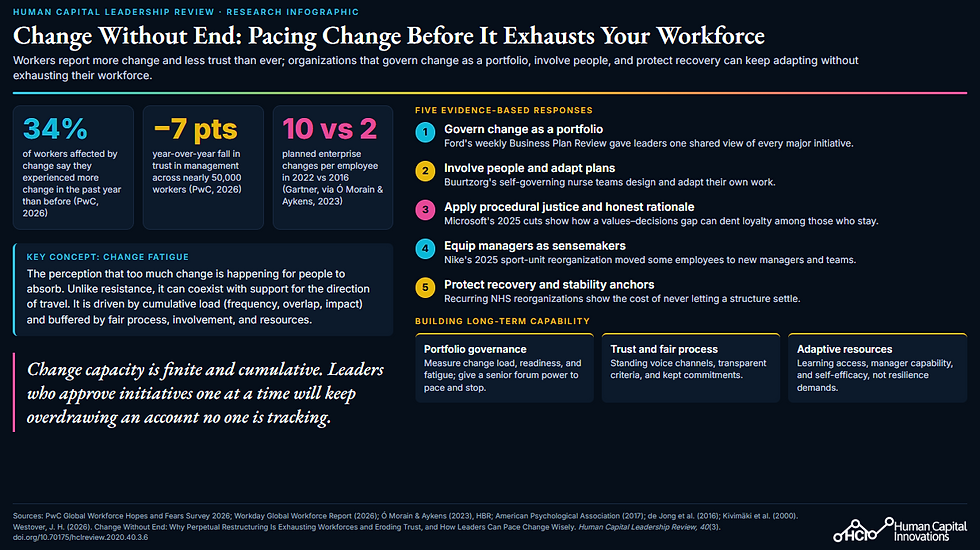
Research Infographic
References
Abrahamson, E. (2004). Change without pain: How managers can overcome initiative overload, organizational chaos, and employee burnout. Harvard Business School Press.
American Psychological Association. (2017, May 24). Change at work linked to employee stress, distrust and intent to quit, new survey finds [Press release].
American Psychological Association. (2025, May 21). More than half of U.S. workers say job insecurity causing stress [Press release].
Armenakis, A. A., Harris, S. G., & Mossholder, K. W. (1993). Creating readiness for organizational change. Human Relations, 46(6), 681–703.
Balogun, J., & Johnson, G. (2004). Organizational restructuring and middle manager sensemaking. Academy of Management Journal, 47(4), 523–549.
Bernerth, J. B., Walker, H. J., & Harris, S. G. (2011). Change fatigue: Development and initial validation of a new measure. Work & Stress, 25(4), 321–337.
Bordia, P., Hobman, E., Jones, E., Gallois, C., & Callan, V. J. (2004). Uncertainty during organizational change: Types, consequences, and management strategies. Journal of Business and Psychology, 18(4), 507–532.
Brockner, J., Konovsky, M., Cooper-Schneider, R., Folger, R., Martin, C., & Bies, R. J. (1994). Interactive effects of procedural justice and outcome negativity on victims and survivors of job loss. Academy of Management Journal, 37(2), 397–409.
Brown, M., Kulik, C. T., Cregan, C., & Metz, I. (2017). Understanding the change–cynicism cycle: The role of HR. Human Resource Management, 56(1), 5–24.
Bugeja-Drinkell, S. (2025, August 29). Nike's recent layoffs and restructuring, explained. Sneaker Freaker.
Cascio, W. F. (1993). Downsizing: What do we know? What have we learned? Academy of Management Executive, 7(1), 95–104.
Clifford, L. (2025, January 6). Bayer attacked bureaucracy by firing some 5,000 managers. Fortune.
CNN Newsource. (2025, July 24). Intel cuts 15% of workforce in major restructuring under new CEO. NBC Palm Springs.
Council Directive 98/59/EC of 20 July 1998 on the approximation of the laws of the Member States relating to collective redundancies. (1998). Official Journal of the European Communities, L 225, 16–21.
Datta, D. K., Guthrie, J. P., Basuil, D., & Pandey, A. (2010). Causes and effects of employee downsizing: A review and synthesis. Journal of Management, 36(1), 281–348.
Day, M. (2024, September 16). Amazon CEO orders 5-day office return, announces cuts to management. Fortune.
Dayan, M., Reed, S., Davies, N., Hoddinott, S., & Fisher, B. (2025). Abolished to perfection? Building a better centre for the NHS. Nuffield Trust and Institute for Government.
de Jong, T., Wiezer, N., de Weerd, M., Nielsen, K., Mattila-Holappa, P., & Mockałło, Z. (2016). The impact of restructuring on employee well-being: A systematic review of longitudinal studies. Work & Stress, 30(1), 91–114.
Fugate, M., Kinicki, A. J., & Prussia, G. E. (2008). Employee coping with organizational change: An examination of alternative theoretical perspectives and models. Personnel Psychology, 61(1), 1–36.
Gartner. (n.d.). Leaders today must routinize, not inspire, change.
Gartner. (2026, March 16). Gartner identifies the top change management trends for CHROs in the age of AI [Press release].
Gray, B. H., Sarnak, D. O., & Burgers, J. S. (2015). Home care by self-governing nursing teams: The Netherlands' Buurtzorg model. The Commonwealth Fund.
Herold, D. M., Fedor, D. B., & Caldwell, S. D. (2007). Beyond change management: A multilevel investigation of contextual and personal influences on employees' commitment to change. Journal of Applied Psychology, 92(4), 942–951.
Herold, D. M., Fedor, D. B., Caldwell, S., & Liu, Y. (2008). The effects of transformational and change leadership on employees' commitment to a change: A multilevel study. Journal of Applied Psychology, 93(2), 346–357.
Huy, Q. N. (2002). Emotional balancing of organizational continuity and radical change: The contribution of middle managers. Administrative Science Quarterly, 47(1), 31–69.
Johnson, K. J. (2016). The dimensions and effects of excessive change. Journal of Organizational Change Management, 29(3), 445–459.
Kiefer, T. (2005). Feeling bad: Antecedents and consequences of negative emotions in ongoing change. Journal of Organizational Behavior, 26(8), 875–897.
Kirkland, R. (2013, November). Leading in the 21st century: An interview with Ford's Alan Mulally. McKinsey & Company.
Kivimäki, M., Vahtera, J., Pentti, J., & Ferrie, J. E. (2000). Factors underlying the effect of organisational downsizing on health of employees: Longitudinal cohort study. BMJ, 320(7240), 971–975.
Mahadevan, D. (2017, January 10). ING's agile transformation. McKinsey Quarterly.
Maitlis, S., & Christianson, M. (2014). Sensemaking in organizations: Taking stock and moving forward. Academy of Management Annals, 8(1), 57–125.
Morgan, D., & Zeffane, R. (2003). Employee involvement, organizational change and trust in management. The International Journal of Human Resource Management, 14(1), 55–75.
Novet, J. (2025, July 24). Microsoft's Satya Nadella says job cuts have been weighing heavily on him. CNBC.
Ó Morain, C., & Aykens, P. (2023, May 9). Employees are losing patience with change initiatives. Harvard Business Review.
Oreg, S., Vakola, M., & Armenakis, A. (2011). Change recipients' reactions to organizational change: A 60-year review of quantitative studies. The Journal of Applied Behavioral Science, 47(4), 461–524.
Peck, E. (2023, April 13). There's a "morale crisis" at Meta. Axios.
PwC. (2026). Global workforce hopes and fears survey 2026.
Rafferty, A. E., & Griffin, M. A. (2006). Perceptions of organizational change: A stress and coping perspective. Journal of Applied Psychology, 91(5), 1154–1162.
Rafferty, A. E., Jimmieson, N. L., & Armenakis, A. A. (2013). Change readiness: A multilevel review. Journal of Management, 39(1), 110–135.
Shin, J., Taylor, M. S., & Seo, M.-G. (2012). Resources for change: The relationships of organizational inducements and psychological resilience to employees' attitudes and behaviors toward organizational change. Academy of Management Journal, 55(3), 727–748.
Smollan, R. K. (2015). Causes of stress before, during and after organizational change: A qualitative study. Journal of Organizational Change Management, 28(2), 301–314.
Starbucks to cut 1,100 corporate jobs. (2025, February 24). The Boston Globe.
Stensaker, I., Meyer, C. B., Falkenberg, J., & Haueng, A. C. (2002). Excessive change: Coping mechanisms and consequences. Organizational Dynamics, 31(3), 296–312.
Sverke, M., Hellgren, J., & Näswall, K. (2002). No security: A meta-analysis and review of job insecurity and its consequences. Journal of Occupational Health Psychology, 7(3), 242–264.
Trevor, C. O., & Nyberg, A. J. (2008). Keeping your headcount when all about you are losing theirs: Downsizing, voluntary turnover rates, and the moderating role of HR practices. Academy of Management Journal, 51(2), 259–276.
Vahtera, J., Kivimäki, M., Pentti, J., Linna, A., Virtanen, M., Virtanen, P., & Ferrie, J. E. (2004). Organisational downsizing, sickness absence, and mortality: 10-town prospective cohort study. BMJ, 328(7439), 555.
Wanberg, C. R., & Banas, J. T. (2000). Predictors and outcomes of openness to changes in a reorganizing workplace. Journal of Applied Psychology, 85(1), 132–142.
Weick, K. E., & Quinn, R. E. (1999). Organizational change and development. Annual Review of Psychology, 50, 361–386.
Workday. (2026, October 5). Workday global workforce report: AI is rewriting jobs more than it's cutting them [Press release].
Zahn, M. (2025, September 25). Starbucks to lay off 900 workers, close stores. ABC7 News.

Jonathan H. Westover, PhD, Chief Research Officer (Nexus Institute for Work and AI); Co-Founder & Chief Workforce and Learning Officer (Future State University); Founder & CEO (Human Capital Innovations); Professor of Organizational Leadership & Change (UVU). Read Jonathan Westover's executive profile here.
Suggested Citation: Westover, J. H. (2026). Change Without End: Why Perpetual Restructuring Is Exhausting Workforces and Eroding Trust, and How Leaders Can Pace Change Wisely. Human Capital Leadership Review, 40(2). doi.org/10.70175/hclreview.2020.40.2.3