





Breaking Through the Discovery Bottleneck: Why Mapping AI into Your Organization is the Key to Unlocking Real Value


Listen to a review of this article:
Abstract: Organizations face a critical but underappreciated challenge in realizing value from artificial intelligence: discovering where and how AI creates value within their specific operations. While extensive research demonstrates AI's productivity gains at the task level, these benefits often fail to materialize at the organizational level. This article examines the "mapping problem"—the challenge of identifying which activities AI can improve and how complementary processes must change—and presents evidence-based strategies for systematically mapping AI capabilities across organizational functions. Drawing on field experimental evidence from 515 ventures and established organizational theory, we demonstrate that the constraint on AI value is not access to technology but rather the cognitive and organizational capacity to search broadly for high-value applications. Organizations that solve the mapping problem complete more work, serve more customers, generate higher revenue, and require less external capital—suggesting AI fundamentally reshapes production economics when properly integrated. We conclude with practical frameworks for expanding organizational search, building cross-functional discovery capabilities, and developing long-term AI integration capacity.
The Productivity Puzzle Persists
Artificial intelligence has demonstrated remarkable capabilities across an expanding range of business activities. Customer service representatives assisted by AI handle cases 14% faster while improving customer satisfaction (Brynjolfsson et al., 2023). Professional writers using generative AI produce 40% more content without sacrificing quality (Noy & Zhang, 2023). Consultants leveraging AI complete tasks 25% faster and produce higher-quality work—at least on tasks within AI's current capabilities (Dell'Acqua et al., 2023).
Yet these impressive task-level gains remain frustratingly disconnected from organizational and economic outcomes. Aggregate productivity statistics show limited evidence of AI-driven acceleration. Firm-level performance data reveal wide variation in returns, with many organizations seeing minimal benefit despite substantial AI investments. The pattern echoes previous general-purpose technologies: electricity, computers, and the internet all exhibited long lags between technological capability and economic impact.
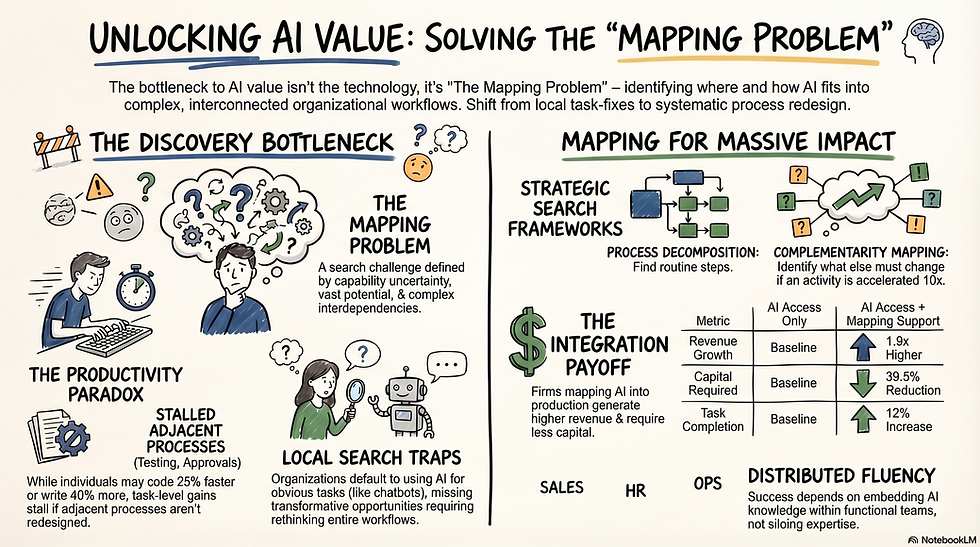
Why do task-level productivity gains fail to aggregate? Theoretical models highlight the challenge: when activities within organizations are complementary—when overall performance depends on the joint quality of interconnected processes—improving one activity provides limited value unless adjacent activities also improve (Gans & Goldfarb, 2026). A customer service agent who resolves inquiries faster creates little value if the organization still takes days to process the resulting orders. Software developers who code faster don't accelerate product delivery if testing and deployment processes remain unchanged.
This complementarity structure implies that organizations must discover not just individual AI applications but entire configurations of AI-enabled processes. Before investing in restructuring, organizations face a fundamental search problem: which of the dozens of activities comprising their operations should incorporate AI, and how should complementary processes adapt? This discovery challenge—what recent research terms the "mapping problem"—may constitute the primary bottleneck preventing AI's capabilities from translating into organizational value.
The Mapping Problem: When the Bottleneck is Discovery, Not Access
Understanding the Search Challenge
The mapping problem reflects three interrelated difficulties that distinguish AI adoption from previous technological transitions:
Capability uncertainty: AI's performance is uneven and difficult to predict. Tasks that appear similar can differ dramatically in how well AI handles them, and even experts systematically misjudge where AI will succeed (Dell'Acqua et al., 2023; Vafa et al., 2024). A model that excels at drafting customer emails may struggle with technical documentation. Image recognition that works flawlessly for product quality control may fail for medical diagnosis. This performance unpredictability makes it difficult for managers to identify promising applications ex ante.
Search space vastness: Within any organization, AI could potentially apply to dozens—even hundreds—of distinct activities. A mid-sized professional services firm might consider AI for client development, proposal writing, project scoping, work execution, quality review, knowledge management, training, performance evaluation, financial planning, and administrative coordination, among others. Each function contains multiple sub-activities, and AI's impact often depends on how it's applied, not just where. The combinatorial possibilities quickly become overwhelming.
Complementarity complexity: The value of applying AI to one activity often depends critically on whether adjacent activities also change (Siggelkow, 2002; Bresnahan et al., 1996). Consider a consulting firm that uses AI to accelerate market research. If the research still flows into a traditional analysis process requiring weeks of senior consultant review, the bottleneck simply shifts. Value materializes only when the firm also redesigns analysis workflows, adjusts staffing models, and revises client engagement processes to capitalize on faster research cycles. Discovering these complementarities requires understanding not just AI's capabilities but the intricate interdependencies within the organization's existing operating model.
Why Local Search Fails
Faced with these challenges, organizations typically default to local search—exploring applications near their current knowledge and familiar practices (Levinthal & March, 1993). A marketing team experiments with AI for social media content. An engineering group tries AI code completion. Customer service tests chatbots. These represent sensible first steps, but research on organizational search suggests this local exploration systematically misses higher-value opportunities (Gavetti & Levinthal, 2000).
The problem intensifies with AI because the highest-value applications often require reconceiving entire workflows rather than layering AI onto existing tasks. The marketing team might generate more social content, but the real opportunity lies in fundamentally reimagining how the organization identifies and responds to market signals. The engineering team codes faster, but the transformative change comes from rethinking the product development cycle to capitalize on rapid prototyping. Customer service answers questions more efficiently, but the strategic shift involves using AI to prevent the need for support in the first place.
Organizations lack reliable signals for where to search next. With previous technologies, physical or structural constraints often indicated where to focus: electricity demanded factory redesign, the internet required distribution channel changes. AI's flexibility—the same models can assist with writing, analysis, coding, customer service, and strategic planning—provides no comparable guidance. Absent structured approaches to broaden search, organizations plateau at obvious applications while high-value uses remain undiscovered.
Recent field experimental evidence dramatically illustrates this dynamic. When 515 early-stage ventures were randomly assigned to receive case studies demonstrating how other organizations reorganized around AI, treated firms discovered 44% more AI applications, spanning a broader range of business functions (Kim et al., 2026). The difference wasn't access to technology—all firms had identical tools, training, and resources. The difference was cognitive: treated firms expanded their search beyond local, obvious applications to explore how AI could reshape their end-to-end operations.
Evidence-Based Strategies for Mapping AI Across Your Organization
Table 1: Case Studies of AI Reorganization and Strategic Integration
Organization Name | Core Business or Industry | Traditional Workflow Bottleneck | AI-Reorganized Approach | Critical Complementary Change | Key Strategic Insight |
Gamma | Presentation software | Sequential chain of specialists (PMs, designers, engineers, QA) where full development cycles span months. | AI systems autonomously monitor usage and generate product variants to address user needs, compressing the development sequence. | Investment in robust "AI evals"—automated systems to assess if AI-generated variants actually improve the product. | Value emerges from AI spanning multiple steps to eliminate coordination work rather than just improving a single task. |
Ryz Labs | Venture development | Sequential prototyping: choosing one tech stack and building one version over months, which concentrates risk. | Parallel exploration: feeding requirements into multiple AI tools to generate three functioning prototypes on different architectures in hours. | Shift in organizational focus from building to learning, requiring new approaches to rapid user recruitment and feedback synthesis. | When processes become orders of magnitude faster, parallel exploration becomes viable, restructuring how solutions are explored. |
FazeShift | Accounts receivable | Disconnected software systems (Excel, QuickBooks, bank portals) with humans serving as manual bridges between them. | AI systems directly integrate software components, performing automated data pulling, reconciliation, and matching. | Complete transformation of the business model from a labor-intensive professional service to a scalable software product. | Processes where humans primarily move information between systems are prime opportunities for end-to-end automation. |
Ranger | Quality assurance testing | Front-loaded capital requirements where organizations must raise money before building or selling to finance learning. | Services-first model: selling services delivered by the founder immediately, then using AI to gradually automate routine delivery steps. | Fundraising shifts from the first step to the last; the organization becomes self-sustaining and raises money only for scaling. | AI can change the sequence of activities and capital requirements, allowing for self-funded growth and lower risk profiles. |
Expand Search Through Structured Frameworks
Organizations can systematically broaden their exploration of AI applications by adopting structured frameworks that guide attention toward non-obvious opportunities. Rather than asking "Where can we use AI?" (which typically surfaces familiar applications), more productive framings include:
Process decomposition: "What are the complete sequences of activities that produce our key outputs? Within each sequence, which steps are routine enough for AI to handle, and how would automating those steps change the bottlenecks?"
Complementarity mapping: "If AI accelerated this activity by 10×, what else would need to change for us to realize value? What new activities would become possible? What current activities would become constraints?"
Failure mode analysis: "What typically goes wrong in this process? What information do we lack when decisions are made? What takes too long to be actionable? Could AI address these failure points?"
Consider a healthcare organization exploring AI for administrative operations. The obvious application: use natural language processing to extract information from patient records. A process decomposition framework prompts deeper investigation: patient information flows through scheduling, registration, clinical intake, care coordination, billing, and follow-up. AI might assist not just with initial extraction but with automated reconciliation between systems, intelligent routing based on clinical needs and resource availability, predictive flagging of billing complications, and proactive outreach for care gaps.
Complementarity mapping reveals second-order opportunities: if AI handles routine clinical documentation during patient visits, physicians' time per patient decreases—but the value emerges only if the organization also adjusts scheduling systems to accommodate shorter visits, revises staffing ratios, and redesigns workflows to maintain quality with higher throughput. The mapping exercise exposes this entire configuration rather than just the initial documentation application.
Learn from Analogous Organizations' Reorganization Patterns
Field evidence indicates that exposure to examples of how others have reorganized around AI significantly expands the range of applications organizations discover (Kim et al., 2026). However, the mechanism isn't simple imitation—organizations don't typically copy specific implementations from other contexts. Rather, examples serve as cognitive scaffolding that helps decision-makers abstract principles and recognize analogous opportunities within their own operations (Gavetti et al., 2005).
Effective learning from examples requires:
Multiple cases across diverse contexts: Seeing how a presentation software company, an accounts receivable startup, and a maternal health nonprofit each reorganized provides richer insight than a single deep case. The diversity helps viewers extract generalizable patterns rather than context-specific details.
Focus on production structure, not just tools: Cases that illustrate how work sequences changed—which steps were eliminated, compressed, or reordered—prove more valuable than cases listing which AI tools were adopted. Understanding that one organization collapsed an eight-step process alternating between software systems and human coordinators into a fully automated sequence provides actionable insight for other organizations facing similar bridging challenges.
Attention to complementary changes: The most instructive examples explicitly show how organizations adapted adjacent processes, staffing models, performance metrics, and customer engagement approaches alongside AI implementation. A case describing how a venture moved from raising capital before building anything to selling services immediately and using AI to improve delivery economics illustrates a complete business model shift, not just a technology substitution.
Organizations can operationalize this approach through several mechanisms:
Structured case study sessions: Regular convenings where cross-functional teams review examples of AI-driven reorganization, then facilitate discussion about analogous opportunities within the organization. Critical guideline: the discussion should focus on identifying similar problems or bottlenecks in your context, not on whether you operate in the same industry.
Cross-industry site visits and exchanges: Partnering with organizations in different sectors to observe their AI implementations firsthand. The cognitive distance often helps participants recognize principles they might miss when examining familiar contexts. A financial services firm visiting a manufacturing plant's AI-driven quality control might recognize analogous opportunities in their loan underwriting process.
Internal documentation and knowledge sharing: Creating accessible repositories where teams document their own AI experiments, reorganization decisions, and lessons learned. This builds organizational memory and helps later teams avoid searching ground already covered while learning from internal discoveries.
Gamma: Transforming Product Development Through AI-Enabled Compression
Gamma, an AI-native presentation company that grew to over $50 million in annual recurring revenue with approximately 50 employees, illustrates how mapping AI across the product development cycle creates compounding value (Koning et al., 2025).
Traditional product development requires a lengthy chain of specialists: product managers gather user feedback, prioritize feature requests, write specifications, designers create interfaces, engineers build functionality, quality assurance tests implementations, data scientists design and analyze A/B tests, and engineers deploy successful variants. Each step takes days to weeks, and full cycles often span months.
Gamma's AI-reorganized approach compresses this sequence dramatically. AI systems continuously monitor usage patterns and automatically generate product variants that address observed user needs. What previously required explicit feedback collection, prioritization meetings, specification documents, and cross-functional coordination now happens autonomously. A single product manager, supported by AI, ships features that would have demanded an entire team.
Critical complementary change: Gamma invested heavily in developing robust "AI evals"—automated systems that assess whether AI-generated variants actually improve the product. Without this complementary capability, rapid AI-driven feature generation would be worthless or even harmful. The evals become the new bottleneck and the key organizational capability.
Key insight: The value doesn't come from applying AI to a single step (e.g., using AI to help PMs write specifications). The value emerges from AI spanning multiple steps and fundamentally reconceiving what the product development process can be. Organizations that map AI only onto existing activities miss the opportunity to eliminate entire categories of coordination work.
Ryz Labs: Parallel Exploration Replaces Sequential Betting
Ryz Labs, a venture development firm, demonstrates how AI enables organizations to replace sequential decision-making with parallel exploration when prototyping becomes nearly costless (Koning et al., 2025).
Traditional prototyping follows a sequential commitment pattern: choose one technology stack, hire a development team aligned with that choice, build one version, gather feedback, then iterate or pivot. The process takes months and concentrates risk—if the initial technology choice proves suboptimal, substantial time and money are already invested.
AI-reorganized approach: Founders write a single product requirements document, then feed it simultaneously into multiple AI coding tools (Bolt, Lovable, Replit). Within hours, they have three functioning prototypes built on different architectures. User testing immediately reveals which approach performs best for the specific use case. Because AI enables rapid iteration, founders can test the leading version with customers, request feature additions during the conversation, implement changes in real-time using AI, and test again—all within a single call.
Critical complementary change: The bottleneck shifts from building to learning. When prototypes can be created and modified in minutes rather than months, the constraining factor becomes how quickly the organization can gather meaningful user feedback. This demands new approaches to user recruitment, testing protocol design, and feedback synthesis.
Key insight: AI's impact isn't limited to making existing processes faster. When a process becomes orders of magnitude faster, entirely new approaches that were previously impractical become viable. Organizations that merely use AI to accelerate their current sequential process miss the opportunity to fundamentally restructure how they explore solutions.
FazeShift: Automated Workflows Replace Human Bridging
FazeShift, an AI accounts receivable startup, illustrates a common but often-overlooked opportunity: many "business processes" aren't actually processes—they're sequences of disconnected software systems with humans serving as bridges (Koning et al., 2025).
Traditional accounts receivable alternates between software and human intervention: Excel (software) → clerk pulls data → QuickBooks (software) → clerk enters data → bank portal (software) → clerk matches payments → Gmail (software) → clerk sends reminders. Eight steps, four pieces of software, four sets of human coordination activities.
AI-reorganized approach: AI systems directly integrate the software components, eliminating the human bridging steps. AI pulls data from multiple sources, performs reconciliation, matches payments, and generates contextual communication automatically. The eight-step process becomes a continuous, automated flow with human involvement only for exceptions requiring judgment.
Critical complementary change: The business model transforms. What was a labor-intensive professional service requiring skilled accounts receivable specialists becomes a scalable software product. This shift demands completely different go-to-market strategies, pricing models, customer success approaches, and organizational capabilities. The organization that simply uses AI to help their clerks work faster captures a fraction of the available value.
Key insight: Look for processes where humans primarily serve to move information or translate between systems. These represent prime opportunities for AI to create value by enabling end-to-end automation—but realizing that value requires recognizing that you're not improving a service business, you're potentially creating a software business. The organizational implications extend far beyond the immediate workflow.
Ranger: Services-First Model Enabled by AI Economics
Ranger, a quality assurance testing venture, demonstrates how AI can enable organizations to rethink not just operations but fundamental business model sequencing and capital requirements (Koning et al., 2025).
Traditional venture-funded product development front-loads capital: raise money → hire team → build product → sell to customers → generate revenue. This sequence requires convincing investors to provide resources before the team has deep market knowledge or proven product-market fit. Most early capital finances learning that proves the initial assumptions were wrong.
AI-reorganized approach: Sell services → founder delivers work → build AI from learnings → hire team that works with AI → scale with better economics. The founder provides quality assurance testing as a service from day one, building intimate knowledge of which steps are routine (AI-automatable) and which require judgment (human-retained). AI gradually improves the founder's productivity and that of early hires, transforming the business's unit economics from service to something more like software margins.
Critical complementary change: Fundraising shifts from the first step to the last. Rather than requiring external capital to get started, the organization becomes self-sustaining and raises money only when scaling proven models. This gives founders optionality on whether and when to pursue venture financing—a fundamentally different risk profile and power dynamic.
Key insight: AI can change when different organizational activities happen, not just how efficiently they execute. Organizations that map AI only onto operational efficiency miss the opportunity to restructure entire business models, capital structures, and growth sequences. The most transformative applications often involve these strategic reconfigurations rather than tactical improvements.
Organizational Impacts: What Changes When Mapping Succeeds
Productivity Gains Through Complementary Activity Redesign
Organizations that successfully map AI across their operations don't just work faster—they complete more work, serve more customers, and generate higher revenue with the same or fewer resources. Field experimental evidence from 515 ventures demonstrates these effects clearly: organizations that received structured support to map AI into their production processes completed 12% more tasks, were 18% more likely to acquire paying customers, and generated 1.9× higher revenue compared to otherwise-identical organizations with the same AI access and training but without mapping support (Kim et al., 2026).
These productivity gains emerge specifically through complementary activity redesign—changes in how work is organized rather than just how individual tasks are performed. Organizations that discover more AI applications also report:
Greater use of AI in product development (prototyping, feature generation, testing) paired with redesigned product management processes
Increased AI application in strategic functions (financial modeling, scenario planning, competitive analysis) paired with shorter planning cycles and more rapid strategic adjustment
Expanded AI deployment in business operations (workflow automation, process coordination, documentation) paired with reduced administrative staffing needs and faster organizational tempo
The pattern suggests AI creates value not primarily by making existing activities incrementally more efficient but by enabling organizations to reconfigure entire activity systems. A consulting firm that uses AI only to help analysts work 20% faster realizes modest gains. The same firm that uses AI to eliminate the analyst role entirely, enable senior consultants to directly conduct research, collapse review cycles, and engage clients in real-time co-creation realizes transformation.
Resource Efficiency: Doing More With Less
Perhaps the most striking finding from recent field evidence: organizations that successfully integrate AI demand substantially less external capital while achieving faster growth. Ventures that received structured support to map AI into their operations reduced their anticipated capital requirements by 39.5%—over $220,000 per organization—while simultaneously achieving higher revenue and customer acquisition (Kim et al., 2026).
This pattern reflects a fundamental change in production economics. Traditionally, organizational growth requires roughly proportional increases in labor and capital: to serve twice as many customers, you hire approximately twice as many employees and invest in corresponding infrastructure. AI-enabled organizations increasingly violate this relationship. They serve more customers without proportional increases in staff. They build more products without proportional increases in development teams. They expand into new markets without proportional increases in support resources.
Labor implications remain nuanced. The same experimental evidence found no overall change in labor demand despite higher output and revenue. Organizations aren't simply replacing people with AI; rather, they're changing what people do. Roles focused on routine information processing, bridging between systems, or manual coordination diminish. Roles requiring judgment, relationship management, strategy formulation, or handling novel situations remain essential. Some organizations report that team members previously focused on execution shift toward higher-value activities—sales, customer relationships, strategic planning—as AI handles operational work.
Capital efficiency stems from several mechanisms:
Reduced experimentation costs: When AI enables rapid, low-cost prototyping, organizations can explore more options before committing substantial resources to any particular direction. This reduces waste from pursuing wrong approaches and accelerates learning.
Lower coordination overhead: Organizations with fewer people but higher per-person output require less management infrastructure, fewer coordination meetings, and simpler organizational structures.
Self-funding growth: Organizations that achieve positive unit economics earlier (because AI enables service delivery or product development with fewer people) can often grow without external capital, providing optionality on fundraising timing and terms.
The efficiency gains appear largest in the upper tail of performance, suggesting AI helps expand what's possible rather than modestly improving average outcomes. Organizations at the 90th percentile and above show particularly dramatic effects on revenue and capital raised—consistent with AI helping overcome specific bottlenecks that, once relieved, unlock substantial value (Kim et al., 2026).
Distribution of Gains: Who Benefits?
Evidence suggests the benefits of systematically mapping AI into organizational activities accrue broadly rather than concentrating among particular organization types or leader profiles. Field experimental results show no significant differential effects based on:
Baseline organizational performance (early-stage vs. more mature ventures)
Founder technical background (technical training vs. non-technical)
Team size or composition
Industry sector or business model
This broad applicability contrasts with some task-level AI studies finding that lower-performing individuals benefit most, and with research showing only high-skill small business owners successfully leverage AI (Otis et al., 2024). The difference likely reflects the nature of the constraint: at the task level, lower performers may benefit more because they have more room for improvement. At the organizational level, the mapping problem—discovering where and how AI creates value—appears to bind across a wide range of capabilities and contexts.
The implication for practice: organizations should not assume that AI primarily benefits technical teams, high-performing units, or particular industries. The challenge of mapping AI into production processes appears relatively universal. Organizations that develop systematic approaches to broaden search and discover applications will likely see returns regardless of their starting point.
Building Long-Term AI Integration Capacity
Beyond immediate application discovery, organizations benefit from developing durable capabilities that enable continuous learning about AI's evolving potential. Research on organizational learning and technology adoption suggests several high-leverage investments:
Distributed AI Fluency, Not Just Central Expertise
Many organizations concentrate AI knowledge within a specialized team—a data science group, an AI center of excellence, or an innovation lab. This centralized expertise model fails for AI integration because the people who best understand specific organizational activities (salespeople, customer service representatives, product managers, operations coordinators) typically don't sit in technology functions. Conversely, AI specialists often lack deep knowledge of the particular workflows, constraints, and opportunities embedded in different parts of the organization.
Effective AI integration requires distributed fluency: broad organizational understanding of AI's general capabilities and limitations, combined with deep functional expertise about specific activities. Rather than asking "How can our AI team help marketing?" more productive approaches involve:
Embedding AI-fluent individuals within functional teams: Place people with solid AI understanding directly into sales, operations, product development, and customer success teams where they can identify opportunities grounded in functional reality.
Building AI awareness across functional roles: Ensure that managers in all functions develop working knowledge of what AI can and cannot do. This doesn't require technical depth—most managers don't need to understand transformer architectures—but does require enough familiarity to recognize potential applications when they encounter them.
Creating forums for cross-functional discovery: Establish regular convenings where people from different functions share what they're learning about AI applications, particularly unexpected successes or failures. The cross-pollination often surfaces opportunities one group wouldn't have discovered in isolation.
A financial services firm implemented a "resident AI fellow" program, placing individuals with strong AI backgrounds into each major business unit for six-month rotations. The fellows weren't there to build AI systems (the firm had a separate engineering organization) but rather to help functional teams discover opportunities, assess feasibility, and specify requirements. The model proved substantially more effective than centralized AI support precisely because the fellows developed deep appreciation for functional constraints while maintaining AI knowledge.
Continuous Experimentation Infrastructure
Organizations that successfully leverage AI treat integration as an ongoing exploration rather than a one-time implementation. This requires infrastructure that reduces the friction of experimentation:
Sandbox environments: Dedicated spaces where teams can test AI applications without risk to production systems or customer-facing operations. Sandboxes should mirror real workflows and data (properly anonymized) closely enough that experiments yield meaningful learning but remain isolated enough that failures cause no harm.
Rapid prototyping capability: Access to tools, talent, and processes that enable quick builds of potential AI applications. The goal is failing fast on poor ideas and progressing rapidly on promising ones. Many organizations find that even crude prototypes—taking days rather than months—reveal enough about feasibility and value to guide further investment decisions.
Learning capture and dissemination: Systematic approaches to documenting what each experiment revealed, making this knowledge accessible to others exploring related applications. Many experiments provide value primarily by revealing where AI doesn't work well—equally important information that, if not captured, leads to redundant failed experiments across the organization.
A professional services organization created an "AI experiment tracker"—a simple database where any team could register planned AI experiments, document approaches and results, and search what others had learned. The tracker's primary value wasn't tracking per se but enabling learning from others' experiences. Teams regularly discovered that approaches they were considering had already been tested elsewhere in the organization, saving substantial duplicated effort.
Mental Model Evolution as AI Capabilities Expand
A challenge specific to AI: the technology's capabilities evolve rapidly, meaning that applications considered and rejected six months ago may be viable today. Organizations need mechanisms for periodically revisiting past decisions as AI models improve.
Several organizations implement "AI capability review" processes where teams systematically reassess potential applications quarterly or semi-annually. The reviews explicitly ask: "What did we previously decide AI couldn't do that might be possible now?" This forcing function prevents organizations from anchoring on outdated capability assessments.
Similarly, effective organizations develop dynamic mental models that incorporate AI's uneven performance across related tasks. Rather than concluding "AI doesn't work well for our domain" based on one failed application, successful organizations develop more nuanced understanding: "AI handles X well but struggles with Y; we'll revisit Y as models improve while exploiting X now."
Conclusion: Access Isn't Enough—Discovery Is the Bottleneck
The evidence increasingly suggests that artificial intelligence can deliver substantial organizational value even at its current capabilities. Task-level productivity gains are real and broad. Organizations that successfully integrate AI complete more work, serve more customers, generate higher revenue, and require less capital. These effects emerge not in some distant future but within months of systematic integration efforts.
Yet most organizations realize only a fraction of this potential. The constraint isn't access to technology—AI models are increasingly available, often at low or no cost. The constraint isn't technical skill—while engineering capacity matters for some applications, many high-value uses require little specialized expertise. The binding constraint is organizational capacity to discover where and how AI creates value within the specific context of that organization's operations.
This mapping problem proves difficult because AI's performance is uneven and hard to predict, the space of potential applications is vast, and value often depends on complementary changes across multiple activities. Organizations default to local search that surfaces obvious applications while missing higher-value opportunities requiring workflow redesign or strategic reconfiguration.
The path forward combines structured frameworks that systematically expand search, learning from analogous organizations' reorganization patterns, and building long-term capabilities for distributed AI fluency and continuous experimentation. Organizations that make these investments discover substantially more applications spanning broader functional areas, particularly in product development and strategic domains where AI enables not just faster execution but fundamentally different approaches.
As AI capabilities continue expanding, the mapping problem likely intensifies rather than resolves. Each improvement in what AI can do expands the set of potential applications, creating more terrain to search. Organizations that develop systematic approaches to exploration, complementarity assessment, and organizational learning will compound advantages over those waiting for obvious applications to emerge. The winners won't necessarily be those with the best AI technology—they'll be those who most effectively discover where and how to use it.
Research Infographic
References
Bresnahan, T. F., Brynjolfsson, E., & Hitt, L. M. (1996). Information technology, workplace organization, and the demand for skilled labor: Firm-level evidence. The Quarterly Journal of Economics, 117(1), 339–376.
Brynjolfsson, E., Li, D., & Raymond, L. R. (2023). Generative AI at work. NBER Working Paper 31161.
Dell'Acqua, F., McFowland, E., Mollick, E. R., Lifshitz-Assaf, H., Kellogg, K., Rajendran, S., Krayer, L., Candelon, F., & Lakhani, K. R. (2023). Navigating the jagged technological frontier: Field experimental evidence of the effects of AI on knowledge worker productivity and quality. Harvard Business School Working Paper 24-013.
Gans, J. S., & Goldfarb, A. (2026). O-ring automation. NBER Working Paper 33085.
Gavetti, G., & Levinthal, D. A. (2000). Looking forward and looking backward: Cognitive and experiential search. Administrative Science Quarterly, 45(1), 113–137.
Gavetti, G., Levinthal, D. A., & Rivkin, J. W. (2005). Strategy making in novel and complex worlds: The power of analogy. Strategic Management Journal, 26(8), 691–712.
Kim, H., Kim, D., & Koning, R. (2026). Mapping AI into production: A field experiment on firm performance. INSEAD Working Paper 2026/20/STR.
Koning, R., Keller, N. T., & Kim, H. (2025). Gamma: Slides in the blink of AI. Harvard Business School Case Study.
Koning, R., Kim, H., & Keller, N. T. (2025). Fazeshift: AI for AR. Harvard Business School Case Study.
Levinthal, D. A., & March, J. G. (1993). The myopia of learning. Strategic Management Journal, 14(S2), 95–112.
Noy, S., & Zhang, W. (2023). Experimental evidence on the productivity effects of generative artificial intelligence. Science, 381(6654), 187–192.
Otis, N., Clarke, R., Delecourt, S., Holtz, D., & Koning, R. (2024). The uneven impact of generative AI on entrepreneurial performance. Working Paper.
Siggelkow, N. (2002). Misperceiving interactions among complements and substitutes: Organizational consequences. Management Science, 48(7), 900–916.
Vafa, K., Rambachan, A., & Mullainathan, S. (2024). Do large language models perform the way people expect? Measuring the human generalization function. arXiv preprint arXiv:2406.01382.

Jonathan H. Westover, PhD is Chief Research Officer (Nexus Institute for Work and AI); Associate Dean and Director of HR Academic Programs (WGU); Professor, Organizational Leadership (UVU); OD/HR/Leadership Consultant (Human Capital Innovations). Read Jonathan Westover's executive profile here.
Suggested Citation: Westover, J. H. (2026). Breaking Through the Discovery Bottleneck: Why Mapping AI into Your Organization is the Key to Unlocking Real Value. Human Capital Leadership Review, 35(3). doi.org/10.70175/hclreview.2020.35.3.6


