





AI Adoption and Employment Growth: Evidence from Enterprise Spending Data


Listen to a review of this article:
Abstract: This article examines the relationship between organizational artificial intelligence adoption and workforce dynamics using firm-level spending and employment data. Analysis of 21,559 U.S. firms reveals that high-intensity AI adopters experience approximately 10% employment growth following adoption, with particularly strong gains in entry-level positions and across multiple occupational categories including engineering, sales, and customer service. These findings challenge widespread predictions of AI-driven job displacement and suggest that intensive AI investment correlates with organizational expansion rather than workforce reduction. The employment gains emerge gradually, are concentrated in the Information sector, and appear only among firms making sustained, material AI investments rather than those engaging in limited experimentation.
The integration of generative artificial intelligence into organizational operations represents one of the most consequential technological shifts facing contemporary labor markets. Unlike previous waves of automation that primarily affected routine manual and clerical tasks, generative AI systems demonstrate capability across non-routine cognitive work—including content creation, code generation, and analytical synthesis—that historically required human expertise (Eloundou et al., 2024). This expansion of automation into knowledge work has generated substantial uncertainty regarding AI's net employment effects, with predictions ranging from widespread job displacement to unprecedented economic expansion.
The practical stakes are considerable. Corporate executives have publicly attributed workforce reductions to AI capabilities, while technology developers alternate between forecasting transformative productivity gains and cautioning about disruptive labor market consequences. Workers across occupational categories face uncertainty about how AI adoption will affect their employment prospects, compensation, and required skill sets. Policymakers confront decisions about workforce transition support, education system adaptation, and regulatory frameworks without clear empirical guidance about AI's realized labor market effects.
Existing research has provided important early evidence, but has largely relied on occupational exposure measures that estimate which jobs AI could theoretically affect rather than observing which firms actually adopt AI and how their employment subsequently changes (Webb, 2020; Felten et al., 2021; Eloundou et al., 2024). This measurement gap creates fundamental uncertainty about AI's actual labor market consequences. A firm employing workers in AI-exposed occupations may never adopt AI tools, while another firm in the same industry with similar workers may integrate AI extensively and experience entirely different employment trajectories.
This article addresses that measurement challenge by examining observed firm-level AI spending linked to workforce records. The analysis reveals that intensive AI adoption correlates with employment growth rather than reduction, but that these gains are concentrated among firms making sustained, substantial investments and are most evident in the Information sector.
The AI Adoption and Employment Landscape
Defining AI Adoption in Organizational Context
Measuring AI adoption presents significant methodological challenges because generative AI deployment occurs primarily through software subscriptions, API consumption, and cloud computing services rather than capital equipment purchases visible in traditional datasets. Prior approaches have therefore constructed occupational exposure indices that vary across jobs but cannot distinguish between firms that adopt AI and those that do not (Gimbel et al., 2026).
Recent work has attempted to address this limitation through several approaches. Babina et al. (2024) measure workforce composition by identifying employees with AI-related skills listed on professional profiles, finding that AI-investing firms experience higher sales and employment growth. Hampole et al. (2025) construct firm-specific AI exposure measures from patent-to-task similarity, using historical university hiring networks as instrumental variables. Survey-based approaches capture self-reported adoption but face response rate challenges, question wording sensitivity, and difficulty distinguishing experimentation from sustained deployment (Yotzov et al., 2026).
Corporate payment records offer more direct observation. When a firm pays an AI vendor for model access, API usage, or enterprise subscriptions, that transaction reveals both adoption timing and spending intensity. This approach captures revealed preference—firms that consistently spend on AI demonstrate commitment beyond stated intentions—and enables measurement of adoption intensity through spending per employee rather than binary adoption indicators.
State of Practice: Adoption Rates and Patterns
AI adoption rates vary substantially depending on measurement approach and sample composition. Nationally representative survey data from the U.S. Census Bureau's Business Trends and Outlook Survey indicates that 17-20% of firms used AI in any business function during late 2025 and early 2026 (U.S. Census Bureau, 2026a). An employment-weighted measure from the same period shows approximately 32% of workers employed at AI-using firms (Bonney et al., 2026), reflecting higher adoption rates among larger employers.
Executive surveys report considerably higher adoption rates, with approximately 69% of senior executives reporting active AI use in a four-country study (Yotzov et al., 2026), and roughly 78% in the Federal Reserve Bank of Atlanta's Survey of Business Uncertainty (Federal Reserve Bank of Atlanta, 2026). These higher estimates likely reflect both sample composition—executives at larger, more technically sophisticated firms—and measurement approach, as senior leaders may have better visibility into organizational AI deployment than respondents in broader surveys.
Adoption patterns reveal clear sectoral concentration. Information sector firms—including software, internet services, and media companies—show adoption rates exceeding 50% in recent data, while sectors such as construction, accommodation and food services, and health care show substantially lower rates, often below 15% (Kharazian et al., 2026). This concentration reflects both the maturity of AI applications in software development and content generation and the technical capacity required for effective AI integration.
Firm size correlates strongly with adoption likelihood. Analysis of linked spending and workforce data shows adoption rates rising from approximately 12% among firms below 10 employees to over 40% among firms exceeding 250 employees (Kharazian et al., 2026). Engineering workforce concentration also predicts adoption, with rates increasing from roughly 12% among firms without engineering staff to 36-38% among firms where engineers represent 30-50% of employment, before declining slightly at higher engineering concentrations.
Distribution of AI Investment Intensity
Among adopting firms, spending intensity varies dramatically. When measured as monthly AI vendor spending per employee during the first three months of sustained adoption, firms in the bottom two terciles average approximately $2.78 per employee monthly, while top-tercile firms average $33.67—more than twelve times higher. This intensity distribution suggests fundamentally different adoption patterns: low-intensity adopters likely deploy enterprise chat subscriptions or limited pilot programs, while high-intensity adopters integrate multiple AI tools, advanced capabilities like coding agents and API access, and broader organizational deployment.
The distinction between experimentation and committed adoption appears consequential. Many organizations may purchase AI subscriptions, run initial pilots, and observe limited value without making the complementary investments—in workflow redesign, training, change management, and technical infrastructure—required to capture meaningful productivity gains. The concentration of observed employment gains among high-intensity adopters supports this interpretation.
Organizational and Individual Consequences of AI Adoption
Organizational Performance Impacts
Early firm-level studies document positive productivity and growth effects from AI adoption, though with important caveats about selection and complementary investments. Babina et al. (2024) find that firms with higher shares of AI-skilled workers experience faster sales growth and employment expansion, suggesting that AI capability correlates with overall organizational growth rather than labor substitution. Their measure captures AI-related human capital rather than technology spending directly, indicating that firms building internal AI expertise tend to grow faster.
Micro-level studies of specific AI deployments consistently find substantial productivity gains without contemporaneous job losses. Brynjolfsson et al. (2025) document a 14% increase in resolution rates among customer service agents at a single firm following generative AI assistant deployment, with productivity gains concentrated among less experienced workers whose performance converges toward more experienced colleagues. Noy and Zhang (2023) report approximately 40% reduction in task completion time for professional writing in experimental settings, with quality improvements alongside speed gains.
These intensive-margin findings—showing how AI affects productivity within existing roles—do not directly address extensive-margin questions about net job creation or destruction across the economy. A productivity-enhancing tool might allow firms to produce more output with the same workforce, increase output while reducing workforce, or expand operations and employment if demand elasticity is sufficiently high. The equilibrium employment effect depends on downstream consequences—market share gains, pricing effects, new product development, and competitive dynamics—that micro studies cannot capture.
Workforce Composition and Employment Impacts
Aggregate analysis using occupational exposure measures provides mixed signals about employment effects. Brynjolfsson et al. (2025) estimate approximately 16% employment decline for workers ages 22-25 in the highest AI-exposure occupations following ChatGPT's release, using ADP payroll records and Eloundou et al.'s (2024) exposure scores. Their identification relies on cross-occupation variation within firms rather than observing which specific firms adopt AI, potentially confounding adoption effects with other factors affecting high-exposure occupations.
Longer historical perspectives suggest that automation has historically coincided with new job category creation that partially absorbs displaced labor, though whether this pattern will hold for generative AI remains uncertain (Autor et al., 2024). The task-based framework distinguishes between technologies that substitute for workers in routine tasks and those complementing workers in non-routine tasks (Autor et al., 2003; Acemoglu & Restrepo, 2018, 2019). Generative AI disrupts this distinction by performing non-routine cognitive work, creating ambiguous theoretical predictions about net employment effects.
The absence of direct firm-level adoption measures in much existing research represents a significant limitation. Brynjolfsson et al. (2025) explicitly note that lack of firm-level adoption data constrains their analysis, as they cannot distinguish firms that actually deploy AI from those that employ workers in theoretically exposed occupations but never adopt AI tools. This measurement gap motivates the spending-based approach: observing actual AI vendor payments enables comparison of employment trajectories between adopters and non-adopters.
Recent work by Massenkoff and McCrory (2026) advances measurement by constructing observed exposure indices from actual Claude usage data collected through Anthropic's Economic Index. Their approach captures which tasks workers actually delegate to AI rather than theoretical capability, revealing substantial gaps between potential and realized automation. Only 33% of Computer and Mathematical tasks show meaningful observed usage despite 94% being theoretically feasible. However, their analysis remains at the occupational level and cannot identify firm-level adoption decisions or within-firm employment consequences.
Entry-Level Employment and Career Pathways
Particular concern centers on entry-level employment and early-career development. If AI enables experienced workers to complete tasks previously delegated to junior employees, organizations might reduce entry-level hiring, disrupting traditional career pathways and preventing skill development among new workforce entrants. This mechanism could create particularly severe consequences for recent graduates and workers seeking to transition into new occupational categories.
Empirical evidence on entry-level effects remains limited. The Brynjolfsson et al. (2025) finding of employment declines among workers ages 22-25 in high-exposure occupations suggests potential early-career impacts, though age imperfectly proxies for seniority and their design cannot isolate effects at adopting firms specifically. Firm-level analysis examining seniority-specific employment changes following observed adoption would provide more direct evidence on whether AI deployment affects entry-level hiring patterns.
Evidence-Based Organizational Responses
Table 1: Case Studies of AI Adoption and Workforce Impact
Company Name | Sector | AI Integration Level | Key AI Applications | Reported Workforce Impact | Implementation Strategy | Observed Productivity Gains |
Stripe | Financial infrastructure | High-intensity strategic commitment | Product development, customer support automation, and fraud detection | Maintained robust engineering hiring, particularly at mid and senior levels; continued expansion of headcount | Integrated AI extensively across multiple departments using AI-assisted development tools to complement talent | Faster feature development and improved operational efficiency |
GitHub | Information / Software | High-intensity strategic commitment | AI-assisted code completion and generation (Copilot) | Continued engineering hiring growth rather than workforce reduction | Automating routine code generation to allow engineers to focus on higher-value architectural and design decisions | Accelerated feature development |
Shopify | E-commerce platform | High-intensity strategic commitment | Customer support, merchant tools, content generation for storefronts, and marketing recommendations | Not in source | Significant experimentation with prompt design, output quality control, and gradual workflow integration over a substantial learning period | Improvements in customer support response times and resolution rates |
Zendesk | Customer service platform | High-intensity strategic commitment | Automated response generation, sentiment analysis, and routing optimization | Maintained or expanded employment; customer success teams grew while shifting toward higher-value consultation | Integrated AI into core product offerings and expanded engineering and sales teams to support these features | Not in source |
Notion | Productivity software | High-intensity strategic commitment | Core product integration and internal functional support | Not in source | Established internal champions, conducted regular knowledge-sharing sessions, and created internal documentation of proven use cases | Accelerated internal adoption and effectiveness |
Jasper AI | Content generation tools | High-intensity strategic commitment | Internal content generation and marketing | Not in source | Investment in workflow redesign, output quality review processes, brand voice consistency controls, and employee training | Substantial internal productivity gains following complementary investments |
High-Intensity Adoption and Employment Growth
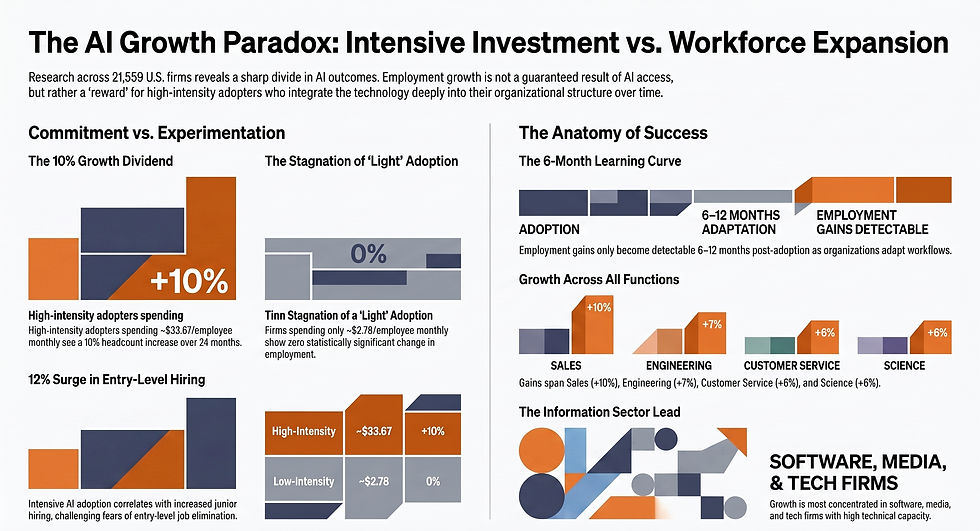
Analysis of 21,559 U.S. firms linking corporate payment data to workforce records reveals that employment gains following AI adoption are concentrated among high-intensity adopters. Firms in the top tercile of AI spending per employee—averaging approximately $33.67 monthly per employee during the first three months of sustained adoption—experience roughly 10% employment growth over the subsequent 24 months compared to similar firms that have not yet adopted. In contrast, firms in the bottom two intensity terciles, averaging $2.78 monthly per employee, show no statistically significant employment change (Kharazian et al., 2026).
This intensity gradient suggests several interpretations:
Complementary investment requirement: Capturing meaningful productivity gains from AI may require substantial complementary investments in workflow redesign, training, technical infrastructure, and organizational change. Low-intensity adopters deploying basic chat subscriptions without complementary investments may observe limited value.
Use case identification: High-intensity adopters may be firms that have identified specific, high-value applications where AI creates clear productivity or capability gains, justifying expanded investment and enabling organizational growth that supports higher employment.
Strategic commitment: Sustained high spending may signal genuine strategic commitment to AI integration rather than experimental pilot programs, with committed adopters more likely to make the organizational changes required to benefit from AI capabilities.
Entry-level employment shows similar patterns, with high-intensity adopters experiencing approximately 12% growth in entry-level headcount over 24 months while low-intensity adopters show no significant change. This finding contradicts concerns that AI adoption primarily eliminates entry-level roles, instead suggesting that intensive AI deployment correlates with junior hiring growth.
Stripe provides an illustrative example of high-intensity AI adoption correlating with continued workforce expansion. The financial infrastructure company has integrated AI extensively across product development, customer support automation, and fraud detection. Following intensive AI tool deployment, the company has maintained robust engineering hiring, particularly at mid and senior levels, while deploying AI-assisted development tools that appear to complement rather than substitute for engineering talent. The firm has publicly described AI capabilities as enabling faster feature development and improved operational efficiency while continuing to expand headcount.
Gradual Implementation and Learning Curves
Employment gains among high-intensity adopters emerge gradually rather than immediately, consistent with organizational learning curves in technology adoption. Analysis shows that employment effects become detectable approximately 6-12 months after initial adoption, with growth continuing and potentially accelerating through 18-24 months post-adoption. The earliest visible gains appear roughly half a year after sustained spending begins, suggesting that firms require time to establish best practices, integrate AI tools into workflows, train employees, and make complementary organizational changes before productivity gains translate into growth that supports higher employment (Kharazian et al., 2026).
This temporal pattern has several implications:
Initial experimentation period: The months immediately following AI tool purchase likely involve experimentation, use case identification, and workflow adaptation rather than immediate productivity transformation.
Skill development requirements: Employees and managers may require time to develop skill in prompt engineering, output evaluation, and effective human-AI collaboration before productivity gains materialize.
Complementary organizational changes: Firms may need to redesign workflows, adjust role definitions, establish quality control processes, and make other organizational changes before capturing full AI benefits.
Shopify illustrates gradual integration. The e-commerce platform began deploying AI capabilities in customer support and merchant tools in early 2023, but described a substantial learning period before productivity gains became evident. The company reported that initial deployment involved significant experimentation with prompt design, output quality control, and workflow integration. Measurable productivity improvements in customer support response times and resolution rates emerged several months after initial tool deployment, with the company subsequently expanding AI integration to additional functions including content generation for merchant storefronts and marketing recommendations.
Broad Functional Deployment
Employment growth among high-intensity adopters spans multiple occupational categories rather than concentrating in specific functions. High-intensity adopters show approximately 7% growth in engineering headcount, 10% growth in sales, 8% growth in administrative roles, 6% growth in customer service, and 6% growth in scientist positions over 24 months. Marketing and finance headcount also grow, though with somewhat weaker statistical confidence. Operations represents the only major category showing no significant change (Kharazian et al., 2026).
This broad functional growth pattern suggests that:
Complementarity across functions: AI deployment in one function may increase demand for complementary work in other functions. For example, AI-accelerated product development may increase demand for sales, marketing, and customer support to serve expanded product offerings.
Firm-level growth effects: Rather than AI substituting for labor in specific tasks while other functions remain unchanged, intensive adoption may enable overall firm growth that increases labor demand broadly across functions.
Limited displacement visibility: If AI were primarily substituting for labor in specific occupational categories, we would expect to observe headcount declines in highly exposed functions even as other categories expand. The absence of such declines, even in functions like customer service and engineering where AI capabilities are relatively mature, suggests limited displacement effects at least in early adoption periods.
Zendesk demonstrates broad deployment patterns. The customer service platform company has integrated AI extensively in its core product offerings, enabling automated response generation, sentiment analysis, and routing optimization. Rather than reducing customer success team headcount, the company has maintained or expanded employment across multiple functions. Engineering teams working on AI feature development have grown, sales teams supporting AI-enabled product offerings have expanded, and customer success teams—initially viewed as potentially displaced by AI capabilities—have grown while shifting toward higher-value consultation and relationship management activities.
Sector Concentration in Information Industries
Employment gains are highly concentrated in the Information sector, which includes software, internet services, media, and telecommunications firms. High-intensity adopters in Information show approximately 13% employment growth over 24 months, with clean pre-treatment parallel trends supporting causal interpretation. Other sectors show smaller, statistically insignificant effects, though professional and technical services show positive point estimates suggesting possible gains that may become statistically detectable with longer observation periods or larger samples (Kharazian et al., 2026).
This sectoral concentration reflects several factors:
Mature use cases: AI applications in software development—particularly code generation, debugging, and documentation—represent relatively mature capabilities where firms have identified clear value propositions and effective deployment patterns.
Technical workforce capacity: Information sector firms employ more workers with technical skills required to evaluate AI tools, integrate them into workflows, and develop complementary capabilities.
Product-market fit: For software and internet services firms, AI can directly improve core product offerings or accelerate feature development, creating clearer paths from AI adoption to revenue growth that supports employment expansion.
Early adoption timing: Information sector firms adopted AI earlier on average, providing longer post-adoption observation periods in current data.
GitHub, owned by Microsoft, exemplifies Information sector AI integration. The company's Copilot product, launched in 2021 and widely deployed by 2023, provides AI-assisted code completion and generation. Internal deployment at GitHub and parent company Microsoft has coincided with continued engineering hiring growth rather than workforce reduction. The company describes Copilot as accelerating feature development and enabling engineers to focus on higher-value architectural and design decisions while automating routine code generation. Post-Copilot deployment, both GitHub and Microsoft's broader engineering organizations have continued expanding headcount.
Evidence Gaps and Limitations
Several important limitations qualify these findings. First, the analysis captures early adoption cohorts—primarily 2023-2025—with observation periods extending only 24 months post-adoption. Longer-term effects may differ from early dynamics if productivity gains eventually enable firms to reduce employment after initial growth periods, though the continued acceleration of effects through 24 months suggests growth rather than displacement patterns.
Second, firms that adopt AI are highly selected: they are larger, more technical, faster-growing, and more likely to be venture-backed than non-adopters. While the analytical approach compares adopters to later adopters in the same intensity group and sector, eliminating some selection concerns, adopting firms may still differ on unobserved dimensions that affect their employment trajectories. The finding that employment gains concentrate among high-intensity adopters provides some reassurance, as the intensity gradient would be difficult to explain by selection alone, but definitive causal claims remain challenging.
Third, the analysis cannot identify specific mechanisms driving employment growth. Possible channels include: AI-enabled product acceleration allowing firms to capture market share; productivity gains reducing costs and supporting price reductions that increase demand; AI capabilities enabling entry into new product categories; improved operational efficiency supporting business model expansion; or AI features directly enhancing product value propositions. Understanding which mechanisms predominate would inform expectations about how gains might persist and generalize as AI capabilities mature and diffuse.
Fourth, the concentration of employment gains in Information raises questions about generalizability. Other sectors may show similar gains as AI applications mature and firms develop sector-specific deployment expertise, or Information sector results may reflect unique characteristics—high baseline technical capacity, direct product integration opportunities, mature use cases—that will not generalize broadly. Extended observation and expanded sectoral analysis will help resolve this uncertainty.
Building Long-Term AI Integration Capabilities
Strategic Intensity Over Experimentation
The contrast between high and low-intensity adopters suggests that firms should approach AI adoption strategically rather than experimentally. Many organizations purchase AI subscriptions, conduct pilot programs, and observe limited value without making sustained investments required to capture meaningful benefits. The concentration of employment growth among high-intensity adopters indicates that substantial commitment—reflected in sustained spending, likely accompanied by complementary investments in training, workflow redesign, and organizational change—may be necessary to realize transformative productivity gains.
Organizations considering AI adoption should:
Identify specific high-value applications where AI capabilities clearly address organizational needs rather than deploying AI broadly without clear use cases
Plan complementary investments in training, workflow redesign, quality control processes, and technical infrastructure necessary to capture AI productivity potential
Commit sustainably rather than treating AI as an experimental pilot program, recognizing that meaningful gains may require 6-12 months of organizational learning and adaptation
Measure adoption intensity through spending per employee or similar metrics rather than treating adoption as binary, recognizing that light deployment may not yield transformative results
Developing Organizational AI Literacy
The gradual emergence of employment gains following adoption suggests that organizational learning represents a critical success factor. Firms require time to develop effective AI utilization practices: identifying appropriate tasks, crafting effective prompts, evaluating output quality, establishing human-AI workflow patterns, and building employee confidence in AI tool reliability.
Organizations can accelerate learning through:
Structured training programs that move beyond tool demonstrations to develop practical skills in prompt engineering, output evaluation, and effective human-AI collaboration patterns
Internal knowledge sharing mechanisms that enable employees who identify effective AI applications to share practices across teams, preventing redundant experimentation and accelerating diffusion of effective approaches
Dedicated AI champions or specialized roles responsible for identifying use cases, developing organizational expertise, and supporting colleagues in AI tool adoption
Experimentation infrastructure that enables safe, low-stakes exploration of AI capabilities in non-production environments before deployment in customer-facing or business-critical applications
Notion illustrates effective organizational learning approaches. The productivity software company integrated AI capabilities into its core product while simultaneously deploying AI tools internally. Rather than assuming employees would independently develop effective AI usage patterns, the company established internal champions within each functional team, conducted regular knowledge-sharing sessions where employees demonstrated effective AI applications, and created internal documentation of proven use cases. This structured approach appears to have accelerated internal adoption and effectiveness compared to firms that simply provided AI tool access without supporting organizational learning.
Investing in Complementary Capabilities
The requirement for sustained high spending intensity to observe employment gains suggests that AI technology alone provides limited value without complementary organizational investments. Firms need technical infrastructure to support AI integration, workflow processes designed to incorporate AI capabilities effectively, quality control mechanisms to ensure AI output meets organizational standards, and cultural changes that help employees view AI as an augmentation tool rather than a threatening replacement.
Complementary investments include:
Technical infrastructure: API integration capabilities, data infrastructure to support AI model training or retrieval-augmented generation, security controls for sensitive data in AI workflows, and technical expertise to evaluate and integrate AI tools
Process redesign: Workflow modifications that enable effective human-AI collaboration rather than simply overlaying AI tools onto existing processes designed for purely human execution
Quality assurance: Review mechanisms, output validation processes, and feedback loops that ensure AI-generated content meets organizational quality standards
Change management: Communication, training, and organizational development efforts that help employees understand how AI deployment affects their roles and develop skills to work effectively with AI tools
Jasper AI, a company providing AI-powered content generation tools, demonstrates the importance of complementary investments in its own operations. After building AI content generation capabilities, the company found that realizing internal productivity gains required substantial investment in workflow redesign, output quality review processes, brand voice consistency controls, and employee training. Simply providing AI tools to marketing and content teams without these complementary investments yielded inconsistent results and limited adoption. Only after investing in surrounding processes and capabilities did the company observe substantial internal productivity gains from its own AI tools.
Building Equitable Access and Support
The concentration of AI adoption among larger, more technical, better-resourced firms raises equity concerns. Organizations without technical expertise, capital for sustained investment, or access to adoption knowledge networks may fall behind in AI capabilities, potentially creating productivity and competitive gaps that exacerbate existing organizational inequalities.
Supporting broader, more equitable adoption requires:
Public investment in technical assistance, training resources, and adoption support that extends beyond large, well-resourced organizations to smaller firms and organizations serving underrepresented communities
Industry consortia or sector-specific knowledge-sharing initiatives that reduce adoption barriers by pooling development resources, sharing implementation lessons, and creating sector-specific AI applications tailored to industry needs
Vendor responsibility for making AI tools accessible and valuable to organizations beyond large technology firms, including simplified deployment processes, integrated training resources, and pricing models that enable smaller organizations to experiment without prohibitive capital requirements
Educational infrastructure that prepares current and future workers to work effectively with AI tools, reducing the specialized expertise requirement for organizational adoption
The sectoral concentration of current employment gains in Information suggests that without active intervention to support broader adoption, AI productivity and employment benefits may concentrate in already advantaged sectors and organizations, potentially widening economic inequality rather than creating broadly shared prosperity.
Conclusion
Analysis of firm-level AI spending linked to workforce records reveals that intensive AI adoption correlates with employment growth rather than job displacement, but these gains are concentrated among firms making sustained, substantial investments and are most evident in the Information sector. High-intensity adopters—firms spending approximately $33 per employee monthly on AI vendors—experience roughly 10% employment growth over 24 months following adoption, with gains spanning multiple occupational categories including engineering, sales, administrative roles, and entry-level positions. Low-intensity adopters show no significant employment change, suggesting that limited experimentation without sustained commitment and complementary investment yields minimal productivity or employment effects.
These findings carry several implications. For workers, particularly those early in careers, the evidence suggests that intensive AI adoption at employing firms correlates with expanded rather than reduced hiring, contradicting widespread concerns about immediate widespread job displacement. For firms, the results indicate that capturing meaningful AI productivity gains likely requires sustained investment intensity and complementary organizational capabilities rather than simply purchasing AI tool subscriptions. For policymakers, the concentration of gains in the Information sector and among larger, more technical, better-resourced firms suggests that realizing broad economic benefits from AI may require active support for adoption among smaller organizations and in sectors beyond software and internet services.
Important limitations qualify these conclusions. The analysis captures early adoption cohorts with relatively short post-adoption observation periods, potentially missing longer-term displacement effects if they emerge after initial growth periods. Adopting firms are highly selected, and while comparing adopters to later adopters in the same intensity group and sector addresses some selection concerns, definitive causal claims remain challenging. The mechanisms driving employment growth remain unclear—whether through market share gains, new product category entry, direct product enhancement, or other channels—limiting ability to forecast whether and how these patterns will persist as AI capabilities mature and adoption broadens.
Several directions warrant continued research attention. First, extending observation periods will reveal whether employment gains persist, accelerate, or eventually reverse as firms fully integrate AI capabilities and potentially require fewer workers to maintain equivalent output. Second, identifying specific mechanisms driving employment growth would inform understanding of which organizational contexts and AI applications are most likely to yield complementary rather than substitutional labor effects. Third, tracking how employment effects evolve as adoption expands beyond Information sector early adopters will clarify whether observed patterns reflect AI capabilities generally or unique characteristics of software and technology firms. Fourth, examining within-occupation task changes, skill requirement evolution, and wage effects will illuminate how AI transforms work even when net employment remains stable or grows.
The early evidence challenges predictions of immediate widespread AI-driven job losses, instead suggesting that intensive AI adoption can correlate with organizational growth that supports employment expansion. However, the concentration of gains among well-resourced Information sector firms and the absence of detectable effects among low-intensity adopters indicate that realizing broad AI productivity benefits may require substantial organizational capability development and potentially active policy support to prevent growing divergence between AI-enabled and AI-excluded organizations and sectors.
Research Infographic
References
Acemoglu, D., & Restrepo, P. (2018). The race between man and machine: Implications of technology for growth, factor shares, and employment. American Economic Review, 108(6), 1488–1542.
Acemoglu, D., & Restrepo, P. (2019). Automation and new tasks: How technology displaces and reinstates labor. Journal of Economic Perspectives, 33(2), 3–30.
Autor, D. H., Levy, F., & Murnane, R. J. (2003). The skill content of recent technological change: An empirical exploration. The Quarterly Journal of Economics, 118(4), 1279–1333.
Autor, D., Chin, C., Salomons, A., & Seegmiller, B. (2024). New frontiers: The origins and content of new work, 1940–2018. The Quarterly Journal of Economics, 139(3), 1399–1465.
Babina, T., Fedyk, A., He, A., & Hodson, J. (2024). Artificial intelligence, firm growth, and product innovation. Journal of Financial Economics, 151, 103745.
Bonney, K., Breaux, C. L., Dinlersoz, E., Foster, L. S., Haltiwanger, J. C., & Pande, A. A. (2026). The microstructure of AI diffusion: Evidence from firms, business functions, and worker tasks. NBER Working Paper No. 35141.
Brynjolfsson, E., Chandar, B., & Chen, R. (2025). Canaries in the coal mine? Six facts about the recent employment effects of artificial intelligence. Stanford Digital Economy Lab Working Paper.
Brynjolfsson, E., Li, D., & Raymond, L. R. (2025). Generative AI at work. The Quarterly Journal of Economics, 140(2), 889–942.
Eloundou, T., Manning, S., Mishkin, P., & Rock, D. (2024). GPTs are GPTs: An early look at the labor market impact potential of large language models. Science, 384(6702), eadl2347.
Federal Reserve Bank of Atlanta. (2026). Survey of Business Uncertainty.
Felten, E. W., Raj, M., & Seamans, R. (2021). Occupational, industry, and geographic exposure to artificial intelligence: A novel dataset and its potential uses. Strategic Management Journal, 42(12), 2195–2217.
Gimbel, M., Kendall, J., & Kulsakdinun, R. (2026). Labor market AI exposure: What do we know? The Budget Lab at Yale.
Hampole, M., Papanikolaou, D., Schmidt, L., & Seegmiller, B. (2025). Artificial intelligence and the labor market. NBER Working Paper No. 33509.
Kharazian, A., Simon, L., & Stevens, R. (2026). A new look at AI's impact on jobs: Firm-level AI spending and workforce adjustment. Ramp Research Paper.
Massenkoff, M., & McCrory, P. (2026). Labor market impacts of AI: A new measure and early evidence. Anthropic Research.
Noy, S., & Zhang, W. (2023). Experimental evidence on the productivity effects of generative artificial intelligence. Science, 381(6654), 187–192.
U.S. Census Bureau. (2026a). AI use at U.S. businesses. America Counts, May 26, 2026.
Webb, M. (2020). The impact of artificial intelligence on the labor market. Stanford University Working Paper.
Yotzov, I., Barrero, J. M., Bloom, N., Bunn, P., Davis, S. J., Foster, K. M., Jalca, A., Meyer, B. H., Mizen, P., Navarrete, M. A., Smietanka, P., Thwaites, G., & Wang, B. Z. (2026). Firm data on AI. NBER Working Paper No. 34836.

Jonathan H. Westover, PhD, Chief Research Officer (Nexus Institute for Work and AI); Co-Founder & Chief Workforce and Learning Officer (Future State University); Founder & CEO (Human Capital Innovations); Professor of Organizational Leadership & Change (UVU). Read Jonathan Westover's executive profile here.
Suggested Citation: Westover, J. H. (2026). AI Adoption and Employment Growth: Evidence from Enterprise Spending Data. Human Capital Leadership Review, 38(3). doi.org/10.70175/hclreview.2020.38.3.2


