





A New Paradigm of Personnel Evaluation: From HR Metrics to AI and Empathy-Led Leadership


Listen to a review of this article:
Abstract: Personnel evaluation systems are undergoing fundamental transformation as organizations confront the limitations of traditional appraisal methods in increasingly dynamic, digitized, and data-rich work environments. This article examines how conventional performance management approaches—characterized by episodic reviews, supervisor-driven ratings, and structural biases—are systematically misaligned with contemporary organizational realities. Through integrative analysis of recent scholarship on HR analytics, artificial intelligence in human resource management, and psychological safety research, this study proposes the Integrated Personnel Evaluation Model (IPEM): a socio-technical framework synthesizing HR metrics, AI-driven people analytics, and empathy-led leadership within a coherent governance architecture. The model addresses three persistent tensions in modern evaluation practice: the conflict between algorithmic objectivity and relational legitimacy, the trade-off between continuous data capture and employee trust, and the contradiction between evaluation as control versus evaluation as development. Findings demonstrate that effective contemporary evaluation systems must be simultaneously more data-informed and more human-centered, integrating analytical precision with developmental purpose. The IPEM contributes a theoretically grounded and practically actionable blueprint for organizations seeking to build valid, trusted, and strategically relevant personnel evaluation capabilities in the digital economy.
Performance evaluation occupies a paradoxical position in contemporary human resource management. Recognized as foundational to talent decisions, developmental resource allocation, and reward legitimacy, evaluation systems nonetheless suffer from well-documented failures that undermine both their technical validity and organizational credibility. The challenge facing today's organizations extends beyond isolated inefficiencies in appraisal design; rather, evidence suggests a systemic misalignment between inherited evaluation architectures and the realities of modern work.
Traditional evaluation instruments—annual performance reviews, supervisor-driven rating scales, static goal frameworks—were designed for organizational contexts characterized by stable job definitions, clear reporting hierarchies, and predictable career trajectories. These conditions no longer obtain in knowledge-intensive, digitally mediated, and increasingly distributed work environments where roles evolve rapidly, collaboration transcends formal structures, and performance depends on adaptive capability rather than standardized task execution. The persistence of legacy evaluation systems in such contexts generates not merely measurement error but fundamental legitimacy deficits that erode the developmental and motivational purposes evaluation is meant to serve.
Three interrelated developments intensify the urgency of evaluation system transformation. First, the proliferation of workplace data infrastructures has created unprecedented capacity for continuous, multidimensional performance tracking, yet most organizations lack the analytical capabilities or governance frameworks to translate data abundance into evaluation improvement. Second, advances in artificial intelligence and people analytics enable descriptive, predictive, and prescriptive insights far beyond human cognitive capacity, but algorithmic systems introduce new risks related to bias, transparency, and employee trust. Third, research on employee wellbeing, psychological safety, and compassionate leadership has established that evaluation effectiveness depends not only on measurement precision but on relational quality and developmental purpose—dimensions frequently absent from both traditional and algorithmically augmented systems.
The present study addresses the critical gap between these fragmented research streams by proposing an integrated conceptual framework that reconciles analytical rigor with human-centered leadership. The Integrated Personnel Evaluation Model synthesizes insights from evidence-based HRM, human-centered AI, and organizational psychology to articulate how measurement, analytics, and empathy can be structurally aligned within coherent evaluation systems. This approach responds to a central insight: evaluation systems that optimize only the technical dimension risk depersonalization and surveillance; those that prioritize only the relational dimension lack evidentiary grounding; only through systematic integration can organizations build evaluation capabilities that are simultaneously more objective, more predictive, more trusted, and more developmental.
The Personnel Evaluation Landscape
Defining Contemporary Evaluation Challenges in Organizational Context
Personnel evaluation, understood as the systematic assessment of employee performance against organizational objectives and role expectations, functions as the primary institutional mechanism through which organizations calibrate talent allocation, justify reward distribution, and structure developmental interventions. However, the effectiveness of this function has come under sustained scholarly critique as traditional evaluation methods confront the complexity, velocity, and collaborative nature of contemporary work.
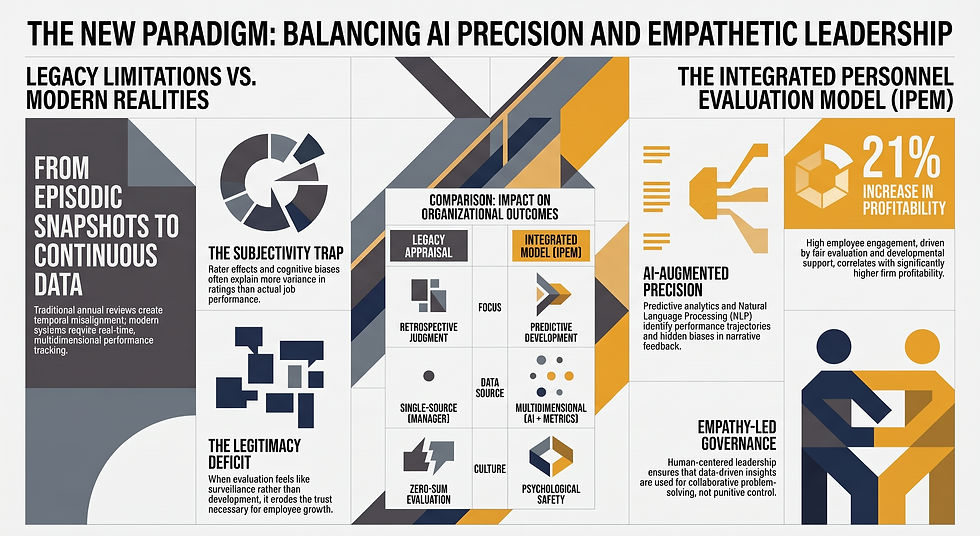
The limitations of conventional appraisal systems are both structural and epistemological. Structurally, annual or semi-annual review cycles create temporal misalignment with dynamic project environments where performance fluctuates significantly within shorter timeframes. Episodically captured performance snapshots fail to represent developmental trajectories, learning curves, or contextual variations that meaningfully differentiate high-quality from merely adequate contributions. This temporal inadequacy is compounded by single-source rater dependencies: when evaluation relies predominantly on supervisor judgment, outcomes reflect not only employee performance but also supervisor cognitive biases, relational dynamics, and observational limitations.
Research by Scullen and colleagues demonstrated that performance ratings partition into three variance components: actual job performance, rater-specific effects, and measurement error, with rater effects often explaining variance proportions comparable to or exceeding true performance variance (Scullen et al., 2000). While subsequent research suggests that behavioral signals can explain meaningful rating variance, the persistence of halo effects, recency bias, similarity bias, and leniency bias across organizational contexts indicates that subjective distortion remains a substantive validity threat. Moreover, when evaluative and developmental objectives coexist within the same appraisal event, employees interpret the interaction primarily through an evaluative lens, activating impression management strategies that undermine the authentic self-reflection necessary for developmental learning (Murphy & Cleveland, 1995).
State of Practice: From Annual Appraisals to Continuous Performance Management
Organizational responses to these limitations have produced a discernible shift from episodic, standardized appraisal toward more fluid performance management architectures. Leading organizations have abandoned forced distribution rankings and rigid annual review schedules in favor of continuous feedback mechanisms, frequent check-in conversations, and adaptive goal systems. This transition reflects recognition that evaluation serves strategic purposes only when it provides timely, actionable intelligence rather than retrospective justifications for predetermined decisions.
Cappelli and Tavis documented this transformation through case analyses of major corporations abandoning traditional appraisal systems, noting that organizations increasingly prioritize agility, developmental dialogue, and real-time performance calibration over standardized rating consistency (Cappelli & Tavis, 2016). The adoption of Objectives and Key Results frameworks exemplifies this evolution: OKRs establish transparent, measurable performance targets while enabling frequent recalibration as organizational priorities shift, thereby aligning individual contribution with strategic objectives in ways that rigid KPI systems cannot accommodate (Doerr, 2018).
However, the shift toward continuous performance management introduces implementation challenges that many organizations underestimate. Frequent feedback conversations require managerial capabilities—coaching skill, emotional intelligence, time allocation—that exceed those needed for annual ratings. Real-time evaluation systems generate data volumes that overwhelm human processing capacity without supporting analytics infrastructure. Most critically, continuous monitoring risks transforming evaluation from developmental dialogue into surveillance, particularly when implemented through digital tracking systems that lack transparency or employee input.
The Data Imperative: HR Metrics and the Analytics Opportunity
The expansion of workplace data infrastructures has fundamentally altered the informational environment within which evaluation occurs. Digital collaboration platforms, project management systems, learning management software, and communication tools generate continuous behavioral data that can be aggregated, analyzed, and translated into performance insights. This data richness creates opportunity for more granular, multidimensional performance representation than supervisor judgment alone can provide.
Contemporary HR metrics frameworks distinguish between input indicators (capturing capabilities, qualifications, and resources brought to roles), process metrics (measuring work quality, collaboration patterns, and skill application), and output measures (assessing tangible results and goal achievement). Effective evaluation systems integrate all three dimensions rather than relying exclusively on outcome metrics, which often reflect contextual factors—market conditions, resource availability, team dynamics—beyond individual control. Balanced Scorecard logic extends this multidimensionality by embedding individual performance within broader strategic contexts, linking employee contributions to organizational objectives across financial, customer, internal process, and learning perspectives (Kaplan & Norton, 1992).
Despite this potential, research by Angrave and colleagues cautions that data availability does not automatically translate into decision-making improvement (Angrave et al., 2016). HR analytics initiatives frequently fail when organizations lack analytical literacy, theoretical grounding, or institutional mechanisms to translate insights into actionable interventions. Metric systems can reinforce compliance-oriented behaviors rather than promote learning when they are perceived primarily as monitoring tools rather than developmental supports. The challenge, therefore, is not merely technical—establishing data infrastructure and measurement protocols—but socio-technical: building organizational capabilities to use data in ways that enhance rather than undermine the relational quality and developmental purpose that effective evaluation requires.
Organizational and Individual Consequences of Evaluation System Failures
Organizational Performance Impacts
Dysfunctional evaluation systems impose measurable costs on organizational effectiveness through multiple channels. When employees perceive appraisal processes as unfair, biased, or disconnected from meaningful performance dimensions, evaluation loses its capacity to motivate improvement or guide developmental investments. Instead, it generates compliance behaviors—impression management, metric gaming, risk avoidance—that optimize measured indicators at the expense of substantive contribution.
Research on goal-setting theory demonstrates that performance improvement depends critically on goal acceptance and commitment, which in turn require perceived fairness and participatory goal-setting processes (Locke & Latham, 2002). Evaluation systems that impose goals unilaterally or fail to provide clear line-of-sight between individual objectives and organizational priorities undermine this motivational mechanism. Similarly, when evaluation criteria emphasize easily quantifiable outputs while ignoring collaborative contributions, knowledge sharing, or innovative experimentation, organizations inadvertently discourage precisely the behaviors most critical for adaptive capability and long-term competitiveness.
The talent management consequences extend beyond motivation. Invalid evaluation systems misallocate developmental resources by failing to identify genuine capability gaps or high-potential employees. Promotion and succession decisions grounded in biased or imprecise performance data elevate individuals lacking requisite capabilities while overlooking superior alternatives. Compensation systems tied to flawed evaluation create perceived inequities that erode trust, increase turnover intentions among high performers, and generate legal exposure when evaluation disparities correlate with protected characteristics.
Quantified estimates of these costs are challenging to establish given measurement difficulties and causal attribution complexities. However, research on employee engagement—which links directly to evaluation quality—provides indicative magnitudes. Organizations in the top quartile of employee engagement demonstrate 21% higher profitability, 17% higher productivity, and substantially lower turnover than bottom-quartile counterparts (Frazier et al., 2017). While engagement reflects multiple factors, evaluation fairness and developmental support constitute significant determinants, suggesting that evaluation system improvements can generate economically meaningful performance gains.
Individual Wellbeing and Employee Experience Impacts
The individual-level consequences of evaluation dysfunction extend beyond career progression to fundamental wellbeing and psychological experience. Employees subject to evaluation systems they perceive as unfair, opaque, or punitive experience elevated stress, reduced job satisfaction, and diminished organizational commitment. When evaluation processes activate threat responses rather than learning orientations, they undermine the psychological safety necessary for authentic development.
Psychological safety, defined as shared belief that interpersonal risk-taking is safe within the team environment, enables individuals to admit mistakes, seek feedback, and experiment with new approaches without fear of status loss or punitive consequences (Edmondson, 1999). Meta-analytic evidence confirms that psychological safety predicts learning behavior, information sharing, creative contribution, and performance across diverse organizational contexts (Frazier et al., 2017). Evaluation systems that operate through episodic judgment rather than continuous dialogue, or that conflate developmental feedback with administrative decisions, systematically erode psychological safety by framing performance conversations as zero-sum evaluations rather than collaborative problem-solving.
The relationship between employee wellbeing and organizational performance has gained increasing empirical support. De Neve and colleagues demonstrated that workplace wellbeing correlates positively with firm profitability, return on assets, and market valuation, even after controlling for industry and size factors (De Neve et al., 2024). This evidence challenges traditional assumptions that wellbeing represents a cost to be minimized or a "nice-to-have" peripheral to core business objectives. Instead, it suggests that evaluation systems should incorporate wellbeing indicators not merely for ethical reasons but as strategically relevant performance dimensions.
Traditional evaluation systems structurally neglect wellbeing considerations. By focusing exclusively on output achievement and behavioral compliance, they ignore sustainable performance capacity—the ability of individuals to maintain high contribution levels over time without burnout, disengagement, or health deterioration. Dewe and Cooper argue that conventional appraisal frameworks are fundamentally incompatible with contemporary knowledge work demands, which require cognitive flexibility, creative problem-solving, and sustained attentional resources that cannot be maintained under chronic stress conditions (Dewe & Cooper, 2021). Evaluation systems that drive such stress through punitive consequences, opaque criteria, or excessive workload pressures paradoxically undermine the performance they ostensibly measure.
Evidence-Based Organizational Responses
Table 1: Key Components and Practices of Modern Personnel Evaluation Systems
Evaluation Strategy | Primary Methodology | Technological Integration | Key Performance Indicators | Developmental Focus | Governance and Ethics | Organizational Benefits |
Integrated Personnel Evaluation Model (IPEM) | Socio-technical synthesis of HR metrics, AI-driven people analytics, and empathy-led leadership. | AI and advanced analytics, including Predictive Performance Analytics and Natural Language Processing (NLP). | Balanced indicators: input (capabilities), process (quality/collaboration), and output (tangible results) metrics. | Continuous feedback, psychological safety, and move from control to mutual learning/growth. | Fairness and ethics review committees, algorithmic auditing, demographic parity testing, and transparency/contestability mechanisms. | Increased profitability (21%), higher productivity (17%), reduced attrition, and improved strategic alignment. |
Continuous Performance Management | Objectives and Key Results (OKRs) and frequent check-in conversations. | Real-time performance dashboards and digital collaboration platforms. | Transparent, measurable performance targets with frequent recalibration. | Real-time performance calibration, coaching skills, and developmental dialogue. | Participatory goal-setting and avoiding evaluation-as-surveillance. | Agility, improved goal commitment, and real-time actionable intelligence. |
Empathy-Led Leadership & Wellbeing Integration | Continuous micro-feedback, structured self-reflection, and compassionate coaching. | Wellbeing dashboards tracking engagement, stress indicators, and work-life balance data. | Team engagement scores, burnout symptoms, time-off utilization, and 360-degree coaching effectiveness ratings. | Sustainable performance capacity, mental health, and resilience building. | Decoupling evaluation from presenteeism; human-centered oversight of algorithmic suggestions. | Reduced nursing turnover, decreased stress-related disability claims, and higher employee satisfaction. |
Implementing Multidimensional HR Metrics Architectures
Organizations seeking to transcend traditional evaluation limitations must begin with foundational measurement architecture improvements that establish more comprehensive, valid, and timely performance representation. This requires moving beyond simplistic output metrics toward integrated frameworks capturing inputs, processes, and outcomes across multiple performance dimensions.
Balanced performance indicator design involves mapping critical performance dimensions that reflect strategic priorities, then establishing specific, measurable indicators for each dimension. Financial services firms, for example, might evaluate client relationship managers on client satisfaction scores (customer dimension), loan quality and risk management (internal process dimension), regulatory compliance (governance dimension), and professional development activity (learning dimension), in addition to revenue targets. Manufacturing organizations might assess production supervisors on safety incident rates, quality defect percentages, team engagement scores, and throughput efficiency, recognizing that output optimization at the expense of safety or quality creates unsustainable performance trajectories.
Technology sector organizations have pioneered multidimensional metric systems that balance individual contribution with collaborative effectiveness. Software engineers are evaluated not only on code production velocity but on code review participation, documentation quality, bug resolution responsiveness, and knowledge-sharing contributions to team learning. Product managers are assessed on feature delivery timelines, but also on cross-functional stakeholder satisfaction, strategic alignment, and user outcome metrics. These multidimensional frameworks reduce gaming incentives by making it difficult to optimize narrowly defined metrics while ignoring broader contribution dimensions.
Participatory goal-setting processes represent a critical complement to expanded metric frameworks. Goal-setting theory demonstrates that performance improvement depends on goal acceptance and commitment, which are maximized when employees participate meaningfully in defining objectives rather than receiving them as mandates (Latham & Locke, 2007). Leading organizations implement structured OKR processes where employees propose objectives aligned with organizational priorities, negotiate key results with managers, and establish transparent tracking mechanisms enabling continuous progress monitoring.
A global professional services network redesigned its evaluation approach by replacing imposed billable hour targets with collaboratively established OKRs incorporating client impact, professional development, and firm-building contributions. Partners and associates jointly define quarterly objectives, establish measurable key results, and conduct biweekly check-ins to assess progress and recalibrate as needed. This participatory approach increased goal commitment, reduced turnover among high-performing associates, and improved alignment between individual activities and strategic priorities. Importantly, the system maintains accountability—objectives and results remain measurable and transparent—while shifting the evaluation experience from externally imposed judgment to collaborative performance management.
Real-time performance dashboards leverage digital infrastructure to provide continuous visibility into performance trajectories, enabling proactive management rather than retrospective assessment. Organizations integrate data from project management systems, CRM platforms, learning management systems, and collaboration tools into unified dashboards displaying progress against goals, skill development activities, and engagement indicators. Managers and employees can access these dashboards continuously, facilitating ongoing dialogue grounded in objective data rather than relying on memory-dependent, retrospective annual discussions.
A multinational technology corporation implemented real-time performance dashboards for engineering teams, displaying sprint completion rates, code quality metrics, peer review engagement, and learning activity participation. Rather than using these dashboards punitively, the organization positioned them as shared visibility tools supporting collaborative problem-solving. When metrics indicate struggling performance, managers initiate support conversations focused on obstacle identification and resource provision rather than blame attribution. This approach transformed evaluation from episodic judgment to continuous developmental partnership, increasing both performance outcomes and employee satisfaction with the evaluation process.
Deploying AI-Enabled People Analytics Capabilities
Artificial intelligence and advanced analytics introduce qualitatively new evaluation capabilities by processing data volumes and detecting patterns beyond human cognitive capacity. However, effective deployment requires careful attention to algorithmic fairness, transparency, and integration with human judgment rather than treating AI as autonomous decision-maker.
Predictive performance analytics apply machine learning algorithms to identify leading indicators of performance trajectories, attrition risk, and developmental needs before problems become acute. Algorithms can analyze historical performance data, learning activity patterns, communication network centrality, and sentiment indicators from written communications to predict which employees face elevated disengagement risk or would benefit most from particular developmental interventions.
A large financial institution developed predictive models identifying employees at elevated flight risk six months before resignation, enabling proactive retention interventions. The models incorporated performance ratings, compensation positioning, promotion velocity, manager relationship quality indicators, and learning engagement metrics. When algorithms flagged high-performing employees as flight risks, HR business partners initiated career conversations, explored development opportunities, and in some cases adjusted compensation or role assignments. This predictive approach reduced regretted attrition among high performers by approximately one-third, generating estimated annual cost savings exceeding the entire analytics investment through reduced recruitment and training expenses.
Natural language processing for evaluation enhancement enables organizations to extract performance-relevant insights from unstructured text data—performance review narratives, peer feedback comments, project retrospectives, communication patterns. NLP algorithms can identify sentiment trends, detect potential bias in narrative evaluations, flag inconsistencies between quantitative ratings and qualitative descriptions, and surface themes in developmental feedback that inform targeted capability-building programs.
A global consulting firm applied NLP analysis to narrative performance review comments, identifying systematic gender differences in evaluation language. Female consultants received more feedback emphasizing communication style and team dynamics, while male consultants received more strategic thinking and leadership potential comments, even at equivalent performance rating levels. This algorithmic audit revealed unconscious bias patterns invisible in aggregated rating distributions, prompting evaluator training interventions and revised evaluation guidance emphasizing consistent criteria application. Follow-up analyses documented reduction in gender-differentiated language patterns following these interventions, demonstrating how AI can support rather than merely automate evaluation processes.
Algorithmic fairness auditing and bias mitigation represent essential governance mechanisms when AI systems inform evaluation decisions. Algorithms trained on historical data risk perpetuating embedded biases if training data reflect past discrimination or if model specifications inadequately account for contextual factors affecting performance. Research by Raghavan and colleagues demonstrates that algorithmic hiring systems frequently fail to deliver promised bias reductions because they are trained on data reflecting existing organizational biases or because fairness constraints are inadequately specified (Raghavan et al., 2020).
Effective algorithmic governance requires multiple safeguards: demographic parity testing to ensure algorithms do not generate systematically different outcomes for protected groups, explainability requirements ensuring managers understand algorithmic recommendations, contestability mechanisms enabling employees to challenge algorithmic conclusions, and periodic audits comparing algorithmic and human decision patterns. Wachter and colleagues argue that technical fairness measures alone prove insufficient; algorithmic fairness must be continuously evaluated against legal non-discrimination standards and ethical principles that extend beyond statistical parity (Wachter et al., 2021).
A technology company implemented comprehensive algorithmic governance for its AI-augmented performance management system. The governance framework includes quarterly demographic impact analyses examining whether algorithms generate differential outcomes across gender, ethnicity, and age categories; explainability requirements mandating that any algorithmic recommendation include interpretable rationales accessible to managers and employees; and a fairness review committee comprising HR, legal, data science, and employee representatives that reviews algorithm performance and adjudicates challenges. This governance infrastructure transformed AI from a potentially opaque "black box" into a transparent, accountable evaluation support system, increasing employee trust and managerial confidence in analytics-informed decisions.
Building Psychological Safety Through Empathy-Led Leadership
Technical evaluation improvements remain insufficient without corresponding transformation in the relational quality and developmental orientation of performance conversations. Empathy-led leadership provides the human dimension that prevents data-driven evaluation from devolving into impersonal surveillance, instead supporting psychological safety and growth orientation.
Continuous micro-feedback conversations replace episodic annual reviews with frequent, informal developmental dialogues. Rather than accumulating feedback for annual delivery, managers provide real-time observations, coaching, and appreciation in the flow of work. These micro-conversations reduce the stakes and anxiety associated with formal reviews while increasing feedback timeliness and actionability.
A healthcare organization redesigned manager training to emphasize continuous feedback skills, teaching supervisors to deliver brief, specific, behavior-focused feedback immediately following observed performance. Managers learned to frame feedback developmentally—"Here's what I noticed, here's why it matters, here's what excellence looks like in this situation"—rather than evaluatively. This approach transformed evaluation culture from judgment-oriented to learning-oriented, with employee surveys indicating substantial increases in perceived feedback fairness, developmental value, and psychological safety. Importantly, nursing turnover decreased following implementation, suggesting that evaluation experience meaningfully affects retention even in high-demand labor markets.
Structured employee self-reflection and goal ownership promotes metacognitive awareness and developmental autonomy. Rather than positioning evaluation as something done to employees by managers, effective systems engage employees as active agents in their own performance assessment and development planning. Structured self-reflection asks employees to assess their progress against objectives, identify capability strengths and gaps, analyze environmental factors affecting performance, and propose development actions.
An international manufacturing company implemented quarterly self-assessment exercises where employees complete structured reflections before meeting with managers. The self-assessment prompts employees to evaluate their performance against established OKRs, identify two things they would do differently if repeating the quarter, name one capability they want to develop, and propose specific development activities supporting that capability. Manager-employee conversations begin with reviewing self-assessments, creating dialogue grounded in employee perspective rather than managerial judgment. This approach increased employees' sense of ownership over their development, improved alignment between development activities and genuine capability gaps, and strengthened manager-employee relationships by framing evaluation as collaborative rather than adversarial.
Manager empathy capability development and accountability recognizes that empathy-led leadership requires deliberate skill cultivation, not merely exhortation to "be more empathetic." Effective organizations embed empathy competencies within managerial evaluation criteria, provide structured training in perspective-taking and active listening, and equip managers with wellbeing and engagement data enabling them to recognize struggling employees before crises emerge.
A professional services firm incorporated "develops others through empathetic coaching" as a formal evaluation criterion for all people managers, weighted at 20% of overall manager performance assessment. The firm provided structured training covering empathetic listening techniques, recognizing signs of burnout or disengagement, and conducting difficult conversations with compassion. Critically, the firm equipped managers with analytics-generated wellbeing dashboards showing team-level engagement scores, work-life balance indicators, and sentiment trends, enabling data-informed empathy rather than relying solely on subjective impressions. Manager evaluations now include structured 360-degree feedback from direct reports specifically assessing empathetic leadership behaviors, creating accountability for this previously unmeasured dimension. Implementation correlated with improvements in employee engagement scores and reductions in stress-related absence, demonstrating that empathy accountability can generate measurable organizational benefits beyond relational quality improvements.
Integrating Wellbeing Monitoring and Support
Contemporary evaluation systems are expanding beyond traditional performance dimensions to incorporate employee wellbeing as both an outcome to be supported and a leading indicator of sustainable performance capacity. This integration reflects growing evidence that wellbeing and performance are complementary rather than competing objectives.
Wellbeing metric integration into evaluation dashboards provides managers with visibility into factors affecting employees' capacity to perform sustainably. Organizations track indicators such as working hours patterns, time-off utilization, engagement survey responses, and self-reported stress or burnout symptoms, presenting these alongside traditional performance metrics. This integrated visibility enables managers to identify situations where high performance occurs through unsustainable means—excessive hours, inadequate recovery, mounting stress—and intervene before performance collapses or health crises emerge.
A financial services organization integrated wellbeing indicators into manager dashboards, flagging when employees accumulated excessive overtime, failed to take scheduled vacation, or showed declining engagement scores. Rather than treating these flags as performance problems, the organization trained managers to interpret them as early warning signals warranting supportive conversations. Managers might explore workload distribution, discuss boundary-setting challenges, or connect employees with wellbeing resources. This proactive approach reduced stress-related short-term disability claims and improved long-term performance sustainability by preventing the burnout that traditional evaluation systems inadvertently incentivize through exclusive focus on output maximization.
Flexible work arrangements and recovery support operationalize wellbeing commitments by providing employees with genuine autonomy over work patterns and recovery time. Research demonstrates that control over work scheduling and location substantially affects stress levels and work-life balance, particularly for employees managing caregiving responsibilities. Evaluation systems that punish flexibility use or that implicitly require constant availability undermine stated wellbeing commitments.
Leading organizations are decoupling evaluation from presenteeism by focusing on outcome delivery rather than activity monitoring. A technology company revised evaluation criteria to eliminate any reference to working hours, location, or meeting attendance, instead evaluating purely on results achieved and collaborative contribution quality. This shift enabled employees to adopt work patterns suiting their circumstances—some work early mornings and evenings around childcare, others prefer concentrated blocks, some thrive in office environments while others are more productive remotely—without evaluation penalty. The organization monitors workload sustainability through wellbeing metrics and manager check-ins, but trusts employees to manage their own work patterns provided outcomes are delivered. This approach increased retention among working parents and employees with disabilities while maintaining performance standards, demonstrating that wellbeing support and performance accountability are compatible when evaluation systems are thoughtfully designed.
Mental health and resilience capability building recognizes that wellbeing depends partly on individual coping capabilities and organizational skill-building investments. Organizations provide stress management training, resilience workshops, mindfulness programs, and mental health literacy education, positioning these as performance-relevant capabilities rather than peripheral benefits. Evaluation conversations explicitly address personal capacity building alongside technical skill development, with managers discussing strategies for managing workload, recovering from setbacks, and maintaining energy over extended periods.
Building Long-Term Evaluation System Capabilities
Recalibrating the Psychological Contract Between Employees and Evaluation Systems
Successful evaluation transformation requires renegotiating the implicit psychological contract governing performance assessment. Traditional systems establish an evaluative contract where organizations judge employee performance and employees strategically manage impressions. Modern integrated approaches seek to establish a developmental contract where evaluation serves mutual learning and growth.
This recalibration requires consistent messaging and structural alignment demonstrating that evaluation exists primarily to support employee success rather than to justify administrative decisions. Organizations can strengthen developmental contracts by decoupling evaluation conversations from immediate compensation decisions, establishing separate "development dialogues" and "calibration processes." When employees trust that honest self-assessment and transparent struggle discussion will not immediately affect compensation, they engage more authentically in developmental conversations.
Psychological contract recalibration also requires addressing the historical evaluation baggage many employees carry from previous negative experiences. Organizations implementing evaluation transformation benefit from explicit acknowledgment that previous systems were flawed, transparent communication about what is changing and why, and demonstrated commitment through visible investments in manager capability building and system improvements. Without this explicit contract renegotiation, employees may approach new evaluation systems with cynicism grounded in past disappointments, limiting transformation effectiveness regardless of technical system quality.
Developing Distributed Evaluation Capability and Leadership Accountability
Evaluation quality depends fundamentally on managerial capability to conduct developmental conversations, interpret data intelligently, and provide coaching support. Many organizations invest heavily in evaluation system design while under-investing in capability building, creating sophisticated tools used incompetently.
Distributed evaluation capability requires comprehensive manager development addressing multiple skill dimensions: data literacy enabling managers to interpret analytics outputs and recognize algorithmic limitations; coaching capability supporting developmental dialogue rather than judgment delivery; empathetic communication enabling perspective-taking and psychological safety creation; and fair decision-making processes that mitigate cognitive biases. These capabilities require sustained development through training, practice opportunities, feedback, and peer learning rather than one-time workshop participation.
Leadership accountability mechanisms ensure evaluation quality remains a strategic priority rather than an administrative afterthought. Organizations can embed evaluation effectiveness within leadership assessment by incorporating direct report engagement and development metrics into executive scorecards, conducting 360-degree feedback evaluating leaders' coaching effectiveness, and including evaluation capability as a promotion criterion for management roles. When leaders recognize that their own advancement depends partly on how effectively they evaluate and develop others, evaluation quality receives the attention and resources it requires.
A multinational corporation implemented a "manager quality index" tracking each manager's direct report engagement scores, turnover rates, internal promotion rates, and 360-degree coaching effectiveness ratings. This index constitutes 30% of senior managers' performance evaluation, creating substantial incentive to invest in people development and evaluation quality. The organization provides extensive support enabling managers to improve—coaching certification programs, peer learning cohorts, data analytics training—while maintaining accountability through transparent performance tracking. This approach dramatically improved evaluation quality and developmental effectiveness by making people management success as consequential as business results delivery.
Establishing Governance Structures for Algorithmic Fairness and Employee Rights
As evaluation systems incorporate more algorithmic decision support, governance structures ensuring fairness, transparency, and employee rights protection become essential. Effective governance operates through multiple mechanisms addressing different aspects of algorithmic accountability.
Fairness and ethics review committees provide multidisciplinary oversight of algorithmic system development and deployment. These committees typically include HR leadership, legal counsel, data science experts, employee representatives, and external advisors, reviewing proposed algorithmic applications before deployment and conducting periodic audits of implemented systems. Review criteria examine whether algorithms serve legitimate purposes, whether fairness testing demonstrates non-discriminatory outcomes, whether explainability requirements are met, and whether employee privacy protections are adequate.
Transparency and contestability mechanisms ensure employees understand how evaluation decisions are made and possess channels to challenge conclusions they believe inaccurate or unfair. Organizations provide documentation explaining what data informs evaluation, how algorithms process information, and what decision rules apply. When algorithmic recommendations affect evaluation outcomes, employees receive interpretable explanations rather than opaque "computer says no" determinations. Contestability processes enable employees to submit challenges, request human review of algorithmic decisions, or provide contextual information the algorithm may have missed.
Regulatory compliance frameworks ensure evaluation systems satisfy evolving legal requirements around data privacy, algorithmic accountability, and non-discrimination. European Union regulations including GDPR and the AI Act establish stringent requirements for data protection, algorithmic transparency, and human oversight of automated decisions with significant individual impact. Organizations operating internationally must design evaluation systems satisfying the most stringent applicable regulatory regime, implementing privacy-by-design principles and maintaining detailed documentation of algorithmic decision processes.
A European financial institution established comprehensive algorithmic governance for its performance management system in anticipation of AI Act requirements. The governance framework includes quarterly fairness audits examining demographic impact patterns, mandatory explainability standards for any algorithmic recommendation, employee access to all data used in their evaluation with rights to correction of inaccuracies, human override authority for all algorithmic conclusions, and detailed logging of algorithmic decision processes enabling retrospective audit. While this governance infrastructure requires substantial investment, it protects the organization against regulatory risk while building employee trust in algorithmic systems through demonstrated fairness commitment.
Cultivating Continuous Learning and Evaluation System Evolution
Evaluation systems should not be treated as static implementations but as learning systems that evolve based on evidence about what works. Organizations committed to evaluation excellence establish mechanisms for systematic learning, experimentation, and continuous improvement.
Evidence-based iteration processes involve establishing clear metrics assessing evaluation system effectiveness—not just employee satisfaction surveys, but behavioral indicators such as feedback conversation frequency, development plan implementation rates, internal mobility patterns, and performance improvement trajectories. Organizations analyze these metrics regularly, identify system weaknesses, implement targeted improvements, and measure whether changes generate expected benefits. This evidence-based approach prevents evaluation systems from ossifying into bureaucratic rituals disconnected from genuine performance or development impact.
Controlled experimentation and pilot testing enable organizations to test evaluation innovations before full deployment. Rather than implementing untested systems organization-wide, leading companies run structured pilots in selected units, comparing outcomes against control groups using traditional approaches. This experimental methodology provides rigorous evidence about innovation effectiveness while limiting risk exposure if new approaches prove inferior to existing practices.
A technology company piloted continuous feedback practices in its product development division while maintaining traditional semi-annual reviews in sales and operations functions. The pilot tracked performance outcomes, employee engagement, and turnover across these groups over eighteen months. When evidence demonstrated that the continuous feedback group showed superior engagement and equivalent performance despite less formal process structure, the organization expanded the approach systematically while incorporating lessons learned during the pilot. This evidence-based rollout generated greater stakeholder confidence and implementation quality than wholesale transformation would have achieved.
External learning and partnership accelerate evaluation capability development by leveraging insights from academic research, professional networks, and technology vendors. Organizations participate in HR analytics consortia where members share anonymized data and insights about evaluation practices, subscribe to research services providing evidence summaries on evaluation effectiveness, and partner with academic institutions conducting evaluation system research. These external connections ensure evaluation approaches remain grounded in best available evidence rather than isolated organizational experience.
Conclusion
This article has developed and theoretically justified the Integrated Personnel Evaluation Model as a comprehensive framework addressing the documented limitations of traditional appraisal systems through systematic integration of HR metrics, AI-driven analytics, and empathy-led leadership. The analysis demonstrates that effective evaluation in contemporary organizations requires simultaneous advancement across technical and relational dimensions rather than optimizing one at the expense of the other.
Three core conclusions emerge with implications for both scholarship and practice. First, evaluation system effectiveness depends critically on architectural integration rather than component excellence. Sophisticated metrics without analytical capacity to generate insights produce data graveyards; powerful analytics without governance frameworks enabling trust generate employee resistance; empathetic leadership without data grounding risks subjectivity and inconsistency. Only through deliberate integration—structured in the IPEM through bidirectional feedback loops, cross-cutting governance, and joint optimization principles—can organizations achieve evaluation systems that are simultaneously more objective, more predictive, and more developmental than legacy approaches.
Second, the transformation from traditional to integrated evaluation requires fundamental recalibration of evaluation's organizational purpose and psychological contract. Evaluation must evolve from episodic judgment justifying administrative decisions toward continuous dialogue supporting development, from control mechanism enforcing compliance toward learning system building capability, and from manager-driven assessment toward collaborative performance partnership. This purpose transformation cannot be achieved through technical system redesign alone; it requires corresponding investments in leadership capability, cultural change, and sustained commitment from senior leadership who model developmental evaluation practices rather than perpetuating judgmental traditions.
Third, responsible integration of artificial intelligence into evaluation demands governance structures and human oversight that prevent algorithmic systems from reproducing historical biases or undermining employee autonomy and trust. The promise of AI-enabled evaluation lies not in replacing human judgment but in augmenting it—providing data-driven insights that inform rather than determine decisions, surfacing patterns invisible to individual cognition while preserving space for contextual interpretation and employee voice. Realizing this promise requires explicit attention to algorithmic fairness, transparency requirements, contestability mechanisms, and regulatory compliance that embed AI within accountable governance frameworks.
For HR practitioners, the IPEM offers an actionable implementation roadmap grounded in evidence-based principles. Organizations beginning evaluation transformation should sequence investments strategically: establishing foundational metric architectures and participatory goal-setting before deploying sophisticated analytics; building managerial coaching capability and psychological safety simultaneously with technical system improvements; implementing robust governance structures before rather than after algorithmic deployment; and adopting experimental approaches that test innovations rigorously before scaling. Implementation success depends less on technological sophistication than on organizational capability to use tools intelligently within supportive cultural contexts that value both analytical rigor and developmental purpose.
For researchers, the article identifies promising directions for empirical investigation. Longitudinal studies examining how evaluation system transformations affect performance outcomes, employee wellbeing, and organizational capabilities across diverse industry and institutional contexts would provide valuable evidence about implementation effectiveness and contingency factors. Experimental research testing specific design choices—continuous versus episodic feedback, algorithmic versus human judgment, multidimensional versus unidimensional metrics—would help identify which components drive evaluation quality improvements. Qualitative research exploring employee and manager experiences with AI-augmented evaluation would illuminate the relational dynamics and trust-building processes essential for algorithmic acceptance. Research examining equity implications—whether integrated evaluation approaches reduce or exacerbate disparities across demographic groups—remains particularly important given evaluation's central role in organizational opportunity allocation.
Ultimately, this study demonstrates that the future of personnel evaluation lies not in choosing between data-driven objectivity and human-centered empathy, but in systematically integrating both within coherent socio-technical systems. Organizations that successfully navigate this integration will build evaluation capabilities that are more valid, more trusted, more developmental, and more strategically valuable than either purely technical or purely relational approaches can achieve independently. In an era characterized by rapid technological change, evolving work arrangements, and heightened employee expectations for fairness and development, such integrated evaluation systems constitute essential organizational capabilities for attracting, developing, and retaining talent capable of driving sustained competitive advantage.
Research Infographic
References
Angrave, D., Charlwood, A., Kirkpatrick, I., Lawrence, M., & Stuart, M. (2016). HR and analytics: Why HR is set to fail the big data challenge. Human Resource Management Journal, 26(1), 1–11.
Bankins, S., Formosa, P., Griep, Y., & Richards, D. (2022). AI decision making with dignity? Contrasting workers' justice perceptions of human and AI decision making in a human resource management context. Information Systems Frontiers, 24, 857–875.
Bankins, S., Ocampo, A. C., Marrone, M., Restubog, S. L. D., & Woo, S. E. (2024). A multilevel review of artificial intelligence in organizations: Implications for organizational behavior research and practice. Journal of Organizational Behavior, 45(2), 159–182.
Cappelli, P., & Tavis, A. (2016). The performance management revolution. Harvard Business Review, 94(10), 58–67.
Chowdhury, S., Dey, P., Joel-Edgar, S., Bhattacharya, S., Rodriguez-Espindola, O., Abadie, A., & Truong, L. (2023). Unlocking the value of artificial intelligence in human resource management through AI literacy: An integrative framework and research agenda. International Journal of Human Resource Management, 36(2), 267–314.
De Neve, J.-E., Kaats, M., & Ward, G. (2024). Workplace wellbeing and firm performance (Wellbeing Research Centre Working Paper 2304). University of Oxford.
Dewe, P., & Cooper, C. L. (2021). Work and stress: A research overview. Routledge/Taylor & Francis Group.
Doerr, J. (2018). Measure what matters: OKRs: The simple idea that drives 10x growth. Portfolio.
Duggan, J., Sherman, U., Carbery, R., & McDonnell, A. (2020). Algorithmic management and app-work in the gig economy: A research agenda for employment relations and HRM. Human Resource Management Journal, 30(1), 114–132.
Edmondson, A. (1999). Psychological safety and learning behavior in work teams. Administrative Science Quarterly, 44(2), 350–383.
Frazier, M. L., Fainshmidt, S., Klinger, R. L., Pezeshkan, A., & Vracheva, V. (2017). Psychological safety: A meta-analytic review and extension. Personnel Psychology, 70(1), 113–165.
Kaplan, R. S., & Norton, D. P. (1992). The balanced scorecard: Measures that drive performance. Harvard Business Review, 70(1), 71–79.
Kellogg, K. C., Valentine, M. A., & Christin, A. (2020). Algorithms at work: The new contested terrain of control. Academy of Management Annals, 14(1), 366–410.
Kniffin, K. M., Narayanan, J., Anseel, F., Antonakis, J., Ashford, S. P., Bakker, A. B., Bamberger, P., Bapuji, H., Bhave, D. P., Choi, V. K., Creary, S. J., Demerouti, E., Flynn, F. J., Gelfand, M. J., Greer, L. L., Johns, G., Lemoine, G. J., Probst, T. M., Putnam, L. L., & van Vugt, M. (2021). COVID-19 and the workplace: Implications, issues, and insights for future research and action. American Psychologist, 76(1), 63–77.
Latham, G. P., & Locke, E. A. (2007). New developments in and directions for goal-setting research. European Psychologist, 12(4), 290–300.
Locke, E. A., & Latham, G. P. (2002). Building a practically useful theory of goal setting and task motivation: A 35-year odyssey. American Psychologist, 57(9), 705–717.
Madad, S., Maumy-Bertrand, M., Bertrand, F., & Valero, Y. (2024). NLP approach to ground employee performance evaluation. In Proceedings of the International Conference on Connected Innovation and Technology & The Smart Healthcare International Conference, Danang, Vietnam.
Marler, J. H., & Boudreau, J. W. (2017). An evidence-based review of HR analytics. The International Journal of Human Resource Management, 28(1), 3–26.
Murphy, K. R., & Cleveland, J. N. (1995). Understanding performance appraisal: Social, organizational, and goal-based perspectives. Sage Publications.
Parent-Rocheleau, X., & Parker, S. K. (2022). Algorithms as work designers: How algorithmic management influences the design of jobs. Human Resource Management Review, 32(3), 100838.
Pulakos, E. D., Hanson, R. M., Arad, S., & Moye, N. (2015). Performance management can be fixed: An on-the-job experiential learning approach for complex behavior change. Industrial and Organizational Psychology: Perspectives on Science and Practice, 8(1), 51–76.
Raghavan, M., Barocas, S., Kleinberg, J., & Levy, K. (2020). Mitigating bias in algorithmic hiring: Evaluating claims and practices. Proceedings of the 2020 ACM Conference on Fairness, Accountability, and Transparency, 469–481.
Rigamonti, E., Gastaldi, L., & Corso, M. (2024). Measuring HR analytics maturity: Supporting the development of a roadmap for data-driven human resources management. Management Decision, 62(13), 243–282.
Rousseau, D. M., & Barends, E. G. R. (2011). Becoming an evidence-based HR practitioner. Human Resource Management Journal, 21, 221–235.
Scullen, S. E., Mount, M. K., & Goff, M. (2000). Understanding the latent structure of job performance ratings. Journal of Applied Psychology, 85(6), 956–970.
Tambe, P., Cappelli, P., & Yakubovich, V. (2019). Artificial intelligence in human resources management: Challenges and a path forward. California Management Review, 61(4), 15–42.
van den Broek, E., Sergeeva, A., & Huysman, M. (2021). When the machine meets the expert: An ethnography of developing AI for hiring. MIS Quarterly, 45(3), 1557–1582.
Wachter, S., Mittelstadt, B., & Russell, C. (2021). Why fairness cannot be automated: Bridging the gap between EU non-discrimination law and AI. Computer Law & Security Review, 41, 105567.

Jonathan H. Westover, PhD, Chief Research Officer (Nexus Institute for Work and AI); Co-Founder & Chief Workforce and Learning Officer (Future State University); Founder & CEO (Human Capital Innovations); Professor of Organizational Leadership & Change (UVU). Read Jonathan Westover's executive profile here.
Suggested Citation: Westover, J. H. (2026). A New Paradigm of Personnel Evaluation: From HR Metrics to AI and Empathy-Led Leadership. Human Capital Leadership Review, 38(2). doi.org/10.70175/hclreview.2020.38.2.1


