top of page
Home
Bio
Pricing
Podcast Network
Advertise with Us
Be Our Guest
Academy
Learning Catalog
Learners at a Glance
The ROI of Certification
Corporate L&D Solutions
Research
Research Models and Tools
Research in Popular Media
Research One Sheets
Research Snapshots
Research Videos
Research Briefs
Research Articles
Free Educational Resources
HCL Review
Contribute to the HCL Review
HCL Review Archive
HCL Reviwe Slide Decks and Infographics
HCL Review Process
HCL Review Reach and Impact
HCI Press
From HCI Academic Press
From HCI Popular Press
Publish with HCI Press
Free OER Texts
Our Impact
Invest with HCI
Industry Recognition
Philanthropic Impact
Kiva Lending Impact
Merch
More
Use tab to navigate through the menu items.
The Strategic ROI of Human Capital: Translating Workforce Investments into Business Value
RESEARCH BRIEFS
16 hours ago
18 min read
Nested Learning: A New Paradigm for Adaptive AI Systems
RESEARCH BRIEFS
1 day ago
15 min read
The Widening AI Value Gap: Strategic Imperatives for Business Leaders
RESEARCH BRIEFS
2 days ago
24 min read
From Individual Expertise to Collective Intelligence: Building Learning-Capable Teams
RESEARCH BRIEFS
2 days ago
23 min read
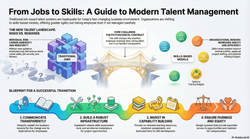
Navigating the Shift to Skills-Based Talent Management: Evidence-Based Strategies for Organizational Success
LEADERSHIP FOR CHANGE
3 days ago
17 min read
Organizational Learning from Crisis: Evidence-Based Strategies for Building Adaptive Capacity
RESEARCH BRIEFS
4 days ago
26 min read
Designing a Better Hiring Process: Strategies to Identify Top Talent
LEADERSHIP IN PRACTICE
5 days ago
7 min read
How Public Service Motivation, Red Tape, and Job Satisfaction Shape Innovation in the Public Sector
RESEARCH BRIEFS
6 days ago
15 min read
The AI Ethics Gap in K–12 Education: Why Technical Training Alone Fails Our Teachers and Students
RESEARCH BRIEFS
Dec 15
17 min read
Unlocking Human Potential: A Capability Approach to Adult Learning and Organizational Development
RESEARCH BRIEFS
Dec 14
27 min read
Human Capital Leadership Review
Why Connection Is Today’s Most Critical Performance Driver
2 hours ago
6 min read
The Strategic ROI of Human Capital: Translating Workforce Investments into Business Value
RESEARCH BRIEFS
16 hours ago
18 min read
Nested Learning: A New Paradigm for Adaptive AI Systems
RESEARCH BRIEFS
1 day ago
15 min read
The Widening AI Value Gap: Strategic Imperatives for Business Leaders
RESEARCH BRIEFS
2 days ago
24 min read
One Year After the AI Boom: Expert Recounts How Marketing Has Transformed in 2025
2 days ago
3 min read
From Individual Expertise to Collective Intelligence: Building Learning-Capable Teams
RESEARCH BRIEFS
2 days ago
23 min read
Navigating the Shift to Skills-Based Talent Management: Evidence-Based Strategies for Organizational Success
LEADERSHIP FOR CHANGE
3 days ago
17 min read
Organizational Learning from Crisis: Evidence-Based Strategies for Building Adaptive Capacity
RESEARCH BRIEFS
4 days ago
26 min read
Why AI Leadership Fails Without ROI Discipline
5 days ago
3 min read
1
2
3
4
5
Human Capital Innovations
Play Video
Play Video
13:12
Before AI Designs Your Job
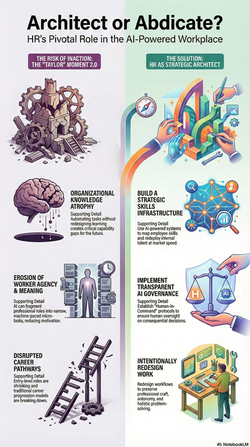
Explore why HR must lead AI-driven work redesign before technology dictates jobs. This playbook, based on Dr. Jonathan H. Westover’s analysis, outlines actionable strategies: transparent AI governance, strategic skills infrastructure, agency-preserving work design, and proactive career architectures to avoid Taylorist fragmentation of knowledge work. Learn how to preserve meaningful careers, enable rapid talent redeployment, and build human-centered AI systems that boost productivity without eroding professional craft. Essential for HR leaders, people ops, CHROs, and organizational designers tackling AI in HR, workforce transformation, and future-of-work challenges. If this helped, please like and share the video. #AIinHR #FutureOfWork #HumanCenteredAI #WorkforceTransformation OUTLINE: 00:00:00 - HR's Fork in the AI Road 00:00:57 - When Technology Designs Jobs by Default 00:02:29 - Erosion of capability and agency 00:03:37 - Vendor dependence and the silent erosion 00:04:53 - Restoring agency and HR’s playbook 00:06:29 - Work redesign and career architecture 00:07:55 - AI at work in the real world 00:09:27 - Human in command and the Anna story 00:10:51 - Shaping a future of meaningful work 00:12:06 - The playbook—act now
Play Video
Play Video
21:08
The Frederick Winslow Taylor Moment: Why HR Must Lead the AI Reorganization of Work, by Jonathan ...
Artificial intelligence is reshaping white-collar work at an unprecedented pace, yet many human resources functions remain on the sidelines of this transformation. Drawing on insights from workforce transformation leaders and emerging organizational research, this article examines the urgent imperative for HR to design AI-integrated work systems before technology architectures determine human roles by default. The parallels to early 20th-century scientific management reveal risks of task fragmentation that prioritizes algorithmic efficiency over professional craft and worker agency. Evidence from large-scale skills transformation initiatives demonstrates that strategic HR leadership can enable talent redeployment at market speed while preserving meaningful work. With entry-level pathways narrowing and traditional career progression disrupted, HR professionals face a pivotal choice: architect human-centered AI work systems now, or inherit technology-determined structures later. This article synthesizes academic research and practitioner experience to outline evidence-based responses across transparent governance, skills infrastructure, and agency-preserving work design that position HR as strategic architects of the AI-augmented workplace.
Play Video
Play Video
07:41
A Conversation about The Taylor Moment: HR’s Role in AI Work Reorganization
This conversation argues that human resources leaders must take a proactive role in redesigning work as artificial intelligence begins to fundamentally reorganize professional roles. Drawing parallels to Taylorism, the author warns that failing to lead this transition risks turning complex knowledge work into fragmented, machine-driven tasks that strip employees of autonomy and purpose. To prevent knowledge atrophy and career disruption, the text advocates for a human-centered architecture that prioritizes skill development and professional agency. Successful integration requires building dynamic skills infrastructures and transparent governance frameworks that ensure technology supports rather than dictates human contribution. Ultimately, the source positions HR as a strategic architect responsible for balancing algorithmic efficiency with the preservation of meaningful work. See Privacy Policy at https://art19.com/privacy and California Privacy Notice at https://art19.com/privacy#do-not-sell-my-info.
Play Video
Play Video
07:39
A Conversation about The Strategic ROI of Human Capital
This conversation argues that organizations must transition from viewing personnel expenses as simple overhead to treating them as strategic investments with measurable financial returns. The author outlines six data-driven frameworks to help leadership quantify how employee retention and upskilling directly influence revenue growth, customer loyalty, and innovation. By adopting the analytical rigor typically reserved for finance, HR departments can transform from reactive cost centers into proactive drivers of business value. Case studies illustrate that modeling workforce risks and the opportunity costs of vacant roles allows companies to make more informed capital allocation decisions. Ultimately, the source suggests that integrating talent analytics into core business planning builds a sustainable competitive advantage that is difficult for rivals to replicate. See Privacy Policy at https://art19.com/privacy and California Privacy Notice at https://art19.com/privacy#do-not-sell-my-info.
Play Video
Play Video
14:30
Critical Thinking, Creative Thinking, Systems Thinking and Many More: Implications for Organizati...
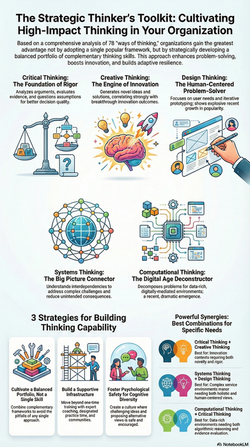
Abstract: This article examines the organizational implications of prevalent "ways of thinking"—cognitive frameworks that shape how individuals and teams perceive problems, generate solutions, and execute strategies. Drawing on Crilly's (2025) comprehensive bibliometric analysis of 78 ways of thinking across research literatures, this article translates academic prevalence patterns into actionable insights for practitioners. Critical thinking, design thinking, creative thinking, systems thinking, and computational thinking emerge as the five most prevalent frameworks in contemporary scholarship. However, their uneven distribution across disciplines and applications, varying rates of adoption, and differential combinations suggest significant opportunities and risks for organizations. The analysis reveals that while critical thinking maintains broad, sustained relevance across sectors, computational thinking shows rapid concentration in specific domains, and design thinking demonstrates explosive recent growth. Organizations that strategically cultivate complementary thinking capabilities—rather than adopting isolated frameworks—demonstrate enhanced problem-solving capacity, innovation outcomes, and adaptive resilience. This article provides evidence-based guidance for selecting, developing, and integrating multiple ways of thinking to address complex organizational challenges, supported by cases spanning engineering, healthcare, education, and public services.
Play Video
Play Video
08:47
Nested Learning
The provided text introduces Nested Learning (NL), a sophisticated framework designed to move artificial intelligence beyond static, pre-trained models toward systems capable of continuous adaptation. By organizing neural networks into a hierarchy of optimization problems that operate at different speeds, this paradigm mimics biological memory to prevent the loss of old information while acquiring new skills. The source highlights how this approach addresses the high costs and operational delays associated with retraining large-scale models in industries like healthcare and finance. It specifically examines innovations such as deep optimizers and continuum memory systems that allow AI to process information across immediate, tactical, and strategic timescales. Ultimately, the text argues that shifting toward temporal depth enables more efficient, reliable, and evolving AI integration within complex organizational environments.
Play Video
Play Video
07:43
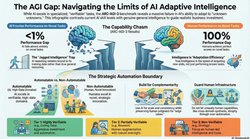
The Widening AI Value Gap
This research analysis identifies a growing performance disparity between a small group of elite "future-built" companies and the majority of organizations struggling to realize returns from artificial intelligence. While most firms face an investment paradox of high costs and low value, leaders achieve superior revenue growth and shareholder returns by integrating AI into core business functions. These successful organizations distinguish themselves through CEO-level leadership, comprehensive workforce upskilling, and the development of interoperable data architectures. The text emphasizes the emerging role of agentic AI as a primary driver of future competitive advantage. Ultimately, the source provides a strategic framework for executives to bridge this gap by transitioning from incremental automation to fundamental workflow redesign.
Play Video
Play Video
08:21
Thinking About Thinking
This article by Jonathan H. Westover analyzes how various cognitive frameworks—such as critical, design, and systems thinking—influence organizational performance and problem-solving. Based on a comprehensive bibliometric study, the text identifies the most prominent ways of thinking and evaluates their disciplinary growth and practical applications. The author emphasizes that organizations achieve the best results by developing a balanced portfolio of these mental models rather than focusing on a single method. To successfully integrate these skills, leaders must provide developmental infrastructure, foster psychological safety, and align specific frameworks with their strategic goals. Ultimately, the source provides an evidence-based guide for cultivating a diverse cognitive toolkit to navigate modern workplace complexity.
Blog: HCI Blog
Human Capital Leadership Review
Featuring scholarly and practitioner insights from HR and people leaders, industry experts, and researchers.
All Articles
Research Briefs
Research Insights
Looking Ahead
Leadership in Practice
Leadership Insights
Leadership for Change
Webinar Recaps
Book Reviews
Transformative Social impact
Search
May 3
5 min read
LEADERSHIP IN PRACTICE
Encouraging Productive Allyship in Organizations
bottom of page