Only 5% Win with AI: Here’s How to Join Them The video explores the significant gap between the promise of artificial intelligence (AI) and its actual impact within organizations, termed the “adoption impact gap.” Despite heavy investments in AI technologies, many companies fail to achieve transformative business results because the problem lies not in the technology but in human factors—how people adopt, understand, and integrate AI into their workflows. True AI capability is not about simply having access to AI tools but involves a complex blend of technical fluency, critical thinking, and systemic support embedded into organizational culture and daily routines. The video outlines a three-stage journey for building AI capability: foundational knowledge, applied practice, and embedded habits. Each stage emphasizes contextual learning, hands-on experience, and cultural integration. Success depends on tailored approaches for different roles—leaders, managers, transformers, and frontline staff—and on addressing fears related to job security, accuracy, and ethical concerns through transparency and psychological safety. Ultimately, organizations must measure AI impact through tangible business outcomes and continuously adapt based on feedback and data.
Highlights
🤖 The adoption impact gap: AI tools are widespread but transformative outcomes remain rare.
🧠 True AI capability depends on human skills—technical fluency, critical thinking, and systemic support.
📚 AI adoption is a journey through foundational knowledge, applied practice, and embedded habits.
👥 Tailored AI training for leaders, managers, transformers, and frontline staff is crucial.
🔄 Embedding AI into daily routines and culture drives lasting change and ROI.
💬 Addressing fears about AI with transparency, ethics, and psychological safety is essential.
📊 Measuring impact by business outcomes and continuous learning ensures sustainable AI success.
Key Insights
🤖 The Adoption Impact Gap Reveals a Human-Centric Challenge:
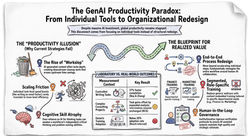
While organizations pour resources into AI platforms, the lack of significant business transformation highlights that AI’s potential is not unlocked by technology alone. This gap exists because AI adoption requires shifts in mindset, skills, and organizational practices, not just software deployment. Recognizing this human dimension is critical to moving past superficial AI usage towards meaningful impact.
🧩 True AI Capability is Multi-Dimensional:
The video identifies three foundational threads—technical fluency, critical thinking, and supportive systems—that together create real AI capability. Technical fluency ensures employees understand AI’s workings and limitations, helping them critically assess outputs rather than blindly trusting them. Critical thinking and creative problem solving remain vital, as AI augments rather than replaces human judgment, especially in ethical and complex decisions. Supportive systems embed AI use into workflows and culture, preventing skill decay and encouraging continual adaptation.
🚀 AI Adoption as a Progressive Journey:
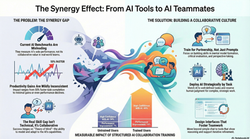
The three-stage model—foundational knowledge, applied practice, and embedded habits—provides a robust framework for sustainable AI integration. Foundational knowledge breaks down AI concepts into relatable, context-specific learning. Applied practice bridges the gap between theory and real-world problem-solving, fostering confidence and relevance. Embedded habits institutionalize AI use, making it part of everyday work through routines, evaluation, and cultural norms, thus scaling impact.
🎯 Role-Specific Tailoring is Essential:
A one-size-fits-all approach to AI training fails due to the varied needs and responsibilities across organizational roles. Leaders require strategic vision and visible AI use to set direction and model behavior. Managers focus on coaching and psychological safety to enable teams to experiment and learn. Transformers—those redesigning workflows—need resources and authority to innovate effectively. Frontline staff benefit from clear, simple prompts and explicit guidelines to apply AI in their daily tasks. Tailored approaches increase relevance and adoption rates.
🔍 Trust and Ethical Considerations are Non-Negotiable:
Concerns about job displacement, AI accuracy, bias, and data privacy are real and must be addressed openly. Building trust requires transparent communication of AI principles, ethical oversight, and quality control. Psychological safety encourages employees to voice concerns and participate in AI system design, increasing acceptance and reducing resistance. Ethical AI use is not only a moral imperative but a business enabler.
Like and share if this helped you shape an AI people-strategy.
#AICapability #AIAdoption #Leadership #WorkflowRedesign #AIforBusiness
OUTLINE:
00:00:00 - Bridging the Adoption-Impact Gap
00:01:17 - Redefining AI Capability as a Human Endeavor
00:02:44 - From Knowledge to Embedded Habits
00:03:52 - Tailoring Adoption, Building Trust, Measuring What Matters