





Reskilling for Resilience: Preparing Workers for the Dynamic Demands of Tomorrow's Workplace


Listen to a review of this article:
Abstract: The contemporary workforce faces unprecedented transformation driven by technological disruption, demographic shifts, global migration patterns, and environmental crises. While organizational training programs have traditionally centered on employer needs, emerging workplace realities demand a fundamental reorientation toward worker-centered continuous learning. This article examines how industrial-organizational (I-O) psychology must expand beyond organization-centric training models to embrace person-centered lifelong learning approaches that equip individuals—whether organizationally affiliated or not—with capabilities to navigate rapid occupational transitions. We analyze converging forces reshaping work accessibility, explore organizational and individual consequences of inadequate skill development, present evidence-based interventions for fostering adaptive learning cultures, and propose frameworks for building long-term workforce resilience. The future of work requires that I-O practitioners champion equitable learning access, particularly for vulnerable populations including gig workers, informal economy participants, aging employees, and displaced workers. By integrating insights from job crafting, career development, and adult learning sciences, we outline practical pathways for organizations, policymakers, and individuals to cultivate the continuous learning ecosystems essential for thriving amid workplace volatility.
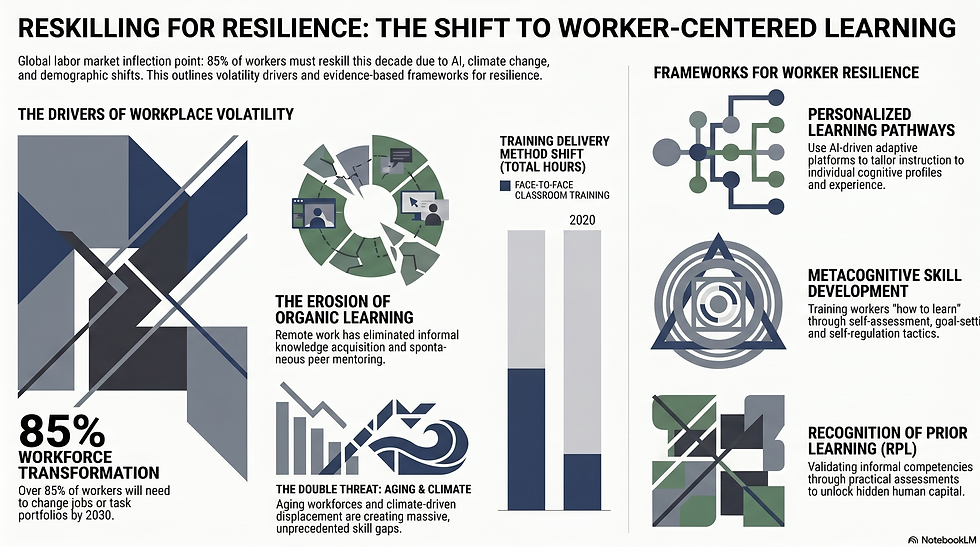
Global labor markets stand at an inflection point. Within this decade, over 85% of workers will need to change jobs or substantially modify their task portfolios to remain employable (Lund et al., 2021). This staggering projection reflects converging disruptions: artificial intelligence automating routine cognitive work, climate change rendering certain occupations untenable in specific geographies, demographic aging creating skill shortages while older workers face learning barriers, and pandemic-accelerated remote work fragmenting traditional organizational learning pathways.
Industrial-organizational psychology has long championed systematic training and development as vehicles for organizational effectiveness (Aguinis & Kraiger, 2009). Yet this predominantly organization-centric perspective—while valuable for enhancing firm performance—inadequately addresses the broader societal imperative of preparing all workers for continuous occupational adaptation. When organizations design training primarily to close immediate performance gaps, they may overlook the developmental needs of contingent workers, job seekers outside organizational boundaries, and employees whose future roles have yet to materialize.
The present moment demands a paradigmatic expansion: augmenting organization-centric training with person-centered workplace learning that prioritizes individual skill development, employability, and adaptive capacity across the lifespan. This approach recognizes that successful navigation of tomorrow's labor market requires workers to engage in self-directed lifelong learning, accurately assess emerging skill demands, identify personal capability gaps, and access quality developmental opportunities—often without organizational scaffolding.
This article articulates why and how I-O psychology must broaden its purview to support worker-centered continuous learning. We examine the workplace landscape drivers necessitating this shift, illuminate organizational and individual stakes, synthesize evidence-based interventions applicable across formal and informal learning contexts, and propose strategies for building resilient learning ecosystems. Throughout, we highlight implications for vulnerable populations whose access to learning resources remains most constrained, positioning equitable skill development as both an occupational health concern and a diversity, equity, and inclusion imperative.
The Evolving Workplace Landscape and Learning Implications
Remote Work Proliferation and Learning Access
The COVID-19 pandemic catalyzed an irreversible shift toward distributed work arrangements. Remote work now occurs at four to five times pre-pandemic levels (Lund et al., 2021), with office occupancy hovering near 50% of prior utilization (Telford, 2023). While remote work offers flexibility benefits (Allen et al., 2015), it fundamentally alters learning opportunities. Face-to-face classroom training hours plummeted from 40% to 16% of total training delivery between 2019 and 2020 (Association for Talent Development, 2021), with many programs hastily converted to online formats of questionable quality.
More critically, remote work eliminates organic learning—the informal knowledge acquisition that occurs through observing colleagues, casual mentoring interactions, and spontaneous problem-solving collaborations (Tannenbaum et al., 2010). For early-career workers, this loss proves particularly acute; virtual onboarding deprives new employees of the interpersonal skill development and professional network formation that in-person environments naturally facilitate (Sani et al., 2023; Woo et al., 2023). Remote workers also report feeling disconnected from supervisory support and organizational learning cultures that reinforce skill application (Hughes et al., 2020).
For workers unaffiliated with organizations—freelancers, gig workers, and informal economy participants—these challenges intensify. Without access to employer-sponsored training or collegial observation opportunities, such individuals bear full responsibility for identifying learning needs, sourcing appropriate content, and self-regulating their development. The shift to remote work thus exacerbates pre-existing inequities in learning access, particularly affecting those with limited digital literacy, unreliable internet connectivity, or financial constraints on purchasing training programs.
Implications for organizational practice: Organizations must design online learning experiences that compensate for lost informal learning opportunities. This requires creating virtual communities of practice, designating peer mentors for remote workers, implementing collaborative learning projects that foster knowledge exchange, and ensuring training quality rather than merely converting face-to-face content to digital delivery. For individual workers, developing metacognitive skills—understanding how they learn best, monitoring comprehension, and seeking feedback—becomes essential when supervisory oversight diminishes.
Workforce Aging and Cognitive Adaptation
Demographic aging represents another transformative force. By 2030, workers aged 55 and older will constitute approximately one-quarter of the U.S. labor force, with even more pronounced aging trends affecting Asia and South America (U.S. Bureau of Labor Statistics, 2020; International Labour Organization, 2024). This creates both opportunities and challenges for workplace learning.
Cognitive aging research reveals mixed implications for skill acquisition. Fluid cognitive abilities—reasoning, processing speed, and working memory—peak in early adulthood and gradually decline thereafter (Salthouse, 2010). These declines can impede learning of genuinely novel information or skills. However, crystallized abilities—accumulated knowledge and expertise—can increase well into one's seventies (Beier, 2022). Consequently, older workers often learn effectively when new content connects to existing knowledge structures, but may struggle when facing entirely unfamiliar domains (Beier & Ackerman, 2005).
Compounding these cognitive realities, older workers confront pervasive age-related stereotypes suggesting they lack motivation or capacity for learning (Posthuma & Campion, 2009). These stereotypes can become self-fulfilling when internalized, undermining self-efficacy for training engagement. Organizations may also discriminate in training access, viewing older workers as poor investments given anticipated shorter tenure—a calculus that ignores both the illegality of such discrimination and the organizational value of experienced workers' contributions.
Moreover, as workers age, their ability and knowledge profiles become increasingly idiosyncratic, reflecting decades of specialized skill development (Ackerman, 1996). Cookie-cutter training programs fail to accommodate this heterogeneity, suggesting the importance of personalized learning approaches that adapt to individual starting points, leverage existing expertise, and provide extended time for mastery when cognitive processing slows.
Implications for organizational practice: Organizations should implement age-inclusive training design principles: allowing self-paced learning, providing worked examples that connect new concepts to familiar contexts, offering extended practice opportunities, and actively combating age stereotypes through messaging that emphasizes diverse learning styles rather than age-related deficits. For older workers themselves, understanding how their skills might transfer to growth occupations—and honestly assessing which new skills lie within their learning capacity—becomes crucial for remaining employable in later career stages (Ackerman & Kanfer, 2020).
Climate Change, Migration, and Occupational Displacement
Climate change presents an underappreciated yet profound threat to occupational stability. Already, climate impacts affect 85% of the global population (Callaghan et al., 2021), with over 20 million people annually displaced by climate-related events (UNHCR, n.d.). Certain occupations—particularly outdoor work and agriculture in increasingly inhospitable regions—may become untenable, forcing workers to reskill for different industries.
Simultaneously, large-scale migration, both international and internal, reshapes labor markets (International Organization for Migration, 2022). Migrant workers often possess substantial skills and educational credentials from their origin countries, yet face language barriers, credential recognition challenges, cultural unfamiliarity, and discrimination that limit their employment options and access to training (McLeman & Hunter, 2010). The stress and trauma associated with displacement—whether climate-driven or resulting from conflict—further undermines psychological resources for learning (Wu et al., 2021).
Climate change also creates opportunities for "green reskilling"—training workers in sustainable practices and renewable energy technologies (Vidric et al., 2023). However, not all occupational transitions are equally feasible. Coal mining skills, for instance, transfer poorly to solar panel installation, despite optimistic policy narratives suggesting otherwise (Robertson, 2019). Without realistic assessment of skill transferability and provision of adequate training pathways, well-intentioned reskilling initiatives may fail, leaving vulnerable workers in precarious circumstances.
Implications for organizational practice: Regional workforce development agencies and employers in affected areas must proactively map declining occupations to growth sectors, identifying realistic transition pathways based on skill overlap rather than wishful thinking. Organizations can partner with community groups to provide apprenticeships or bridge training that combines income support with skill development. For policymakers, tools that assess individual workers' skills and match them to accessible opportunities—accounting for transferable competencies and training requirements—can facilitate more equitable occupational transitions (Khalaf & Jolley, 2020; World Economic Forum, 2018).
The Informal Economy: Hidden Workers and Informal Learning
Over 61% of the global workforce operates in the informal economy—work outside government regulation, taxation, and often labor protections (International Labour Organization, 2019). This encompasses diverse arrangements: intergenerational artisans (potters, weavers, sculptors) who sustain themselves through culturally embedded skills, day-wage laborers in agriculture or construction, and gig economy workers providing services like food delivery or ridesharing (Saxena, 2021, 2023a).
Informal workers face severe barriers to formal training access. They lack employer sponsorship for courses, often have limited digital literacy and internet access, work exhausting hours that preclude time for learning, and may view formal educational credentials as irrelevant to their livelihoods (Carr et al., 2008). Yet many informal occupations require sophisticated skills acquired through apprenticeship and experiential learning—traditional craftwork, for instance, demands extraordinary manual dexterity, material knowledge, and aesthetic judgment developed over decades (Saxena, 2021).
The challenge lies in recognizing and formalizing these existing competencies, providing pathways for skill upgrading when needed, and supporting informal workers' livelihood sustainability rather than forcing them into low-wage formal economy jobs that disregard their expertise. Approaches like "recognition of prior learning"—which certifies informally acquired skills through practical assessments rather than formal coursework—have shown promise in contexts like India (International Labour Organization, 2024). Dual apprenticeships combining on-the-job training with classroom instruction can also upgrade informal training systems while preserving cultural knowledge transfer (International Labour Organization, 2024).
Implications for organizational practice: Rather than viewing informal workers as deficient in skills, organizations and policymakers should map the competencies embedded in informal occupations, develop frameworks for certifying these skills, and create training offerings that augment rather than displace traditional knowledge. Technology literacy initiatives—teaching digital sales platforms or online marketing—can expand market reach for informal micro-entrepreneurs without requiring wholesale occupational transitions. For researchers, informal economy work represents a largely unexplored domain for understanding workplace learning, offering insights into intergenerational knowledge transfer and community-based skill development that formal organizations might adapt.
Consequences of Inadequate Skill Development: Organizational and Individual Stakes
Organizational Performance and Competitive Capacity
From an organizational perspective, workforce skill gaps directly threaten competitive advantage in rapidly evolving markets. When employees lack emerging competencies—data analytics, AI tool proficiency, cross-functional collaboration skills—organizations lose ground to more agile competitors. The 2021 shift requiring 85% of workers to change roles (Lund et al., 2021) implies that organizational success depends on having either workers who can rapidly reskill or the capacity to attract already-skilled talent in tight labor markets.
Strategic workforce planning that anticipates future skill needs and invests in proactive development yields measurable returns. Meta-analyses demonstrate that well-designed training improves both individual performance and team effectiveness (Arthur et al., 2003; Aguinis & Kraiger, 2009). Organizations offering robust development opportunities also enjoy lower turnover; tuition reimbursement programs, for example, reduce voluntary departure while building firm-specific human capital (Benson et al., 2004; Manchester, 2012).
Conversely, organizations that neglect systematic learning risk losing high-potential employees seeking development elsewhere, accumulating obsolete skill profiles, and finding themselves unable to adapt when disruptions occur. The pandemic provided a stark illustration: organizations with established online learning infrastructures and cultures of continuous development pivoted more successfully to remote operations than those lacking such foundations (Rudolph et al., 2021).
Individual Employability, Well-being, and Work Volition
For individual workers, skill obsolescence carries profound consequences. Workers unable or unwilling to reskill face unemployment, underemployment (working in roles below their capability), or persistent employment in declining occupations with deteriorating wages and conditions (Erdogan & Bauer, 2021). Older workers particularly suffer; re-employment rates drop precipitously after age 50, with job searches extending far longer than for younger counterparts (Wanberg et al., 2016).
Beyond economic impacts, skill stagnation undermines psychological well-being. Individuals unable to adapt may experience diminished self-efficacy, perceiving themselves as irrelevant in modern labor markets. This threatens work volition—the sense of having genuine occupational choice—which proves especially constrained for marginalized populations (Duffy et al., 2012; Laaser & Bolton, 2022). When workers feel they lack agency over their work lives, they become less proactive in seeking development, creating a vicious cycle wherein those most needing skill renewal engage least in learning activities.
The stress associated with rapid occupational change also takes health tolls. Uncertainty about job security, financial strain during transitions, and identity disruption when leaving long-held occupations all elevate risks for anxiety, depression, and stress-related illness (Rudolph et al., 2021). For vulnerable populations—low-income workers, those in the informal economy, displaced migrants—these stressors compound with pre-existing adversities, positioning inadequate learning access as both an occupational health and social justice concern.
Evidence-Based Interventions: Fostering Adaptive Learning Ecosystems
Table 1: Evidence-Based Reskilling Interventions and Workforce Challenges
Workforce Segment | Primary Challenges | Intervention Category | Specific Implementation Strategies | Key Evidence/Theories | Organizational Implications | Individual/Policy Outcomes |
Aging Workers (55+) | Decline in fluid cognitive abilities (processing speed), age-related stereotypes, and internalization of skill-acquisition myths. | Age-Inclusive/Adaptive Learning Design | Self-paced learning, worked examples connecting new concepts to prior knowledge, and extended practice opportunities. | Salthouse (2010) on fluid vs. crystallized intelligence; Posthuma & Campion (2009) on age stereotypes. | Retention of institutional expertise (crystallized knowledge); mitigation of age-discrimination risks; customized training for heterogeneous profiles. | Improved training self-efficacy; sustained employability in later career stages; psychological well-being through continued relevance. |
Displaced/Migrant Workers (Climate or Conflict) | Language barriers, credential recognition issues, trauma-related stress, and poor skill transferability (e.g., coal mining to solar). | Bridge Training and Skills Mapping | Occupational mapping based on skill overlap, bridge training with income support, and community-partnered apprenticeships. | McLeman & Hunter (2010) on climate migration; Wu et al. (2021) on trauma's impact on learning; Robertson (2019) on reskilling failures. | Fills labor gaps in growth sectors (green energy); leverages existing global talent pools; reduces hiring friction for "non-traditional" candidates. | Facilitated equitable occupational transitions; reduction in poverty/precariousness; restoration of work volition. |
Informal Economy / Gig Workers | Lack of employer sponsorship, exhausting hours, limited digital literacy, and invisibility of traditional/cultural expertise. | Recognition of Prior Learning (RPL) and Digital Literacy | Practical trade tests/assessments, digital sales platforms training, and certification of informally acquired skills (craftsmanship). | Saxena (2021) on cultural skills; ILO (2024) on RPL context in India; Carr et al. (2008) on organizational psychology and poverty. | Formalization of hidden human capital; expanded market reach for micro-entrepreneurs; research insights into intergenerational knowledge. | Enhanced bargaining power; access to microcredit; pathways to formal employment without discarding traditional expertise. |
Remote Workers | Loss of organic learning (observing colleagues, casual mentoring), virtual onboarding challenges, and isolation from supervisory support. | Virtual Learning Communities and Metacognitive Support | Virtual communities of practice, peer mentors for remote staff, collaborative learning projects, and teaching metacognitive skills for self-regulation. | Tannenbaum et al. (2010) on organic learning; Association for Talent Development (2021) on training delivery shifts. | Reduces virtual onboarding friction; ensures training quality over simple digital conversion; prevents skill application decay. | Enhanced professional network formation; better comprehension monitoring and feedback-seeking for isolated workers. |
General Workforce (Internal) | Self-assessment inaccuracy (overestimating ability), limited agency over development, and lack of time/resources for learning. | Supported Self-Directed Learning | Learning allowances, protected time, Deloitte-style learning coaches, and digital badging/micro-credentials. | Kruger & Dunning (1999) on self-assessment; Tannenbaum & Wolfson (2022) on self-directed development; Wrzesniewski & Dutton (2001) on job crafting. | Lower voluntary turnover (Benson et al., 2004); increased agility and competitive capacity; culture of continuous development. | Enhanced work volition and agency; increased self-efficacy; lifelong employability across occupational transitions. |
Personalized Learning Pathways Leveraging Technology
Technology-enhanced learning offers unprecedented potential for individualized skill development. Adaptive learning platforms powered by artificial intelligence can diagnose learners' current knowledge, identify optimal instructional sequences, and adjust difficulty in real-time (Committee on How People Learn II, 2018). Such personalization proves particularly valuable for age-diverse workforces; older learners benefit from extended practice opportunities and connection to prior knowledge, while younger learners may prefer accelerated pacing (Beier, 2022).
However, personalization requires careful implementation. Meta-analyses confirm that online instruction achieves equivalent outcomes to face-to-face delivery when instructional methods remain comparable (Sitzmann et al., 2006)—that is, when online programs incorporate demonstration, practice, and feedback rather than merely presenting static content. MOOCs (massive open online courses) illustrate both the promise and limitations of technology-based learning; while they provide free access to quality content, completion rates hover below 10%, particularly for learners lacking self-regulation skills or those from disadvantaged backgrounds (Schmid et al., 2015).
Effective technology-enhanced learning integrates cognitive learning principles: spaced practice (distributing learning over time rather than massing it), retrieval practice (testing oneself to strengthen memory), and elaborative interrogation (explaining concepts in one's own words; Donoghue & Hattie, 2021). Platforms that guide learners through these evidence-based strategies, provide immediate feedback, and scaffold self-regulation yield superior outcomes (Kraiger & Ford, 2021).
Implementation approaches:
Intelligent tutoring systems that adapt content difficulty based on learner performance, offering additional examples or moving forward as appropriate
Microlearning modules delivering focused 5-10 minute lessons accessible on mobile devices, enabling learning during brief work breaks or commutes
Digital badging and micro-credentials that certify specific competencies, allowing workers to accumulate recognized skills incrementally rather than committing to lengthy degree programs
Virtual reality simulations providing risk-free practice environments for complex skills (e.g., equipment operation, emergency response)
Organizations can curate libraries of vetted learning resources tailored to their strategic workforce needs while empowering employees to self-select pathways aligned with their career aspirations. For individuals outside organizational contexts, partnerships between libraries, community colleges, and workforce development agencies can provide free access to learning technologies along with coaching support for navigating them effectively.
Supported Self-Directed Learning and Metacognitive Skill Development
Person-centered learning requires workers to become skilled self-directed learners—individuals who can accurately diagnose their learning needs, identify quality resources, self-regulate their engagement, and assess their own competency development (Tannenbaum & Wolfson, 2022). Yet these metacognitive skills do not develop automatically; many adults struggle with accurate self-assessment, often overestimating their abilities (Kruger & Dunning, 1999) or failing to recognize skill gaps until performance failures occur.
Training workers how to learn represents a critical intervention. This includes teaching:
Self-assessment strategies that involve seeking external benchmarks, comparing one's work to exemplars, and soliciting honest feedback rather than relying solely on intuition
Goal-setting frameworks that specify both learning process goals (e.g., "study for 30 minutes daily") and outcome goals (e.g., "complete certification by month-end")
Learning strategies such as practice testing, elaborative questioning, and teaching others to deepen understanding
Self-regulation tactics for managing motivation, creating distraction-free study environments, and persisting through difficulty
The lifelong learning matrix (Kraiger et al., 2020) exemplifies a practical tool for supporting self-directed development. This framework has learners identify competencies relevant to both their current role and lifelong employability, then map available developmental opportunities (on-the-job experiences, courses, mentoring) against these competencies. Regularly revisiting this matrix enables workers to track progress, adjust goals as opportunities shift, and maintain agency over their learning trajectories.
Organizations can facilitate self-directed learning through various mechanisms:
Learning allowances providing budgets for employees to access any development opportunity they identify (not just approved courses)
Learning communities where workers pursuing similar skills support each other through study groups and knowledge sharing
Coaching from managers focused on developmental planning rather than solely performance evaluation
Protected time for learning activities, signaling organizational commitment to continuous development
Deloitte's Learning CultureConsulting firm Deloitte exemplifies person-centered learning support through its Deloitte University facility combined with digital learning platforms. Employees receive annual learning allowances to pursue any development aligned with their interests—technical skills, leadership capabilities, or entirely unrelated pursuits. Managers are trained as learning coaches who conduct regular development conversations focused on employee aspirations rather than only firm needs. The company tracks learning engagement metrics (hours invested, skill credentials earned) as indicators of organizational health, creating a culture where continuous learning becomes normative rather than exceptional.
Job Crafting and Stretch Assignments for Experiential Learning
While formal training provides foundational knowledge, experiential learning—applying skills in authentic work contexts—proves essential for deep competency development (Tannenbaum et al., 2010). Job crafting, wherein employees proactively modify their role boundaries, relationships, or task approaches to better align with their strengths and interests, represents one vehicle for person-directed experiential learning (Wrzesniewski & Dutton, 2001).
Research on job crafting toward strengths demonstrates that when workers seek tasks leveraging their capabilities or aligning with their interests, they experience greater person-job fit and enhanced performance (Kooij et al., 2017). However, successful crafting requires clarity about one's strengths, awareness of organizational needs, and permission to modify one's role—factors not uniformly present.
Organizations can facilitate developmental job crafting through:
Stretch assignments temporarily assigning workers to projects beyond their current capability level, providing scaffolding through mentoring or teaming with more experienced colleagues
Job rotation exposing employees to different functional areas, broadening their skill portfolios and networks
Innovation time allocating percentage of work hours for self-directed projects, as famously implemented by companies like Google
Cross-functional project teams requiring collaboration across expertise domains, fostering informal learning through peer observation
These approaches combine structure (organizational scaffolding) with autonomy (worker choice), supporting both experiential learning and development of transferable skills like collaboration, problem-solving, and initiative-taking.
Example: Manufacturing Upskilling Through Rotational ProgramsA mid-sized automotive parts manufacturer facing automation-driven workforce transitions implemented a rotational apprenticeship program. Production workers were invited to apply for 6-month assignments rotating through maintenance, quality assurance, and programming roles. Participants received classroom instruction in foundational concepts combined with hands-on mentoring from technical specialists. Upon completion, workers could either return to enhanced production roles or transition into technical positions. This approach leveraged workers' existing manufacturing knowledge while building skills for emerging automated production systems, avoiding wholesale layoffs while addressing critical technical talent shortages.
Communities of Practice and Peer Learning Networks
Learning occurs not just through individual study or formal instruction but through participation in communities sharing common practice domains (Tannenbaum et al., 2010). Communities of practice—groups of practitioners who regularly interact to solve problems, share innovations, and develop collective expertise—provide informal yet powerful learning contexts.
These communities prove especially valuable for:
Tacit knowledge transfer sharing insights difficult to codify in formal training (e.g., how to navigate organizational politics, troubleshoot ambiguous technical problems)
Normative socialization conveying professional standards and values
Network development creating relationships that become resources for future learning and career opportunities
Collective problem-solving pooling diverse expertise to address complex challenges
While communities of practice traditionally formed organically in co-located workplaces, remote work necessitates deliberate community cultivation through virtual forums, regular synchronous meetings, and structured knowledge-sharing protocols (Zajac et al., 2022).
Organizations can foster learning communities by:
Recognizing participation in communities as valued contribution (not extracurricular burden)
Providing platforms for asynchronous knowledge sharing (wikis, forums, shared document repositories)
Sponsoring convenings such as lunch-and-learns, case study discussions, or external speaker series
Connecting internal experts with those seeking to develop competencies through formalized mentoring or informal consultation
For workers outside organizational contexts, professional associations, occupational guilds, and online communities fulfill similar functions. I-O psychologists can support these structures by researching effective virtual community design, helping associations develop member learning resources, and advocating for public investment in community-based learning infrastructure.
Recognizing and Formalizing Informal Skills
Many workers possess substantial competencies acquired outside formal educational systems—through apprenticeships, self-directed study, volunteer work, or cultural transmission. Yet employers often discount these capabilities due to lack of official credentials, creating barriers for informal economy workers, immigrants, and those with non-traditional career paths.
Recognition of prior learning (RPL) systems address this gap by assessing competencies against occupational standards regardless of how they were acquired (International Labour Organization, 2024). RPL typically involves:
Self-assessment where candidates document their capabilities with supporting evidence (work samples, testimonials, project documentation)
Demonstration through practical assessments where candidates perform job-relevant tasks under observation
Certification issuing recognized credentials for verified competencies
India's practical trade tests for informal economy workers illustrate this approach. Artisans, repair technicians, and service workers can obtain official skill certificates by demonstrating competency in standardized assessments, even without formal training credentials. These certificates enhance bargaining power with clients, facilitate access to microcredit for business expansion, and provide pathways into formal economy employment when desired (International Labour Organization, 2024).
Similar principles apply in organizational contexts. Skills-based hiring practices that evaluate demonstrated capabilities rather than solely degrees or previous job titles can surface hidden talent while promoting equity. Digital portfolios showcasing actual work products provide richer capability evidence than traditional resumes.
Implementation approaches:
Competency-based assessment centers where candidates complete simulations or work samples evaluated against objective criteria
Digital badging systems enabling workers to accumulate and display verified micro-credentials from multiple sources
Portfolio-based credential evaluation assessing compilations of work products against occupational standards
Challenge exams allowing individuals to test out of training requirements by demonstrating existing proficiency
For policymakers, investing in accessible RPL infrastructure—assessment centers, low-cost examination options, credential databases—can unlock human capital currently hidden behind credentialing barriers. Organizations benefit by accessing broader talent pools and avoiding unnecessary training investments when hiring already-capable workers.
Building Long-Term Workforce Resilience: Strategic Imperatives
Cultivating Learning Agility and Growth Mindsets
Beyond specific skills, the most valuable competency for navigating occupational turbulence may be learning agility—the willingness and ability to learn from experience and apply that learning to novel, ambiguous situations (Dai et al., 2013). Learning-agile individuals actively seek challenging assignments, reflect on successes and failures to extract lessons, solicit feedback, and transfer insights across contexts.
Related to learning agility is growth mindset—the belief that abilities can be developed through effort rather than being fixed traits (Wu et al., 2021). Workers with growth mindsets persist longer when facing difficulty, embrace challenges as learning opportunities, and react to setbacks by increasing effort rather than disengaging.
Organizations can cultivate learning agility through:
Explicitly valuing experimentation with psychological safety for intelligent failures that yield learning
Rewarding reflection through after-action reviews, project retrospectives, and knowledge capture processes
Modeling learning from mistakes with leaders sharing their own failures and lessons
Providing diverse experiences through job rotations, cross-functional projects, and international assignments
Growth mindset interventions—relatively brief activities emphasizing malleable ability beliefs—have shown promise in educational contexts (Wu et al., 2021). Adapting these for workplace settings could involve testimonials from workers who successfully reskilled, training emphasizing incremental skill development over time, and performance management systems that reward learning progress rather than solely outcomes.
AT&T's Workforce 2020 InitiativeFacing technology disruption threatening to obsolete much of its workforce, telecommunications giant AT&T launched a comprehensive reskilling initiative rather than wholesale layoffs. The company publicly committed to retraining 100,000+ employees for emerging technology roles, creating an internal "career intelligence" platform showing skills required for future positions, existing skill gaps, and recommended learning pathways. Critically, AT&T positioned this as a partnership with employees—the company would invest in training resources and protect time for learning, while employees took ownership of their development through self-directed learning and credential pursuit. By framing reskilling as collective challenge rather than individual deficit, AT&T fostered growth mindsets and learning agility across its workforce.
Embedding Learning in Organizational DNA
Organizations often treat training as episodic—something done when performance problems arise or new systems launch. Building resilient workforces requires transforming learning into continuous, embedded practice woven through daily work.
Learning organizations, as articulated in classic literature and updated for contemporary contexts (Bell et al., 2017), exhibit several characteristics:
Psychological safety enabling risk-taking, question-asking, and admission of uncertainty without fear of punishment
Inquiry orientation with curiosity valued and time protected for exploration
Knowledge sharing systems capturing and disseminating insights across organizational boundaries
Experimentation processes testing new approaches on small scales before full implementation
Leadership commitment with executives modeling continuous learning and investing resources accordingly
Practically, embedding learning requires:
Designing jobs with built-in learning opportunities (autonomy, feedback, skill variety)
Manager development equipping supervisors as learning coaches who facilitate development conversations
Performance systems that balance current productivity with learning investment, rewarding skill growth
Resource allocation dedicating percentage of work time, budget, and management attention to learning initiatives
Organizations might establish "learning budgets" separate from training budgets—funds employees control for self-directed development including books, conference attendance, online courses, or coaching. Regular development conversations become routine rather than annual HR rituals, with employees maintaining development plans they update as interests and opportunities evolve.
Public Investment in Learning Infrastructure and Equitable Access
While organizations play essential roles in workforce development, societal-level challenges require corresponding public sector investment. Just as 20th-century prosperity depended on universal primary and secondary education, 21st-century economic competitiveness and social equity demand universal access to continuous learning opportunities.
This requires:
Community learning centers providing free internet access, computers, and learning software along with coaches assisting with self-directed learning
Public funding for workforce development programs targeting growth industries and serving displaced workers
Labor market information systems making transparent data about occupational trends, skill demands, and typical compensation publicly available
Portable credentials recognized across employers and industries, enabling workers to accumulate skills incrementally
Income support during transitions such as unemployment benefits tied to reskilling participation, allowing workers to invest in learning without immediate financial crisis
Innovative policy models exist internationally. Singapore's SkillsFuture initiative provides citizens with learning credits usable across approved training providers, encouraging continuous skill upgrading. Germany's dual apprenticeship system combines workplace training with formal instruction, creating high-quality vocational pathways. These approaches merit adaptation to diverse national contexts.
For informal economy workers—the global majority—specialized interventions are needed: mobile training vans bringing vocational programs to rural areas, recognition systems that certify traditional skills, and technology literacy initiatives delivered through community organizations trusted by marginalized populations.
I-O psychologists can inform policy design through several contributions:
Evidence synthesis on effective training approaches, accessible to non-academic audiences
Tool development such as skill assessment instruments, learning need diagnosis protocols, and program evaluation frameworks
Advocacy positioning equitable learning access as essential for occupational health, social mobility, and economic prosperity
Partnership with workforce development agencies to pilot evidence-based interventions and rigorously evaluate outcomes
Practical Recommendations and Future Directions
For Organizations: Balancing Business Needs with Worker Empowerment
Organizations walking the line between immediate performance requirements and long-term workforce resilience should:
Conduct strategic workforce planning that anticipates future skill needs 3-5 years out, not just current gaps. Identify roles likely to evolve or become obsolete, and proactively develop internal talent pipelines for emerging positions.
Implement transparent skill frameworks making visible the capabilities required for various roles, enabling employees to self-assess and chart development pathways aligned with their aspirations (even if those lead outside the organization).
Offer learning budgets and protected time signaling genuine commitment to development rather than merely exhorting workers to "take ownership" without resources or permission.
Design inclusive training accommodating diverse learner profiles (age, prior experience, learning disabilities) through self-pacing, multiple modalities, and content connecting to varied knowledge foundations.
Measure learning culture tracking metrics like learning engagement hours, skill credential attainment, and employee-reported development opportunities as indicators of organizational health alongside traditional productivity measures.
Partner externally with community colleges, workforce development agencies, and industry associations to co-create training infrastructure serving broader communities, not just internal talent pools.
For Individual Workers: Taking Agency Amid Uncertainty
Workers navigating turbulent labor markets should:
Develop self-assessment capabilities regularly evaluating your skills against market demands through job postings analysis, informational interviews, and honest feedback seeking from credible sources rather than relying solely on self-perception.
Create a personal learning plan using tools like the lifelong learning matrix to map competencies relevant to your career aspirations, identify gaps, and track developmental activities against goals.
Invest in learning-to-learn skills such as time management for study, effective note-taking, practice testing, and self-monitoring of comprehension—capabilities applicable across content domains.
Build learning networks joining professional communities, finding mentors, and cultivating relationships with peers pursuing similar skill development who can provide support and accountability.
Prioritize transferable skills like critical thinking, collaboration, digital literacy, and communication that remain valuable across occupations versus hyper-specialized capabilities vulnerable to obsolescence.
Embrace growth mindset reframing challenges as learning opportunities and viewing setbacks as temporary rather than indictments of fixed ability.
For Policymakers: Creating Enabling Ecosystems
Governments can facilitate workforce resilience through:
Public learning infrastructure establishing community learning centers with technology access, curated learning resources, and coaching support particularly in underserved communities.
Portable credential systems developing stackable, recognized micro-credentials enabling workers to incrementally build qualifications across providers and demonstrate competencies to potential employers.
Transparent labor market intelligence publishing accessible data on occupational growth projections, typical skill requirements, and realistic reskilling pathways between declining and growth sectors.
Transition income support providing benefits contingent on reskilling participation, allowing workers to invest learning time without immediate financial precarity.
Recognition of prior learning funding accessible assessment centers and examination processes that certify informally acquired skills, reducing credentialing barriers.
Equity-focused investments directing resources toward populations facing greatest learning access barriers—older workers, informal economy participants, immigrants, and those in economically distressed regions.
For Researchers: Expanding the Evidence Base
I-O psychology must broaden its research scope to inform person-centered learning through:
Including diverse samples actively recruiting participants representing the labor market's demographic and employment diversity rather than convenience samples of college students or employees at sophisticated organizations.
Studying informal and gig workers examining learning needs, processes, and barriers for those outside traditional organizational contexts where most research occurs.
Investigating self-assessment accuracy in high-stakes contexts such as career transitions, clarifying whether and how workers can accurately evaluate their skill gaps when making reskilling decisions.
Examining technology-enhanced learning effectiveness with working adult samples facing authentic learning needs, not just undergraduate participants learning laboratory tasks.
Integrating across domains connecting training research with career development, job crafting, occupational health, and diversity/equity scholarship to build comprehensive understanding of lifelong learning.
Partnering with practitioners conducting field studies that test evidence-based interventions in real-world settings while building capacity of organizations and agencies to evaluate their own programs.
Employing mixed methods combining quantitative effectiveness studies with qualitative investigations capturing workers' lived experiences of learning, particularly in understudied populations.
Conclusion
The future of work is not a distant abstraction—it arrives daily through automation implementations, climate-driven disruptions, demographic shifts, and technological advances that render yesterday's capabilities insufficient. Whether workers thrive in this turbulent environment depends fundamentally on their capacity for continuous learning and adaptation.
Industrial-organizational psychology must expand beyond its historical organization-centric training focus to embrace person-centered workplace learning that serves all workers—those within organizations, those working independently, those currently unemployed, and particularly those most vulnerable to being left behind. This requires recognizing learning access as an occupational health and social justice imperative, not merely an efficiency concern.
The stakes extend beyond individual careers. Societal prosperity and cohesion depend on broad-based opportunity for meaningful work. When large population segments lack pathways to employability, economic inequality widens, social mobility stagnates, and political instability intensifies. Conversely, investments in equitable learning infrastructure can unlock human potential, reduce dependence on social safety nets, and foster the adaptable workforce essential for economic competitiveness.
Organizations, while facing competitive pressures, nonetheless benefit from workforce development that may ultimately serve employees' long-term interests over immediate firm needs. Companies recognized as learning organizations attract superior talent, enjoy lower turnover, and cultivate the adaptive capacity crucial for navigating disruption. Moreover, ethical considerations suggest that organizations profiting from workers' efforts bear some responsibility for equipping those workers to remain employable beyond their immediate tenure.
For I-O psychologists, the choice is clear: we can continue concentrating research and practice on sophisticated organizations while marginalizing vulnerable workers, or we can broaden our mission to champion universal learning access and capability development. The latter path demands methodological innovation, uncomfortable confrontations with systems that perpetuate inequity, and partnerships with communities and institutions beyond our traditional purview. But it offers the prospect of a discipline that fulfills psychology's broader mandate to enhance human welfare—not just organizational performance.
The future of work will be shaped by forces beyond any individual's or organization's control. But the future of workers—whether they face that environment with agency and capability or with precarity and obsolescence—depends on choices we make today about whose learning matters and who deserves support in developing skills for tomorrow's opportunities. I-O psychology can and should lead in ensuring that answer is: everyone.
Research Infographic
References
Ackerman, P. L. (1996). A theory of adult intellectual development: Process, personality, interests, and knowledge. Intelligence, 22, 227–257.
Ackerman, P. L., Beier, M. E., & Bowen, K. R. (2002). What we really know about our abilities and our knowledge. Personality and Individual Differences, 33(4), 587–605.
Ackerman, P. L., & Kanfer, R. (2020). Work in the 21st century: New directions for aging and adult development. American Psychologist, 75(4), 486–498.
Aguinis, H., & Kraiger, K. (2009). Benefits of training and development for individuals and teams, organizations, and society. Annual Review of Psychology, 60(1), 451–474.
Allen, T. D., Golden, T. D., & Shockley, K. M. (2015). How effective is telecommuting? Assessing the status of our scientific findings. Psychological Science in the Public Interest, 16(2), 40–68.
Arthur, W., Bennett, W., Edens, P. S., & Bell, S. T. (2003). Effectiveness of training in organizations: A meta-analysis of design and evaluation features. Journal of Applied Psychology, 88(2), 234–245.
Association for Talent Development. (2021). 2021 state of the industry report: Talent development benchmarks and trends. Author.
Beier, M. E. (2022). Life-span learning and development and its implications for workplace training. Current Directions in Psychological Science, 31(1), 56–61.
Beier, M. E., & Ackerman, P. L. (2005). Age, ability, and the role of prior knowledge on the acquisition of new domain knowledge: Promising results in a real-world learning environment. Psychology and Aging, 20, 341–355.
Bell, B. S., Tannenbaum, S. I., Ford, J. K., Noe, R. A., & Kraiger, K. (2017). 100 years of training and development research: What we know and where we should go. Journal of Applied Psychology, 102(3), 305–323.
Benson, G. S., Finegold, D., & Mohrman, S. A. (2004). You paid for the skills, now keep them: Tuition reimbursement and voluntary turnover. Academy of Management Journal, 47(3), 315–331.
Callaghan, M., Schleussner, C.-F., Nath, S., Lejeune, Q., Knutson, T. R., Reichstein, M., Hansen, G., Theokritoff, E., Andrijevic, M., Brecha, R. J., Hegarty, M., Jones, C., Lee, K., Lucas, A., Maanen, N. V., Menke, I., Pfleiderer, P., Yesil, B., & Minx, J. C. (2021). Machine learning-based evidence and attribution mapping of 100,000 climate impact studies. Nature Climate Change, 11, 966–972.
Carr, S., MacLachlan, M., Reichman, W., Klobas, J., Berry, M. O. N., & Furnham, A. (2008). Organizational psychology and poverty reduction: Where supply meets demand. Journal of Organizational Behavior, 29(7), 843–851.
Committee on How People Learn II. (2018). How people learn II: Learners, contexts, and cultures. National Academies Press.
Dai, G., De Meuse, K., & Tang, K. Y. (2013). The role of learning agility in executive career success: The results of two field studies. Journal of Managerial Issues, 25(2), 108–131.
Donoghue, G. M., & Hattie, J. A. C. (2021). A meta-analysis of ten learning techniques. Frontiers in Education, 6(581216).
Duffy, R. D., Diemer, M. A., Perry, J. C., Laurenzi, C., & Torrey, C. L. (2012). The construction and initial validation of the Work Volition Scale. Journal of Vocational Behavior, 80(2), 400–411.
Erdogan, B., & Bauer, T. N. (2021). Overqualification at work: A review and synthesis of the literature. Annual Review of Organizational Psychology and Organizational Behavior, 8(1), 259–283.
Hughes, A. M., Zajac, S., Woods, A. L., & Salas, E. (2020). The role of work environment in training sustainment: A meta-analysis. Human Factors, 62(1), 166–183.
International Labour Organization. (2019). Small matters: Global evidence on the contributions to employment by the self-employed, micro-enterprises and SMEs.
International Labour Organization. (2024). World employment and social outlook: Trends 2024.
International Organization for Migration. (2022). World migration report 2022.
Khalaf, C., & Jolley, G. J. (2020). Skillshed analysis as a tool to inform workforce training programs: The case of Amazon HQ2. Journal of Economic Development in Higher Education, 3, 1–5.
Kooij, D. T. A. M., van Woerkom, M., Wilkenloh, J., Dorenbosch, L., & Denissen, J. J. A. (2017). Job crafting towards strengths and interests: The effects of a job crafting intervention on person-job fit and the role of age. Journal of Applied Psychology, 102(6), 971–981.
Kraiger, K., & Ford, J. K. (2021). The science of workplace instruction: Learning and development applied to work. Annual Review of Organizational Psychology and Organizational Behavior, 8, 45–72.
Kraiger, K., Wolfson, N., Davenport, M. K., & Beier, M. E. (2020). Assessing learning needs and outcomes in lifelong learning support systems. In M. London (Ed.), The Oxford handbook of lifelong learning (2nd ed.). Oxford University Press.
Kruger, J., & Dunning, D. (1999). Unskilled and unaware of it: How difficulties in recognizing one's own incompetence lead to inflated self-assessments. Journal of Personality and Social Psychology, 77, 1121–1134.
Laaser, K., & Bolton, S. (2022). Absolute autonomy, respectful recognition and derived dignity: Towards a typology of meaningful work. International Journal of Management Reviews, 24(3), 373–393.
Lund, S., Madgavkar, A., Manyika, J., Smit, S., Ellingrud, K., Meaney, M., & Robinson, O. (2021). The future of work after COVID-19. McKinsey Global Institute.
Manchester, C. F. (2012). General human capital and employee mobility: How tuition reimbursement increases retention through sorting and participation. ILR Review, 65(4), 951–974.
McLeman, R. A., & Hunter, L. M. (2010). Migration in the context of vulnerability and adaptation to climate change: Insights from analogues. Wiley Interdisciplinary Reviews: Climate Change, 1(3), 450–461.
Posthuma, R. A., & Campion, M. A. (2009). Age stereotypes in the workplace: Common stereotypes, moderators, and future research directions. Journal of Management, 35(1), 158–188.
Robertson, C. (2019, May 12). They were promised coding jobs in Appalachia. Now they say it was a fraud. The New York Times.
Rudolph, C. W., Allan, B., Clark, M., Hertel, G., Hirschi, A., Kunze, F., Shockley, K., Shoss, M., Sonnentag, S., & Zacher, H. (2021). Pandemics: Implications for research and practice in industrial and organizational psychology. Industrial and Organizational Psychology, 14, 1–35.
Salthouse, T. A. (2010). Major issues in cognitive aging. Oxford University Press.
Sani, K. F., Adisa, T. A., Adekoya, O. D., & Oruh, E. S. (2023). Digital onboarding and employee outcomes: Empirical evidence from the UK. Management Decision, 61(3), 637–654.
Saxena, M. (2021). Cultural skills as drivers of decency in decent work: An investigation of skilled workers in the informal economy. European Journal of Work and Organisational Psychology, 30(6), 824–836.
Saxena, M. (2023a). Informal work. Oxford Research Encyclopedia of Psychology. Oxford University Press.
Schmid, L., Manturuk, K., Simpkins, I., Goldwasser, M., & Whitfield, K. E. (2015). Fulfilling the promise: Do MOOCs reach the educationally underserved? Educational Media International, 52(2), 116–128.
Sitzmann, T., Kraiger, K., Stewart, D., & Wisher, R. (2006). The comparative effectiveness of web-based and classroom instruction: A meta-analysis. Personnel Psychology, 59(3), 623–664.
Tannenbaum, S. I., Beard, R. L., McNall, L. A., & Salas, E. (2010). Informal learning and development in organizations. In S. W. J. Kozlowski & E. Salas (Eds.), Learning, training, and development in organizations (pp. 303–331). Routledge.
Tannenbaum, S. I., & Wolfson, M. A. (2022). Informal (field-based) learning. Annual Review of Organizational Psychology and Organizational Behavior, 9(1), 391–414.
Telford, T. (2023, February 4). America's offices are now half-full. They may not get much fuller. The Washington Post.
U.S. Bureau of Labor Statistics. (2020). Table 3.1 Civilian labor force by age, sex, race, and ethnicity, 2003, 2013, 2023, and projected to 2033 [Data set].
UNHCR. (n.d.). Climate change and disaster displacement. The UN High Commissioner for Refugees.
Vidric, V., Paulus, C., Grebner, S., Treiber, M., Mayr, M., & Mandler, A. (2023). Re/Upskilling the agricultural labour force: Micro-credentials as innovative LLL strategy [Conference paper]. 51st Annual Conference of the European Society for Engineering Education (SEFI).
Wanberg, C. R., Kanfer, R., Hamann, D. J., & Zhang, Z. (2016). Age and reemployment success after job loss: An integrative model and meta-analysis. Psychological Bulletin, 142(4), 400–426.
Woo, D., Endacott, C. G., & Myers, K. K. (2023). Navigating water cooler talks without the water cooler: Uncertainty and information seeking during remote socialization. Management Communication Quarterly, 37(2), 251–280.
World Economic Forum. (2018). Toward a reskilling revolution: A future of jobs for all.
Wrzesniewski, A., & Dutton, J. E. (2001). Crafting a job: Revisioning employees as active crafters of their work. Academy of Management Review, 26(2), 179–201.
Wu, R., Zhao, J., Cheung, C., Natsuaki, M. N., Rebok, G. W., & Strickland-Hughes, C. M. (2021). Learning as an important privilege: A life span perspective with implications for successful aging. Human Development, 65(1), 51–64.
Zajac, S., Randall, J., & Holladay, C. (2022). Promoting virtual, informal learning now to thrive in a post-pandemic world. Business and Society Review, 127, 283–298.

Jonathan H. Westover, PhD is Chief Research Officer (Nexus Institute for Work and AI); Associate Dean and Director of HR Academic Programs (WGU); Professor, Organizational Leadership (UVU); OD/HR/Leadership Consultant (Human Capital Innovations). Read Jonathan Westover's executive profile here.
Suggested Citation: Westover, J. H. (2026). Reskilling for Resilience: Preparing Workers for the Dynamic Demands of Tomorrow's Workplace. Human Capital Leadership Review, 37(2). doi.org/10.70175/hclreview.2020.37.2.4


