top of page
Home
Bio
Pricing
Podcast Network
Advertise with Us
Be Our Guest
Academy
Learning Catalog
Learners at a Glance
The ROI of Certification
Corporate L&D Solutions
Research
Research Models and Tools
Research in Popular Media
Research One Sheets
Research Snapshots
Research Videos
Research Briefs
Research Articles
Free Educational Resources
HCL Review
Contribute to the HCL Review
HCL Review Archive
HCL Reviwe Slide Decks and Infographics
HCL Review Process
HCL Review Reach and Impact
HCI Press
From HCI Academic Press
From HCI Popular Press
Publish with HCI Press
Free OER Texts
Our Impact
Invest with HCI
Industry Recognition
Philanthropic Impact
Kiva Lending Impact
Merch
More
Use tab to navigate through the menu items.
Holistic Employee Benefits in 2026: Building Personalized, Equitable Wellness Ecosystems
RESEARCH BRIEFS
13 hours ago
22 min read
Building a GenAI-Powered Personal Board of Directors: A Strategic Framework for Adaptive Leadership
RESEARCH BRIEFS
2 days ago
17 min read
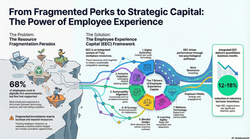
The Strategic ROI of Human Capital: Translating Workforce Investments into Business Value
RESEARCH BRIEFS
3 days ago
18 min read
Nested Learning: A New Paradigm for Adaptive AI Systems
RESEARCH BRIEFS
4 days ago
15 min read
The Widening AI Value Gap: Strategic Imperatives for Business Leaders
RESEARCH BRIEFS
4 days ago
24 min read
From Individual Expertise to Collective Intelligence: Building Learning-Capable Teams
RESEARCH BRIEFS
5 days ago
23 min read
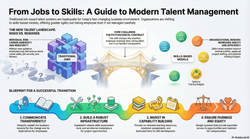
Navigating the Shift to Skills-Based Talent Management: Evidence-Based Strategies for Organizational Success
LEADERSHIP FOR CHANGE
6 days ago
17 min read
Organizational Learning from Crisis: Evidence-Based Strategies for Building Adaptive Capacity
RESEARCH BRIEFS
7 days ago
26 min read
Designing a Better Hiring Process: Strategies to Identify Top Talent
LEADERSHIP IN PRACTICE
Dec 17
7 min read
How Public Service Motivation, Red Tape, and Job Satisfaction Shape Innovation in the Public Sector
RESEARCH BRIEFS
Dec 16
15 min read
Human Capital Leadership Review
Holistic Employee Benefits in 2026: Building Personalized, Equitable Wellness Ecosystems
RESEARCH BRIEFS
13 hours ago
22 min read
The AI Adoption Gap: Why Most Organizations Struggle to Turn Use Into Value
1 day ago
3 min read
How Women Can Successfully Rise to Leadership Roles in Healthcare
2 days ago
5 min read
Building a GenAI-Powered Personal Board of Directors: A Strategic Framework for Adaptive Leadership
RESEARCH BRIEFS
2 days ago
17 min read
Why Connection Is Today’s Most Critical Performance Driver
2 days ago
6 min read
The Strategic ROI of Human Capital: Translating Workforce Investments into Business Value
RESEARCH BRIEFS
3 days ago
18 min read
Nested Learning: A New Paradigm for Adaptive AI Systems
RESEARCH BRIEFS
4 days ago
15 min read
The Widening AI Value Gap: Strategic Imperatives for Business Leaders
RESEARCH BRIEFS
4 days ago
24 min read
One Year After the AI Boom: Expert Recounts How Marketing Has Transformed in 2025
4 days ago
3 min read
1
2
3
4
5
Human Capital Innovations
Play Video
Play Video
07:23
Stop Burning Out: The Career Minimalism Playbook
The video explores a transformative approach to work called career minimalism, which challenges the traditional narrative of relentless ambition and constant achievement. It highlights how the prevailing work culture, centered on climbing the career ladder at all costs, has led to widespread exhaustion and burnout. Career minimalism is presented as a strategic, intentional response aimed at designing a work life that supports overall well-being rather than consumes it. This concept is not about doing less work but doing the right work with clear boundaries, prioritizing long-term stability, meaningful engagement, and personal balance. Highlights 🔄 Career minimalism is a strategic response to burnout, focusing on doing the right work with clear boundaries. 🛡️ Prioritizing security over status means valuing stability and peace of mind over prestige and pressure. ⏰ Setting unwavering work boundaries protects personal time and prevents exhaustion. 🎯 Active workload management involves negotiating priorities rather than passively accepting tasks. 🎓 Building a diverse skill portfolio enhances resilience in a volatile job market. 🧑💼 Leaders play a pivotal role by modeling healthy boundaries and focusing on outcomes, not hours. 🌱 Small, deliberate changes can lead to a more sustainable, balanced career and life. Key Insights 🔥 Burnout Epidemic and Cultural Shift: The video underscores the urgent need to rethink traditional career ambition, which has prioritized relentless productivity but led to widespread exhaustion. This shift reflects growing awareness that endless striving is unsustainable, signaling a cultural movement toward balance and well-being. It highlights how societal definitions of success must evolve to prevent professional burnout. 🛡️ Security Over Status – Redefining Ambition: The first core tenet challenges the conventional ambition model by valuing job security and predictability over high-pressure, high-prestige roles. This redefinition reframes ambition as the pursuit of peace of mind and life balance, rather than external validation or titles. It’s a mindset that fosters long-term stability and mental health. ⏳ Boundaries as Professional Discipline: Setting and enforcing clear work boundaries is framed not as weakness but as essential for sustainable productivity. In an always-connected digital world, the ability to disconnect and reclaim personal time is a crucial skill. This insight speaks to the importance of work-life integration policies that respect human limits and promote recovery. 🎯 Active Prioritization and Workload Negotiation: The video promotes the practice of strategically managing tasks by negotiating priorities instead of default compliance. This skill empowers professionals to communicate capacity limits clearly, fostering mutual respect and realistic expectations. It also encourages a shift in workplace culture toward valuing quality over quantity. 🎓 Skills Portfolio for Volatility: Career minimalism embraces the need for adaptability by encouraging ongoing skill development. Maintaining a diverse skill set provides a buffer against job market uncertainty, making professionals more resilient to disruptions and more capable of seizing new opportunities. This insight aligns with lifelong learning as a cornerstone of career sustainability. 🧑💼 Leadership’s Role in Cultivating Minimalist Teams: Leaders are portrayed as key agents in embedding career minimalism. By focusing on measurable outcomes rather than hours worked, protecting team members’ time, and modeling healthy boundaries, leaders can create environments where employees thrive without burnout. This approach challenges traditional leadership norms that equate presenteeism with productivity. 🌿 Small Steps, Big Impact – The Path to Sustainability: The video emphasizes that career minimalism is accessible through incremental changes, such as not checking emails after hours or blocking focus time. These small acts of self-preservation accumulate, creating a ripple effect that enhances not only professional effectiveness but overall life satisfaction. This insight encourages a practical, non-radical approach to cultural and personal transformation. If this helped, please like and share the video to spread healthier career strategies. #CareerMinimalism #WorkLifeBalance #Burnout #SustainableCareers OUTLINE: 00:00:00 - Redefining Our Relationship with Work 00:00:58 - The Core Tenets of Career Minimalism 00:02:48 - Practical Steps for the Modern Professional 00:04:29 - Cultivating Sustainable Teams 00:05:54 - Choosing Balance Over Burnout
Play Video
Play Video
18:18
Career Minimalism: Strategic Work Design for Sustainable Professional Lives
Abstract: Career minimalism represents a fundamental shift in how professionals—particularly Generation Z and millennials—conceptualize work's role in their lives. Rather than pursuing traditional upward mobility at all costs, career minimalists prioritize stability, boundaries, and fulfillment through secure employment, clear work-life separation, and diversified skill development. This article examines the emergence of career minimalism as a response to chronic workplace burnout, economic volatility, and evolving generational values. Drawing on organizational psychology, human resource management, and labor economics literature, we analyze the individual and organizational consequences of this philosophy and identify evidence-based practices for supporting sustainable career approaches. We argue that career minimalism is not withdrawal from work but strategic energy allocation—a recalibration of the psychological contract between employees and employers that prioritizes long-term resilience over short-term advancement. Organizations that understand and accommodate this shift stand to benefit from improved retention, reduced burnout, and access to diverse talent seeking meaningful but bounded employment relationships.
Play Video
Play Video
18:18
A Conversation about Career Minimalism: Strategic Work Design for Sustainable Professional Lives
This conversation explores the rise of career minimalism, a professional philosophy where workers prioritize stability and strict boundaries over traditional upward mobility and status. Driven by generational shifts and chronic burnout, this movement emphasizes strategic energy allocation and the protection of personal time rather than a total rejection of work. The research suggests that organizations can benefit from this shift by adopting outcome-based evaluations and transparent communication regarding workload expectations. By respecting individual recovery time and offering flexible career pathways, employers may see improved retention and reduced employee exhaustion. Ultimately, the sources argue for a recalibrated psychological contract that fosters sustainable professional lives through a more honest and balanced employment relationship. See Privacy Policy at https://art19.com/privacy and California Privacy Notice at https://art19.com/privacy#do-not-sell-my-info.
Play Video
Play Video
05:59
29-Point Boost: The Human–AI Advantage
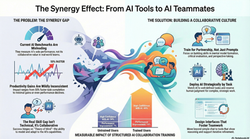
The video transcript highlights a critical oversight in current AI evaluation methods, which predominantly assess AI models in isolation rather than in collaboration with humans. This isolated testing approach, akin to judging an athlete solely by their solo practice, misses the essential aspect of teamwork and synergy—the combined performance of humans and AI working together. The speaker stresses that the true value of AI lies not in replacing humans but in augmenting human capabilities, thereby boosting productivity and quality in real-world tasks. Highlights 🤝 Current AI tests focus too much on solo AI performance, ignoring human-AI collaboration. 🚀 Human-AI synergy yields productivity gains up to 30 points, accelerating progress by years. ⚖️ AI acts as an equalizer, helping lower-performing individuals catch up to skilled peers. 🧠 Theory of mind—understanding AI’s mental state—is key to effective collaboration. 🛠️ Smart task selection and tailored interfaces enhance human-AI teamwork quality. 🌟 The goal is a “centaur” workforce where humans are augmented, not replaced. 📈 Leadership must foster continuous learning, prompt engineering, and adaptive governance. Key Insights 🤔 Reevaluating AI Success Metrics: Traditional AI benchmarks emphasize isolated model performance, which fails to capture the real-world impact of AI. In business and society, AI’s worth is measured by how it elevates human productivity, not by standalone capabilities. This calls for a paradigm shift in AI evaluation methodologies to include human-AI interaction metrics. 🔄 From Substitution to Collaboration Mindset: The prevalent assumption that AI should replace humans narrows the scope of AI’s potential. The collaboration mindset recognizes that AI and humans together create exponentially greater value, encouraging investments in tools and workflows designed for synergy rather than competition. 📊 Empirical Evidence of Human-AI Synergy: Studies show a dramatic increase in work quality and speed when professionals collaborate with AI. The nearly 30-point boost on a 100-point scale exemplifies how AI can fast-track improvements that traditionally take years, transforming workforce productivity and quality standards. ⚖️ AI as an Equalizer in Skill Gaps: AI’s ability to disproportionately uplift lower-performing individuals is transformative for workforce development. By raising the floor, AI democratizes expertise and reduces disparities, fostering a more capable and competitive workforce. This has significant implications for training, hiring, and organizational equity. 🧠 Theory of Mind Applied to AI: Effective human-AI collaboration hinges on users’ capacity to model the AI’s knowledge, intentions, and limitations. This psychological skill, traditionally used in human interactions, is critical for crafting precise prompts, anticipating errors, and extracting maximum value, underscoring the need to train users in this cognitive approach. 🛠️ Designing for Collaboration: The interface plays a pivotal role in enabling effective teamwork with AI. Features like confidence indicators, source transparency, rapid prompt editing, and dialogue guidance help users build a robust mental model of the AI, leading to better outcomes. Poor interface design can hamper this synergy and limit AI’s usefulness. 🌍 Leadership’s Role in a Human-AI Future: The path forward requires leaders to reimagine workforce structures, governance, and skill development. Embracing a centaur model of augmented workers necessitates continuous learning programs on AI capabilities, prompt engineering, and critical evaluation. Adaptive governance frameworks will ensure ethical and effective AI integration as technologies and risks evolve. If this helped, please like and share the video. #HumanAICollaboration #LLM #BayesianIRT #TheoryOfMind #GPT4o #AIinWorkplace #CollectiveIntelligence OUTLINE: 00:00:00 - Why Teamwork Trumps Solo Performance 00:00:56 - Evidence of the Human-AI Boost 00:02:19 - The Skill That Unlocks AI's Potential 00:03:25 - Practical Steps for Companies 00:04:39 - Leadership for a Human-AI Future
Play Video
Play Video
40:10
Quantifying and Optimizing Human-AI Synergy: Evidence-Based Strategies for Adaptive Collaboration...
Abstract: The emergence of large language models (LLMs) has transformed human-machine interaction, yet evaluation frameworks remain predominantly model-centric, focusing on standalone AI performance rather than emergent collaborative outcomes. This article introduces a novel Bayesian Item Response Theory framework that quantifies human–AI synergy by separately estimating individual ability, collaborative ability, and AI model capability while controlling for task difficulty. Analysis of benchmark data (n=667) reveals substantial synergy effects, with GPT-4o improving human performance by 29 percentage points and Llama-3.1-8B by 23 percentage points. Critically, collaborative ability proves distinct from individual problem-solving ability, with Theory of Mind—the capacity to infer and adapt to others' mental states—emerging as a key predictor of synergy. Both stable individual differences and moment-to-moment fluctuations in perspective-taking influence AI response quality, highlighting the dynamic nature of effective human-AI interaction. Organizations can leverage these insights to design training programs, selection criteria, and AI systems that prioritize emergent team performance over standalone capabilities, marking a fundamental shift toward optimizing collective intelligence in human-AI teams.
Play Video
Play Video
13:12
Before AI Designs Your Job
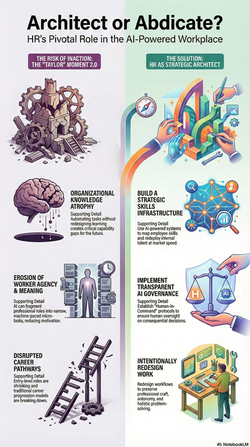
Artificial intelligence (AI) is rapidly transforming office work, fundamentally altering how tasks are performed and reshaping entire career paths. This shift presents human resources (HR) departments with a critical decision: to lead this transformation or remain passive observers. Historically, passive approaches—leaving technology teams to drive AI adoption—have risked allowing software design to dictate job workflows, often at the cost of employee growth and organizational health. The video highlights parallels to Taylorism, an industrial-era system that prioritized efficiency but stripped workers of autonomy and skill, warning that AI could similarly reduce professional roles to fragmented, monotonous tasks, diminishing opportunities for learning and career development. Highlights 🤖 AI is fundamentally transforming office work, shifting how tasks and jobs are designed. ⚠️ Passive HR approaches risk allowing AI to de-skill jobs and reduce employee growth opportunities. 🏭 AI could replicate the negative effects of Taylorism by fragmenting white-collar jobs into monotonous tasks. 🔍 Early evidence shows AI replacing entry-level roles, making it harder for young professionals to develop skills. 🛡️ HR must establish AI governance to ensure fairness, transparency, and human oversight. 🔄 Redesigning work to preserve meaningful tasks and autonomy is key to maintaining engagement and innovation. 🚀 HR leadership can create new, skill-based career paths that prepare employees for the AI-driven future. Key Insights 🤝 Human-Centric AI Integration Requires Proactive HR Leadership: The video stresses that HR departments cannot afford to remain passive or defer AI implementation solely to technology teams. When HR is sidelined, AI-driven job design often prioritizes efficiency over human development, leading to a loss of autonomy and meaningful work. HR’s unique perspective on employee needs positions it as the critical leader in shaping AI’s role in the workforce, ensuring technology serves human potential rather than undermines it. 🏭 Historical Lessons from Taylorism Warn Against Efficiency-Only Models: The comparison to Taylorism is insightful, showing how past industrial efficiency models increased productivity but at the cost of worker skill, pride, and autonomy. AI risks a similar fate for knowledge workers by automating routine tasks and leaving humans with fragmented, less meaningful work. This historical parallel provides a cautionary framework, emphasizing that efficiency gains should not come at the expense of human capital development. 👩🎓 AI’s Impact on Entry-Level Roles Threatens Long-Term Skill Development: The video highlights a critical but often overlooked consequence of AI adoption—the reduction in entry-level hiring and the automation of foundational tasks that traditionally helped new professionals build skills. This creates a skills gap and a bottleneck in workforce development, as emerging employees miss out on essential learning experiences, potentially stunting career growth and weakening the future talent pipeline. 📉 Job Fragmentation Leads to Disengagement and Reduced Productivity: When jobs become a collection of small, monotonous tasks, employees tend to feel disconnected and undervalued. This disengagement can increase stress, anxiety, and turnover, ultimately harming organizational culture and productivity. The human cost of poorly designed AI integration—where creativity and judgment are minimized—can undermine innovation and morale, with long-term negative effects on business success. 🛡️ Establishing AI Governance Builds Trust and Accountability: The call for clear governance frameworks is a vital insight. AI systems must be transparent, fair, and explainable, with humans retaining final decision authority where appropriate. Involving employees in governance builds trust, reduces fear, and ensures AI tools are used responsibly. This emphasis on oversight counters the “black box” nature of many AI systems and safeguards against bias and ethical pitfalls. If this helped, please like and share the video. #AIinHR #FutureOfWork #HumanCenteredAI #WorkforceTransformation OUTLINE: 00:00:00 - HR's Fork in the AI Road 00:00:57 - When Technology Designs Jobs by Default 00:02:29 - Erosion of capability and agency 00:03:37 - Vendor dependence and the silent erosion 00:04:53 - Restoring agency and HR’s playbook 00:06:29 - Work redesign and career architecture 00:07:55 - AI at work in the real world 00:09:27 - Human in command and the Anna story 00:10:51 - Shaping a future of meaningful work 00:12:06 - The playbook—act now
Play Video
Play Video
21:08
The Frederick Winslow Taylor Moment: Why HR Must Lead the AI Reorganization of Work, by Jonathan ...
Artificial intelligence is reshaping white-collar work at an unprecedented pace, yet many human resources functions remain on the sidelines of this transformation. Drawing on insights from workforce transformation leaders and emerging organizational research, this article examines the urgent imperative for HR to design AI-integrated work systems before technology architectures determine human roles by default. The parallels to early 20th-century scientific management reveal risks of task fragmentation that prioritizes algorithmic efficiency over professional craft and worker agency. Evidence from large-scale skills transformation initiatives demonstrates that strategic HR leadership can enable talent redeployment at market speed while preserving meaningful work. With entry-level pathways narrowing and traditional career progression disrupted, HR professionals face a pivotal choice: architect human-centered AI work systems now, or inherit technology-determined structures later. This article synthesizes academic research and practitioner experience to outline evidence-based responses across transparent governance, skills infrastructure, and agency-preserving work design that position HR as strategic architects of the AI-augmented workplace.
Play Video
Play Video
07:41
A Conversation about The Taylor Moment: HR’s Role in AI Work Reorganization
This conversation argues that human resources leaders must take a proactive role in redesigning work as artificial intelligence begins to fundamentally reorganize professional roles. Drawing parallels to Taylorism, the author warns that failing to lead this transition risks turning complex knowledge work into fragmented, machine-driven tasks that strip employees of autonomy and purpose. To prevent knowledge atrophy and career disruption, the text advocates for a human-centered architecture that prioritizes skill development and professional agency. Successful integration requires building dynamic skills infrastructures and transparent governance frameworks that ensure technology supports rather than dictates human contribution. Ultimately, the source positions HR as a strategic architect responsible for balancing algorithmic efficiency with the preservation of meaningful work. See Privacy Policy at https://art19.com/privacy and California Privacy Notice at https://art19.com/privacy#do-not-sell-my-info.
Blog: HCI Blog
Human Capital Leadership Review
Featuring scholarly and practitioner insights from HR and people leaders, industry experts, and researchers.
All Articles
Research Briefs
Research Insights
Looking Ahead
Leadership in Practice
Leadership Insights
Leadership for Change
Webinar Recaps
Book Reviews
Transformative Social impact
Search
Mar 3
5 min read
LEADERSHIP IN PRACTICE
From Local to Global: Leading an International Workforce
bottom of page