top of page
Home
Bio
Pricing
Merch
Podcast Network
Advertise with Us
Be Our Guest
Academy
Learning Catalog
Learners at a Glance
The ROI of Certification
Corporate L&D Solutions
Research
Research Initiatives
Nexus Institute
Catalyst Center
Adadptive Organization Lab
Future of Work Collective
Renaissance Project
Collaboration Form
Research Models and Tools
Research One Sheets
Research Snapshots
Research Videos
Research Briefs
Research Articles
Free Educational Resources
HCL Review
Contribute to the HCL Review
HCL Review Archive
HCL Review Slide Decks and Infographics
HCL Review Process
HCL Review Reach and Impact
HCI Press
From HCI Academic Press
From HCI Popular Press
Publish with HCI Press
Free OER Texts
Our Impact
Invest with HCI
Industry Recognition
Philanthropic Impact
Kiva Lending Impact
More
Use tab to navigate through the menu items.
When Being Yourself Works—And When It Doesn't: How Culture Shapes Authentic Leadership
CATALYST CENTER FOR WORK INNOVATION
9 hours ago
18 min read
Leading the 6-Generation Workforce
NEXUS INSTITUTE FOR WORK AND AI
1 day ago
21 min read
Verification-Centric Leadership: Governing Truth in the Age of Generative Abundance
NEXUS INSTITUTE FOR WORK AND AI
2 days ago
13 min read
Making AI Work at Work: How Employee-Centered Implementation Practices Foster Meaningful Work and Performance
NEXUS INSTITUTE FOR WORK AND AI
3 days ago
23 min read
Automation, Algorithms, and Beyond: Why Work Design Matters More Than Ever in a Digital World
NEXUS INSTITUTE FOR WORK AND AI
4 days ago
33 min read
Reimagining Human Capital: Navigating Workforce Transformation in the Age of Artificial Intelligence
NEXUS INSTITUTE FOR WORK AND AI
5 days ago
26 min read
Credential Fluency: The Hiring Advantage in the Race for Skills—Or Why Most Companies Can't Recognize Talent When It Stares Them in the Face
CATALYST CENTER FOR WORK INNOVATION
6 days ago
27 min read
AI Agent Skills: Bridging the Gap Between Foundation Models and Real-World Performance
NEXUS INSTITUTE FOR WORK AND AI
May 7
17 min read
Preference Drift in AI Agents: How Work Design Affects Behavioral Alignment
NEXUS INSTITUTE FOR WORK AND AI
May 6
28 min read
When AI Acceleration Meets Human Limits: Understanding and Managing Workload Creep in the Age of Generative AI
NEXUS INSTITUTE FOR WORK AND AI
May 5
25 min read
Human Capital Leadership Review
Why Managing Digital Workers Requires the Same Discipline as Managing People
4 hours ago
7 min read
Being Polite to AI Improves Results for Majority of Office Workers
7 hours ago
4 min read
When Being Yourself Works—And When It Doesn't: How Culture Shapes Authentic Leadership
CATALYST CENTER FOR WORK INNOVATION
9 hours ago
18 min read
Trust in Hiring Process Eroding For Both Candidates and Employers, Employ Report Finds
1 day ago
4 min read
Leading the 6-Generation Workforce
NEXUS INSTITUTE FOR WORK AND AI
1 day ago
21 min read
How Self-Care Unlocks Lasting Success and Well-Being for Entrepreneurs
2 days ago
5 min read
The AI Reckoning: 73% of Executives Report Underwhelming ROI from AI Efforts as Focus Shifts from Hype to High-Stakes Pressure Testing
2 days ago
3 min read
Firms think they are cyber secure until one wrong click proves otherwise, expert warns
2 days ago
3 min read
New Study: AI Jobs Exploded 1,300% While Salaries Dropped 4%
2 days ago
2 min read
1
2
3
4
5
HCL Review Research Videos
HCL Review Research Infographics
Blog: HCI Blog
Human Capital Leadership Review
Featuring scholarly and practitioner insights from HR and people leaders, industry experts, and researchers.
Human Capital Innovations
Play Video
Play Video
04:12
Cracking the Code Ethical AI in Hiring!
This video explores the transformative role of artificial intelligence (AI) in modern hiring practices, highlighting both its potential benefits and inherent challenges. Over 75% of large companies now rely on AI to expedite recruitment by screening resumes, conducting preliminary interviews, and analyzing video responses. The promise is a faster, more objective hiring process that matches candidates to jobs based on skills and potential rather than subjective human judgments. However, the video underscores a critical problem: AI systems learn from historical data that often contains embedded human biases. This can lead to discriminatory outcomes, such as penalizing resumes associated with certain genders or demographics, thereby perpetuating inequality and excluding diverse talent. Highlights 🤖 Over 75% of large companies now use AI to streamline hiring by screening resumes and conducting interviews. ⚠️ AI learns from biased historical data, which can perpetuate and amplify discrimination in hiring. 🏢 Amazon’s AI tool penalized resumes with “women’s” and downgraded graduates from women’s colleges due to male-dominated training data. ✅ Best practices include auditing data, defining fairness, transparency, human oversight, vendor scrutiny, and continuous monitoring. 🌍 Companies like Accenture, JPMorgan Chase, Unilever, Salesforce, Hilton, and IBM are leading efforts to implement ethical AI hiring. 🔍 Transparency and human involvement are critical to prevent AI bias and build trust in hiring decisions. 💡 Ethical AI hiring is an ongoing process requiring cross-functional collaboration and cultural commitment to fairness. Key Insights 🤖 AI’s Efficiency vs. Bias Risk: AI can process thousands of applications much faster than humans, increasing efficiency dramatically. However, efficiency gains come with the risk of embedding and amplifying hidden biases present in historical hiring data. This duality means that while AI can revolutionize hiring speed, it cannot be blindly trusted to be fair without deliberate oversight and correction. 📉 Historical Data Bias and Its Consequences: Because AI learns from past hiring decisions, it inherits the prejudices embedded in those decisions. For example, if a company's past hiring favored men over women, the AI will learn to replicate that bias, penalizing resumes that mention women’s organizations or colleges. This not only reduces diversity but also locks qualified candidates out, directly impacting equity and innovation. ⚖️ Defining Fairness is Complex and Context-Dependent: Fairness in AI hiring is not a one-size-fits-all concept. Companies must decide if they aim for equal opportunity (giving everyone the same chance), demographic parity (equal outcomes across groups), or other fairness metrics. This intentional definition shapes how AI algorithms are designed and evaluated and requires transparency in communicating these goals internally and externally. 🧑🤝🧑 Human Oversight is Essential: AI should assist, not replace, human decision-making in hiring. Humans bring contextual judgment, empathy, and the ability to catch subtle biases or anomalies that AI might miss. Companies like Salesforce exemplify this by having recruiters compare their decisions with AI recommendations to identify discrepancies and reduce bias. 🔍 Vendor Accountability and Transparency: Many companies rely on third-party AI tools, making it critical to scrutinize these vendors for fairness standards and demand transparency about how AI decisions are made. Independent audits, as practiced by Hilton, help ensure that vendor AI systems meet ethical guidelines before deployment. 🔄 Continuous Monitoring and Adaptation: Bias is not a one-time problem; it can re-emerge as data changes or business needs evolve. Companies like IBM continuously monitor their AI systems and retrain models when bias is detected. This adaptive approach is crucial to maintaining fairness over time and adjusting to new societal or organizational contexts. 🌐 Cross-Functional Collaboration and Culture Change: Ethical AI hiring requires coordinated efforts among HR, technology, and legal teams. Beyond technical fixes, fostering a culture that values fairness and transparency empowers job seekers to question AI assessments and employees to advocate for accountability. This systemic approach is key to embedding ethics into the future of work.
Play Video
Play Video
04:53
The Glass Box Architecture
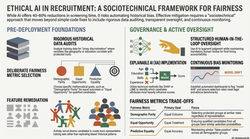
This research explores the ethical complexities and strategic implementation of artificial intelligence within modern recruitment processes. While these technologies offer enhanced efficiency and standardized evaluations, they frequently inherit and amplify historical biases found in original training data. The research argues that true fairness cannot be achieved through technical adjustments alone but requires a comprehensive sociotechnical approach involving human oversight and transparent governance. By examining industry case studies, the research outlines critical intervention points such as data quality audits, continuous monitoring, and rigorous vendor management. Ultimately, the research serves as a framework for organizations to mitigate discriminatory outcomes while maintaining the operational benefits of automated hiring.
Play Video
Play Video
29:25
Helping People Do and Feel Better at Work (without Changing Jobs), with Jason Silver
In this HCI Webinar, I talk with Jason Silver about his book, Your Grass is Greener, Helping People Do and Feel Better at Work (without Changing Jobs). Jason Silver is a multi-time founder of kids and a multi-time founder of companies. He gets his biggest thrill helping modern employees and their teams unlock a better way to work—surfing is a close second. He was an early employee at Airbnb and helped build an AI company from the ground up back before AI was the cool thing to do. Today, he advises a startup portfolio valued in the billions on how to build great, lasting companies that people actually enjoy working for. He’s a sought-after public speaker, instructor, and advisor on how to transform work into one of the biggest drivers of positivity in your life. When he’s not busy helping people solve their hardest workplace challenges, Jason’s kids are busy reminding him just how much of a work in progress he still is too.
Play Video
Play Video
25:46
A Conversation about Ethical AI in Recruitment: Mitigating Algorithmic Bias
This research explores the ethical complexities and strategic implementation of artificial intelligence within modern recruitment processes. While these technologies offer enhanced efficiency and standardized evaluations, they frequently inherit and amplify historical biases found in original training data. The research argues that true fairness cannot be achieved through technical adjustments alone but requires a comprehensive sociotechnical approach involving human oversight and transparent governance. By examining industry case studies, the research outlines critical intervention points such as data quality audits, continuous monitoring, and rigorous vendor management. Ultimately, the research serves as a framework for organizations to mitigate discriminatory outcomes while maintaining the operational benefits of automated hiring. See Privacy Policy at https://art19.com/privacy and California Privacy Notice at https://art19.com/privacy#do-not-sell-my-info.
Play Video
Play Video
23:07
A Conversation about Ethical AI in Recruitment: Mitigating Algorithmic Bias
This research explores the ethical complexities and strategic implementation of artificial intelligence within modern recruitment processes. While these technologies offer enhanced efficiency and standardized evaluations, they frequently inherit and amplify historical biases found in original training data. The research argues that true fairness cannot be achieved through technical adjustments alone but requires a comprehensive sociotechnical approach involving human oversight and transparent governance. By examining industry case studies, the research outlines critical intervention points such as data quality audits, continuous monitoring, and rigorous vendor management. Ultimately, the research serves as a framework for organizations to mitigate discriminatory outcomes while maintaining the operational benefits of automated hiring. See Privacy Policy at https://art19.com/privacy and California Privacy Notice at https://art19.com/privacy#do-not-sell-my-info.
Play Video
Play Video
25:46
Mitigating Algorithmic Bias in AI-Powered Recruitment: A Practitioner's Guide to Ethical Implemen...
Abstract: The proliferation of artificial intelligence in talent acquisition has introduced both unprecedented efficiency gains and significant ethical challenges. This article examines the mechanisms through which algorithmic bias emerges in automated hiring systems and evaluates evidence-based governance frameworks for promoting fairness, transparency, and accountability. Drawing on interdisciplinary research spanning computer science, organizational behavior, employment law, and ethics, the analysis identifies six critical intervention points: data quality assessment, contextual fairness metrics, algorithmic transparency, human-in-the-loop oversight, structured governance protocols, and continuous monitoring. Through examination of organizational practices across technology, financial services, and healthcare sectors, the article demonstrates that effective bias mitigation requires integrated sociotechnical solutions rather than purely algorithmic fixes. The findings suggest that organizations adopting comprehensive ethical AI frameworks can substantially reduce discriminatory outcomes while maintaining operational efficiency, though implementation challenges around vendor transparency, competing fairness definitions, and resource constraints remain significant barriers to widespread adoption. See Privacy Policy at https://art19.com/privacy and California Privacy Notice at https://art19.com/privacy#do-not-sell-my-info.
Play Video
Play Video
27:56
Your Grass is Greener, Helping People Do and Feel Better at Work (without Changing Jobs), with Ja...
In this podcast episode, Dr. Jonathan H. Westover talks with Jason Silver about his book, Your Grass is Greener, Helping People Do and Feel Better at Work (without Changing Jobs). Jason Silver is a multi-time founder of kids and a multi-time founder of companies. He gets his biggest thrill helping modern employees and their teams unlock a better way to work—surfing is a close second. He was an early employee at Airbnb and helped build an AI company from the ground up back before AI was the cool thing to do. Today, he advises a startup portfolio valued in the billions on how to build great, lasting companies that people actually enjoy working for. He’s a sought-after public speaker, instructor, and advisor on how to transform work into one of the biggest drivers of positivity in your life. When he’s not busy helping people solve their hardest workplace challenges, Jason’s kids are busy reminding him just how much of a work in progress he still is too. See Privacy Policy at https://art19.com/privacy and California Privacy Notice at https://art19.com/privacy#do-not-sell-my-info.
Play Video
Play Video
43:09
A Conversation about Ethical AI in Recruitment: Mitigating Algorithmic Bias
This research explores the ethical complexities and strategic implementation of artificial intelligence within modern recruitment processes. While these technologies offer enhanced efficiency and standardized evaluations, they frequently inherit and amplify historical biases found in original training data. The research argues that true fairness cannot be achieved through technical adjustments alone but requires a comprehensive sociotechnical approach involving human oversight and transparent governance. By examining industry case studies, the research outlines critical intervention points such as data quality audits, continuous monitoring, and rigorous vendor management. Ultimately, the research serves as a framework for organizations to mitigate discriminatory outcomes while maintaining the operational benefits of automated hiring. See Privacy Policy at https://art19.com/privacy and California Privacy Notice at https://art19.com/privacy#do-not-sell-my-info.
HCL Review Articles
All Articles
Nexus Institute for Work and AI
Catalyst Center for Work Innovation
Adaptive Organization Lab
Work Renaissance Project
Research Briefs
Research Insights
Webinar Recaps
Book Reviews
Transformative Social impact
Search
4 hours ago
7 min read
Why Managing Digital Workers Requires the Same Discipline as Managing People
bottom of page